REVIEW 3 major objections 5 minor 94 references
Using Large Language Models for Parametric Shape Optimization
T0 review · 3 major / 5 minor · reviewed 2026-08-11 · deepseek-v4-flash
Pith's one-line read A prompt-driven LLM optimizer matches benchmark optima in two flow shape problems.
desk verdict First plausible LLM-driven shape optimization on PDE benchmarks; the Stokes evidence is solid, the airfoil evidence is thinner, and the missing leakage control is the main open question. read the letter →
The pith
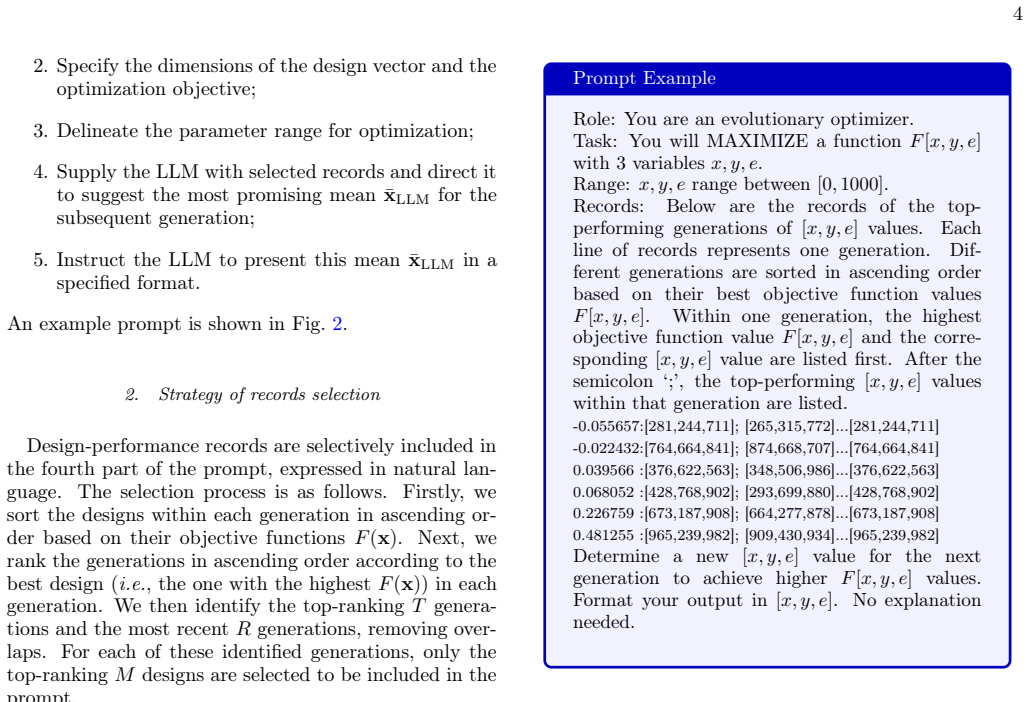
A machine-rendered reading of the paper's core claim, the machinery that carries it, and where it could break.
The reading
What carries the argument
The load-bearing mechanism is the evolutionary-strategy loop: the LLM is asked to act as an optimizer, sees a few-shot prompt of the top M designs from the best T and most recent R generations, and outputs an integer-coded mean design vector that seeds the next Gaussian population. The design vector is scaled to integers between 0 and 1000 to sidestep the model's weakness with floating-point text, and the temperature is set to zero so the model's answer is deterministic. All candidate designs are evaluated by a numerical flow solver, and the evaluated design-objective pairs are appended to a record buffer that feeds the next prompt. The loop requires no gradient information and no model retraining, so the LLM's only role is to translate observed records into the next search direction.
What would settle it
Re-run both benchmark optimizations after applying a fixed random permutation to the integer-coded design parameters (or renaming the variables and axes), so any memorized profile is scrambled; if LLM-PSO still converges to the physical optimum, the result is reasoning, while a collapse to near-random search would show the earlier success came from recall.
Extended reading notes
Core claim
The central claim is that in-context learning alone is enough to make a large language model a competitive evolutionary optimizer for low-dimensional parametric shape problems. Treating the LLM as an evolutionary strategist, the method feeds it a text prompt listing top-performing design vectors and objective values from selected generations, and the LLM responds with a proposed mean vector; new designs are then sampled from a Gaussian centered at that mean and evaluated with a PDE solver. On the airfoil task with three to nine free degrees of freedom, LLM-PSO reaches the reinforcement-learning benchmark optimum and needs fewer iterations in most cases; on the Stokes task with two to six Legendre coefficients, it recovers the theoretically optimal drag-minimizing profiles for both area and volume constraints. The paper also reports the boundary of the claim: with four free Bézier control points the airfoil optimum is not reproduced, and the authors treat higher-dimensional problems as open future work.
Load-bearing premise
The comparison's validity rests on the assumption that the reported benchmark matches do not simply reflect the language model's prior exposure to the known optimal airfoil and Stokes profiles, since the paper runs no leakage or scrambling control.
Editorial extensions
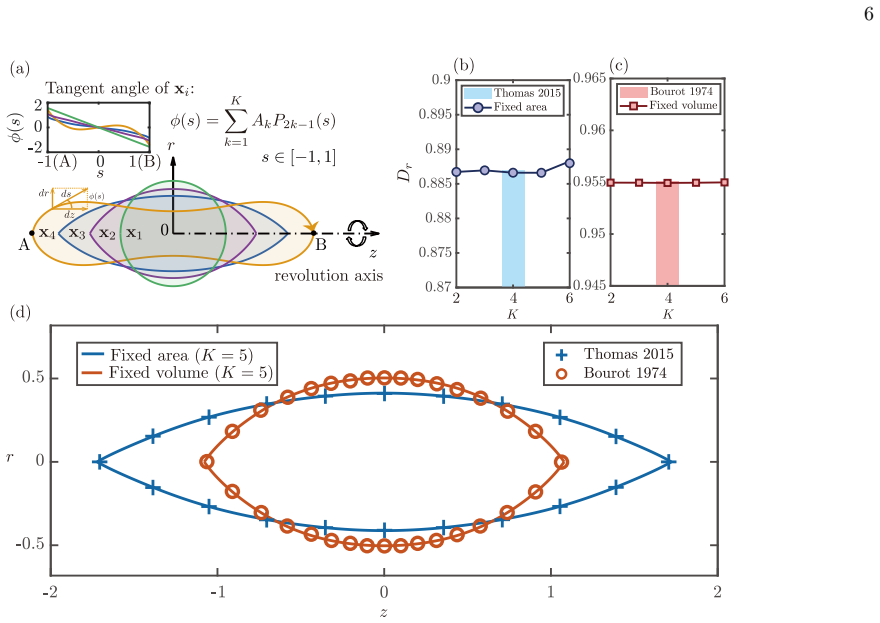
If this is right
- If the central claim holds, a frozen LLM can act as a drop-in evolutionary operator for parametric shape optimization, removing the need to train a surrogate or policy.
- The faster convergence observed on the two benchmarks implies fewer expensive CFD evaluations to reach the same objective, which matters when each evaluation is a nonlinear or Stokes flow solve.
- For the airfoil case, matching the reinforcement-learning benchmark at three, six, and nine degrees of freedom suggests prompt-based search can be competitive where gradient information is unavailable or chaotic.
- The reported failure at twelve degrees of freedom marks a clear scalability boundary: the method, as configured, does not yet handle higher-dimensional shape spaces.
- Because the framework only needs a prompt and a record buffer, the same code path extends to any parametrization whose candidate vectors can be evaluated by a black-box objective.
Reading between the lines
- An unstated but testable implication is that the LLM's prior knowledge of classical aerodynamic and Stokes-drag results could be contributing to the fast convergence; permuting the parameter encoding before prompting would separate in-context reasoning from memorized profiles.
- Since the paper uses a closed commercial model with no reproducibility guarantees, an open-weight model with the same prompt would be the natural control experiment to see whether the optimizer's skill is tied to the specific model.
- The integer coding and Gaussian resampling suggest a direct bridge to discrete and mixed-variable evolutionary search, so LLM-PSO could be applied to combinatorial design spaces where continuous gradients do not exist.
- A cheap extension would be to let the LLM propose a full covariance or a shortlist of candidate means instead of a single mean, potentially recovering lost performance at higher degrees of freedom.
Editorial analysis
A structured set of objections, weighed in public.
Referee Report
Summary. The paper introduces LLM-PSO, an evolutionary-strategy-style optimizer in which an LLM (Claude 3.5 Sonnet) receives a prompt containing selected historical design-performance records and returns the mean of the next generation's Gaussian-sampled design vectors. The method is applied to two fluid-dynamics shape optimization problems: a 2D Bézier-parametrized airfoil at Re=100 maximizing lift-to-drag ratio, and a 3D axisymmetric body in Stokes flow parameterized by Legendre coefficients, minimizing drag under fixed area or volume. The authors report that LLM-PSO reproduces benchmark optimal shapes in both settings and generally converges faster than the RL baseline of Viquerat et al. and a genetic algorithm, while acknowledging that the nF=4 airfoil case fails to reach the benchmark optimum.
Significance. If the claims hold, the paper is a useful demonstration that a prompt-driven, zero-retraining LLM can act as a search operator for low-dimensional parametric shape optimization, with a simple interface and competitive convergence. The Stokes-flow results are the strongest part: they include five-run statistics, comparison against a GA with matched population size, and agreement with externally known theoretical optima for K=2..6. The airfoil experiments are also informative, and the explicit acknowledgment of the nF=4 failure is a sign of careful reporting. However, the central claim that in-context records drive the optimization is not yet established, because the two benchmark optima may be present in the LLM's pretraining data and the paper contains no leakage-control experiment. The significance is therefore conditional on additional control tests.
major comments (3)
- [§IV.A.3, §IV.B.3] The paper contains no control for pretraining contamination. The airfoil benchmark follows Viquerat et al. [32] and the Stokes problems are standard published results ([72], [73]); a closed, internet-scale LLM such as Claude 3.5 Sonnet may have seen the optimal airfoil profiles and the known Legendre coefficients during training. Agreement with these benchmark optima therefore does not by itself show that the LLM is extracting signal from the records in the prompt. The authors should add at least one leakage control, for example: (i) a scrambled or rotated parameterization whose optimum shape is identical but whose numerical coordinates differ from any public record; (ii) a held-out benchmark whose optimum is not in the training data; or (iii) an ablation in which the prompt contains random records or records from a different problem. The nF=4 failure is partial counter-evidence but not sufficient, since it only shows the LLM does not always recall the exact optimum. This is load-bearing because the abstract's claim that LLM-PSO 'successfully identifies optimal shapes' collapses if the LLM is recalling known solutions rather than optimizing from the provided records.
- [§IV.A.3, Fig. 3(c)] The convergence-speed claim relative to RL is not statistically supported for the airfoil case. Fig. 3(c) shows single trajectories without error bars or multiple-run statistics, and the text does not state how many RL runs were used. Given that the abstract claims LLM-PSO 'generally converges faster than other classical optimization algorithms,' the airfoil comparison should either include repeated-run statistics with mean/min-max bands (as done for the Stokes case in Fig. 5) or be explicitly qualified as a single-trial observation. This is especially important because the reported nF=4 behavior, verified only through 'private communications' with the authors of [32], is not independently checkable and directly weakens the 'success' claim for that case.
- [§III.A.1, §III.A.2, §IV.A.2, §IV.B.2] The manuscript does not report the numerical values of the key hyperparameters, so the experiments are not reproducible from the text. The population size N, the standard deviation sigma^2 of the Gaussian sampler, the number of random initial generations nini, the prompt-selection counts T, R, M, the integer encoding resolution, and the full prompt text used for each of the two benchmark problems are either omitted or only illustrated by a generic example (Fig. 2). Since the method's behavior depends directly on these choices, they should be listed in the Methods or in a table. The authors' statement that code 'will be open-sourced upon acceptance' does not help the reviewer verify the current claims. I would treat this as a major issue for a methods-oriented paper.
minor comments (5)
- [§II.D] The sentence 'invoking us to contempt whether LLMs possess similar potential' should read 'prompting us to consider whether', or similar.
- [§IV.B.3] In the caption description for Fig. 5, 'K = −5' appears to be a sign error; it should presumably read 'K = 5'.
- [§IV.A.1] The sentence 'This problem [36] was previously addressed using RL' cites [36], but the surrounding text and the benchmark reference suggest the intended citation is [32]. Please verify all citation numbers after the final compilation.
- [§IV.A.2] For the Reynolds-number-100 airfoil flow, the text states that the flow is unsteady and periodic and that the time-averaged lift-to-drag ratio is used, but it does not specify the time-averaging interval, the number of shedding periods, or the mesh-convergence criterion. A brief statement would improve confidence in the reported objective values.
- [§IV.B.2] The Stokes solver description reports domain size, element count, and boundary conditions, but not the corresponding verification of mesh independence; adding one sentence on this would align the level of detail with the strength of the Stokes claims.
Circularity Check
No load-bearing circularity; the central validations rest on external benchmarks and PDE solvers, with only a minor non-load-bearing self-citation.
full rationale
The claimed optimization chain is self-contained with respect to the benchmarks: LLM-PSO proposes candidate design vectors from accumulated records; the objective values are computed by external PDE solvers (FEniCS for the airfoil, COMSOL for Stokes flow); and the final shapes are compared against independently published benchmarks [32,72,73]. No parameter appearing in the objective or in the solver is fitted to those benchmark optima, and the Stokes optimum is used only as a post-hoc validation target, not as an input to the optimizer. The Legendre parametrization in Eq. (6) is borrowed from the external paper [73], and the airfoil objective in Eq. (5) follows the external RL study [32], so neither step imports a circular constraint from the present authors. The only self-citation is [38] (Xu and Zhu, who are also authors here), used to justify rescaling design variables to integers before querying the LLM; this is a practical implementation detail and does not support or determine the central 'agreement with benchmark solutions' claim. The paper's explicit admission that the nF=4 airfoil case cannot reproduce [32]'s optimum is an honest limitation and is partial evidence against pure memorization of the benchmark shape. The lack of a leakage/control experiment is an experimental-validity risk, but it is not a definitional or fitted-input circularity: even under a memorization hypothesis, no equation in the paper is equivalent to its own input by construction. Because the only author-self-citation is minor and non-load-bearing, the circularity score is kept at 2 on the supplied rubric, with no circular step identified.
Assumptions & free parameters
free parameters (6)
- Population size N
- Gaussian variance sigma^2
- Prompt record counts T, R, M
- Initial generations nini
- Integer encoding resolution =
1000
- LLM sampling temperature =
0
assumptions (5)
- domain assumption Gaussian search distribution with fixed variance (Eq 2) is a sufficient proposal mechanism for PSO.
- ad hoc to paper Selected records (top T generations, recent R generations, top M designs) are sufficient prompt context for the LLM.
- domain assumption LLM suggestions are free of pretraining memorization of the benchmark optima.
- domain assumption Time-periodic averaging at Re=100 is valid and the solver reaches the periodic state.
- domain assumption The Bezier and Legendre parametrizations can represent the true optimum within tolerance.
Cite this review
Pith. "Pith review of Using Large Language Models for Parametric Shape Optimization." pith.science (2026). https://pith.science/paper/2BWSYULU
@misc{pith2026241208072,
  author       = {Pith},
  title        = {Pith review of: Using Large Language Models for Parametric Shape Optimization},
  year         = {2026},
  howpublished = {\url{https://pith.science/paper/2BWSYULU}},
  note         = {Machine review of arXiv:2412.08072}
}
read the original abstract
Recent advanced large language models (LLMs) have showcased their emergent capability of in-context learning, facilitating intelligent decision-making through natural language prompts without retraining. This new machine learning paradigm has shown promise in various fields, including general control and optimization problems. Inspired by these advancements, we explore the potential of LLMs for a specific and essential engineering task: parametric shape optimization (PSO). We develop an optimization framework, LLM-PSO, that leverages an LLM to determine the optimal shape of parameterized engineering designs in the spirit of evolutionary strategies. Utilizing the ``Claude 3.5 Sonnet'' LLM, we evaluate LLM-PSO on two benchmark flow optimization problems, specifically aiming to identify drag-minimizing profiles for 1) a two-dimensional airfoil in laminar flow, and 2) a three-dimensional axisymmetric body in Stokes flow. In both cases, LLM-PSO successfully identifies optimal shapes in agreement with benchmark solutions. Besides, it generally converges faster than other classical optimization algorithms. Our preliminary exploration may inspire further investigations into harnessing LLMs for shape optimization and engineering design more broadly.
Figures


Figures from the paper (3 more)


Reference graph
Works this paper leans on
-
[52]
Direct shape optimization through deep reinforcement learning,
J. Viquerat, J. Rabault, A. Kuhnle, H. Ghraieb, A. Larcher, and E. Hachem, “Direct shape optimization through deep reinforcement learning,”J. Comput. Phys., vol. 428, p. 110080, 2021
work page 2021
-
[32]
Shape optimization of a fan- shaped hole to enhance film-cooling effectiveness,
K.-D. Lee and K.-Y. Kim, “Shape optimization of a fan- shaped hole to enhance film-cooling effectiveness,” Int. J. Heat Mass Transf., vol. 53, no. 15-16, pp. 2996–3005, 2010
work page 2010
-
[72]
Large language models asevolutionstrategies,
R. Lange, Y. Tian, and Y. Tang, “Large language models asevolutionstrategies,” in Proceedings of the Genetic and Evolutionary Computation Conference Companion, 2024, pp. 579–582
work page 2024
-
[73]
Large language models to enhance Bayesian optimiza- tion,
T. Liu, N. Astorga, N. Seedat, and M. van der Schaar, “Large language models to enhance Bayesian optimiza- tion,” arXiv preprint arXiv:2402.03921, 2024
arXiv 2024
-
[1]
JtyaTEBrIVl0VCeQ65TZfZamCts=
Assign the role of optimizer <latexit sha1_base64="JtyaTEBrIVl0VCeQ65TZfZamCts=">AAAB6nicbVA9SwNBEJ3zM8avqKXNYlCswl2KaBmwsYgQ0XxAcoS9zVyyZG/v2N0TQshPsLFQxNZfZOe/cZNcoYkPBh7vzTAzL0gE18Z1v5219Y3Nre3cTn53b//gsHB03NRxqhg2WCxi1Q6oRsElNgw3AtuJQhoFAlvB6Gbmt55QaR7LRzNO0I/oQPKQM2qs9FCr3fUKRbfkzkFWiZeRImSo9wpf3X7M0gilYYJq3fHcxPgTqgxnAqf5bqoxoWxEB9ixVNIItT+Znzol51bp...
-
[2]
EdlQWFwDnZXigpK4Nb+4lgMl4hM=
Define the optimization problem <latexit sha1_base64="EdlQWFwDnZXigpK4Nb+4lgMl4hM=">AAACCnicbVA9TwJBEN3DL8SvU0ubFWJiRe4o0BJjY4mJfCRAyN4yBxv2di+7cyZIqG38KzYWGmPrL7Dz33h8FAq+ZJKX92YyMy+IpbDoed9OZm19Y3Mru53b2d3bP3APj+pWJ4ZDjWupTTNgFqRQUEOBEpqxARYFEhrB8HrqN+7BWKHVHY5i6ESsr0QoOMNU6rqnfpFeWSv6iuIAqNESqA6pjlFE4gFMLtd1C17Rm4GuEn9BCmSBatf9avc0TyJQyCWztuV7MXbGzKDgEi...
-
[3]
RbR5yGJjJ1MtTCdh78fFrwf5AyU=
State the limits of solutions <latexit sha1_base64="RbR5yGJjJ1MtTCdh78fFrwf5AyU=">AAACCnicbVA9TwJBEN3DL8Qv1NJmhZjYSO5IREsSCy0xkY8ECNlbBtiwt3fZnTMSQm3jX7Gx0Bhbf4Gd/8Y9oFDwJZO8fW8mO/P8SAqDrvvtpFZW19Y30puZre2d3b3s/kHNhLHmUOWhDHXDZwakUFBFgRIakQYW+BLq/vAq8ev3oI0I1R2OImgHrK9ET3CGVupkj88L9BoUaIZAFTzgWX/2si4NgKlMJ5t3C+4UdJl4c5Inc1Q62a9WN+RxAAq5ZMY0PTfC9phpFFzCJNO...
-
[4]
A7STkCuJbDm9ZWNqGxIUdCyKOpA=
Show optimization records <latexit sha1_base64="A7STkCuJbDm9ZWNqGxIUdCyKOpA=">AAACC3icbVDLSsNAFJ34rPUVdelmaBFchaRCdVlw47KifUAbymR60w6dZMLMjVBK9278FTcuFHHrD7jzb0zaLrT1wMDhnHO5c0+QSGHQdb+ttfWNza3twk5xd2//4NA+Om4alWoODa6k0u2AGZAihgYKlNBONLAokNAKRte533oAbYSK73GcgB+xQSxCwRlmUs8uXTj0DhkCxSFQKSKBhqqQGiXTPGGKxZ5ddh13BrpKvAUpkwXqPfur21c8jSBGLpkxHc9N0J8wjYJLmBa7qYG...
Show all 94 references
-
[5]
n5FH9w+lu+6TVzGpr9HydjpVkQQ=
Generate next-generation mean <latexit sha1_base64="n5FH9w+lu+6TVzGpr9HydjpVkQQ=">AAACDHicbVDLTgIxFO34RHyhLt00EBNXZIYFuiTRhUtM5JEAIZ1yBxra6aS9Y4KED3Djr7hxoTFu/QB3/o3lsVDwJE1Ozjm37T1hIoVF3//21tY3Nre2MzvZ3b39g8Pc0XHd6tRwqHEttWmGzIIUMdRQoIRmYoCpUEIjHF5N/cY9GCt0fIejBDqK9WMRCc7QSd1...
-
[6]
Overview of the prompt We develop for LLM-PSO a few-shot prompting archi- tecture consisting of five parts:
-
[7]
Assign the task of evolutionary optimization to the LLM; 4
-
[8]
Specify the dimensions of the design vector and the optimization objective
-
[9]
Delineate the parameter range for optimization
-
[10]
Supply the LLM with selected records and direct it to suggest the most promising mean¯xLLM for the subsequent generation
-
[11]
An example prompt is shown in Fig
Instruct the LLM to present this mean¯xLLM in a specified format. An example prompt is shown in Fig. 2
-
[12]
The selection process is as follows
Strategy of records selection Design-performance records are selectively included in the fourth part of the prompt, expressed in natural lan- guage. The selection process is as follows. Firstly, we sort the designs within each generation in ascending or- der based on their obj...
-
[13]
The selection process is as follows
Strategy of records selection Design-performance records are selectively included in the fourth part of the prompt, expressed in natural lan- guage. The selection process is as follows. Firstly, we sort the designs within each generation in ascending or- der based on their obj...
-
[14]
Thei-th point is characterized by its Cartesian coordi- nates(xi,yi)and a sharpness factorei(see SI) of the Bézier curve at this point
Shape parametrization We parameterize the airfoil profile by a Bézier curve connecting four control points indexed i2{0,1,2,3}. Thei-th point is characterized by its Cartesian coordi- nates(xi,yi)and a sharpness factorei(see SI) of the Bézier curve at this point. Here, the coor...
-
[15]
The i-th point is characterized by its Cartesian coordi- nates (xi, yi) and a sharpness factor ei (see SI) of the Bézier curve at this point
Shape parametrization We parameterize the airfoil profile by a Bézier curve connecting four control points indexed i ∈ {0, 1, 2, 3}. The i-th point is characterized by its Cartesian coordi- nates (xi, yi) and a sharpness factor ei (see SI) of the Bézier curve at this point. He...
-
[16]
Specifically, we focus on the ratio,fL/fD, of its aerodynamic liftfL to drag fD
Optimization setup Using an open-source finite-element-method solver, FEniCS [71] for partial differential equations, we solve the dimensionless Navier-Stokes equation to evaluate an airfoil’s aerodynamic performance (see SI). Specifically, we focus on the ratio,fL/fD, of its ...
-
[17]
Because each free point has three degrees of freedom (DOFs), the total number of optimization DOFs varies from three to 6 Fig
Optimal airfoil profiles In the optimization, we fix certain control points and free the remaining nF points for optimization. Because each free point has three degrees of freedom (DOFs), the total number of optimization DOFs varies from three to 6 Fig. 4. (a) Parametrization ...
-
[18]
4(a), the axisymmetric 3D bodyΩ is characterized by a 2D profile in therz-plane
Shape parametrization As shown in Fig. 4(a), the axisymmetric 3D bodyΩ is characterized by a 2D profile in therz-plane. The z- 7 Fig. 5. Comparison of the performance of LLM-PSO and GA based on their optimization trajectories: the normalized drag versus iteration number Dr(n),...
-
[19]
To calculate thedrag D, wenumericallysolvetheaxisymmetricStokes equation using the PDE mode of COMSOL Multiphysics 5.5 (I-Math, Singapore)
Optimization setup We perform two types of shape optimization to mini- mize the dragD over the body, either with a constraint on its volumeV [72] or surface areaS [73]. To calculate thedrag D, wenumericallysolvetheaxisymmetricStokes equation using the PDE mode of COMSOL Multip...
-
[20]
Their drags, normalized by the reference drag of a sphere with the same area or volume, are denoted asDr, as presented in Fig
Optimal profiles Using the algorithm and fixing either the area or the volume of the body of revolution, we determine its drag- minimizing profiles for mode numbersK ∈ [2, 6]. Their drags, normalized by the reference drag of a sphere with the same area or volume, are denoted a...
-
[21]
Efficient aerodynamic shape optimization with deep-learning- based geometric filtering,
J. Li, M. Zhang, J. R. Martins, and C. Shu, “Efficient aerodynamic shape optimization with deep-learning- based geometric filtering,”AIAA J., vol. 58, no. 10, pp. 4243–4259, 2020
2020
-
[22]
On two-step design of microstructure with desired Poisson’s ratio for AM,
H. Zong, H. Zhang, Y. Wang, M. Y. Wang, and J. Y. Fuh, “On two-step design of microstructure with desired Poisson’s ratio for AM,”Mater. Des., vol. 159, pp. 90– 102, 2018
2018
-
[23]
Shape optimiza- tion of high-rise solar chimneys to improve the unifor- mity of flowrate distribution,
J. Gong, L. W. Chew, and P. S. Lee, “Shape optimiza- tion of high-rise solar chimneys to improve the unifor- mity of flowrate distribution,”Build. Environ., vol. 243, p. 110650, 2023
2023
-
[24]
Design and optimization of conformal cooling channels for injection molding: a review,
B. B. Kanbur, S. Suping, and F. Duan, “Design and optimization of conformal cooling channels for injection molding: a review,” J. Adv. Manuf. Technol., vol. 106, no. 7, pp. 3253–3271, 2020
2020
-
[25]
Optimization strategies toward functional sodium- ion batteries,
J. Chen, G. Adit, L. Li, Y. Zhang, D. H. Chua, and P. S. Lee, “Optimization strategies toward functional sodium- ion batteries,” Energy Environ. Mater, vol. 6, no. 4, p. e12633, 2023
2023
-
[26]
Parametric solutions involving geometry: a step towards efficient shape optimization,
A. Ammar, A. Huerta, F. Chinesta, E. Cueto, and A. Leygue, “Parametric solutions involving geometry: a step towards efficient shape optimization,” Comput. Methods Appl. Mech. Eng., vol. 268, pp. 178–193, 2014
2014
-
[27]
Parametric shape optimization techniques based on meshless methods: A review,
S. D. Daxini and J. M. Prajapati, “Parametric shape optimization techniques based on meshless methods: A review,” Struct. Multidiscip. Optim., vol. 56, pp. 1197– 1214, 2017
2017
-
[28]
Nu- merical investigation of minimum drag profiles in laminar flow using deep learning surrogates,
L.-W. Chen, B. A. Cakal, X. Hu, and N. Thuerey, “Nu- merical investigation of minimum drag profiles in laminar flow using deep learning surrogates,”J. Fluid Mech., vol. 919, p. A34, 2021
2021
-
[29]
Design for minimum stress concentration by finite elements and linear pro- gramming,
P. Pedersen and C. L. Laursen, “Design for minimum stress concentration by finite elements and linear pro- gramming,” J. Struct. Mech., vol. 10, no. 4, pp. 375–391, 1982
1982
-
[30]
Mesh deformation us- ing radial basis functions for gradient-based aerodynamic shape optimization,
S. Jakobsson and O. Amoignon, “Mesh deformation us- ing radial basis functions for gradient-based aerodynamic shape optimization,” Comput. Fluids., vol. 36, no. 6, pp. 1119–1136, 2007
2007
-
[31]
Shape optimization of shell structures,
E. Ramm, K.-U. Bletzinger, and R. Reitinger, “Shape optimization of shell structures,”Revue Européenne des Éléments Finis, vol. 2, no. 3, pp. 377–398, 1993
1993
-
[33]
Inverse de- sign of local solar flux distribution for a solar methanol reforming reactor based on shape optimization,
X. Tang, W. Yang, Z. Dai, and Y. Yang, “Inverse de- sign of local solar flux distribution for a solar methanol reforming reactor based on shape optimization,”Front. Energy Res., vol. 10, p. 881822, 2022
2022
-
[34]
Topology and shape optimization methods using evolutionary al- gorithms: a review,
D. J. Munk, G. A. Vio, and G. P. Steven, “Topology and shape optimization methods using evolutionary al- gorithms: a review,”Struct. Multidiscip. Optim., vol. 52, pp. 613–631, 2015
2015
-
[35]
Structural application of a shape optimization method based on a genetic algorithm,
S. Y. Woon, O. M. Querin, and G. P. Steven, “Structural application of a shape optimization method based on a genetic algorithm,” Struct. Multidiscip. Optim., vol. 22, pp. 57–64, 2001
2001
-
[36]
Shape optimization on constrained single-layer sound absorber by using GA method and mathematical gradi- ent methods,
Y.-C. Chang, L.-J. Yeh, M.-C. Chiu, and G.-J. Lai, “Shape optimization on constrained single-layer sound absorber by using GA method and mathematical gradi- ent methods,” J. Sound Vib., vol. 286, no. 4-5, pp. 941– 961, 2005
2005
-
[37]
Shape de- sign optimization of a robot arm using a surrogate-based evolutionaryapproach,
J. Hsiao, K. Shivam, C. Chou, and T. Kam, “Shape de- sign optimization of a robot arm using a surrogate-based evolutionaryapproach,” Appl. Sci., vol.10, no.7, p.2223, 2020
2020
-
[38]
Shape optimization of 2D structures us- ing simulated annealing,
F. O. Sonmez, “Shape optimization of 2D structures us- ing simulated annealing,”Comput. Methods Appl. Mech. Eng., vol. 196, no. 35-36, pp. 3279–3299, 2007
2007
-
[39]
Multi- objective shape optimization using ant colony coupled computational fluid dynamics solver,
G. S. Kumar, A. Mahendra, and G. Gouthaman, “Multi- objective shape optimization using ant colony coupled computational fluid dynamics solver,” Comput. Fluids., vol. 46, no. 1, pp. 298–305, 2011
2011
-
[40]
Bat algorithm: a novel approach for global eng. optim
X.-S. Yang and A. Hossein Gandomi, “Bat algorithm: a novel approach for global eng. optim.”Eng. Comput., vol. 29, no. 5, pp. 464–483, 2012
2012
-
[41]
Shape optimization of structures for frequency constraints by sequential har- mony search algorithm,
S. Gholizadeh and A. Barzegar, “Shape optimization of structures for frequency constraints by sequential har- mony search algorithm,”Eng. Optim., vol. 45, no. 6, pp. 627–646, 2013
2013
-
[42]
Op- timal design of hybrid wind/photovoltaic electrolyzer for maximum hydrogen production using imperialist com- petitive algorithm,
A. Khalilnejad, A. Sundararajan, and A. I. Sarwat, “Op- timal design of hybrid wind/photovoltaic electrolyzer for maximum hydrogen production using imperialist com- petitive algorithm,” J. Mod. Power Syst. Clean Energy., vol. 6, no. 1, pp. 40–49, 2018
2018
-
[43]
Machine learning in aerodynamic shape optimization,
J. Li, X. Du, and J. R. Martins, “Machine learning in aerodynamic shape optimization,” Prog. Aerosp. Sci., vol. 134, p. 100849, 2022
2022
-
[44]
A multi-fidelity shape optimiza- tion via surrogate modeling for civil structures,
F. Ding and A. Kareem, “A multi-fidelity shape optimiza- tion via surrogate modeling for civil structures,”J. Wind Eng. Ind. Aerodyn., vol. 178, pp. 49–56, 2018
2018
-
[45]
Shape optimization of a bidirectional impulse turbine via surro- gate models,
K. Ezhilsabareesh, S. H. Rhee, and A. Samad, “Shape optimization of a bidirectional impulse turbine via surro- gate models,” Eng. Appl. Comput. Fluid Mech., vol. 12, no. 1, pp. 1–12, 2018
2018
-
[46]
Airfoil design optimization using reduced order models based on proper orthogonal decomposition,
P. LeGresley and J. Alonso, “Airfoil design optimization using reduced order models based on proper orthogonal decomposition,” in Fluids 2000 Conference and Exhibit, 2000, p. 2545
2000
-
[47]
Model reduction by by CPOD and Kriging: application to the shape opti- mization of an intake port,
M. Xiao, P. Breitkopf, R. Filomeno Coelho, C. Knopf- Lenoir, M. Sidorkiewicz, and P. Villon, “Model reduction by by CPOD and Kriging: application to the shape opti- mization of an intake port,”Struct. Multidiscip. Optim., vol. 41, pp. 555–574, 2010
2010
-
[48]
A POD-based reduced order design scheme for shape optimization of air vehicles,
S. Ghoman, Z. Wang, P. Chen, and R. Kapa- nia, “A POD-based reduced order design scheme for shape optimization of air vehicles,” in 53rd AIAA/ASME/ASCE/AHS/ASC Structures, Struc- tural Dynamics and Materials Conference 20th AIAA/ASME/AHS Adaptive Structures Conference 14th AIA...
2012
-
[49]
Reinforcement learning in robotics: A survey,
J. Kober, J. A. Bagnell, and J. Peters, “Reinforcement learning in robotics: A survey,” Int. J. Robot. Res., vol. 32, no. 11, pp. 1238–1274, 2013
2013
-
[50]
Mastering the game of Go without hu- man knowledge,
D. Silver, J. Schrittwieser, K. Simonyan, I. Antonoglou, A. Huang, A. Guez, T. Hubert, L. Baker, M. Lai, A. Boltonet al., “Mastering the game of Go without hu- man knowledge,”Nature, vol. 550, no. 7676, pp. 354–359, 2017. 11
2017
-
[51]
Aerodynamic shape optimization using a novel optimizer based on ma- chine learning techniques,
X. Yan, J. Zhu, M. Kuang, and X. Wang, “Aerodynamic shape optimization using a novel optimizer based on ma- chine learning techniques,”Aerosp. Sci. Technol., vol. 86, pp. 826–835, 2019
2019
-
[53]
A reinforcement learning approach to air- foil shape optimization,
T. P. Dussauge, W. J. Sung, O. J. Pinon Fischer, and D. N. Mavris, “A reinforcement learning approach to air- foil shape optimization,”Sci. Rep., vol. 13, no. 1, p. 9753, 2023
2023
-
[54]
Deep reinforcement learning for heat exchanger shape opti- mization,
H. Keramati, F. Hamdullahpur, and M. Barzegari, “Deep reinforcement learning for heat exchanger shape opti- mization,” Int. J. Heat Mass Transf., vol. 194, p. 123112, 2022
2022
-
[55]
Emergent abilities of large language models,
J. Wei, Y. Tay, R. Bommasani, C. Raffel, B. Zoph, S. Borgeaud, D. Yogatama, M. Bosma, D. Zhou, D. Met- zler et al., “Emergent abilities of large language models,” arXiv preprint arXiv:2206.07682, 2022
2022 arXiv
-
[56]
A survey on in-context learning,
Q. Dong, L. Li, D. Dai, C. Zheng, J. Ma, R. Li, H. Xia, J. Xu, Z. Wu, T. Liu et al., “A survey on in-context learning,” arXiv preprint arXiv:2301.00234, 2022
2022 arXiv
-
[57]
Prompt a robot to walk with large language models,
Y.-J. Wang, B. Zhang, J. Chen, and K. Sreenath, “Prompt a robot to walk with large language models,” arXiv preprint arXiv:2309.09969, 2023
2023 arXiv
-
[58]
Training microrobots to swim by a large language model,
Z. Xu and L. Zhu, “Training microrobots to swim by a large language model,”arXiv preprint arXiv:2402.00044, 2024
2024 arXiv
-
[59]
Pre-trained large language models for industrial control,
L. Song, C. Zhang, L. Zhao, and J. Bian, “Pre-trained large language models for industrial control,” arXiv preprint arXiv:2308.03028, 2023
2023 arXiv
-
[60]
To- wards optimizing with large language models,
P.-F. Guo, Y.-H. Chen, Y.-D. Tsai, and S.-D. Lin, “To- wards optimizing with large language models,” arXiv preprint arXiv:2310.05204, 2023
2023 arXiv
-
[61]
Large language models as optimizers,
C. Yang, X. Wang, Y. Lu, H. Liu, Q. V. Le, D. Zhou, and X. Chen, “Large language models as optimizers,” 2024. [Online]. Available: https://arxiv.org/abs/2309.03409
2024 arXiv
-
[62]
Using large language models for hyperparameter opti- mization,
M. R. Zhang, N. Desai, J. Bae, J. Lorraine, and J. Ba, “Using large language models for hyperparameter opti- mization,” in NeurIPS 2023 Foundation Models for De- cision Making Workshop, 2023
2023
-
[63]
MechGPT, a language-based strategy for mechanics and materials modeling that connects knowl- edge across scales, disciplines, and modalities,
M. J. Buehler, “MechGPT, a language-based strategy for mechanics and materials modeling that connects knowl- edge across scales, disciplines, and modalities,” Appl. Mech. Rev., vol. 76, no. 2, p. 021001, 2024
2024
-
[64]
MyCrunchGPT: A ChatGPT as- sisted framework for scientific machine learning,
V. Kumar, L. Gleyzer, A. Kahana, K. Shukla, and G. E. Karniadakis, “MyCrunchGPT: A ChatGPT as- sisted framework for scientific machine learning,”arXiv preprint arXiv:2306.15551, 2023
2023 arXiv
-
[65]
A ChatGPT-MATLAB framework for numerical mod- eling in geotechnical engineering applications,
D. Kim, T. Kim, Y. Kim, Y.-H. Byun, and T. S. Yun, “A ChatGPT-MATLAB framework for numerical mod- eling in geotechnical engineering applications,”Comput. Geotech., vol. 169, p. 106237, 2024
2024
-
[66]
MetaOpen- FOAM: an LLM-based multi-agent framework for CFD,
Y. Chena, X. Zhua, H. Zhoua, and Z. Rena, “MetaOpen- FOAM: an LLM-based multi-agent framework for CFD,” arXiv preprint arXiv:2407.21320, 2024
2024 arXiv
-
[67]
Large languagemodelsforautomaticequationdiscoveryofnon- linear dynamics,
M. Du, Y. Chen, Z. Wang, L. Nie, and D. Zhang, “Large languagemodelsforautomaticequationdiscoveryofnon- linear dynamics,” Phys. Fluids, vol. 36, no. 9, 2024
2024
-
[68]
FLUID-LLM: Learning computational fluid dynamics with spatiotemporal- aware large language models,
M. Zhu, A. Bazaga, and P. Liò, “FLUID-LLM: Learning computational fluid dynamics with spatiotemporal- aware large language models,” arXiv preprint arXiv:2406.04501, 2024
2024 arXiv
-
[69]
Large language models for supply chain optimization,
B. Li, K. Mellou, B. Zhang, J. Pathuri, and I. Menache, “Large language models for supply chain optimization,” arXiv preprint arXiv:2307.03875, 2023
2023 arXiv
-
[70]
Large language models as evolutionary optimizers,
S. Liu, C. Chen, X. Qu, K. Tang, and Y.-S. Ong, “Large language models as evolutionary optimizers,” in 2024 IEEE Congress on Evolutionary Computation (CEC). IEEE, 2024, pp. 1–8
2024
-
[71]
Large language model-based evolutionary optimizer: Reasoning with elitism,
S. Brahmachary, S. M. Joshi, A. Panda, K. Koneri- palli, A. K. Sagotra, H. Patel, A. Sharma, A. D. Jag- tap, and K. Kalyanaraman, “Large language model-based evolutionary optimizer: Reasoning with elitism,” arXiv preprint arXiv:2403.02054, 2024
2024 arXiv
-
[74]
Reevo: Large language models as hyper-heuristics with reflective evo- lution,
H. Ye, J. Wang, Z. Cao, and G. Song, “Reevo: Large language models as hyper-heuristics with reflective evo- lution,” arXiv preprint arXiv:2402.01145, 2024
2024 arXiv
-
[75]
Evolu- tionary computation in the era of large language model: Survey and roadmap,
X. Wu, S.-h. Wu, J. Wu, L. Feng, and K. C. Tan, “Evolu- tionary computation in the era of large language model: Survey and roadmap,”arXiv preprint arXiv:2401.10034, 2024
2024 arXiv
-
[76]
Leveraging large language model to generate a novel metaheuristic algo- rithm with CRISPE framework,
R. Zhong, Y. Xu, C. Zhang, and J. Yu, “Leveraging large language model to generate a novel metaheuristic algo- rithm with CRISPE framework,” Cluster Comput., pp. 1–35, 2024
2024
-
[77]
Leveraging large language models for the generation of novel metaheuristic optimization algo- rithms,
M. Pluhacek, A. Kazikova, T. Kadavy, A. Viktorin, and R. Senkerik, “Leveraging large language models for the generation of novel metaheuristic optimization algo- rithms,” inProceedings of the Companion Conference on Genetic and Evolutionary Computation, 2023, pp. 1812– 1820
2023
-
[78]
Algorithm evolution using large language model,
F. Liu, X. Tong, M. Yuan, and Q. Zhang, “Algorithm evolution using large language model,” arXiv preprint arXiv:2311.15249, 2023
2023 arXiv
-
[79]
Review of artificial intelligence applications in engineer- ingdesignperspective,
N. Yüksel, H. R. Börklü, H. K. Sezer, and O. E. Canyurt, “Review of artificial intelligence applications in engineer- ingdesignperspective,” Eng. Appl. Artif. Intell., vol.118, p. 105697, 2023
2023
-
[80]
Genera- tive AI design for building structures,
W. Liao, X. Lu, Y. Fei, Y. Gu, and Y. Huang, “Genera- tive AI design for building structures,”Autom. Constr., vol. 157, p. 105187, 2024
2024
-
[81]
Airfoil GAN: encoding and synthesizing airfoils for aerodynamic shapeoptimization,
Y. Wang, K. Shimada, and A. Barati Farimani, “Airfoil GAN: encoding and synthesizing airfoils for aerodynamic shapeoptimization,” J. Comput. Des. Eng., vol.10, no.4, pp. 1350–1362, 2023
2023
-
[82]
Generative vs non-generative models in engineering shape optimization,
M. Usama, Z. Masood, S. Khan, K. Kostas, and P. Kak- lis, “Generative vs non-generative models in engineering shape optimization,” arXiv preprint arXiv:2402.08540, 2024
2024 arXiv
-
[83]
Building layout generation using site-embedded GAN model,
F. Jiang, J. Ma, C. J. Webster, X. Li, and V. J. Gan, “Building layout generation using site-embedded GAN model,” Autom. Constr., vol. 151, p. 104888, 2023
2023
-
[84]
Shap-E: Generating conditional 3D implicit functions,
H. Jun and A. Nichol, “Shap-E: Generating conditional 3D implicit functions,”arXiv preprint arXiv:2305.02463, 2023
2023 arXiv
-
[85]
Large language and text-to-3D models for engineering design optimization,
T. Rios, S. Menzel, and B. Sendhoff, “Large language and text-to-3D models for engineering design optimization,” in 2023 IEEE Symposium Series on Computational In- telligence (SSCI). IEEE, 2023, pp. 1704–1711. 12
2023
-
[86]
Prompt evolutionary design optimization with generative shape and vision-language models,
M. Wong, T. Rios, S. Menzel, and Y. S. Ong, “Prompt evolutionary design optimization with generative shape and vision-language models,” in2024 IEEE Congress on Evolutionary Computation (CEC). IEEE, 2024, pp. 1–8
2024
-
[87]
Aligning optimization trajectories with diffusion mod- els for constrained design generation,
G. Giannone, A. Srivastava, O. Winther, and F. Ahmed, “Aligning optimization trajectories with diffusion mod- els for constrained design generation,”Adv. Neural Inf. Process. Syst., vol. 36, pp. 51830–51861, 2023
2023
-
[88]
Generating interior design from text: A new diffusion model-based method for effi- cient creative design,
J. Chen, Z. Shao, and B. Hu, “Generating interior design from text: A new diffusion model-based method for effi- cient creative design,”Buildings, vol. 13, no. 7, p. 1861, 2023
2023
-
[89]
DiffAirfoil: An efficient novel airfoil sampler based on latent space diffusion model for aerodynamic shape optimization,
Z. Wei, E. R. Dufour, C. Pelletier, P. Fua, and M. Bauer- heim, “DiffAirfoil: An efficient novel airfoil sampler based on latent space diffusion model for aerodynamic shape optimization,” in AIAA AVIATION Forum and Ascend 2024, 2024, p. 3755
2024
-
[90]
Evolution strategies for continuous optimization: A survey of the state-of-the- art,
Z. Li, X. Lin, Q. Zhang, and H. Liu, “Evolution strategies for continuous optimization: A survey of the state-of-the- art,” Swarm Evol. Comput., vol. 56, p. 100694, 2020
2020
-
[91]
The FEniCS project version 1.5,
M. Alnæs, J. Blechta, J. Hake, A. Johansson, B. Kehlet, A.Logg, C.Richardson, J.Ring, M.E.Rognes, andG.N. Wells, “The FEniCS project version 1.5,”Archive of nu- merical software, vol. 3, no. 100, 2015
2015
-
[92]
On the numerical computation of the op- timum profile in Stokes flow,
J.-M. Bourot, “On the numerical computation of the op- timum profile in Stokes flow,” J. Fluid Mech., vol. 65, no. 3, pp. 513–515, 1974
1974
-
[93]
The other op- timal Stokes drag profile,
T. D. Montenegro-Johnson and E. Lauga, “The other op- timal Stokes drag profile,”J. Fluid Mech., vol. 762, p. R3, 2015
2015
-
[94]
Gmsh: A 3D fi- nite element mesh generator with built-in pre-and post- processing facilities,
C. Geuzaine and J.-F. Remacle, “Gmsh: A 3D fi- nite element mesh generator with built-in pre-and post- processing facilities,” Int. J. Numer. Methods Eng. , vol. 79, no. 11, pp. 1309–1331, 2009
2009
Reviewed August 11, 2026 · model on record in the stance chip above.
Discussion (0). Continue with ORCID to comment.