Tuning quantum magic of pure quantum chaotic states with a gravity dual
Pith reviewed 2026-07-03 08:46 UTC · model grok-4.3
The pith
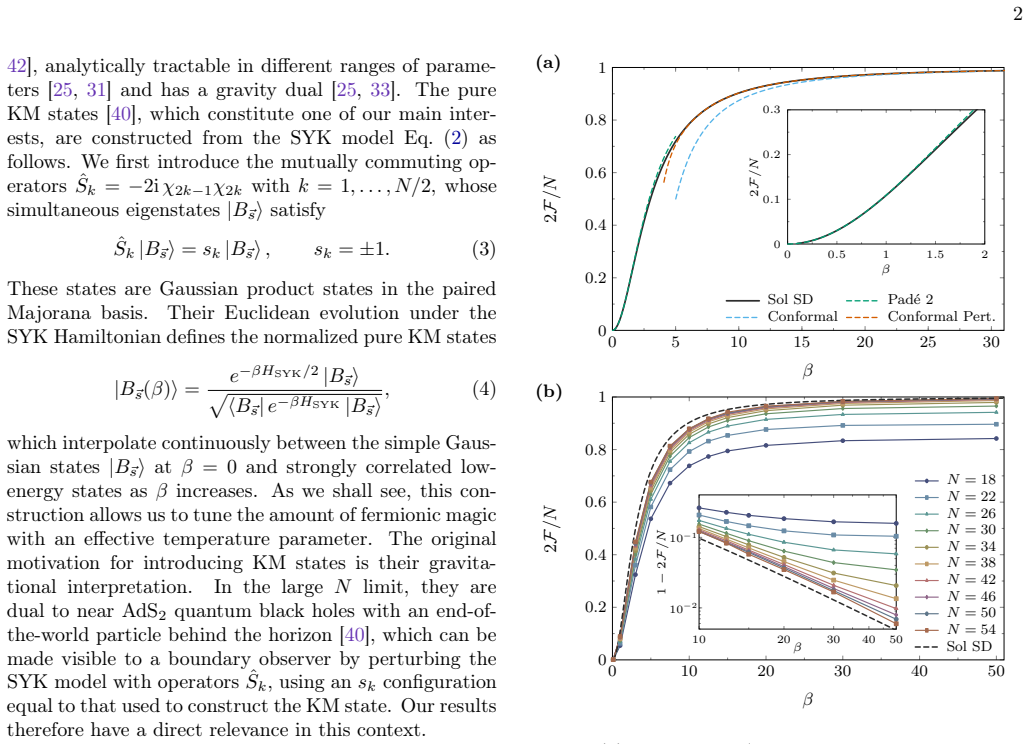
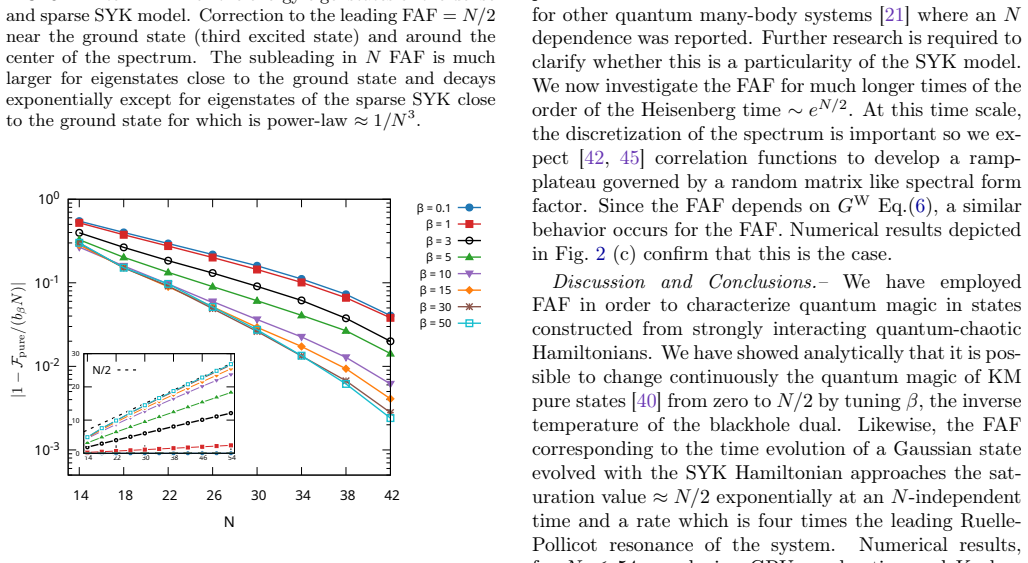
In the large-N limit the quantum magic of pure KM states dual to black holes is linear in N with temperature-tunable slope from 0 to 1/2.
A machine-rendered reading of the paper's core claim, the machinery that carries it, and where it could break.
Core claim
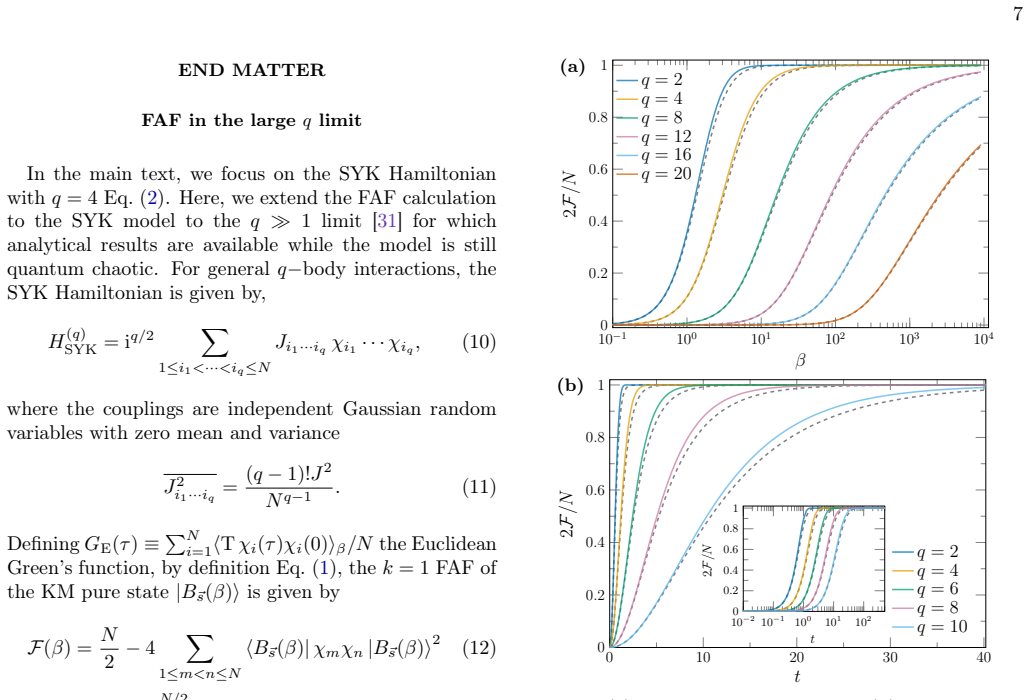
We show analytically that, in the large N limit, the quantum magic of pure Kourkoulou-Maldacena (KM) states, dual to a quantum black hole with an end-of-world particle behind the horizon, is linear in N with a slope, depending on the black hole temperature, that can be tuned between zero and 1/2.
What carries the argument
Fermionic anti-flatness (FAF) measure applied to pure Kourkoulou-Maldacena states in the SYK model.
If this is right
- Magic of pure KM states can be continuously tuned between zero and N/2 by varying black-hole temperature.
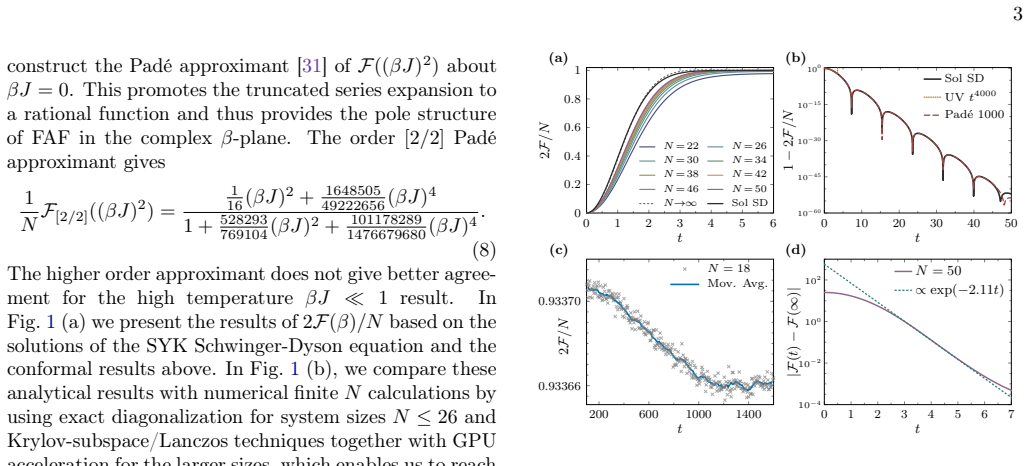
- FAF of Gaussian states evolved under the SYK Hamiltonian approaches N/2 exponentially at a rate set by the leading Ruelle-Pollicot resonance.
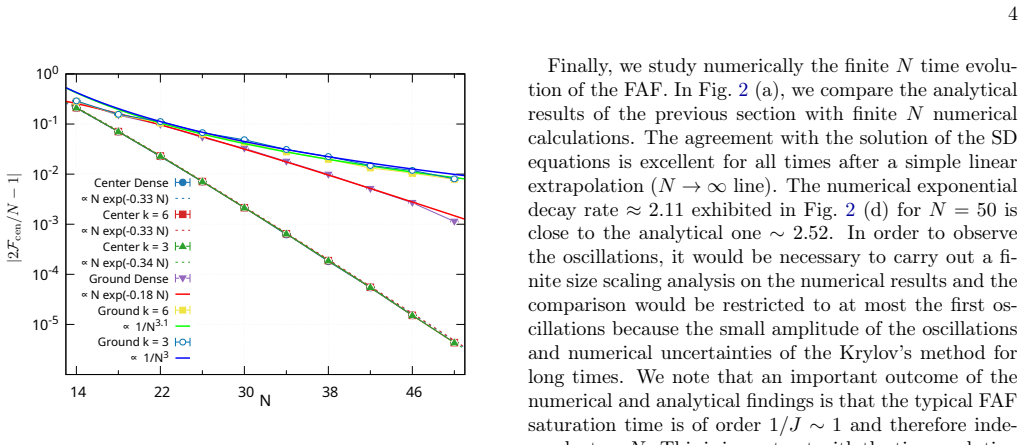
- Subleading corrections in N for SYK energy eigenstates decay exponentially with N.
- The same corrections decay only as a power law when the SYK couplings are sparsified.
- Corrections remain an order of magnitude larger for eigenstates close to the ground state.
Where Pith is reading between the lines
- Temperature control of the magic slope may translate into a gravitational handle on classical simulability of the dual state.
- The end-of-world particle could be the microscopic source of the tunable magic resource.
- Sparsified SYK models with slower correction decay may correspond to gravitational regimes with qualitatively different information-processing properties.
Load-bearing premise
The fermionic anti-flatness measure is assumed to correctly capture quantum magic for these states, and the large-N limit plus gravity dual interpretation are taken to apply directly to the magic calculation.
What would settle it
A direct numerical evaluation of the FAF for KM states at moderate but accessible N that fails to reproduce the predicted linear scaling with N.
Figures
read the original abstract
Quantum magic is a fundamental resource that quantifies to what extent quantum states can be efficiently simulated on a classical computer. We study it for states constructed from the Sachdev-Ye-Kitaev (SYK) Hamiltonian with $N$ Majoranas by the fermionic anti-flatness (FAF). We show analytically that, in the large $N$ limit, the quantum magic of pure Kourkoulou-Maldacena (KM) states, dual to a quantum black hole with an end-of-world particle behind the horizon, is linear in $N$ with a slope, depending on the black hole temperature, that can be tuned between zero and $1/2$. By contrast, the FAF of Gaussian states evolved in real time with the SYK Hamitonian approaches $\approx N/2$ exponentially at a rate given by a multiple of the leading Ruelle-Pollicot resonance. Subleading corrections in $N$ for SYK energy eigenstates, computed numerically for $N \leq 54$ by combining Krylov subspace with GPU acceleration techniques, decay exponentially with $N$, but power-law if the SYK couplings are sparsified, and are order of magnitude larger for states close to the ground state, a region with an established gravity analogue. Our results offer new insights about the relation between quantum information, quantum chaos and low-dimension quantum gravity.
Editorial analysis
A structured set of objections, weighed in public.
Referee Report
Summary. The manuscript claims to analytically compute, in the large-N limit, the fermionic anti-flatness (FAF) of quantum magic for pure Kourkoulou-Maldacena (KM) states in the SYK model (dual to a black hole with an end-of-world particle), finding the magic linear in N with a temperature-dependent slope tunable between 0 and 1/2. It contrasts this with the FAF of real-time evolved Gaussian states, which approaches N/2 exponentially at a rate set by a multiple of the leading Ruelle-Pollicott resonance. Subleading N corrections for SYK energy eigenstates are computed numerically up to N=54 via Krylov subspace methods with GPU acceleration, showing exponential decay in N (power-law when couplings are sparsified) and larger values near the ground state.
Significance. If the central large-N analytical result holds, the work establishes a direct, tunable connection between a quantum-information resource (magic) and holographic black-hole states, offering new insights at the intersection of quantum chaos, magic monotones, and low-dimensional gravity. The explicit linearity result and the numerical access to N=54 via Krylov+GPU techniques are concrete strengths; the latter in particular enables falsifiable checks of the gravity-analogue regime near the ground state.
minor comments (3)
- [§3.2] §3.2, below Eq. (18): the statement that the slope is 'parameter-free' in the large-N limit should be cross-referenced to the explicit temperature dependence derived from the KM state construction; a brief sentence clarifying that temperature enters only through the dual geometry would remove potential ambiguity.
- [§4.3] Figure 4 caption and §4.3: the numerical data for N≤54 report exponential decay of corrections, but the fitting window (which N values are included) and the precise definition of the 'sparsified' ensemble are not stated; adding these details would strengthen reproducibility.
- [§1] The abstract and §1 mention 'combining Krylov subspace with GPU acceleration' but provide no pseudocode or reference to the implementation; a short methods paragraph or supplementary note would aid readers attempting to replicate the N=54 results.
Simulated Author's Rebuttal
We thank the referee for their positive assessment of the manuscript, including recognition of the large-N analytical result on tunable magic in KM states and the numerical access to N=54 via Krylov+GPU methods. The recommendation for minor revision is noted. No specific major comments appear in the report.
Circularity Check
No significant circularity; derivation is self-contained analytical result
full rationale
The central claim is an explicit large-N analytical evaluation of the fermionic anti-flatness (FAF) measure on pure Kourkoulou-Maldacena states constructed from the SYK Hamiltonian. This computation is presented as a direct large-N limit evaluation independent of any fitted parameters or prior results that would reduce the output to the input by construction. The gravity dual enters only as interpretive context for the states, not as a load-bearing step in the FAF derivation itself. Numerical subleading corrections are computed separately via Krylov methods and do not feed back into the analytical claim. No self-definitional, fitted-input-called-prediction, or self-citation-load-bearing patterns are present in the derivation chain. The result therefore stands as an independent calculation on the SYK side.
Axiom & Free-Parameter Ledger
axioms (1)
- domain assumption Large-N limit of the SYK model applies to the magic calculation for KM states
Reference graph
Works this paper leans on
-
[1]
(9) In contrast to the temperature dependence, this expan- sion has a finite convergence radius approximately equal to3.56, rendering it well suited to Padé construction
using the SD equations yields 1 N F(t) = (J t)2 4 − 13(J t)4 192 + 307(J t)6 23040 − 5549(J t)8 2580480 + 141067(J t)10 464486400 − 957373(J t)12 24524881920 +O (J t)14 . (9) In contrast to the temperature dependence, this expan- sion has a finite convergence radius approximately equal to3.56, rendering it well suited to Padé construction. As demonstrated...
-
[2]
Therefore, the FAF in these cases is of direct relevance for the characterization of magic in quantum gravity
and its gravity [33] is governed by the Schwarzian action. Therefore, the FAF in these cases is of direct relevance for the characterization of magic in quantum gravity. By contrast, after a timet∼1/J, the real time- evolution of Gaussian states results in states with an en- ergy far from the ground state that in principle does not have a gravity dual. Th...
-
[3]
S.BravyiandA.Kitaev,Universalquantumcomputation with ideal clifford gates and noisy ancillas, Phys. Rev. A 71, 022316 (2005)
2005
-
[4]
Veitch, C
V. Veitch, C. Ferrie, D. Gross, and J. Emerson, Negative quasi-probabilityasaresourceforquantumcomputation, New Journal of Physics14, 113011 (2012)
2012
-
[5]
Veitch, S
V. Veitch, S. A. Hamed Mousavian, D. Gottesman, and J. Emerson, The resource theory of stabilizer quantum computation, New Journal of Physics16, 013009 (2014)
2014
-
[6]
Chitambar and G
E. Chitambar and G. Gour, Quantum resource theories, Rev. Mod. Phys.91, 025001 (2019)
2019
-
[7]
Pashayan, J
H. Pashayan, J. J. Wallman, and S. D. Bartlett, Esti- mating outcome probabilities of quantum circuits using quasiprobabilities, Phys. Rev. Lett.115, 070501 (2015)
2015
-
[8]
Quantum magic dynamics in random circuits
Y. Zhang and Y. Gu, Quantum magic dynamics in ran- dom circuits (2024), arXiv:2410.21128 [quant-ph]
work page internal anchor Pith review Pith/arXiv arXiv 2024
-
[9]
X.Wang, M.M.Wilde,andY.Su,Efficientlycomputable bounds for magic state distillation, Phys. Rev. Lett.124, 090505 (2020)
2020
-
[10]
Leone, S
L. Leone, S. F. E. Oliviero, and A. Hamma, Stabilizer rényi entropy, Phys. Rev. Lett.128, 050402 (2022)
2022
-
[11]
Leone and L
L. Leone and L. Bittel, Stabilizer entropies are mono- tones for magic-state resource theory, Phys. Rev. A110, L040403 (2024)
2024
-
[12]
Liu and A
Z.-W. Liu and A. Winter, Many-body quantum magic, PRX Quantum3, 020333 (2022)
2022
-
[13]
Hoshino, M
M. Hoshino, M. Oshikawa, and Y. Ashida, Stabilizer rényi entropy and conformal field theory, Phys. Rev. X 16, 011037 (2026)
2026
-
[14]
Zhang, S
P. Zhang, S. Zhou, and N. Sun, Stabilizer rényi entropy anditstransitioninthecoupledsachdev-ye-kitaevmodel, Phys. Rev. Lett.136, 080201 (2026)
2026
-
[15]
C. Cao, G. Cheng, A. Hamma, L. Leone, W. Munizzi, and S. F. Oliviero, Gravitational backreaction is magical, PRX Quantum6, 040375 (2025)
2025
-
[16]
X. Turkeshi, E. Tirrito, and P. Sierant, Magic spread- ing inrandom quantum circuits, NatureCommunications 16, 10.1038/s41467-025-57704-x (2025)
- [17]
-
[18]
P. Sierant and X. Turkeshi, Theory of magic phase transitions in encoding-decoding circuits (2026), arXiv:2603.00235 [quant-ph]
-
[19]
Niroula, C
P. Niroula, C. D. White, Q. Wang, S. Johri, D. Zhu, C. Monroe, C. Noel, and M. J. Gullans, Phase transition in magic with random quantum circuits, Nature Physics 20, 1786–1792 (2024)
2024
-
[20]
Haug and M
T. Haug and M. Kim, Scalable measures of magic re- source for quantum computers, PRX Quantum4, 010301 (2023)
2023
-
[21]
Y.-M. Ding, Z. Wang, and Z. Yan, Evaluating many- body stabilizer rényi entropy by sampling reduced pauli strings: Singularities, volume law, and nonlocal magic, PRX Quantum6, 030328 (2025)
2025
-
[22]
Sierant, J
P. Sierant, J. Vallès-Muns, and A. Garcia-Saez, Comput- ing quantum magic of state vectors, Quantum10, 2059 (2026)
2059
-
[23]
Sierant, P
P. Sierant, P. Stornati, and X. Turkeshi, Fermionic magic resources of quantum many-body systems, PRX Quan- tum7, 010302 (2026)
2026
- [24]
- [25]
-
[26]
Tirrito, P
E. Tirrito, P. S. Tarabunga, G. Lami, T. Chanda, L.Leone, S.F.E.Oliviero, M.Dalmonte, M.Collura,and A.Hamma,Quantifyingnonstabilizernessthroughentan- glement spectrum flatness, Phys. Rev. A109, L040401 (2024)
2024
-
[27]
Kitaev, A simple model of quantum holography, Talks at KITP: String seminar and Entanglement 2015 pro- gram, 12 Feb, 7 Apr, 27 May (2015),http://online
A. Kitaev, A simple model of quantum holography, Talks at KITP: String seminar and Entanglement 2015 pro- gram, 12 Feb, 7 Apr, 27 May (2015),http://online. kitp.ucsb.edu/online/entangled15/
2015
-
[28]
French and S
J. French and S. Wong, Validity of random matrix theo- ries for many-particle systems, Physics Letters B33, 449 (1970)
1970
-
[29]
Bohigas and J
O. Bohigas and J. Flores, Two-body random hamiltonian and level density, Physics Letters B34, 261 (1971)
1971
-
[30]
Sachdev and J
S. Sachdev and J. Ye, Gapless spin-fluid ground state in a random quantum heisenberg magnet, Physical Review Letters70, 3339–3342 (1993)
1993
-
[31]
Benet, T
L. Benet, T. Rupp, and H. A. Weidenmüller, Nonuni- versal behavior of thek-body embedded gaussian uni- tary ensemble of random matrices, Phys. Rev. Lett.87, 010601 (2001)
2001
-
[32]
A. M. García-García and J. J. M. Verbaarschot, Spectral and thermodynamic properties of the Sachdev-Ye-Kitaev model, Phys. Rev. D94, 126010 (2016)
2016
-
[33]
Maldacena and D
J. Maldacena and D. Stanford, Remarks on the sachdev- ye-kitaev model, Phys. Rev. D94, 106002 (2016)
2016
-
[34]
A. M. García-García, L. Sá, and J. J. M. Ver- baarschot, Symmetry Classification and Universality in Non-Hermitian Many-Body Quantum Chaos by the Sachdev-Ye-Kitaev Model, Phys. Rev. X12, 021040 (2022)
2022
-
[35]
Conformal symmetry and its breaking in two dimensional Nearly Anti-de-Sitter space
J. Maldacena, D. Stanford, and Z. Yang, Conformal sym- 6 metry and its breaking in two dimensional nearly anti- de-sitter space (2016), arXiv:1606.01857 [hep-th]
work page internal anchor Pith review Pith/arXiv arXiv 2016
-
[36]
S. Bera and M. Schirò, Non-stabilizerness of sachdev- ye-kitaev model, SciPost Physics19, 10.21468/scipost- phys.19.6.159 (2025)
-
[37]
Jasser, J
B. Jasser, J. Odavić, and A. Hamma, Stabilizer entropy and entanglement complexity in the sachdev-ye-kitaev model, Phys. Rev. B112, 174204 (2025)
2025
-
[38]
Russomanno, G
A. Russomanno, G. Passarelli, D. Rossini, and P. Lu- cignano, Nonstabilizerness in the unitary and monitored quantum dynamics of xxz-staggered and sachdev-ye- kitaev models, Phys. Rev. B112, 064312 (2025)
2025
-
[39]
J. Maldacena, A. Milekhin, and F. Popov, Traversable wormholes in four dimensions (2018), arXiv:1807.04726 [hep-th]
-
[40]
Magic and Wormholes in the Sachdev-Ye-Kitaev Model
V. Bettaque and B. Swingle, Magic and wormholes in the sachdev-ye-kitaev model (2026), arXiv:2602.12339 [hep- th]
work page internal anchor Pith review Pith/arXiv arXiv 2026
-
[41]
Connecting magic dynamics in thermofield double states to spectral form factors
N. Sun and P. Zhang, Connecting magic dynamics in thermofield double states to spectral form factors (2026), arXiv:2601.12787 [quant-ph]
-
[42]
Pure states in the SYK model and nearly-$AdS_2$ gravity
I. Kourkoulou and J. Maldacena, Pure states in the syk model and nearly-ads2 gravity (2017), arXiv:1707.02325 [hep-th]
work page internal anchor Pith review Pith/arXiv arXiv 2017
-
[43]
P. Zhang, Entanglement entropy and its quench dynamics for pure states of the sachdev-ye-kitaev model, Journal of High Energy Physics2020, 10.1007/jhep06(2020)143 (2020)
-
[44]
A. M. García-García, L. Sá, J. J. M. Verbaarschot, and J.-P. Zheng, Many-body quantum chaos at all time scales (2026), arXiv:2605.27512 [hep-th]
work page internal anchor Pith review Pith/arXiv arXiv 2026
-
[45]
E. A. Cruz and G. Tarnopolsky, Precise low-temperature expansions for the sachdev-ye-kitaev model, Physical Re- view B108, 10.1103/physrevb.108.035103 (2023)
-
[46]
Dodelson, Ringdown in the syk model, SciPost Physics19, 10.21468/scipostphys.19.3.081 (2025)
M. Dodelson, Ringdown in the syk model, SciPost Physics19, 10.21468/scipostphys.19.3.081 (2025)
-
[47]
Cotler, N
J. Cotler, N. Hunter-Jones, J. Liu, and B. Yoshida, Chaos, complexity, andrandommatrices,JournalofHigh Energy Physics2017, 48 (2017)
2017
-
[48]
A. M. García-García, L. Sá, J. J. M. Verbaarschot, and J. P. Zheng, Keldysh wormholes and anomalous relax- ation in the dissipative sachdev-ye-kitaev model, Phys. Rev. D107, 106006 (2023)
2023
-
[49]
Kulkarni, T
A. Kulkarni, T. Numasawa, and S. Ryu, Lindbladian dynamics of the sachdev-ye-kitaev model, Phys. Rev. B 106, 075138 (2022)
2022
-
[50]
A. M. García-García, Y. Jia, D. Rosa, and J. J. M. Verbaarschot, Sparse sachdev-ye-kitaev model, quantum chaos, and gravity duals, Phys. Rev. D103, 106002 (2021)
2021
-
[51]
1− 2 q log(cosh(Jt)) +. . . # ≈ sgn(t) 2 cosh(Jt) 2 q . (20) The FAF then is 1 N F(t) = 1 2 − 1 2
T. Nosaka and T. Numasawa, Quantum Chaos, Thermo- dynamics and Black Hole Microstates in the mass de- formed SYK model, JHEP08, 081. 7 END MA TTER F AF in the largeqlimit In the main text, we focus on the SYK Hamiltonian withq= 4Eq. (2). Here, we extend the FAF calculation to the SYK model to theq≫1limit [31] for which analytical results are available whi...
discussion (0)
Sign in with ORCID, Apple, or X to comment. Anyone can read and Pith papers without signing in.