REVIEW 2 major objections 4 minor 34 references
Beamfocusing Capabilities of a Uniform Linear Array in the Holographic Regime
T0 review · 2 major / 4 minor · reviewed 2026-08-08 · deepseek-v4-flash
Pith's one-line read A uniform linear array can focus its energy in the near field only when its total length exceeds about $4.4\lambda$, and the paper proves this by reducing beamfocusing to a local-concavity condition on the received SNR.
desk verdict Careful holographic-ULA beamfocusing analysis with a likely-right but overclaimed 4.4λ threshold. read the letter →
The pith
A machine-rendered reading of the paper's core claim, the machinery that carries it, and where it could break.
The reading
What carries the argument
The load-bearing object is the second-order SNR expansion of Corollary 1 combined with the quadric-surface criterion. After rewriting the SNR as $\mathrm{SNR}(\mathbf{r}_0)[1-2\Delta\mathbf{r}^{\mathsf T}\mathbf{m}_M-\Delta\mathbf{r}^{\mathsf T}\mathbf{M}_M\Delta\mathbf{r}]+\epsilon_M$, the set where $\mathrm{SNR}\ge \kappa\,\mathrm{SNR}(\mathbf{r}_0)$ is an ellipsoid iff $\mathbf{M}_M$ is positive definite; in the holographic regime this becomes the condition $\mathbf{M}_2\succ 0$ (equivalently $D^2\mathbf{M}_2\succ 0$), whose eigenvalue signs are functions only of $\rho=L/D$, $\theta$, and $L/\lambda$. The named regime is the holographic regime, $M\to\infty$ with $\Delta_T\to 0$ and $M\Delta_T\to L$, which turns sums over elements into integrals and yields the closed-form quantities $\chi_k$, $\bar\chi_k$ used in inequality (23) and in the $D_{\max}$ formula.
What would settle it
Scan all elevation angles and normalized distances $\rho=L/D$ for a holographic ULA with total length $2L=4.2\lambda$, computing the eigenvalues of $D^2\mathbf{M}_2$ from (22); if any location has all three eigenvalues positive, the claimed $4.4\lambda$ threshold is false. Equivalently, numerically minimize the left-hand side of (23) over all $\rho>0$; any value below $2.2048$ would also falsify the broadside threshold.
Extended reading notes
Core claim
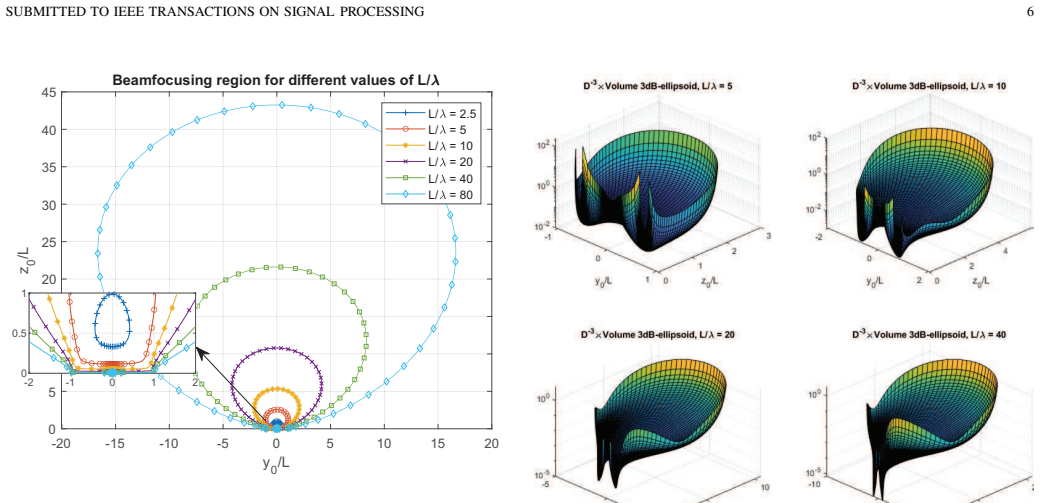
On the paper's own terms, the central discovery is that beamfocusing by a ULA is a local-concavity phenomenon with a sharp aperture threshold. The paper considers the SNR at a point $\mathbf{r}$ relative to its value at the intended receiver $\mathbf{r}_0$ and shows that, up to third-order error, the level sets are quadrics; beamfocusing is feasible precisely when the quadric is an ellipsoid, i.e. when all three eigenvalues of the curvature matrix $\mathbf{M}$ are positive. In the holographic limit the relevant matrix is $D^2\mathbf{M}_2$, a function only of $\rho=L/D$, elevation $\theta$, and $L/\lambda$. For a broadside receiver, the decisive eigenvalue $\gamma_3$ is positive exactly when inequality (23) holds, and the left-hand side of (23) has its minimum at $\rho=1.72776$, where $L/\lambda=2.2048$; hence the total aperture $2L$ must exceed $4.4096\lambda$. For large $D/L$ the maximum focusing distance is $D_{\max}\approx 2\pi L^2/(3\lambda\sqrt{15})=\pi/(12\sqrt{15})\,D_{\mathrm{Fraun}}$, so the feasibility region is a radial interval whose endpoints depend on elevation.
Load-bearing premise
The whole threshold rests on the analytic core being carried out for a receiver on the yz-plane ($x_0=0$), where the dominant eigenvector is known; the paper asserts the broadside case yields the $4.4\lambda$ bound without proving that no off-broadside direction allows focusing with a shorter array.
Editorial extensions
If this is right
- For any ULA shorter than $4.4\lambda$, the paper's condition says no receiver location has locally concave SNR, so near-field spatial focusing is impossible regardless of element count or spacing.
- For longer arrays, beamfocusing works only inside a distance interval; receivers too close (below $D_{\min}$, often in the reactive near field) or too far (beyond the asymptotic $D_{\max}$) cannot be focused.
- The asymptotic maximum focusing distance scales as $L^2/\lambda$, the same scaling as the Fraunhofer distance, but with a numerical factor roughly $1/46$ of it, so the focusing region occupies a definite fraction of the usual far-field boundary.
- Inside the feasibility region the 3-dB coverage set is described as an ellipsoid whose semiaxes, center, and volume are given in closed form; outside that region the level sets become hyperboloids and energy spreads rather than focuses.
- The paper's numerical results show that the holographic approximation matches finite arrays with half-wavelength spacing and about one hundred elements, so the idealized continuum results are directly usable for practical discrete ULAs.
Reading between the lines
- The broadside derivation fixes $x_0=0$ and uses the known dominant eigenvector $\mathbf{u}=\mathbf{e}_1$; the universal $4.4\lambda$ statement assumes this is the hardest direction to focus in, which the paper does not prove for all elevation angles.
- If the threshold carries over to other aperture geometries, one would expect a similar minimum aperture length, likely controlled by the smallest dimension of the array; the paper gives no direct evidence for planar or curved surfaces.
- A testable extension is to run the full eigenvalue computation for receivers with $x_0\neq 0$ and check whether the minimum feasible $L/\lambda$ is really attained at broadside; if not, the abstract's threshold should become a direction-dependent condition.
- The local-concavity definition of beamfocusing is a stricter, local notion than global beam-depth criteria used elsewhere; comparing the two on the same channel model would clarify when the $4.4\lambda$ limit is the binding constraint for spatial multiplexing.
Editorial analysis
A structured set of objections, weighed in public.
Referee Report
Summary. The paper studies near-field beamfocusing by a uniform linear array using a dyadic Green's function channel model. It defines beamfocusing feasibility as local concavity of the SNR around the intended receiver, characterized by positive definiteness of the quadratic form in a second-order Taylor expansion. Closed-form expressions are derived for the ellipsoid of κ-fraction SNR in the finite-M case, and the holographic regime (M→∞, ΔT→0) is used to obtain simplified feasibility conditions. For a receiver on the broadside of the array, the paper derives condition (23) and a threshold L>2.2048λ (total aperture >4.4λ), plus asymptotic formulas for the range of focusing distances. Numerical results with 101 antennas at λ/2 spacing support the accuracy of the holographic approximations.
Significance. The paper's main strengths are the careful Taylor expansion with 'nice constant' bounds on the remainder, the closed-form computation of the quadratic form in Proposition 2, and the clean passage to the holographic limit. The broadside feasibility condition (23) is analytically explicit and yields a concrete, falsifiable design rule. The numerical study is extensive and shows that the holographic approximation remains accurate at λ/2 spacing with moderate array sizes. However, the headline 4.4λ threshold, as stated in the Abstract, goes beyond what is proven: the derivation covers only receivers on the yz-plane and, for the threshold, only the broadside location. If the universal claim can be established, the result would be a practically useful lower bound for near-field focusing apertures.
major comments (2)
- [Abstract and Section III.A] The headline claim that beamfocusing is only possible when the ULA size is at least 4.4λ is not supported by the analysis for all receiver positions. Equation (23) and the threshold ρ=1.72776, L/λ=2.2048 are derived under two restrictions: the receiver is on the yz-plane (x0=0) and, within that plane, the broadside case y0=0. The paper does not prove that this configuration is the most favorable, nor does it analyze x0≠0. In particular, no argument rules out an off-broadside angle θ or an out-of-plane position for which the minimum required L/λ is below 2.2048; Fig. 2 starts at L/λ=2.5 and the high-D/L approximation in Eq. (25) actually suggests that off-broadside angles may give positive feasibility for smaller L/λ when taken at face value. The universal statement in the Abstract therefore needs either a rigorous proof or an explicit qualification to the yz-plane/broadside case. Relatedly, the text asserts that the left-hand side of (23) 'presents a single inflection point (local minima)' at ρ=1.72776; an inflection point is not a local extremum, and a local minimum does not by itself establish the global minimum needed for the threshold, although the singular behavior at the domain boundaries suggests the claim can be proven.
- [Section III.B, Eq. (25)] The large-D/L approximation in Eq. (25) is used to describe feasibility for general elevation angles, but its validity is only demonstrated for L/λ ≥ 10 in Fig. 5. For smaller L/λ, the approximation gives positive right-hand sides for some angles (e.g., θ=0 with L/λ=1), which would imply feasibility with an aperture below the claimed 4.4λ threshold if extrapolated. Since the approximation is a Taylor expansion around ρ=0, it is not valid in that regime, but the paper does not state this or provide alternative evidence. To support the universal threshold, the authors should either prove analytically that γ3<0 for all θ and all ρ when L/λ<2.2048, or provide a dense numerical sweep over θ and ρ for L/λ in the interval (2.2, 2.5) showing that the feasibility region is empty.
minor comments (4)
- [Section III.A, after Eq. (23)] The asymptotic expansions attached to 'large values of ρ' and 'small values of ρ' appear to be interchanged: the expansion 3√15/(2πρ) is the small-ρ (large-D/L) behavior, while the expansion with √(7/(π²−8)) is the large-ρ (small-D/L) behavior. The subsequent use for Dmax and Dmin is consistent with the interchanged labeling, but the text should be corrected.
- [Section III.A, Eq. (23)] The phrase 'inflection point (local minima)' is mathematically contradictory; it should read 'local minimum' (or 'global minimum' if proven). Additionally, the square-root quantity in (23) is not defined for all ρ>0 because the radicand becomes negative for small ρ; the domain on which the feasibility analysis applies should be stated explicitly.
- [Throughout] Minor typos include 'tramsmit' in Section II, 'whcih' in Appendix A, and 'Comparision' in the caption of Fig. 5. Reference [33] duplicates reference [14] and should be merged or cross-referenced.
- [Fig. 4 caption] The caption could clarify that the curve has two vertical asymptotes (at D/L=0 and at the lower bound of ρ) with a single minimum in between; this structure is not immediately evident from the current caption or from the text.
Circularity Check
No significant circularity: the 4.4λ threshold and feasibility formulas are derived from the paper's own second-order SNR expansion and quadric-surface analysis; self-citations are used only as independent lemmas.
full rationale
The paper's central derivation is self-contained: beamfocusing feasibility is defined via local concavity of the SNR, expanded to second order in Proposition 1 and Corollary 1, specialized to the yz-plane in Proposition 2, and then taken to the holographic limit. The 4.4λ threshold comes from condition (23), obtained by setting the eigenvalue γ3 > 0 for y0 = 0 and minimizing its left-hand side; the maximum-distance formula Dmax = π/(12√15)DFraun comes from a large-ρ asymptotic expansion of the same condition. None of these outputs is an input by definition. The cited prior work [31] supplies the closed forms of the holographic integrals χk, and [34] supplies the eigenvector fact u = e1 for x0 = 0; both are parameter-free lemmas with stated assumptions that do not include the target result, and the finite-M numerical validation uses an independent full-channel simulation. The skeptic's concern—that the abstract states a universal threshold without proving that the broadside case is the most favorable direction and without a proof that (23) has a global minimum at ρ = 1.72776—is a rigor or generalization gap, not circularity: no equation is defined in terms of the claimed threshold and no fitted parameter is renamed as a prediction. Therefore the circularity score is 0.
Assumptions & free parameters
assumptions (5)
- domain assumption Dyadic Green's channel model with only radiative terms: Hm(r)=hm(r)P⊥_m(r)
- domain assumption Receiver is restricted to the yz-plane (x0=0) for the analytic formulas
- ad hoc to paper Beamfocusing feasibility is defined by local concavity of SNR (quadric being an ellipsoid)
- ad hoc to paper The left-hand side of (23) has a single local minimum at ρ=1.72776 with value 2.2048
- domain assumption The holographic limit (M→∞, ΔT→0 with MΔT→L) produces convergent integrals χk, χ̄k and bounded error terms
Cite this review
Pith. "Pith review of Beamfocusing Capabilities of a Uniform Linear Array in the Holographic Regime." pith.science (2026). https://pith.science/paper/2CGVRR77
@misc{pith2026250207318,
  author       = {Pith},
  title        = {Pith review of: Beamfocusing Capabilities of a Uniform Linear Array in the Holographic Regime},
  year         = {2026},
  howpublished = {\url{https://pith.science/paper/2CGVRR77}},
  note         = {Machine review of arXiv:2502.07318}
}
abstract
The use of multiantenna technologies in the near field offers the possibility of focusing the energy in spatial regions rather than just in angle. The objective of this paper is to provide a formal framework that allows to establish the region in space where this effect can take place and how efficient this focusing can be, assuming that the transmit architecture is a uniform linear array (ULA). A dyadic Green's channel model is adopted, and the amplitude differences between the receiver and each transmit antenna are effectively incorporated in the model. By considering a second-order expansion of the SNR around the intended receiver, a formal criterion is derived in order to establish whether beamfocusing is feasible or not. An analytic description is provided that determines the shape and position of the asymptotic ellipsoid where a minimum SNR is achieved. Further insights are provided by considering the holographic regime, whereby the number of elements of the ULA increase without bound while the distance between adjacent elements converges to zero. This asymptotic framework allows to simplify the analytical form of the beamfocusing feasibility region, which in turn provides some further insights into the shape of the coverage regions depending on the position of the intended receiver. In particular, it is shown that beamfocusing is only possible if the size of the ULA is at least $4.4\lambda$ where $\lambda$ is the transmission wavelength. Furthermore, a closed form analytical expression is provided that asymptotically determines the maximum distance where beamfocusing is feasible as a function of the elevation angle. In particular, beamfocusing is only feasible when the receiver is located between a minimum and a maximum distance from the array, where these upper and lower distance limits effectively depend on the angle of elevation
Figures


Figures from the paper (3 more)


Reference graph
Works this paper leans on
-
[1]
Stochastic modeling of THz indo or radio channels,
S. Priebe and T. Kurner, “Stochastic modeling of THz indo or radio channels,” IEEE Transactions on Wireless Communications , vol. 12, no. 9, pp. 4445–4455, 2013
work page 2013
-
[2]
M. Shafi, J. Zhang, H. Tataria, A. F. Molisch, S. Sun, T. S. R appaport, F. Tufvesson, S. Wu, and K. Kitao, “Microwave vs. millimeter -wave propagation channels: Key differences and impact on 5G cell ular sys- tems,” IEEE Communications Magazine , vol. 56, no. 12, pp. 14–20, 2018
work page 2018
-
[3]
P . Driessen and G. Foschini, “On the capacity formula for multiple input- multiple output wireless channels: a geometric interpreta tion,” IEEE Transactions on Communications , vol. 47, no. 2, pp. 173–176, 1999
work page 1999
-
[4]
Spherical-wave model for sho rt-range MIMO,
J.-S. Jiang and M. Ingram, “Spherical-wave model for sho rt-range MIMO,” IEEE Transactions on Communications , vol. 53, no. 9, pp. 1534–1541, 2005
work page 2005
-
[5]
On spherical vs. pla ne wave modeling of line-of-sight MIMO channels,
F. Bohagen, P . Orten, and G. E. Oien, “On spherical vs. pla ne wave modeling of line-of-sight MIMO channels,” IEEE Transactions on Communications, vol. 57, no. 3, pp. 841–849, 2009
work page 2009
-
[6]
Wavenumbe r-division multiplexing in line-of-sight holographic MIMO communica tions,
L. Sanguinetti, A. A. D’Amico, and M. Debbah, “Wavenumbe r-division multiplexing in line-of-sight holographic MIMO communica tions,” IEEE Transactions on Wireless Communications , vol. 22, no. 4, pp. 2186–2201, 2023
work page 2023
-
[7]
6g wireless communications: From far-field beam steering to ne ar-field beam focusing,
H. Zhang, N. Shlezinger, F. Guidi, D. Dardari, and Y . C. El dar, “6g wireless communications: From far-field beam steering to ne ar-field beam focusing,” IEEE Communications Magazine , vol. 61, no. 4, pp. 72–77, 2023
work page 2023
-
[8]
E. Bj¨ ornson, C.-B. Chae, R. W. Heath Jr, T. L. Marzetta, A . Mezghani, L. Sanguinetti, F. Rusek, M. R. Castellanos, D. Jun, and ¨O. T. Demir, “Towards 6G MIMO: Massive spatial multiplexing, dense arra ys, and interplay between electromagnetics and processing,” arXiv preprint arXiv:2401.02844, 2024
arXiv 2024
Show all 34 references
-
[9]
Ne ar- field communications: A tutorial review,
Y . Liu, Z. Wang, J. Xu, C. Ouyang, X. Mu, and R. Schober, “Ne ar- field communications: A tutorial review,” IEEE Open Journal of the Communications Society , vol. 4, pp. 1999–2049, 2023
1999
-
[10]
Ramezani and E
P . Ramezani and E. Bj¨ ornson,Near-Field Beamforming and Multiplexing Using Extremely Large Aperture Arrays . Cham: Springer International Publishing, 2024, pp. 317–349
2024
-
[11]
Infocus: A spatial coding te chnique to mitigate misfocus in near-field los beamforming,
N. J. Myers and R. W. Heath, “Infocus: A spatial coding te chnique to mitigate misfocus in near-field los beamforming,” IEEE Transactions on Wireless Communications, vol. 21, no. 4, pp. 2193–2209, 2022
2022
-
[12]
Multiple access for near-field communi cations: Sdma or ldma?
Z. Wu and L. Dai, “Multiple access for near-field communi cations: Sdma or ldma?” IEEE Journal on Selected Areas in Communications , vol. 41, no. 6, pp. 1918–1935, 2023
1918
-
[13]
Finite beam depth analysi s for large arrays,
A. Kosasih and E. Bj¨ ornson, “Finite beam depth analysi s for large arrays,” IEEE Transactions on Wireless Communications , vol. 23, no. 8, pp. 10 015–10 029, 2024
2024
-
[14]
A primer on near-field beamforming for arrays and reconfigurable intelligent surf aces,
E. Bj¨ ornson, O. T. Demir, and L. Sanguinetti, “A primer on near-field beamforming for arrays and reconfigurable intelligent surf aces,” in 2021 55th Asilomar Conference on Signals, Systems, and Computer s, 2021, pp. 105–112
2021
-
[15]
Tri-polarized hologr aphic MIMO surfaces for near-field communications: Channel model ing and precoding design,
L. Wei, C. Huang, G. C. Alexandropoulos, Z. Y ang, J. Y ang , W. E. I. Sha, Z. Zhang, M. Debbah, and C. Y uen, “Tri-polarized hologr aphic MIMO surfaces for near-field communications: Channel model ing and precoding design,” IEEE Trans. on Wireless Comms. , pp. 1–1, 2023
2023
-
[16]
Near-field channel modeling for holographic MI MO communications,
T. Gong, L. Wei, C. Huang, G. C. Alexandropoulos, M. Debb ah, and C. Y uen, “Near-field channel modeling for holographic MI MO communications,” IEEE Wireless Communications , vol. 31, no. 3, pp. 108–116, 2024
2024
-
[17]
Near-field beamfocusing with polarized antennas,
A. Agustin and X. Mestre, “Near-field beamfocusing with polarized antennas,” in 2024 IEEE Wireless Communications and Networking Conference (WCNC), 2024, pp. 01–06
2024
-
[18]
Degrees of freedom in multiple- antenna channels: a signal space approach,
A. Poon, R. Brodersen, and D. Tse, “Degrees of freedom in multiple- antenna channels: a signal space approach,” IEEE Transactions on Information Theory , vol. 51, no. 2, pp. 523–536, 2005
2005
-
[19]
Re- view of metasurface antennas for computational microwave i maging,
M. F. Imani, J. N. Gollub, O. Y urduseven, A. V . Diebold, M . Boyarsky, T. Fromenteze, L. Pulido-Mancera, T. Sleasman, and D. R. Smi th, “Re- view of metasurface antennas for computational microwave i maging,” IEEE Transactions on Antennas and Propagation , vol. 68, no. 3, pp...
2020
-
[20]
Metamaterial apertures for coherent compu tational imaging on the physical layer,
G. Lipworth, A. Mrozack, J. Hunt, D. L. Marks, T. Driscol l, D. Brady, and D. R. Smith, “Metamaterial apertures for coherent compu tational imaging on the physical layer,” J. Opt. Soc. Am. A , vol. 30, no. 8, pp. 1603–1612, Aug 2013
2013
-
[21]
Compre hensive simulation platform for a metamaterial imaging system,
G. Lipworth, A. Rose, O. Y urduseven, V . R. Gowda, M. F. Im ani, H. Odabasi, P . Trofatter, J. Gollub, and D. R. Smith, “Compre hensive simulation platform for a metamaterial imaging system,” Appl. Opt. , vol. 54, no. 31, pp. 9343–9353, Nov 2015
2015
-
[22]
Analysis of a waveguide-fed metasurface antenna,
D. R. Smith, O. Y urduseven, L. P . Mancera, P . Bowen, and N. B. Kundtz, “Analysis of a waveguide-fed metasurface antenna,” Phys. Rev. Appl. , vol. 8, p. 054048, Nov 2017
2017
-
[23]
Two-dimensio nal dynamic metasurface apertures for computational microwave imagin g,
M. F. Imani, T. Sleasman, and D. R. Smith, “Two-dimensio nal dynamic metasurface apertures for computational microwave imagin g,” IEEE Antennas and Wireless Propagation Letters , vol. 17, no. 12, pp. 2299– 2303, 2018
2018
-
[24]
Holographic communication using intel- ligent surfaces,
D. Dardari and N. Decarli, “Holographic communication using intel- ligent surfaces,” IEEE Communications Magazine , vol. 59, no. 6, pp. 35–41, 2021
2021
-
[25]
Holographic MIMO surfa ces for 6g wireless networks: Opportunities, challenges, and t rends,
C. Huang, S. Hu, G. C. Alexandropoulos, A. Zappone, C. Y u en, R. Zhang, M. D. Renzo, and M. Debbah, “Holographic MIMO surfa ces for 6g wireless networks: Opportunities, challenges, and t rends,” IEEE Wireless Communications, vol. 27, no. 5, pp. 118–125, 2020
2020
-
[26]
Holographic MIM O communications: Theoretical foundations, enabling techn ologies, and future directions,
T. Gong, P . Gavriilidis, R. Ji, C. Huang, G. C. Alexandro poulos, L. Wei, Z. Zhang, M. Debbah, H. V . Poor, and C. Y uen, “Holographic MIM O communications: Theoretical foundations, enabling techn ologies, and future directions,” IEEE Communications Surveys & Tutorials , vol....
2024
-
[27]
Fourier p lane-wave series expansion for holographic MIMO communications,
A. Pizzo, L. Sanguinetti, and T. L. Marzetta, “Fourier p lane-wave series expansion for holographic MIMO communications,” IEEE Transactions on Wireless Communications , vol. 21, no. 9, pp. 6890–6905, 2022
2022
-
[28]
Continuous aperture phased MI MO: Basic theory and applications,
A. Sayeed and N. Behdad, “Continuous aperture phased MI MO: Basic theory and applications,” in 2010 48th Annual Allerton Conference on Communication, Control, and Computing , 2010, pp. 1196–1203
2010
-
[29]
Continuous aperture phased MIMO: A new architecture for optimum line-of-sight links,
A. M. Sayeed and N. Behdad, “Continuous aperture phased MIMO: A new architecture for optimum line-of-sight links,” in 2011 IEEE International Symposium on Antennas and Propagation (APSU RSI), 2011, pp. 293–296
2011
-
[30]
Beyond massive MIMO: The potential of data transmission with large intelligent surfaces,
S. Hu, F. Rusek, and O. Edfors, “Beyond massive MIMO: The potential of data transmission with large intelligent surfaces,” IEEE Transactions on Signal Processing , vol. 66, no. 10, pp. 2746–2758, 2018
2018
-
[31]
Exploiting multiple polariz ations in extra large holographic mimo,
A. Agustin and X. Mestre, “Exploiting multiple polariz ations in extra large holographic mimo,” Submitted to IEEE Transactions on Wireless Communications , 2024. [Online]. Available: https://arxiv.org/abs/2410.08839
2024 arXiv
-
[32]
J. L. Coolidge, A history of the Conic Sections and Quadric Surfaces . New Y ork: Dover Publications, 1968
1968
-
[33]
A primer on near-field beamforming for arrays and reconfigurable intelligent surf aces,
E. Bj¨ ornson, O. T. Demir, and L. Sanguinetti, “A primer on near-field beamforming for arrays and reconfigurable intelligent surf aces,” 2021
2021
-
[34]
Available degrees of spatial multiplexing of a uniform linear array with multiple polarizations: A hol ographic perspective,
X. Mestre and A. Agustin, “Available degrees of spatial multiplexing of a uniform linear array with multiple polarizations: A hol ographic perspective,” IEEE Open Journal on Signal Processing , 2025
2025
Reviewed August 8, 2026 · model on record in the stance chip above.
Discussion (0). Continue with ORCID to comment.