Thermal stability of vapor-deposited stable glasses of an organic semiconductor
Pith reviewed 2026-06-25 21:45 UTC · model grok-4.3
The pith
Vapor-deposited TPD glasses transform to supercooled liquid via propagating fronts whose velocity varies over an order of magnitude with substrate temperature while activation energy stays constant.
A machine-rendered reading of the paper's core claim, the machinery that carries it, and where it could break.
Core claim
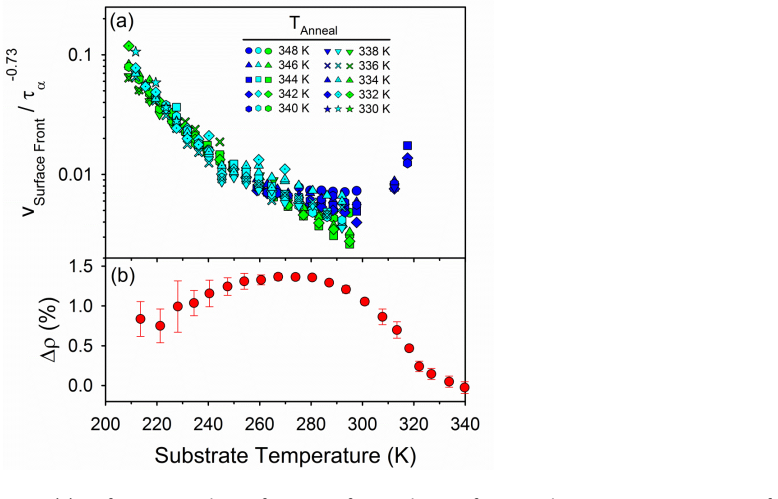
Vapor-deposited glasses of TPD transform via propagating fronts. The front velocity varies by over an order of magnitude with TSubstrate while the activation energy remains constant. Using dielectric spectroscopy the structural relaxation time of supercooled TPD is measured and shown to be independent of glass structure in setting thermal stability. Front velocities and their TSubstrate dependence are similar to those of model glassformers, indicating universal behavior.
What carries the argument
Propagating transformation fronts whose velocity is set independently by deposition substrate temperature and by the structural relaxation time of the supercooled liquid.
If this is right
- Front velocity can be tuned over an order of magnitude simply by changing substrate temperature during vapor deposition.
- Activation energy for front propagation is independent of the substrate temperature used to prepare the glass.
- Liquid mobility and glass structure control thermal stability as separate factors.
- Transformation behavior in TPD is quantitatively similar to that in model glassformers.
Where Pith is reading between the lines
- The observed separation implies that deposition temperature alters the packing or density of the glass in ways that change front speed without modifying the energy barrier for molecular rearrangement.
- If the pattern holds for other organic semiconductors it would supply a general rule for selecting deposition conditions to improve thermal endurance of active layers without altering their relaxation kinetics.
- The universality claim could be tested by repeating the front-velocity measurements on a second semiconductor whose molecular shape differs markedly from TPD.
Load-bearing premise
The spectroscopic ellipsometry signal combined with the high-throughput annealing protocol isolates the propagating front velocity without contributions from surface effects, thickness variations, or protocol artifacts.
What would settle it
A direct optical or calorimetric measurement that finds front velocities independent of TSubstrate or activation energies that change with TSubstrate would falsify the reported dependence and constancy.
Figures
read the original abstract
Vapor-deposited organic glasses can show enhanced kinetic stability relative to liquid-cooled glasses. When such stable glasses of model glassformers are annealed above the glass transition temperature Tg, they lose their thermal stability and transform into the supercooled liquid via constant velocity propagating fronts. In this work, we show that vapor-deposited glasses of an organic semiconductor, N,N-bis(3-methylphenyl)-N,N-diphenylbenzidine (TPD), also transform via propagating fronts. Using spectroscopic ellipsometry and a new high-throughput annealing protocol, we measure transformation front velocities for TPD glasses prepared with substrate temperatures (TSubstrate) from 0.63 to 0.96 Tg, at many different annealing temperatures. We observe that the front velocity varies by over an order of magnitude with TSubstrate, while the activation energy remains constant. Using dielectric spectroscopy, we measure the structural relaxation time of supercooled TPD. We find that the mobility of the liquid and the structure of the glass are independent factors in controlling the thermal stability of TPD films. In comparison to model glassformers, the transformation fronts of TPD have similar velocities and a similar dependence on TSubstrate, suggesting universal behavior. These results may aid in designing active layers in organic electronic devices with improved thermal stability.
Editorial analysis
A structured set of objections, weighed in public.
Referee Report
Summary. The paper claims that vapor-deposited stable glasses of the organic semiconductor TPD transform into the supercooled liquid via constant-velocity propagating fronts upon annealing above Tg. Spectroscopic ellipsometry combined with a new high-throughput annealing protocol measures front velocities for films deposited at TSubstrate ranging from 0.63 to 0.96 Tg; these velocities vary by more than an order of magnitude with TSubstrate while the activation energy remains constant. Dielectric spectroscopy determines the structural relaxation time of supercooled TPD, supporting the conclusion that liquid mobility and glass structure act as independent factors controlling thermal stability. The front velocities and TSubstrate dependence are reported to be similar to those of model glassformers, indicating universal behavior with implications for organic electronic devices.
Significance. If the front-velocity measurements are free of systematic artifacts, the work provides experimental evidence that the transformation mechanism observed in model glassformers extends to an organic semiconductor, with the independence of mobility and structure as a key result. The high-throughput protocol enabling measurements across many annealing temperatures and deposition conditions is a methodological strength that supports the reported trends.
major comments (1)
- [Methods (high-throughput annealing protocol)] Methods paragraph on the high-throughput annealing protocol and spectroscopic ellipsometry: the description does not detail controls or validation experiments that would rule out systematic contributions to the ellipsometry signal from surface layers, thickness variations, or protocol-induced effects that could vary with TSubstrate. Because the central claim of independent control by liquid mobility and glass structure rests on the observed >10x variation in front velocity at constant Ea, any such artifact would directly undermine the reported independence.
minor comments (2)
- [Abstract] The abstract states that front velocities 'vary by over an order of magnitude with TSubstrate' but does not specify the exact range or number of TSubstrate values measured; adding this detail would improve clarity.
- [Figures] Figure captions and legends should explicitly state the number of independent samples or runs used to determine each front velocity and activation energy to allow assessment of reproducibility.
Simulated Author's Rebuttal
We thank the referee for their careful reading of the manuscript and for the constructive comment. We agree that additional methodological details will strengthen the presentation of the high-throughput protocol and address potential concerns about systematic artifacts. We respond to the major comment below and will revise the manuscript accordingly.
read point-by-point responses
-
Referee: Methods paragraph on the high-throughput annealing protocol and spectroscopic ellipsometry: the description does not detail controls or validation experiments that would rule out systematic contributions to the ellipsometry signal from surface layers, thickness variations, or protocol-induced effects that could vary with TSubstrate. Because the central claim of independent control by liquid mobility and glass structure rests on the observed >10x variation in front velocity at constant Ea, any such artifact would directly undermine the reported independence.
Authors: We agree that the current methods description is insufficiently detailed on validation. In the revised manuscript we will expand the relevant section to include: (i) explicit checks that front velocities are independent of film thickness over the range used (0.5–2 μm), (ii) comparison of ellipsometry-derived front velocities with a subset of samples measured by atomic-force microscopy to confirm that surface-layer or optical artifacts do not dominate, and (iii) verification that the high-throughput annealing protocol itself does not introduce TSubstrate-dependent offsets by repeating a subset of measurements with a conventional single-sample protocol. These additions will directly support the claim that the observed order-of-magnitude variation in velocity at fixed activation energy reflects genuine differences in glass stability rather than measurement artifacts. revision: yes
Circularity Check
No circularity; experimental measurements only
full rationale
The paper reports direct experimental measurements of transformation front velocities via spectroscopic ellipsometry on vapor-deposited TPD films and structural relaxation times via dielectric spectroscopy. No equations, derivations, or fitted parameters are presented that reduce the reported velocities, activation energies, or independence conclusion to quantities defined from the same dataset. No self-citations are invoked as load-bearing for the central claims. The work is self-contained against external benchmarks as a set of independent physical measurements.
Axiom & Free-Parameter Ledger
axioms (2)
- domain assumption Ellipsometry signal change corresponds directly to the position of a sharp transformation front moving at constant velocity.
- domain assumption Dielectric relaxation time measured on the supercooled liquid is the relevant mobility metric for the front process.
Reference graph
Works this paper leans on
-
[1]
Angell, Science 267, 1924 (1995)
1 C.A. Angell, Science 267, 1924 (1995). 2 C.A. Angell, K.L. Ngai, G.B. McKenna, P.F. McMillan, and S.W. Martin, J. Appl. Phys. 88, 3113 (2000). 3 D. Yokoyama, J. Mater. Chem. 21, 19187 (2011). 4 K. Ishii and H. Nakayama, Phys. Chem. Chem. Phys. 16, 12073 (2014). 5 I. Lyubimov, M.D. Ediger, and J.J. de Pablo, J. Chem. Phys. 139, 144505 (2013). 6 S.F. Swal...
1924
-
[2]
Satija, Science 315, 353 (2007). 20 7 K. Dawson, L. Zhu, L.A. Kopff, R.J. McMahon, L. Yu, and M.D. Ediger, J. Phys. Chem. Lett. 2, 2683 (2011). 8 K. Ishii, H. Nakayama, R. Moriyama, and Y. Yokoyama, Bull. Chem. Soc. Jpn. 82, 1240 (2009). 9 H. Nakayama, K. Omori, K. Ino-u-e, and K. Ishii, J. Phys. Chem. B 117, 10311 (2013). 10 S.S. Dalal, A. Sepúlveda, G.K...
2007
discussion (0)
Sign in with ORCID, Apple, or X to comment. Anyone can read and Pith papers without signing in.