REVIEW 3 major objections 4 minor 3 references
Pushing the limits of one-dimensional NMR spectroscopy for automated structure elucidation using artificial intelligence
T0 review · 3 major / 4 minor · reviewed 2026-08-03 · deepseek-v4-flash
Pith's one-line read A transformer maps 1D 1H/13C NMR spectra to full molecular structure for molecules up to 40 heavy atoms, without needing the molecular formula, scoring 55.2% top-15 on simulated spectra and 19.9% on experimental spectra after light fine-tun
desk verdict Solid scale-up of 1D-NMR structure elucidation to 12 elements and 40 heavy atoms via Morgan-fingerprint pretraining, but the headline accuracy is a simulator-to-simulator number, not a real-world benchmark. read the letter →
The pith
A machine-rendered reading of the paper's core claim, the machinery that carries it, and where it could break.
The reading
What carries the argument
The load-bearing mechanism is pretraining on 'substructure-to-structure': translating a molecule's Morgan fingerprint (radius 2, 8,192 bits — a near-unique binary code for its circular substructure environments) back into its SMILES string. This forces the transformer to learn how fragments assemble into valid molecules, and those learned weights initialize the spectrum-to-structure branch. A convolutional embedding of the 1H NMR spectrum joined with a binned 13C vector then drives two output heads — an encoder–decoder for SMILES and an encoder-only head for substructure probabilities — making the whole pipeline ingest spectra with minimal preprocessing.
What would settle it
Resolve the accuracy discrepancy first: the posted abstract says 60.4% top-15, while the full-text abstract, main text, and conclusion say 55.2%; the headline claim is not fixed until these agree. Then run the released model on an independent set of experimental 1H/13C spectra from drug-like molecules not used in fine-tuning; top-15 accuracy near zero would show the simulated-to-experimental transfer promise does not hold.
Extended reading notes
Core claim
The central claim is that end-to-end spectrum-to-structure learning is feasible. In the authors' model, a convolutional embedding of the raw 1H NMR trace (28,000 points over −2 to 12 ppm) is concatenated with an 80-bin binned 13C peak vector; a transformer encoder–decoder emits the SMILES string, and an encoder-only head emits probabilities for roughly 2,800 substructures. The encoder–decoder is initialized from a transformer pretrained on 88 million compounds to invert Morgan fingerprints into SMILES, which the paper shows raises top-15 structure accuracy by 11.5 percentage points over random initialization. On a test set of roughly 200,000 simulated spectra, the correct canonical SMILES ap
Load-bearing premise
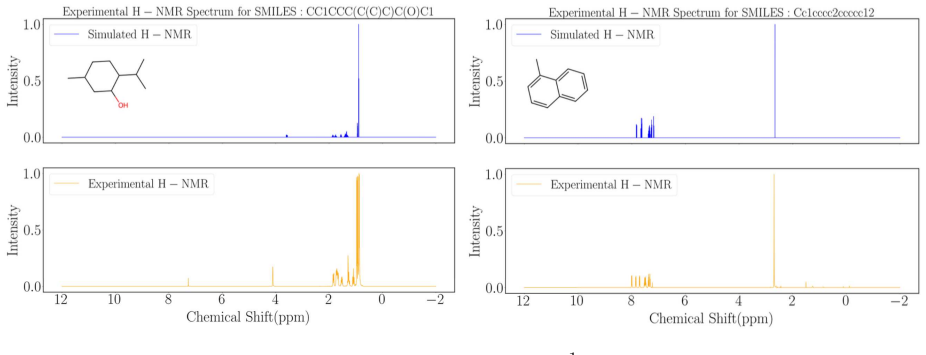
The load-bearing premise is that the vendor's batch NMR predictor produces simulated 1H and 13C spectra that are faithful enough to real instrument data that a model trained on two million simulations generalizes to experimental samples; the fine-tuning result (19.9% on 25 molecules) is too thin to verify this by itself.
Editorial extensions
If this is right
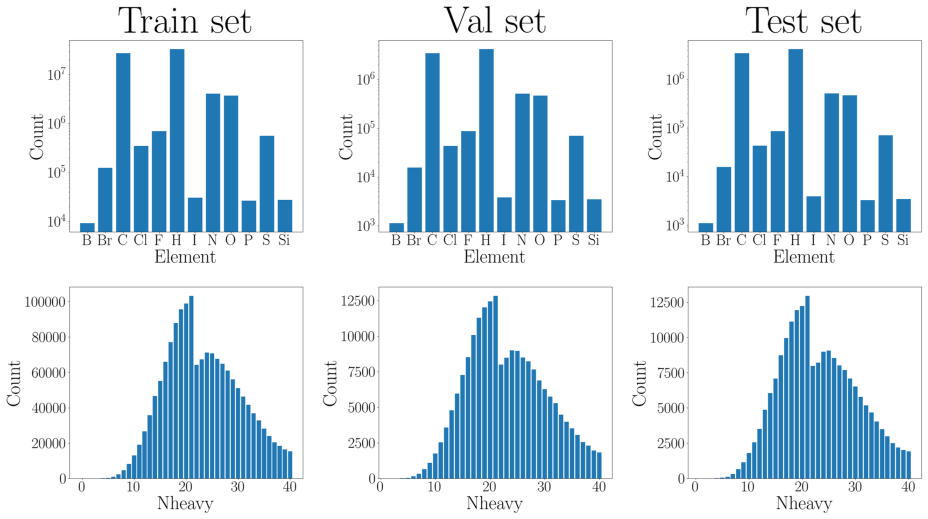
- The correct structure appears within the first 15 predictions 55.2% of the time on simulated spectra for molecules up to 40 heavy atoms across C, N, O, H, P, S, Si, B, and the halogens.
- Using only the 1H spectrum, top-15 accuracy remains 46.6%, so the method works when 13C acquisition is impractical.
- The pretrained substructure-to-structure transformer reconstructs molecules from Morgan fingerprints with 97.8% accuracy, and pretraining improves spectrum-to-structure accuracy by 11.5 percentage points.
- Substructure predictions reach an F1 of 0.84 and are highly confident (98.2% of predicted probabilities are >0.9 or <0.1), so the model can constrain candidate searches even when it misses the exact structure.
- Fine-tuning on 50 experimental spectra yields 19.9% top-15 accuracy on 25 held-out experimental molecules while keeping simulated-spectrum accuracy at 54.6%.
- The system generates predictions quickly (2.8 seconds on a CPU, 0.8 on a GPU), making it a practical candidate generator that can seed or accelerate search-based elucidation workflows.
Reading between the lines
- The 19.9% experimental result rests on only 25 test molecules; a reader should treat it as a proof of concept, not a validated deployment accuracy.
- A natural next experiment is to fine-tune on a larger, chemically diverse collection of experimental spectra and measure how accuracy grows with the number of real spectra, which would quantify how well the simulated pretraining transfers.
- Because stereochemistry is stripped from the SMILES strings, the model cannot distinguish enantiomers or diastereomers — a stated boundary for where a 1D-NMR-only tool will need help.
- The discrepancy between the posted abstract (60.4%) and the full-text abstract/main text/conclusion (55.2%) should be resolved before either figure is quoted as the headline result.
Editorial analysis
A structured set of objections, weighed in public.
Referee Report
Summary. The paper presents a transformer-based framework for automated structure elucidation from routine 1D 1H/13C NMR spectra. The model is pretrained on 88M PubChem molecules for the substructure-to-structure task (Morgan fingerprint to SMILES), then adapted to a multitask spectrum-to-structure/substructure model trained on 2M ACD/Labs-simulated spectra. On a simulated test set of ~200k molecules up to 40 heavy atoms spanning C, N, O, H, B, P, S, Si, F, Cl, Br, I, the authors report 55.2% top-15 structure accuracy (and 60.4% in the posted arXiv abstract). They further report that fine-tuning on 50 experimental BMRB spectra yields 19.9% top-15 accuracy on 25 held-out molecules. Code and data are released.
Significance. If the simulated-to-experimental transfer were convincingly demonstrated, this would be a substantial advance: an end-to-end 1D-NMR-to-structure method that avoids molecular-formula or 2D-NMR conditioning and covers a wide elemental and size range. The architecture and pretraining strategy are sensible, and the open release of code and data is a clear strength. I found no circularity in the training setup: the pretraining task (Morgan fingerprint to SMILES) and the downstream task (spectrum to SMILES) are distinct, and the splits avoid molecular leakage. However, the central quantitative claim is currently supported only on ACD/Labs-simulated spectra, and the experimental evidence is statistically thin. The paper also contains a mechanical but serious inconsistency between the abstract number (60.4%) and the rest of the text (55.2%). These issues prevent acceptance in the present form.
major comments (3)
- [Abstract vs. main text (headline accuracy)] The posted abstract reports "predicts the correct molecule with 60.4% accuracy within the first 15 predictions", while the article abstract, Results section, Table 1, and Conclusion all state 55.2%. This is an internal inconsistency in the paper's central quantitative claim and must be reconciled before publication.
- [Results, 'Molecule structure and substructure prediction...'; SI §3.5] The 55.2% headline accuracy is computed exclusively on spectra forward-simulated with the ACD/Labs v2024.2 predictors; the model is trained and tested on outputs of the same simulator. The only experimental evaluation is supervised fine-tuning on 50 BMRB spectra, evaluated on 25 test molecules, giving 19.9% top-15 accuracy (SI Table 6). The conclusion itself lists "bridging the gap between simulated and experimental data" as an open challenge. As written, the claim that the framework "achieves de novo structure elucidation from 1D NMR spectra" is not established for real experimental data; the manuscript should either provide an independent experimental benchmark on a larger set or explicitly scope the headline claim to simulated spectra.
- [SI §3.5, Table 6] The reported uncertainty 19.87 ± 0.59 is the standard error of the mean over 30 random-seed evaluations on a single fixed 25-molecule test split. It does not reflect split-to-split variability. For n = 25, the binomial standard error of a 19.9% proportion is approximately ±8 percentage points. The authors should report a confidence interval appropriate to the tiny test-set size, or provide multiple scaffold splits, before the 19.9% figure is used to support the extensibility claim.
minor comments (4)
- [Results, 'Molecule structure and substructure prediction...'] In the paragraph after Figure 3, "Similar to our observation in the spectrum-to-structure task" should read "substructure-to-structure task," since the comparison is with Figure 2.
- [SI §3.5.1] The phrase "collected at resolutions of 400 to 500 MHz" should specify that this refers to the 1H Larmor frequency; 13C frequency would be different.
- [References] Reference 42 (SPECTRE) is missing year/venue; please complete the citation.
- [Table 1] Consider adding binomial confidence intervals to the structure-accuracy column; the 13C-only row in particular would benefit from an uncertainty estimate.
Circularity Check
No significant circularity: the central spectrum-to-structure accuracy is an independent empirical benchmark on held-out molecules.
full rationale
The paper's derivation chain is empirical rather than definitional. The headline result (55.2% top-15 structure accuracy) is measured on a held-out test set of 201,953 molecules that were excluded from training by a no-leakage split, so the correct structure is not an input to the model. The spectrum-to-structure task is distinct from the Morgan-fingerprint-to-SMILES pretraining task; the pretrained weights are shown to help by an explicit ablation (55.2% with pretraining vs 43.7% without), rather than being assumed to transfer. The use of ACD/Labs-simulated spectra for both training and evaluation is a domain-fidelity limitation, not a circular reduction: the simulator is an external forward model, and the test molecules and their spectra are not used to fit the model's parameters. Self-citations (refs 21 and 45) are used for dataset reuse and comparison to the authors' previous model, not to justify the new claim. The paper also explicitly acknowledges that bridging simulated and experimental data remains a challenge, and it reports an honest small-scale experimental fine-tuning result (19.9% on 25 held-out BMRB spectra). The abstract's 60.4% vs the main text's 55.2% discrepancy is an internal inconsistency, not evidence of circularity. No load-bearing step reduces to its own input, and no prediction is a renamed fitted parameter.
Assumptions & free parameters
free parameters (6)
- Morgan fingerprint radius =
2
- Morgan fingerprint bit-vector size =
8192
- Top-k sampling k and number of predictions =
k=5, 15 predictions
- Substructure occurrence cutoff =
50 occurrences (0.0025% of molecules)
- Spectral input grids =
1H: 28,000 bins over -2..12 ppm; 13C: 80 bins over 3..231 ppm
- Fine-tuning unfrozen decoder layers =
3
assumptions (5)
- domain assumption ACD/Labs v2024.2 NMR predictor produces spectra faithful enough to experimental 1H/13C NMR for transfer learning.
- domain assumption PubChem, after filtering, is representative of drug-like chemical space and of the molecules for which the claim should hold.
- domain assumption Morgan fingerprints with radius 2 and 8192 bits are near-injective for the molecule set.
- domain assumption Structure elucidation can be reduced to constitution (connectivity) because stereochemistry is removed from all SMILES strings.
- domain assumption Top-15 sampling with k=5 and T=1.0 is a meaningful operationalization of 'predicting the molecule'.
Cite this review
Pith. "Pith review of Pushing the limits of one-dimensional NMR spectroscopy for automated structure elucidation using artificial intelligence." pith.science (2026). https://pith.science/paper/2D6U3UYY
@misc{pith2026251218531,
  author       = {Pith},
  title        = {Pith review of: Pushing the limits of one-dimensional NMR spectroscopy for automated structure elucidation using artificial intelligence},
  year         = {2026},
  howpublished = {\url{https://pith.science/paper/2D6U3UYY}},
  note         = {Machine review of arXiv:2512.18531}
}
abstract
One-dimensional NMR spectroscopy is one of the most widely used techniques for the characterization of organic compounds and natural products. For molecules with up to 36 non-hydrogen atoms, the number of possible structures has been estimated to range from $10^{20} - 10^{60}$. The task of determining the structure (formula and connectivity) of a molecule of this size using only its one-dimensional $^1$H and/or $^{13}$C NMR spectrum, i.e. de novo structure generation, thus appears completely intractable. Here we show how it is possible to achieve this task for systems with up to 40 non-hydrogen atoms across the full elemental coverage typically encountered in organic chemistry (C, N, O, H, P, S, Si, B, and the halogens) using a deep learning framework, thus covering a vast portion of the drug-like chemical space. Leveraging insights from natural language processing, we show that our transformer-based architecture predicts the correct molecule with 60.4% accuracy within the first 15 predictions using only the $^1$H and $^{13}$C NMR spectra, thus overcoming the combinatorial growth of the chemical space while also being extensible to experimental data via fine-tuning.
Figures


Figures from the paper (13 more)






Reference graph
Works this paper leans on
-
[1]
N.; Kaiser, L.; Polosukhin, I
(1) Vaswani, A.; Shazeer, N.; Parmar, N.; Uszkoreit, J.; Jones, L.; Gomez, A. N.; Kaiser, L.; Polosukhin, I. Attention Is All You Need. 2017, Publisher: arXiv Version Number:
2017
-
[3]
G.; Madzhidov, T
(13) Polishchuk, P. G.; Madzhidov, T. I.; Varnek, A. Estimati on of the size of drug-like chemical space based on GDB-17 data. Journal of Computer-Aided Molecular Design 2013, 27, 675–679. (14) Fink, T.; Reymond, J.-L. Virtual Exploration of the Chemic al Universe up to 11 Atoms of C, N, O, F: Assembly of 26.4 Million Structures (110.9 Millio n Stereoisom...
2013
-
[7]
(2) Rogers, D.; Hahn, M. Extended-Connectivity Fingerprints . Journal of Chemical Infor- mation and Modeling 2010, 50, 742–754. (3) Schwaller, P.; Gaudin, T.; L´ anyi, D.; Bekas, C.; Laino, T. “Found in Translation”: predicting outcomes of complex organic chemistry reaction s using neural sequence-to- sequence models. Chemical Science 2018, 9, 6091–6098. ...
arXiv 2010
Reviewed August 3, 2026 · model on record in the stance chip above.
Discussion (0). Sign in to comment.