REVIEW 5 minor 50 references
Quantum optics with single spins
T0 review · 0 major / 5 minor · reviewed 2026-08-14 · deepseek-v4-flash
Pith's one-line read The chapter claims that coherent dispersive light-matter coupling, described by the Jaynes-Cummings Hamiltonian, is the common origin of both the Faraday effect and the optical Stark effect in single solid-state spins.
desk verdict A clear, honest review chapter that re-derives Faraday and optical Stark effects for NV centers from the Jaynes-Cummings Hamiltonian; no new results, but the pedagogy is sound and the claims are no stronger than the cited experiments. read the letter →
The pith
A machine-rendered reading of the paper's core claim, the machinery that carries it, and where it could break.
The reading
What carries the argument
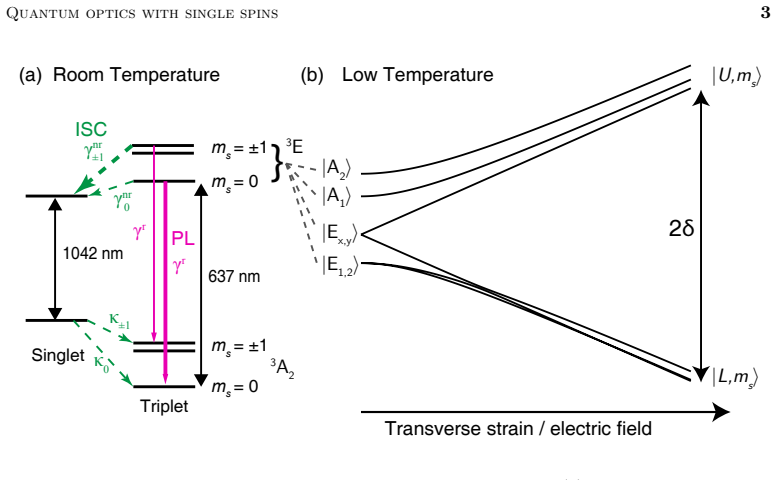
The load-bearing object is the Jaynes-Cummings Hamiltonian $\hat{H}_{\mathrm{JC}}^{(j)} = E_{\mathrm{ph}}\hat a^\dagger\hat a + E_j \hat\sigma_z^{(j)}/2 + (\hbar\Omega_0/2)(\hat a\hat\sigma_+^{(j)} + \hat a^\dagger\hat\sigma_-^{(j)})$ in the basis of polariton states $|g_j,n+1\rangle$ and $|e_j,n\rangle$. Diagonalization gives the dispersive energy shift $\varepsilon_g(n,\Delta_j) = (\hbar\Delta_j/2)[\sqrt{1+\Omega_0^2/\Delta_j^2}-1]$, which, integrated over the pulse duration $\tau$, becomes the spin-dependent phase per photon $D/\Delta_j$. Tracing out the light leaves a spin rotation, while tracing out the spin leaves a light phase shift; the same constant $D$ appears in both, which is what unifies the Faraday and optical Stark effects. A Schrieffer-Wolff effective Hamiltonian for the strain-split excited state and a five-level Lindblad model for the $\Lambda$ system carry the all-optical control protocols.
What would settle it
Measure the Faraday phase shift and the optical-Stark rotation on the same spin transition while sweeping detuning from far-detuned through resonance, and compare both lineshapes to Eqs. (51) and (52) using the same fitted $\Omega_0$ and $\Gamma_j$. If the phase-shift lineshape is not the odd Lorentzian required by Kramers-Kronig, or if the ratio of Faraday phase to Stark rotation deviates from the predicted proportionality as $\Delta$ changes, the Jaynes-Cummings polariton account is falsified.
Extended reading notes
Core claim
The central claim is that coherent light-matter interaction for an individual solid-state spin is governed by the Jaynes-Cummings Hamiltonian, with the laser pulse playing the role of the cavity. In the dispersive limit $|\Delta_j|\gg \Omega_0$, each photon acquires a spin-dependent phase $\varphi_j = D/\Delta_j$ when the spin is in state $j$, and a coherent pulse rotates the spin by the accumulated phase $\langle n\rangle(\varphi_j-\varphi_k)$. This yields the Faraday effect in the transmitted light and the optical Stark effect on the spin, with $\Phi_{\mathrm{OSE}} = n \Phi_F$ in the far-detuned limit. The chapter further claims that the same polariton physics, extended to a $\Lambda$ configuration, produces dark states, coherent population trapping, and stimulated Raman transitions, so arbitrary single-qubit operations can be performed with light; and that with ultrafast pulses, free evolution under the excited-state Hamiltonian generates spin rotations at rates near 260 MHz, approaching microwave control speeds.
Load-bearing premise
The load-bearing premise is that each laser pulse has a smooth adiabatic turn-on, propagates as a single spatial mode with a well-defined phase, and has negligible spontaneous emission, spectral hopping, and laser noise during the interaction; if those conditions fail, the phase formulas and the predicted proportionality between the Faraday and optical Stark effects need correction.
Editorial extensions
If this is right
- A single NV-center spin can be initialized, coherently controlled, and projectively read out using only light, without microwaves, through CPT initialization and SRT rotations.
- The Faraday measurement is in principle non-destructive: the absorption falls as $1/\Delta^2$, while the phase shift falls as $1/|\Delta|$; in an optical cavity, the enhanced phase shift could allow spin readout without reinitialization.
- Because the control only requires a $\Lambda$ configuration, the protocols transfer to other defects, such as silicon-vacancy centers and silicon carbide impurities, including systems without an intersystem crossing.
- The relation $\Phi_{\mathrm{OSE}} = n \Phi_F$ lets one calibrate spin rotation and optical phase shift against each other using the same detuning-dependent constant $D$.
- Ultrafast optical pulses bypass the dispersive approximation and use excited-state spin-orbit evolution directly, giving measured Rabi frequencies near 260 MHz and $\pi$-rotations in about 1.9 ns.
Reading between the lines
- An editorial extension: if a single constant $D$ controls both the Faraday and optical Stark signals, a high-precision measurement of their ratio versus photon number would be a direct test of the coherent-state polariton model and a sensitive probe of decoherence during the pulse.
- The chapter notes cavity-coupled silicon-vacancy spins but does not work out a two-spin gate; extending the same dispersive Hamiltonian to two defects in one cavity suggests a natural route to entangling operations, not just readout.
- The adiabatic turn-on assumption implies that pulse shaping should matter: comparing smooth and abrupt pulse envelopes at fixed area would quantify non-adiabatic corrections to the phase formulas.
- The time-domain quantum tomography technique described for the NV excited-state Hamiltonian could also map tunable strain and electric-field Hamiltonians in other defects, turning it into a general tool for choosing optimal control operating points.
Signed reviews
Editorial analysis
A structured set of objections, weighed in public.
Referee Report
Summary. This manuscript is a lecture/review chapter, based on the author's 2018 Enrico Fermi School lectures, that presents a pedagogical account of quantum optics with single solid-state spins, using the diamond nitrogen-vacancy (NV) center as the central example. Section 2 reviews the NV electronic structure and derives effective excited-state Hamiltonians in the low- and high-strain regimes via a Schrieffer-Wolff transformation. Section 3 derives the Jaynes-Cummings polariton picture and uses it to unify the Faraday effect and the optical Stark effect as two manifestations of the same dispersive light-matter interaction, with quantitative comparisons to the experiments of Ref. [1]. Section 4 extends the treatment to Lambda systems, covering coherent population trapping, stimulated Raman transitions, and all-optical initialization, control, and readout following Ref. [2]. Section 5 describes an alternative ultrafast, non-dispersive approach to spin control and time-domain quantum tomography following Ref. [3]. The manuscript explicitly states that much of the material is adapted from Refs. [1]-[3], and it carefully lists the assumptions (adiabatic pulse turn-on, single-mode propagation, neglect of spontaneous emission and spectral noise) and practical limitations (small Faraday phase without a cavity, dual-Lambda constraints on stimulated Raman transition speed).
Significance. If the derivation is taken as a review statement, the chapter is a valuable pedagogical resource. Its main strength is that it derives the Faraday phase and the optical Stark rotation from a single polariton energy-shift calculation, making the proportionality Phi_OSE = n Phi_F (Eq. (49)) and the lineshape comparison in Fig. 2(c) transparent. The standard Jaynes-Cummings calculation is carried out carefully, and the comparison with the published data of Refs. [1]-[3] is concrete. The text is honest about the conditions under which the derivation holds: Section 3.1 states the adiabatic and decoherence-free assumptions; Section 3.3 quantifies the smallness of the nondispersive phase; and Section 5 explicitly discusses the dual-Lambda limitation on the fidelity and speed of the stimulated Raman approach. Because the chapter is a review of published work and openly credits the original sources, there is no novelty or circularity concern. The main weakness is the imprecise treatment of the reduced spin density matrix in Section 3.2, which is local and does not affect the central conclusions.
minor comments (5)
- [3.2, Eqs. (44)-(45)] The expression labeled rho_spin is defined as <alpha|rho|alpha>, which is a conditional projection onto the original coherent state rather than the reduced spin state Tr_light(rho). The exact partial trace yields off-diagonal elements proportional to exp[-|alpha|^2(1-cos(phi_j-phi_k))] e^{i|alpha|^2 sin(phi_j-phi_k)}, so the real dephasing factor in Eq. (45) is off by a factor of two relative to the correct result. The subsequent linearization in Eq. (47) retains only the leading phase, so the central Faraday/Stark relations are unaffected, but the derivation should be corrected for rigor.
- [3.1, Eq. (27)] In Eq. (27), the n-dependence of Omega_0 is stated to enter through the field amplitude, but the Jaynes-Cummings matrix element in the basis of Eq. (26) involves sqrt(n+1), not sqrt(n). The authors should state explicitly that they neglect the difference between n and n+1, or redefine Omega_0(n) accordingly, since this is a notational shortcut that could confuse readers.
- [3.2, after Eq. (47)] The condition under which the pure-state approximation for the spin is valid, namely |alpha|^2 (phi_j-phi_k)^2 << 1 for the relevant pairs, is not stated; adding this inequality would make the domain of validity of Eq. (48) quantitative.
- [4.3 and Section 2.1 (typos)] There are typographical errors such as 'dissipate' for 'dissipate' in Section 4.3 and 'diagmagnetic' for 'diamagnetic' in Section 2.1; a careful proofreading pass is recommended.
- [Fig. 2(c)] The text compares Eq. (50) to the data in Fig. 2(c) and states that extracted parameter values are obtained, but it does not specify the fitting procedure or the error bars on the extracted parameters; one or two sentences on this would improve reproducibility.
Circularity Check
No significant circularity; the polariton-based derivation is self-contained and the fitted parameters are presented as extractions, not predictions.
full rationale
The paper is a review/lecture chapter whose central derivation starts from the textbook Jaynes-Cummings Hamiltonian and obtains the dispersive phase shifts, Faraday effect, and optical Stark effect as derived consequences. The eigenenergy expression in Eq. (27) leads to the accumulated phase in Eq. (31), then to the Faraday phase in Eq. (43) and the spin-state phase in Eq. (48); the proportionality in Eq. (49) follows algebraically from those expressions. No equation is defined in terms of the quantity it is supposed to predict. The experimental parameters F_j, Γ_j, and Ω0 in Section 3.2 are explicitly described as extracted from data ('we extract experimental values'), so they are fits rather than predictions claimed from the model. The self-citations to Refs. [1–3] are used to credit the original experiments and models, not to provide an unexamined load-bearing premise; the derivation in the chapter is independent of those papers. The modeling assumptions (adiabatic turn-on, single-mode field, neglect of decoherence) are stated assumptions, not circular inputs. The minor technical point that Eq. (45) projects onto 〈α| rather than performing a full partial trace affects only the dephasing prefactor, not the optical-Stark phase, and in any case does not constitute circularity. No uniqueness theorem, ansatz-via-citation, or renaming of an empirical pattern is used to force the conclusions. The derivation is therefore self-contained, with no circular step that reduces an output to an input.
Assumptions & free parameters
free parameters (7)
- Debye-Waller factor F_DW =
0.04 +/- 0.01
- Phase-per-photon scale D/2pi =
approx 10 kHz
- Faraday amplitude F_0 =
2pi*6.9 urad.GHz
- Absorption width Gamma_0 =
2pi*140 MHz
- Faraday amplitude F_-1 =
2pi*7.6 urad.GHz
- Absorption width Gamma_-1 =
2pi*300 MHz
- Optical Rabi frequency Omega_0 =
2pi*70 MHz
assumptions (5)
- standard math Jaynes-Cummings model with rotating-wave approximation is valid for the NV optical transition.
- domain assumption The optical pulse can be described as a single-mode coherent state with a cavity defined by the pulse duration, with adiabatic turn-on and no spontaneous emission or spectral diffusion.
- domain assumption The NV excited-state Hamiltonian has the symmetry-allowed form of Eq. (2) with spin-orbit, spin-spin, Zeeman, diamagnetic, and strain terms.
- domain assumption The strain splitting 2delta dominates over other couplings, justifying the Schrieffer-Wolff expansion to lowest order in 1/delta.
- standard math Kramers-Kronig relation links the Faraday lineshape to the absorption resonance.
Cite this review
Pith. "Pith review of Quantum optics with single spins." pith.science (2026). https://pith.science/paper/2DQPKAZF
@misc{pith2026190805566,
  author       = {Pith},
  title        = {Pith review of: Quantum optics with single spins},
  year         = {2026},
  howpublished = {\url{https://pith.science/paper/2DQPKAZF}},
  note         = {Machine review of arXiv:1908.05566}
}
read the original abstract
Defects in solids are in many ways analogous to trapped atoms or molecules. They can serve as long-lived quantum memories and efficient light-matter interfaces. As such, they are leading building blocks for long-distance quantum networks and distributed quantum computers. This chapter describes the quantum-mechanical coupling between atom-like spin states and light, using the diamond nitrogen-vacancy (NV) center as a paradigm. We present an overview of the NV center's electronic structure, derive a general picture of coherent light-matter interactions, and describe several methods that can be used to achieve all-optical initialization, quantum-coherent control, and readout of solid-state spins. These techniques can be readily generalized to other defect systems, and they serve as the basis for advanced protocols at the heart of many emerging quantum technologies.
Figures


Figures from the paper (3 more)


Reference graph
Works this paper leans on
-
[1]
Buckley B. B., Fuchs G. D., Bassett L. C. and Awschalom D. D., Science, 330 (2010) 1212
work page 2010
-
[2]
Yale C. G., Buckley B. B., Christle D. J., Burkard G., Heremans F. J., Bassett L. C. and Awschalom D. D., Proc. Natl. Acad. Sci. U.S.A., 110 (2013) 7595. Quantum optics with single spins 29
work page 2013
-
[3]
Bassett L. C., Heremans F. J., Christle D. J., Yale C. G., Burkard G., Buckley B. B. and Awschalom D. D., Science, 345 (2014) 1333
work page 2014
-
[4]
Doherty M. W., Manson N. B., Delaney P., Jelezko F., Wrachtrup J. and Hollenberg L. C., Phys. Rep., 528 (2013) 1
work page 2013
-
[5]
Hopper D. A., Shulevitz H. J. and Bassett L. C. , Micromachines, 9 (2018) 437
work page 2018
-
[6]
Fu K.-M. C., Santori C., Barclay P. E., Rogers L. J., Manson N. B. and Beausoleil R. G., Phys. Rev. Lett., 103 (2009) 256404
work page 2009
-
[7]
Batalov A., Jacques V., Kaiser F., Siyushev P., Neumann P., Rogers L. J., McMurtrie R. L., Manson N. B., Jelezko F. and Wrachtrup J., Phys. Rev. Lett., 102 (2009) 195506
work page 2009
-
[8]
Robledo L., Bernien H., van Weperen I. and Hanson R., Phys. Rev. Lett. , 105 (2010) 177403
work page 2010
Show all 50 references
-
[9]
R., Gali A., Togan E., Chu Y., Trifonov A., Kaxiras E
Maze J. R., Gali A., Togan E., Chu Y., Trifonov A., Kaxiras E. and Lukin M. D., New J. Phys. , 13 (2011) 025025
2011
-
[10]
W., Manson N
Doherty M. W., Manson N. B., Delaney P. and Hollenberg L. C. L., New J. Phys., 13 (2011) 025019
2011
-
[11]
and Krausz E., J
Reddy N., Manson N. and Krausz E., J. Lumin., 38 (1987) 46
1987
-
[12]
J., McMurtrie R
Rogers L. J., McMurtrie R. L., Sellars M. J. and Manson N. B. , New Journal of Physics , 11 (2009) 063007
2009
-
[13]
C., Heremans F
Bassett L. C., Heremans F. J., Yale C. G., Buckley B. B.and Awschalom D. D., Phys. Rev. Lett., 107 (2011) 266403
2011
-
[14]
S., Robledo L., Taminiau T
Bernien H., Hensen B., Pfaff W., Koolstra G., Blok M. S., Robledo L., Taminiau T. H., Markham M., Twitchen D. J., Childress L. and Hanson R., Nature, 497 (2013) 86
2013
-
[15]
F., Dimmock J
Koster G. F., Dimmock J. O., Wheeler R. G. and Statz H., Properties of the thirty-two point groups (MIT Press) 1963
1963
-
[16]
and Lukin M
Togan E., Chu Y., Imamoglu A. and Lukin M. D., Nature, 478 (2011) 497
2011
-
[17]
Yang S., Wang Y., Rao D. D. B., Hien Tran T., Momenzadeh A. S., MarkhamM., J. T., Wang P., Yang W., St ¨ohr R., Neumann P., Kosaka H. and Wrachtrup J., Nature Photonics, 10 (2016) 507
2016
-
[18]
S., Jiang L., Maze J., Childress L., Dutt M
Togan E., Chu Y., Trifonov A. S., Jiang L., Maze J., Childress L., Dutt M. V. G., Sorensen A. S., Hemmer P. R., Zibrov A. S. and Lukin M. D. , Nature, 466 (2010) 730. 30 Lee C. Bassett
2010
-
[19]
Gerry C. C. and Knight P. L. , Introductory Quantum Optics (Cambridge Uni- versity Press: Cambridge) 2005
2005
-
[20]
and Gu´ery-Odelin D., Advances in atomic physics: An overview (World Scientific: Annals of the Academy of Medicine, Singapore) 2011
Cohen-Tannoudji C. and Gu´ery-Odelin D., Advances in atomic physics: An overview (World Scientific: Annals of the Academy of Medicine, Singapore) 2011
2011
-
[21]
Davies G., Journal of Physics C: Solid State Physics , 7 (1974) 3797
1974
-
[22]
T., Thomaz M
Collins A. T., Thomaz M. F. and Jorge M. I. B., Journal of Physics C: Solid State Physics, 16 (1983) 2177
1983
-
[23]
Blais A., Huang R.-S., Wallraff A., Girvin S. M. and Schoelkopf R. J., Phys. Rev. A , 69 (2004) 062320
2004
-
[24]
E., Sukachev D
Sipahigil A., Evans R. E., Sukachev D. D., Burek M. J., Borregaard J., Bhaskar M. K., Nguyen C. T., Pacheco J. L., Atikian H. A., Meuwly C., Camacho R. M., Jelezko F., Bielejec E., Park H., Lon ˇcar M. and Lukin M. D., Science, 354 (2016) 847
2016
-
[25]
E., Bhaskar M
Evans R. E., Bhaskar M. K., Sukachev D. D., Nguyen C. T., Sipahigil A., Burek M. J., Machielse B., Zhang G. H., Zibrov A. S., Bielejec E., Park H., Lonˇcar M. and Lukin M. D., Science, 362 (2018) 662
2018
-
[26]
and Orriols G
Alzetta G., Gozzini A., Moi L. and Orriols G. , Il Nuovo Cimento B , 36 (1976) 5
1976
-
[27]
R., Whitley R
Gray H. R., Whitley R. M. and Stroud C. R., Opt. Lett., 3 (1978) 218
1978
-
[28]
and Wood C., Fortschritte der Physik, 46 (1999) 363
Wineland D., Monroe C., Itano W., King B., Leibfried D., Meekhof D., Myatt C. and Wood C., Fortschritte der Physik, 46 (1999) 363
1999
-
[29]
R., Steel D
Xu X., Sun B., Berman P. R., Steel D. G., Bracker A. S., Gammon D. and Sham L. J., Nature Physics, 4 (2008) 692
2008
-
[30]
R., Dutton Z., Schlafer J., Mookerji B., Ohki T
Kelly W. R., Dutton Z., Schlafer J., Mookerji B., Ohki T. A., Kline J. S. and Pappas D. P., Phys. Rev. Lett., 104 (2010) 163601
2010
-
[31]
and Harris S
Boller K.-J., Imamo˘glu A. and Harris S. E., Phys. Rev. Lett., 66 (1991) 2593
1991
-
[32]
F., Rochester S
Budker D., Kimball D. F., Rochester S. M. and Yashchuk V. V. , Phys. Rev. Lett., 83 (1999) 1767
1999
-
[33]
Vanier J., Appl. Phys. B , 81 (2005) 421
2005
-
[34]
T., Henderson M
Harley R. T., Henderson M. J. and Macfarlane R. M., Journal of Physics C: Solid State Physics , 17 (1984) L233
1984
-
[35]
R., Turukhin A
Hemmer P. R., Turukhin A. V., Shahriar M. S. and Musser J. A. , Opt. Lett., 26 (2001) 361. Quantum optics with single spins 31
2001
-
[36]
G., Rabeau J., Olivero P., Greentree A
Santori C., Tamarat P., Neumann P., Wrachtrup J., Fattal D., Beau- soleil R. G., Rabeau J., Olivero P., Greentree A. D., Prawer S., Jelezko F. and Hemmer P., Phys. Rev. Lett., 97 (2006) 247401
2006
-
[37]
Robledo L., Childress L., Bernien H., Hensen B., Alkemade P. F. A. and Hanson R., Nature, 477 (2011) 574
2011
-
[38]
J., Jahnke K
Rogers L. J., Jahnke K. D., Metsch M. H., Sipahigil A., Binder J. M., Teraji T., Sumiya H., Isoya J., Lukin M. D., Hemmer P. and Jelezko F., Phys. Rev. Lett., 113 (2014) 263602
2014
-
[39]
N., Schulte C
Pingault B., Becker J. N., Schulte C. H. H., Arend C., Hepp C., Godde T., Tartakovskii A. I., Markham M., Becher C. and Atat¨ure M. , Phys. Rev. Lett., 113 (2014) 263601
2014
-
[40]
F., Diler B., Whiteley S
Koehl W. F., Diler B., Whiteley S. J., Bourassa A., Son N. T., Janz ´en E. and Awschalom D. D., Phys. Rev. B , 95 (2017) 035207
2017
-
[41]
D., Dobrovitski V
Fuchs G. D., Dobrovitski V. V., Toyli D. M., Heremans F. J. and Awschalom D. D., Science, 326 (2009) 1520
2009
-
[42]
G., Heremans F
Yale C. G., Heremans F. J., Zhou B. B., Auer A., Burkard G. and Awschalom D. D., Nature Photonics, 10 (2016) 184
2016
-
[43]
B., Baksic A., Ribeiro H., Yale C
Zhou B. B., Baksic A., Ribeiro H., Yale C. G., Heremans F. J., Jerger P. C., Auer A., Burkard G., Clerk A. A. and Awschalom D. D., Nature Physics, 13 (2017) 330
2017
-
[44]
B., Jerger P
Zhou B. B., Jerger P. C., Shkolnikov V. O., Heremans F. J., Burkard G. and Awschalom D. D., Phys. Rev. Lett., 119 (2017) 140503
2017
-
[45]
D., Press D., McMahon P
Greve K. D., Press D., McMahon P. L. and Yamamoto Y. , Reports on Progress in Physics, 76 (2013) 092501
2013
-
[46]
N., G ¨orlitz J., Arend C., Markham M
Becker J. N., G ¨orlitz J., Arend C., Markham M. and Becher C., Nature Communications, 7 (2016) 13512
2016
-
[47]
N., Pingault B., Groß D., G ¨undo˘gan M., Kukharchyk N., Markham M., Edmonds A., Atat ¨ure M., Bushev P
Becker J. N., Pingault B., Groß D., G ¨undo˘gan M., Kukharchyk N., Markham M., Edmonds A., Atat ¨ure M., Bushev P. and Becher C., Phys. Rev. Lett., 120 (2018) 053603
2018
-
[48]
J., Klimov P
Christle D. J., Klimov P. V., de las Casas C. F., Sz ´asz K., Iv ´ady V., Jokubavicius V., Ul Hassan J., Syv ¨aj¨arvi M., Koehl W. F., Ohshima T., Son N. T., Janz´en E., Gali A. and Awschalom D. D., Phys. Rev. X, 7 (2017) 021046
2017
-
[49]
and Wrachtrup J
Atat¨ure M., Englund D., Vamivakas N., Lee S.-Y. and Wrachtrup J. , Nature Reviews Materials, 3 (2018) 38. 32 Lee C. Bassett
2018
-
[50]
D., Hanson R., Wrachtrup J
Awschalom D. D., Hanson R., Wrachtrup J. and Zhou B. B., Nature Pho- tonics, 12 (2018) 516
2018
Reviewed August 14, 2026 · model on record in the stance chip above.
Discussion (0). Continue with ORCID to comment.