An Interpretable CF-RL-TOPSIS Fusion Model for Skills-Aware Talent Recommendation
Pith reviewed 2026-06-30 14:17 UTC · model grok-4.3
The pith
A late-fusion model combining collaborative filtering, reinforcement learning and TOPSIS improves talent recommendations on one benchmark while remaining competitive on another through auditable branch weights.
A machine-rendered reading of the paper's core claim, the machinery that carries it, and where it could break.
Core claim
The CF-RL-TOPSIS model integrates three branches whose validation-selected fusion coefficients remain auditable, and on JobHop it significantly surpasses multiple baselines while on Karrierewege the adaptive branch correctly becomes inactive, showing the architecture adapts to different regimes through its collaborative backbone.
What carries the argument
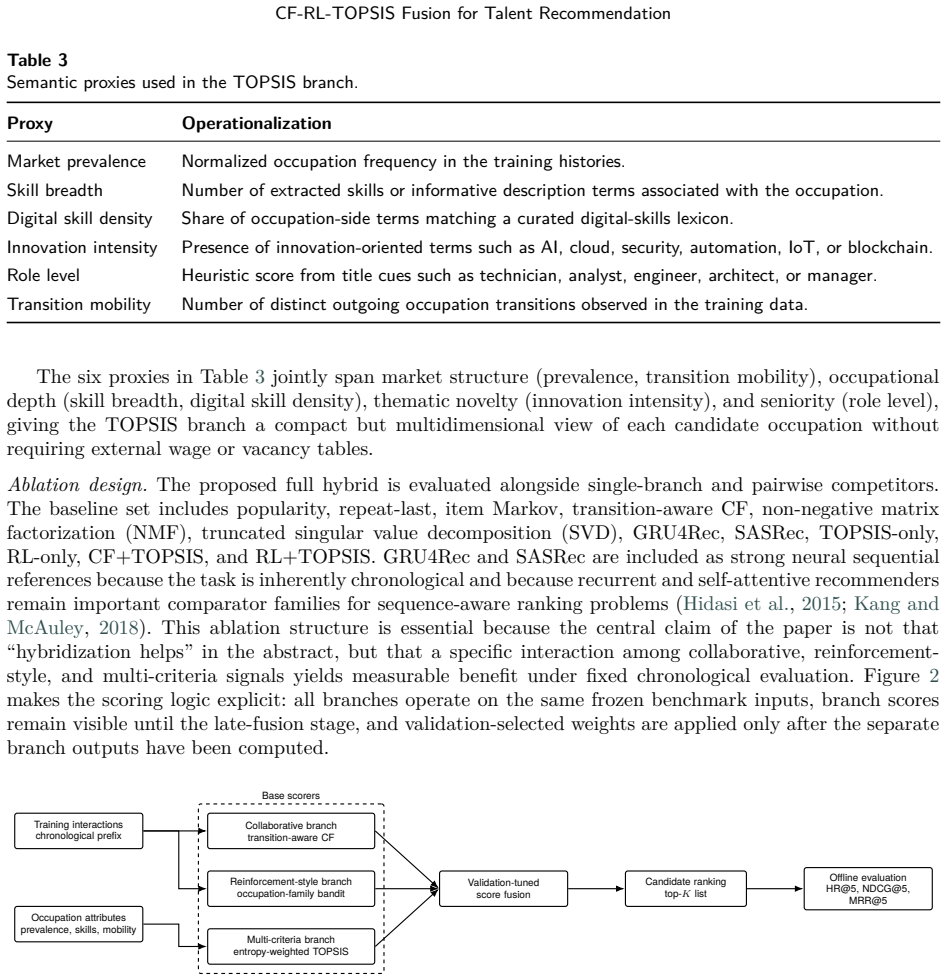
The CF-RL-TOPSIS late-fusion architecture that combines transition-aware collaborative filtering, a compact reinforcement-style occupation-family bandit, and an entropy-weighted TOPSIS branch constructed from six semantic proxies, with validation-selected fusion coefficients.
If this is right
- In semantically rich talent-history settings the three branches reinforce one another to improve ranking quality.
- In persistence-dominated regimes the same model remains competitive by relying on its collaborative filtering component.
- Branch scores, criterion weights, and rank shifts can be inspected for individual recommendations.
- Proxy-sensitivity and family-level deep Q-network checks support the interpretation of when each branch contributes.
Where Pith is reading between the lines
- Similar late-fusion approaches could be tested in other recommendation domains where interpretability is required alongside performance.
- The use of frozen benchmarks allows direct comparison but may limit claims about generalization to live systems.
- Extending the semantic proxies or bandit to other domains might reveal additional conditions for fusion value.
Load-bearing premise
The validation-selected fusion coefficients and the six semantic proxies in the TOPSIS branch produce stable, auditable rankings that generalize beyond the two frozen benchmarks without post-hoc adjustment.
What would settle it
A new talent-history benchmark where the hybrid model fails to match or exceed the strongest baseline or where the selected fusion weights lead to unstable rankings.
Figures
read the original abstract
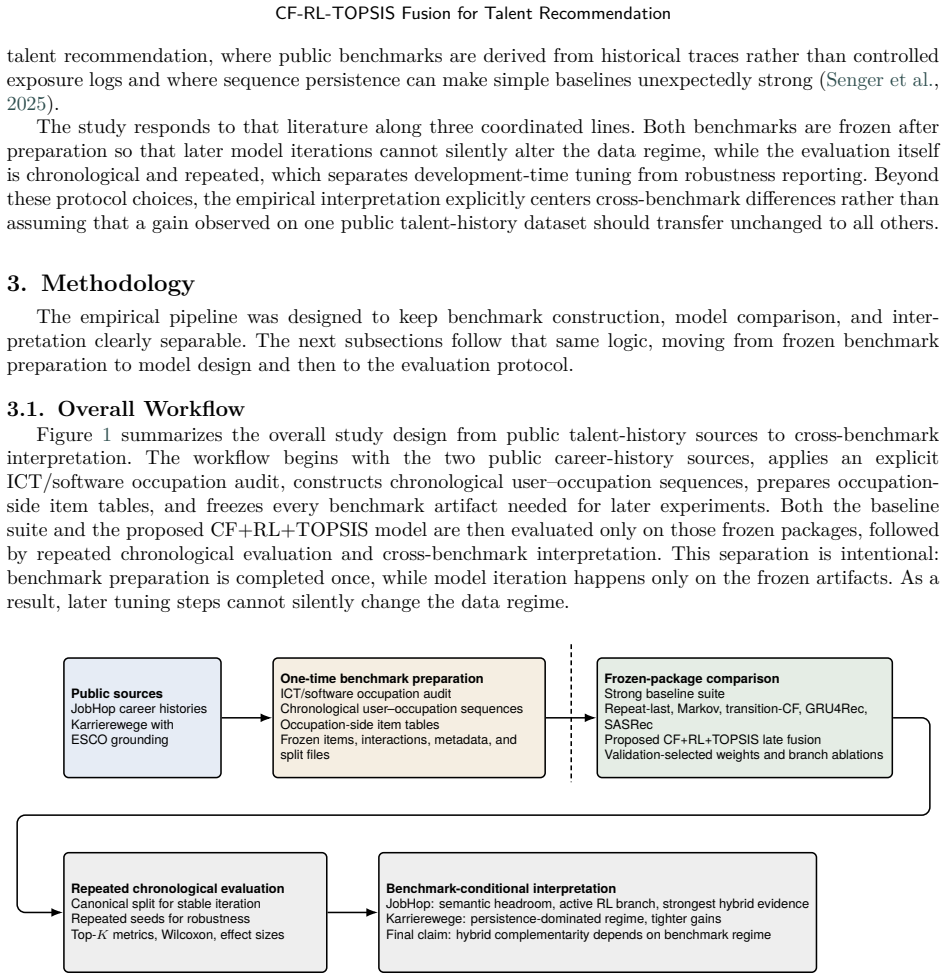
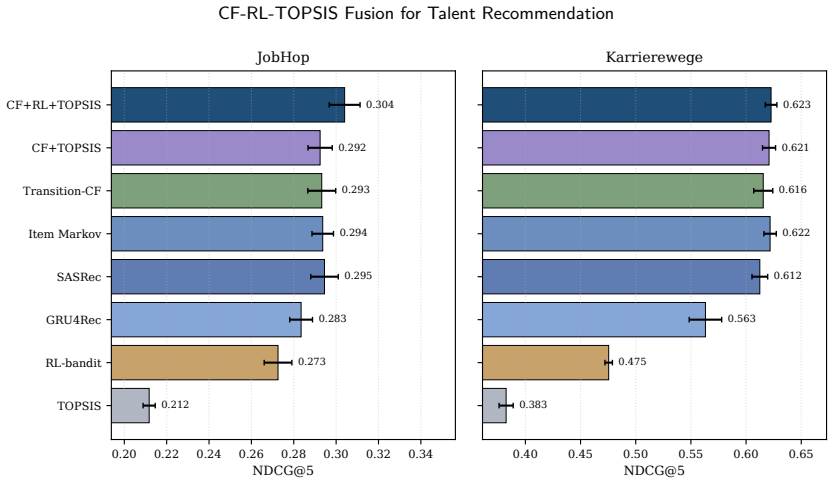
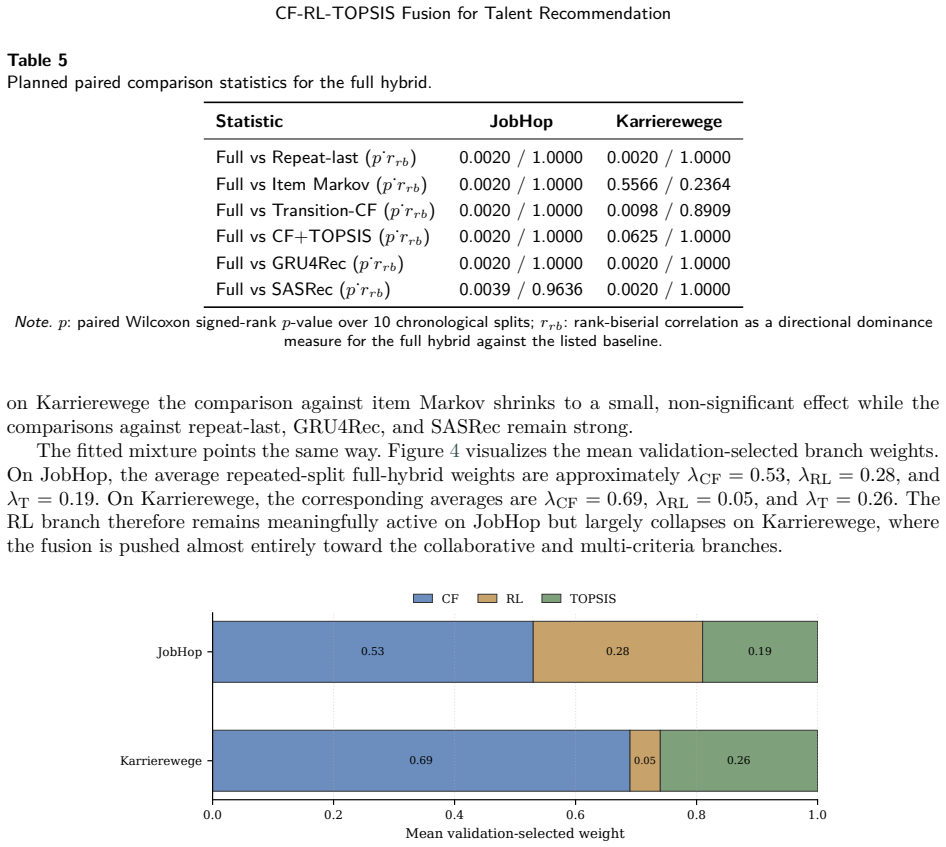
Effective skills-aware talent recommendation must balance behavioral transition patterns, trajectory-sensitive adaptation, and inspectable occupation-level criteria. Evidence from public benchmarks on how these signals interact, however, remains limited. This study proposes CF-RL-TOPSIS, an interpretable late-fusion model that integrates a transition-aware collaborative branch, a compact reinforcement-style occupation-family bandit, and an entropy-weighted TOPSIS branch constructed from six semantic proxies; the validation-selected fusion coefficients remain auditable. The model is evaluated on two frozen public ICT talent-history benchmarks, JobHop and Karrierewege, using repeated chronological top-5 ranking and paired Wilcoxon tests. On JobHop the full hybrid attains NDCG@5 = 0.3040 +/- 0.0073 and significantly surpasses repeat-last, item Markov, transition-aware collaborative filtering, the CF+TOPSIS hybrid, GRU4Rec, and SASRec (p <= 0.0039 across planned comparisons). On Karrierewege the hybrid remains competitive but does not significantly exceed the strongest Markov baseline, revealing a persistence-dominated setting in which the bandit branch appropriately shrinks to near-zero weight. Proxy-sensitivity, family-level deep Q-network, and runtime checks support this interpretation, and a worked user-level case shows how branch scores, criterion weights, and rank shifts can be inspected for an individual recommendation. The contribution is not a benchmark-agnostic superiority claim, but a reproducible account of the conditions under which transparent late fusion adds value beyond simple continuation heuristics. In semantically rich, non-saturating talent-history regimes the three branches reinforce one another; in persistence-dominated regimes the same architecture remains competitive through its collaborative backbone, with the adaptive branch correctly inactive.
Editorial analysis
A structured set of objections, weighed in public.
Referee Report
Summary. The paper proposes CF-RL-TOPSIS, an interpretable late-fusion model for skills-aware talent recommendation that combines a transition-aware collaborative filtering branch, a reinforcement learning occupation-family bandit, and an entropy-weighted TOPSIS branch constructed from six semantic proxies. Fusion coefficients are selected on validation splits and remain auditable. The model is evaluated on two frozen public benchmarks (JobHop and Karrierewege) using repeated chronological top-5 ranking and paired Wilcoxon tests. On JobHop the hybrid reports NDCG@5 = 0.3040 +/- 0.0073 and significantly outperforms repeat-last, item Markov, transition-aware CF, CF+TOPSIS, GRU4Rec, and SASRec (p <= 0.0039). On Karrierewege the hybrid is competitive but does not significantly exceed the strongest Markov baseline, with the RL branch weight shrinking to near-zero. The contribution is scoped to the observed conditions under which the branches reinforce one another, supported by proxy-sensitivity checks and a worked user-level interpretability case.
Significance. If the reported gains hold under the stated conditions, the work supplies a reproducible demonstration of when transparent late fusion of behavioral, adaptive, and semantic signals adds value beyond continuation heuristics in talent-history data. Explicit credit is due for the use of chronological splits on public benchmarks, planned statistical comparisons with p-values, proxy-sensitivity and runtime checks, and the inclusion of a concrete user-level case showing branch scores, criterion weights, and rank shifts.
major comments (2)
- [Evaluation and Results sections] The two late-fusion coefficients and the six semantic proxies for the TOPSIS branch are selected on validation performance within each benchmark. No ablation or stability results are reported under alternative chronological validation folds or under transfer of the JobHop-selected coefficients to Karrierewege (or vice versa). This directly affects attribution of the NDCG@5 = 0.3040 gain on JobHop to intrinsic branch synergy rather than post-selection tuning.
- [Results on Karrierewege and proxy-sensitivity analysis] The observation that the RL branch weight collapses on the persistence-dominated Karrierewege set is noted, yet no experiment verifies whether the validation-selected coefficients from JobHop would produce comparable shrinkage or performance when applied without re-tuning. This is load-bearing for the claim that the architecture 'appropriately' adapts across regimes.
minor comments (2)
- [Model description] The abstract refers to a 'family-level deep Q-network' in the RL branch; a concise description of its state representation, reward definition, and training procedure would improve reproducibility without lengthening the main text.
- [Experimental setup] Table or figure presenting the exact numerical values of the validation-selected fusion coefficients and TOPSIS entropy weights for each dataset would make the 'auditable' claim more concrete.
Simulated Author's Rebuttal
We thank the referee for the detailed and constructive comments, which help clarify the scope of our evaluation claims. We address each major point below and commit to revisions that strengthen the attribution of results to branch synergy.
read point-by-point responses
-
Referee: [Evaluation and Results sections] The two late-fusion coefficients and the six semantic proxies for the TOPSIS branch are selected on validation performance within each benchmark. No ablation or stability results are reported under alternative chronological validation folds or under transfer of the JobHop-selected coefficients to Karrierewege (or vice versa). This directly affects attribution of the NDCG@5 = 0.3040 gain on JobHop to intrinsic branch synergy rather than post-selection tuning.
Authors: We agree that the per-benchmark validation selection of coefficients and proxies leaves open the possibility that reported gains partly reflect tuning rather than intrinsic synergy. To address this, the revised manuscript will include ablations across multiple alternative chronological validation folds on each benchmark, reporting the stability of the selected coefficients and resulting NDCG@5 values. We will also add explicit transfer experiments that apply the JobHop-selected coefficients (and proxies) directly to Karrierewege without re-tuning, and vice versa, to quantify how much performance depends on benchmark-specific selection. revision: yes
-
Referee: [Results on Karrierewege and proxy-sensitivity analysis] The observation that the RL branch weight collapses on the persistence-dominated Karrierewege set is noted, yet no experiment verifies whether the validation-selected coefficients from JobHop would produce comparable shrinkage or performance when applied without re-tuning. This is load-bearing for the claim that the architecture 'appropriately' adapts across regimes.
Authors: We acknowledge that the current results do not directly test whether the observed RL weight collapse on Karrierewege is reproducible under transferred coefficients. In revision we will add the requested transfer experiment: apply the full set of JobHop validation-selected coefficients to the Karrierewege test folds without any re-optimization, and report the resulting branch weights, NDCG@5, and whether the bandit weight again shrinks toward zero. This will provide direct evidence on the architecture's adaptation behavior across regimes. revision: yes
Circularity Check
No significant circularity; empirical results on held-out data
full rationale
The paper reports measured NDCG@5 and statistical comparisons on chronologically held-out test portions of two public benchmarks (JobHop, Karrierewege). Fusion coefficients are explicitly chosen on a validation split and the contribution is scoped to 'reproducible account of the conditions' rather than any derivation or general claim. No equations, self-citations, or ansatzes are presented that reduce the reported performance numbers to the inputs by construction. This matches standard ML benchmark evaluation with no load-bearing circular steps.
Axiom & Free-Parameter Ledger
free parameters (2)
- late-fusion coefficients
- TOPSIS entropy weights
axioms (2)
- standard math NDCG@5 and paired Wilcoxon signed-rank test assumptions hold for the chronological splits
- domain assumption The six semantic proxies are sufficient to capture occupation-level criteria
Reference graph
Works this paper leans on
-
[1]
An e-commerce recommendation system based on dynamic analysis of customer behavior. Sustainability 13, 10786. doi:10.3390/su131910786. Al-bashiri, H., Abdulgabber, M.A., Romli, A.,
-
[2]
An improved memory-based collaborative filtering method based on the topsis technique. PLOS ONE 13, e0204434. doi:10.1371/journal.pone.0204434. Al-Hasan, T.M., Sayed, A.N., Bensaali, F., Himeur, Y., Varlamis, I., Dimitrakopoulos, G.,
-
[3]
Alsaif, S.A., Hidri, M.S., Eleraky, H.A.,
doi:10.3390/bdcc8040036. Alsaif, S.A., Hidri, M.S., Eleraky, H.A.,
-
[4]
Azri, M., Haw, S.C., Ng, K.W.,
doi:10.3390/computers11110161. Azri, M., Haw, S.C., Ng, K.W.,
-
[5]
Bączkiewicz, A., Kizielewicz, B., Shekhovtsov, A.,
doi:10.62527/joiv.9.2.3021. Bączkiewicz, A., Kizielewicz, B., Shekhovtsov, A.,
-
[6]
Journal of Theoretical and Applied Electronic Commerce Research 16, 2192–2229
Methodical aspects of mcdm based e-commerce recommender system. Journal of Theoretical and Applied Electronic Commerce Research 16, 2192–2229. doi:10.3390/jtaer16060122. Bangari, S., Nayak, S., Patel, L., Rashmi, K.T.,
-
[7]
A review on reinforcement learning based news recommendation systems and its challenges, in: 2021 International Conference on Artificial Intelligence and Smart Systems, pp. 260–265. doi:10.1109/ICAIS50930.2021.9395812. Bied, G., Nathan, S., Pérennès, E., Deleu, J., Duflo, G., Piwowarski, B., Soulier, L.,
-
[8]
Toward job recommendation for all, in: Proceedings of the Thirty-Second International Joint Conference on Artificial Intelligence, pp. 5906–5914. doi:10.24963/ijcai.2023/655. Canay:Preprint submitted to Knowledge-Based SystemsPage 21 of 23 CF-RL-TOPSIS Fusion for Talent Recommendation Burke, R.,
-
[9]
User Modeling and User-Adapted Interaction 12, 331–370
Hybrid recommender systems: Survey and experiments. User Modeling and User-Adapted Interaction 12, 331–370. doi:10.1023/A:1021240730564. Caro-Martínez, M., Jiménez-Díaz, G., Recio-García, J.A.,
-
[10]
Journal of Artificial Intelligence Research 71, 557–589
Conceptual modeling of explainable recommender systems: An ontological formalization to guide their design and development. Journal of Artificial Intelligence Research 71, 557–589. doi:10.1613/jair.1.12789. Carraro, D., Bridge, D.,
-
[11]
Journal of Intelligent Information Systems 58, 311–336
A sampling approach to debiasing the offline evaluation of recommender systems. Journal of Intelligent Information Systems 58, 311–336. doi:10.1007/s10844-021-00651-y. Channabasamma, A., Suresh, Y.,
-
[12]
Journal of Computer Science 18, 612–621
A recommendation-based contextual model for talent acquisition. Journal of Computer Science 18, 612–621. doi:10.3844/jcssp.2022.612.621. Chen, W.H., Hsu, C.C., Lai, Y.A.,
-
[13]
Cui, S., Sun, Y., Zhang, Y., Meng, Q., Zhu, H.,
doi:10.3389/fdata.2019.00049. Cui, S., Sun, Y., Zhang, Y., Meng, Q., Zhu, H.,
-
[14]
ACM Transactions on Management Information Systems doi:10.1145/3787466
LLM-enhanced career knowledge graph understanding for job mobility prediction. ACM Transactions on Management Information Systems doi:10.1145/3787466. Cureton, E.E.,
-
[15]
Rank-biserial correlation. Psychometrika 21, 287–290. doi:10.1007/BF02289138. Dhameliya, J., Desai, N.P.,
-
[16]
International Journal of Soft Computing and Engineering 9, 8–13
Job recommendation system using content and collaborative filtering based techniques. International Journal of Soft Computing and Engineering 9, 8–13. doi:10.35940/ijsce.c3266.099319. Du, Y., Luo, D., Yan, R., Li, Z., Ma, Y., Liu, Y., Zhang, R., Zhang, X., Zhang, L.,
-
[17]
Proceedings of the AAAI Conference on Artificial Intelligence 38, 8363–8371
Enhancing job recommendation through llm-based generative adversarial networks. Proceedings of the AAAI Conference on Artificial Intelligence 38, 8363–8371. doi:10.1609/aaai.v38i8.28678. Feng, J., Yang, J., Li, S., Miao, Q., Xi, Y., Xia, Z.,
-
[18]
Expert Systems with Applications 300, 130413
Enhancing person-job fit through multi-temporal career trajectory modeling. Expert Systems with Applications 300, 130413. doi:10.1016/j.eswa.2025.130413. Fu, M., Huang, L., Rao, A., Irissappane, A.A., Zhang, J., Qu, H.,
-
[19]
IEEE Transactions on Industrial Informatics 19, 2049–2061
A deep reinforcement learning recommender system with multiple policies for recommendations. IEEE Transactions on Industrial Informatics 19, 2049–2061. doi:10.1109/TII. 2022.3209290. Guan, Z., Yang, J.Q., Yang, Y., Zhu, H., Li, W., Xiong, H.,
work page doi:10.1109/tii 2049
-
[20]
ACM Transactions on Knowledge Discovery from Data doi:10.1145/3701735
JobFormer: Skill-aware job recommendation with semantic- enhanced transformer. ACM Transactions on Knowledge Discovery from Data doi:10.1145/3701735. Gugnani, A., Misra, H.,
-
[21]
Proceedings of the AAAI Conference on Artificial Intelligence 34, 13286–13293
Implicit skills extraction using document embedding and its use in job recommendation. Proceedings of the AAAI Conference on Artificial Intelligence 34, 13286–13293. doi:10.1609/aaai.v34i08.7038. Hidasi, B., Karatzoglou, A., Baltrunas, L., et al.,
-
[22]
Session-based Recommendations with Recurrent Neural Networks
Session-based recommendations with recurrent neural networks. arXiv , arXiv:1511.06939doi:10.48550/arXiv.1511.06939. Hoque, S., Karim, A., Alam, M., Gope, N.,
work page internal anchor Pith review Pith/arXiv arXiv doi:10.48550/arxiv.1511.06939
-
[23]
When LLM meets Fuzzy-TOPSIS for personnel selection through automated profile analysis. IEEE Access 14, 15778–15794. doi:10.1109/ACCESS.2026.3658575. Intayoad, W., Kamyod, C., Temdee, P.,
-
[24]
Reinforcement learning for online learning recommendation system, in: 2018 Global Wireless Summit (GWS), pp. 167–170. doi:10.1109/GWS.2018.8686513. Jadidinejad, A.H., Macdonald, C., Ounis, I.,
-
[25]
ACM Transactions on Information Systems 40, 1–22
The simpson’s paradox in the offline evaluation of recommendation systems. ACM Transactions on Information Systems 40, 1–22. doi:10.1145/3458509. Johary, I., Romero, R., Mara, A., De Bie, T.,
-
[26]
JobHop: A large-scale dataset of career trajectories, in: Proceedings of the 2025 IEEE International Conference on Big Data (BigData), IEEE. pp. 2184–2191. doi:10.1109/BigData66926.2025. 11402454. Kang, W.C., McAuley, J.,
-
[27]
Self-attentive sequential recommendation, in: 2018 IEEE International Conference on Data Mining (ICDM), pp. 197–206. doi:10.1109/ICDM.2018.00035. Li, Y., Liu, K., Satapathy, R., Wang, S., Cambria, E.,
-
[28]
IEEE Computational Intelligence Magazine 19, 78–95
Recent developments in recommender systems: A survey. IEEE Computational Intelligence Magazine 19, 78–95. doi:10.1109/MCI.2024.3363984. Lin, Y., Liu, Y., Lin, F., Zou, L., Wu, P., Zeng, W., Miao, C.,
-
[29]
IEEE Transactions on Neural Networks and Learning Systems 35, 13164–13184
A survey on reinforcement learning for recommender systems. IEEE Transactions on Neural Networks and Learning Systems 35, 13164–13184. doi:10.1109/TNNLS.2023.3280161. Liu, H., Ismail, F., Zhang, W., Zou, P., Hussain, T., Sharma, Y., Lilhore, U., Simaiya, S., Tekeste, L.,
-
[30]
Artificial Intelligence Review 54, 427–468
A systematic literature review of multicriteria recommender systems. Artificial Intelligence Review 54, 427–468. doi:10.1007/s10462-020-09851-4. Mukhametzyanov, I.Z.,
-
[31]
doi:10.1109/ICOIACT.2018.8350761
Deep reinforcement learning for recommender systems, in: 2018 InternationalConferenceonInformationandCommunicationsTechnology,pp.226–233. doi:10.1109/ICOIACT.2018.8350761. Nematollahi, M., Guitouni, A., Izadyar, N., Belacel, N., Park, A.,
-
[32]
Computers and Operations Research doi:10.1016/j.cor.2026.107426
Multi-attribute utility deep reinforcement learning method for sequential multi-criteria decision problems: Application to human resource planning. Computers and Operations Research doi:10.1016/j.cor.2026.107426. Panda, M., Jagadev, A.K.,
-
[33]
Topsis in multi-criteria decision making: a survey, in: 2018 International Conference on Data Science and Business Analytics, pp. 51–54. doi:10.1109/ICDSBA.2018.00017. Peng, S., Siet, S., Ilkhomjon, S.,
-
[34]
doi:10.3390/app14031155. Canay:Preprint submitted to Knowledge-Based SystemsPage 22 of 23 CF-RL-TOPSIS Fusion for Talent Recommendation Poncio, F.P.,
-
[35]
Journal of Research in Innovative Teaching & Learning 17, 352–367
Navigating techniques in job recommender systems on internship profile matching: A systematic review. Journal of Research in Innovative Teaching & Learning 17, 352–367. doi:10.1108/JRIT-01-2024-0016. Reusens, M., Lemahieu, W., Baesens, B.,
-
[36]
Decision Support Systems 98, 26–35
A note on explicit versus implicit information for job recommendation. Decision Support Systems 98, 26–35. doi:10.1016/j.dss.2017.04.002. Roy, D., Dutta, M.,
-
[37]
doi:10.1186/s40537-022-00592-5. Schellingerhout,R.,2024. Explainablemulti-stakeholderjobrecommendersystems,in:Proceedingsofthe18thACMConference on Recommender Systems, pp. 1318–1322. doi:10.1145/3640457.3688014. Senger, E., Campbell, Y., van der Goot, R., Plank, B.,
-
[38]
arXiv preprint arXiv:2412.14612 doi:10.48550/arXiv.2412.14612
Karrierewege: A large scale career path prediction dataset. arXiv preprint arXiv:2412.14612 doi:10.48550/arXiv.2412.14612. Senger, E., Campbell, Y., van der Goot, R., Plank, B.,
-
[39]
Frontiers in Big Data 8, 1564521
Toward more realistic career path prediction: Evaluation and methods. Frontiers in Big Data 8, 1564521. doi:10.3389/fdata.2025.1564521. Shani, G., Heckerman, D., Brafman, R.I.,
-
[40]
ACM Transactions on Information Systems 43, 1–35
Market-aware long-term job skill recommendation with explainable deep reinforcement learning. ACM Transactions on Information Systems 43, 1–35. doi:10.1145/3704998. Sun, Y., Zhuang, F., Zhu, H., Zhang, Q., Xiong, H., He, Q.,
-
[41]
Proceedings of The Web Conference 2021 , 3827–3838doi:10.1145/3442381.3449985
Cost-effective and interpretable job skill recommendation with deep reinforcement learning. Proceedings of The Web Conference 2021 , 3827–3838doi:10.1145/3442381.3449985. Tang, F., Zhu, R., Yao, F., Li, Q., Guo, X.,
-
[42]
Frontiers in Artificial Intelligence 8, 1660548
Explainable person–job recommendations: Challenges, approaches, and comparative analysis. Frontiers in Artificial Intelligence 8, 1660548. doi:10.3389/frai.2025.1660548. Tang, X., Chen, Y., Li, X., Liu, J., Ying, Z.,
-
[43]
British Journal of Mathematical and Statistical Psychology 72, 108–135
A reinforcement learning approach to personalized learning recommendation systems. British Journal of Mathematical and Statistical Psychology 72, 108–135. doi:10.1111/bmsp.12144. Tiwary, N., Noah, S.A.M., Fauzi, F., Yee, T.S.,
-
[44]
A review of explainable recommender systems utilizing knowledge graphs and reinforcement learning. IEEE Access 12, 91999–92019. doi:10.1109/ACCESS.2024.3422416. Wilcoxon, F.,
-
[45]
Individual comparisons by ranking methods. Biometrics Bulletin 1, 80–83. doi:10.2307/3001968. Wu, L., Qiu, Z., Zheng, Z., Li, Y., Xu, H., Chen, E., Xiong, H.,
-
[46]
Proceedings of the AAAI Conference on Artificial Intelligence 38, 9178–9186
Exploring large language model for graph data understanding in online job recommendations. Proceedings of the AAAI Conference on Artificial Intelligence 38, 9178–9186. doi:10.1609/aaai.v38i8.28769. Xin, X., Karatzoglou, A., Arapakis, I., Jose, J.M.,
-
[47]
Self-supervised reinforcement learning for recommender systems, in: Proceedings of the 43rd International ACM SIGIR Conference on Research and Development in Information Retrieval, pp. 931–940. doi:10.1145/3397271.3401147. Zavadskas, E.K., Mardani, A., Turskis, Z., Jusoh, A., Nor, K.M.,
-
[48]
IEEE Transactions on Computational Social Systems doi:10.1109/TCSS.2023.3239038
Career mobility analysis with uncertainty- aware graph autoencoders: A job title transition perspective. IEEE Transactions on Computational Social Systems doi:10.1109/TCSS.2023.3239038. Zhang, E., Ma, W., Zhang, J., Xia, X.,
-
[49]
doi:10.3390/electronics12245034. Zhang, Y., Chen, X.,
-
[50]
Foundations and Trends in Information Retrieval 14, 1–101
Explainable recommendation: A survey and new perspectives. Foundations and Trends in Information Retrieval 14, 1–101. doi:10.1561/1500000066. Zhao, W.X., Lin, Z., Feng, Z., Wang, H., Wen, J.R., Li, J.,
-
[51]
ACM Transactions on Information Systems 41, 1–41
A revisiting study of appropriate offline evaluation for top-n recommendation algorithms. ACM Transactions on Information Systems 41, 1–41. doi:10.1145/3545796. Zhao, X., Gu, C., Zhang, H., Yang, X., Liu, X., Tang, J., Liu, H.,
-
[52]
Dear: Deep reinforcement learning for online advertising impression in recommender systems, in: Proceedings of the AAAI Conference on Artificial Intelligence, pp. 750–758. doi:10.1609/aaai.v35i1.16156. Zheng, Y., Wang, D.X.,
-
[53]
A survey of recommender systems with multi-objective optimization. Neurocomputing 474, 141–153. doi:10.1016/j.neucom.2021.11.041. Zhou, S., Dai, X., Chen, H., Zhang, W., Ren, K., Tang, R., Yu, Y.,
- [54]
-
[55]
Journal of Advanced Research in Applied Sciences and Engineering Technology 41, 113–124
A review on job recommendation system. Journal of Advanced Research in Applied Sciences and Engineering Technology 41, 113–124. doi:10.37934/araset.41.2.113124. Canay:Preprint submitted to Knowledge-Based SystemsPage 23 of 23
discussion (0)
Sign in with ORCID, Apple, or X to comment. Anyone can read and Pith papers without signing in.