REVIEW 3 major objections 3 minor 2 references
A 20-Year Community Roadmap for Artificial Intelligence Research in the US
T0 review · 3 major / 3 minor · reviewed 2026-08-14 · deepseek-v4-flash
Pith's one-line read The US must create a national AI research infrastructure and overhaul AI workforce training to realize the field's full potential, this 20-year roadmap argues.
desk verdict A well-organized community roadmap with honest caveats, but its central institutional recommendation is asserted rather than argued, and the arXiv file is badly contaminated by an unrelated AAAI press email. read the letter →
The pith
A machine-rendered reading of the paper's core claim, the machinery that carries it, and where it could break.
The reading
What carries the argument
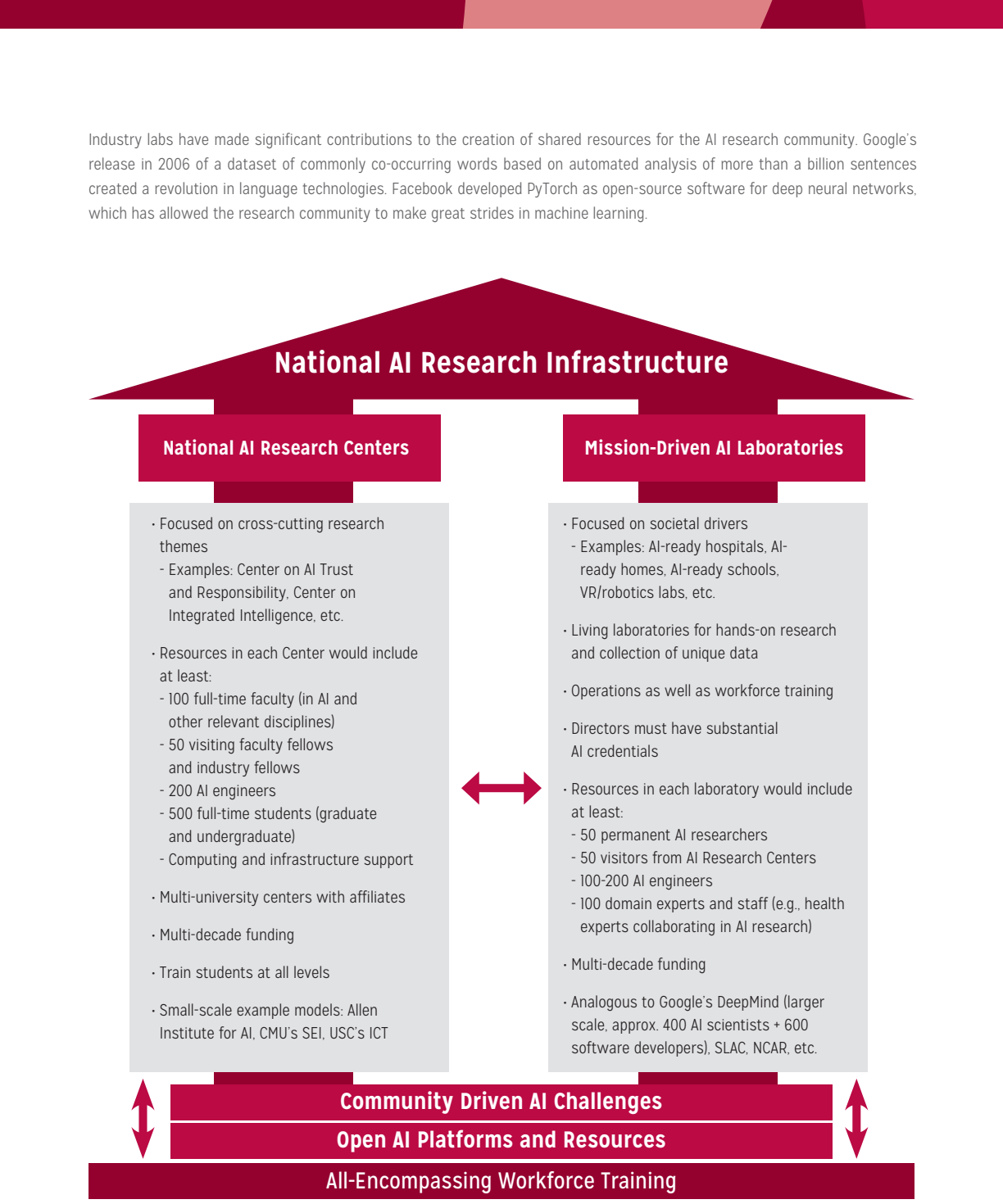
The load-bearing object is the proposed National AI Infrastructure, a federally funded constellation of four interlocking capabilities: open AI platforms and resources (shared datasets, software, knowledge repositories, and testbeds); sustained community-driven AI challenges that build on those resources; National AI Research Centers (multi-university, decade-long centers focused on pivotal research areas); and mission-driven AI laboratories placed in real-world settings such as hospitals and schools. This infrastructure is the mechanism by which the report expects the research priorities—integrated intelligence, meaningful interaction, and self-aware learning—to be realized; without it, the report argues, academic AI lacks the resources to answer foundational questions and industry AI will remain limited to near-term, narrow solutions. The roadmap also uses explicit 5/10/15-year milestones as the tracking mechanism for progress.
What would settle it
A natural experiment would settle it: if two comparable research communities received equal funding, one through a decade-long National AI Research Center and the other through conventional project grants, and the center showed no faster progress toward integrated, trustworthy AI after ten years, the roadmap's core recommendation would be undermined.
Extended reading notes
Core claim
The report's central claim is that the full potential of AI will remain out of reach unless the US reinvents how AI research is organized. Current AI successes come from data-driven methods, massive industry resources, and narrowly scoped applications; the report identifies three priority areas—integrated intelligence (combining modular capabilities into broader systems), meaningful interaction (natural, trustworthy collaboration between people and machines), and self-aware learning (robust, uncertainty-aware, durable learning)—and argues none can be achieved through piecemeal academic projects or industry's near-term focus. The required transformation, it says, is a National AI Infrastructure with four interlocking capabilities: open AI platforms and resources, sustained community-driven challenges, National AI Research Centers, and mission-driven AI laboratories embedded in hospitals, schools, and other real-world settings. It further recommends workforce training at all levels and protected core research funding. The report attaches 5-, 10-, and 15-year milestones to each priority, asserting that with sustained investment these coordinated institutions will deliver AI systems that are integrated, interactive, and trustworthy by roughly 2040.
Load-bearing premise
The load-bearing premise is that the proposed National AI Infrastructure—a specific federally funded institutional design—will actually produce the research advances and societal benefits promised; the report asserts this causal link rather than demonstrating it with pilots or comparative evidence.
Editorial extensions
If this is right
- Federal funding would need to shift from short project grants toward decade-long institutional commitments, with centers employing on the order of 100 faculty, 200 engineers, and 500 students each.
- AI research would become more experimental and infrastructural: open datasets, knowledge repositories, and physical testbeds would be first-class research products.
- Workforce training would extend from K-12 through PhD and into community-college and retraining programs, treating AI literacy and engineering skill as part of the national infrastructure.
- If the milestones are met, by 2040 AI systems would handle new situations by first principles and analogy, maintain themselves largely through user interaction, and collaborate with people across multiple communication channels with trust.
Reading between the lines
- The report's own argument implies that the binding constraint on AI progress is institutional, not algorithmic; if that is right, comparable arguments should apply to any country seeking AI leadership, not just the US.
- A testable extension the report does not design: compare the output of a decade-long National AI Research Center against a matched portfolio of conventional project grants on measures like publications, patents, and downstream deployment; the roadmap's central claim predicts the center wins.
- The emphasis on AI-ready hospitals and schools implies a largely unstated precondition: sustained public-sector willingness to share sensitive data and accept AI in high-stakes settings, which is as much a political and legal condition as a research one.
Signed reviews
Editorial analysis
A structured set of objections, weighed in public.
Referee Report
Summary. This manuscript is a community roadmap, coordinated by the Computing Community Consortium and AAAI, that identifies three research priority areas—integrated intelligence, meaningful interaction, and self-aware learning—and connects them to six societal drivers. It proposes three principal recommendations: establish a National AI Infrastructure with open platforms, community-driven challenges, research centers, and mission-driven laboratories; reconceptualize and expand AI workforce training; and sustain core AI research programs. The report presents 5-, 10-, and 15-year milestones toward 2040 stretch goals, illustrated by vignettes. The roadmap's central claim is that realizing AI's full potential requires a radical transformation of the AI research enterprise, facilitated by significant and sustained investment.
Significance. If its central claim is accepted, the roadmap could materially influence federal AI research funding and institutional design in the US. The document has several genuine strengths: the workshop process is transparently documented in §1.2 with participant counts and venues; the vignettes and milestones are explicitly labeled as illustrative rather than as predictions; and §1.1 candidly acknowledges that AI systems will still be far from general intelligence in 20 years, which tempers overclaiming. The report is also well aligned with prior documents such as the NITRD strategic plan and the US Robotics Roadmap. However, the roadmap's core policy recommendation—the creation of a National AI Infrastructure—is not supported by a causal argument, a baseline, or an evaluation framework, and the submitted text contains a large extraneous and duplicated email thread. These issues are load-bearing because the report asks for substantial new public investment on the strength of its institutional design claims.
major comments (3)
- [Executive Summary and §5.1] The central claim that a 'radical transformation of the AI research enterprise' and a 'National AI Infrastructure' will produce the promised transformative outcomes is asserted rather than argued. Section 5.1 specifies four interlocking capabilities (open platforms, community challenges, research centers, mission-driven laboratories), but the report provides no theory of change linking each component to the milestones in §3, no baseline measure of current research enterprise productivity, no pilot or comparative evidence from analogous large-scale research infrastructures, and no evaluation framework that would allow the causal claim to be tested. The reader is left with consensus-based recommendations that may be valuable, but the load-bearing step from research priorities to institutional design remains unsupported.
- [Full text, repeated email block] The body of the manuscript contains a multi-page email thread concerning AAAI Press production problems, including specific complaints about figure formatting and XML uploads, that is entirely unrelated to the AI research roadmap and is repeated verbatim at least twice. This is not a minor typographical artifact: it makes the submitted document unusable in its current form and suggests a serious compilation or submission error. The manuscript must be cleaned before any further review can be considered.
- [§1.2 and §5.1] The report asserts in §5.1 that 'the outcomes will be transformative' and in §1.2 that the workshop process yielded 'findings and recommendations,' but it offers no evidence that the proposed organizational forms are necessary or superior to alternatives such as expanded investigator grants or existing center models. A concrete test would be a comparison of the proposed National AI Research Centers with the productivity of existing multi-university centers or with a counterfactual scenario of equivalent funding distributed through core programs. Without such an analysis, the recommendation remains a reasonable opinion rather than a substantiated policy claim.
minor comments (3)
- [Throughout] The text contains numerous OCR artifacts, such as '/f_igures', 'Arti/f_icial', and 'signi/f_icant', particularly in headers and the repeated email block; these should be corrected in a clean version.
- [§2.1–§2.3] Several market-size and impact claims cite press releases or secondary news sources (e.g., the Frost & Sullivan healthcare figure and the $15 trillion GDP projection); for a policy roadmap, primary or peer-reviewed sources would strengthen credibility.
- [§1.5] The report says it is 'consistent with' the NITRD strategic plan and extends it, but it never explicitly identifies where it diverges or adds new recommendations; a short comparison table would help readers understand the incremental contribution.
Circularity Check
No circularity: the roadmap is a consensus document whose recommendations are not derived from fitted parameters or self-citation chains.
full rationale
This document is a community roadmap, not a derivational paper. It contains no equations, no fitted parameters, and no predictions that are statistically forced by construction. The central claim that achieving AI's potential requires a radical transformation of the research enterprise is presented as the consensus outcome of workshops, town halls, and community comment, with the process described in Section 1.2 rather than derived from an input dataset. The recommendations for a National AI Infrastructure, workforce training, and core research programs are justified by stated societal drivers and research priorities, not by a chain of mathematical reductions. The only self-referential element is that the authors and workshop participants are AI researchers recommending increased support for AI research; this is a conflict of interest or a matter of institutional advocacy, not a logical circularity. No load-bearing argument reduces to a self-citation, and no cited prior result is invoked to forbid alternatives. The absence of a causal evidence base for the institutional design is a correctness or persuasion concern, not a circularity concern, and the review rules require reserving circularity flags for quotable reductions that are not present here.
Assumptions & free parameters
assumptions (3)
- domain assumption The 20-year roadmap milestones are feasible if sufficient funding is provided.
- domain assumption Investment in the proposed national AI infrastructure will produce the described societal benefits.
- domain assumption The 91 workshop participants are a representative sample of the AI research community.
Cite this review
Pith. "Pith review of A 20-Year Community Roadmap for Artificial Intelligence Research in the US." pith.science (2026). https://pith.science/paper/2EBDZ4SN
@misc{pith2026190802624,
  author       = {Pith},
  title        = {Pith review of: A 20-Year Community Roadmap for Artificial Intelligence Research in the US},
  year         = {2026},
  howpublished = {\url{https://pith.science/paper/2EBDZ4SN}},
  note         = {Machine review of arXiv:1908.02624}
}
read the original abstract
Decades of research in artificial intelligence (AI) have produced formidable technologies that are providing immense benefit to industry, government, and society. AI systems can now translate across multiple languages, identify objects in images and video, streamline manufacturing processes, and control cars. The deployment of AI systems has not only created a trillion-dollar industry that is projected to quadruple in three years, but has also exposed the need to make AI systems fair, explainable, trustworthy, and secure. Future AI systems will rightfully be expected to reason effectively about the world in which they (and people) operate, handling complex tasks and responsibilities effectively and ethically, engaging in meaningful communication, and improving their awareness through experience. Achieving the full potential of AI technologies poses research challenges that require a radical transformation of the AI research enterprise, facilitated by significant and sustained investment. These are the major recommendations of a recent community effort coordinated by the Computing Community Consortium and the Association for the Advancement of Artificial Intelligence to formulate a Roadmap for AI research and development over the next two decades.
Figures


Figures from the paper (3 more)


Reference graph
Works this paper leans on
-
[6]
Conclusions This Roadmap is the result of a community activity to articulate AI research priorities for the next 20 years in a wide range of areas in AI and related disciplines. These research priorities are motivated by a detailed analysis of the potential benefits of AI for society in the domains of health, education, science, innovation, justice, and s...
-
[7]
Appendices 7.1 Workshop Participants INTEGRATED INTELLIGENCE David Aha, US Naval Research Laboratory Liz Bradley, U Colorado Boulder Joyce Chai, Michigan State Alexandra Coman, Capitol One Vincent Conitzer, Duke University Adnan Darwiche, UCLA Johan de Kleer, PARC Marie desJardins, Simmons University Khari Douglas, CCC Ann Schwartz Drobnis, CCC Doug Fishe...
Reviewed August 14, 2026 · model on record in the stance chip above.
Discussion (0). Continue with ORCID to comment.