REVIEW 3 major objections 5 minor 74 references
Few-shot Classification as Multi-instance Verification: Effective Backbone-agnostic Transfer across Domains
T0 review · 3 major / 5 minor · reviewed 2026-08-06 · deepseek-v4-flash
Pith's one-line read A classification head trained only on few-shot support data, with the backbone frozen, matches or exceeds adapter-based fine-tuning methods on cross-domain few-shot image classification while using substantially less compute.
desk verdict Frozen-backbone MIV-head genuinely reduces adaptation cost and matches adapters on many benchmarks, but the headline eTT parity rests on a patch-size mismatch that needs fixing. read the letter →
The pith
A machine-rendered reading of the paper's core claim, the machinery that carries it, and where it could break.
The reading
What carries the argument
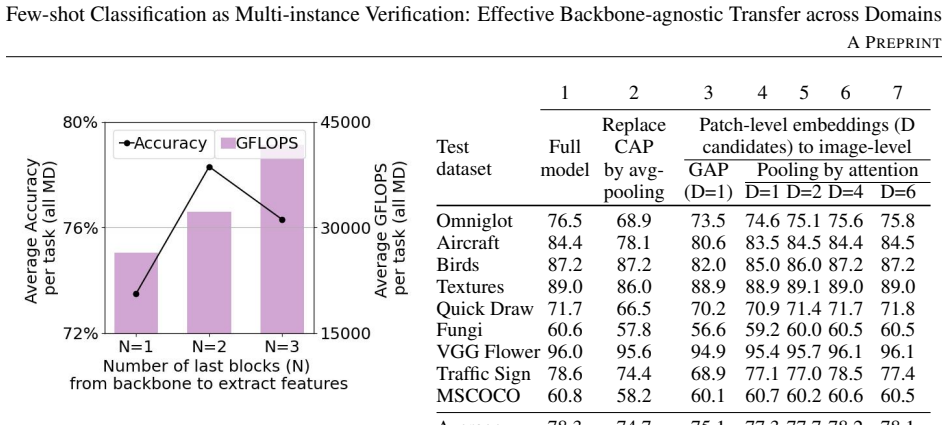
The MIV-head is the central object: a backbone-agnostic classification head made of three components. Component 1, pooling-by-attention, converts patch-level feature maps from the backbone API into image-level embeddings by letting patches and candidate pooled representations compete through learned attention queries. Component 2, cross-attention pooling (CAP), treats each support class as a bag and produces a query-dependent prototype and query representation through cross-attention, co-excitation, and an in-attention skip connection. Component 3 aggregates per-block logits from several backbone blocks with logsumexp, letting the block whose prototypes best resemble the query dominate the prediction. The whole head is trained from scratch at test time on the support set with cross-entropy loss, and the query-dependent prototypes are what let it adapt to new domains without changing the backbone.
What would settle it
Run the exact published TSA and eTT implementations with their original hyperparameters and the original Meta-dataset sampling procedure on the same off-the-shelf backbones, giving all methods an equal adaptation budget; if either baseline then matches or beats the MIV-head on average over the 17 datasets, the claimed accuracy parity would be refuted.
Extended reading notes
Core claim
The central claim is that representing few-shot classification as a series of multi-instance verification tasks lets a test-time-trained head compensate for the low-quality static embeddings of a frozen backbone. For each support class, all support images form a target bag; a query is paired with each bag through cross-attention pooling to produce a query-dependent prototype, and the pairwise similarities across multiple backbone blocks are merged with a logsumexp operation. Trained end-to-end on the support set, this MIV-head achieves accuracy that is competitive with or exceeds the state-of-the-art adapter methods TSA and eTT on the same off-the-shelf backbones, and also compares favorably with LN-Tune, while incurring substantially lower adaptation cost. The paper additionally reports that conventional head methods such as Baseline++ and FiT Head lag far behind, and that the three core components contribute collectively rather than independently.
Load-bearing premise
The headline parity claim rests on the faithfulness of the re-implemented TSA and eTT baselines and on the swapped task-sampling schema; if those baselines are under-tuned, run under worse hardware constraints, or evaluated on different tasks, the accuracy gap could be an artifact of the comparison setup rather than of the method itself.
Editorial extensions
If this is right
- If the MIV-head's reported accuracy holds, black-box API users can obtain near-fine-tuning few-shot classification accuracy without modifying or even knowing the backbone architecture.
- Adapter methods that require backward passes through the backbone become unnecessary in this setting, because the MIV-head trains with a single forward pass through the backbone and incurs substantially lower adaptation cost.
- The head works with a broad range of off-the-shelf backbones including ResNet, DeiT, DINO ViT, Swin, and CLIP, whereas TSA and eTT are each tied to one backbone family and can fail with out-of-memory errors.
- Standard head methods such as Baseline++ and FiT Head are far less accurate, indicating the gain comes from the multi-instance verification representation rather than merely training a stronger classifier on top of frozen embeddings.
- Ablations show the three components are mutually dependent, so the design should be adopted as a whole rather than as independent tricks.
Reading between the lines
- The query-dependent prototypes make the MIV-head an episodic classifier whose class representations change per query; a natural extension the paper leaves implicit is to apply the same bag-verification head to retrieval over frozen vector-database embeddings.
- The paper's reported weakness on low-resolution CIFAR data suggests meta-training the MIV-head parameters on source episodic tasks could close that gap, and the paper itself notes the head is compatible with meta-training.
- Because the paper reuses TSA's task sampling schema rather than the original Meta-dataset sampling procedure, an outside replication using the original protocol would clarify how much of the reported gain is due to the representation and how much to the evaluation setup.
Editorial analysis
A structured set of objections, weighed in public.
Referee Report
Summary. The paper proposes MIV-head, a classification head for cross-domain few-shot classification (CDFSL) that operates on frozen, off-the-shelf backbones by reformulating few-shot classification as a series of multiple-instance verification (MIV) tasks. The head consists of three components: pooling-by-attention on patch-level feature maps, cross-attention pooling (CAP) adapted from the authors' prior work, and multi-block logit aggregation via logsumexp. The head is trained at test time on the support set only, without any backbone fine-tuning. The authors evaluate on an extended 17-dataset Meta-dataset benchmark with several CNN and ViT backbones, comparing against TSA, eTT, and LN-Tune. They report accuracy competitive with or exceeding these adapter methods while incurring substantially lower adaptation cost in GFLOPs and training time, and support this with paired t-tests, confidence intervals, ablations, and cost analyses. The core claim is that a frozen-backbone head approach can match fine-tuning-based methods, which would be a meaningful result for practical black-box settings.
Significance. If the claims hold, this is a valuable contribution to CDFSL: it challenges the prevailing assumption that partially fine-tuning the backbone is necessary for state-of-the-art cross-domain few-shot accuracy, and it offers a computationally cheaper and backbone-agnostic alternative. The paper is commendably transparent, releasing code, reporting confidence intervals, using paired significance tests, and providing detailed ablations, including interaction analyses that show the components are jointly necessary. The experiments are extensive in scope: multiple backbones, multiple baselines, both supervised and self-supervised pretraining, and two evaluation protocols. The significance is somewhat tempered by the fact that CAP is adapted from the authors' own unpublished prior work, so the architectural novelty is in the combination and application rather than in the individual mechanisms. Nevertheless, the demonstration that a frozen-backbone head can be competitive with adapter methods, if confirmed after addressing the comparison caveats below, would be an important step for practical few-shot deployment.
major comments (3)
- [Section 4.2.1, Table 1] The headline accuracy comparison for the DINO ViT-small backbone does not satisfy the 'same backbones' condition stated in the abstract. In Table 1, the MIV-head's headline MD average of 80.4 uses the patch-8 backbone, while eTT is evaluated on the patch-16 backbone because of OOM. The paper itself notes that prior work has found patch-8 can be superior to patch-16. On the truly comparable patch-16 backbone, eTT outperforms MIV-head on MD (80.3 vs 79.1) and on MD+ (78.0 vs 76.4). Thus the abstract's claim of 'highly competitive accuracy ... applied to the same backbones' is not supported in the strongest ViT setting; it holds only for the supervised DeiT comparison. The authors should either provide evidence that eTT cannot be run on patch-8 even with reasonable memory optimizations, or revise the claims and the table presentation to make clear that the DINO ViT comparison is 'MIV-head patch-8 vs eTT patch-16' rather than a same-backbone comparison.
- [Section 4.2.1 and Appendix B.4.2] The comparison to TSA and eTT is not matched for data augmentation. The MIV-head uses RandAugment and additional transforms on the support set to create pseudo-queries during adaptation, as described in Appendix B.4.2, while the TSA and eTT baselines are not given augmentation. Since augmentation is known to improve few-shot accuracy, the reported accuracy gap may partly reflect an unequal evaluation protocol rather than the method's intrinsic advantage. The paper does apply the same augmentation to LN-Tune in Section 4.3.2, but not to TSA/eTT. The authors should either run TSA/eTT with the same augmentation (subject to their OOM constraints) or provide a no-augmentation comparison for eTT on the DINO ViT setting. Table 18 shows a no-augmentation comparison for the supervised ResNet-50 backbone, but no such comparison is provided for the ViT/eTT setting, which is the setting that anchors the parity claim.
- [Section 1 and Section 3.1] The paper's 'black-box' framing is stronger than what the method actually requires. The MIV-head requires access to patch-level feature maps from multiple intermediate blocks of the backbone, as described in Section 3.1 and Figure 3a. Many real-world black-box APIs (e.g., a hosted CLIP endpoint) expose only a single final image embedding, not intermediate activations or patch-level features. The authors should explicitly define the API contract assumed by the method: it applies when the user can retrieve intermediate feature maps from specified blocks, but not when only a single pooled vector is available. Without this clarification, the 'black-box backbone' claim in the abstract and introduction is misleading and the scope of the contribution is overstated.
minor comments (5)
- [Title page] The preprint header shows a date of 'September 17, 2025', while the arXiv version is dated '1 Jul 2025'; please ensure the manuscript date is consistent with the submission version.
- [Table 1 note] The explanation of underlined entries in Table 1 is hard to follow; please clarify the statistical meaning of the underlining (e.g., 'underlined if not significantly worse than Ours(Patch-8) but significantly better than Ours(Patch-16)') in the caption.
- [Section 4.2.2, Figure 5] The GFLOPs measurement uses the 'common rule of thumb' that backward pass costs twice the forward pass; please state this explicitly in the main text rather than only in Appendix C.2.
- [Appendix B.2] The statement that the authors use 'TSA's sampling schema instead of their sampling procedure' would benefit from a brief explanation of why this does not affect the validity of the comparisons with published results, since the published numbers are based on the original MD sampling procedure.
- [Section 4.3.3] In Figure 6, the y-axis labels are reversed between accuracy and GFLOPs; please double-check the axis descriptions to avoid confusion.
Circularity Check
No significant circularity: the MIV-head accuracy claims rest on external benchmark comparisons and on ablations of the method's own components, not on a derivation that reduces to its inputs.
full rationale
The central claim—that the MIV-head achieves accuracy competitive with adapter methods TSA and eTT on frozen backbones—is an empirical claim evaluated on fixed Meta-dataset/MD+ test tasks against re-implemented baselines with aligned backbones. The method is trained at meta-test time on support sets and evaluated on held-out queries, so there is no fitted parameter renamed as a prediction and no equation-level reduction of outputs to inputs. The only self-citation is the adoption of cross-attention pooling (CAP) from the authors' earlier paper [71]; however, CAP's contribution is not assumed by fiat but is directly tested in the paper's ablations (Tables 7, 8, 9, and 17), and the headline same-backbone comparisons in Tables 1 and 2 are external benchmarks whose results do not depend on the validity of [71]. No uniqueness theorem is imported from the authors' prior work, and no ansatz is smuggled in via citation: the paper explicitly states that each individual component is not new and that the novelty lies in their collective use, which is then empirically justified. The eTT patch-16 versus MIV-head patch-8 comparison is a fairness or protocol concern rather than a circularity, and the choice of hyperparameters via ablation on the MD benchmark is a validation concern, not a logical circularity, because the reported accuracies are not entailed by the hyperparameters by construction. Overall, the derivation chain is self-contained and the empirical claims are independently checkable against the benchmark.
Assumptions & free parameters
free parameters (6)
- Number of output blocks N =
2 for ResNet (3 for off-the-shelf ResNet-18), 4 for ViT
- Number of pooling candidates D =
3 to 5, with specific shapes per backbone listed in Appendix B.4.2 and D.1
- Cross-attention down-scaling hyperparameter eta =
0.1 for all backbones
- Temperature tau in Equations (1) and (2) =
200 for ViTs, 500 for ResNets
- Logits temperature Sigma =
0.1
- Data augmentation threshold T =
30 for input resolution 84, 15 for 224, reduced on OOM
assumptions (6)
- domain assumption The pretrained backbone weights are fixed and used only as feature extractors accessed through an API-style forward pass.
- domain assumption The distance-based attention function (DBA) and cross-attention pooling (CAP) from [71] are effective as claimed in the prior paper.
- domain assumption Meta-dataset task sampling and the extended MD+ benchmark are valid proxies for cross-domain few-shot performance.
- standard math The paired t-test with 600 tasks per dataset adequately accounts for task-level variance.
- domain assumption Random augmentation of support samples (RandAugment, grayscale, horizontal flip) creates useful pseudo-queries without leaking test information.
- domain assumption The re-implementations of TSA, eTT, and LN-Tune faithfully reproduce the original methods.
Cite this review
Pith. "Pith review of Few-shot Classification as Multi-instance Verification: Effective Backbone-agnostic Transfer across Domains." pith.science (2026). https://pith.science/paper/2EDLEABR
@misc{pith2026250700401,
  author       = {Pith},
  title        = {Pith review of: Few-shot Classification as Multi-instance Verification: Effective Backbone-agnostic Transfer across Domains},
  year         = {2026},
  howpublished = {\url{https://pith.science/paper/2EDLEABR}},
  note         = {Machine review of arXiv:2507.00401}
}
read the original abstract
We investigate cross-domain few-shot learning under the constraint that fine-tuning of backbones (i.e., feature extractors) is impossible or infeasible -- a scenario that is increasingly common in practical use cases. Handling the low-quality and static embeddings produced by frozen, "black-box" backbones leads to a problem representation of few-shot classification as a series of multiple instance verification (MIV) tasks. Inspired by this representation, we introduce a novel approach to few-shot domain adaptation, named the "MIV-head", akin to a classification head that is agnostic to any pretrained backbone and computationally efficient. The core components designed for the MIV-head, when trained on few-shot data from a target domain, collectively yield strong performance on test data from that domain. Importantly, it does so without fine-tuning the backbone, and within the "meta-testing" phase. Experimenting under various settings and on an extension of the Meta-dataset benchmark for cross-domain few-shot image classification, using representative off-the-shelf convolutional neural network and vision transformer backbones pretrained on ImageNet1K, we show that the MIV-head achieves highly competitive accuracy when compared to state-of-the-art "adapter" (or partially fine-tuning) methods applied to the same backbones, while incurring substantially lower adaptation cost. We also find well-known "classification head" approaches lag far behind in terms of accuracy. Ablation study empirically justifies the core components of our approach. We share our code at https://github.com/xxweka/MIV-head.
Figures


Figures from the paper (6 more)




Reference graph
Works this paper leans on
-
[1]
Cross-Domain Few-Shot Learning by Representation Fusion
Thomas Adler, Johannes Brandstetter, Michael Widrich, Andreas Mayr, David P. Kreil, Michael Kopp, Günter Klambauer, and Sepp Hochreiter. Cross-domain few-shot learning by representation fusion. arXiv preprint arXiv:2010.06498, 2020. 30 Few-shot Classification as Multi-instance Verification: Effective Backbone-agnostic Transfer across Domains A PREPRINT
work page Pith review arXiv 2010
-
[2]
Jimmy Lei Ba, Jamie Ryan Kiros, and Geoffrey E. Hinton. Layer normalization. arXiv preprint arXiv:1607.06450, 2016
arXiv 2016
-
[3]
Meta-learning with adaptive hyperparameters
Sungyong Baik, Myungsub Choi, Janghoon Choi, Heewon Kim, and Kyoung Mu Lee. Meta-learning with adaptive hyperparameters. In Advances in Neural Information Processing Systems, volume 33, pages 20755–20765, 2020
work page 2020
-
[4]
Strong baselines for parameter-efficient few-shot fine-tuning
Samyadeep Basu, Shell Xu Hu, Daniela Massiceti, and Soheil Feizi. Strong baselines for parameter-efficient few-shot fine-tuning. In Thirty-Eighth AAAI Conference on Artificial Intelligence, AAAI, pages 11024–11031, 2024
work page 2024
-
[5]
Food-101 – mining discriminative components with random forests
Lukas Bossard, Matthieu Guillaumin, and Luc Van Gool. Food-101 – mining discriminative components with random forests. In European Conference on Computer Vision, 2014
2014
-
[6]
Memory efficient meta-learning with large images
John F Bronskill, Daniela Massiceti, Massimiliano Patacchiola, Katja Hofmann, Sebastian Nowozin, and Richard E Turner. Memory efficient meta-learning with large images. In Thirty-Fifth Conference on Neural Information Processing Systems, 2021
work page 2021
-
[7]
Emerging properties in self-supervised vision transformers
Mathilde Caron, Hugo Touvron, Ishan Misra, Hervé Jégou, Julien Mairal, Piotr Bojanowski, and Armand Joulin. Emerging properties in self-supervised vision transformers. In Proceedings of the International Conference on Computer Vision (ICCV), 2021
2021
-
[8]
Adaptformer: Adapting vision transformers for scalable visual recognition
Shoufa Chen, Chongjian Ge, Zhan Tong, Jiangliu Wang, Yibing Song, Jue Wang, and Ping Luo. Adaptformer: Adapting vision transformers for scalable visual recognition. NeurIPS, 2022
work page 2022
Show all 74 references
-
[9]
A closer look at few-shot classification
Wei-Yu Chen, Yen-Cheng Liu, Zsolt Kira, Yu-Chiang Wang, and Jia-Bin Huang. A closer look at few-shot classification. In International Conference on Learning Representations (ICLR), 2019
2019
-
[10]
Meta-baseline: Exploring simple meta-learning for few-shot learning
Yinbo Chen, Zhuang Liu, Huijuan Xu, Trevor Darrell, and Xiaolong Wang. Meta-baseline: Exploring simple meta-learning for few-shot learning. In Proceedings of the IEEE/CVF International Conference on Computer Vision, pages 9062–9071, 2021
2021
-
[11]
Describing textures in the wild
Mircea Cimpoi, Subhransu Maji, Iasonas Kokkinos, Sammy Mohamed, and Andrea Vedaldi. Describing textures in the wild. In 2014 IEEE Conference on Computer Vision and Pattern Recognition, pages 3606–3613, 2014
2014
-
[12]
RandAugment: Practical automated data augmentation with a reduced search space
Ekin Dogus Cubuk, Barret Zoph, Jonathon Shlens, and Quoc Le. RandAugment: Practical automated data augmentation with a reduced search space. In Advances in Neural Information Processing Systems 33: Annual Conference on Neural Information Processing Systems (NeurIPS) 2020, 2020
2020
-
[13]
J. Deng, W. Dong, R. Socher, L.-J. Li, K. Li, and L. Fei-Fei. ImageNet: A Large-Scale Hierarchical Image Database. In CVPR09, 2009
2009
-
[14]
BERT: Pre-training of deep bidirectional transformers for language understanding
Jacob Devlin, Ming-Wei Chang, Kenton Lee, and Kristina Toutanova. BERT: Pre-training of deep bidirectional transformers for language understanding. In Proceedings of the 2019 Conference of the North American Chapter of the Association for Computational Linguistics: Human Langu...
2019
-
[15]
A baseline for few-shot image classification
Guneet Singh Dhillon, Pratik Chaudhari, Avinash Ravichandran, and Stefano Soatto. A baseline for few-shot image classification. In International Conference on Learning Representations (ICLR), 2020
2020
-
[16]
Dietterich, Richard H
Thomas G. Dietterich, Richard H. Lathrop, and Tomás Lozano-Pérez. Solving the multiple instance problem with axis-parallel rectangles. Artificial Intelligence, 89(1):31–71, 1997
1997
-
[17]
Crosstransformers: spatially-aware few-shot transfer
Carl Doersch, Ankush Gupta, and Andrew Zisserman. Crosstransformers: spatially-aware few-shot transfer. In NeurIPS, 2020
2020
-
[18]
An image is worth 16x16 words: Transformers for image recognition at scale
Alexey Dosovitskiy, Lucas Beyer, Alexander Kolesnikov, Dirk Weissenborn, Xiaohua Zhai, Thomas Unterthiner, Mostafa Dehghani, Matthias Minderer, Georg Heigold, Sylvain Gelly, Jakob Uszkoreit, and Neil Houlsby. An image is worth 16x16 words: Transformers for image recognition at...
2021
-
[19]
Comparing transfer and meta learning approaches on a unified few-shot classification benchmark
Vincent Dumoulin, Neil Houlsby, Utku Evci, Xiaohua Zhai, Ross Goroshin, Sylvain Gelly, and Hugo Larochelle. Comparing transfer and meta learning approaches on a unified few-shot classification benchmark. arXiv preprint arXiv:2104.02638, 2021
2021 arXiv
-
[20]
A unified few-shot classification benchmark to compare transfer and meta learning approaches
Vincent Dumoulin, Neil Houlsby, Utku Evci, Xiaohua Zhai, Ross Goroshin, Sylvain Gelly, Hugo Larochelle, and Hugo Larochelle. A unified few-shot classification benchmark to compare transfer and meta learning approaches. In Proceedings of the Neural Information Processing System...
2021
-
[21]
Generalized meta-fdmixup: Cross-domain few-shot learning guided by labeled target data
Yuqian Fu, Yanwei Fu, Jingjing Chen, and Yu-Gang Jiang. Generalized meta-fdmixup: Cross-domain few-shot learning guided by labeled target data. IEEE Transactions on Image Processing, 31:7078–7090, 2022. 31 Few-shot Classification as Multi-instance Verification: Effective Backb...
2022
-
[22]
Codella, Leonid Karlinsky, James V
Yunhui Guo, Noel C. Codella, Leonid Karlinsky, James V . Codella, John R. Smith, Kate Saenko, Tajana Rosing, and Rogerio Feris. A broader study of cross-domain few-shot learning. In ECCV 2020, pages 124–141, 2020
2020
-
[23]
A brief survey on semantic segmentation with deep learning
Shijie Hao, Yuan Zhou, and Yanrong Guo. A brief survey on semantic segmentation with deep learning. Neurocomputing, 406:302–321, 2020
2020
-
[24]
Spatial pyramid pooling in deep convolutional networks for visual recognition
Kaiming He, Xiangyu Zhang, Shaoqing Ren, and Jian Sun. Spatial pyramid pooling in deep convolutional networks for visual recognition. In Computer Vision – ECCV 2014, volume 8691, pages 346–361, 2014
2014
-
[25]
Deep residual learning for image recognition
Kaiming He, Xiangyu Zhang, Shaoqing Ren, and Jian Sun. Deep residual learning for image recognition. In 2016 IEEE Conference on Computer Vision and Pattern Recognition (CVPR), pages 770–778, 2016
2016
-
[26]
Few-shot learning via repurposing ensemble of black-box models
Minh Hoang and Trong Nghia Hoang. Few-shot learning via repurposing ensemble of black-box models. Proceedings of the AAAI Conference on Artificial Intelligence, 38(11):12448–12455, Mar. 2024
2024
-
[27]
Cross attention network for few-shot classification
Ruibing Hou, Hong Chang, Bingpeng MA, Shiguang Shan, and Xilin Chen. Cross attention network for few-shot classification. In Advances in Neural Information Processing Systems, volume 32, 2019
2019
-
[28]
Squeeze-and-excitation networks
Jie Hu, Li Shen, and Gang Sun. Squeeze-and-excitation networks. In Computer Vision and Pattern Recognition, pages 7132–7141, 2018
2018
-
[29]
Hospedales
Shell Xu Hu, Da Li, Jan Stühmer, Minyoung Kim, and Timothy M. Hospedales. Pushing the limits of simple pipelines for few-shot learning: External data and fine-tuning make a difference. In CVPR, 2022
2022
-
[30]
Densely connected convolutional networks
Gao Huang, Zhuang Liu, Laurens van der Maaten, and Kilian Q Weinberger. Densely connected convolutional networks. In Proceedings of the IEEE Conference on Computer Vision and Pattern Recognition, 2017
2017
-
[31]
Ashraful Islam, Chun-Fu Chen, Rameswar Panda, Leonid Karlinsky, Rogério Schmidt Feris, and Richard J. Radke. Dynamic distillation network for cross-domain few-shot recognition with unlabeled data. In Neural Information Processing Systems, 2021
2021
-
[32]
The Quick, Draw! – A.I
Jonas Jongejan, Henry Rowley, Takashi Kawashima, Jongmin Kim, and Nick Fox-Gieg. The Quick, Draw! – A.I. experiment. quickdraw.withgoogle.com, 2016
2016
-
[33]
Learning multiple layers of features from tiny images
Alex Krizhevsky and Geoffrey Hinton. Learning multiple layers of features from tiny images. Technical Report 0, University of Toronto, 2009
2009
-
[34]
Human-level concept learning through probabilistic program induction
Brenden M Lake, Ruslan Salakhutdinov, and Joshua B Tenenbaum. Human-level concept learning through probabilistic program induction. Science, 2015
2015
-
[35]
Lecun, L
Y . Lecun, L. Bottou, Y . Bengio, and P. Haffner. Gradient-based learning applied to document recognition. Proceedings of the IEEE, 86(11):2278–2324, 1998
1998
-
[36]
Kosiorek, Seungjin Choi, and Yee Whye Teh
Juho Lee, Yoonho Lee, Jungtaek Kim, Adam R. Kosiorek, Seungjin Choi, and Yee Whye Teh. Set transformer: A framework for attention-based permutation-invariant neural networks. In Proceedings of the 36th International Conference on Machine Learning, pages 3744–3753, 2019
2019
-
[37]
BLIP-2: bootstrapping language-image pre-training with frozen image encoders and large language models
Junnan Li, Dongxu Li, Silvio Savarese, and Steven Hoi. BLIP-2: bootstrapping language-image pre-training with frozen image encoders and large language models. In Proceedings of the 40th International Conference on Machine Learning, 2023
2023
-
[38]
Universal representation learning from multiple domains for few-shot classification
Wei-Hong Li, Xialei Liu, and Hakan Bilen. Universal representation learning from multiple domains for few-shot classification. In Proceedings of the IEEE/CVF International Conference on Computer Vision (ICCV), pages 9526–9535, October 2021
2021
-
[39]
Cross-domain few-shot learning with task-specific adapters
Wei-Hong Li, Xialei Liu, and Hakan Bilen. Cross-domain few-shot learning with task-specific adapters. In CVPR, 2022
2022
-
[40]
Maire, Serge J
Tsung-Yi Lin, M. Maire, Serge J. Belongie, James Hays, P. Perona, D. Ramanan, Piotr Dollár, and C. L. Zitnick. Microsoft COCO: Common objects in context. In ECCV, 2014
2014
-
[41]
Swin transformer: Hierarchical vision transformer using shifted windows
Ze Liu, Yutong Lin, Yue Cao, Han Hu, Yixuan Wei, Zheng Zhang, Stephen Lin, and Baining Guo. Swin transformer: Hierarchical vision transformer using shifted windows. InProceedings of the IEEE/CVF International Conference on Computer Vision (ICCV), 2021
2021
-
[42]
A closer look at few-shot classification again
Xu Luo, Hao Wu, Ji Zhang, Lianli Gao, Jing Xu, and Jingkuan Song. A closer look at few-shot classification again. In International Conference on Machine Learning, 2023
2023
-
[43]
S. Maji, J. Kannala, E. Rahtu, M. Blaschko, and A. Vedaldi. Fine-grained visual classification of aircraft. Technical report, 2013
2013
-
[44]
Distance-based image classification: Generalizing to new classes at near-zero cost
Thomas Mensink, Jakob Verbeek, and Gabriela Csurka. Distance-based image classification: Generalizing to new classes at near-zero cost. IEEE Transactions on Pattern Analysis and Machine Intelligence, 35:2624–37, 11 2013. 32 Few-shot Classification as Multi-instance Verificatio...
2013
-
[45]
Automated flower classification over a large number of classes
Maria-Elena Nilsback and Andrew Zisserman. Automated flower classification over a large number of classes. In 2008 Sixth Indian Conference on Computer Vision, Graphics & Image Processing, pages 722–729. IEEE, 2008
2008
-
[46]
Pytorch: An imperative style, high-performance deep learning library
Adam Paszke, Sam Gross, Francisco Massa, Adam Lerer, James Bradbury, Gregory Chanan, Trevor Killeen, Zeming Lin, Natalia Gimelshein, Luca Antiga, Alban Desmaison, Andreas Kopf, Edward Yang, Zachary DeVito, Martin Raison, Alykhan Tejani, Sasank Chilamkurthy, Benoit Steiner, Lu ...
2019
-
[47]
Contextual squeeze-and-excitation for efficient few-shot image classification
Massimiliano Patacchiola, John Bronskill, Aliaksandra Shysheya, Katja Hofmann, Sebastian Nowozin, and Richard E Turner. Contextual squeeze-and-excitation for efficient few-shot image classification. In Advances in Neural Information Processing Systems, 2022
2022
-
[48]
Discriminative sample-guided and parameter-efficient feature space adaptation for cross-domain few-shot learning
Rashindrie Perera and Saman Halgamuge. Discriminative sample-guided and parameter-efficient feature space adaptation for cross-domain few-shot learning. In CVPR, pages 23794–23804, 2024
2024
-
[49]
Multi- instance attention network for few-shot learning
Zhili Qin, Han Wang, Cobbinah Bernard Mawuli, Wei Han, Rui Zhang, Qinli Yang, and Junming Shao. Multi- instance attention network for few-shot learning. Information Sciences, 611:464–475, 2022
2022
-
[50]
Learning transferable visual models from natural language supervision
Alec Radford, Jong Wook Kim, Chris Hallacy, Aditya Ramesh, Gabriel Goh, Sandhini Agarwal, Girish Sastry, Amanda Askell, Pamela Mishkin, Jack Clark, Gretchen Krueger, and Ilya Sutskever. Learning transferable visual models from natural language supervision. In Marina Meila and ...
2021
-
[51]
Designing network design spaces
Ilija Radosavovic, Raj Prateek Kosaraju, Ross Girshick, Kaiming He, and Piotr Dollar. Designing network design spaces. In Proceedings of the IEEE/CVF Conference on Computer Vision and Pattern Recognition (CVPR), June 2020
2020
-
[52]
Fast and flexible multi-task classification using conditional neural adaptive processes
James Requeima, Jonathan Gordon, John Bronskill, Sebastian Nowozin, and Richard E Turner. Fast and flexible multi-task classification using conditional neural adaptive processes. In Advances in Neural Information Processing Systems 32, pages 7957–7968. 2019
2019
-
[53]
Berg, and Li Fei-Fei
Olga Russakovsky, Jia Deng, Hao Su, Jonathan Krause, Sanjeev Satheesh, Sean Ma, Zhiheng Huang, Andrej Karpathy, Aditya Khosla, Michael Bernstein, Alexander C. Berg, and Li Fei-Fei. ImageNet Large Scale Visual Recognition Challenge. International Journal of Computer Vision (IJC...
2015
-
[54]
Optimized generic feature learning for few-shot classification across domains
Tonmoy Saikia, Thomas Brox, and Cordelia Schmid. Optimized generic feature learning for few-shot classification across domains. arXiv preprint arXiv:2001.07926, 2020. URL https://arxiv.org/abs/2001.07926
2001 arXiv
-
[55]
FGVCx fungi classification challenge 2018
Brigit Schroeder and Yin Cui. FGVCx fungi classification challenge 2018. github.com/visipedia/fgvcx_fungi_ comp, 2018
2018
-
[56]
FiT: Parameter efficient few-shot transfer learning for personalized and federated image classification
Aliaksandra Shysheya, John Bronskill, Massimiliano Patacchiola, Sebastian Nowozin, and Richard Turner. FiT: Parameter efficient few-shot transfer learning for personalized and federated image classification. In International Conference on Learning Representations (ICLR), 06 2023
2023
-
[57]
Prototypical networks for few-shot learning
Jake Snell, Kevin Swersky, and Richard Zemel. Prototypical networks for few-shot learning. In Proceedings of the 31st International Conference on Neural Information Processing Systems, page 4080–4090, 2017
2017
-
[58]
The German Traffic Sign Recognition Benchmark: A multi-class classification competition
Johannes Stallkamp, Marc Schlipsing, Jan Salmen, and Christian Igel. The German Traffic Sign Recognition Benchmark: A multi-class classification competition. In IEEE International Joint Conference on Neural Networks, pages 1453–1460, 2011
2011
-
[59]
Rethinking few-shot image classification: a good embedding is all you need? In Computer Vision–ECCV 2020, 2020
Yonglong Tian, Yue Wang, Dilip Krishnan, Joshua B Tenenbaum, and Phillip Isola. Rethinking few-shot image classification: a good embedding is all you need? In Computer Vision–ECCV 2020, 2020
2020
-
[60]
Training data-efficient image transformers & distillation through attention
Hugo Touvron, Matthieu Cord, Matthijs Douze, Francisco Massa, Alexandre Sablayrolles, and Herve Jegou. Training data-efficient image transformers & distillation through attention. In International Conference on Machine Learning, volume 139, pages 10347–10357, July 2021
2021
-
[61]
Meta-dataset: A dataset of datasets for learning to learn from few examples
Eleni Triantafillou, Tyler Zhu, Vincent Dumoulin, Pascal Lamblin, Utku Evci, Kelvin Xu, Ross Goroshin, Carles Gelada, Kevin Swersky, Pierre-Antoine Manzagol, and Hugo Larochelle. Meta-dataset: A dataset of datasets for learning to learn from few examples. In 8th International ...
2020
-
[62]
Learning a universal template for few-shot dataset generalization
Eleni Triantafillou, Hugo Larochelle, Richard Zemel, and Vincent Dumoulin. Learning a universal template for few-shot dataset generalization. In ICML. 05 2021
2021
-
[63]
Cross-domain few-shot classification via learned feature-wise transformation
Hung-Yu Tseng, Hsin-Ying Lee, Jia-Bin Huang, and Ming-Hsuan Yang. Cross-domain few-shot classification via learned feature-wise transformation. In International Conference on Learning Representations, 2020. 33 Few-shot Classification as Multi-instance Verification: Effective B...
2020
-
[64]
Gomez, Lukasz Kaiser, and Illia Polosukhin
Ashish Vaswani, Noam Shazeer, Niki Parmar, Jakob Uszkoreit, Llion Jones, Aidan N. Gomez, Lukasz Kaiser, and Illia Polosukhin. Attention is all you need. In Advances in Neural Information Processing Systems, pages 5998–6008, 2017
2017
-
[65]
Matching networks for one shot learning
Oriol Vinyals, Charles Blundell, Tim Lillicrap, Daan Wierstra, et al. Matching networks for one shot learning. In Advances in Neural Information Processing Systems, pages 3630–3638, 2016
2016
-
[66]
C. Wah, S. Branson, P. Welinder, P. Perona, and S. Belongie. The caltech-ucsd birds- 200-2011 dataset. Technical Report CNS-TR-2011-001, California Institute of Technology, 2011
2011
-
[67]
Feature extractor stacking for cross-domain few-shot learning
Hongyu Wang, Eibe Frank, Bernhard Pfahringer, Michael Mayo, and Geoffrey Holmes. Feature extractor stacking for cross-domain few-shot learning. Machine Learning, 113(1):121–158, 2024
2024
-
[68]
Generalizing from a few examples: A survey on few-shot learning
Yaqing Wang, Quanming Yao, James T Kwok, and Lionel M Ni. Generalizing from a few examples: A survey on few-shot learning. ACM Computing Surveys (CSUR), 53(3):1–34, 2020
2020
-
[69]
Simmim: A simple framework for masked image modeling
Zhenda Xie, Zheng Zhang, Yue Cao, Yutong Lin, Jianmin Bao, Zhuliang Yao, Qi Dai, and Han Hu. Simmim: A simple framework for masked image modeling. In International Conference on Computer Vision and Pattern Recognition (CVPR), 2022
2022
-
[70]
Exploring efficient few-shot adaptation for vision transformers
Chengming Xu, Siqian Yang, Yabiao Wang, Zhanxiong Wang, Yanwei Fu, and Xiangyang Xue. Exploring efficient few-shot adaptation for vision transformers. Transactions on Machine Learning Research, 2022
2022
-
[72]
Deepemd: Few-shot image classification with differentiable earth mover’s distance and structured classifiers
Chi Zhang, Yujun Cai, Guosheng Lin, and Chunhua Shen. Deepemd: Few-shot image classification with differentiable earth mover’s distance and structured classifiers. In IEEE/CVF Conference on Computer Vision and Pattern Recognition (CVPR), June 2020
2020
-
[73]
Tip-adapter: Training-free adaption of CLIP for few-shot classification
Renrui Zhang, Wei Zhang, Rongyao Fang, Peng Gao, Kunchang Li, Jifeng Dai, Yu Qiao, and Hongsheng Li. Tip-adapter: Training-free adaption of CLIP for few-shot classification. In ECCV, page 493–510, 2022
2022
-
[74]
Yixiong Zou, Shanghang Zhang, Jianpeng Yu, Yonghong Tian, and José M. F. Moura. Revisiting mid-level patterns for cross-domain few-shot recognition. In Proceedings of the 29th ACM International Conference on Multimedia, page 741–749, 2021. 34
2021
-
[2024]
URL https://arxiv.org/abs/2407.06544
Reviewed August 6, 2026 · model on record in the stance chip above.
Discussion (0). Sign in to comment.