REVIEW 4 major objections 5 minor 65 references
No evidence for critical slowing down prior to human epileptic seizures
T0 review · 4 major / 5 minor · reviewed 2026-08-14 · deepseek-v4-flash
Pith's one-line read Using intracranial EEG from 28 people and 105 seizures, this paper finds no evidence that variance or lag-1 autocorrelation—the standard critical-slowing-down indicators—increase before seizure onset.
desk verdict A systematic, careful negative study: CSD indicators show no reliable increase before 105 seizures, though the contaminated ROC control baseline and unremoved circadian rhythm make the null less clean than the abstract implies. read the letter →
The pith
A machine-rendered reading of the paper's core claim, the machinery that carries it, and where it could break.
The reading
What carries the argument
The argument rests on a surrogate-based ROC evaluation. For every brain site, the two indicators are computed in sliding 20.48-s windows; the area under the receiver-operating-characteristic curve measures how well indicator values in assumed pre-seizure periods (4, 2, 1, or 0.5 h) separate from the remaining data, while 19 seizure-time surrogates per subject—random permutations of the intervals between seizures—define the null distribution for significance. This machinery is what lets the authors distinguish a real pre-seizure change from chance fluctuations and from the strong 24-h circadian modulation they observe in both indicators.
What would settle it
Look for whether the conclusion changes when the control set is cleaned: rerun the ROC analysis excluding every 4-h window immediately before any seizure from the "remaining data," rather than only the 60 min after each seizure. If variance or lag-1 autocorrelation then shows $A_{\mathrm{ROC}}>0$ beyond the seizure-time surrogate threshold at substantially more sites, the paper's negative result would be overturned by exactly the kind of pre-seizure signal it claims to rule out.
Extended reading notes
Core claim
The central discovery is a null result stated on the paper's own terms: across 1647 intracranial brain sites in 28 subjects, neither variance nor lag-1 autocorrelation of the EEG shows a robust, statistically significant increase in the 4 h before seizure onset relative to the rest of the recording. Roughly one-seventh of sites passed a seizure-time surrogate test, but most of those significant sites showed decreases ("critical speeding up"), and the few sites with CSD-like increases could be traced to spatial oversampling in two to three subjects. The authors conclude that these data do not support the bifurcation-induced tipping picture of seizure generation and that univariate linear CSD indicators are not reliable generic early warning signals for human seizures.
Load-bearing premise
The control baseline still contains the 4-h pre-seizure windows of other seizures—only the 60 min after each seizure was removed—so a true pre-seizure signal would contaminate both distributions and bias the ROC area toward zero, making the null result easier to obtain.
Editorial extensions
If this is right
- If the result holds, seizure-warning devices that rely solely on rising variance or lag-1 autocorrelation lack empirical support in this dataset.
- The absence of spatial specificity to the seizure-onset zone argues against a local bifurcation driving the transition into a seizure and supports network-level accounts of seizure emergence.
- Daily modulation of the indicators means that any future early-warning test must control for time-of-day and sleep-wake state, or risk false positives and missed detections.
- The same surrogate-ROC framework can be applied to other candidate seizure-predictor indicators, not just the two CSD indicators tested here.
- The negative result narrows but does not eliminate the possibility of seizure prediction; it redirects attention to noise-induced or rate-dependent tipping, for which generic early warnings are not expected.
Reading between the lines
- A direct check the authors do not perform: repeating the analysis with all pre-seizure windows excluded from the control baseline could reveal whether the null result is partly an artifact of the contaminated reference set.
- The strong circadian modulation they report suggests a testable alternative route to seizure prediction: use multiday rhythms of interictal activity or network measures as covariates, since those are the processes their spectral analysis shows dominate the variability of the CSD indicators.
- If the result generalizes, the human epileptic brain becomes a counterexample in the wider early-warning-signal debate, showing that a system can undergo a major transition to an extreme event without leaving the statistical fingerprints of bifurcation-induced critical slowing down.
Editorial analysis
A structured set of objections, weighed in public.
Referee Report
Summary. This paper tests the hypothesis that critical slowing down (CSD), measured as increases in variance and lag-1 autocorrelation, precedes human epileptic seizures. The authors analyze 2056 h of multichannel intracranial EEG from 28 subjects with 105 seizures. For each recording site, they compute sliding-window estimates of variance and lag-1 autocorrelation, compare the distributions of these indicators in pre-seizure windows (T_pre = 4, 2, 1, 0.5 h) with the remaining data using the area under the ROC curve, and assess significance with a seizure-time surrogate test. They report that only about one-seventh of brain sites pass the surrogate test, that the majority of significant sites show a 'critical speeding up' rather than slowing down, and that there is no clear spatial clustering in the seizure onset zone. They conclude that there is no evidence for CSD prior to these seizures and that bifurcation-induced tipping may be too simplistic for the epileptic brain.
Significance. The manuscript addresses an important and controversial question with an unusually large clinical dataset (28 subjects, 105 seizures, 2056 h of iEEG). The use of seizure-time surrogates is a methodological strength, and a robust null result would be a valuable contribution to both the epilepsy and critical-transition literatures. However, the negative conclusion is conditional on several control assumptions that are not tested or not clearly described: the ROC baseline includes pre-seizure windows of other seizures, the strong 24 h modulation is identified but not removed, and the reported 'critical speeding up' result appears inconsistent with the one-sided surrogate test defined in the Methods. These issues require reanalysis before the central claim is fully supported.
major comments (4)
- [Section II, ROC analysis] The control distribution in the ROC analysis is contaminated by other pre-seizure periods. The manuscript states that only the 60 min interval after seizure onset is excluded, so for the 105 seizures, the 'remaining data' include the T_pre windows preceding every other seizure. If a genuine pre-seizure increase in ρ or σ² exists, those elevated values appear in both the signal distribution and the control distribution, compressing AROC toward zero and reducing the number of sites that pass the surrogate threshold. The seizure-time surrogate test does not repair this bias because it uses the same contaminated baseline. Please re-run the analysis after excluding all pre-seizure windows from the control distribution, or using a time-of-day/state-matched control, and report whether the distribution of AROC and the number of significant sites change.
- [Section III, Fig. 3 vs Section II] There is an internal inconsistency in the definition of the surrogate test. Section II defines a significant indication of CSD as 'AROC > 0 for original seizure times and AROC exceeds the maximum one obtained with 19 the seizure time surrogates', which is a one-sided test for positive AROC. Section III, however, reports for the sites that passed the surrogate test that 'in the majority of cases both ρ and σ2 rather point to a "critical speeding up"', which requires negative AROC values in that set. Please clarify whether the surrogate test was actually two-sided; if so, specify the two thresholds and report the counts of significant positive and negative AROC values separately. If not, the 'critical speeding up' statement is unsupported by the test as defined.
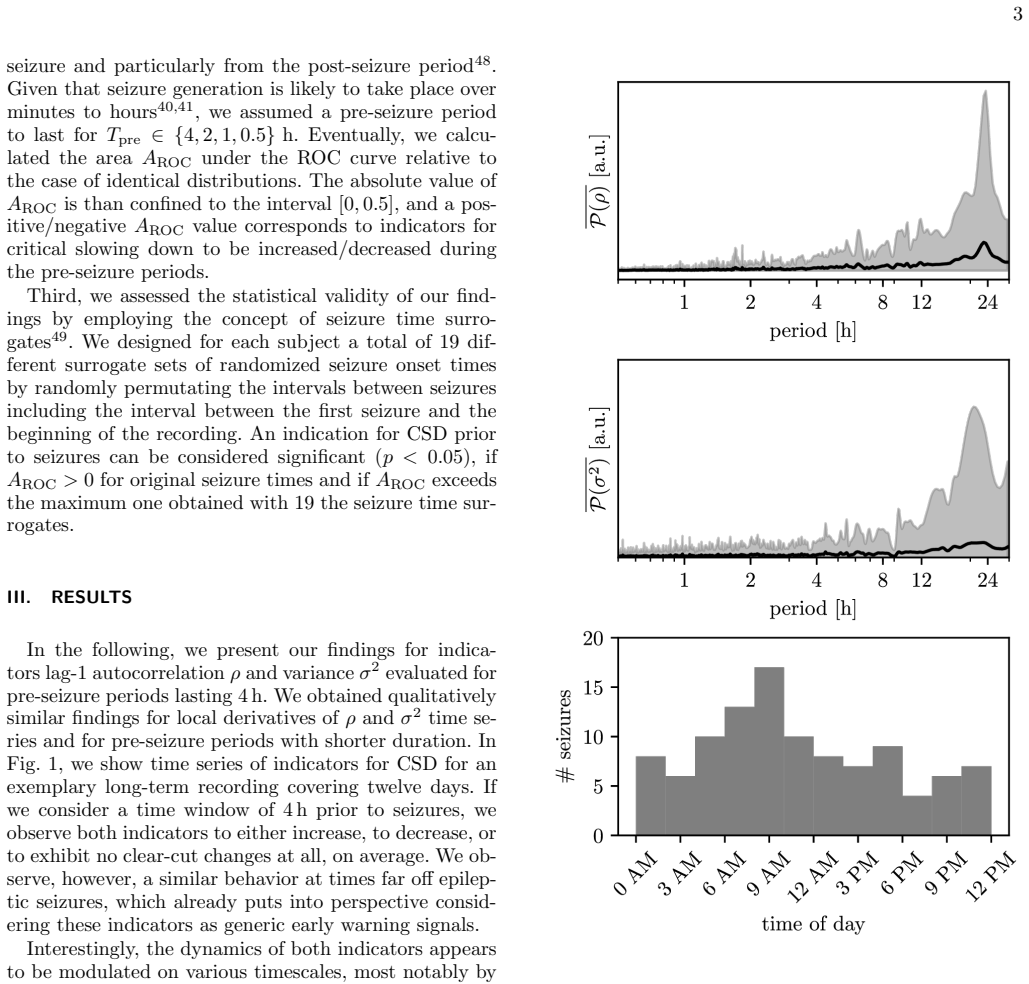
- [Section III, Fig. 2 and Conclusion] The 24 h rhythm is identified as a dominant contributor to the variability of both indicators, yet it is not removed or stratified in the ROC analysis. The power spectral densities in Fig. 2 show strong contributions at about 24 h for both ρ and σ², and the Conclusion names the sleep-wake cycle as a potential confounding variable. Because this slow modulation inflates the variance of both the pre-seizure and baseline distributions, it can reduce the sensitivity of the ROC comparison even if seizures are uniformly distributed over the day. Please repeat the analysis after removing the 24 h component (e.g., by subtracting a subject-specific diurnal average computed from interictal data or by stratifying the comparison by time of day) and report the resulting AROC distributions and surrogate-test outcomes.
- [Section II, variance preprocessing] The preprocessing that omits the upper 0.5% of all σ² values is applied to the very indicator under study. If a genuine pre-seizure elevation of variance falls in the upper tail, this step removes the signal of interest. The paper provides no robustness analysis for this threshold, and it does not report whether the excluded windows are enriched in the pre-seizure periods. Please either justify the threshold with a quantitative check or repeat the analysis for several thresholds (e.g., no exclusion, 0.1%, 1%) and show that the negative result is unchanged.
minor comments (5)
- [Throughout] There are small typographical errors; for example, 'There is a ongoing debate' in the abstract, 'An alternatively, data-driven approach' in the Introduction, and 'The absolute value of AROC is than confined' in Section II.
- [Data and code availability] No data or code availability statement is provided; for a quantitative null result of this kind, a statement about data availability and analysis code would improve reproducibility.
- [Section II, surrogate test] The surrogate test uses only 19 surrogates, yielding a minimum p-value of 0.05; the manuscript does not discuss how the granularity of this permutation test affects the interpretation of 'one-seventh of brain sites' passing.
- [Section III, seizure timing] The statement that seizures occurred equally distributed over the 24 h cycle is based on all 105 seizures pooled across subjects; a per-subject circadian distribution would be more informative given the subject-level analysis elsewhere in the paper.
- [Section III, prior results] The phrase 'similar to what has been described before [24,39]' would benefit from a brief description of how the previously reported fraction compares quantitatively with the 1-2% found here.
Circularity Check
No circularity: the negative result is derived from direct data estimates and a surrogate null; no fitted quantity is renamed as a prediction.
full rationale
The paper's central claim is an empirical null result: variance and lag-1 autocorrelation estimated from iEEG do not systematically increase before seizures. The derivation chain is data -> sliding-window estimates -> ROC separation of preseizure vs. remaining data -> seizure-time surrogate threshold. No parameter is fitted to the outcome and then reported as a prediction; the surrogate procedure is an explicit null built by permuting seizure onset intervals, so a significant AROC is defined as exceeding the surrogate maximum, not as a transformed fit. The indicators (variance, lag-1 autocorrelation) are standard operationalizations of CSD, not definitions that presuppose the conclusion. The self-citations (refs. 39-45, 49) concern data provenance, seizure-prediction context, and the seizure-time-surrogate concept, but the surrogate procedure is described in the text and applied to the authors' own data; the cited surrogate method is an independent statistical tool, not an unverified premise that forces the result. A reviewer's concern that the 'remaining data' baseline includes 4 h preseizure windows of other seizures is a legitimate statistical power/control issue that could obscure a real signal, but it is not a circular reduction: the AROC is still computed from the data, and the negative finding is conditional on that baseline choice rather than equivalent to an input by construction. No equation is reused as its own conclusion, and no known empirical pattern is simply renamed. Therefore the paper is self-contained against external benchmarks and merits a circularity score of 0.
Assumptions & free parameters
free parameters (5)
- Pre-seizure window T_pre =
4 h (2, 1, and 0.5 h also tested)
- Lag tau for lag-1 autocorrelation =
30 ms
- Upper 0.5% variance values omitted =
0.5%
- Number of seizure-time surrogates =
19
- Sliding window length =
20.48 s
assumptions (4)
- domain assumption Increased variance and lag-1 autocorrelation are valid indicators of critical slowing down for the observed iEEG observable
- domain assumption Each electrode's iEEG time series is an appropriate system observable whose fluctuations reflect perturbations
- domain assumption Randomly permuting intervals between seizures produces a valid null distribution for pre-seizure indicator changes
- ad hoc to paper The remaining data, excluding only 60 min after each seizure, form a valid control baseline for the ROC comparison
Cite this review
Pith. "Pith review of No evidence for critical slowing down prior to human epileptic seizures." pith.science (2026). https://pith.science/paper/2F4NDXJR
@misc{pith2026190808973,
  author       = {Pith},
  title        = {Pith review of: No evidence for critical slowing down prior to human epileptic seizures},
  year         = {2026},
  howpublished = {\url{https://pith.science/paper/2F4NDXJR}},
  note         = {Machine review of arXiv:1908.08973}
}
read the original abstract
There is a ongoing debate whether generic early warning signals for critical transitions exist that can be applied across diverse systems. The human epileptic brain is often considered as a prototypical system, given the devastating and, at times, even life-threatening nature of the extreme event epileptic seizure. More than three decades of international effort has successfully identified predictors of imminent seizures. However, the suitability of typically applied early warning indicators for critical slowing down, namely variance and lag-1 autocorrelation, for indexing seizure susceptibility is still controversially discussed. Here, we investigated long-term, multichannel recordings of brain dynamics from 28 subjects with epilepsy. Using a surrogate-based evaluation procedure of sensitivity and specificity of time-resolved estimates of early warning indicators, we found no evidence for critical slowing down prior to 105 epileptic seizures.
Figures


Reference graph
Works this paper leans on
-
[1]
author author V. Afrajmovich , author Y. S. \ Il'yashenko , author L. Shil'nikov , author V. Arnold , author V. Arnold , \ and\ author N. Kazarinoff ,\ @noop title Dynamical Systems V : B ifurcation Theory and Catastrophe Theory \ ( publisher Springer ,\ year 1994 ) NoStop
work page 1994
-
[2]
author author J. M. T. \ Thompson , author H. B. \ Stewart , \ and\ author Y. Ueda ,\ title title Safe, explosive, and dangerous bifurcations in dissipative dynamical systems , \ @noop journal journal Phys. Rev. E \ volume 49 ,\ pages 1019 ( year 1994 ) NoStop
work page 1994
-
[3]
author author V. Dakos , author M. Scheffer , author E. H. \ van Nes , author V. Brovkin , author V. Petoukhov , \ and\ author H. Held ,\ title title Slowing down as an early warning signal for abrupt climate change , \ 10.1073/pnas.0802430105 journal journal Proc. Natl. Acad. Sci. U.S.A. \ volume 105 ,\ pages 14308--14312 ( year 2008 ) NoStop
-
[4]
author author M. Scheffer , author J. Bascompte , author W. A. \ Brock , author V. Brovkin , author S. R. \ Carpenter , author V. Dakos , author H. Held , author E. H. \ Van Nes , author M. Rietkerk , \ and\ author G. Sugihara ,\ title title Early-warning signals for critical transitions , \ @noop journal journal Nature \ volume 461 ,\ pages 53 ( year 200...
work page 2009
-
[5]
author author C. Kuehn ,\ title title A mathematical framework for critical transitions: Bifurcations, fast-slow systems and stochastic dynamics , \ 10.1016/j.physd.2011.02.012 journal journal Physica D \ volume 240 ,\ pages 1020--1035 ( year 2011 ) NoStop
-
[6]
author author T. Lenton , author V. Livina , author V. Dakos , author E. Van Nes , \ and\ author M. Scheffer ,\ title title Early warning of climate tipping points from critical slowing down: comparing methods to improve robustness , \ @noop journal journal Phil. Trans. Roy. Soc. A: Mathematical, Physical and Engineering Sciences \ volume 370 ,\ pages 118...
work page 2012
-
[7]
author author J. Sieber \ and\ author J. M. T. \ Thompson ,\ title title Nonlinear softening as a predictive precursor to climate tipping , \ @noop journal journal Phil. Trans. Roy. Soc. A: Mathematical, Physical and Engineering Sciences \ volume 370 ,\ pages 1205--1227 ( year 2012 ) NoStop
work page 2012
-
[8]
author author M. Scheffer , author S. R. \ Carpenter , author T. M. \ Lenton , author J. Bascompte , author W. Brock , author V. Dakos , author J. van de Koppel , author I. A. \ van de Leemput , author S. A. \ Levin , author E. H. \ van Nes , author M. Pascual , \ and\ author J. Vandermeer ,\ title title Anticipating critical transitions , \ 10.1126/scien...
Show all 65 references
-
[9]
Dai , author D
author author L. Dai , author D. Vorselen , author K. S. \ Korolev , \ and\ author J. Gore ,\ title title Generic indicators for loss of resilience before a tipping point leading to population collapse , \ @noop journal journal Science \ volume 336 ,\ pages 1175--1177 ( year 2...
2012
-
[10]
Feudel , author A
author author U. Feudel , author A. N. \ Pisarchik , \ and\ author K. Showalter ,\ title title Multistability and tipping: From mathematics and physics to climate and brain—minireview and preface to the focus issue , \ 10.1063/1.5027718 journal journal Chaos \ volume 28 ,\ pag...
-
[11]
Kasz \'a s , author U
author author B. Kasz \'a s , author U. Feudel , \ and\ author T. T \'e l ,\ title title Tipping phenomena in typical dynamical systems subjected to parameter drift , \ @noop journal journal Sci. Rep. \ volume 9 ,\ pages 8654 ( year 2019 ) NoStop
2019
-
[12]
Dakos , author S
author author V. Dakos , author S. R. \ Carpenter , author W. A. \ Brock , author A. M. \ Ellison , author V. Guttal , author A. R. \ Ives , author S. Kéfi , author V. Livina , author D. A. \ Seekell , author E. H. \ van Nes , \ and\ author M. Scheffer ,\ title title Methods f...
-
[13]
Kubo ,\ title title The fluctuation-dissipation theorem , \ @noop journal journal Rep
author author R. Kubo ,\ title title The fluctuation-dissipation theorem , \ @noop journal journal Rep. Prog. Phys. \ volume 29 ,\ pages 255 ( year 1966 ) NoStop
1966
-
[14]
author author P. D. \ Ditlevsen \ and\ author S. J. \ Johnsen ,\ title title Tipping points: early warning and wishful thinking , \ @noop journal journal Geophys. Res. Lett. \ volume 37 ,\ pages L19703 ( year 2010 ) NoStop
2010
-
[15]
Boettiger \ and\ author A
author author C. Boettiger \ and\ author A. Hastings ,\ title title Early warning signals and the prosecutor's fallacy , \ @noop journal journal Proc Roy Soc. B: Biol. Sci. \ volume 279 ,\ pages 4734--4739 ( year 2012 ) NoStop
2012
-
[16]
Boettiger , author N
author author C. Boettiger , author N. Ross , \ and\ author A. Hastings ,\ title title Early warning signals: the charted and uncharted territories , \ 10.1007/s12080-013-0192-6 journal journal Theor. Ecol. \ volume 6 ,\ pages 255--264 ( year 2013 ) NoStop
-
[17]
Boettiger \ and\ author A
author author C. Boettiger \ and\ author A. Hastings ,\ title title No early warning signals for stochastic transitions: insights from large deviation theory , \ @noop journal journal Proc. Roy. Soc. B: Biol. Sci. \ volume 280 ,\ pages 20131372 ( year 2013 ) NoStop
2013
-
[18]
Guttal , author C
author author V. Guttal , author C. Jayaprakash , \ and\ author O. P. \ Tabbaa ,\ title title Robustness of early warning signals of regime shifts in time-delayed ecological models , \ 10.1007/s12080-013-0194-4 journal journal Theor. Ecol. \ volume 6 ,\ pages 271--283 ( year 2...
-
[19]
Dakos , author S
author author V. Dakos , author S. R. \ Carpenter , author E. H. \ van Nes , \ and\ author M. Scheffer ,\ title title Resilience indicators: prospects and limitations for early warnings of regime shifts , \ 10.1098/rstb.2013.0263 journal journal Phil. Trans. R. Soc. B: Biol. S...
2013
-
[20]
Dai , author K
author author L. Dai , author K. S. \ Korolev , \ and\ author J. Gore ,\ title title Relation between stability and resilience determines the performance of early warning signals under different environmental drivers , \ @noop journal journal Proc. Natl. Acad. Sci. (U.S.A.) \ ...
2015
-
[21]
Diks , author C
author author C. Diks , author C. Hommes , \ and\ author J. Wang ,\ title title Critical slowing down as an early warning signal for financial crises? \ https://doi.org/10.1007/s00181-018-1527-3 journal journal Empirical Economics \ ,\ pages 1--28 ( year 2015 ) NoStop
-
[22]
author author T. J. \ Wagner \ and\ author I. Eisenman ,\ title title False alarms: How early warning signals falsely predict abrupt sea ice loss , \ @noop journal journal Geophys. Res. Lett. \ volume 42 ,\ pages 10--333 ( year 2015 ) NoStop
2015
-
[23]
Zhang , author C
author author X. Zhang , author C. Kuehn , \ and\ author S. Hallerberg ,\ title title Predictability of critical transitions , \ 10.1103/PhysRevE.92.052905 journal journal Phys. Rev. E \ volume 92 ,\ pages 052905 ( year 2015 ) NoStop
2015 doi
-
[24]
Milanowski \ and\ author P
author author P. Milanowski \ and\ author P. Suffczynski ,\ title title Seizures start without common signatures of critical transition , \ @noop journal journal Int. J. Neural Syst. \ volume 26 ,\ pages 1650053 ( year 2016 ) NoStop
2016
-
[25]
Qin \ and\ author C
author author S. Qin \ and\ author C. Tang ,\ title title Early-warning signals of critical transition: E ffect of extrinsic noise , \ @noop journal journal Phys. Rev. E \ volume 97 ,\ pages 032406 ( year 2018 ) NoStop
2018
-
[26]
author author S. M. \ O'Regan \ and\ author D. L. \ Burton ,\ title title How stochasticity influences leading indicators of critical transitions , \ @noop journal journal Bull. Math. Biol. \ volume 80 ,\ pages 1630--1654 ( year 2018 ) NoStop
2018
-
[27]
Romano \ and\ author C
author author F. Romano \ and\ author C. Kuehn ,\ title title Analysis and predictability of tipping points with leading-order nonlinear term , \ @noop journal journal Int. J. Bifurcation Chaos \ volume 28 ,\ pages 1850103 ( year 2018 ) NoStop
2018
-
[28]
Wen , author M
author author H. Wen , author M. P. \ Ciamarra , \ and\ author S. A. \ Cheong ,\ title title How one might miss early warning signals of critical transitions in time series data: A systematic study of two major currency pairs , \ @noop journal journal PloS one \ volume 13 ,\ p...
2018
-
[29]
author author C. F. \ Clements , author M. A. \ McCarthy , \ and\ author J. L. \ Blanchard ,\ title title Early warning signals of recovery in complex systems , \ @noop journal journal Nat. Commun. \ volume 10 ,\ pages 1681 ( year 2019 ) NoStop
2019
-
[30]
a ger \ and\ author M. F \
author author G. J \"a ger \ and\ author M. F \"u llsack ,\ title title Systematically false positives in early warning signal analysis , \ @noop journal journal PloS one \ volume 14 ,\ pages e0211072 ( year 2019 ) NoStop
2019
-
[31]
author author M. A. \ Kramer , author W. Truccolo , author U. T. \ Eden , author K. Q. \ Lepage , author L. R. \ Hochberg , author E. N. \ Eskandar , author J. R. \ Madsen , author J. W. \ Lee , author A. Maheshwari , author E. Halgren , et al. ,\ title title Human seizures se...
2012
-
[32]
Meisel \ and\ author C
author author C. Meisel \ and\ author C. Kuehn ,\ title title Scaling effects and spatio-temporal multilevel dynamics in epileptic seizures , \ @noop journal journal PLoS One \ volume 7 ,\ pages e30371 ( year 2012 ) NoStop
2012
-
[33]
author author I. A. \ van de Leemput , author M. Wichers , author A. O. \ Cramer , author D. Borsboom , author F. Tuerlinckx , author P. Kuppens , author E. H. \ van Nes , author W. Viechtbauer , author E. J. \ Giltay , author S. H. \ Aggen , et al. ,\ title title Critical slo...
2014
-
[34]
Meisel , author A
author author C. Meisel , author A. Klaus , author C. Kuehn , \ and\ author D. Plenz ,\ title title Critical slowing down governs the transition to neuron spiking , \ @noop journal journal PLoS Comput. Biol. \ volume 11 ,\ pages e1004097 ( year 2015 ) NoStop
2015
-
[35]
Bayani , author F
author author A. Bayani , author F. Hadaeghi , author S. Jafari , \ and\ author G. Murray ,\ title title Critical slowing down as an early warning of transitions in episodes of bipolar disorder: A simulation study based on a computational model of circadian activity rhythms , ...
2017
-
[36]
Scheffer , author J
author author M. Scheffer , author J. E. \ Bolhuis , author D. Borsboom , author T. G. \ Buchman , author S. M. \ Gijzel , author D. Goulson , author J. E. \ Kammenga , author B. Kemp , author I. A. \ van de Leemput , author S. Levin , author C. M. \ Martin , author R. J. F. \...
2018
-
[37]
author author D. R. \ Freestone , author P. J. \ Karoly , \ and\ author M. J. \ Cook ,\ title title A forward-looking review of seizure prediction , \ @noop journal journal Curr. Opin. Neurol. \ volume 30 ,\ pages 167--173 ( year 2017 ) NoStop
2017
-
[38]
Nazarimehr , author S
author author F. Nazarimehr , author S. M. R. H. \ Golpayegani , \ and\ author B. Hatef ,\ title title Does the onset of epileptic seizure start from a bifurcation point? \ @noop journal journal Eur. Phys. J. ST \ volume 227 ,\ pages 697--705 ( year 2018 ) NoStop
2018
-
[39]
Mormann , author T
author author F. Mormann , author T. Kreuz , author C. Rieke , author R. G. \ Andrzejak , author A. Kraskov , author P. David , author C. E. \ Elger , \ and\ author K. Lehnertz ,\ title title On the predictability of epileptic seizures , \ 10.1016/j.clinph.2004.08.025 journal ...
-
[40]
Mormann , author R
author author F. Mormann , author R. Andrzejak , author C. E. \ Elger , \ and\ author K. Lehnertz ,\ title title Seizure prediction: the long and winding road , \ 10.1093/brain/awl241 journal journal Brain \ volume 130 ,\ pages 314--333 ( year 2007 ) NoStop
-
[41]
Kuhlmann , author K
author author L. Kuhlmann , author K. Lehnertz , author M. P. \ Richardson , author B. Schelter , \ and\ author H. P. \ Zaveri ,\ title title Seizure prediction---ready for a new era , \ @noop journal journal Nat Rev. Neurol. \ ,\ pages 618--630 ( year 2018 ) NoStop
2018
-
[42]
Dickten , author S
author author H. Dickten , author S. Porz , author C. E. \ Elger , \ and\ author K. Lehnertz ,\ title title Weighted and directed interactions in evolving large-scale epileptic brain networks , \ 10.1038/srep34824 journal journal Sci. Rep. \ volume 6 ,\ pages 34824 ( year 2016...
-
[43]
Lehnertz , author H
author author K. Lehnertz , author H. Dickten , author S. Porz , author C. Helmstaedter , \ and\ author C. E. \ Elger ,\ title title Predictability of uncontrollable multifocal seizures – towards new treatment options , \ 10.1038/srep24584 journal journal Sci. Rep. \ volume ...
-
[44]
Rings , author M
author author T. Rings , author M. Mazarei , author A. Akhshi , author C. Geier , author M. R. R. \ Tabar , \ and\ author K. Lehnertz ,\ title title Traceability and dynamical resistance of precursor of extreme events , \ @noop journal journal Sci. Rep. \ volume 9 ,\ pages 174...
2019
-
[45]
Rings , author R
author author T. Rings , author R. von Wrede , \ and\ author K. Lehnertz ,\ title title Precursors of seizures due to specific spatial-temporal modifications of evolving large-scale epileptic brain networks , \ @noop journal journal Sci. Rep. \ volume 9 ,\ pages 10623 ( year 2...
2019
-
[46]
Lehnertz , author C
author author K. Lehnertz , author C. Geier , author T. Rings , \ and\ author K. Stahn ,\ title title Capturing time-varying brain dynamics , \ @noop journal journal EPJ Nonlin. Biomed. Phys. \ volume 5 ,\ pages 2 ( year 2017 ) NoStop
2017
-
[47]
author author J. P. \ Egan ,\ @noop title Signal detection theory and ROC -analysis \ ( publisher Academic press ,\ year 1975 ) NoStop
1975
-
[48]
author author N. K. \ So \ and\ author W. T. \ Blume ,\ title title The postictal EEG , \ @noop journal journal Epilepsy Behav. \ volume 19 ,\ pages 121--126 ( year 2010 ) NoStop
2010
-
[49]
author author R. G. \ Andrzejak , author F. Mormann , author T. Kreuz , author C. Rieke , author A. Kraskov , author C. E. \ Elger , \ and\ author K. Lehnertz ,\ title title Testing the null hypothesis of the nonexistence of a preseizure state , \ @noop journal journal Phys. R...
2003
-
[50]
author author W. H. \ Press \ and\ author G. B. \ Rybicki ,\ title title Fast algorithm for spectral analysis of unevenly sampled data , \ 10.1086/167197 journal journal Astrophys. J. \ volume 338 ,\ pages 277--280 ( year 1989 ) NoStop
-
[51]
author author D. A. \ Steyn-Ross , author M. L. \ Steyn-Ross , author J. W. \ Sleigh , author M. T. \ Wilson , author I.-P. \ Gillies , \ and\ author J. J. \ Wright ,\ title title The sleep cycle modelled as a cortical phase transition , \ @noop journal journal J. Biol. Phys. ...
2005
-
[52]
\ Yang , author L
author author D.-P. \ Yang , author L. McKenzie-Sell , author A. Karanjai , \ and\ author P. A. \ Robinson ,\ title title Wake-sleep transition as a noisy bifurcation , \ 10.1103/PhysRevE.94.022412 journal journal Phys. Rev. E \ volume 94 ,\ pages 022412 ( year 2016 ) NoStop
-
[53]
Stevens , author H
author author J. Stevens , author H. Kodama , author B. Lonsbury , \ and\ author L. Mills ,\ title title Ultradian characteristics of spontaneous seizures discharges recorded by radio telemetry in man , \ @noop journal journal Electroencephalogr. Clin. Neurophysiol. \ volume 3...
1971
-
[54]
author author P. J. \ Karoly , author D. R. \ Freestone , author R. Boston , author D. B. \ Grayden , author D. Himes , author K. Leyde , author U. Seneviratne , author S. Berkovic , author T. O’Brien , \ and\ author M. J. \ Cook ,\ title title Interictal spikes and epileptic ...
2016
-
[55]
author author M. O. \ Baud , author J. K. \ Kleen , author E. A. \ Mirro , author J. C. \ Andrechak , author D. King-Stephens , author E. F. \ Chang , \ and\ author V. R. \ Rao ,\ title title Multi-day rhythms modulate seizure risk in epilepsy , \ @noop journal journal Nat. Co...
2018
-
[56]
author author P. J. \ Karoly , author D. M. \ Goldenholz , author D. R. \ Freestone , author R. E. \ Moss , author D. B. \ Grayden , author W. H. \ Theodore , \ and\ author M. J. \ Cook ,\ title title Circadian and circaseptan rhythms in human epilepsy: a retrospective cohort ...
2018
-
[57]
Takagi ,\ title title Sleep and epilepsy , \ @noop journal journal Sleep Biol
author author S. Takagi ,\ title title Sleep and epilepsy , \ @noop journal journal Sleep Biol. Rhythms \ volume 15 ,\ pages 189--196 ( year 2017 ) NoStop
2017
-
[58]
Khan , author L
author author S. Khan , author L. Nobili , author R. Khatami , author T. Loddenkemper , author C. Cajochen , author D.-J. \ Dijk , \ and\ author S. H. \ Eriksson ,\ title title Circadian rhythm and epilepsy , \ @noop journal journal Lancet Neurol. \ volume 17 ,\ pages 1098--11...
2018
-
[59]
Lehnertz , author G
author author K. Lehnertz , author G. Ansmann , author S. Bialonski , author H. Dickten , author C. Geier , \ and\ author S. Porz ,\ title title Evolving networks in the human epileptic brain , \ 10.1016/j.physd.2013.06.009 journal journal Physica D \ volume 267 ,\ pages 7--15...
2013 doi
-
[60]
Geier , author S
author author C. Geier , author S. Bialonski , author C. E. \ Elger , \ and\ author K. Lehnertz ,\ title title How important is the seizure onset zone for seizure dynamics? \ 10.1016/j.seizure.2014.10.013 journal journal Seizure \ volume 25 ,\ pages 160--166 ( year 2015 ) NoStop
2014 doi
-
[61]
author author D. D. \ Spencer , author J. L. \ Gerrard , \ and\ author H. P. \ Zaveri ,\ title title The roles of surgery and technology in understanding focal epilepsy and its comorbidities , \ @noop journal journal Lancet Neurol. \ volume 17 ,\ pages 373--382 ( year 2018 ) NoStop
2018
-
[62]
Ashwin , author S
author author P. Ashwin , author S. Wieczorek , author R. Vitolo , \ and\ author P. Cox ,\ title title Tipping points in open systems: bifurcation, noise-induced and rate-dependent examples in the climate system , \ @noop journal journal Phil. Trans. Roy. Soc. A: Mathematical,...
2012
-
[63]
Ritchie \ and\ author J
author author P. Ritchie \ and\ author J. Sieber ,\ title title Early-warning indicators for rate-induced tipping , \ @noop journal journal Chaos \ volume 26 ,\ pages 093116 ( year 2016 ) NoStop
2016
-
[64]
Ritchie \ and\ author J
author author P. Ritchie \ and\ author J. Sieber ,\ title title Probability of noise- and rate-induced tipping , \ @noop journal journal Phys. Rev. E \ volume 95 ,\ pages 052209 ( year 2017 ) NoStop
2017
-
[65]
author author P. E. \ McSharry , author L. A. \ Smith , \ and\ author L. Tarassenko ,\ title title Prediction of epileptic seizures: Are nonlinear methods relevant? \ @noop journal journal Nat. Med. \ volume 9 ,\ pages 241 ( year 2003 ) NoStop
2003
Reviewed August 14, 2026 · model on record in the stance chip above.
Discussion (0). Continue with ORCID to comment.