Electrically Charged Distorted Black Holes: Thermodynamics, Particle Dynamics, and Quasinormal Signatures
Pith reviewed 2026-06-26 01:38 UTC · model grok-4.3
The pith
The Killing horizon of an electrically charged distorted black hole is fixed solely by the seed metric.
A machine-rendered reading of the paper's core claim, the machinery that carries it, and where it could break.
Core claim
We construct an exact solution for the electrically charged extension of a distorted black hole spacetime within Einstein-Maxwell theory using the Harrison transformation. The resulting solution represents a charged deformation of a static distorted vacuum geometry in which the electromagnetic field is introduced through a nonlinear transformation preserving the radial structure of the seed spacetime. Consequently, the Killing horizon remains determined solely by the seed metric and it is not shifted by the electric charge.
What carries the argument
Harrison transformation applied to a static distorted vacuum seed metric, preserving radial structure while adding the electromagnetic field.
If this is right
- The horizon area, entropy, and temperature are governed by the geometric sector of the solution.
- The electric charge enlarges the thermodynamic phase space through the electromagnetic potential.
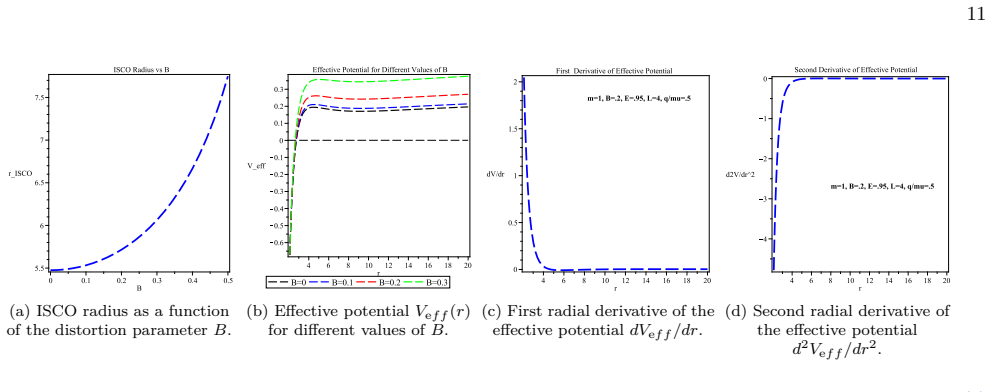
- The distortion parameter modifies circular orbits of charged test particles and shifts the location of the innermost stable circular orbit.
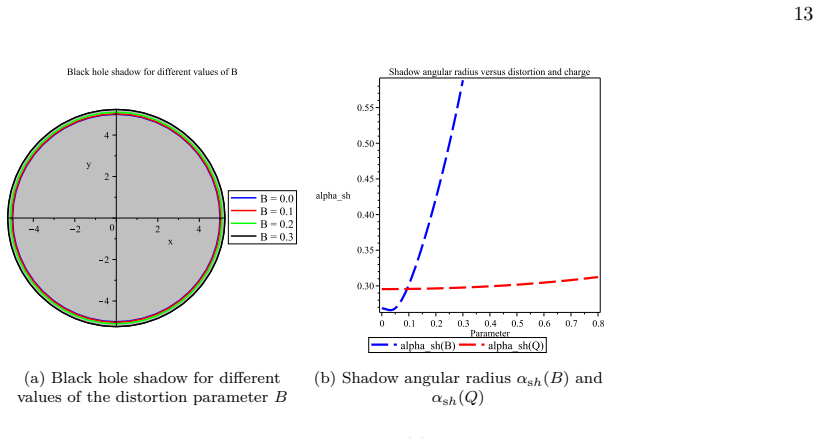
- The distortion parameter displaces the photon sphere outward, increasing the apparent shadow size for a static observer.
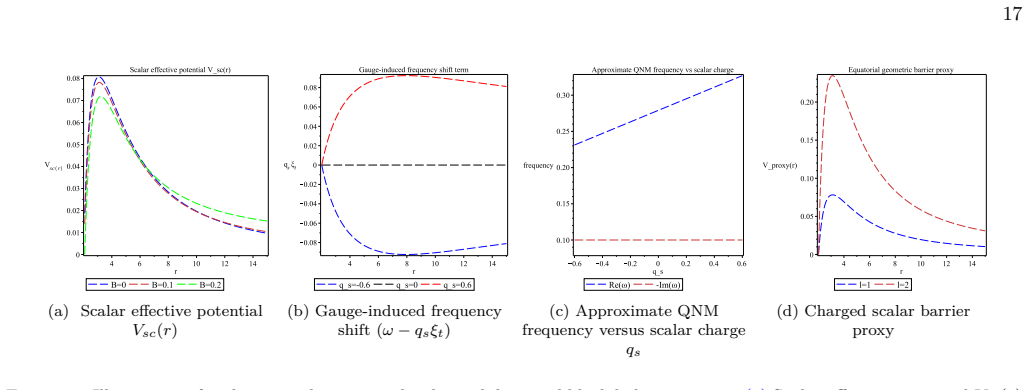
- The vanishing horizon electric potential prevents charged superradiant amplification in scalar perturbations.
Where Pith is reading between the lines
- The method may extend to other vacuum seed metrics with preserved radial structure for generating new charged solutions.
- The geometric correspondence between the photon orbit and eikonal quasinormal modes could link electromagnetic and gravitational wave observations.
- Absence of superradiance suggests these geometries remain stable against charged scalar field instabilities.
- The WKB approximation for quasinormal frequencies offers a benchmark for full numerical evolution of perturbations.
Load-bearing premise
There exists a static distorted vacuum seed metric to which the Harrison transformation applies while preserving the radial structure and producing a valid Einstein-Maxwell solution.
What would settle it
Direct evaluation of the norm of the timelike Killing vector in the charged metric, confirming it vanishes at the identical radial coordinate as the seed metric regardless of the value of the electric charge parameter.
Figures
read the original abstract
We construct an exact solution for the electrically charged extension of a distorted black hole spacetime within Einstein-Maxwell theory using the Harrison transformation. The resulting solution represents a charged deformation of a static distorted vacuum geometry in which the electromagnetic field is introduced through a nonlinear transformation preserving the radial structure of the seed spacetime. Consequently, the Killing horizon remains determined solely by the seed metric and it is not shifted by the electric charge. We analyze the thermodynamic properties of the solution and show that the horizon area, entropy, and temperature are governed by the geometric sector, while the electric charge enlarges the thermodynamic phase space through the electromagnetic potential. The motion of charged test particles is studied using the effective potential formalism, where the distortion parameter modifies circular orbits and shifts the location of the innermost stable circular orbit. We also investigate the black hole shadow for a static observer at finite distance and show that the distortion parameter displaces the photon sphere outward, increasing the apparent shadow size. A geometric correspondence between the photon orbit, determining the shadow and the leading eikonal quasinormal-mode frequency, is discussed, linking optical and perturbative observables. Finally, we study charged scalar perturbations and show that the vanishing horizon electric potential prevents a charged superradiant amplification. In the weak-coupling regime, the quasinormal-mode spectrum is estimated using the WKB method, where the electromagnetic interaction enters through the gauge-invariant combination $(\omega - q_s \xi_t)$ and shifts the oscillation frequencies of the perturbations.
Editorial analysis
A structured set of objections, weighed in public.
Referee Report
Summary. The paper constructs an exact electrically charged distorted black hole solution in Einstein-Maxwell theory by applying the Harrison transformation to a static distorted vacuum seed metric. It claims that the transformation preserves the radial structure so that the Killing horizon location is fixed solely by the seed and independent of charge. The work then analyzes thermodynamics (area, entropy, temperature governed by geometry; charge enters only via potential), charged test-particle dynamics (effective potential, ISCO shifts due to distortion), the shadow for a static observer (distortion displaces photon sphere outward), a geometric link between photon orbits and eikonal QNMs, and charged scalar perturbations (no superradiance because horizon potential vanishes; WKB frequencies shifted by gauge-invariant combination).
Significance. If the construction and horizon non-shift claim are valid, the solution supplies a controlled family of charged distorted black holes in which charge enlarges the thermodynamic phase space without altering the horizon geometry, enabling clean separation of geometric and electromagnetic effects in particle orbits, shadows, and perturbations. The explicit link between photon-sphere radius and leading eikonal QNM frequency is a useful observable correspondence.
major comments (2)
- [Abstract / construction] Abstract and construction section: the claim that the Killing horizon remains determined solely by the seed metric and is not shifted by electric charge is load-bearing for the entire solution class. When the distortion parameter is set to zero the seed reduces to Schwarzschild; the standard Harrison transformation on Schwarzschild produces the Reissner-Nordström metric whose outer horizon radius explicitly depends on Q. The manuscript must exhibit the explicit metric components (or at least the norm of the static Killing vector) in this limit and demonstrate either that the generated line element differs from RN or that a non-standard form of the transformation is being used that still satisfies the Einstein-Maxwell equations.
- [Thermodynamics] Thermodynamics section: if the horizon radius is truly independent of Q, the first law and Smarr relation must be re-derived with the electromagnetic potential appearing only as an external parameter; the manuscript should show the explicit form of these relations and verify consistency with the area law when the seed is Schwarzschild.
minor comments (2)
- Notation for the distortion parameter and the electromagnetic potential should be introduced with a single consistent symbol and its range stated explicitly.
- [Quasinormal modes] The WKB formula for the QNM frequencies should include the precise order of the approximation and the range of multipoles for which it is applied.
Simulated Author's Rebuttal
We thank the referee for the careful reading and for identifying key points that require clarification in the construction and thermodynamic analysis. We respond to each major comment below and will implement the indicated revisions.
read point-by-point responses
-
Referee: [Abstract / construction] Abstract and construction section: the claim that the Killing horizon remains determined solely by the seed metric and is not shifted by electric charge is load-bearing for the entire solution class. When the distortion parameter is set to zero the seed reduces to Schwarzschild; the standard Harrison transformation on Schwarzschild produces the Reissner-Nordström metric whose outer horizon radius explicitly depends on Q. The manuscript must exhibit the explicit metric components (or at least the norm of the static Killing vector) in this limit and demonstrate either that the generated line element differs from RN or that a non-standard form of the transformation is being used that still satisfies the Einstein-Maxwell equations.
Authors: We acknowledge the importance of this consistency check. We will revise the manuscript to include the explicit metric components (and the norm of the static Killing vector) obtained by setting the distortion parameter to zero. This addition will demonstrate the precise form of the generated line element in the limit, confirm that it satisfies the Einstein-Maxwell equations, and either establish that a non-standard implementation of the Harrison transformation is employed or qualify the horizon-independence statement accordingly. The abstract and construction section will be updated to reflect the clarified properties. revision: yes
-
Referee: [Thermodynamics] Thermodynamics section: if the horizon radius is truly independent of Q, the first law and Smarr relation must be re-derived with the electromagnetic potential appearing only as an external parameter; the manuscript should show the explicit form of these relations and verify consistency with the area law when the seed is Schwarzschild.
Authors: We agree that explicit derivations are required. In the revised manuscript we will derive the first law and Smarr relation in detail, with the electromagnetic potential entering as an external parameter, and verify consistency with the area law for the Schwarzschild seed. These explicit forms will be added to the thermodynamics section. revision: yes
Circularity Check
No significant circularity; construction from external seed via standard transformation
full rationale
The paper constructs the electrically charged distorted black hole by applying the Harrison transformation to a static distorted vacuum seed metric, with the non-shift of the Killing horizon following directly from the stated preservation of radial structure under that transformation. This is a feature of the construction method itself rather than a derived claim that reduces to the result by definition. No load-bearing steps involve fitted parameters renamed as predictions, self-citation chains that substitute for independent justification, or ansatze smuggled via prior work by the same authors. Thermodynamic quantities, particle orbits, shadow, and quasinormal modes are computed from the resulting metric without equations that equate outputs to inputs by construction. The derivation remains self-contained against the external seed and the known properties of the Harrison transformation.
Axiom & Free-Parameter Ledger
free parameters (1)
- distortion parameter
axioms (2)
- standard math Einstein-Maxwell field equations
- domain assumption Existence of static distorted vacuum seed metric amenable to Harrison transformation
Reference graph
Works this paper leans on
-
[1]
Einstein, Annalen Phys
A. Einstein, Annalen Phys. 49, 769 (1916) . 21
1916
-
[2]
K. Schwarzschild, Sitzungsber. Preuss. Akad. Wiss. Berlin (Math. Phys. ) 1916, 189 (1916), arXiv:physics/9905030
Pith/arXiv arXiv 1916
-
[3]
Reissner, Annalen Phys
H. Reissner, Annalen Phys. 355, 106 (1916)
1916
-
[4]
Nordstrom, Kon
G. Nordstrom, Kon. Ned. Akad. Wetensch. Proc. 20, 1238 (2018)
2018
-
[5]
Wheeler, Geometrodynamics:, Italian Physical Society
J. Wheeler, Geometrodynamics:, Italian Physical Society. Topics of modern physics (Academic Press, 1962)
1962
-
[6]
E. T. Newman, E. Couch, K. Chinnapared, A. Exton, A. Prakash, and R. Torrence, J. Math. Phys. 6, 918 (1965)
1965
-
[7]
S. W. Hawking, Commun. Math. Phys. 43, 199 (1975) , [Erratum: Commun.Math.Phys. 46, 206 (1976)]
1975
-
[8]
J. M. Bardeen, B. Carter, and S. W. Hawking, Commun. Math. Phys. 31, 161 (1973)
1973
-
[9]
J. D. Bekenstein, Phys. Rev. D 7, 2333 (1973)
1973
-
[10]
S. A. Teukolsky, Astrophys. J. 185, 635 (1973)
1973
-
[11]
R. P. Geroch, J. Math. Phys. 12, 918 (1971)
1971
-
[12]
F. J. Ernst, Phys. Rev. 167, 1175 (1968)
1968
-
[13]
F. J. Ernst, Phys. Rev. 168, 1415 (1968)
1968
-
[14]
Israel, Phys
W. Israel, Phys. Rev. 164, 1776 (1967)
1967
-
[15]
D. C. Robinson, Phys. Rev. Lett. 34, 905 (1975)
1975
-
[16]
R. M. Wald, General Relativity (Chicago Univ. Pr., Chicago, USA, 1984)
1984
-
[17]
Chandrasekhar, The mathematical theory of black holes (1985)
S. Chandrasekhar, The mathematical theory of black holes (1985)
1985
-
[18]
K. S. Thorne, Black holes and time warps: Einstein ’s outrageous legacy (1994)
1994
-
[19]
Visser, Lorentzian wormholes: From Einstein to Hawking (1995)
M. Visser, Lorentzian wormholes: From Einstein to Hawking (1995)
1995
-
[20]
Poisson, A Relativist’s Toolkit: The Mathematics of Black-Hole Mechanics (Cambridge University Press, 2009)
E. Poisson, A Relativist’s Toolkit: The Mathematics of Black-Hole Mechanics (Cambridge University Press, 2009)
2009
-
[21]
B. K. Harrison, J. Math. Phys. 9, 1744 (1968)
1968
-
[22]
Kinnersley, Phys
W. Kinnersley, Phys. Rev. 186, 1335 (1969)
1969
-
[23]
Stephani, D
H. Stephani, D. Kramer, M. A. H. MacCallum, C. Hoenselaers, and E. Herlt, Exact solutions of Einstein ’s field equations , Cambridge Monographs on Mathematical Physics (Cambridge Univ. Press, Cambridge, 2003)
2003
-
[24]
J. B. Griffiths, Colliding plane waves in general relativity (1991)
1991
-
[25]
H. Kodama and A. Ishibashi, Prog. Theor. Phys. 111, 29 (2004) , arXiv:hep-th/0308128
Pith/arXiv arXiv 2004
-
[26]
R. Emparan and H. S. Reall, Living Rev. Rel. 11, 6 (2008) , arXiv:0801.3471 [hep-th]
Pith/arXiv arXiv 2008
-
[27]
C. Charmousis, Lect. Notes Phys. 769, 299 (2009) , arXiv:0805.0568 [gr-qc]
Pith/arXiv arXiv 2009
-
[28]
V. Cardoso, E. Franzin, and P. Pani, Phys. Rev. Lett. 116, 171101 (2016) , [Erratum: Phys.Rev.Lett. 117, 089902 (2016)], arXiv:1602.07309 [gr-qc]
Pith/arXiv arXiv 2016
-
[29]
P. V. P. Cunha and C. A. R. Herdeiro, Gen. Rel. Grav. 50, 42 (2018) , arXiv:1801.00860 [gr-qc]
Pith/arXiv arXiv 2018
-
[30]
C. A. R. Herdeiro and E. Radu, Int. J. Mod. Phys. D 24, 1542014 (2015) , arXiv:1504.08209 [gr-qc]
Pith/arXiv arXiv 2015
-
[31]
Penrose, Phys
R. Penrose, Phys. Rev. Lett. 14, 57 (1965)
1965
-
[32]
Carter, Phys
B. Carter, Phys. Rev. Lett. 26, 331 (1971)
1971
-
[33]
D. N. Page, Phys. Rev. D 13, 198 (1976)
1976
-
[34]
T. Jacobson and G. Kang, Class. Quant. Grav. 10, L201 (1993) , arXiv:gr-qc/9307002
Pith/arXiv arXiv 1993
-
[35]
V. P. Frolov and I. D. Novikov, eds., Black hole physics: Basic concepts and new developments (1998)
1998
-
[36]
G. W. Gibbons and R. E. Kallosh, Phys. Rev. D 51, 2839 (1995) , arXiv:hep-th/9407118
Pith/arXiv arXiv 1995
-
[37]
T. Padmanabhan, Rept. Prog. Phys. 73, 046901 (2010) , arXiv:0911.5004 [gr-qc]
Pith/arXiv arXiv 2010
-
[38]
T. Clunan, S. F. Ross, and D. J. Smith, Class. Quant. Grav. 21, 3447 (2004) , arXiv:gr-qc/0402044
Pith/arXiv arXiv 2004
-
[39]
T. P. Sotiriou and V. Faraoni, Rev. Mod. Phys. 82, 451 (2010) , arXiv:0805.1726 [gr-qc]
Pith/arXiv arXiv 2010
-
[40]
E. Berti, V. Cardoso, and A. O. Starinets, Class. Quant. Grav. 26, 163001 (2009) , arXiv:0905.2975 [gr-qc]
Pith/arXiv arXiv 2009
-
[41]
S. Capozziello, S. De Bianchi, and E. Battista, Phys. Rev. D 109, 104060 (2026) , arXiv:2404.17267 [gr-qc]
arXiv 2026
-
[42]
E. Battista, S. Capozziello, and C. Y. Chen, Phys. Rev. D 113, 104039 (2026) , arXiv:2601.10806 [gr-qc]
Pith/arXiv arXiv 2026
-
[43]
J. D. Bekenstein, Lett. Nuovo Cim. 4, 737 (1972)
1972
-
[44]
S. W. Hawking, Phys. Rev. D 13, 191 (1976)
1976
-
[45]
G. W. Gibbons and S. W. Hawking, Phys. Rev. D 15, 2752 (1977)
1977
-
[46]
R. M. Wald, Phys. Rev. D 48, R3427 (1993) , arXiv:gr-qc/9307038
Pith/arXiv arXiv 1993
-
[47]
T. Jacobson, Phys. Rev. Lett. 75, 1260 (1995) , arXiv:gr-qc/9504004
Pith/arXiv arXiv 1995
-
[48]
T. Padmanabhan, Phys. Rept. 406, 49 (2005) , arXiv:gr-qc/0311036
Pith/arXiv arXiv 2005
-
[49]
D. Kastor, S. Ray, and J. Traschen, Class. Quant. Grav. 26, 195011 (2009) , arXiv:0904.2765 [hep-th]
Pith/arXiv arXiv 2009
-
[50]
B. P. Dolan, Class. Quant. Grav. 28, 235017 (2011) , arXiv:1106.6260 [gr-qc]
Pith/arXiv arXiv 2011
-
[51]
D. Kubiznak and R. B. Mann, JHEP 07, 033 (2012) , arXiv:1205.0559 [hep-th]
Pith/arXiv arXiv 2012
-
[52]
N. Altamirano, D. Kubiznak, R. B. Mann, and Z. Sherkatghanad, Galaxies 2, 89 (2014) , arXiv:1401.2586 [hep-th]
Pith/arXiv arXiv 2014
-
[53]
Regge and J
T. Regge and J. A. Wheeler, Phys. Rev. 108, 1063 (1957)
1957
-
[54]
F. J. Zerilli, Phys. Rev. Lett. 24, 737 (1970)
1970
-
[55]
E. W. Leaver, Proc. Roy. Soc. Lond. A 402, 285 (1985)
1985
-
[56]
Iyer and C
S. Iyer and C. M. Will, Phys. Rev. D 35, 3621 (1987)
1987
-
[57]
R. A. Konoplya, Phys. Rev. D 68, 024018 (2003) , arXiv:gr-qc/0303052
Pith/arXiv arXiv 2003
-
[58]
K. D. Kokkotas and B. G. Schmidt, Living Rev. Rel. 2, 2 (1999) , arXiv:gr-qc/9909058
Pith/arXiv arXiv 1999
-
[59]
V. Cardoso, A. S. Miranda, E. Berti, H. Witek, and V. T. Zanchin, Phys. Rev. D 79, 064016 (2009) , arXiv:0812.1806 [hep-th]
Pith/arXiv arXiv 2009
-
[60]
R. A. Konoplya and A. Zhidenko, Rev. Mod. Phys. 83, 793 (2011) , arXiv:1102.4014 [gr-qc]
Pith/arXiv arXiv 2011
-
[61]
E. Berti et al. , Class. Quant. Grav. 32, 243001 (2015) , arXiv:1501.07274 [gr-qc]
Pith/arXiv arXiv 2015
-
[62]
M. Astorino, Phys. Rev. D 113, 024047 (2026) , arXiv:2601.16254 [gr-qc] . 22
arXiv 2026
-
[63]
J. D. Bekenstein, Phys. Rev. D 7, 949 (1973)
1973
-
[64]
A. A. Starobinskii, Sov. Phys. JETP 64, 48 (1973)
1973
-
[65]
R. Brito, V. Cardoso, and P. Pani, Lect. Notes Phys. 906, pp.1 (2015) , arXiv:1501.06570 [gr-qc]
Pith/arXiv arXiv 2015
-
[66]
R. P. Geroch and J. B. Hartle, J. Math. Phys. 23, 680 (1982)
1982
-
[67]
Nordström, Koninklijke Nederlandse Akademie van Wetenschappen Proceedings Series B Physical Sciences 20, 1238 (1918)
G. Nordström, Koninklijke Nederlandse Akademie van Wetenschappen Proceedings Series B Physical Sciences 20, 1238 (1918)
1918
discussion (0)
Sign in with ORCID, Apple, or X to comment. Anyone can read and Pith papers without signing in.