REVIEW 2 major objections 5 minor 4 references
From Isolated Tasks to Structured Capabilities: A Multilayer Taxonomy for Large Language Models
T0 review · 2 major / 5 minor · reviewed 2026-08-01 · deepseek-v4-flash
Pith's one-line read This paper claims that LLM research, once mapped through a 14-domain, 91-subskill cognitive capability taxonomy, shows a systematic asymmetry: a few capabilities absorb most direct attention while six domains get under 2% of papers, and wit
desk verdict A genuinely useful capability taxonomy is undermined by an unvalidated annotation pipeline; treat the headline mapping numbers as illustrative, not measured fact. read the letter →
The pith
A machine-rendered reading of the paper's core claim, the machinery that carries it, and where it could break.
The reading
What carries the argument
The central object is the taxonomy itself plus the annotation pipeline that operationalizes it: a codebook of 14 domains and 91 subskills organized into Primitive, Constructed, and Integrative layers, with layer assignment based on developmental precedence and hypothesized functional support from human cognitive science. The pipeline runs three LLM annotators over each paper, validates their structured labels, resolves by consensus and majority voting, and sends remaining cases to arbitration; it distinguishes 'strong' evidence (capability is a central target) from 'weak' evidence (capability appears contextually). This machinery converts papers into capability vectors, enabling prevalence,
What would settle it
Re-annotate a stratified sample of the 15,934 papers with human experts at the subskill level, using the same codebook but without model-generated defaults; if the most frequent subskill's prevalence in a domain drops well below the reported 90% or more, or if many papers receive no subskill at all, then the subskill-concentration finding is an artifact of the annotation procedure rather than a property of the literature.
Extended reading notes
Core claim
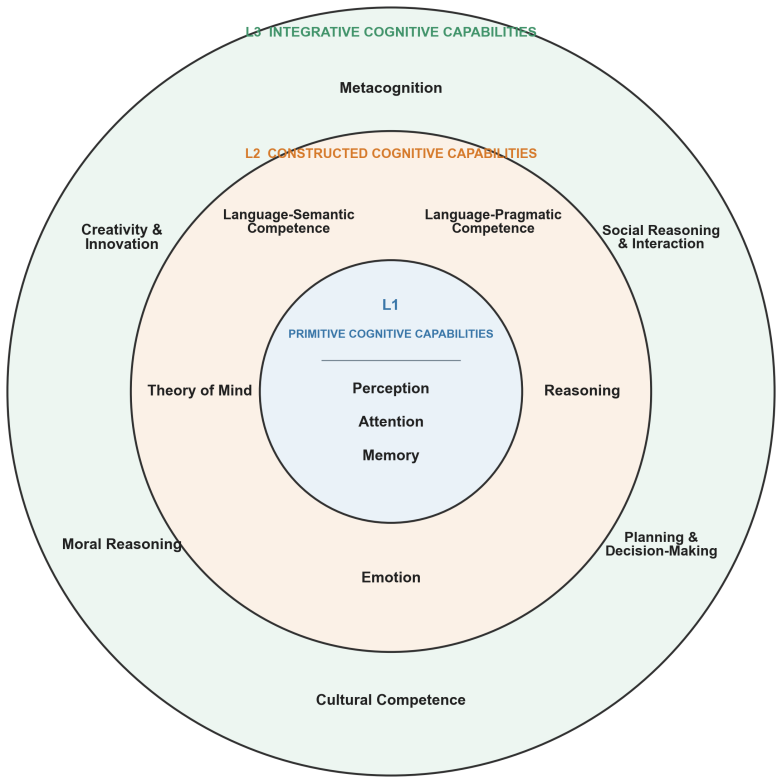
The paper's central claim is that LLM capability research can be organized into a multi-layer taxonomy of 14 cognitive capability domains and 91 subskills—Primitive (Perception, Attention, Memory), Constructed (Language-Semantic, Language-Pragmatic, Reasoning, Emotion, Theory of Mind), and Integrative (Metacognition, Social Reasoning and Interaction, Planning and Decision-Making, Creativity and Innovation, Cultural Competence, Moral Reasoning)—and that mapping the 2023–2025 ACL/AAAI/ICML/NeurIPS literature through this taxonomy reveals real structure: direct attention is concentrated in Language-Semantic Competence, Reasoning, Planning and Decision-Making, and Perception; six domains are nea
Load-bearing premise
The paper's central claim stands or falls on whether the three-model annotation pipeline correctly identifies which capabilities a paper actually studies—at both the domain and subskill level—since all reported concentration and co-occurrence patterns are derived from those labels.
Editorial extensions
If this is right
- If the taxonomy is sound, benchmark suites can be audited as capability portfolios, showing which domains and subskills they actually cover and where gaps remain.
- Evaluation results can be interpreted diagnostically: poor performance on an Integrative capability may point to lower-layer supporting capabilities rather than the target itself.
- Training and transfer research gains a hypothesis space: compare direct training on a capability with staged training on supporting capabilities, and use subskill labels for data selection.
- Coverage audits grounded in the taxonomy can prioritize understudied domains such as Theory of Mind, Moral Reasoning, Cultural Competence, and Creativity.
Reading between the lines
- Inference: The same annotation procedure could be run on later years or additional venues to track whether the concentration pattern shifts over time, giving a quantitative measure of capability diversification.
- Inference: If the taxonomy is adopted for benchmark design, the within-domain subskill concentration suggests that adding benchmarks targeting neglected subskills (e.g., orienting attention, prospective memory, moral implementation) would diversify coverage more than adding more tasks in the dominant subskill.
- Inference: Because subskills are pooled only from models that endorsed the parent domain, the reported near-universal top-subskill prevalence could partly reflect an annotation default; an independent human subskill-level annotation study would settle whether the concentration is real or an artifact.
- Inference: The taxonomy's layer structure invites a concrete transfer hypothesis—improving a Primitive capability such as working memory should raise performance on Constructed and Integrative capabilities that functionally rely on it, which can be tested with controlled ablations.
Editorial analysis
A structured set of objections, weighed in public.
Referee Report
Summary. This paper proposes a three-layer taxonomy of LLM cognitive capabilities (14 domains, 91 subskills) grounded in human cognitive science, and applies it to a corpus of 15,934 LLM-focused papers from ACL/AAAI/ICML/NeurIPS 2023–2025. The taxonomy is constructed in four phases from developmental and functional-support criteria, and operationalized as an annotation codebook. Using three LLM annotators with consensus and arbitration, the authors estimate domain prevalence (RQ1), subskill prevalence within domains (RQ2), and domain co-occurrence/lift (RQ3), reporting concentration in Language-Semantic Competence and Reasoning, near-universal top-subskill prevalence, and high-lift social/pragmatic/cultural pairs.
Significance. If the mapping pipeline is valid, the paper delivers a reusable capability space and the first large-scale map of research attention across it, with practical value for benchmark audits and evaluation design. Strengths include the transparent taxonomy construction (§2.3), honest hedging about the status of dependency relations, and a detailed 91-subskill codebook in the appendix. The empirical contribution, however, depends on annotation reliability that is currently demonstrated only weakly, at domain level and on 50 papers; the subskill-level result in particular needs validation before the RQ2 conclusion can be accepted.
major comments (2)
- [§4.1.4 and Table 4] The subskill aggregation rule makes the RQ2 saturation result potentially an artifact. Domain labels require support from at least two models, but subskills are 'pooled from models that endorsed the corresponding parent capability' with no two-model requirement. Because RQ2 percentages use the domain's strong-evidence count as denominator, any subskill that a single annotator emits whenever it endorses the parent domain will appear in ~100% of papers regardless of actual content. Table 4 shows exactly this pattern — 100.0% in Creativity, Cultural Competence, and Moral Reasoning, ≥90% in 10 of 14 domains. The only reliability evidence is domain-level κ=0.70 on 50 papers (§4.1.3); no subskill-level validation is reported. Therefore the claim that 'coverage masks concentration' is not yet supported. The authors should (a) require multi-model support for subskills or otherwise de-bias poolin
- [§4.1.3 and §4.1.4] Domain-level reliability is insufficient to support RQ1 and RQ3. The 50-paper expert sample is small and yields only moderate κ=0.70; no confidence interval, per-domain breakdown, or agreement on the strong/weak evidence distinction is reported. RQ1's headline percentages and RQ3's co-occurrence counts both use strong-evidence labels, so errors in evidence-strength assignment directly change the reported structure. Additionally, 8,583 of 31,505 papers were resolved by an LLM arbiter (§4.1.4) with no human check on arbitration decisions. I would like to see (i) per-domain and evidence-strength agreement on a larger stratified sample, (ii) a sensitivity analysis with the evidence-strength threshold changed, and (iii) a small human audit of arbitrated outputs.
minor comments (5)
- [Abstract and §4] The abstract states the mapping results without the 'illustrative' caveat that §4 explicitly gives. Please add a hedge in the abstract to match §5.4, since the corpus is restricted to four venues and three years.
- [Figure 1] Figure 1 is not legible at normal page size for the 91 subskills. Provide a higher-resolution figure or a supplementary table so the codebook is readable.
- [§4.1.3] For the 50-paper validation, report confidence intervals for κ, per-domain agreement, and agreement on the relevance-screening decision. The current single κ value is hard to interpret.
- [§5.4] The limitations section mentions 'ambiguity remains for conceptually adjacent domains' but does not address the conditional pooling/subskill defaulting concern raised by the aggregation rule in §4.1.4. Please add an explicit discussion.
- [§1] The concept of 'ability inversion' is introduced with examples but never connected to the mapping analysis. Clarify whether it is a motivating observation only or a claim that the taxonomy helps measure.
Circularity Check
No significant circularity: the taxonomy is built a priori from external cognitive-science sources and applied as a fixed codebook; the corpus statistics are empirical outputs that could have differed. Only a minor non-load-bearing self-citation and a subskill-label validity caveat weigh in.
full rationale
The paper's derivation chain is self-contained in the direction that matters for its claims. The 14-domain/91-subskill taxonomy is constructed a priori from human cognitive science (§2.3: iterative phases, textbook/handbook sources, external developmental and functional-support citations), and the paper explicitly disclaims that the mapping validates it: 'The process establishes the taxonomy's conceptual and operational basis but does not independently validate its proposed dependency relations' (§2.3, Phase 4). RQ1-RQ3 are then empirical measurements over a 15,934-paper corpus whose headline numbers (22.3% Language-Semantic, 21.3% Reasoning, median 97.9% top subskill, lift=30.84) are pipeline outputs, not taxonomy assumptions; the codebook fixes neither the domain prevalences nor the subskill distribution (Reasoning's top subskill is 67.7%), so no 'prediction' reduces to its input by construction. There is no fitted parameter relabeled as a prediction, no imported uniqueness theorem, and no ansatz smuggled via citation. Two residual items, neither load-bearing: (1) §1 cites Zhang et al. (2025), co-authored by two of the present authors (Jiang, Xiao), for the Bloom's-taxonomy coverage claim; this is a minor self-citation, but the same motivation is independently supported by Bean et al. (2025) and by the paper's own RQ1, so the argument does not reduce to it. (2) RQ2's 'coverage masks concentration' finding rests on subskill labels that are 'pooled from models that endorsed the corresponding parent capability' (§4.1.4) and received no subskill-level reliability check (the only expert validation is domain-level κ=0.70 on 50 papers, §4.1.3), so single-model default subskills could inflate prevalence. This is a genuine measurement-validity threat the paper only partially acknowledges (§5.4: 'some ambiguity remains for conceptually adjacent domains'), but because the aggregation rule does not force the 97.9% median, it is a correctness caveat rather than circularity. Score 2 reflects only the minor non-load-bearing self-citation.
Assumptions & free parameters
free parameters (4)
- Consensus agreement threshold =
0.60 mean layer-level agreement
- Minimum co-occurrence threshold for normalized rankings =
20 papers
- Priority weight of functional support vs. developmental precedence =
Qualitative priority (no numeric weight)
- Evidence-strength tie rule =
Resolved conservatively in favor of weak evidence
assumptions (3)
- domain assumption Human cognitive science (textbooks and handbooks) provides a valid reference space for LLM capabilities
- domain assumption Developmental precedence and functional support jointly determine layer membership
- domain assumption The three LLM annotators plus consensus/arbitration recover the true capability content of papers
invented entities (2)
-
14-domain/91-subskill three-layer capability taxonomy
independent evidence
-
Ability inversion
independent evidence
Cite this review
Pith. "Pith review of From Isolated Tasks to Structured Capabilities: A Multilayer Taxonomy for Large Language Models." pith.science (2026). https://pith.science/paper/2GESBBH4
@misc{pith2026260722182,
  author       = {Pith},
  title        = {Pith review of: From Isolated Tasks to Structured Capabilities: A Multilayer Taxonomy for Large Language Models},
  year         = {2026},
  howpublished = {\url{https://pith.science/paper/2GESBBH4}},
  note         = {Machine review of arXiv:2607.22182}
}
read the original abstract
Large language model (LLM) evaluation spans diverse tasks and benchmarks, yet evidence remains organized around tasks rather than the capabilities they probe. This fragmentation limits cross-study comparison, obscures capabilities tasks recruit, and makes coverage gaps difficult to identify. We introduce a multi-layer taxonomy of 14 capability domains and 91 subskills across Primitive, Constructed, and Integrative layers. Human cognitive science guides capability definition and organization, not LLM architecture. Layer assignments draw on developmental precedence and hypothesized functional support, while human-origin constructs are adapted to observable model behavior. To demonstrate operational utility, we screened 31,505 papers from ACL, AAAI, ICML, and NeurIPS between 2023 and 2025 and mapped 15,934 LLM-focused papers through multi-model annotation, consensus, and arbitration. Direct research attention concentrated on Language-Semantic Competence (3,551; 22.3%), Reasoning (3,388; 21.3%), Planning and Decision-Making (2,149; 13.5%), and Perception (1,954; 12.3%), whereas six domains appeared in fewer than 2% of papers. Within domains, the most frequent subskill had a median prevalence of 97.9% and appeared in at least 90% of papers in 10 of 14 domains. Language-Semantic Competence and Reasoning formed the highest-volume pair (n = 1,864; 11.7%; lift = 2.47), whereas Theory of Mind and Social Reasoning and Interaction showed the highest lift among pairs with at least 20 co-occurrences (n = 62; lift = 30.84). By shifting the unit of analysis from isolated tasks to structured capabilities, the taxonomy supports research organization, coverage audits, evaluation interpretation, and testable hypotheses for diagnosis, training, and transfer.
Figures


Figures from the paper (2 more)


Reference graph
Works this paper leans on
-
[1]
Albert, D., & Steinberg, L. (2011). Age differences in strategic planning as indexed by the Tower of London. Child Development, 82(5), 1501-1517. https://doi.org/10.1111/j.1467-8624.2011.01613.x Baddeley, A. (2003). Working memory and language: An overview. Journal of Communication Disorders, 36(3), 189-208. https://doi.org/10.1016/S0021-9924(03)00019-4 B...
arXiv 2011
-
[36]
Coda-Forno, J., Binz, M., Wang, J. X., & Schulz, E. (2024). CogBench: A large language model walks into a psychology lab. arXiv preprint arXiv:2402.18225. de Langis, K., Park, J. I., Hu, B., Le, K. C., Schramm, A., Mensink, M. C., Elfenbein, A., & Kang, D. (2025). A framework for robust cognitive evaluation of LLMs. arXiv preprint arXiv:2504.02789. Diamon...
arXiv 2024
-
[38]
Bisk, Y., Holtzman, A., Thomason, J., Andreas, J., Bengio, Y., Chai, J., Lapata, M., Lazaridou, A., May, J., Nisnevich, A., Pinto, N., & Turian, J. (2020). Experience grounds language. In Proceed- ings of the 2020 Conference on Empirical Methods in Natural Language Processing (pp. 8718-8735). Association for Computational Linguistics. https://doi.org/10.1...
arXiv 2020
-
[523]
https://doi.org/10.3389/fpsyg.2016.00523 Fischer, K. W. (1980). A theory of cognitive development: The control and construction of hier- archies of skills. Psychological Review, 87(6), 477-531. https://doi.org/10.1037/0033-295X.87.6.477 Gauvain, M. (2022). Cognitive development in infancy and childhood. Cambridge University Press. https://doi.org/10.1017/...
arXiv 2016
Reviewed August 1, 2026 · model on record in the stance chip above.
Discussion (0). Sign in to comment.