REVIEW 5 major objections 5 minor 85 references
Shallow Features Matter: Hierarchical Memory with Heterogeneous Interaction for Unsupervised Video Object Segmentation
T0 review · 5 major / 5 minor · reviewed 2026-08-06 · deepseek-v4-flash
Pith's one-line read Keeping shallow pixel-detail features and high-level semantic features in separate memory banks sets new top scores on three unsupervised video segmentation benchmarks.
desk verdict Solid, testable architectural claim for UVOS — separate shallow/high-level memory banks with heterogeneous interaction — but the self-feedback memory loop needs an explicit control. read the letter →
The pith
A machine-rendered reading of the paper's core claim, the machinery that carries it, and where it could break.
The reading
What carries the argument
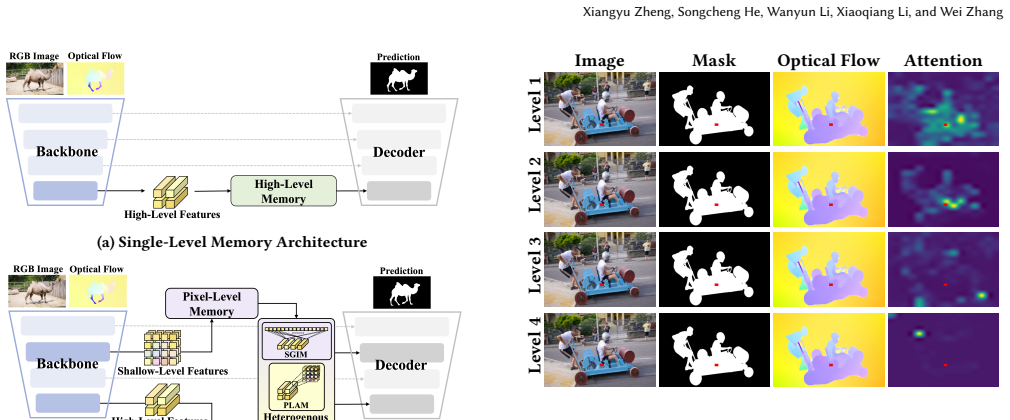
The machinery has three parts. First, a hierarchical memory: two separate banks store features from encoder layer 2 (shallow, pixel-detail rich) and layer 4 (high, semantic), each updated in a first-in-first-out sliding window with the current predicted mask plus the refined features. Second, a unified memory readout: the current frame's features at each level attend to the stored reference features through scaled dot-product attention, so each frame is refined by both pixel-level and semantic history. Third, the heterogeneous interaction, consisting of PLAM, which aligns shallow features to high-level resolution and fuses them by concatenation with channel and spatial attention, and SGIM, which projects high-level features down to the shallow space and applies self-attention plus global cross-attention. The two modules are deliberately asymmetric, because the paper's argument is that shallow and high-level features have different spatial resolutions and semantic granularities, so each direction of refinement needs its own operation.
What would settle it
Run the released HMHI-Net on DAVIS-16 twice, once with the layer-2 memory bank active and once with it replaced by an identity no-op, and check whether the J&F gap matches the paper's reported +0.8 margin; then repeat on the longest sequences to see whether the gap grows, which would reveal the predicted-mask feedback loop compounding errors.
Extended reading notes
Core claim
The central claim is that previous memory-based UVOS models are limited by a simple design flaw: storing only high-level features in memory. Because the encoder compresses images and dilutes fine-grained details, and because UVOS has no first-frame mask to provide pixel-level guidance, high-level memory alone can maintain object identity but cannot recover precise boundaries. The paper argues that storing shallow encoder features (layer 2) in a separate memory bank, alongside high-level features (layer 4), supplies the missing pixel detail, and that the two banks must interact heterogeneously: PLAM injects spatially coherent local structure into high-level features, while SGIM injects global semantic context into shallow features. On the paper's evidence this combination lifts HMHI-Net to 89.8% J&F on DAVIS-16, 86.9% J on FBMS, and 76.2% J on YouTube-Objects, improving over the strongest prior methods by 1.6, 3.5, and 1.5 points respectively, with similar gains on video salient object detection benchmarks and across multiple backbones.
Load-bearing premise
The load-bearing premise is that the predicted masks written into memory can be treated as reliable supervision, so a wrong early prediction can be stored, read back, and amplified in later frames.
Editorial extensions
If this is right
- The layer-selection ablation shows memory at layer 2 gives the biggest single gain (+0.8 J&F on DAVIS-16), so future UVOS memory designs should store shallow features rather than only the deepest layer.
- The interaction modules are both load-bearing: swapping PLAM and SGIM drops performance on DAVIS-16 from 89.8 to 89.1-89.3, so the asymmetry is doing causal work, not just adding parameters.
- The same model tops both UVOS and video saliency benchmarks, so the hierarchical memory recipe transfers to other mask-free video prediction tasks.
- Gains hold across mit_b1, mit_b2, mit_b3, and swin_tiny backbones, meaning the design can be attached to a hierarchical encoder without per-backbone customization.
- At 26.2 FPS on a single 4090 GPU, the two-bank memory and interactions add accuracy without sacrificing real-time inference.
Reading between the lines
- Because the paper never quantifies error accumulation, a natural follow-up is to measure per-frame J&F as video length grows, or to swap predicted masks in memory for ground-truth masks and measure the headroom.
- Since the shallow bank stores features merged from image and optical flow, the fine-grained gain probably concentrates on motion boundaries; testing on static-camera clips or with flow removed would separate appearance detail from motion detail.
- The paper's own layer-1 ablation is slower (9.2 FPS) yet weaker (+0.5 J&F) than layer-2 memory, which suggests the very earliest features carry too much background noise; a learned or adaptive choice of which level to store could do better than fixing layer 2.
- The paper fixes five memorized frames at inference; if long-term memory is the mechanism claimed, accuracy should improve with more stored frames, so sweeping the memory size T from 1 to 20 would directly test how much of the gain comes from temporal memory rather than the interaction modules.
Editorial analysis
A structured set of objections, weighed in public.
Referee Report
Summary. The manuscript proposes HMHI-Net for unsupervised video object segmentation (UVOS). The architecture stores both shallow (encoder layer 2) and high-level (encoder layer 4) features in two separate memory banks, motivated by the claim that UVOS lacks pixel-level priors and that memory built solely from high-level features loses fine-grained detail. Two heterogeneous interaction modules are introduced: PLAM, which refines high-level features using spatially aligned shallow details, and SGIM, which injects global semantic cues into shallow features. The predicted mask is written into both memory banks at every frame under a first-in-first-out sliding window with T=5 and k=1. The model is trained on YouTube-VOS with five-frame sequences and fine-tuned per benchmark, and it is evaluated on DAVIS-16, FBMS, YouTube-Objects, and four VSOD benchmarks. The paper reports 89.8% J&F on DAVIS-16, 86.9% J on FBMS, and 76.2% J on YouTube-Objects, claimed to be state-of-the-art, along with ablations of memory layer selection, module contributions, input modalities, and backbone robustness.
Significance. If the reported results hold, the central hypothesis—that UVOS memory should store shallow encoder features alongside semantic ones to compensate for the absence of pixel-level priors—is a simple and transferable insight, and the layer-wise ablation (Table 3) offers a falsifiable check of it on DAVIS-16. Strengths of the manuscript are that the architecture is specified precisely enough to reimplement (Eqs. 1-12); the memory-layer, module, input, and backbone ablations cover the main design choices; training details (losses, optimizer, epochs, resolution, T=5, k=1) are given; and the promised project page would aid reproducibility. Table 6 also shows the design helps when only one input modality is available, evidence that the gain is not purely an optical-flow artifact. The limiting factors are the small margins over prior SOTA and over the ablation baseline, the reliance on the authors' unreleased baseline [75], the absence of oracle and contamination controls for the self-referential memory loop, and single-run reporting. These are addressable with additional experiments rather than being fundamental flaws.
major comments (5)
- [Sec. 3.2/3.4, Eq. (4)] The self-referential memory loop is asserted to be reliable but is never stress-tested. Section 3.2 states that the memory banks contain "the encode attributes of former predictions, which are relatively reliable supervision," and Section 3.4/Eq. (4) update both banks with the predicted mask M_Pred, with the first frame initialized by the baseline (final sentence of Sec. 3.4). The manuscript does not report per-frame or per-video temporal error curves, does not ablate an oracle-memory variant (writing ground-truth masks into memory), does not break down results by video length, and does not state whether training-time memory updates use M_Pred or ground truth, leaving a possible train/inference mismatch. I note that Table 4 does compare against a memory-free baseline, so the general ablation exists; the missing controls are specifically the oracle-mask and temporal-contamination ones. Given that the full model improves over that baseline by only +1.4 J&F on DAVIS-16 and +1.1 J on YouTube-Objects, a few points of accumulated error could change the conclusion. Please add an oracle-memory ablation, state the training-time memory scheme, and provide a per-video or long-video analysis.
- [Tables 3, 4, 6; Sec. 4.1] The ablation baseline is the authors' own unreleased model from reference [75], an arXiv preprint for which no code or weights are indicated as available. This baseline already reaches 88.4 J&F on DAVIS-16 (Tables 3 and 4), above every published method listed in Table 1, so both the ablation increments and the SOTA claim depend on a system that third parties cannot run. Please either release the [75] baseline with the project page, or re-run the core ablations with a standard public baseline (for example, the mit_b1/decoder configuration or a released method such as HFAN or SimulFlow) so the contributions of the hierarchical memory and of PLAM/SGIM can be independently verified.
- [Table 5; Abstract and Conclusion] The cross-backbone robustness claim in the abstract and conclusion ("consistently exhibits high performance across different backbones") is contradicted by Table 5 on YouTube-Objects: HMHI-Net scores below its own baseline for mit_b1* (75.3 to 75.2) and for mit_b2 (76 to 75.7), and these two regressions are left without reported deltas. The same table's caveat that the mit_b2 and mit_b3 models "may not be fully trained" further weakens the claim. Please report all deltas including the negative ones, give the training budget per backbone, and revise the robustness claim accordingly.
- [Tables 1-5] All quantitative results are single-run point estimates. The decisive margins are small: +1.6 J&F over the best prior method on DAVIS-16 (Table 1), +0.2 to +0.8 point differences in the layer-selection ablation (Table 3), and +0.1 to +0.4 point module deltas (Table 4). These differences are within the range of typical seed-to-seed variation for segmentation training, so without mean and standard deviation over multiple runs, or a justification for why single runs are sufficient, the SOTA and ablation claims are fragile. Please report multi-seed statistics for the main tables.
- [Tables 3 and 4; Sec. 4.4] The ablation evidence for the central mechanism is mixed on YouTube-Objects and should be reconciled. In Table 3, the text says "memory at the final layer brings only marginal gains," yet on YTOBJ the layer-4 (high-level) memory gives the largest single-layer gain (+1.0 J, versus +0.8 for layer 2), and on FBMS layer-1 memory (+1.3) beats layer-2 memory (+1.2). In Table 4, adding PLAM or SGIM alone to Multi-Mem decreases YTOBJ performance (76.1 to 75.6 and 75.3, respectively), and the swapped variant "H2S w/PLAM" outperforms the correctly assigned "H2S w/SGIM" (75.7 vs. 75.3), contradicting the statement that both swaps degrade performance; in addition, no layer pair other than (2,4) is tested. These inconsistencies do not refute the full-model results, but they weaken the stated motivation and the necessity claims, and they should be addressed with pair-wise layer ablations and per-benchmark discussion.
minor comments (5)
- [Throughout] There are numerous typos and grammatical errors, including "YouTube-Objetcs" (Sec. 1), "long-tern memory" and "viedo salient object detection" (Sec. 4.2), "perception filed" (Sec. 1), "the encode attributes" (Sec. 3.2), and "we update two memory banks the final refined features" (Sec. 3.4, missing preposition). A careful proofread is needed.
- [Sec. 4.1] The optical flow estimator used to produce O_t is never specified. Flow quality strongly affects UVOS results, so the method, library, and any preprocessing should be stated for reproducibility.
- [Sec. 3.3, Eq. (12)] The SGIM output notation is inconsistent: Eq. (12) writes F''2+ while the text and Eq. (3) use F''_2. Please also clarify how the SGIM output in Sec. 3.3 relates to the term F2''_t in Eq. (3).
- [Table 5, footnote] The footnote to Table 5 is ambiguous: it is unclear which rows use the original backbone versus the modification following [75], and whether the main results in Tables 1-4 use the modified mit_b1. Please specify this clearly.
- [Fig. 2] Fig. 2 uses a single image to motivate the central claim that shallow layers carry pixel-level detail while high layers focus on a few semantic tokens; since that claim is load-bearing, consider adding quantitative evidence or several representative videos.
Circularity Check
No circular derivation; the sole self-citation is the authors' prior baseline [75], used as an implementation starting point rather than as proof of the memory contribution.
full rationale
The paper's central claim is empirical: storing both shallow (layer 2) and high-level (layer 4) features in separate memory banks with PLAM/SGIM interaction leads to state-of-the-art scores on DAVIS-16 (89.8 J&F), FBMS (86.9 J), and YouTube-Objects (76.2 J). These claims are supported by Tables 1-2, which compare with many external methods, and by ablations (Tables 3-6) that vary one component at a time against a fixed baseline. No equation in Section 3 defines a predicted quantity in terms of itself: Eq. (4) writes the predicted mask into memory, but this is a recurrent self-supervised design choice, not a mathematical reduction that makes the output equal to its input. The only self-citation is reference [75], the authors' prior motion-appearance fusion baseline, adopted in Section 4.1 'to avoid redundant discussion on the fusion mechanism'; this is an implementation detail, and the memory modules are also evaluated against independent published methods, so the self-citation is not load-bearing. The self-feedback memory loop could accumulate errors in long videos, but that is a robustness limitation rather than circularity, and the paper itself notes the storage and computation overhead as a limitation in its conclusion.
Assumptions & free parameters
free parameters (4)
- Memory bank capacity T =
5
- Memory update interval k =
1
- Memory layer selection =
encoder layers 2 and 4
- Input resolution =
512x512
assumptions (4)
- domain assumption Predicted masks are reliable enough to serve as memory supervision
- domain assumption Shallow encoder features preserve pixel-level detail and high-level features capture semantic abstraction
- standard math Scaled dot-product attention memory readout transfers from SVOS to UVOS
- domain assumption Optical flow is a valid auxiliary cue for UVOS
invented entities (3)
-
Hierarchical memory banks for shallow and high-level features
-
PLAM
-
SGIM
Cite this review
Pith. "Pith review of Shallow Features Matter: Hierarchical Memory with Heterogeneous Interaction for Unsupervised Video Object Segmentation." pith.science (2026). https://pith.science/paper/2GMF6ITK
@misc{pith2026250722465,
  author       = {Pith},
  title        = {Pith review of: Shallow Features Matter: Hierarchical Memory with Heterogeneous Interaction for Unsupervised Video Object Segmentation},
  year         = {2026},
  howpublished = {\url{https://pith.science/paper/2GMF6ITK}},
  note         = {Machine review of arXiv:2507.22465}
}
read the original abstract
Unsupervised Video Object Segmentation (UVOS) aims to predict pixel-level masks for the most salient objects in videos without any prior annotations. While memory mechanisms have been proven critical in various video segmentation paradigms, their application in UVOS yield only marginal performance gains despite sophisticated design. Our analysis reveals a simple but fundamental flaw in existing methods: over-reliance on memorizing high-level semantic features. UVOS inherently suffers from the deficiency of lacking fine-grained information due to the absence of pixel-level prior knowledge. Consequently, memory design relying solely on high-level features, which predominantly capture abstract semantic cues, is insufficient to generate precise predictions. To resolve this fundamental issue, we propose a novel hierarchical memory architecture to incorporate both shallow- and high-level features for memory, which leverages the complementary benefits of pixel and semantic information. Furthermore, to balance the simultaneous utilization of the pixel and semantic memory features, we propose a heterogeneous interaction mechanism to perform pixel-semantic mutual interactions, which explicitly considers their inherent feature discrepancies. Through the design of Pixel-guided Local Alignment Module (PLAM) and Semantic-guided Global Integration Module (SGIM), we achieve delicate integration of the fine-grained details in shallow-level memory and the semantic representations in high-level memory. Our Hierarchical Memory with Heterogeneous Interaction Network (HMHI-Net) consistently achieves state-of-the-art performance across all UVOS and video saliency detection benchmarks. Moreover, HMHI-Net consistently exhibits high performance across different backbones, further demonstrating its superiority and robustness. Project page: https://github.com/ZhengxyFlow/HMHI-Net .
Figures


Figures from the paper (1 more)

Reference graph
Works this paper leans on
-
[75]
Xiangyu Zheng, Wanyun Li, Songcheng He, Xiaoqiang Li, and We Zhang. 2025. Intrinsic Saliency Guided Trunk-Collateral Network for Unsupervised Video Object Segmentation. arXiv:2504.05904 [cs.CV] https://arxiv.org/abs/2504.05904
work page Pith review arXiv 2025
-
[1]
Olivier Barnich and Marc Van Droogenbroeck. 2011. ViBe: A Universal Back- ground Subtraction Algorithm for Video Sequences. IEEE Transactions on Im- age Processing 20 (2011), 1709–1724. https://api.semanticscholar.org/CorpusID: 783186
2011
-
[2]
Thomas Brox and Jitendra Malik. 2010. Object Segmentation by Long Term Analysis of Point Trajectories. InEuropean Conference on Computer Vision. https: //api.semanticscholar.org/CorpusID:16608752
2010
-
[3]
Sebastian Brutzer, Benjamin Höferlin, and Gunther Heidemann. 2011. Evaluation of background subtraction techniques for video surveillance. CVPR 2011 (2011), 1937–1944. https://api.semanticscholar.org/CorpusID:206591471
2011
-
[4]
Lin Chen, Jianbing Shen, Wenguan Wang, and Bingbing Ni. 2015. Video Object Segmentation Via Dense Trajectories. IEEE Transactions on Multimedia 17 (2015), 2225–2234. https://api.semanticscholar.org/CorpusID:10157303
2015
-
[5]
Price, Joon-Young Lee, and Alexander G
Ho Kei Cheng, Seoung Wug Oh, Brian L. Price, Joon-Young Lee, and Alexander G. Schwing. 2023. Putting the Object Back into Video Object Segmentation. 2024 IEEE/CVF Conference on Computer Vision and Pattern Recognition (CVPR) (2023), 3151–3161. https://api.semanticscholar.org/CorpusID:264305820
2023
-
[6]
Ho Kei Cheng and Alexander G. Schwing. 2022. XMem: Long-Term Video Object Segmentation with an Atkinson-Shiffrin Memory Model. In European Conference on Computer Vision. https://api.semanticscholar.org/CorpusID:250526250
work page 2022
-
[7]
Ho Kei Cheng, Yu-Wing Tai, and Chi-Keung Tang. 2021. Rethinking Space-Time Networks with Improved Memory Coverage for Efficient Video Object Segmen- tation. In Neural Information Processing Systems . https://api.semanticscholar. org/CorpusID:235376958
work page 2021
Show all 85 references
-
[8]
Suhwan Cho, Minhyeok Lee, Seunghoon Lee, Dogyoon Lee, and Sangyoun Lee
-
[9]
Suhwan Cho, Minhyeok Lee, Seung-Hyun Lee, Chaewon Park, Donghyeon Kim, and Sangyoun Lee. 2022. Treating Motion as Option to Reduce Motion Dependency in Unsupervised Video Object Segmentation. 2023 IEEE/CVF Winter Conference on Applications of Computer Vision (W ACV) (2022), 51...
2022
-
[10]
Jifeng Dai, Kaiming He, and Jian Sun. 2015. Instance-Aware Semantic Segmenta- tion via Multi-task Network Cascades. 2016 IEEE Conference on Computer Vision and Pattern Recognition (CVPR) (2015), 3150–3158. https://api.semanticscholar. org/CorpusID:8510667
2015
-
[11]
Elgammal, Ramani Duraiswami, David Harwood, and Larry S
A. Elgammal, Ramani Duraiswami, David Harwood, and Larry S. Davis. 2002. Background and foreground modeling using nonparametric kernel density estimation for visual surveillance. Proc. IEEE 90 (2002), 1151–1163. https: //api.semanticscholar.org/CorpusID:751988
2002
-
[12]
Deng-Ping Fan, Wenguan Wang, Ming-Ming Cheng, and Jianbing Shen. 2019. Shifting More Attention to Video Salient Object Detection. 2019 IEEE/CVF Conference on Computer Vision and Pattern Recognition (CVPR) (2019), 8546–8556. https://api.semanticscholar.org/CorpusID:198905006
2019
-
[13]
Jiaqing Fan, Tiankang Su, Kaihua Zhang, Bo Liu, and Qingshan Liu. 2023. Tem- porally Efficient Gabor Transformer for Unsupervised Video Object Segmenta- tion. Proceedings of the 31st ACM International Conference on Multimedia (2023). https://api.semanticscholar.org/CorpusID:264492527
2023
-
[14]
Katerina Fragkiadaki, Geng Zhang, and Jianbo Shi. 2012. Video segmentation by tracing discontinuities in a trajectory embedding. 2012 IEEE Conference on Computer Vision and Pattern Recognition (2012), 1846–1853. https://api. semanticscholar.org/CorpusID:2980297
2012
-
[15]
Ken Fukuchi, Kouji Miyazato, Akisato Kimura, Shigeru Takagi, and Junji Yamato
-
[16]
Lianli Gao, Zhao Guo, Hanwang Zhang, Xing Xu, and Heng Tao Shen. 2017. Video Captioning With Attention-Based LSTM and Semantic Consistency. IEEE Transactions on Multimedia 19 (2017), 2045–2055. https://api.semanticscholar. org/CorpusID:25497516
2017
-
[17]
Daniela Giordano, Francesca Murabito, Simone Palazzo, and Concetto Spamp- inato. 2015. Superpixel-based video object segmentation using perceptual orga- nization and location prior. 2015 IEEE Conference on Computer Vision and Pattern Recognition (CVPR) (2015), 4814–4822. https...
2015
-
[18]
Vitor Campanholo Guizilini and Fabio Tozeto Ramos. 2013. Online self- supervised segmentation of dynamic objects. 2013 IEEE International Conference on Robotics and Automation (2013), 4720–4727. https://api.semanticscholar.org/ CorpusID:17349052
2013
-
[19]
Zhang, Shaoqing Ren, and Jian Sun
Kaiming He, X. Zhang, Shaoqing Ren, and Jian Sun. 2015. Deep Residual Learning for Image Recognition. 2016 IEEE Conference on Computer Vision and Pattern Recognition (CVPR) (2015), 770–778. https://api.semanticscholar.org/CorpusID: 206594692
2015
-
[20]
Lingyi Hong, Wei Zhang, Shuyong Gao, Hong Lu, and Wenqiang Zhang. 2023. SimulFlow: Simultaneously Extracting Feature and Identifying Target for Unsu- pervised Video Object Segmentation. Proceedings of the 31st ACM International Conference on Multimedia (2023). https://api.sema...
2023
-
[21]
Lukas Hoyer, Dengxin Dai, and Luc Van Gool. 2021. DAFormer: Improving Net- work Architectures and Training Strategies for Domain-Adaptive Semantic Seg- mentation. 2022 IEEE/CVF Conference on Computer Vision and Pattern Recognition (CVPR) (2021), 9914–9925. https://api.semantic...
2021
-
[22]
Edward Hu, Yelong Shen, Phillip Wallis, Zeyuan Allen-Zhu, Yuanzhi Li, Shean Wang, and Weizhu Chen
J. Edward Hu, Yelong Shen, Phillip Wallis, Zeyuan Allen-Zhu, Yuanzhi Li, Shean Wang, and Weizhu Chen. 2021. LoRA: Low-Rank Adaptation of Large Language Models. ArXiv abs/2106.09685 (2021). https://api.semanticscholar.org/CorpusID: 235458009
2021 arXiv
-
[23]
Ge-Peng Ji, Keren Fu, Zhe Wu, Deng-Ping Fan, Jianbing Shen, and Ling Shao
-
[24]
Lyu, and Irwin King
Wenxiang Jiao, Michael R. Lyu, and Irwin King. 2019. Real-Time Emotion Recog- nition via Attention Gated Hierarchical Memory Network. In AAAI Conference on Artificial Intelligence. https://api.semanticscholar.org/CorpusID:208176127
2019
-
[25]
Dejiang Kong and Fei Wu. 2018. HST-LSTM: A Hierarchical Spatial-Temporal Long-Short Term Memory Network for Location Prediction. InInternational Joint Conference on Artificial Intelligence. https://api.semanticscholar.org/CorpusID: 51606411
2018
-
[26]
Minhyeok Lee, Suhwan Cho, Dogyoon Lee, Chaewon Park, Jungho Lee, and Sangyoun Lee. 2023. Guided Slot Attention for Unsupervised Video Object Seg- mentation. 2024 IEEE/CVF Conference on Computer Vision and Pattern Recognition (CVPR) (2023), 3807–3816. https://api.semanticschola...
2023
-
[27]
Minhyeok Lee, Suhwan Cho, Seung-Hyun Lee, Chaewon Park, and Sangyoun Lee. 2022. Unsupervised Video Object Segmentation via Prototype Memory Network. 2023 IEEE/CVF Winter Conference on Applications of Computer Vision (W ACV)(2022), 5913–5923. https://api.semanticscholar.org/Cor...
2022
-
[28]
Youngjo Lee, Hongje Seong, and Euntai Kim. 2021. Iteratively Selecting an Easy Reference Frame Makes Unsupervised Video Object Segmentation Easier. In AAAI Conference on Artificial Intelligence . https://api.semanticscholar.org/ CorpusID:245424944
2021
-
[29]
Dickinson
Alex Levinshtein, Cristian Sminchisescu, and Sven J. Dickinson. 2012. Optimal Image and Video Closure by Superpixel Grouping. International Journal of Computer Vision 100 (2012), 99–119. https://api.semanticscholar.org/CorpusID: 468651
2012
-
[30]
Wanyun Li, Jack Fan, Pinxue Guo, Lingyi Hong, and Wei Zhang. 2024. HFVOS: History-Future Integrated Dynamic Memory for Video Object Segmentation. IEEE Transactions on Circuits and Systems for Video Technology 34 (2024), 10208– 10222. https://api.semanticscholar.org/CorpusID:270039383
2024
-
[31]
Wanyun Li, Pinxue Guo, Xinyu Zhou, Lingyi Hong, Yangji He, Xiangyu Zheng, Wei Zhang, and Wenqiang Zhang. 2024. OneVOS: Unifying Video Object Segmen- tation with All-in-One Transformer Framework. ArXiv abs/2403.08682 (2024). https://api.semanticscholar.org/CorpusID:268379457
2024 arXiv
-
[32]
Daizong Liu, Dongdong Yu, Changhu Wang, and Pan Zhou. 2020. F2Net: Learning to Focus on the Foreground for Unsupervised Video Object Segmentation. ArXiv abs/2012.02534 (2020). https://api.semanticscholar.org/CorpusID:227305215
2020 arXiv
-
[33]
Weihuang Liu, Xi Shen, Haolun Li, Xiu-Li Bi, Bo Liu, Chi-Man Pun, and Xi- aodong Cun. 2024. Depth-Aware Test-Time Training for Zero-Shot Video Object Segmentation. 2024 IEEE/CVF Conference on Computer Vision and Pattern Recog- nition (CVPR) (2024), 19218–19227. https://api.sem...
2024
-
[34]
Ze Liu, Yutong Lin, Yue Cao, Han Hu, Yixuan Wei, Zheng Zhang, Stephen Lin, and Baining Guo. 2021. Swin Transformer: Hierarchical Vision Transformer using Shifted Windows. 2021 IEEE/CVF International Conference on Computer Vision (ICCV) (2021), 9992–10002. https://api.semantics...
2021
-
[35]
Xiankai Lu, Wenguan Wang, Chao Ma, Jianbing Shen, Ling Shao, and Fatih Mu- rat Porikli. 2019. See More, Know More: Unsupervised Video Object Segmen- tation With Co-Attention Siamese Networks. 2019 IEEE/CVF Conference on Computer Vision and Pattern Recognition (CVPR) (2019), 36...
2019
-
[36]
Uma Mageswari
T. Uma Mageswari. 2016. Density Based Multifeature Background Subtrac- tion with Relevance Vector Machine. Artificial Intelligent Systems and Machine Learning 8 (2016), 272–274. https://api.semanticscholar.org/CorpusID:64841243
2016
-
[37]
Sabarinath Mahadevan, Ali Athar, Aljosa Osep, Sebastian Hennen, Laura Leal- Taixé, and B. Leibe. 2020. Making a Case for 3D Convolutions for Object Seg- mentation in Videos. ArXiv abs/2008.11516 (2020). https://api.semanticscholar. org/CorpusID:221319536
2020 arXiv
-
[38]
Peter Ochs, Jitendra Malik, and Thomas Brox. [n. d.]. Ieee Transactions on Pattern Analysis and Machine Intelligence Segmentation of Moving Objects by Long Term Video Analysis. https://api.semanticscholar.org/CorpusID:12351806
-
[39]
Xu, and Seon Joo Kim
Seoung Wug Oh, Joon-Young Lee, N. Xu, and Seon Joo Kim. 2019. Video Ob- ject Segmentation Using Space-Time Memory Networks. 2019 IEEE/CVF In- ternational Conference on Computer Vision (ICCV) (2019), 9225–9234. https: //api.semanticscholar.org/CorpusID:90262243 Xiangyu Zheng, S...
2019
-
[40]
Anestis Papazoglou and Vittorio Ferrari. 2013. Fast Object Segmentation in Unconstrained Video. 2013 IEEE International Conference on Computer Vision (2013), 1777–1784. https://api.semanticscholar.org/CorpusID:3194346
2013
-
[41]
Gensheng Pei, Fumin Shen, Yazhou Yao, Tao Chen, Xian-Sheng Hua, and Heng Tao Shen. 2023. Hierarchical Graph Pattern Understanding for Zero-Shot VOS. ArXiv abs/2312.09525 (2023). https://api.semanticscholar.org/CorpusID: 266335664
2023 arXiv
-
[42]
Gensheng Pei, Fumin Shen, Yazhou Yao, Guosen Xie, Zhenmin Tang, and Jinhui Tang. 2022. Hierarchical Feature Alignment Network for Unsupervised Video Object Segmentation. In European Conference on Computer Vision . https://api. semanticscholar.org/CorpusID:250627320
2022
-
[43]
Gensheng Pei, Yazhou Yao, Fumin Shen, Daniel Huang, Xing-Rui Huang, and Hengtao Shen. 2023. Hierarchical Co-Attention Propagation Network for Zero- Shot Video Object Segmentation. IEEE Transactions on Image Processing 32 (2023), 2348–2359. https://api.semanticscholar.org/Corpu...
2023
-
[44]
Gross, and Alexander Sorkine-Hornung
Federico Perazzi, Jordi Pont-Tuset, Brian McWilliams, Luc Van Gool, Markus H. Gross, and Alexander Sorkine-Hornung. 2016. A Benchmark Dataset and Evaluation Methodology for Video Object Segmentation. 2016 IEEE Con- ference on Computer Vision and Pattern Recognition (CVPR) (201...
2016
-
[45]
Alessandro Prest, Christian Leistner, Javier Civera, Cordelia Schmid, and Vittorio Ferrari. 2012. Learning object class detectors from weakly annotated video. 2012 IEEE Conference on Computer Vision and Pattern Recognition (2012), 3282–3289. https://api.semanticscholar.org/Cor...
2012
-
[46]
Ryali, Tengyu Ma, Haitham Khedr, Roman Rädle, Chloé Rolland, Laura Gustafson, Eric Mintun, Junting Pan, Kalyan Vasudev Alwala, Nicolas Carion, Chao-Yuan Wu, Ross B
Nikhila Ravi, Valentin Gabeur, Yuan-Ting Hu, Ronghang Hu, Chaitanya K. Ryali, Tengyu Ma, Haitham Khedr, Roman Rädle, Chloé Rolland, Laura Gustafson, Eric Mintun, Junting Pan, Kalyan Vasudev Alwala, Nicolas Carion, Chao-Yuan Wu, Ross B. Girshick, Piotr Doll’ar, and Christoph Fe...
2024 arXiv
-
[47]
Sucheng Ren, Wenxi Liu, Yongtuo Liu, Haoxin Chen, Guoqiang Han, and Shengfeng He. 2021. Reciprocal Transformations for Unsupervised Video Object Segmentation. 2021 IEEE/CVF Conference on Computer Vision and Pattern Recog- nition (CVPR) (2021), 15430–15439. https://api.semantic...
2021
-
[48]
Hongje Seong, Seoung Wug Oh, Joon-Young Lee, Seongwon Lee, Suhyeon Lee, and Euntai Kim. 2021. Hierarchical Memory Matching Network for Video Object Segmentation. 2021 IEEE/CVF International Conference on Computer Vision (ICCV) (2021), 12869–12878. https://api.semanticscholar.o...
2021
-
[49]
Jianbo Shi and Jitendra Malik. 1997. Normalized cuts and image segmentation. Proceedings of IEEE Computer Society Conference on Computer Vision and Pattern Recognition (1997), 731–737. https://api.semanticscholar.org/CorpusID:14848918
1997
-
[50]
Liu, and Jian Yang
Xiangbo Shu, Jinhui Tang, Guo-Jun Qi, W. Liu, and Jian Yang. 2018. Hierarchical Long Short-Term Concurrent Memory for Human Interaction Recognition. IEEE Transactions on Pattern Analysis and Machine Intelligence 43 (2018), 1110–1118. https://api.semanticscholar.org/CorpusID:53164806
2018
-
[51]
Mennatullah Siam, Chen Jiang, Steven Weikai Lu, Laura Petrich, Mahmoud Gamal, Mohamed Elhoseiny, and Martin Jägersand. 2018. Video Object Segmen- tation using Teacher-Student Adaptation in a Human Robot Interaction (HRI) Setting. 2019 International Conference on Robotics and A...
2018
-
[52]
Huihui Song, Tiankang Su, Yuhui Zheng, Kaihua Zhang, Bo Liu, and Dong Liu. 2024. Generalizable Fourier Augmentation for Unsupervised Video Ob- ject Segmentation. In AAAI Conference on Artificial Intelligence . https://api. semanticscholar.org/CorpusID:268692695
2024
-
[53]
Hongmei Song, Wenguan Wang, Sanyuan Zhao, Jianbing Shen, and Kin-Man Lam
-
[54]
Nasim Souly, Concetto Spampinato, and Mubarak Shah. 2017. Semi Super- vised Semantic Segmentation Using Generative Adversarial Network. 2017 IEEE International Conference on Computer Vision (ICCV) (2017), 5689–5697. https://api.semanticscholar.org/CorpusID:11996618
2017
-
[55]
Tiankang Su, Huihui Song, Dong Liu, Bo Liu, and Qingshan Liu. 2023. Unsu- pervised video object segmentation with online adversarial self-tuning. (2023), 688–698
2023
-
[56]
Patrik Sundberg, Thomas Brox, Michael Maire, Pablo Arbeláez, and Jitendra Malik. 2011. Occlusion boundary detection and figure/ground assignment from optical flow. CVPR 2011 (2011), 2233–2240. https://api.semanticscholar.org/ CorpusID:9894725
2011
-
[57]
Hamarneh
Saeid Asgari Taghanaki, Kumar Abhishek, Joseph Paul Cohen, Julien Cohen- Adad, and G. Hamarneh. 2019. Deep semantic segmentation of natural and medical images: a review. Artificial Intelligence Review 54 (2019), 137 – 178. https://api.semanticscholar.org/CorpusID:204743865
2019
-
[58]
Andrew Tao, Karan Sapra, and Bryan Catanzaro. 2020. Hierarchical Multi-Scale Attention for Semantic Segmentation. ArXiv abs/2005.10821 (2020). https: //api.semanticscholar.org/CorpusID:218763375
2020 arXiv
-
[59]
Shazeer, Niki Parmar, Jakob Uszkoreit, Llion Jones, Aidan N
Ashish Vaswani, Noam M. Shazeer, Niki Parmar, Jakob Uszkoreit, Llion Jones, Aidan N. Gomez, Lukasz Kaiser, and Illia Polosukhin. 2017. Attention is All you Need. In Neural Information Processing Systems . https://api.semanticscholar.org/ CorpusID:13756489
2017
-
[60]
Crandall, and Ling Shao
Wenguan Wang, Xiankai Lu, Jianbing Shen, David J. Crandall, and Ling Shao
-
[61]
Wenguan Wang, Jianbing Shen, and Ling Shao. 2015. Consistent Video Saliency Using Local Gradient Flow Optimization and Global Refinement. IEEE Transac- tions on Image Processing 24 (2015), 4185–4196. https://api.semanticscholar.org/ CorpusID:4303753
2015
-
[62]
Wenguan Wang, Hongmei Song, Shuyang Zhao, Jianbing Shen, Sanyuan Zhao, Steven C. H. Hoi, and Haibin Ling. 2019. Learning Unsupervised Video Ob- ject Segmentation Through Visual Attention. 2019 IEEE/CVF Conference on Computer Vision and Pattern Recognition (CVPR) (2019), 3059–3...
2019
-
[63]
Yuchao Wang, Haochen Wang, Yujun Shen, Jingjing Fei, Wei Li, Guoqiang Jin, Liwei Wu, Rui Zhao, and Xinyi Le. 2022. Semi-Supervised Semantic Segmentation Using Unreliable Pseudo-Labels. 2022 IEEE/CVF Conference on Computer Vision and Pattern Recognition (CVPR) (2022), 4238–4247...
2022
-
[64]
Sanghyun Woo, Jongchan Park, Joon-Young Lee, and In-So Kweon. 2018. CBAM: Convolutional Block Attention Module. ArXiv abs/1807.06521 (2018). https: //api.semanticscholar.org/CorpusID:49867180
2018 arXiv
-
[65]
Enze Xie, Wenhai Wang, Zhiding Yu, Anima Anandkumar, José Manuel Ál- varez, and Ping Luo. 2021. SegFormer: Simple and Efficient Design for Seman- tic Segmentation with Transformers. In Neural Information Processing Systems . https://api.semanticscholar.org/CorpusID:235254713
2021
-
[66]
N. Xu, L. Yang, Yuchen Fan, Jianchao Yang, Dingcheng Yue, Yuchen Liang, Brian L. Price, Scott D. Cohen, and Thomas S. Huang. 2018. YouTube-VOS: Sequence- to-Sequence Video Object Segmentation. In European Conference on Computer Vision. https://api.semanticscholar.org/CorpusID:52154988
2018
-
[67]
Shu-Hsiang Yang, Lu Zhang, Jinqing Qi, Huchuan Lu, Shuo Wang, and Xiaoxing Zhang. 2021. Learning Motion-Appearance Co-Attention for Zero-Shot Video Object Segmentation. 2021 IEEE/CVF International Conference on Computer Vision (ICCV) (2021), 1544–1553. https://api.semanticscho...
2021
-
[68]
Zhao Yang, Qiang Wang, Luca Bertinetto, Weiming Hu, Song Bai, and Philip H. S. Torr. 2019. Anchor Diffusion for Unsupervised Video Object Segmentation. 2019 IEEE/CVF International Conference on Computer Vision (ICCV) (2019), 931–940. https://api.semanticscholar.org/CorpusID:201710064
2019
-
[69]
Zongxin Yang, Yunchao Wei, and Yi Yang. 2021. Associating Objects with Transformers for Video Object Segmentation. In Neural Information Processing Systems. https://api.semanticscholar.org/CorpusID:235352901
2021
-
[70]
Tao Yu, Rui Zhang, Kai-Chou Yang, Michihiro Yasunaga, Dongxu Wang, Zifan Li, James Ma, Irene Z Li, Qingning Yao, Shanelle Roman, Zilin Zhang, and Dragomir R. Radev. 2018. Spider: A Large-Scale Human-Labeled Dataset for Complex and Cross-Domain Semantic Parsing and Text-to-SQL ...
2018 arXiv
-
[71]
Yichen Yuan, Yifan Wang, Lijun Wang, Xiaoqi Zhao, Huchuan Lu, Yu Wang, Wei Su, and Lei Zhang. 2023. Isomer: Isomerous Transformer for Zero-shot Video Object Segmentation. 2023 IEEE/CVF International Conference on Computer Vision (ICCV) (2023), 966–976. https://api.semanticscho...
2023
-
[72]
Kaihua Zhang, Zicheng Zhao, Dong Liu, Qingshan Liu, and Bo Liu. 2021. Deep Transport Network for Unsupervised Video Object Segmentation. 2021 IEEE/CVF International Conference on Computer Vision (ICCV) (2021), 8761–8770. https: //api.semanticscholar.org/CorpusID:245022221
2021
-
[73]
Lin, Radomír Měch, Huchuan Lu, and You He
Lu Zhang, Jianming Zhang, Zhe L. Lin, Radomír Měch, Huchuan Lu, and You He
-
[74]
Mingmin Zhen, Shiwei Li, Lei Zhou, Jiaxiang Shang, Haoan Feng, Tian Fang, and Long Quan. 2020. Learning Discriminative Feature with CRF for Unsu- pervised Video Object Segmentation. ArXiv abs/2008.01270 (2020). https: //api.semanticscholar.org/CorpusID:220961430
2020 arXiv
-
[76]
Tianfei Zhou, Shunzhou Wang, Yi Zhou, Yazhou Yao, Jianwu Li, and Ling Shao
-
[77]
Yunzhi Zhuge, Hongyu Gu, Lu Zhang, Jinqing Qi, and Huchuan Lu. 2024. Learning Motion and Temporal Cues for Unsupervised Video Object Segmen- tation. IEEE transactions on neural networks and learning systems PP (2024). https://api.semanticscholar.org/CorpusID:271062835
2024
-
[83]
IEEE Transactions on Image Processing 29 (2020), 8326–
MATNet: Motion-Attentive Transition Network for Zero-Shot Video Object Segmentation. IEEE Transactions on Image Processing 29 (2020), 8326–
2020
-
[2009]
2009 IEEE International Conference on Multimedia and Expo (2009), 638–641
Saliency-based video segmentation with graph cuts and sequentially updated priors. 2009 IEEE International Conference on Multimedia and Expo (2009), 638–641. https://api.semanticscholar.org/CorpusID:15569415
2009
-
[2018]
In European Conference on Computer Vision
Pyramid Dilated Deeper ConvLSTM for Video Salient Object Detection. In European Conference on Computer Vision . https://api.semanticscholar.org/ CorpusID:52954448
-
[2019]
2019 IEEE/CVF International Conference on Computer Vision (ICCV) (2019), 9235–9244
Zero-Shot Video Object Segmentation via Attentive Graph Neural Net- works. 2019 IEEE/CVF International Conference on Computer Vision (ICCV) (2019), 9235–9244. https://api.semanticscholar.org/CorpusID:207968609
2019
-
[2020]
In European Conference on Computer Vision
Unsupervised Video Object Segmentation with Joint Hotspot Tracking. In European Conference on Computer Vision . https://api.semanticscholar.org/ CorpusID:226842087
-
[2021]
Computational Visual Media 9 (2021), 155–175
Full-duplex strategy for video object segmentation. Computational Visual Media 9 (2021), 155–175. https://api.semanticscholar.org/CorpusID:236950747
2021
-
[2022]
2024 IEEE/CVF Conference on Computer Vision and Pattern Recognition (CVPR) (2022), 19238–19247
Dual Prototype Attention for Unsupervised Video Object Segmentation. 2024 IEEE/CVF Conference on Computer Vision and Pattern Recognition (CVPR) (2022), 19238–19247. https://api.semanticscholar.org/CorpusID:257532674
2022
-
[8338]
https://api.semanticscholar.org/CorpusID:212633918
Reviewed August 6, 2026 · model on record in the stance chip above.
Discussion (0). Sign in to comment.