REVIEW 3 major objections 4 minor 14 references
RuleKit: A Comprehensive Suite for Rule-Based Learning
T0 review · 3 major / 4 minor · reviewed 2026-08-14 · deepseek-v4-flash
Pith's one-line read This paper presents RuleKit, an open-source Java suite for rule-based classification, regression, and survival analysis, and argues it is the first tool to cover all three problem settings.
desk verdict RuleKit is a real, open-source rule-learning tool that unifies classification, regression, and survival in one suite; the paper is a serviceable software announcement, but its 'first tool' claim and inherited effectiveness need supporting comparisons before it fully convinces. read the letter →
The pith
A machine-rendered reading of the paper's core claim, the machinery that carries it, and where it could break.
The reading
What carries the argument
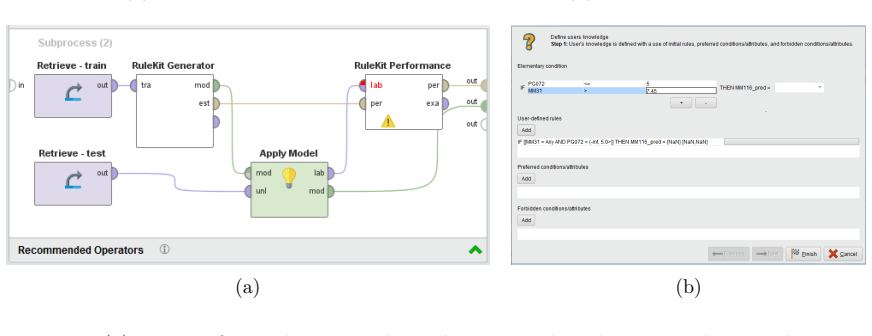
The central mechanism is the sequential covering (separate-and-conquer) induction algorithm, which iteratively adds rules that cover part of the training data until every example is covered. In RuleKit this engine is wrapped in an experimental environment: a rule-quality measure, with more than 40 built-in options plus user-defined formulas, scores candidate conditions; pruning trims rules; and task-specific significance tests such as Fisher's exact, $\chi^2$, and log-rank attach p-values to rules. The user-guided induction mode is the other load-bearing piece: it accepts an initial rule set and lists of preferred or forbidden conditions and attributes, so domain knowledge can steer the search. The combination of these components, packaged for batch, plug-in, and programming-environment use, carries the paper's claim of a comprehensive suite.
What would settle it
Run the three case-study tasks (deals classification, methane regression, bone-marrow survival) with RuleKit on independent test splits and compare against the established rule learners cited in the paper on the same folds; if RuleKit does not remain competitive in all three task types, the central promise of a single effective rule-learning tool is falsified.
Extended reading notes
Core claim
On the paper's own terms, the discovery is a software engineering one: a single rule-learning environment can host sequential covering for classification, regression, and survival analysis, with dozens of rule-quality measures, user-guided induction, parallel execution, and several front ends including batch mode, a plug-in, and a package for a statistical programming environment. The argument rests on the claim that this is the first tool suitable for all three problem settings, so the contribution is completeness plus availability rather than a new induction algorithm. The case studies—future-customer classification, coal-mine methane regression, and bone-marrow transplant survival—demonstrate that each mode runs end to end, producing human-readable rules with per-rule statistics and significance tests.
Load-bearing premise
RuleKit's practical value rests on the assumption that the effectiveness of its underlying algorithms, established in earlier studies by the same authors, transfers to this implementation without new comparative benchmarks.
Editorial extensions
If this is right
- A single Java library and API can now produce interpretable rule models for all three predictive tasks, so knowledge-discovery workflows need no longer mix separate rule learners.
- User-guided induction makes it possible to test specific hypotheses about data dependencies by forcing or forbidding conditions and inspecting the resulting rules.
- The integrated experimental environment supports automated investigation of many algorithm configurations over multiple datasets, with train-test and cross-validation schemes and dozens of performance metrics.
- Because the suite is released as open source with a documented API, other projects can embed the learner or extend its functionality without reimplementing sequential covering.
- If the earlier validation transfers, practitioners in fields such as medicine can obtain rules that are both interpretable and predictive across classification, regression, and survival benchmarks.
Reading between the lines
- A direct benchmark against the existing rule learners named in the paper would settle whether the 'first tool' claim is also a 'best tool' claim; the paper itself stops at illustrative case studies.
- User-guided induction could turn rule learning into an interactive hypothesis-verification loop for domain experts, letting them encode constraints and read back which conditions survive; this is a consequence the paper gestures at but does not develop.
- A Python-facing wrapper or standalone interface would likely widen adoption more than additional algorithms, since most modern data-analysis workflows center on Python; this follows from the paper's own emphasis on interfaces but is not tested.
- The design suggests a testable prediction: on small or noisy datasets, informatively constrained rules should outperform fully automatic rules, while on large clean datasets the advantage should shrink; this can be checked experimentally.
Signed reviews
Editorial analysis
A structured set of objections, weighed in public.
Referee Report
Summary. The manuscript presents RuleKit, a Java-based software suite for sequential-covering rule induction for classification, regression, and survival analysis. The tool is offered in batch mode, as a RapidMiner plug-in, and as an R package, with a documented API and open-source availability under AGPL-3.0. The paper describes the features, gives three short case studies (deals classification, methane regression, bone-marrow-transplant survival), and claims that RuleKit is the first tool suitable for all three problem types. The effectiveness of the underlying algorithms is asserted based on the authors' prior publications rather than on experiments in this paper.
Significance. If the claims are substantiated, RuleKit would be a useful contribution to the rule-learning ecosystem: a publicly available, cross-platform implementation covering three problem settings with user-guided induction, multiple quality measures, and an experimental harness. The repository and documented API are concrete, testable deliverables that support reproducibility. However, the manuscript currently provides only illustrative case studies, with no comparative evaluation, no held-out test-set performance for regression or survival, and no evidence that the current implementation reproduces the previously published validation results. The 'first tool' claim is also unsupported by a systematic survey. For these reasons the contribution is currently more of a software announcement than a validated software contribution.
major comments (3)
- [Section 1, Introduction] The assertion that RuleKit is 'the first tool suitable for classification, regression, and survival analysis problems' is load-bearing but unsubstantiated. No systematic survey of existing software is provided, and the examples cited (CN2, AQ, RIPPER, M5Rules) are not compared in terms of problem-type coverage. The claim should either be removed, softened to 'to our knowledge', or supported by a concrete enumeration of existing tools and their capabilities.
- [Section 3, Case Studies] The three case studies report only training-set metrics and illustrative outputs. For example, Figure 1(b) explicitly labels 'Training set performance' and the text states that performance metrics are 'calculated on the training set'; no test-set accuracy, regression error, or survival concordance is reported. Since the paper presents RuleKit as a tool with predictive value, at least one experiment per problem type should report held-out test-set performance, preferably with variance estimates and comparison to a baseline tool.
- [Section 1 and 3, transfer of prior validation] The paper's effectiveness claim relies entirely on prior publications (Wróbel et al., 2016, 2017; Sikora et al., 2019), but no evidence is given that the RuleKit implementation faithfully reproduces the algorithms validated there. Differences in defaults, pruning, quality measures, or experimental protocols could invalidate the transfer. A small replication study — running RuleKit on one or two datasets from those papers and comparing the resulting model quality to the published numbers — would close this gap.
minor comments (4)
- [Section 2, item numbering] The feature list contains two items labeled '(vii)': one for portability and one for extensibility. Renumber the second as '(viii)'.
- [Section 3, R package case study] The BMT-Ch dataset is not described or referenced; a citation or a brief description of its source and size would help the reader assess the example.
- [Section 3, batch mode] The XML example in Figure 1(a) refers to a test file path '../deals/data/deals-test.arff', but the report in Figure 1(b) only shows training output; clarifying that the prediction stage output is omitted would avoid confusion.
- [General] The paper would benefit from a link to an online documentation page or a user guide, since the feature list cannot convey how to configure the over 40 quality measures or the user-guided induction modes.
Circularity Check
Software paper with minor self-citation for algorithm pedigree; no derivation chain is reduced to its inputs.
full rationale
RuleKit is a software/tool paper rather than a derivation paper. The central claim is that the suite exists, is publicly available, and implements sequential-covering rule induction for classification, regression, and survival analysis. The Introduction cites the authors' earlier work (Wrobel et al., 2016, 2017; Sikora et al., 2019) for the effectiveness of the underlying algorithm variant and user-guided induction. This is self-citation used as supporting evidence for the method's pedigree, but the paper does not derive any quantitative result from those citations; no equation in the paper is equivalent to an input by construction. The three case studies in Section 3 are explicitly illustrative, showing commands, reports, and plots, and they make no comparative predictive claim, so there is no fitted-input-called-prediction pattern. The 'first tool suitable for classification, regression, and survival analysis' claim is an availability/capability assertion whose truth is independent of the cited validations; even if factually wrong, that would be an error of fact, not circularity. No self-definitional, ansatz-smuggling, or uniqueness-importation pattern is present. The only mild concern is that practical effectiveness is delegated to prior papers by the same group rather than re-benchmarked here, which is a reproducibility/transfer concern, not circularity. Score 1 reflects the minor self-citation that is not load-bearing.
Assumptions & free parameters
assumptions (2)
- domain assumption The effectiveness of the RuleKit algorithms is established by prior papers by the same authors (Wróbel et al. 2016, 2017; Sikora et al. 2019).
- domain assumption No existing tool covers classification, regression, and survival rule learning in one suite.
Cite this review
Pith. "Pith review of RuleKit: A Comprehensive Suite for Rule-Based Learning." pith.science (2026). https://pith.science/paper/2GWOXO24
@misc{pith2026190801031,
  author       = {Pith},
  title        = {Pith review of: RuleKit: A Comprehensive Suite for Rule-Based Learning},
  year         = {2026},
  howpublished = {\url{https://pith.science/paper/2GWOXO24}},
  note         = {Machine review of arXiv:1908.01031}
}
read the original abstract
Rule-based models are often used for data analysis as they combine interpretability with predictive power. We present RuleKit, a versatile tool for rule learning. Based on a sequential covering induction algorithm, it is suitable for classification, regression, and survival problems. The presence of a user-guided induction facilitates verifying hypotheses concerning data dependencies which are expected or of interest. The powerful and flexible experimental environment allows straightforward investigation of different induction schemes. The analysis can be performed in batch mode, through RapidMiner plug-in, or R package. A documented Java API is also provided for convenience. The software is publicly available at GitHub under GNU AGPL-3.0 license.
Figures


Reference graph
Works this paper leans on
-
[1]
L. Breiman, J. H. Friedman, R. A. Olshen, and C. J. Stone. Classification and Regression Trees. Chapman & Hall/CRC, Boca Raton, London, New York, Washington, 1984
work page 1984
-
[2]
P. Clark and T. Niblett. The CN2 induction algorithm. Mach. Learn., 3 0 (4): 0 261--283, 1989
work page 1989
-
[3]
W. W. Cohen. Fast Effective Rule Induction . In ICML 1995, pages 115--123. Morgan Kaufmann, 1995
work page 1995
-
[4]
J. Dem s ar, T. Curk, A. Erjavec, et al. Orange: Data Mining Toolbox in Python . J. Mach. Learn. Res., 14 0 (1): 0 2349--2353, 2013
work page 2013
-
[5]
J. F \"u rnkranz, D. Gamberger, and N. Lavra c . Foundations of Rule Learning . Springer-Verlag, Berlin, Heidelberg, 2012
work page 2012
- [6]
- [7]
-
[8]
R. S. Michalski. On the quasi-minimal solution of the general covering problem. In FCIP 69, volume A3, pages 125--128, 1969
work page 1969
Show all 14 references
-
[9]
Sikora and A
M. Sikora and A. Gudy \'s . CHIRA---Convex Hull Based Iterative Algorithm of Rules Aggregation . Fundam. Inform., 123 0 (2): 0 143--170, 2013
2013
-
[10]
M. Sikora, . Wr \'o bel, and A. Gudy \'s . GuideR: A guided separate-and-conquer rule learning in classification, regression, and survival settings . Knowl.-Based Syst., 173: 0 1--14, 2019
2019
-
[11]
I. H. Witten, E. Frank, M. A. Hall, and C. J. Pal. Data Mining: Practical Machine Learning Tools and Techniques . Morgan Kaufmann, San Francisco, 4th edition, 2016
2016
-
[12]
Wojna and R
A. Wojna and R. Latkowski. Rseslib 3: Library of Rough Set and Machine Learning Methods with Extensible Architecture . In Transactions on Rough Sets XXI, volume 10810 of LNCS, pages 301--323. Springer, Berlin, Heidelberg, 2019
2019
-
[13]
Sikora, and M
Wr \'o bel, M. Sikora, and M. Michalak. Rule Quality Measures Settings in Classification, Regression and Survival Rule Induction---an Empirical Approach . Fundam. Inform., 149 0 (4): 0 419--449, 2016
2016
-
[14]
Gudy \'s , and M
Wr \'o bel, A. Gudy \'s , and M. Sikora. Learning rule sets from survival data. BMC Bioinformatics, 18 0 (1): 0 285, 2017
2017
Reviewed August 14, 2026 · model on record in the stance chip above.
Discussion (0). Continue with ORCID to comment.