REVIEW 4 major objections 6 minor 60 references
The five-dimensional N=4 supergravity with SO(2)×ISO(3) gauge group is shown to generate supersymmetric holographic RG flows, non-conformal Janus interfaces, AdS5 black strings and black holes, all uplifting to M-theory.
Reviewed by Pith at T0; open to challenge. T0 means a machine referee read the full paper against a public rubric. the ladder, T0–T4 →
T0 review · deepseek-v4-flash
2026-08-04 10:46 UTC pith:2H755T4T
load-bearing objection A useful catalog of BPS solutions with a new non-conformal Janus class, but the load-bearing φ𝜃𝜃=φ𝜄=0 truncation is asserted, not proven. the 4 major comments →
Holographic solutions from 5D SO(2)times ISO(3) N=4 gauged supergravity
The pith
A machine-rendered reading of the paper's core claim, the machinery that carries it, and where it could break.
Core claim
The paper's core claim is that the SO(2)×ISO(3) N=4 gauged supergravity, coupled to three vector multiplets and reduced from seven dimensions on a Riemann surface H², supports an extensive set of supersymmetric holographic solutions. Working in the SO(2)_diag singlet sector with φ2=φ4=0, the author derives first-order BPS equations from a superpotential and solves them explicitly or numerically: two analytic RG flows whose IR singularities fail standard physicality tests, one numerical N=1 flow to N=2 SYM with a physical singularity, numerical Janus interfaces between N=2 SYM phases (the first non-conformal Janus solutions in five-dimensional gauged supergravity), black strings with AdS3×H²
What carries the argument
The engine of the paper is the BPS-equation system of the gauged supergravity. The author truncates to the SO(2)_diag singlet sector of the scalar coset SO(5,3)/SO(5)×SO(3), sets φ2=φ4=0 to eliminate the Yang-Mills currents, and derives first-order flow equations from the supersymmetry transformations of the gravitini, dilatini and gaugini; the superpotential W serves as the generating function for the scalar potential. For the black-string and black-hole sections, topological twisting is the additional mechanism: magnetic gauge fields (an SO(2) pair or an SO(3) triplet) are turned on so that their charges cancel the spin connection of the compact Riemann surface or 3-manifold, permitting Ki
Load-bearing premise
The derivation assumes that setting the two scalar fields φ2 and φ4 to zero is a genuine consistent truncation that removes all vector fields; the paper states this in Section 3 but gives no proof, so if that truncation fails the BPS equations do not describe solutions of the full theory.
What would settle it
Evaluate the full vector-field equations on the truncated ansatz with φ2=φ4=0 and all gauge fields set to zero; if the Yang-Mills currents sourced by the discarded scalars do not vanish identically, the truncation is inconsistent and the derived BPS solutions are not solutions of the complete gauged supergravity.
If this is right
- The N=2 SCFT of M5-branes wrapped on a higher-genus surface has holographic RG flows to four-dimensional N=2 SYM; one family (with SO(2)_diag symmetry) preserves four supercharges and ends in a physical IR singularity.
- The numerical Janus solutions are claimed to be the first non-conformal Janus solutions in five-dimensional gauged supergravities, providing gravity duals for conformal interfaces inside N=2 SYM.
- Topologically twisted compactifications of the N=2 SCFT on H² or S² yield two-dimensional N=(2,2) and N=(0,2) SCFTs, with central charges computed from the AdS3×Σ fixed points.
- A twisted compactification on H³ leads to superconformal quantum mechanics in the IR, with a black-hole entropy S_BH ∝ N²|g̃−1|vol(H³)/g³ that can be compared with a supersymmetric index.
- Because every solution uplifts to M-theory via the consistent H²×S⁴ truncation, the backgrounds are genuine eleven-dimensional supergravity solutions rather than artifacts of the five-dimensional model.
Where Pith is reading between the lines
- Editorial inference: if the truncation is consistent, the numerical N=1 flow is a concrete gravity dual for an N=2 SYM phase; identifying the exact operator deformations along this flow would sharpen the field-theory interpretation.
- Editorial inference: the apparent absence of regular Janus interfaces between two AdS5 vacua within this truncation hints at a possible no-go theorem; extending the scalar sector or the twist choices would test how general that obstruction is.
- Editorial inference: the black-hole entropy formula is a direct target for a twisted-index computation of the N=2 SCFT on H³; a match would provide a microscopic count of the black-hole microstates.
- Editorial inference: flows that pass through an intermediate AdS5 geometry before reaching lower-dimensional fixed points suggest a general sequential RG-cascade mechanism that may appear in other gauged supergravities with multiple fixed points.
Editorial analysis
A structured set of objections, weighed in public.
Referee Report
Summary. The paper constructs supersymmetric holographic solutions in five-dimensional N=4 SO(2)×ISO(3) gauged supergravity coupled to three vector multiplets, a theory previously shown to arise from a consistent truncation of eleven-dimensional supergravity on H^2×S^4. It studies RG flows from the supersymmetric AdS5 vacuum (dual to an N=2 SCFT) to non-conformal phases, numerical Janus interfaces between non-conformal phases, and black string/black hole solutions with AdS3×Σ and AdS2×H3 near-horizon geometries. The paper also computes central charges and a black-hole entropy proportional to N^2 and claims that all solutions uplift to M-theory via the established consistent truncation.
Significance. If the solutions are genuine solutions of the full 5D theory, the paper provides a broad new class of holographic duals, including what is claimed to be the first non-conformal Janus solutions in five-dimensional gauged supergravities, and a concrete black-hole entropy formula that could in principle be matched to a twisted index. The use of an established 11D consistent truncation [4,7] and the standard BPS formalism are strengths, and many of the analytic solutions and singularity diagnoses are self-contained and checkable. The main caveat is that the internal scalar/vector truncation underlying all of the solutions is asserted rather than proved; this must be resolved before the results can be regarded as solutions of the full theory.
major comments (4)
- [§3, after Eq. (33); cf. §5.1 and §5.2] The load-bearing truncation to φ2=φ4=0 with all vector fields zero is stated without proof: "It turns out that in order to consistently truncate out all the vector fields, we need to set φ2=φ4=0. The latter lead to non-vanishing Yang-Mills currents." This is not an automatic consistency statement; if the discarded scalars source the retained fields, then the BPS systems (40), (44), (54)-(57), and the numerical solutions in §4-§6 do not solve the full N=4 theory and cannot be uplifted. Please provide an explicit consistency check from the bosonic equations of motion or a symmetry projection, and similarly justify the later assertions "compatibility ... requires φ4=0" and that the two-form fields can be consistently set to zero.
- [§5.2, Eqs. (149)-(150)] Two equations are both labeled h′ but they are not equal as written; this makes the BPS system appear overdetermined. From the structure of Eqs. (124)-(125) and (131)-(132), one of them should almost certainly be f′. The fixed-point solution (152) and the numerical flows in Figs. 5-8 depend on the correct assignment. Please correct the labels and re-verify the subsequent analysis.
- [§6, Eqs. (168)-(169)] The BPS equations contain cosh φ3, but the scalar sector in this section has only the single SO(3) singlet φ, with coset representative (161). This appears to be a typo for cosh φ. Since the AdS2×H3 fixed point is obtained by setting φ=0, the precise form of these equations is important; please fix and re-derive the fixed point and the flow equations.
- [§5.1, Eqs. (135)-(143); §6, Eq. (173)] The central charge and entropy formulas depend on the normalization of G_N^{(5)}, which is assembled in Eqs. (137)-(140) using several dimensional-reduction relations. The intermediate steps are only sketched. Since Eqs. (143), (155), and (173) are advertised as quantitative predictions that could be matched to field theory, please present the derivation of G_N^{(5)} (or provide a direct reference with the same normalization) so that the numerical factors can be audited.
minor comments (6)
- [Abstract] "Rimann surface" is a typo for "Riemann surface."
- [Throughout] There are multiple typos, e.g., "constrast" in Section 1, "perserve" in Sections 3.1 and 3.2, and "Combing" before Eq. (59).
- [Eq. (37)] The combination "sinhϕ2ϕ3" appears in the expression for β; this is likely a typo for "sinh 2ϕ3." Please check and correct.
- [References] Reference [2] is missing the article title, and reference [42] has a formatting break in the author list.
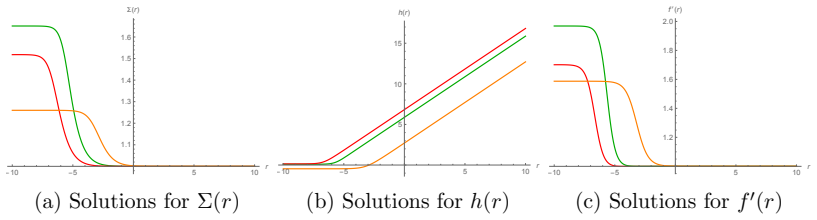
- [Figures] The numerical solutions in Figs. 1-10 are not accompanied by the initial/boundary conditions, numerical method, or tolerance criteria. Please provide these details to make the solutions reproducible.
- [Eq. (155)] The central-charge formula contains an overall factor of κ; for κ=+1 it would be negative unless the other terms conspire. Please state the sign convention and confirm that the physical values (κ=-1 for H^2, κ=+1 for S^2 with the chosen a3) give positive c.
Circularity Check
No circularity: the central BPS constructions are derived from the gauged-supergravity action and solved directly; the flagged truncation gap is an omitted proof, not a circular reduction.
full rationale
The paper's central derivation chain is self-contained against the cited gauged-supergravity framework: the 5D SO(2)×ISO(3) theory and its H^2×S^4 11D origin are taken from [4],[7] (no author overlap with the present author), the AdS5 vacuum and the absence of other supersymmetric vacua are cited to [4], and the RG-flow, Janus, black-string and black-hole BPS equations are obtained from the supersymmetry variations (15)-(17) and then solved, analytically or numerically, in §§3-6. The central charges and black-hole entropy in (142), (143), (155) and (173) are computed from the resulting AdS3×H2/AdS2×H3 fixed-point data via standard holographic formulas; no quantity is fitted and then renamed as a prediction. The Janus section does cite [27] (same author) for the structural fact that real A1 eigenvalues do not support curved domain walls, but the subsequent BPS equations and constraints are derived in the present paper, and [27] does not assert the non-conformal Janus result; this is methodological self-citation, not load-bearing circularity. I do flag one genuine gap: the internal truncation to φ2=φ4=0 — "It turns out that in order to consistently truncate out all the vector fields, we need to set φ2=φ4=0. The latter lead to non-vanishing Yang-Mills currents" (Section 3, after Eq. (33)) — and the analogous φ4=0/two-form vanishings in §§5-6 are asserted without proof. This is a load-bearing completeness and correctness risk, but it is not a circular step: no claimed prediction here reduces by construction to an equivalent input or fitted parameter. The remaining self-citations [19,41-43,50,52] are contextual or methodological and do not carry the derivations. Therefore the circularity score is 0.
Axiom & Free-Parameter Ledger
free parameters (8)
- gauge coupling ratio g1 = -g/√2 =
g1 = -g/√2 (g>0)
- integration constant C0 =
C0 = -g1/(√2 g)
- integration constant C =
C = π/2
- integration constant Σ0 =
Σ0 = 0
- twist parameters a0, a3 (black strings) =
e.g., g=2, κ=-1, a3=2; twist conditions g1 a0=1, g a3=1, or g1 a0 + g a3=1
- twist parameter a (black holes) =
a = a3 = -a4 = a5, with a3 g=1, a4 g=-1, a5 g=1
- Janus turning-point value φ5(r0) =
φ5(0)=0.1, 1.0 (examples)
- Unspecified numerical boundary conditions =
not given
axioms (5)
- domain assumption The SO(2)×ISO(3) gauged N=4 supergravity is a consistent truncation of 11D supergravity on H^2 × S^4.
- domain assumption The truncation to the SO(2)_diag singlet sector with φ2=φ4=0 consistently removes all vector fields.
- standard math The BPS equations derived from fermion shifts exhaust the full second-order field equations.
- domain assumption Gubser [47] and Maldacena-Nunez [29] criteria correctly diagnose physical versus unphysical singularities in the uplifted solutions.
- domain assumption There are no other supersymmetric AdS5 vacua in this gauged supergravity.
read the original abstract
We study various types of holographic solutions from five-dimensional $N=4$ gauged supergravity coupled to three vector multiplets with $SO(2)\times ISO(3)$ gauge group. This gauged supergravity can be obtained from the maximal gauged supergravity in seven dimensions on a Riemann surface. For a negatively curved Riemann surface $H^2$, the resulting five-dimensional gauged supergravity admits a supersymmetric $N=4$ $AdS_5$ critical point. This $AdS_5$ vacuum is dual to an $N=2$ superconformal field theory (SCFT) arising from M5-branes wrapped on $H^2$. We study holographic RG flows between this SCFT and $N=2$ non-conformal phases by deformations involving relevant, marginal and irrelevant operators. Solutions describing conformal interfaces between these non-conformal phases and singular boundaries are also given. We finally study a number of supersymmetric $AdS_5$ black string and black hole solutions holographically dual to RG flows across dimensions from the $N=2$ SCFT to two-dimensional SCFTs and superconformal quantum mechanics in the IR. A number of solutions describing black strings and black holes in asymptotically domain wall space-time are also found. All of the solutions can be uplifted to M-theory by a consistent truncation on $H^2\times S^4$.
Figures




Reference graph
Works this paper leans on
-
[1]
The largeNlimit of superconformal field theories and supergravity
J. M. Maldacena, “The largeNlimit of superconformal field theories and supergravity”, Adv. Theor. Math. Phys.2(1998) 231-252, arXiv: hep- th/9711200
arXiv 1998
-
[2]
S. S. Gubser, I. R. Klebanov and A. M. Polyakov, “”, Phys. Lett.B428 (1998) 105-114, arXiv: hep-th/9802.109
1998
-
[3]
Anti De Sitter Space and holography
E. Witten, “Anti De Sitter Space and holography”, Adv. Theor. Math. Phys. 2(1998) 253-291, arXiv: 9802150
1998
-
[4]
Consistent KK truncations for M5-branes wrapped on Riemann surfaces
K. C. M. Cheung, J. P. Gauntlett, C. Rosen, “Consistent KK truncations for M5-branes wrapped on Riemann surfaces”, Class. Quant. Grav.36(2019) 22, 225003 , arXiv: 1906.08900. 37
Pith/arXiv arXiv 2019
-
[5]
H. Nastase, D. Vaman, and P. van Nieuwenhuizen, “Consistent nonlinear KK reduction of 11-d supergravity onAdS 7 ×S 4 and selfduality in odd dimensions”, Phys. Lett.B469(1999) 96–102, arXiv: hep-th/9905075
Pith/arXiv arXiv 1999
-
[6]
Consistency of the AdS7 ×S 4 reduction and the origin of selfduality in odd dimensions
H. Nastase, D. Vaman, and P. van Nieuwenhuizen, “Consistency of the AdS7 ×S 4 reduction and the origin of selfduality in odd dimensions”, Nucl. Phys.B581(2000) 179–239, arXiv: hep-th/9911238
Pith/arXiv arXiv 2000
-
[7]
Consistent truncations around half-maximal AdS5 vacua of 11-dimensional supergravity
E. Malek and V. V. Camell, “Consistent truncations around half-maximal AdS5 vacua of 11-dimensional supergravity”, Class. Quant. Grav.39(2022) 7, 075026, arXiv: 2012.15601
Pith/arXiv arXiv 2022
-
[8]
L. Girardello, M. Petrini, M. Porrati, and A. Zaffaroni, “Novel local CFT and exact results on perturbations ofN= 4 super Yang Mills from AdS dynamics, JHEP 12 (1998)022, arXiv: hep-th/9810126
Pith/arXiv arXiv 1998
-
[9]
Renormalization group flows from holography supersymmetry and a c theorem
D. Z. Freedman, S. S. Gubser, K. Pilch, and N. P. Warner, “Renormalization group flows from holography supersymmetry and a c theorem”, Adv. Theor. Math. Phys.3(1999) 363–417, arXiv: hep-th/9904017
Pith/arXiv arXiv 1999
-
[10]
A Class ofN= 1 Supersymmetric RG Flows from Five-dimensionalN= 8 Supergravity
A. Khavaev and N. P. Warner, “A Class ofN= 1 Supersymmetric RG Flows from Five-dimensionalN= 8 Supergravity”, Phys. Lett.B495(2000) 215- 222, arXiv: hep-th/0009159
Pith/arXiv arXiv 2000
-
[11]
N= 2 Supersymmetric RG Flows and the IIB Dilaton
K. Pilch and N. P. Warner, “N= 2 Supersymmetric RG Flows and the IIB Dilaton”, Nucl. Phys.B594(2001) 209-228, arXiv: hep-th/0004063
Pith/arXiv arXiv 2001
-
[12]
AdS RG-Flow and the Super-Yang-Mills Cas- cade
N. Evans and M. Petrini, “AdS RG-Flow and the Super-Yang-Mills Cas- cade”, Nucl. Phys.B592(2001) 129-142, arXiv: hep-th/0006048
Pith/arXiv arXiv 2001
-
[13]
Domain walls ofD= 5 supergravity and fixed points of N= 1 Super Yang Mills
K. Behrndt, “Domain walls ofD= 5 supergravity and fixed points of N= 1 Super Yang Mills”, Nucl. Phys.B573(2000) 127-148, arXiv: hep- th/9907070
arXiv 2000
-
[14]
Holographic RG Flows for Four- dimensionalN= 2 SCFTs
N. Bobev, D. Cassani and H. Triendl, “Holographic RG Flows for Four- dimensionalN= 2 SCFTs”, JHEP 06(2018)086, arXiv: 1804.03276
Pith/arXiv arXiv 2018
-
[16]
BPS domain walls inN= 4 supergravity and dual flows
D. Cassani, G. Dall’Agata and A. F. Faedo, “BPS domain walls inN= 4 supergravity and dual flows”, JHEP 03 (2013)007, arXiv: 1210.8125
Pith/arXiv arXiv 2013
-
[17]
Hypermulti- plets, domain walls and supersymmetric attractors
A. Ceresole, G. Dall’Agata, R. Kollosh and A. Van Proeyen, “Hypermulti- plets, domain walls and supersymmetric attractors” Phys. Rev.D64(2001) 104006, arXiv: hep-th/0104056. 38
Pith/arXiv arXiv 2001
-
[18]
Consistent truncations of supergravity and 1 2 -BPS RG flows in 4dSCFTs
A. F. Faedo, C. Nunez and C. Rosen, “Consistent truncations of supergravity and 1 2 -BPS RG flows in 4dSCFTs”, JHEP 03 (2020)080, arXiv: 1912.13516
Pith/arXiv arXiv 2020
-
[19]
AdS 5 vacua and holographic RG flows from 5DN= 4 gauged supergravity
P. Karndumri, “AdS 5 vacua and holographic RG flows from 5DN= 4 gauged supergravity”, Eur. Phys. J.C83(2023) 164, arXiv: 2209.05270
Pith/arXiv arXiv 2023
-
[20]
A Dilatonic Deformation ofAdS 5 and its Field Theory Dual
D. Bak, M. Gutperle and S. Hirano, “A Dilatonic Deformation ofAdS 5 and its Field Theory Dual”, JHEP 05 (2003)072, arXiv: hep-th/0304129
Pith/arXiv arXiv 2003
-
[21]
A. Clark and A. Karch, “Super Janus”, JHEP 10 (2005)094, arXiv: hep- th/0506265
arXiv 2005
-
[22]
Dual of the Janus solution: An interface conformal field theory
A. B. Clark, D. Z. Freedman, A. Karch and M. Schnabl, “Dual of the Janus solution: An interface conformal field theory”, Phys. Rev.D71(2005) 066003, arXiv: hep-th/0407073
Pith/arXiv arXiv 2005
-
[23]
Interface Yang-Mills, supersymme- try, and Janus
E. D’ Hoker, J. Estes and M. Gutperle, “Interface Yang-Mills, supersymme- try, and Janus”, Nucl. Phys.B753(2006) 16, arXiv: hep-th/0603013
Pith/arXiv arXiv 2006
-
[24]
Supersymmetric Janus solutions in five and ten dimensions
M. W. Suh, “Supersymmetric Janus solutions in five and ten dimensions”, JHEP 09 (2011)064, arXiv: 1107.2796
Pith/arXiv arXiv 2011
-
[25]
Janus and J-fold Solutions from Sasaki-Einstein Manifolds
N. Bobev, F. F. Gautason, K. Pilch, M. Suh, J. van Muiden, “Janus and J-fold Solutions from Sasaki-Einstein Manifolds”, Phys. Rev.D100(2019) 081901, arXiv: 1907.11132
Pith/arXiv arXiv 2019
-
[26]
Holographic Interfaces inN= 4 SYM: Janus and J-folds
N. Bobev, F. F. Gautason, K. Pilch, M. Suh, J. van Muiden, “Holographic Interfaces inN= 4 SYM: Janus and J-folds”, JHEP 05 (2020)134, arXiv: 2003.09154
Pith/arXiv arXiv 2020
-
[27]
Janus and RG-flow interfaces from 5D N= 4 gauged super- gravity
P. Karndumri, “Janus and RG-flow interfaces from 5D N= 4 gauged super- gravity”, Phys. Rev.D111(2025) 12, 126020, arXiv: 2503.06704
Pith/arXiv arXiv 2025
-
[28]
Topological Quantum Field Theory
E. Witten, “Topological Quantum Field Theory”, Commun. Math. Phys. 117 (1988)353
1988
-
[29]
Supergravity description of field theories on curved manifolds and a no go theorem
J. M. Maldacena and C. Nunez, “Supergravity description of field theories on curved manifolds and a no go theorem”, Int. J. Mod. Phys.A16(2001) 822-855, arXiv: hep-th/0007018
Pith/arXiv arXiv 2001
-
[30]
Supersymmetry of black strings ind= 5 gauged supergravities
D. Klemm and W. A. Sabra, “Supersymmetry of black strings ind= 5 gauged supergravities”, Phys. Rev.D62(2000) 024003, arXiv: hep- th/0001131
arXiv 2000
-
[31]
Supersymmetric domain walls and strings ind= 5 gauged supergravity coupled to vector multiplets
S. L. Cacciatori, D. Klemm and W. A. Sabra, “Supersymmetric domain walls and strings ind= 5 gauged supergravity coupled to vector multiplets”, JHEP 03 (2003)023, arXiv: hep-th/0302218. 39
Pith/arXiv arXiv 2003
-
[32]
A. Bernamonti, M. M. Caldarelli, D. Klemm, R. Olea, C. Sieg and E. Zorzan, “Black strings inAdS 5”, JHEP 01 (2008)061, arXiv: 0708.2402
Pith/arXiv arXiv 2008
-
[33]
Two-dimensional SCFTs from wrapped branes and c-extremization
F. Benini and N. Bobev, “Two-dimensional SCFTs from wrapped branes and c-extremization”, JHEP 06 (2013)005, arXiv: 1302.4451
Pith/arXiv arXiv 2013
-
[34]
3D Supergravity from wrapped D3- branes
P. Karndumri and E. O Colgain, “3D Supergravity from wrapped D3- branes”, JHEP 10 (2013)094, arXiv: 1307.2086
Pith/arXiv arXiv 2013
-
[35]
(0,2) SCFTs from the Leigh-Strassler fixed point
N. Bobev, K. Pilch, and O. Vasilakis, “(0,2) SCFTs from the Leigh-Strassler fixed point”, JHEP 06 (2014)094, arXiv:1403.7131
Pith/arXiv arXiv 2014
-
[36]
Two-dimensional SCFTs from D3-branes
F. Benini, N. Bobev and P. M. Crichigno, “Two-dimensional SCFTs from D3-branes”, JHEP 07 (2016)020, arXiv: 1511.09462
Pith/arXiv arXiv 2016
-
[37]
Black string first order flow in N= 2,d= 5 abelian gauged supergravity
D. Klemm, N. Petri and M. Rabbiosi, “Black string first order flow in N= 2,d= 5 abelian gauged supergravity”, JHEP 01 (2017)106, arXiv: 1610.07367
Pith/arXiv arXiv 2017
-
[38]
Universal RG Flows Across Dimensions and Holography
N. Bobev and P. M. Crichigno, “Universal RG Flows Across Dimensions and Holography”, JHEP 12 (2017) 065, arXiv: 1708.05052
Pith/arXiv arXiv 2017
-
[39]
AdS 5 black strings in the stu model of FI-gaugedN= 2 supergravity
M. Azzola, D. Klemm and M. Rabbiosi, “AdS 5 black strings in the stu model of FI-gaugedN= 2 supergravity”, JHEP 10 (2018)080, arXiv: 1803.03570
Pith/arXiv arXiv 2018
-
[40]
Betti multiplets, flows across dimensions and c-extremization
A. Amariti and C. Toldo, “Betti multiplets, flows across dimensions and c-extremization”, JHEP 07 (2017)040, arXiv: 1610.08858
Pith/arXiv arXiv 2017
-
[41]
Holographic RG flows andAdS 5 black strings from 5D half-maximal gauged supergravity
H. L. Dao and P. Karndumri, “Holographic RG flows andAdS 5 black strings from 5D half-maximal gauged supergravity”, Eur. Phys. J.C79(2019) 137, arXiv: 1811.01608
Pith/arXiv arXiv 2019
-
[42]
Supersymmetric black holes and strings from 5D gauged supergravity
H. L. Dao and P. Karndumri, “Supersymmetric black holes and strings from 5D gauged supergravity”, Eur. Phys. J.C79(2019) 247, arXiv: 1812.10122. C. Couzens, N. T. Macpherson and A. Passias,N= (2,2)AdS 3 from D3-branes wrapped on Riemann surfaces, JHEP 02 (2022)189, arXiv: 2107.13562
Pith/arXiv arXiv 2019
-
[43]
New supersymmetricAdS 5 black strings from 5DN= 4 gauged supergravity
P. Karndumri, “New supersymmetricAdS 5 black strings from 5DN= 4 gauged supergravity”, Eur. Phys. J.C83(2023) 432, arXiv: 2211.07456
Pith/arXiv arXiv 2023
-
[44]
J. Schon and M. Weidner, “GaugedN= 4 supergravities”, JHEP 05 (2006) 034, arXiv: hep-th/0602024
Pith/arXiv arXiv 2006
-
[45]
General matter coupled N= 4 gauged supergravity in five-dimensions
G. Dall’Agata, C. Herrmann, and M. Zagermann, “General matter coupled N= 4 gauged supergravity in five-dimensions”, Nucl. Phys.B612(2001) 123–150, arXiv: hep-th/0103106. 40
Pith/arXiv arXiv 2001
-
[46]
N= 4 supersymmetricAdS 5 vacua and their moduli spaces
J. Louis, H. Triendl and M. Zagermann, “N= 4 supersymmetricAdS 5 vacua and their moduli spaces”, JHEP 10 (2015)083, arXiv:1507.01623
Pith/arXiv arXiv 2015
-
[47]
Curvature singularities: the good, the bad and the naked,
Steven S. Gubser, “Curvature singularities: the good, the bad and the naked,” Adv. Theor. Math. Phys.4(2000), 679-745, arXiv: hep-th/0002160
Pith/arXiv arXiv 2000
-
[48]
Janus solutions in six-dimensional gauged supergravity
M. Gutperle, J. Kaidi and H. Raj, “Janus solutions in six-dimensional gauged supergravity”, JHEP 12 (2017)018, arXiv: 1709.09204
Pith/arXiv arXiv 2017
-
[49]
Supersymmetric Janus solutions of dyonicISO(7)-gaugedN= 8 supergravity
M. Suh, “Supersymmetric Janus solutions of dyonicISO(7)-gaugedN= 8 supergravity”, JHEP 04 (2018)109, arXiv: 1803.00041
Pith/arXiv arXiv 2018
-
[50]
Janus solutions from dyonicISO(7) max- imal gauged supergravity
P. Karndumri and C. Maneerat, “Janus solutions from dyonicISO(7) max- imal gauged supergravity”, JHEP 10 (2021)117, arXiv: 2108.13398
Pith/arXiv arXiv 2021
-
[51]
Holographic RG-flows and Boundary CFTs
M/ Gutperle and J. Samani, “Holographic RG-flows and Boundary CFTs”, Phys. Rev.D86(2012) 106007, arXiv: 1207.7325
Pith/arXiv arXiv 2012
-
[52]
Supersymmetric deformations of 3D SCFTs from tri- sasakian truncation
P. Karndumri, “Supersymmetric deformations of 3D SCFTs from tri- sasakian truncation”, Eur. Phys. J. C (2017)77, 130, arXiv: 1610.07983
Pith/arXiv arXiv 2017
-
[53]
GaugedN= 4 supergravities in five dimensions and their magnetovac backgrounds
L. J. Romans, “GaugedN= 4 supergravities in five dimensions and their magnetovac backgrounds”, Nucl. Phys.B267(1986) 433,
1986
-
[54]
D= 5SU(2)×U(1) gauged supergravity fromD= 11 supergravity
J. P. Gauntlett and O. Varela, “D= 5SU(2)×U(1) gauged supergravity fromD= 11 supergravity”, JHEP 02 (2008)083, arXiv: 0712.3560
Pith/arXiv arXiv 2008
-
[55]
Supergravity and D-branes Wrapping Supersymmetric 3-Cycles
H. Nieder and Y. Oz, “Supergravity and D-branes Wrapping Supersymmetric 3-Cycles”, JHEP 03 (2001)008, arXiv: hep-th/0011288
Pith/arXiv arXiv 2001
-
[56]
Defects in 4d SCFTs from supergravity and holographic renormalization
F. Faedo, N. Petri and A. Segati, “Defects in 4d SCFTs from supergravity and holographic renormalization”, JHEP 05 (2025)070, arXiv: 2501.17923
Pith/arXiv arXiv 2025
-
[57]
D3-Branes Wrapped on a Spindle
P. Ferrero, J. P. Gauntlett, J. M. Perez Ipina, D. Martelli and J. Sparks, “D3-Branes Wrapped on a Spindle”, Phys. Rev. Lett.126(2021) 111601, arXiv: 2011.10579
Pith/arXiv arXiv 2021
-
[58]
D3-branes and M5-branes wrapped on a topological disc
M. Suh, “D3-branes and M5-branes wrapped on a topological disc”, JHEP 03 (2022)043, arXiv: 2108.01105
Pith/arXiv arXiv 2022
-
[59]
A topologically twisted index for three- dimensional supersymmetric theories
F. Benini and A. Zaffaroni, “A topologically twisted index for three- dimensional supersymmetric theories”, JHEP 07 (2015)127, arXiv: 1504.03698
Pith/arXiv arXiv 2015
-
[60]
Black hole microstates in AdS4 from supersymmetric localization
F. Benini, K. Hristov, and A. Zaffaroni, “Black hole microstates in AdS4 from supersymmetric localization”, JHEP 05 (2016)054, arXiv: 1511.04085. 41
Pith/arXiv arXiv 2016
-
[61]
Exact microstate counting for dyonic black holes in AdS4
F. Benini, K. Hristov, and A. Zaffaroni, “Exact microstate counting for dyonic black holes in AdS4”, Phys. Lett.B771(2017) 462–466, arXiv: 1608.07294. 42
Pith/arXiv arXiv 2017
discussion (0)
Sign in with ORCID, Apple, or X to comment. Anyone can read and Pith papers without signing in.