REVIEW 4 major objections 4 minor 1 cited by
Tunable quantum router with giant atoms, implementing quantum gates, teleportation, non-reciprocity, and circulators
T0 review · 4 major / 4 minor · reviewed 2026-08-12 · deepseek-v4-flash
Pith's one-line read The paper claims that a single phase-tunable giant-atom node can route single photons between waveguides, run path-encoded quantum gates, teleport states between nodes, and act as a four-port circulator.
desk verdict A broad, plausible giant-atom router proposal with a real soft spot: the Markovian assumption needs a quantitative check before the bandwidth and gate claims hold. read the letter →
The pith
A machine-rendered reading of the paper's core claim, the machinery that carries it, and where it could break.
The reading
What carries the argument
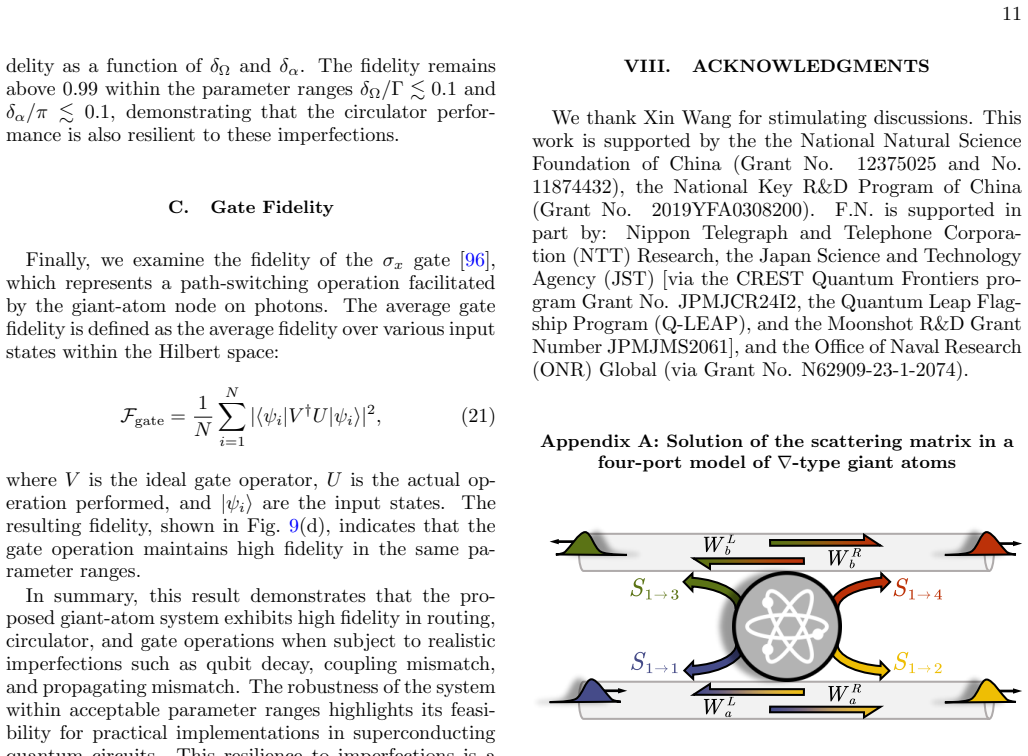
The central object is the four-port scattering matrix $S$ of the giant-atom node—a single artificial atom whose coupling to the waveguide is distributed over several spatially separated points—computed by inserting the Bethe-ansatz wavefunction into the Schrödinger equation in the single-excitation subspace. The mechanism that carries the argument is multipath interference: each of the two atomic transitions couples to both waveguides at separated points, so a photon can scatter along several paths whose relative phases (the coupling phases $\theta_i$, the propagation phases $\phi_{a,b}$, and the interatomic phase $\alpha$) either cancel or reinforce. The key derived quantity is the amplitude ratio $\beta=u_{e2}/u_{e1}$, which encodes how the waveguide-mediated interaction redistributes the excitation between the two excited states. The phase-matching conditions select parameter sets where destructive interference kills the unwanted scattering channels, leaving the remaining sub-block unitary and equal to $U(\Omega,\theta)=e^{-i\delta}(\cos\delta,\, i e^{i\phi}\sin\delta;\, i e^{-i\phi}\sin\delta,\, \cos\delta)$ on the path-encoded qubit.
What would settle it
Measure the trans-waveguide scattering probability $S_{1\to3}+S_{1\to4}$ as a function of detuning in a dual-rail giant-atom device with the phase-matching parameters of Eq. (11). If the finite travel time $\tau=d/v_g$ between coupling points is significant, the interference phases shift with frequency and the unity-efficiency plateau should narrow or develop oscillations; observing such frequency dependence at detunings of order $1/\tau$ would contradict the Markovian prediction on which the routing, gates, and circulator all rely.
Extended reading notes
Core claim
Under the Bethe-ansatz solution of the single-excitation scattering problem, the paper claims that the 4x4 scattering matrix of the ∇-type giant atom can be engineered by choosing phases. In the trans-waveguide regime, with propagation phases $\phi_a=\phi_b=\pi/2$, coupling phases satisfying $\theta_1=-\theta_2$ and $\theta_4-\theta_3=2\alpha+\theta_2-\theta_1$, and interatomic coupling $\Omega=2\cos(2\theta_2+\alpha)\Gamma_{12}$, the unwanted off-diagonal amplitudes vanish, so a photon entering port 1 must leave through the upper waveguide with unit probability. In the unidirectional regime, the conditions of Eq. (12) suppress back-reflection, and the remaining scattering amplitudes reduce to the unitary $U(\Omega,\theta)$ of Eqs. (14)–(15), a rotation on the photon's path qubit; tuning $\delta$ and $\phi$ gives identity, $\sigma_x$, $\sigma_y$, and, with two cascaded nodes, $\sigma_z$, while an auxiliary qubit that switches $\Omega$ between $0$ and $10\Gamma_{12}$ realizes a CNOT gate. With the phase conditions of Eq. (18) and a detuning $\Delta=\pm\Omega$, the same scattering matrix approximates the ideal clockwise or counterclockwise circulator matrices of Eq. (17).
Load-bearing premise
The central claim assumes the Markovian limit: the photon travel time between the giant atom's coupling points is taken to be negligible, so the propagation phases are treated as constant numbers rather than frequency-dependent functions.
Editorial extensions
If this is right
- With the phase-matching conditions of Eq. (11), photon transfer from the lower to the upper waveguide reaches unit efficiency, so the node acts as a deterministic trans-waveguide router.
- In the unidirectional regime the scattering matrix is exactly the unitary $U(\Omega,\theta)$; choosing $\delta$ and $\phi$ implements the identity, $\sigma_x$, $\sigma_y$, and, by cascading two nodes, $\sigma_z$ on a path-encoded photon qubit.
- An auxiliary qubit that controls the interatomic coupling strength $\Omega$ converts the node into a CNOT gate between the auxiliary qubit and the photon.
- The same node, with detuning $\Delta=\pm\Omega$ and the phases of Eq. (18), realizes four-port circulation in either direction without external drives.
- The routing, circulator, and gate fidelities remain above 0.99 for decay rates and phase or strength mismatches within roughly ten percent of their ideal values.
Reading between the lines
- Beyond the paper: relaxing the Markovian approximation makes the propagation phases frequency-dependent, so the same phase-matching conditions would turn the router into a frequency-selective device; the paper does not analyze this regime.
- Beyond the paper: because $U(\Omega,\theta)$ is a general rotation on the path qubit, cascading $N$ nodes should synthesize arbitrary SU(2) operations on the photon state, going beyond the discrete $\sigma$ gates explicitly listed.
- Beyond the paper: the derivation only assumes point-like couplings and controllable phases, so the design could transfer to other multi-point platforms, such as acoustic or optical waveguide systems; the superconducting realization is only one option.
- Beyond the paper: the teleportation protocol between two nodes suggests a modular quantum-network architecture, but the paper does not quantify the effect of node decay or detector inefficiency on end-to-end teleportation fidelity.
Signed reviews
Editorial analysis
A structured set of objections, weighed in public.
Referee Report
Summary. The paper studies a giant-atom node formed by two coupled superconducting qubits (a ∇-type structure) interacting with two waveguides at multiple points. Using a Bethe-ansatz solution of the single-photon scattering problem, the authors derive a 4×4 scattering matrix and show that by adjusting propagation, coupling, and interatomic phases one can achieve trans-waveguide routing and unidirectional routing with, in principle, unit efficiency. The same node is then used to construct path-encoded quantum gates (σx, σy, σz, and a CNOT controlled by an auxiliary qubit), a quantum state-transfer/teleportation protocol, and a four-port circulator with switchable circulation direction. The paper also analyzes the robustness of these operations against qubit decay and parameter mismatches, and proposes a superconducting-circuit implementation via flux-tunable mutual inductances.
Significance. The central strength of the manuscript is that it provides an analytic, closed-form scattering solution for a multi-port giant-atom node and derives explicit phase-matching conditions that are testable in circuit QED. If the predicted routing, gate, and circulator operations are confirmed, the node would be a versatile, compact component for on-chip quantum networks, avoiding external circulators and strong drives. The derivation is standard (Bethe ansatz plus input-output), the parameter space is clearly mapped, and the proposed implementation in Appendix B is concrete. The significance is moderated by the Markovian assumption underlying the static-phase conditions and by a numerical inconsistency in the circulator fidelity, both of which need to be resolved before the claims can be accepted at face value.
major comments (4)
- [Sec. II (Markovian approximation), Eqs. (11)–(12), (18), Figs. 4(e), 8(b)] The scattering matrix is derived after setting the propagation times τ_a,b to zero (end of Sec. II), so the phases φ_a,b are treated as static. However, the routing and gate conditions are used at finite detuning: Fig. 4(e) shows bandwidth Δ ~ Γ and the circulator is computed at Δ = ±5Γ0 (Fig. 8). For finite τ, the phases acquire a detuning-dependent term τΔ, making the cancellation conditions frequency-dependent. The paper provides no estimate of τΓ0 for the proposed superconducting implementation and no check that the unitarity and routing/gate conditions survive over the quoted bandwidth. Please provide a quantitative non-Markovian analysis or an explicit bound on τΓ0 that justifies the Markovian limit.
- [Sec. V B and Sec. VI B, Fig. 8(d,e), Eq. (20)] At the nominal circulator operating point (Ω = 5Γ0, Δ = ∓5Γ0), the scattering matrices in Figs. 8(d,e) display 0.962 in the intended channels and 0.038 in leakage channels. With the fidelity definition of Eq. (20), this gives F_cir ≈ 0.962 at zero mismatch. This is inconsistent with the statement in Sec. VI B that the circulator fidelity exceeds 0.99 for small mismatches. Please clarify whether the displayed values are amplitudes or probabilities and, if they are probabilities, reconcile the zero-mismatch point with the fidelity curves in Fig. 9(c).
- [Sec. IV C] The teleportation protocol is described only in words. The text does not specify the measurement basis on the photon, the classical bit mapping from the measurement outcome, or the explicit conditional corrections on node N; nor does it provide a state calculation or a success probability. This is a substantial gap for a claimed application. Please provide a full derivation of the protocol, or alternatively present it as a qualitative suggestion.
- [Sec. IV B (CNOT gate)] The text states that when the auxiliary qubit is in |0⟩, the coupling strength Ω = 10Γ12, 'i.e., δ = 0', meaning the node acts as the identity. However, δ = arctan(2Γ12/Ω) ≈ 0.197 for Ω = 10Γ12, so the controlled operation is only approximately an identity. Please correct this statement and specify the achievable gate fidelity, or choose a larger Ω so that δ is negligibly small.
minor comments (4)
- [Appendix A, Eq. (A1)] In the equation for E u_e2, the first term reads (ω_e2 − i γ_e2/2) u_e1; it should be (ω_e2 − i γ_e2/2) u_e2.
- [Sec. IV C] The sentence 'The process concludes with the measurement of the photon, entangling the two auxiliary qubits...' is duplicated in consecutive sentences; please remove the repetition.
- [Sec. II] The Markovian approximation is stated only as 'τ_a,b is sufficiently small to be neglected'; please make this quantitative (e.g., τ_a,b Γ0 ≪ 1) and state the expected range of τ_a,b for the proposed architecture.
- [Sec. VI B, Eq. (20)] The fidelity definition would be clearer if the text explicitly stated whether the scattering matrices in Eq. (20) contain probability amplitudes or probabilities, given that all other figures plot probabilities.
Circularity Check
No material circularity: routing conditions, gates, and circulator matrices are computed outputs of the Bethe-ansatz scattering solution, not inputs reframed as predictions.
full rationale
The paper's central derivation is self-contained. The four-port scattering matrix (Eq. 8) follows from inserting the Bethe-ansatz wavefunction (Eq. 6) into the Schrödinger equation (Appendix A) for the Hamiltonian of Eqs. (1)-(4). The trans-waveguide conditions (s11=s12=0) and unidirectional conditions (s11=s13=s31=s33=0) are constraints solved from these scattering amplitudes, with the resulting parameter relations (Eqs. 11, 12, 18) being algebraic consequences; the unitarity of Eq. (14), the sigma_x/sigma_y/sigma_z gates, the CNOT construction, and the circulator matrices of Eq. (17) are all evaluated from the same s-matrix rather than imposed as inputs. The 0.962 circulator fidelity is a computed output from the derived scattering probabilities. Self-citations (e.g., Refs. 46, 54, 69) appear only as background on giant-atom physics, standard Bethe-ansatz methods, and circuit ingredients, and none supplies a load-bearing uniqueness theorem or an ansatz that is itself the target result. The Markovian approximation (tau_a,b neglected) is a stated physical assumption; if it fails at finite bandwidth, the routing conditions acquire corrections, but that is a validity concern, not a circularity. No fitted parameter is renamed as a prediction and no target result is fed back into the derivation.
Assumptions & free parameters
free parameters (5)
- Interatomic coupling strength Omega =
chosen: 2cos(2theta_2+alpha)Gamma_12; 1.4Gamma; 5Gamma_0; 0 or 10Gamma_12 per application
- Interatomic phase alpha =
chosen: pi/4, pi/2, or theta_4-theta_3 depending on application
- Coupling phases theta_1, theta_2, theta_3, theta_4 =
chosen to satisfy theta_1=-theta_2 and theta_4-theta_3=2alpha+theta_2-theta_1 (trans) or Eq. (12) (unidirectional)
- Propagation phases phi_a, phi_b =
set to pi/2 for most results
- Coupling strengths g1..g4 =
set equal to g0 in the symmetric case
assumptions (6)
- standard math Bethe ansatz single-excitation ansatz for the wave function (Eqs. 5-6)
- domain assumption Markovian approximation: propagation time tau_a,b between coupling points is neglected
- domain assumption Linearized waveguide dispersion omega = omega_0 + v_g k
- domain assumption Degenerate transitions omega_e1 = omega_e2
- standard math Rotating-wave approximation and first-order flux modulation in Appendix C
- domain assumption The two waveguides are identical
Cite this review
Pith. "Pith review of Tunable quantum router with giant atoms, implementing quantum gates, teleportation, non-reciprocity, and circulators." pith.science (2026). https://pith.science/paper/2H7NM33C
@misc{pith2026241119307,
  author       = {Pith},
  title        = {Pith review of: Tunable quantum router with giant atoms, implementing quantum gates, teleportation, non-reciprocity, and circulators},
  year         = {2026},
  howpublished = {\url{https://pith.science/paper/2H7NM33C}},
  note         = {Machine review of arXiv:2411.19307}
}
read the original abstract
The unique photon-scattering phenomena of giant-atom systems offer a novel paradigm for exploring innovative quantum optics phenomena and applications. Here, we investigate a giant-atom configuration embedded in a dual-rail waveguide, whose scattering behavior is analytically derived based on a four-port model and affected by both waveguide-induced and interatomic interaction phases. One can modulate these phases to achieve targeted routing and non-reciprocal scattering of photons. Furthermore, using such a configuration, we propose quantum applications such as quantum storage, path-encoded quantum gates (e.g., CNOT gate), quantum teleportation, and quantum circulators. This configuration can be implemented with state-of-the-art solid-state quantum systems, enabling a wide range of quantum applications and facilitating the development of quantum networks.
Figures


Figures from the paper (8 more)



Forward citations
Cited by 1 Pith paper
-
Networked Quantum Services
A survey of networked quantum services, from distributed quantum computers and cloud platforms to programming languages and standardization efforts.
Reference graph
Works this paper leans on
-
[1]
Time-Dependent Modulation of Coupling Strengths The mutual inductance between the giant atom and the waveguide at the ith coupling point is given by Mi = L2 0 L(i) T cos 2π Φ0 Φext i , (C1) 14 where L0 is the loop inductance, LT is the Josephson inductance, Φ 0 is the magnetic flux quantum, and Φ ext i is the external magnetic flux threading the ith coupl...
-
[2]
Abstract Model Correspondence Specifically, we consider the interaction between the gi- ant atom and the waveguide at multiple coupling points with time-dependent mutual inductances Mi(t). The Hamiltonian of our system can be expressed as H(t) = Hq + Hw + Hint(t), (C7) where Hq is the Hamiltonian of the giant atom (qubit), Hw is the Hamiltonian of the wav...
-
[3]
Derivation of Phase Coupling The interaction Hamiltonian at the ith coupling point is given by H (i) int(t) = Mi(t)Iq(t)Iw(xi, t), (C8) where Iq(t) is the current operator of the qubit, and Iw(xi, t) is the current operator of the waveguide at po- sition xi. Expressing the qubit current operator in terms of the qubit lowering and raising operators, Iq(t) ...
-
[4]
H. J. Kimble, The quantum internet, Nature 453, 1023 (2008)
2008
-
[5]
Wehner, D
S. Wehner, D. Elkouss, and R. Hanson, Quantum in- ternet: A vision for the road ahead, Science 362, 9288 (2018)
2018
-
[6]
Xiang, M
Z.-L. Xiang, M. Zhang, L. Jiang, and P. Rabl, Intracity quantum communication via thermal microwave net- works, Phys. Rev. X 7, 011035 (2017)
2017
-
[7]
Xiang, D
Z.-L. Xiang, D. G. Olivares, J. J. Garc ´ ıa-Ripoll, and P. Rabl, Universal time-dependent control scheme for realizing arbitrary linear bosonic transformations, Phys. Rev. Lett. 130, 050801 (2023)
2023
-
[8]
Agust ´ ı, X
J. Agust ´ ı, X. H. H. Zhang, Y. Minoguchi, and P. Rabl, Autonomous distribution of programmable multiqubit entanglement in a dual-rail quantum network, Phys. Rev. Lett. 131, 250801 (2023)
2023
Show all 102 references
-
[9]
X. Gu, A. F. Kockum, A. Miranowicz, Y.-X. Liu, and F. Nori, Microwave photonics with superconducting quantum circuits, Physics Reports 718-719, 1 (2017)
2017
-
[10]
Couteau, S
C. Couteau, S. Barz, T. Durt, T. Gerrits, J. Huwer, R. Prevedel, J. Rarity, A. Shields, and G. Weihs, Ap- plications of single photons to quantum communication and computing, Nature Reviews Physics 5, 326 (2023)
2023
-
[11]
Caloz, A
C. Caloz, A. Al` u, S. Tretyakov, D. Sounas, K. Achouri, and Z.-L. Deck-L´ eger, Electromagnetic nonreciprocity, Phys. Rev. Appl. 10, 047001 (2018)
2018
-
[12]
C. L. Hogan, The ferromagnetic faraday effect at mi- crowave frequencies and its applications, Rev. Mod. Phys. 25, 253 (1953)
1953
-
[13]
Gonzalez-Ballestero, E
C. Gonzalez-Ballestero, E. Moreno, F. J. Garcia-Vidal, and A. Gonzalez-Tudela, Nonreciprocal few-photon routing schemes based on chiral waveguide-emitter cou- plings, Phys. Rev. A 94, 063817 (2016)
2016
-
[14]
Yang, M.-T
D.-C. Yang, M.-T. Cheng, X.-S. Ma, J. Xu, C. Zhu, and X.-S. Huang, Phase-modulated single-photon router, Phys. Rev. A 98, 063809 (2018)
2018
-
[15]
L. Zhou, S. Yang, Y.-X. Liu, C. P. Sun, and F. Nori, Quantum zeno switch for single-photon coherent trans- port, Phys. Rev. A 80, 062109 (2009)
2009
-
[16]
Gyongyosi and S
L. Gyongyosi and S. Imre, Decentralized base-graph routing for the quantum internet, Phys. Rev. A 98, 022310 (2018)
2018
-
[17]
Petersen, J
J. Petersen, J. Volz, and A. Rauschenbeutel, Chiral nanophotonic waveguide interface based on spin-orbit interaction of light, Science 346, 67 (2014)
2014
-
[18]
Xia and J
K. Xia and J. Twamley, All-optical switching and router via the direct quantum control of coupling between cav- ity modes, Phys. Rev. X 3, 031013 (2013)
2013
-
[19]
Lai, J.-F
D.-G. Lai, J.-F. Huang, X.-L. Yin, B.-P. Hou, W. Li, D. Vitali, F. Nori, and J.-Q. Liao, Nonreciprocal ground-state cooling of multiple mechanical resonators, Phys. Rev. A 102, 011502 (2020)
2020
-
[20]
Cai, K.-J
Y. Cai, K.-J. Ma, J. Liu, G.-F. Guo, L. Tan, and W.- M. Liu, Highly scalable quantum router with frequency- independent scattering spectra, New Journal of Physics 26, 113003 (2024)
2024
-
[21]
D. E. Chang, J. S. Douglas, A. Gonz´ alez-Tudela, C.-L. Hung, and H. J. Kimble, Colloquium: Quantum matter built from nanoscopic lattices of atoms and photons, Rev. Mod. Phys. 90, 031002 (2018)
2018
-
[22]
Gonz´ alez-Tudela, A
A. Gonz´ alez-Tudela, A. Reiserer, J. J. Garc ´ ıa-Ripoll, and F. J. Garc ´ ıa-Vidal, Light–matter interactions in 16 quantum nanophotonic devices, Nature Reviews Physics 6, 166 (2024)
2024
-
[23]
C.-H. Yan, Y. Li, H. Yuan, and L. F. Wei, Targeted photonic routers with chiral photon-atom interactions, Phys. Rev. A 97, 023821 (2018)
2018
-
[24]
L. Zhou, H. Dong, Y.-X. Liu, C. P. Sun, and F. Nori, Quantum supercavity with atomic mirrors, Phys. Rev. A 78, 063827 (2008)
2008
-
[25]
L. Zhou, Z. R. Gong, Y.-X. Liu, C. P. Sun, and F. Nori, Controllable scattering of a single photon inside a one- dimensional resonator waveguide, Phys. Rev. Lett. 101, 100501 (2008)
2008
-
[26]
Zhou, L.-P
L. Zhou, L.-P. Yang, Y. Li, and C. P. Sun, Quantum routing of single photons with a cyclic three-level sys- tem, Phys. Rev. Lett. 111, 103604 (2013)
2013
-
[27]
J. Lu, L. Zhou, L.-M. Kuang, and F. Nori, Single-photon router: Coherent control of multichannel scattering for single photons with quantum interferences, Phys. Rev. A 89, 013805 (2014)
2014
-
[28]
Shomroni, S
I. Shomroni, S. Rosenblum, Y. Lovsky, O. Bechler, G. Guendelman, and B. Dayan, All-optical routing of single photons by a one-atom switch controlled by a single photon, Science 345, 903 (2014)
2014
-
[29]
Ahumada, P
M. Ahumada, P. A. Orellana, F. Dom ´ ınguez-Adame, and A. V. Malyshev, Tunable single-photon quantum router, Phys. Rev. A 99, 033827 (2019)
2019
-
[30]
G. S. Agarwal and S. Huang, Optomechanical sys- tems as single-photon routers, Phys. Rev. A 85, 021801 (2012)
2012
-
[31]
I.-C. Hoi, C. M. Wilson, G. Johansson, T. Palomaki, B. Peropadre, and P. Delsing, Demonstration of a single- photon router in the microwave regime, Phys. Rev. Lett. 107, 073601 (2011)
2011
-
[32]
Neumeier, M
L. Neumeier, M. Leib, and M. J. Hartmann, Single- photon transistor in circuit quantum electrodynamics, Phys. Rev. Lett. 111, 063601 (2013)
2013
-
[33]
Z. Wang, Y. Wu, Z. Bao, Y. Li, C. Ma, H. Wang, Y. Song, H. Zhang, and L. Duan, Experimental realiza- tion of a deterministic quantum router with supercon- ducting quantum circuits, Phys. Rev. Appl. 15, 014049 (2021)
2021
-
[34]
D. Roy, C. Wilson, and O. Firstenberg, Colloquium : Strongly interacting photons in one-dimensional contin- uum, Rev. Mod. Phys. 89, 021001 (2017)
2017
-
[35]
Gonzalez-Tudela, D
A. Gonzalez-Tudela, D. Martin-Cano, E. Moreno, L. Martin-Moreno, C. Tejedor, and F. J. Garcia- Vidal, Entanglement of two qubits mediated by one- dimensional plasmonic waveguides, Phys. Rev. Lett. 106, 020501 (2011)
2011
-
[36]
D. E. Chang, L. Jiang, A. V. Gorshkov, and H. J. Kim- ble, Cavity qed with atomic mirrors, New Journal of Physics 14, 063003 (2012)
2012
-
[37]
Lalumi` ere, B
K. Lalumi` ere, B. C. Sanders, A. F. van Loo, A. Fe- dorov, A. Wallraff, and A. Blais, Input-output theory for waveguide qed with an ensemble of inhomogeneous atoms, Phys. Rev. A 88, 043806 (2013)
2013
-
[38]
Gonz´ alez-Tudela, V
A. Gonz´ alez-Tudela, V. Paulisch, D. E. Chang, H. J. Kimble, and J. I. Cirac, Deterministic generation of ar- bitrary photonic states assisted by dissipation, Phys. Rev. Lett. 115, 163603 (2015)
2015
-
[39]
A. F. van Loo, A. Fedorov, K. Lalumi` ere, B. C. Sanders, A. Blais, and A. Wallraff, Photon-mediated interac- tions between distant artificial atoms, Science342, 1494 (2013)
2013
-
[40]
Z. H. Peng, J. H. Ding, Y. Zhou, L. L. Ying, Z. Wang, L. Zhou, L. M. Kuang, Y.-X. Liu, O. V. Astafiev, and J. S. Tsai, Vacuum-induced autler-townes splitting in a superconducting artificial atom, Phys. Rev. A 97, 063809 (2018)
2018
-
[41]
Mirhosseini, E
M. Mirhosseini, E. Kim, X. Zhang, A. Sipahigil, P. B. Dieterle, A. J. Keller, A. Asenjo-Garcia, D. E. Chang, and O. Painter, Cavity quantum electrodynamics with atom-like mirrors, Nature 569, 692 (2019)
2019
-
[42]
M. V. Gustafsson, T. Aref, A. F. Kockum, M. K. Ekstr¨ om, G. Johansson, and P. Delsing, Propagating phonons coupled to an artificial atom, Science 346, 207 (2014)
2014
-
[43]
Kannan, M
B. Kannan, M. J. Ruckriegel, D. L. Campbell, A. Frisk Kockum, J. Braum¨ uller, D. K. Kim, M. Kjaer- gaard, P. Krantz, A. Melville, B. M. Niedzielski, A. Veps¨ al¨ ainen, R. Winik, J. L. Yoder, F. Nori, T. P. Orlando, S. Gustavsson, and W. D. Oliver, Waveguide quantum electrody...
2020
-
[44]
Joshi, F
C. Joshi, F. Yang, and M. Mirhosseini, Resonance flu- orescence of a chiral artificial atom, Phys. Rev. X 13, 021039 (2023)
2023
-
[45]
A. M. Vadiraj, A. Ask, T. G. McConkey, I. Nsanzineza, C. W. S. Chang, A. F. Kockum, and C. M. Wilson, Engineering the level structure of a giant artificial atom in waveguide quantum electrodynamics, Phys. Rev. A 103, 023710 (2021)
2021
-
[46]
M. O. Scully, M. S. Zubairy, and I. A. Walmsley, Quantum Optics, American Journal of Physics 67, 648 (1999)
1999
-
[47]
G. S. Agarwal, Quantum Optics (Cambridge University Press, 2012)
2012
-
[48]
Frisk Kockum, Quantum optics with giant atoms— the first five years, in International Symposium on Mathematics, Quantum Theory, and Cryptography , edited by T
A. Frisk Kockum, Quantum optics with giant atoms— the first five years, in International Symposium on Mathematics, Quantum Theory, and Cryptography , edited by T. Takagi, M. Wakayama, K. Tanaka, N. Ku- nihiro, K. Kimoto, and Y. Ikematsu (Springer Singa- pore, Singapore, 2021) ...
2021
-
[49]
A. F. Kockum, G. Johansson, and F. Nori, Decoherence- Free Interaction between Giant Atoms in Waveg- uide Quantum Electrodynamics, Phys. Rev. Lett. 120, 140404 (2018)
2018
-
[50]
Carollo, D
A. Carollo, D. Cilluffo, and F. Ciccarello, Mechanism of decoherence-free coupling between giant atoms, Phys. Rev. Research 2, 043184 (2020)
2020
-
[52]
L. Du, L. Guo, and Y. Li, Complex decoherence-free interactions between giant atoms, Phys. Rev. A 107, 023705 (2023)
2023
-
[53]
W. Su, W. Qin, A. Miranowicz, T. Li, and F. Nori, Her- alded nonlocal quantum gates for distributed quantum computation in a decoherence-free subspace, Phys. Rev. A 110, 052612 (2024)
2024
-
[54]
Andersson, B
G. Andersson, B. Suri, L. Guo, T. Aref, and P. Delsing, Non-exponential decay of a giant artificial atom, Nat. Phys. 15, 1123 (2019)
2019
-
[55]
L. Guo, A. Grimsmo, A. F. Kockum, M. Pletyukhov, and G. Johansson, Giant acoustic atom: A single quan- tum system with a deterministic time delay, Phys. Rev. A 95, 053821 (2017)
2017
-
[56]
L. Guo, A. F. Kockum, F. Marquardt, and G. Johans- son, Oscillating bound states for a giant atom, Phys. 17 Rev. Res. 2, 043014 (2020)
2020
-
[57]
X. Wang, T. Liu, A. F. Kockum, H.-R. Li, and F. Nori, Tunable Chiral Bound States with Giant Atoms, Phys. Rev. Lett. 126, 043602 (2021)
2021
-
[58]
H. Xiao, L. Wang, Z.-H. Li, X. Chen, and L. Yuan, Bound state in a giant atom-modulated resonators sys- tem, npj Quantum Inf 8, 80 (2022)
2022
-
[59]
C. Vega, M. Bello, D. Porras, and A. Gonz´ alez-Tudela, Qubit-photon bound states in topological waveguides with long-range hoppings, Phys. Rev. A 104, 053522 (2021)
2021
-
[60]
Cheng, Z
W. Cheng, Z. Wang, and Y.-X. Liu, Topology and retar- dation effect of a giant atom in a topological waveguide, Phys. Rev. A 106, 033522 (2022)
2022
-
[61]
Zhu, X.-L
H. Zhu, X.-L. Yin, and J.-Q. Liao, Single-photon scat- tering in giant-atom topological-waveguide-qed systems, arXiv preprint arXiv:2408.14178 (2024)
2024 arXiv
-
[62]
C. Vega, D. Porras, and A. Gonz´ alez-Tudela, Topologi- cal multimode waveguide qed, Phys. Rev. Res.5, 023031 (2023)
2023
-
[63]
E. Kim, X. Zhang, V. S. Ferreira, J. Banker, J. K. Iverson, A. Sipahigil, M. Bello, A. Gonz´ alez-Tudela, M. Mirhosseini, and O. Painter, Quantum electrody- namics in a topological waveguide, Phys. Rev. X 11, 011015 (2021)
2021
-
[64]
Yin and J.-Q
X.-L. Yin and J.-Q. Liao, Generation of two-giant-atom entanglement in waveguide-qed systems, Phys. Rev. A 108, 023728 (2023)
2023
-
[65]
Yin, W.-B
X.-L. Yin, W.-B. Luo, and J.-Q. Liao, Non- markovian disentanglement dynamics in double-giant- atom waveguide-qed systems, Phys. Rev. A106, 063703 (2022)
2022
-
[66]
A. C. Santos and R. Bachelard, Generation of maxi- mally entangled long-lived states with giant atoms in a waveguide, Phys. Rev. Lett. 130, 053601 (2023)
2023
-
[67]
Frisk Kockum, P
A. Frisk Kockum, P. Delsing, and G. Johansson, De- signing frequency-dependent relaxation rates and Lamb shifts for a giant artificial atom, Phys. Rev. A 90, 013837 (2014)
2014
-
[68]
Almanakly, B
A. Almanakly, B. Yankelevich, M. Hays, B. Kannan, R. Assouly, A. Greene, M. Gingras, B. M. Niedzielski, H. Stickler, M. E. Schwartz, et al., Deterministic re- mote entanglement using a chiral quantum interconnect, arXiv preprint arXiv:2408.05164 (2024)
2024 arXiv
-
[69]
Kannan, A
B. Kannan, A. Almanakly, Y. Sung, A. Di Paolo, D. A. Rower, J. Braum¨ uller, A. Melville, B. M. Niedzielski, A. Karamlou, K. Serniak, et al., On-demand directional microwave photon emission using waveguide quantum electrodynamics, Nature Physics 19, 394 (2023)
2023
-
[70]
Guimond, B
P.-O. Guimond, B. Vermersch, M. L. Juan, A. Sharafiev, G. Kirchmair, and P. Zoller, A unidirectional on-chip photonic interface for superconducting circuits, npj Quantum Information 6, 32 (2020)
2020
-
[71]
Wang and H.-R
X. Wang and H.-R. Li, Chiral quantum network with giant atoms, Quantum Sci. Technol. 7, 035007 (2022)
2022
-
[72]
Xu, Z.-H
K. Xu, Z.-H. Sun, W. Liu, Y.-R. Zhang, H. Li, H. Dong, W. Ren, P. Zhang, F. Nori, D. Zheng, H. Fan, and H. Wang, Probing dynamical phase transitions with a superconducting quantum simulator, Science Advances 6, eaba4935 (2020)
2020
-
[73]
Roushan, C
P. Roushan, C. Neill, A. Megrant, Y. Chen, R. Bab- bush, R. Barends, B. Campbell, Z. Chen, B. Chiaro, A. Dunsworth, et al., Chiral ground-state currents of interacting photons in a synthetic magnetic field, Na- ture Physics 13, 146 (2017)
2017
-
[74]
Shen and S
J.-T. Shen and S. Fan, Theory of single-photon trans- port in a single-mode waveguide. I. Coupling to a cavity containing a two-level atom, Phys. Rev. A 79, 023837 (2009)
2009
-
[75]
Shen and S
J.-T. Shen and S. Fan, Theory of single-photon trans- port in a single-mode waveguide. II. Coupling to a whispering-gallery resonator containing a two-level atom, Phys. Rev. A 79, 023838 (2009)
2009
-
[76]
Y.-T. Chen, L. Du, L. Guo, Z. Wang, Y. Zhang, Y. Li, and J.-H. Wu, Nonreciprocal and chiral single-photon scattering for giant atoms, Commun Phys5, 215 (2022)
2022
-
[77]
Y. T. Zhu, S. Xue, R. B. Wu, W. L. Li, Z. H. Peng, and M. Jiang, Spatial-nonlocality-induced non-Markovian electromagnetically induced transparency in a single gi- ant atom, Phys. Rev. A 106, 043710 (2022)
2022
-
[78]
Zhou, X.-L
J. Zhou, X.-L. Yin, and J.-Q. Liao, Chiral and nonrecip- rocal single-photon scattering in a chiral-giant-molecule waveguide-QED system, Phys. Rev. A 107, 063703 (2023)
2023
-
[79]
C. Zhou, P. Lu, M. Praquin, T.-C. Chien, R. Kaufman, X. Cao, M. Xia, R. S. K. Mong, W. Pfaff, D. Pekker, and M. Hatridge, Realizing all-to-all couplings among de- tachable quantum modules using a microwave quantum state router, npj Quantum Information 9, 54 (2023)
2023
-
[80]
Soro and A
A. Soro and A. F. Kockum, Chiral quantum optics with giant atoms, Phys. Rev. A 105, 023712 (2022)
2022
-
[81]
Poudyal and I
B. Poudyal and I. M. Mirza, Collective photon rout- ing improvement in a dissipative quantum emitter chain strongly coupled to a chiral waveguide qed ladder, Phys. Rev. Res. 2, 043048 (2020)
2020
-
[82]
Burgarth and S
D. Burgarth and S. Bose, Conclusive and arbitrarily perfect quantum-state transfer using parallel spin-chain channels, Phys. Rev. A 71, 052315 (2005)
2005
-
[83]
Lodahl, S
P. Lodahl, S. Mahmoodian, S. Stobbe, A. Rauschenbeu- tel, P. Schneeweiss, J. Volz, H. Pichler, and P. Zoller, Chiral quantum optics, Nature 541, 473 (2017)
2017
-
[84]
K. Y. Bliokh, F. J. Rodr ´ ıguez-Fortu˜ no, F. Nori, and A. V. Zayats, Spin–orbit interactions of light, Nature Photonics 9, 796 (2015)
2015
-
[85]
Xu and L
L. Xu and L. Guo, Catch and release of propagating bosonic field with non-markovian giant atom, New Jour- nal of Physics 26, 013025 (2024)
2024
-
[86]
Levy-Yeyati, C
T. Levy-Yeyati, C. Vega, T. Ramos, and A. Gonz´ alez- Tudela, Passive photonic cz gate with two-level emit- ters in chiral multi-mode waveguide qed, arXiv preprint arXiv:2407.06283 (2024)
2024 arXiv
-
[87]
Guimond, B
P.-O. Guimond, B. Vermersch, M. L. Juan, A. Sharafiev, G. Kirchmair, and P. Zoller, A unidirectional on-chip photonic interface for superconducting circuits, npj Quantum Inf 6, 32 (2020)
2020
-
[88]
Carolan, C
J. Carolan, C. Harrold, C. Sparrow, E. Mart ´ ın-L´ opez, N. J. Russell, J. W. Silverstone, P. J. Shadbolt, N. Mat- suda, M. Oguma, M. Itoh, G. D. Marshall, M. G. Thompson, J. C. F. Matthews, T. Hashimoto, J. L. O’Brien, and A. Laing, Universal linear optics, Science 349, 711 (2015)
2015
-
[89]
X.-M. Hu, Y. Guo, B.-H. Liu, C.-F. Li, and G.-C. Guo, Progress in quantum teleportation, Nature Re- views Physics 5, 339 (2023)
2023
-
[90]
Bouwmeester, J.-W
D. Bouwmeester, J.-W. Pan, K. Mattle, M. Eibl, H. We- infurter, and A. Zeilinger, Experimental quantum tele- portation, Nature 390, 575 (1997)
1997
-
[91]
Fleury, D
R. Fleury, D. L. Sounas, C. F. Sieck, M. R. Haberman, 18 and A. Al` u, Sound isolation and giant linear nonre- ciprocity in a compact acoustic circulator, Science 343, 516 (2014)
2014
-
[92]
Scheucher, A
M. Scheucher, A. Hilico, E. Will, J. Volz, and A. Rauschenbeutel, Quantum optical circulator con- trolled by a single chirally coupled atom, Science 354, 1577 (2016)
2016
-
[93]
K. Y. Bliokh, D. Smirnova, and F. Nori, Quantum spin hall effect of light, Science 348, 1448 (2015)
2015
-
[94]
Navarathna, D
R. Navarathna, D. T. Le, A. R. Hamann, H. D. Nguyen, T. M. Stace, and A. Fedorov, Passive superconduct- ing circulator on a chip, Phys. Rev. Lett. 130, 037001 (2023)
2023
-
[95]
Jalas, A
D. Jalas, A. Petrov, M. Eich, W. Freude, S. Fan, Z. Yu, R. Baets, M. Popovi´ c, A. Melloni, J. D. Joannopoulos, M. Vanwolleghem, C. R. Doerr, and H. Renner, What is — and what is not — an optical isolator, Nature Photonics 7, 579 (2013)
2013
-
[96]
X. Cao, A. Irfan, M. Mollenhauer, K. Singirikonda, and W. Pfaff, Parametrically controlled chiral interface for superconducting quantum devices, arXiv preprint arXiv:2405.15086 (2024)
2024 arXiv
-
[97]
Wang and H.-R
X. Wang and H.-R. Li, Chiral quantum network with gi- ant atoms, Quantum Science and Technology 7, 035007 (2022)
2022
-
[98]
D. C. McKay, S. Filipp, A. Mezzacapo, E. Magesan, J. M. Chow, and J. M. Gambetta, Universal gate for fixed-frequency qubits via a tunable bus, Phys. Rev. Appl. 6, 064007 (2016)
2016
-
[99]
M. A. Nielsen, A simple formula for the average gate fidelity of a quantum dynamical operation, Physics Let- ters A 303, 249 (2002)
2002
-
[100]
M. R. Geller, E. Donate, Y. Chen, M. T. Fang, N. Le- ung, C. Neill, P. Roushan, and J. M. Martinis, Tunable coupler for superconducting xmon qubits: Perturbative nonlinear model, Phys. Rev. A 92, 012320 (2015)
2015
-
[101]
Wulschner, J
F. Wulschner, J. Goetz, F. R. Koessel, E. Hoffmann, A. Baust, P. Eder, M. Fischer, M. Haeberlein, M. J. Schwarz, M. Pernpeintner, et al., Tunable coupling of transmission-line microwave resonators mediated by an rf squid, EPJ Quantum Technology 3, 1 (2016)
2016
-
[102]
J. Koch, T. M. Yu, J. Gambetta, A. A. Houck, D. I. Schuster, J. Majer, A. Blais, M. H. Devoret, S. M. Girvin, and R. J. Schoelkopf, Charge-insensitive qubit design derived from the cooper pair box, Physical Re- view A 76, 042319 (2007)
2007
-
[103]
Y. T. Zhu and W. Z. Jia, Single-photon quantum router in the microwave regime utilizing double superconduct- ing resonators with tunable coupling, Phys. Rev. A 99, 063815 (2019)
2019
Reviewed August 12, 2026 · model on record in the stance chip above.
Discussion (0). Continue with ORCID to comment.