REVIEW 3 major objections 6 minor 35 references
HAECcity: Open-Vocabulary Scene Understanding of City-Scale Point Clouds with Superpoint Graph Clustering
T0 review · 3 major / 6 minor · reviewed 2026-08-16 · deepseek-v4-flash
Pith's one-line read HAEC claims that a city-scale point cloud can be given open-vocabulary panoptic labels—naming and counting arbitrary objects—by a purely 3D model trained with no human annotation.
desk verdict A promising self-supervised open-vocabulary pipeline for city-scale point clouds, but the long-tail showcase runs on the preprocessing features rather than the trained model. read the letter →
The pith
A machine-rendered reading of the paper's core claim, the machinery that carries it, and where it could break.
The reading
What carries the argument
The load-bearing object is the superpoint graph transformer, a hierarchy of geometrically coherent point clusters connected as a graph, combined with a mixture-of-experts modification: at each level, top-2 expert graph-attention blocks are gated by each superpoint’s representation and the mean-aggregated relative positional encodings of its incoming edges. This hierarchy lets the model process millions of points as a small set of superpoints, so an entire city scene fits in one forward pass. The semantic head outputs a CLIP feature vector per superpoint instead of a class logit, and the training objective combines cosine reconstruction with a triplet loss that pulls same-pseudo-class superpoints together and pushes different pseudo-classes apart.
What would settle it
Project the pseudo-label features on a held-out SensatUrban scene and test free-text queries such as “a red car” against manually verified regions; if retrieved points show no significant cosine-similarity advantage over random regions, or if the preprocessing oracle mIoU is within noise of the majority-class baseline, the pipeline cannot supply usable training targets.
Extended reading notes
Core claim
The central discovery is that a strictly 3D superpoint-graph architecture can be trained with no human labels to produce open-vocabulary panoptic segmentation of city-scale point clouds. Training targets come from a synthetic labeling pipeline: cameras are cast into the point cloud, rendered images are screened by a lightweight vision-language model and given depth masks, per-pixel features from OpenSeg are projected back onto 3D points and averaged, and spherical k-means plus adaptive DBSCAN turn those features into pseudo-class and pseudo-instance labels. The backbone predicts CLIP feature vectors per superpoint rather than discrete classes, using cosine reconstruction and triplet losses. On SensatUrban the model reaches a semantic mIoU of 22.45 and on ScanNet a panoptic quality of 40.03, and it can answer long-tail text queries such as “the gate of King’s College” directly from the raw cloud.
Load-bearing premise
The load-bearing premise is that the OpenSeg feature vectors computed from synthetic, point-cloud-rendered images are semantically accurate enough to act as training labels; if that fails, no amount of backbone engineering can teach meaningful open-vocabulary semantics.
Editorial extensions
If this is right
- Raw city-scale point clouds can be semantically queried and panoptically segmented in a single 3D pass, avoiding expensive per-scene 2D-to-3D projection at inference time.
- Open-vocabulary 3D training no longer depends on hand-annotated 3D datasets, since synthetic images rendered from the cloud itself supply the supervision.
- Long-tail and unique objects, such as specific buildings or colored cars, can be retrieved by free-form text queries even when they appear in no fixed class list.
- The same pipeline transfers from indoor scenes to outdoor city data, suggesting a path toward foundation models trained on many unlabeled point clouds.
- Because inference runs directly on the 3D data, preprocessing cost is paid once at training time rather than for every novel scene.
Reading between the lines
- The system’s ceiling is set by the vision-language feature extractor’s ability to read synthetic, point-cloud-style images, so improving that alignment, for example by fine-tuning a VLM on rendered-versus-real image pairs, should lift the whole pipeline more than any backbone change.
- If pseudo-label noise can be reduced, the same superpoint mixture-of-experts backbone could be trained jointly on many unlabeled city scans, acting as an unsupervised foundation model for urban 3D understanding.
- The stuff-versus-things split via an “object versus amorphous” text query is a testable shortcut: one could measure how sensitive final panoptic quality is to that binary threshold and replace it with a learned criterion.
- The results suggest that expensive reconstruction-based open-vocabulary methods may be unnecessary for city-scale understanding once a trained 3D network can predict the same feature space directly.
Signed reviews
Editorial analysis
A structured set of objections, weighed in public.
Referee Report
Summary. The paper presents HAEC, a superpoint-graph transformer with mixture-of-experts blocks that predicts per-superpoint CLIP feature vectors and instance labels for point clouds, with the goal of open-vocabulary panoptic segmentation at city scale. Training targets are produced by a synthetic pipeline: synthetic RGB images are rendered from the point cloud, filtered with MobileCLIP, processed by OpenSeg, projected back to 3D, and then clustered with spherical k-means and DBSCAN to form pseudo-classes and pseudo-instances. The model is evaluated on ScanNet for panoptic quality and on SensatUrban for semantic segmentation, and qualitative long-tail queries are shown for two SensatUrban scenes. The paper claims the first strictly-3D, non-projection-based open-vocabulary panoptic system for city-scale point clouds, trained without hand annotations.
Significance. If the central claim were fully supported, this would be a valuable demonstration that a single-pass 3D model can be trained on noisy synthetic pseudo-labels and transfer to human-annotated benchmarks at city scale. The paper has genuine strengths: the model outperforms its own pseudo-label oracle on SensatUrban (mIoU 22.45 vs. 5.62), which suggests the learned representation is not merely memorizing pseudo-labels; inference is a single 3D pass without per-scene image projection; and the attempt to scale open-vocabulary understanding to a multi-square-kilometer dataset is timely. However, the evidence as presented does not yet substantiate the headline open-vocabulary capability of the trained model, because the only open-vocabulary demonstrations query preprocessing features rather than HAEC predictions, and the quantitative evaluation is closed-set. The contribution is therefore promising but currently under-supported.
major comments (3)
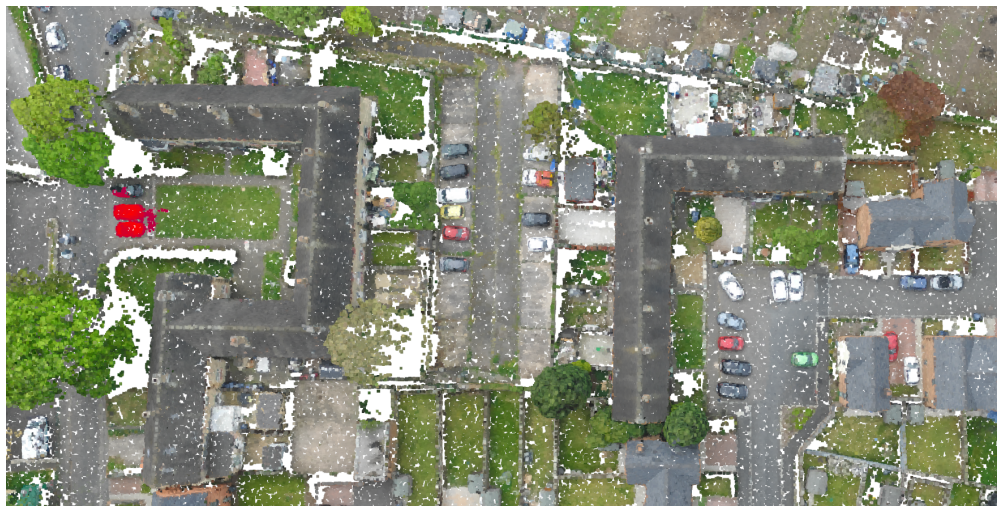
- [Section 4.3] The open-vocabulary queries shown in Figures 1 and 5 are explicitly computed on 'the preprocessing derived point cloud features' rather than on HAEC's predicted CLIP vectors. This means the paper does not demonstrate that the trained model can answer novel text queries; it demonstrates only that the pseudo-label pipeline can sometimes retrieve a long-tail object from the raw OpenSeg features. Since the third stated contribution is 'the first employment of a strictly 3D processing model based ... open-vocabulary panoptic segmentation system onto city-scale point clouds,' this is a load-bearing gap. Please run the same long-tail and class-agnostic text queries on the HAEC-predicted features, report quantitative retrieval metrics (e.g., mAP or IoU at a similarity threshold) for both the preprocessing features and the model predictions, and compare them on the same scenes.
- [Section 5 / Table 2] The paper itself concedes in Section 5 that 'the most significant limitation to our approach comes from the quality of the synthetic-image-derived CLIP features,' and the preprocessing oracle mIoU on SensatUrban is only 5.62. Because the training targets (OpenSeg features), the spherical k-means pseudo-classes, and the text-embedding evaluation all live in the same CLIP-derived space, the closed-set mIoU of 22.45 could partly reflect learning the pseudo-label distribution rather than open-vocabulary generalization. To support the open-vocabulary claim, please report the model's alignment with held-out text queries that were not used in the pseudo-class clustering, and compare HAEC's retrieval performance against the preprocessing oracle. A quantitative separation between the model and the oracle on unseen categories would directly address this concern.
- [Section 1 / Table 1] The novelty claim that this is the first strictly-3D open-vocabulary panoptic system at city scale is asserted rather than demonstrated against cited related work. In particular, OpenGraph is described as an 'open-vocabulary hierarchical 3D graph representation in large-scale outdoor environments' and Search3D is a hierarchical open-vocabulary 3D segmentation method; neither is quantitatively compared on SensatUrban or ScanNet, and Table 1's checkmark pattern for these methods is not explained. Please provide a concrete comparison or a precise argument for why these systems fall outside the claimed scope, and clarify whether the 'first' claim refers to scale, to the absence of projection at inference, to the absence of hand-labeled training data, or to all three.
minor comments (6)
- [Section 3.2] The text says 'The processing of the partitions proceeds from fine to course partitions'; 'course' should be 'coarse'.
- [Header / Title Page] The author name 'Fr ´ed´eric Kaplan' contains LaTeX accent artifacts; this should be rendered as 'Frédéric Kaplan' in the final version.
- [Table 2] The table columns include both PQ and mIoU/mAcc for ScanNet and SensatUrban, but several rows (e.g., SuperCluster, RandLA-Net, OpenScene) list values in a way that makes it unclear which metric is being reported. Please separate the two benchmarks into distinct tables or add explicit column headers for each metric and each dataset.
- [Section 3.1] The phrase 'strictly 3D processing model based, rather than 2D to 3D projection based' in the contributions is potentially confusing because the pseudo-label pipeline in Section 3.1 is itself a 2D-to-3D projection method. Please clarify that the claim concerns inference-time processing, and that 2D-to-3D projection is used only to generate training targets.
- [Section 3.1 / Section 3.2] The paper does not report values for the key hyperparameters, including the spherical k-means cluster count K, the DBSCAN epsilon and minPts settings, the triplet margin alpha, the MobileCLIP acceptance threshold, the number of MoE experts, or the loss weighting between Lrec and Ltriplet. Please provide these settings, or an appendix with the full training configuration, to make the experiments reproducible.
- [Figure 4] The caption for Figure 4 says the OpenSeg bar is 'representative of the preprocessing time for training samples in our approach,' but it is not clear whether this includes the synthetic image rendering time and the MobileCLIP/Depth Anything filtering. Please specify which preprocessing stages are included in each bar.
Circularity Check
The open-vocabulary long-tail demos in Section 4.3 query preprocessing-derived CLIP features rather than HAEC's predicted features, so the showcased open-vocabulary capability reduces to the training input replayed; closed-set benchmarks do not test open vocabulary.
-
fitted input called prediction
[Section 4.3 'Open Querying of Unique Objects', Figures 1 and 5; compare Section 3.1 Eq. (1) and Section 4.2/Table 2]
"In order to demonstrate this ability and highlight some of the limitations of our approach, we query the preprocessing derived point cloud features on two scenes from SensatUrban."
The open-vocabulary queries ('The gate of King's College', 'a red car') are presented as evidence of HAEC's ability to recognize long-tail objects, but the features queried are the preprocessing pipeline's CLIP features, which are exactly the training targets of Section 3.1 (Eq. 1 plus spherical k-means/DBSCAN pseudo-labels). The paper never queries HAEC's predicted CLIP vectors for these text prompts; the only quantitative evaluation of HAEC's own semantic output is closed-set mIoU/mAcc on SensatUrban and ScanNet, which does not exercise open-vocabulary or long-tail generalization. Thus the showcased open-vocabulary capability is the input pipeline replayed as the model's output, so the central claim of a strictly-3D open-vocabulary system is not directly demonstrated.
full rationale
The core training/evaluation chain is not circular: OpenSeg/MobileCLIP features are projected to 3D, clustered into pseudo-classes and pseudo-instances, and used as targets for HAEC's reconstruction and triplet losses; the model is then scored against human annotations on ScanNet and SensatUrban, with an honestly reported preprocessing oracle (mIoU 5.62). No self-citation chain is load-bearing, and the equations are not self-referential. However, the paper's central open-vocabulary claim is showcased in Section 4.3 by querying 'the preprocessing derived point cloud features' rather than HAEC's predicted CLIP features. That demonstration therefore reduces by construction to the input pipeline, not to the trained model. The paper itself flags that the synthetic-image-derived CLIP features are the most significant limitation and that OpenSeg is 'unlikely familiar' with point-cloud-style images, which reinforces that the open-vocabulary evidence is input-replaying. Since the closed-set metrics provide independent but non-open-vocabulary validation, the circularity is partial rather than total.
Assumptions & free parameters
free parameters (7)
- Spherical k-means cluster count K
- DBSCAN epsilon and minPts
- Triplet loss margin alpha
- MobileCLIP acceptance threshold =
65 percent
- Camera grid spacing and image resolution
- Depth screening threshold
- Number of MoE experts per level
assumptions (5)
- domain assumption OpenSeg and CLIP features projected from synthetic point cloud renders are semantically meaningful for 3D points.
- domain assumption Spherical k-means on CLIP vectors produces coherent pseudo-classes.
- domain assumption Adaptive DBSCAN within pseudo-classes on point positions yields object instances.
- domain assumption Cosine similarity against 'an object' versus 'amorphous, uncountable stuff' correctly separates things from stuff.
- domain assumption The superpoint hierarchy preserves the fine-grained information of per-point CLIP features.
Cite this review
Pith. "Pith review of HAECcity: Open-Vocabulary Scene Understanding of City-Scale Point Clouds with Superpoint Graph Clustering." pith.science (2026). https://pith.science/paper/2HOHMCPK
@misc{pith2026250413590,
  author       = {Pith},
  title        = {Pith review of: HAECcity: Open-Vocabulary Scene Understanding of City-Scale Point Clouds with Superpoint Graph Clustering},
  year         = {2026},
  howpublished = {\url{https://pith.science/paper/2HOHMCPK}},
  note         = {Machine review of arXiv:2504.13590}
}
read the original abstract
Traditional 3D scene understanding techniques are generally predicated on hand-annotated label sets, but in recent years a new class of open-vocabulary 3D scene understanding techniques has emerged. Despite the success of this paradigm on small scenes, existing approaches cannot scale efficiently to city-scale 3D datasets. In this paper, we present Hierarchical vocab-Agnostic Expert Clustering (HAEC), after the latin word for 'these', a superpoint graph clustering based approach which utilizes a novel mixture of experts graph transformer for its backbone. We administer this highly scalable approach to the first application of open-vocabulary scene understanding on the SensatUrban city-scale dataset. We also demonstrate a synthetic labeling pipeline which is derived entirely from the raw point clouds with no hand-annotation. Our technique can help unlock complex operations on dense urban 3D scenes and open a new path forward in the processing of digital twins.
Figures


Figures from the paper (2 more)

Reference graph
Works this paper leans on
-
[1]
Amro Kamal Mohamed Abbas, Evgenia Rusak, Kushal Tiru- mala, Wieland Brendel, Kamalika Chaudhuri, and Ari S. Morcos. Effective pruning of web-scale datasets based on complexity of concept clusters. In The Twelfth International Conference on Learning Representations, 2024. 4
work page 2024
-
[2]
Panoptic vision-language feature fields
Haoran Chen, Kenneth Blomqvist, Francesco Milano, and Roland Siegwart. Panoptic vision-language feature fields. IEEE Robotics and Automation Letters , 9(3):2144–2151,
-
[3]
Medieval Theories of Haecceity
Richard Cross. Medieval Theories of Haecceity. In The Stanford Encyclopedia of Philosophy. Metaphysics Research Lab, Stanford University, Winter 2022 edition, 2022. 2
work page 2022
-
[4]
Chang, Manolis Savva, Maciej Hal- ber, Thomas Funkhouser, and Matthias Nießner
Angela Dai, Angel X. Chang, Manolis Savva, Maciej Hal- ber, Thomas Funkhouser, and Matthias Nießner. Scannet: Richly-annotated 3d reconstructions of indoor scenes. In Proc. Computer Vision and Pattern Recognition (CVPR), IEEE, 2017. 2, 6
work page 2017
-
[5]
Opengraph: Open-vocabulary hierarchical 3d graph representation in large-scale outdoor environments
Yinan Deng, Jiahui Wang, Jingyu Zhao, Xinyu Tian, Guangyan Chen, Yi Yang, and Yufeng Yue. Opengraph: Open-vocabulary hierarchical 3d graph representation in large-scale outdoor environments. IEEE Robotics and Au- tomation Letters, 9(10):8402–8409, 2024. 3
work page 2024
-
[6]
A density-based algorithm for discovering clusters in large spatial databases with noise
Martin Ester, Hans-Peter Kriegel, J ¨org Sander, and Xiaowei Xu. A density-based algorithm for discovering clusters in large spatial databases with noise. In Proceedings of the Sec- ond International Conference on Knowledge Discovery and Data Mining, page 226–231. AAAI Press, 1996. 4
1996
-
[7]
Scal- ing open-vocabulary image segmentation with image-level labels
Golnaz Ghiasi, Xiuye Gu, Yin Cui, and Tsung-Yi Lin. Scal- ing open-vocabulary image segmentation with image-level labels. In Computer Vision – ECCV 2022 , pages 540–557, Cham, 2022. Springer Nature Switzerland. 3, 4
work page 2022
-
[8]
Bridging nonlinearities and stochastic regularizers with gaussian error linear units,
Dan Hendrycks and Kevin Gimpel. Bridging nonlinearities and stochastic regularizers with gaussian error linear units,
Show all 35 references
-
[9]
Spherical k-means clustering
Kurt Hornik, Ingo Feinerer, Martin Kober, and Christian Buchta. Spherical k-means clustering. Journal of Statisti- cal Software, 50:1–22, 2012. 4
2012
-
[10]
Randla-net: Efficient semantic segmentation of large-scale point clouds
Qingyong Hu, Bo Yang, Linhai Xie, Stefano Rosa, Yulan Guo, Zhihua Wang, Niki Trigoni, and Andrew Markham. Randla-net: Efficient semantic segmentation of large-scale point clouds. Proceedings of the IEEE Conference on Com- puter Vision and Pattern Recognition, 2020. 7
2020
-
[11]
Towards semantic segmen- tation of urban-scale 3d point clouds: A dataset, benchmarks and challenges
Qingyong Hu, Bo Yang, Sheikh Khalid, Wen Xiao, Niki Trigoni, and Andrew Markham. Towards semantic segmen- tation of urban-scale 3d point clouds: A dataset, benchmarks and challenges. In Proceedings of the IEEE/CVF Conference on Computer Vision and Pattern Recognition, 2021. 2, 6
2021
-
[12]
Lerf: Language embed- ded radiance fields
Justin Kerr, Chung Min Kim, Ken Goldberg, Angjoo Kanazawa, and Matthew Tancik. Lerf: Language embed- ded radiance fields. In Proceedings of the IEEE/CVF In- ternational Conference on Computer Vision (ICCV) , pages 19729–19739, 2023. 3
2023
-
[13]
Abu Bakr Sid- dique, Rezoana Bente Arif, and Mahjabin Rahman Oishe
Mohammad Mahmudur Rahman Khan, Md. Abu Bakr Sid- dique, Rezoana Bente Arif, and Mahjabin Rahman Oishe. Adbscan: Adaptive density-based spatial clustering of appli- cations with noise for identifying clusters with varying den- sities. In 2018 4th International Conference on Ele...
2018
-
[14]
Semantic-sam: Segment and recognize anything at any gran- ularity, 2023
Feng Li, Hao Zhang, Peize Sun, Xueyan Zou, Shilong Liu, Jianwei Yang, Chunyuan Li, Lei Zhang, and Jianfeng Gao. Semantic-sam: Segment and recognize anything at any gran- ularity, 2023. 3
2023
-
[15]
Patel, and Lei Zhang
Ruihuang Li, Zhengqiang Zhang, Chenhang He, Zhiyuan Ma, Vishal M. Patel, and Lei Zhang. Dense multimodal alignment for open-vocabulary 3d scene understanding. In Computer Vision – ECCV 2024 , pages 416–434, Cham,
2024
-
[16]
Instant neural graphics primitives with a multires- olution hash encoding
Thomas M ¨uller, Alex Evans, Christoph Schied, and Alexan- der Keller. Instant neural graphics primitives with a multires- olution hash encoding. ACM Transactions on Graphics, 41 (4):1–15, 2022. 3
2022
-
[17]
Openscene: 3d scene understanding with open vocabular- ies
Songyou Peng, Kyle Genova, Chiyu “Max” Jiang, An- drea Tagliasacchi, Marc Pollefeys, and Thomas Funkhouser. Openscene: 3d scene understanding with open vocabular- ies. In Proceedings of the IEEE/CVF Conference on Com- puter Vision and Pattern Recognition (CVPR) , pages 815– 82...
2023
-
[18]
Scaling learned metric index to 100m datasets
David Proch ´azka, Ter ´ezia Slanin ´akov´a, Jozef ˇCerˇnansk´y, Jaroslav Olha, Matej Antol, and Vlastislav Dohnal. Scaling learned metric index to 100m datasets. In Similarity Search and Applications, pages 266–273, Cham, 2025. Springer Na- ture Switzerland. 4
2025
-
[19]
Learning transferable visual models from natural language supervision, 2021
Alec Radford, Jong Wook Kim, Chris Hallacy, Aditya Ramesh, Gabriel Goh, Sandhini Agarwal, Girish Sastry, Amanda Askell, Pamela Mishkin, Jack Clark, Gretchen Krueger, and Ilya Sutskever. Learning transferable visual models from natural language supervision, 2021. 1
2021
-
[20]
Grounded sam: Assembling open-world models for diverse visual tasks,
Tianhe Ren, Shilong Liu, Ailing Zeng, Jing Lin, Kun- chang Li, He Cao, Jiayu Chen, Xinyu Huang, Yukang Chen, Feng Yan, Zhaoyang Zeng, Hao Zhang, Feng Li, Jie Yang, Hongyang Li, Qing Jiang, and Lei Zhang. Grounded sam: Assembling open-world models for diverse visual tasks,
-
[21]
Efficient 3d semantic segmentation with superpoint transformer
Damien Robert, Hugo Raguet, and Loic Landrieu. Efficient 3d semantic segmentation with superpoint transformer. In Proceedings of the IEEE/CVF International Conference on Computer Vision (ICCV), pages 17195–17204, 2023. 5
2023
-
[22]
Scalable 3D Panoptic Segmentation As Superpoint Graph Clustering
Damien Robert, Hugo Raguet, and Loic Landrieu. Scalable 3D Panoptic Segmentation As Superpoint Graph Clustering . In 2024 International Conference on 3D Vision (3DV), pages 179–189, Los Alamitos, CA, USA, 2024. IEEE Computer Society. 1, 2, 5
2024
-
[23]
Opera Omnia
Duns Scotus. Opera Omnia. 1639. 2
-
[24]
Sumner, Francis Engelmann, Johanna Wald, and Federico Tombari
Ayc ¸a Takmaz, Alexandros Delitzas, Robert W. Sumner, Francis Engelmann, Johanna Wald, and Federico Tombari. Search3d: Hierarchical open-vocabulary 3d segmentation. CoRR, abs/2409.18431, 2024. 3
2024 arXiv
-
[25]
Mobile- clip: Fast image-text models through multi-modal reinforced training
Pavan Kumar Anasosalu Vasu, Hadi Pouransari, Fartash Faghri, Raviteja Vemulapalli, and Oncel Tuzel. Mobile- clip: Fast image-text models through multi-modal reinforced training. In Proceedings of the IEEE/CVF Conference on Computer Vision and Pattern Recognition (CVPR) , pages...
2024
-
[26]
Graph mixture of experts: Learning on large-scale graphs with explicit diversity modeling
Haotao Wang, Ziyu Jiang, Yuning You, Yan Han, Gaowen Liu, Jayanth Srinivasa, Ramana Rao Kompella, and Zhangyang Wang. Graph mixture of experts: Learning on large-scale graphs with explicit diversity modeling. In NeurIPS, 2023. 6
2023
-
[27]
3d open-vocabulary panoptic segmen- tation with 2d-3d vision-language distillation
Zihao Xiao, Longlong Jing, Shangxuan Wu, Alex Zihao Zhu, Jingwei Ji, Chiyu Max Jiang, Wei-Chih Hung, Thomas Funkhouser, Weicheng Kuo, Anelia Angelova, Yin Zhou, and Shiwei Sheng. 3d open-vocabulary panoptic segmen- tation with 2d-3d vision-language distillation. In Computer Vi...
2024
-
[28]
A unified framework for 3d scene understanding
Wei Xu, Chunsheng Shi, Sifan Tu, Xin Zhou, Dingkang Liang, and Xiang Bai. A unified framework for 3d scene understanding. In The Thirty-eighth Annual Conference on Neural Information Processing Systems, 2024. 3
2024
-
[29]
Depth anything: Unleashing the power of large-scale unlabeled data
Lihe Yang, Bingyi Kang, Zilong Huang, Xiaogang Xu, Jiashi Feng, and Hengshuang Zhao. Depth anything: Unleashing the power of large-scale unlabeled data. In CVPR, 2024. 4
2024
-
[30]
Panopticrecon: Leverage open-vocabulary instance segmentation for zero- shot panoptic reconstruction, 2024
Xuan Yu, Yili Liu, Chenrui Han, Sitong Mao, Shunbo Zhou, Rong Xiong, Yiyi Liao, and Yue Wang. Panopticrecon: Leverage open-vocabulary instance segmentation for zero- shot panoptic reconstruction, 2024. 3
2024
-
[31]
Leverage cross-attention for end- to-end open-vocabulary panoptic reconstruction, 2025
Xuan Yu, Yuxuan Xie, Yili Liu, Haojian Lu, Rong Xiong, Yiyi Liao, and Yue Wang. Leverage cross-attention for end- to-end open-vocabulary panoptic reconstruction, 2025. 3
2025
-
[32]
Open3D: A modern library for 3D data processing
Qian-Yi Zhou, Jaesik Park, and Vladlen Koltun. Open3D: A modern library for 3D data processing. arXiv:1801.09847,
-
[33]
Mixture-of-experts with expert choice routing
Yanqi Zhou, Tao Lei, Hanxiao Liu, Nan Du, Yanping Huang, Vincent Zhao, Andrew M Dai, zhifeng Chen, Quoc V Le, and James Laudon. Mixture-of-experts with expert choice routing. In Advances in Neural Information Processing Sys- tems, pages 7103–7114. Curran Associates, Inc., 2022. 6
2022
-
[34]
Openannotate3d: Open- vocabulary auto-labeling system for multi-modal 3d data,
Yijie Zhou, Likun Cai, Xianhui Cheng, Zhongxue Gan, Xi- angyang Xue, and Wenchao Ding. Openannotate3d: Open- vocabulary auto-labeling system for multi-modal 3d data,
-
[2025]
Springer Nature Switzerland. 3
Reviewed August 16, 2026 · model on record in the stance chip above.
Discussion (0). Continue with ORCID to comment.