REVIEW 2 major objections 5 minor 24 references
Preparing single SiV$^{-}$ center in nanodiamonds for external, optical coupling with access to all degrees of freedom
T0 review · 2 major / 5 minor · reviewed 2026-08-14 · deepseek-v4-flash
Pith's one-line read The paper demonstrates that single silicon-vacancy centers in nanodiamonds retain bulk-like optical properties under both translational and rotational atomic-force nanomanipulation, giving access to all degrees of freedom for evanescent…
desk verdict Useful nanomanipulation demonstration, but the claimed rotational angle extraction is not supported by the paper's own data. read the letter →
The pith
A machine-rendered reading of the paper's core claim, the machinery that carries it, and where it could break.
The reading
What carries the argument
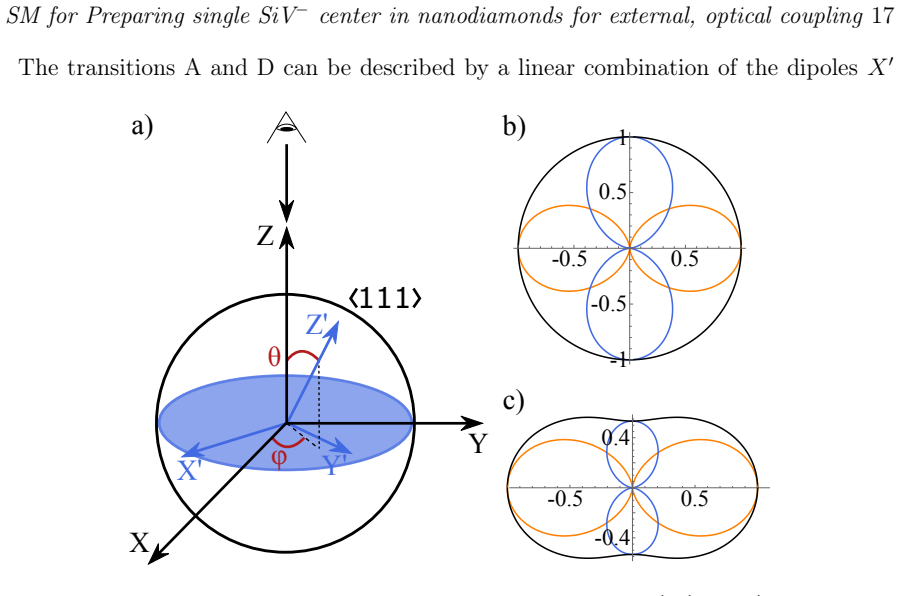
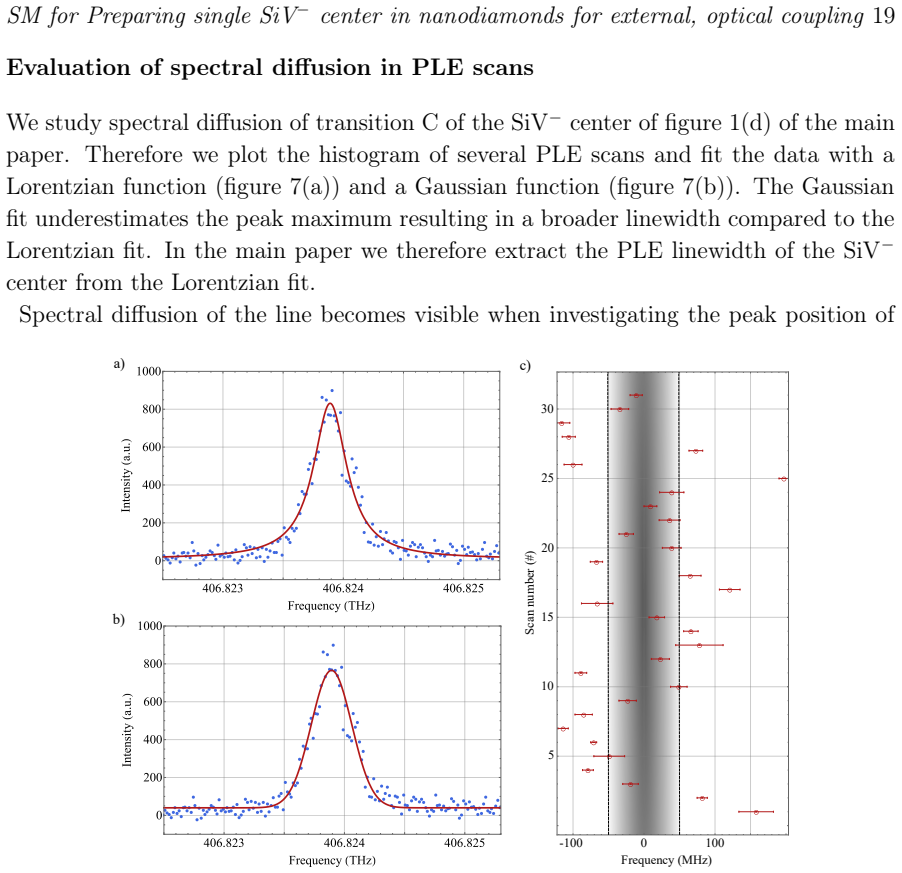
The central object is the single negatively-charged silicon-vacancy center, a color center in diamond with a four-line zero-phonon fine structure (transitions A–D) arising from spin-orbit splitting of the electronic ground and excited states. The argument is carried by three tools: photoluminescence excitation spectroscopy under resonant excitation to measure homogeneous linewidths close to the ~100 MHz Fourier limit; polarization plots of the four transitions whose axis rotation gives the in-plane angle φ and whose contrast change gives the out-of-plane tilt θ via C = (1 − cos²θ)/(1 + cos²θ); and pulsed repumping to extract the orbital relaxation time T1. Together these tools establish that the emitter's degrees of freedom remain fully addressable under nanomanipulation.
What would settle it
Rotate a single nanodiamond on the atomic force microscope stage by a known mechanical angle while monitoring its shape, measure the polarization contrast before and after, and compare the angle predicted by the formula C = (1 − cos²θ)/(1 + cos²θ) with the known angle; a disagreement beyond the stated 6° uncertainty, or a full-wave simulation showing the formula materially overestimates the tilt, would falsify the rotation-angle determination.
Extended reading notes
Core claim
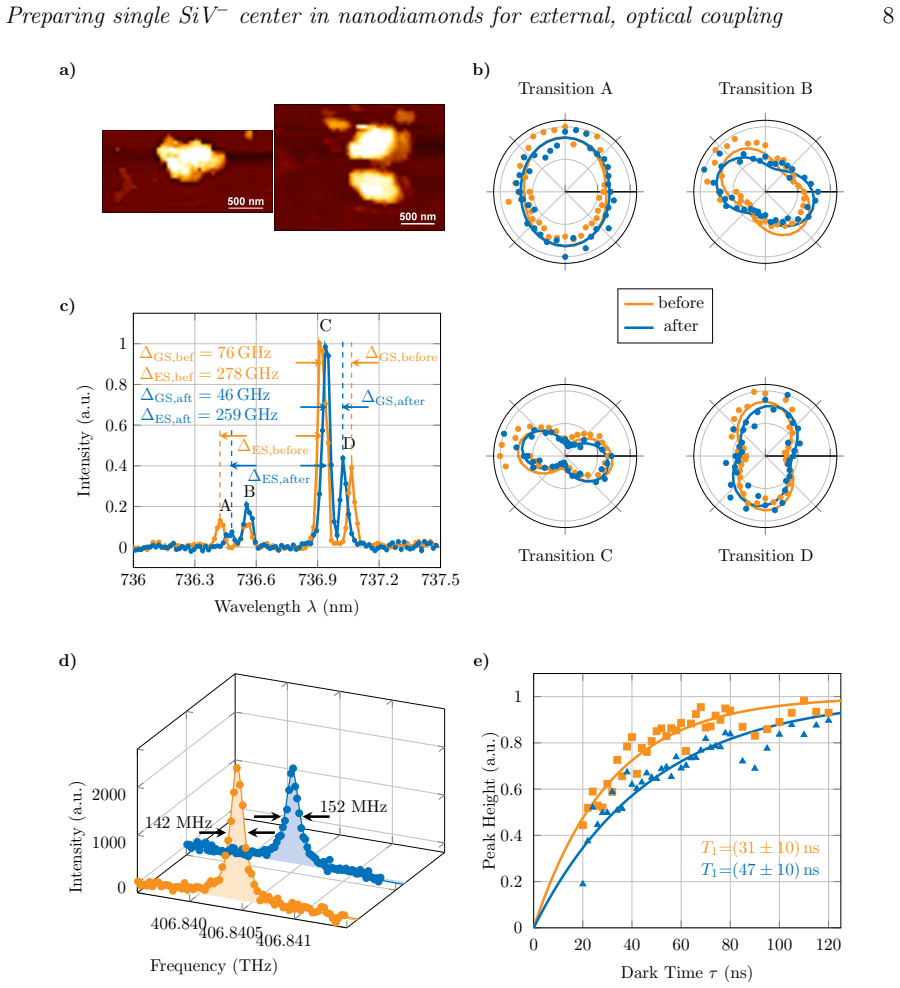
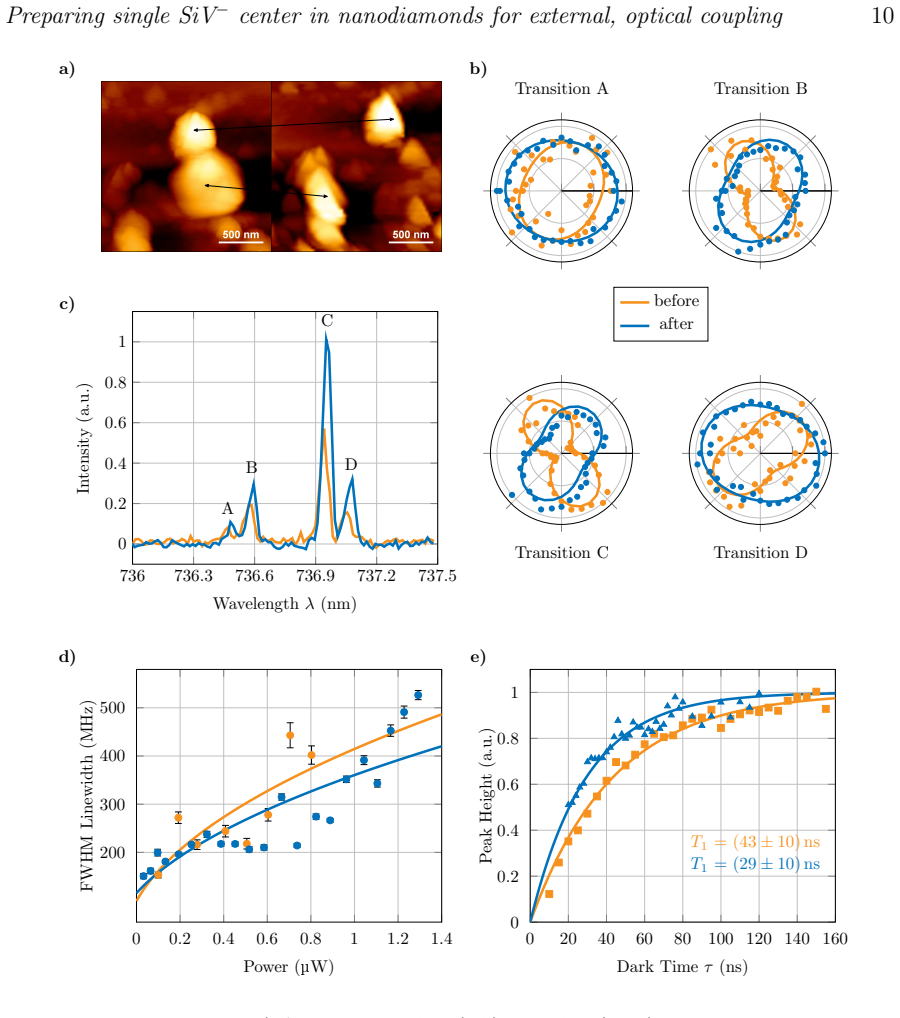
The central discovery is that the intrinsic optical properties of a single SiV− center with bulk-like quality survive both translational and rotational nanomanipulation of its nanodiamond host, and that the rotation angle can be inferred from the change in polarization contrast. For translation, linewidths of transition C were 142(3) MHz before and 152(12) MHz after, close to the Fourier-transform limit; the ground-state splitting moved from 76(4) GHz to 46(2) GHz, ending within error of the zero-strain value, indicating strain relief upon declustering. For rotation, the in-plane angle Δφ = 56(6)° was read from the rotation of the polarization axes, and the out-of-plane angle Δθ = 15(6)° was derived from the contrast change using the dipole model C = (1 − cos²θ)/(1 + cos²θ), while linewidths again remained near the Fourier limit. In a survey of 25 centers the inhomogeneous line distribution was 6.8(9) GHz, and 7 centers could be paired with a partner whose zero-phonon-line detuning is smaller than the Fourier-transform-limited linewidth, making them candidates for Hong-Ou-Mandel interference.
Load-bearing premise
The method for measuring the out-of-plane rotation angle assumes that the only thing changing in the polarization pattern is the tilt of the emitter's dipole, and that the simple dipole formula C = (1 − cos²θ)/(1 + cos²θ) is exact, ignoring the nanodiamond's high refractive index, the finite lens aperture, and any strain-induced change in the dipole pattern; if this assumption fails, the claimed access to all rotational degrees of freedom is not established.
Editorial extensions
If this is right
- Pre-selected, high-quality single-photon emitters in nanodiamonds can be deterministically placed and oriented for evanescent coupling to waveguides, cavities, or plasmonic structures.
- The ability to read both in-plane and out-of-plane rotation angles from polarization data gives full orientational control without needing an external magnetic field or optically detected magnetic resonance.
- The measured spectral overlap among 25 centers suggests that two different nanodiamonds can be brought into resonance for indistinguishable photon emission and Hong-Ou-Mandel interference.
- Conservation of optical properties during manipulation implies that bottom-up assembly of coupled emitter arrays for quantum simulators is feasible.
Reading between the lines
- The contrast-based angle determination could be refined by full electromagnetic calculations that include the nanodiamond's high refractive index and the finite collection numerical aperture; such a correction could shift the absolute θ values, although the demonstrated conservation of linewidths would be unaffected.
- If the same polarization-contrast readout of orientation were extended to other color centers, it could serve as a general compass for dipole emitters embedded in high-index nanoparticles.
- The observed strain relief upon declustering suggests that nanomanipulation could be used as a post-synthesis strain engineering tool, tuning centers closer to the zero-strain splitting.
- The likelihood of finding spectrally overlapping pairs (7 of 25) could be tested directly in a two-emitter Hong-Ou-Mandel experiment; if overlap persists under simultaneous excitation, the route to distributed quantum networks would be shortened.
Signed reviews
Editorial analysis
A structured set of objections, weighed in public.
Referee Report
Summary. The paper reports a complete workflow for preparing single SiV− centers in nanodiamonds for external optical coupling: pre-characterization of the optical properties, AFM-based translational and rotational nanomanipulation, and post-characterization to verify conservation. The authors measure near-Fourier-limited PLE linewidths, orbital T1 times, polarization contrast of all four ZPL transitions, and a spectral survey of 25 centers showing an inhomogeneous distribution of 6.8(9) GHz, from which they identify candidates for two-photon interference. The central claim, stated in Sec. 6, is that the intrinsic bulk-like optical properties of single SiV− centers persist against translational and rotational nanomanipulation, giving access to all degrees of freedom needed for evanescent optical coupling.
Significance. If the results hold, the paper would demonstrate a practical route to deterministic placement and orientation of nanodiamond-hosted SiV− centers with bulk-like optical quality, directly relevant for evanescent coupling to photonic structures and for quantum networks. The single-emitter characterization is careful: the PLE linewidths are close to the Fourier-transform limit, g2(0) is well below 0.5, and the T1 measurements are properly analyzed. The spectral survey of 25 centers and the identification of spectrally overlapping candidates are useful resources for future Hong-Ou-Mandel experiments. However, the central claim of full rotational control rests on a rotation-angle extraction that is internally inconsistent with the data, and the translational-conservation claim is overstated in view of the observed change in fine-structure splitting.
major comments (2)
- [Section 5 and Supplemental Material, Eqs. (5)-(6)] The extraction of the out-of-plane tilt angle Δθ from the polarization contrast is not supported by the reported data. For transition A, the contrast changes from 13% to 6%, which via Eq. (6) gives θ values of approximately 28.5° and 19.6°. For transition D, the contrast changes from 40% to 12%, giving θ values of approximately 49.1° and 27.6°. Since Eq. (5) is derived under the assumption that both A and D are linear combinations of the X′/Y′ dipoles and therefore share the same tilt angle θ, the ~20° discrepancy before manipulation is far outside the quoted 6° uncertainty and indicates that the model does not describe the data. The model also neglects the finite collection numerical aperture and the high refractive index of the nanodiamond, effects that Sec. 4 itself invokes to explain the low overall polarization contrast. Consequently, the value Δθ=15(6)° is not uniquely determined, and the claim of "access to all degrees of freedom" in Sec. 6 is not established by the data as presented. The authors should either provide a model that accounts for the different contrasts of A and D (for example, unequal dipole contributions or detection-geometry effects), fit the tilt angle from a consistent model, or explicitly qualify the rotational degree-of-freedom claim.
- [Section 4, Fig. 2(c), Abstract, and Sec. 6] The statement that "all optical properties are conserved during translational nanomanipulation" is directly contradicted by the observed change of the fine-structure splittings from 76(4) to 46(2) GHz (ground state) and from 278(4) to 259(2) GHz (excited state). Although the authors interpret this as a decrease of transverse strain toward the zero-strain values, the fine-structure splittings are themselves optical properties and they change significantly. The claim should be qualified to list the specific conserved quantities (e.g., PLE linewidth, T1, polarization contrast, ZPL position) and explicitly acknowledge that the strain-related splittings changed, or the central claim should be reformulated to reflect what is actually demonstrated.
minor comments (5)
- [Fig. 3(b) caption vs. Section 5] The caption states that the polarization angle is shifted by ≈90° after nanomanipulation, while the text reports Δφ=56(6)° from changes of 115°→63° and 117°→56°. These statements are inconsistent and should be reconciled, for example by clarifying that the 90° refers to the polar-plot representation rather than the fitted dipole angle.
- [Eq. (1)] The saturation model is written as I(P)=IsatP/Psat/ (1+P/Psat), which is ambiguous; it should be written as I(P)=Isat (P/Psat)/(1+P/Psat) for clarity.
- [Supplemental Material, Eq. (5)] The derivation of Eq. (5) is not shown; a short derivation or a more explicit reference to the dipole-projection model would help the reader assess the applicability of the formula to the measured A/D transitions.
- [Section 5, Eq. (3)] The power-broadening model uses the beam diameter d, but the value of d for the measurement is not given; specifying it would improve reproducibility.
- [Section 3, Fig. 1(c)] The statement that the PL linewidth is limited by the grating spectrometer resolution to about 20 GHz could be complemented by a brief note on the spectral resolution of the 1800 grooves/mm grating used.
Circularity Check
No circularity: central claims rest on direct before/after measurements of the same SiV- center; the only model step is a literature formula applied to data, not fitted to the conclusion.
full rationale
The paper's main claims—conservation of linewidth, fine-structure splitting, orbital T1, and polarization properties under translational and rotational nanomanipulation—are established by direct spectroscopic measurements of the same SiV- center before and after manipulation, not derived from an assumed model. The only model-based step is the Supplemental determination of the tilt angle from polarization contrast via C = (1 - cos^2 theta)/(1 + cos^2 theta) and its inversion theta(C) = arccos(sqrt((1-C)/(1+C))). That formula is taken from the literature (Ref. [14]) and applied to measured contrast values; the resulting Delta-theta = 15(6) degrees is a measurement outcome, not a parameter fitted to reproduce the paper's central claim. Even if the dipole model neglects the nanodiamond refractive index, collection NA, or strain-induced dipole changes, that is a physical validity or calibration concern, not circularity: the formula does not reduce by construction to the claim of full rotational access. Self-citations (e.g., Refs. [12] and [20]) provide sample synthesis and zero-strain reference splittings from prior independent experiments by overlapping groups; they are used as benchmarks, not as arguments that force the persistence conclusion. No prediction is equivalent to a fitted input, no uniqueness theorem is imported from the authors' prior work, and no known result is merely renamed. The paper is self-contained against external benchmarks, so the appropriate finding is no significant circularity.
Assumptions & free parameters
assumptions (4)
- domain assumption The four-line PL spectrum of a SiV- center corresponds to the four optical transitions A-D of the zero-phonon line, with ground and excited state splittings from spin-orbit interaction.
- domain assumption A single SiV- center is certified by an isolated confocal spot, a four-line PL structure without extra lines, and a single Lorentzian PLE line.
- domain assumption The same SiV- center is identified before and after nanomanipulation by unchanged zero-phonon line position and similar fine structure.
- ad hoc to paper The polarization contrast of the A/D transitions is described by C=(1 - cos^2θ)/(1 + cos^2θ), where θ is the tilt angle relative to the optical axis.
Cite this review
Pith. "Pith review of Preparing single SiV$^{-}$ center in nanodiamonds for external, optical coupling with access to all degrees of freedom." pith.science (2026). https://pith.science/paper/2HOVM7FG
@misc{pith2026190801591,
  author       = {Pith},
  title        = {Pith review of: Preparing single SiV$^-$ center in nanodiamonds for external, optical coupling with access to all degrees of freedom},
  year         = {2026},
  howpublished = {\url{https://pith.science/paper/2HOVM7FG}},
  note         = {Machine review of arXiv:1908.01591}
}
abstract
Optical coupling enables intermediate- and long-range interactions between distant quantum emitters. Such interaction may be the basic element in bottom-up approaches of coupled spin systems or for integrated quantum photonics and quantum plasmonics. Here, we prepare nanodiamonds carrying single, negatively-charged silicon-vacancy centers for evanescent optical coupling with access to all degrees of freedom by means of atomic force nanomanipulation. The color centers feature excellent optical properties, comparable to silicon-vacancy centers in bulk diamond, resulting in a resolvable fine structure splitting, a linewidth close to the Fourier-Transform limit under resonant excitation and a good polarization contrast. We determine the orbital relaxation time $T_{1}$ of the orbitally split ground states and show that all optical properties are conserved during translational nanomanipulation. Furthermore, we demonstrate the rotation of the nanodiamonds. In contrast to the translational operation, the rotation leads to a change in polarization contrast. We utilize the change in polarization contrast before and after nanomanipulation to determine the rotation angle. Finally, we evaluate the likelihood for indistinguishable, single photon emission of silicon-vacancy centers located in different nanodiamonds. Our work enables ideal evanescent, optical coupling of distant nanodiamonds containing silicon-vacancy centers with applications in the realization of quantum networks, quantum repeaters or complex quantum systems.
Figures

Figures from the paper (4 more)


Reference graph
Works this paper leans on
-
[12]
Rogers, Ou Wang, Liu Yan, Lukas Antoniuk, Christian Osterkamp, Valery A
Lachlan J. Rogers, Ou Wang, Liu Yan, Lukas Antoniuk, Christian Osterkamp, Valery A. Davydov, Viatcheslav N. Agafonov, Andrea B. Filipovski, Fedor Jelezko, and Alexander Kubanek. Single siv- centers in low-strain nanodiamonds with bulklike spectral properties and nanomanipulation capabilities. Physical Review Applied, 11:024073, 2019
work page 2019
-
[1]
Quantum internet: A vision for the road ahead
Stephanie Wehner, David Elkouss, and Ronald Hanson. Quantum internet: A vision for the road ahead. Science, 362(6412), 2018
2018
-
[2]
Jeronimo R. Maze, Paul L. Stanwix, James S. Hodges, Seungpyo Hong, Jacob M. Taylor, Paola Cappellaro, Liang Jiang, Gurudev M. V. Dutt, Emre Togan, Alexander Zibrov, Amir Yacoby, Ronald L. Walsworth, and Mikhail D. Lukin. Nanoscale magnetic sensing with an individual electronic spin in diamond.Nature, 455:644–647, 2008
work page 2008
-
[3]
Gopalakrishnan Balasubramanian, Ignatius Y. Chan, Roman Kolesov, Mohannad Al-Hmoud, Julia Tisler, Chang Shin, Changdong Kim, Aleksander Wojcik, Philip R. Hemmer, Anke Krueger, Tobias Hanke, Alfred Leitenstorfer, Rudolf Bratschitsch, Fedor Jelezko, and Jörg Wrachtrup. Nanoscale imaging magnetometry with diamond spins under ambient conditions. Nature, 455:6...
work page 2008
-
[4]
Single defect centres in diamond: A review.Physica Status Solidi a, 203(13):3207–3225, 2006
Fedor Jelezko and Jörg Wrachtrup. Single defect centres in diamond: A review.Physica Status Solidi a, 203(13):3207–3225, 2006
work page 2006
-
[5]
Marcus W. Doherty, Neil B. Manson, Paul Delaney, Fedor Jelezko, Jörg Wrachtrup, and Lloyd C. L. Hollenberg. The nitrogen-vacancy colour centre in diamond.Physics Reports, 528:1–45, 2013
work page 2013
-
[6]
Kim, Young-Chul Byun, Chang-Yong Nam, Jiyoung Kim, Charles T
Jiabao Zheng, Benjamin Lienhard, Gregory Doerk, Mircea Cotlet, Eric Bersin, Harrison S. Kim, Young-Chul Byun, Chang-Yong Nam, Jiyoung Kim, Charles T. Black, and Dirk Englund. Top- down fabrication of high-uniformity nanodiamonds by self-assembled block copolymer masks. Scientific Reports, 9(6914), 2019
work page 2019
-
[7]
Konstantin G. Fehler, Anna P. Ovvyan, Nico Gruhler, Wolfram H. P. Pernice, and Alexander Kubanek. Efficient coupling of an ensemble of nitrogen vacancy center to the mode of a high-q, si3n4 photonic crystal cavity.ACS Nano, 13(6):6891–6898, 2019
work page 2019
Show all 24 references
-
[8]
On-chip integration of single solid-state quantum emitters with a sio2 photonic platform
Florian Böhm, Niko Nikolay, Christoph Pyrlik, Jan Schlegel, Andreas Thies, Andreas Wicht, Preparing single SiV− center in nanodiamonds for external, optical coupling 14 Günther Tränkle, and Oliver Benson. On-chip integration of single solid-state quantum emitters with a sio2 p...
2019
-
[9]
Mouradian, Jiabao Zheng, Matthew E
Tim Schröder, Sara L. Mouradian, Jiabao Zheng, Matthew E. Trusheim, Michael Walsh, Edward H. Chen, Luozhou Li, Igal Bayn, and Dirk Englund. Quantum nanophotonics in diamond. Journal of the Optical Society of America B, 33:B65–B83, 2016
2016
-
[10]
Hänsch, and David Hunger
JuliaBenedikter, HannoKaupp, ThomasHümmer, YuejiangLiang, AlexanderBommer, Christoph Becher, Anke Krueger, Jason Smith, Theodor W. Hänsch, and David Hunger. Cavity-enhanced single-photon source based on the silicon-vacancy center in diamond.Physical Review Applied, 7:024031, 2017
2017
-
[11]
Schell, Günter Kewes, Tim Schröder, Janik Wolters, Thomas Aichele, and Oliver Benson
Andreas W. Schell, Günter Kewes, Tim Schröder, Janik Wolters, Thomas Aichele, and Oliver Benson. A scanning probe-based pick-and-place procedure for assembly of integrated quantum optical hybrid devices. Review of Scientific Instruments, 82(7):073709, 2011
2011
-
[13]
Becker, Benjamin Pingault, Hadwig Sternschulte, Doris Steinmüller-Nethl, Adam Gali, Jeronimo R
Christian Hepp, Tina Müller, Victor Waselowski, Jonas N. Becker, Benjamin Pingault, Hadwig Sternschulte, Doris Steinmüller-Nethl, Adam Gali, Jeronimo R. Maze, Mete Atatüre, and Christoph Becher. Electronic structure of the silicon vacancy color center in diamond.Physical Revie...
2014
-
[14]
Rogers, Kay D
Lachlan J. Rogers, Kay D. Jahnke, Marcus W. Doherty, Andreas Dietrich, Liam P. McGuinness, Christoph Müller, Tokuyuki Teraji, Hitoshi Sumiya, Junichi Isoya, Neil B. Manson, and Fedor Jelezko. Electronic structure of the negatively charged silicon-vacancy center in diamond. Phy...
2014
-
[15]
Jahnke, Lachlan J
Alp Sipahigil, Kay D. Jahnke, Lachlan J. Rogers, Tokuyuki Teraji, Junichi Isoya, Alexander S. Zibrov, Fedor Jelezko, and Mikhail D. Lukin. Indistinguishable photons from separated silicon- vacancy centers in diamond.Physical Review Letters, 113:113602, 2014
2014
-
[16]
Jahnke, Jan M
Andreas Dietrich, Kay D. Jahnke, Jan M. Binder, Tokuyuki Teraji, Junichi Isoya, Lachlan J. Rogers, and Fedor Jelezko. Isotopically varying spectral features of silicon-vacancy in diamond. New Journal of Physics, 16(11):113019, 2014
2014
-
[17]
Rogers, Kay D
Lachlan J. Rogers, Kay D. Jahnke, Tokuyuki Teraji, Luca Marseglia, Christoph Müller, Boris Naydenov, Hardy Schauffert, Christine Kranz, Junichi Isoya, Liam P. McGuinness, and Fedor Jelezko. Multiple intrinsically identical single-photon emitters in the solid state. Nature Commu...
2014
-
[18]
Single photon emission from silicon-vacancy colour centres in chemical vapour deposition nano-diamonds on iridium.New Journal of Physics, 13(2):025012, 2011
Elke Neu, David Steinmetz, Janine Riedrich-Möller, Stefan Gsell, Martin Fischer, Matthias Schreck, and Christoph Becher. Single photon emission from silicon-vacancy colour centres in chemical vapour deposition nano-diamonds on iridium.New Journal of Physics, 13(2):025012, 2011
2011
-
[19]
Tran, Mehran Kianinia, Kerem Bray, Sejeong Kim, Zai-Quan Xu, Angus Gentle, Bernd Sontheimer, Carlo Bradac, and Igor Aharonovich
Toan T. Tran, Mehran Kianinia, Kerem Bray, Sejeong Kim, Zai-Quan Xu, Angus Gentle, Bernd Sontheimer, Carlo Bradac, and Igor Aharonovich. Nanodiamonds with photostable, sub- gigahertz linewidth quantum emitters.APL Photonics, 2(11):116103, 2017
2017
-
[20]
Bolshedvorkii, Anton I
Stepan V. Bolshedvorkii, Anton I. Zeleneev, Vadim V. Vorobyov, Vladimir V. Soshenko, Olga R. Rubinas, Leonid A. Zhulikov, Pavel A. Pivovarov, Vadim N. Sorokin, Andrey N. Smolyaninov, Liudmila F. Kulikova, Anastasia S. Garanina, Viatcheslav N. Agafonov, Rustem E. Uzbekov, Valer...
2019
-
[21]
Kurz, Daniel S
Uwe Jantzen, Andrea B. Kurz, Daniel S. Rudnicki, Clemens Schäfermeier, Kay D. Jahnke, Ulrik L. Andersen, Valery A. Davydov, Viatcheslav N. Agafonov, Alexander Kubanek, Lachlan J. Rogers, and Fedor Jelezko. Nanodiamonds carrying silicon-vacancy quantum emitters with almost life...
2016
-
[22]
Jahnke, Alp Sipahigil, Jan M
Kay D. Jahnke, Alp Sipahigil, Jan M. Binder, Marcus W. Doherty, Mathias Metsch, Lachlan J. Rogers, Neil B. Manson, Mikhail D. Lukin, and Fedor Jelezko. Electron–phonon processes of the silicon-vacancy centre in diamond.New Journal of Physics, 17(4):043011, 2015
2015
-
[23]
A simplified calculation of power-broadened linewidths, with application toresonance ionization mass spectrometry.Spectrochimica Acta Part B, 69:61–66, 2012
Jonathan Levine. A simplified calculation of power-broadened linewidths, with application toresonance ionization mass spectrometry.Spectrochimica Acta Part B, 69:61–66, 2012
2012
-
[24]
Preparing single SiV − center in nanodiamonds for external, optical coupling with access to all degrees of freedom
Jan M. Binder, Alexander Stark, Nikolas Tomek, Jochen Scheuer, Florian Frank, Kay D. Jahnke, Christoph Müller, Simon Schmitt, Mathias H. Metsch, Thomas Unden, Tobias Gehring, Alexander Huck, Ulrik L. Andersen, Lachlan J. Rogers, and Fedor Jelezko. Qudi: A modular python suite ...
2017
Reviewed August 14, 2026 · model on record in the stance chip above.
Discussion (0). Continue with ORCID to comment.