REVIEW 2 major objections 4 minor 41 references
A quantum divide-and-conquer algorithm solves general TSP in O*(1.866^n) time, the first to beat the classical 2^n barrier.
Reviewed by Pith at T0; open to challenge. T0 means a machine referee read the full paper against a public rubric. the ladder, T0–T4 →
T0 review · grok-4.5
2026-07-12 14:52 UTC pith:2HPCT2T7
load-bearing objection Solid query-complexity improvement and a clean Ambainis correction; the O*(1.866^n) time claim is model-dependent on QRAM depth-only accounting. the 2 major comments →
Quantum Divide-and-Conquer for the Traveling Salesman Problem: Surpassing the 2^n Barrier
The pith
A machine-rendered reading of the paper's core claim, the machinery that carries it, and where it could break.
Core claim
The first quantum algorithm that solves general TSP with both query and time complexity O*(1.866^n), obtained by partitioning the vertex set into four subsets of optimal relative sizes, classically pre-computing all short paths inside subsets of that size, and searching the resulting labelled partitions by quantum minimum finding after preparing a structured set-partition superposition.
What carries the argument
The set-partition state: a uniform superposition over all ways to colour the n vertices with k labels and mark an origin and end inside each colour class, prepared by a sequence of Dicke-state circuits of O(n^{2}) gates and O(n) depth that lets the oracle evaluate tour lengths in quantum parallel without a classical bijection.
Load-bearing premise
The claim that a memory device needing exponentially many qubits can still be counted as having only polynomial cost because its circuit depth is linear in n.
What would settle it
Either a corrected counting argument that pushes the optimal four-subset exponent back to at least 1, or an explicit classical construction showing that the set-partition state preparation itself requires super-polynomial resources once realistic memory access is accounted for.
Editorial analysis
A structured set of objections, weighed in public.
Referee Report
Summary. The manuscript corrects a structural counting error in the Ambainis et al. (SODA 2019) hybrid quantum algorithm for TSP, proving that the claimed O*(1.727^n) query complexity is in fact Omega*(2^n) once the oracle is required to concatenate complete solutions over the full recursive tree (Theorem 1). It then introduces a parameterized quantum divide-and-conquer framework: classically precompute shortest paths inside subsets of size at most alpha_1 n via Held-Karp DP, prepare a uniform superposition over all labeled k-partitions (the set-partition state), and run quantum minimum finding. Optimizing the classical-quantum trade-off yields O*(1.890^n) for k=3 and the global optimum O*(1.866^n) for k=4 with alpha_i approximately 0.3157 (Theorem 2). An explicit O(n^2)-gate, O(n)-depth circuit based on Dicke-state preparation constructs the set-partition state (Theorem 3); the oracle is realized via bucket-brigade QRAM, converting the query bound into a claimed total time complexity of O*(1.866^n). Qiskit simulations for n=6,7 (k=3) report high success probabilities.
Significance. A genuine asymptotic improvement over the classical Held-Karp O*(2^n) barrier for general TSP would be a landmark result in quantum algorithms for NP-hard problems. The correction of the SODA 2019 claim is carefully derived and valuable on its own. The optimization of the classical-quantum balance (balancing binary-entropy precomputation against the square-root of the multinomial partition count) is thorough and free of circularity, and the explicit Dicke-based circuit for the set-partition state is a concrete technical contribution that addresses a common oracle-construction bottleneck. The framework is cleanly parameterized and potentially portable to other partition-based combinatorial problems. These strengths stand even if the strongest time-complexity claim requires model clarification.
major comments (2)
- Abstract and Section III.C: the conversion of the O*(1.865666...^n) query bound into a total time complexity of O*(1.866^n) rests on counting only the O(n) circuit depth of each bucket-brigade QRAM query while explicitly acknowledging that the QRAM itself requires exponentially many qubits and gates. Under ordinary quantum circuit accounting (total gate count, or space-time product), that exponential resource is not absorbed into the O* notation; the claimed time advantage therefore holds only in a non-standard model that charges solely for depth. The manuscript should either adopt an explicit depth-only model with a clear statement of the exponential space cost, or weaken the headline claim to the (already solid) query complexity plus polynomial-depth oracles under exponential space.
- Section III.C (select(f_i) construction): the Boolean-function selectors that load the classical DP table are stated to use O*(2^{4n}) ancillary qubits. Even if each individual QRAM query has depth O(n), the preparation and uncomputation of these exponential ancillas must be accounted for in any total-resource claim; otherwise the same model inconsistency that affects the QRAM tree reappears. A precise resource table (qubits, gates, depth) for one full oracle call under the chosen model is needed.
minor comments (4)
- Table I and the abstract both list 1.865666...n / 1.866^n; a single consistent numerical presentation (or an explicit statement that the two differ only by rounding) would avoid reader confusion.
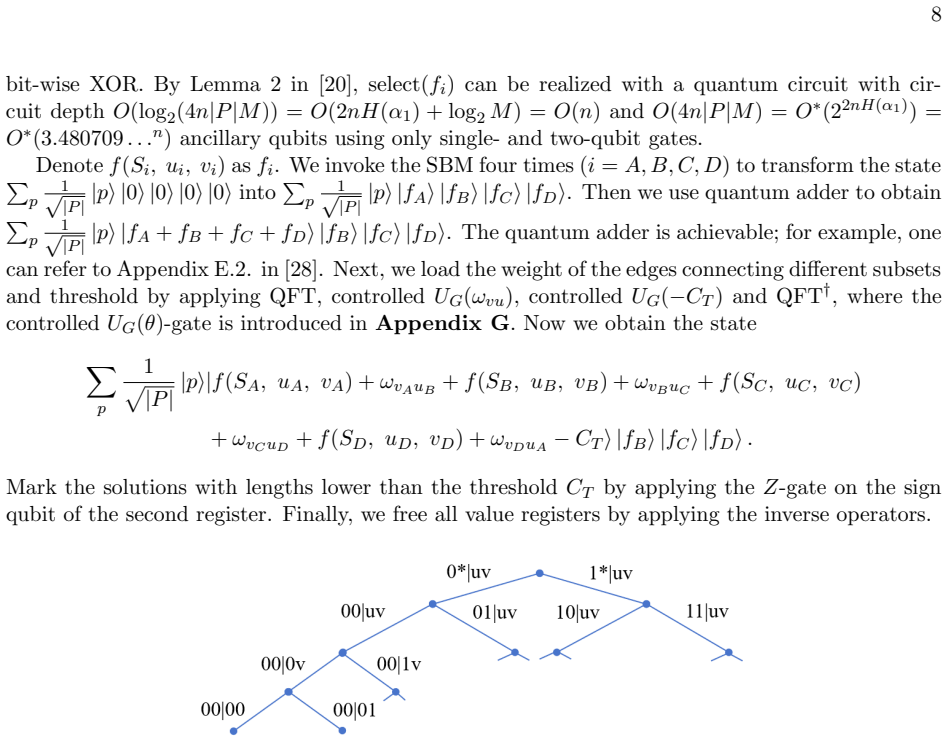
- Figure 1 caption and the surrounding text in Section II.A: the recursive tree is clear, but labeling the eight leaves that must be concatenated would make the counting argument of Theorem 1 immediately visual.
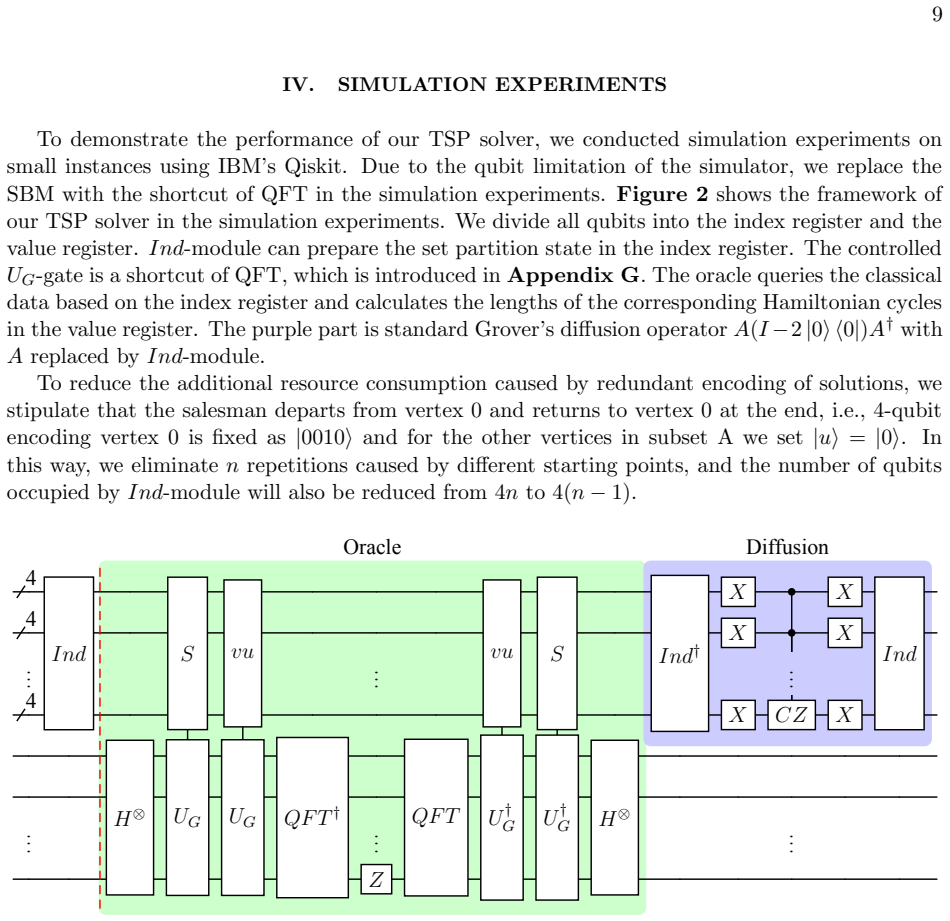
- Section IV: the simulations replace QRAM by a QFT shortcut and fix the starting vertex; a short remark that these experiments validate only the amplitude-amplification and state-preparation components, not the full QRAM oracle, would set expectations correctly.
- Equation (15) and the subsequent gradient calculation: the induction establishing g_k is clean, but a one-line reminder that the multinomial coefficient identity underlies the closed form would help readers who skip the induction.
Circularity Check
No circularity: the O*(1.866^n) bound is obtained by independently balancing classical binary-entropy precomputation against the square-root of a multinomial partition count and solving a low-dimensional numerical optimization.
full rationale
The paper's central claim (Theorem 2) equates the classical cost O*(2^{n H(\alpha1)}) with the quantum cost O*(sqrt(n! / \prod mi!)), rewrites the latter via the closed-form entropy identity proved by induction in Eq. (15), and numerically solves f(\alpha1) = g*_4(\alpha1) for the unique balancing point \alpha1 = \alpha2 = \alpha3 \approx 0.315742. Neither expression is defined in terms of the other; the numerical value is simply the intersection of two independently derived monotone functions. The correction of Ambainis et al. (Theorem 1) is a pure counting argument that does not feed into the new bound. Structured state preparation (Theorem 3) and the QRAM oracle are constructive circuit arguments that convert the query bound into a claimed time bound; they introduce no fitted parameters or self-referential definitions. Self-citations are limited to ordinary background (Dicke states, quantum minimum finding) and are not load-bearing for the complexity claim. The derivation is therefore self-contained against external benchmarks and exhibits no circular step of any of the seven enumerated kinds.
Axiom & Free-Parameter Ledger
free parameters (1)
- optimal subset proportions alpha_1=alpha_2=alpha_3 =
0.315742...
axioms (5)
- standard math Quantum minimum finding (Durr-Hoyer / Boyer et al.) finds the minimum among N candidates with O(sqrt(N)) queries to a coherent oracle.
- standard math Classical Held-Karp DP computes all shortest paths through subsets of size at most m in O*(2^{n H(m/n)}) time.
- standard math Dicke states |D_n^k> can be prepared deterministically with O(kn) gates and O(n) depth without ancillas (Bartschi-Eidenbenz).
- domain assumption A bucket-brigade QRAM can load classical data into a quantum register with circuit depth linear in the address length, even though the number of qubits and gates is exponential.
- domain assumption The optimal Hamiltonian cycle always arises as the concatenation of shortest paths on some labeled k-partition (Lemma 1).
invented entities (1)
-
set partition state
independent evidence
read the original abstract
The traveling salesman problem (TSP) is a classic NP-hard problem. Held--Karp dynamic programming~\cite{held1962dynamic, bellman1962dynamic} solves it exactly in $O(n^2 2^n)$ time, a barrier that has stood for over six decades. Whether quantum computing can surpass $O^*(2^n)$ is a central open question. The authors of~\cite{ambainis2019quantum}\ (SODA~2019) claimed a query complexity of $O^*(1.727^n)$, but we identify a structural counting error: when corrected, their scheme requires $\Omega^*(2^n)$ queries and offers no advantage over classical Held--Karp. We design a quantum divide-and-conquer framework: partition $n$-vertex set into $k$ subsets, classically precompute shortest paths within each, then search over all $k$-partitions via quantum minimum finding. We prove $k=3$ achieves $O^*(1.890^n)$, and $k=4$ attains the global optimum $O^*(1.866^n)$, the first quantum algorithm to surpass $O^*(2^n)$ for general TSP. To convert the query bound into a time-complexity advantage, we overcome the oracle-construction bottleneck by preparing a set partition state, requiring $O(n^2)$ gates and $O(n)$ depth. Leveraging structured state preparation, we achieve a total time complexity of $O^*(1.866^n)$. Qiskit simulations on $n=6,7$ achieve $98.9\%$ and $100\%$ accuracy.
Figures



Reference graph
Works this paper leans on
-
[1]
Fork >2, letα 1 < 1 2, thenf(α 1) is monotonically increasing
= 1, meaning that the complexity cannot be better thanAlgorithm 1fork= 2. Fork >2, letα 1 < 1 2, thenf(α 1) is monotonically increasing. By (15), the gradient ofg k(⃗ α) is ∇gk(⃗ α) =[− 1 2 ln 2(lnα j + 1−ln 1− k−1X i=1 αi ! −1)] k−1 j=1 =(−1 2 log2 αj 1− Pk−1 i=1 αi )k−1 j=1 .(16) We have 1 2 > α 1 ≥...≥α k−1 ≥1− Pk−1 i=1 αi >0 forn > m 1 ≥m 2 ≥...≥m k >...
-
[2]
Finally, we calculate the optimal query complexity
Moreover, in this case, sincefis fixed for a givenα 1, and the optimization ofg k eventually drives its value down to that ofg r, it suffices to optimizeg r wherer <5. Finally, we calculate the optimal query complexity. Fork= 3, we haveα 1 ≥ 1
-
[3]
atα 1 =α 2 = 1 3, which is below the mini- mum value off, i.e.,f( 1
It is easy to see thatg 3 attains its global maximum of 0.792481. . .atα 1 =α 2 = 1 3, which is below the mini- mum value off, i.e.,f( 1
-
[4]
The corresponding query complexity isO ∗(20.918295...n) = O∗(1.889881
= 0.918295. . .The corresponding query complexity isO ∗(20.918295...n) = O∗(1.889881. . . n). Fork= 4, we haveα 1 ≥ 1
-
[5]
qubits” denotes the required number of qubits, “num
Ifα 1 < 1 3, we haveg 4(⃗ α)≥g∗ 4(α1). Sinceg ∗ 4 is mono- tonically decreasing whilefis monotonically increasing, the optimal complexity is attained when f(α 1) =g ∗ 4(α1), where numerical evaluation givesf(0.315742. . .) =g ∗ 4(0.315742. . .) = 0.899691. . . Ifα 1 ≥ 1 3, the complexity cannot be lower becausef(α 1)≥f( 1 3). 11 Therefore, the optimal que...
-
[6]
Quantum speedups for exponential-time dynamic programming algorithms
Andris Ambainis, Kaspars Balodis, J¯ anis Iraids, Martins Kokainis, Kriˇ sj¯ anis Pr¯ usis, and Jevg¯ enijs Vihrovs. Quantum speedups for exponential-time dynamic programming algorithms. InProceedings of the Thirtieth Annual ACM-SIAM Symposium on Discrete Algorithms (SODA), pages 1783–1793. SIAM, 2019
2019
-
[7]
Weakly measured while loops: peeking at quantum states
Pablo Andr´ es-Mart´ ınez and Chris Heunen. Weakly measured while loops: peeking at quantum states. Quantum Science and Technology, 7(2):025007, 2022
2022
-
[8]
A quantum speedup algorithm for tsp based on quantum dynamic pro- gramming with very few qubits.Theoretical Computer Science, page 115423, 2025
Xujun Bai and Yun Shang. A quantum speedup algorithm for tsp based on quantum dynamic pro- gramming with very few qubits.Theoretical Computer Science, page 115423, 2025
2025
-
[9]
Deterministic preparation of dicke states
Andreas B¨ artschi and Stephan Eidenbenz. Deterministic preparation of dicke states. InInternational Symposium on Fundamentals of Computation Theory, pages 126–139. Springer, 2019
2019
-
[10]
Grover mixers for qaoa: Shifting complexity from mixer design to state preparation
Andreas B¨ artschi and Stephan Eidenbenz. Grover mixers for qaoa: Shifting complexity from mixer design to state preparation. In2020 IEEE International Conference on Quantum Computing and Engineering (QCE), pages 72–82. IEEE, 2020
2020
-
[11]
Dynamic programming treatment of the travelling salesman problem.Journal of the ACM (JACM), 9(1):61–63, 1962
Richard Bellman. Dynamic programming treatment of the travelling salesman problem.Journal of the ACM (JACM), 9(1):61–63, 1962
1962
-
[12]
Lennart Binkowski and Marvin Schwiering. Quantum fisher-yates shuffle: Unifying methods for gener- ating uniform superpositions of permutations.arXiv preprint arXiv:2504.17965, 2025
Pith/arXiv arXiv 2025
-
[13]
Tight bounds on quantum searching
Michel Boyer, Gilles Brassard, Peter Høyer, and Alain Tapp. Tight bounds on quantum searching. Fortschritte der Physik: Progress of Physics, 46(4-5):493–505, 1998
1998
-
[14]
Quantum amplitude amplification and estimation.arXiv preprint quant-ph/0005055, 2000
Gilles Brassard, Peter Hoyer, Michele Mosca, and Alain Tapp. Quantum amplitude amplification and estimation.arXiv preprint quant-ph/0005055, 2000
Pith/arXiv arXiv 2000
-
[15]
Deterministic quantum search via recursive oracle expansion
John Burke and Ciaran McGoldrick. Deterministic quantum search via recursive oracle expansion. arXiv preprint arXiv:2507.15797, 2025
Pith/arXiv arXiv 2025
-
[16]
Madelyn Cain, Qian Xu, Robbie King, Lewis RB Picard, Harry Levine, Manuel Endres, John Preskill, Hsin-Yuan Huang, and Dolev Bluvstein. Shor’s algorithm is possible with as few as 10,000 reconfigurable atomic qubits.arXiv preprint arXiv:2603.28627, 2026
Pith/arXiv arXiv 2026
-
[17]
Survey of methods of solving tsp along with its implementation using dynamic programming approach.International journal of computer applications, 52(4), 2012
Chetan Chauhan, Ravindra Gupta, and Kshitij Pathak. Survey of methods of solving tsp along with its implementation using dynamic programming approach.International journal of computer applications, 52(4), 2012
2012
-
[18]
Graph comparison via nonlinear quantum search.Quantum Information Processing, 18(10):302, 2019
Mitchell Chiew, Kooper de Lacy, Chao-Hua Yu, Samuel Marsh, and Jingbo B Wang. Graph comparison via nonlinear quantum search.Quantum Information Processing, 18(10):302, 2019
2019
-
[19]
Coherence in spontaneous radiation processes.Physical review, 93(1):99, 1954
Robert H Dicke. Coherence in spontaneous radiation processes.Physical review, 93(1):99, 1954
1954
-
[20]
A quantum algorithm for finding the minimum.arXiv preprint quant-ph/9607014, 1996
Christoph Durr and Peter Hoyer. A quantum algorithm for finding the minimum.arXiv preprint quant-ph/9607014, 1996
Pith/arXiv arXiv 1996
-
[21]
Statistical tables for biological, agricultural and medical research
Ronald Aylmer Fisher and Frank Yates. Statistical tables for biological, agricultural and medical research. 1957
1957
-
[22]
Constructing large controlled nots
Craig Gidney. Constructing large controlled nots. Algorithmic Assertions, jun 2015
2015
-
[23]
Grover adaptive search for constrained polynomial binary optimization.Quantum, 5:428, 2021
Austin Gilliam, Stefan Woerner, and Constantin Gonciulea. Grover adaptive search for constrained polynomial binary optimization.Quantum, 5:428, 2021
2021
-
[24]
Quantum random access memory.Physical review letters, 100(16):160501, 2008
Vittorio Giovannetti, Seth Lloyd, and Lorenzo Maccone. Quantum random access memory.Physical review letters, 100(16):160501, 2008
2008
-
[25]
A fast quantum mechanical algorithm for database search
Lov K Grover. A fast quantum mechanical algorithm for database search. InProceedings of the twenty- eighth annual ACM symposium on Theory of computing, pages 212–219, 1996
1996
-
[26]
Resilience of quantum random access memory to generic noise.Prx Quantum, 2(2):020311, 2021
Connor T Hann, Gideon Lee, SM Girvin, and Liang Jiang. Resilience of quantum random access memory to generic noise.Prx Quantum, 2(2):020311, 2021
2021
-
[27]
Hardware-efficient quantum random access memory with hybrid quantum acoustic systems.Physical review letters, 123(25):250501, 2019
Connor T Hann, Chang-Ling Zou, Yaxing Zhang, Yiwen Chu, Robert J Schoelkopf, Steven M Girvin, and Liang Jiang. Hardware-efficient quantum random access memory with hybrid quantum acoustic systems.Physical review letters, 123(25):250501, 2019
2019
-
[28]
A dynamic programming approach to sequencing problems.Journal of the Society for Industrial and Applied mathematics, 10(1):196–210, 1962
Michael Held and Richard M Karp. A dynamic programming approach to sequencing problems.Journal of the Society for Industrial and Applied mathematics, 10(1):196–210, 1962
1962
-
[29]
Dicke state quantum search for solving the vertex cover problem.Mathematics, 30 13(18):3005, 2025
Jehn-Ruey Jiang. Dicke state quantum search for solving the vertex cover problem.Mathematics, 30 13(18):3005, 2025
2025
-
[30]
The traveling salesman problem: An overview of exact and approximate algorithms
Gilbert Laporte. The traveling salesman problem: An overview of exact and approximate algorithms. European Journal of Operational Research, 59(2):231–247, 1992
1992
-
[31]
Generalised phase kick-back: the structure of computational algorithms from physical principles.New Journal of Physics, 18(3):033023, 2016
Ciar´ an M Lee and John H Selby. Generalised phase kick-back: the structure of computational algorithms from physical principles.New Journal of Physics, 18(3):033023, 2016
2016
-
[32]
Grover algorithm with zero theoretical failure rate.Physical Review A, 64(2):022307, 2001
Gui-Lu Long. Grover algorithm with zero theoretical failure rate.Physical Review A, 64(2):022307, 2001
2001
-
[33]
Combinatorial optimization via highly efficient quantum walks
Samuel Marsh and Jingbo B Wang. Combinatorial optimization via highly efficient quantum walks. Physical Review Research, 2(2):023302, 2020
2020
-
[34]
Lauro Mascarenhas, Vinicius NA Lula-Rocha, and Marco AS Trindade. Quantum classification and search algorithms using spinorial representations.arXiv preprint arXiv:2603.16564, 2026
Pith/arXiv arXiv 2026
-
[35]
A generalisation of the phase kick- back.Quantum Information Processing, 22(3):143, 2023
Joaqu´ ın Ossorio-Castillo, Ulises Pastor-D´ ıaz, and Jos´ e M Tornero. A generalisation of the phase kick- back.Quantum Information Processing, 22(3):143, 2023
2023
-
[36]
Yihui Quek, Clement Canonne, and Patrick Rebentrost. Robust quantum minimum finding with an application to hypothesis selection.arXiv preprint arXiv:2003.11777, 2020
Pith/arXiv arXiv 2003
-
[37]
An algorithm to generate a random cyclic permutation.Information processing letters, 22(6):315–317, 1986
Sandra Sattolo. An algorithm to generate a random cyclic permutation.Information processing letters, 22(6):315–317, 1986
1986
-
[38]
A bucket-brigade quantum random access memory.Nature Physics, pages 1–6, 2026
Fanhao Shen, Yujie Ji, Debin Xiang, Yanzhe Wang, Ke Wang, Chuanyu Zhang, Aosai Zhang, Yiren Zou, Yu Gao, Zhengyi Cui, et al. A bucket-brigade quantum random access memory.Nature Physics, pages 1–6, 2026
2026
-
[39]
Overview of sattolo’s algorithm
Mark C Wilson. Overview of sattolo’s algorithm. InAlgorithms Seminar, 2002–2004, page 105, 2005
2002
-
[40]
Quantum state preparation with optimal circuit depth: Implementations and applications.Physical Review Letters, 129(23):230504, 2022
Xiao-Ming Zhang, Tongyang Li, and Xiao Yuan. Quantum state preparation with optimal circuit depth: Implementations and applications.Physical Review Letters, 129(23):230504, 2022
2022
-
[41]
Jieao Zhu, Yihuai Gao, Hansen Wang, Tiefu Li, and Hao Wu. A realizable gas-based quantum algorithm for traveling salesman problem.arXiv preprint arXiv:2212.02735, 2022
Pith/arXiv arXiv 2022
discussion (0)
Sign in with ORCID, Apple, or X to comment. Anyone can read and Pith papers without signing in.