REVIEW 2 major objections 4 minor 51 references
The paper claims that autonomous driving can be planned by predicting a latent embedding of the future ego trajectory — a 'driving intent' — and retrieving executable trajectories from a fixed memory, without dense future-world prediction.
Reviewed by Pith at T0; open to challenge. T0 means a machine referee read the full paper against a public rubric. the ladder, T0–T4 →
T0 review · deepseek-v4-flash
2026-08-03 14:57 UTC pith:2IVAGN3Z
load-bearing objection Auto-JEPA is a legitimate new combination with strong empirical results, but the paper should directly validate its latent retrieval space before we fully trust the mechanism. the 2 major comments →
Auto-JEPA: A Latent World Model of Continuous Intent for End-to-End Autonomous Driving
The pith
A machine-rendered reading of the paper's core claim, the machinery that carries it, and where it could break.
Core claim
Auto-JEPA establishes that a planning-oriented world model can be built by predicting the latent representation of the future ego trajectory through joint-embedding predictive learning, rather than predicting the future state of the scene. The predicted embedding is aligned with the latent of the ground-truth future trajectory from a frozen trajectory encoder, and at inference it retrieves near neighbors from a fixed memory of 110,335 recorded trajectories. A scene-conditioned scorer and a drivable-area feasibility gate then select the final trajectory. The paper reports 91.3 PDMS on NAVSIM v1 and 89.1 EPDMS on NAVSIM v2, and that systematically occluding dynamic agents produces a 2.97x larg
What carries the argument
The central mechanism is the continuous driving-intent latent: an 8-token embedding of the future ego trajectory (waypoints over a four-second horizon) produced by a frozen trajectory encoder. The same encoder maps every candidate trajectory in a fixed ground-truth memory into the same latent space, so the predicted intent can serve directly as a retrieval key via flat cosine similarity. The retrieval is followed by a scene-conditioned trajectory scorer and a drivable-area feasibility gate, separating the questions of what kind of future motion is appropriate, which candidate is best for this scene, and which candidate is drivable.
Load-bearing premise
The central assumption is that the representation learned for a trajectory by the frozen encoder makes nearby (by cosine similarity) trajectories genuinely similar in driving relevance — if that is not true, retrieval will pick unsuitable plans.
What would settle it
Retrain the trajectory encoder with a different random seed and rebuild the memory from scratch; if the final NAVSIM PDMS changes by more than about 1 point, retrieval depends on accidental latent geometry rather than on stable maneuver compatibility.
If this is right
- If the approach holds, latent-intent prediction can replace dense future-world reconstruction in end-to-end driving, reducing compute and avoiding error propagation from perception and forecasting into planning.
- A frozen visual encoder and frozen trajectory encoder mean only the predictor, scorer, and gate need training, so adaptation to new sensors or routes could be done with modest fine-tuning.
- The fixed trajectory memory bounds the reachable motion space; the paper observes saturation at K=300, implying that memory coverage or an intent-conditioned generator would be needed to extend maneuverability.
- The 2.97x occlusion result suggests the model learns planning-relevant attention without any object-level supervision, which could support interpretability and safety analysis.
- Separating retrieval from scoring allows the scorer or gate to be replaced or refined independently without retraining the intent predictor.
Where Pith is reading between the lines
- A natural extension the authors leave implicit is to replace the fixed memory with an intent-conditioned trajectory generator at inference, which could remove the coverage limit while preserving the selective-attention property.
- The occlusion protocol could become a planning-relevance attribution benchmark: measuring how much a planner's output changes when each traffic participant is masked yields a per-scene map of which objects drive decisions.
- Because the intent is predicted from appearance and egomotion alone, the method may transfer to domains with scarce trajectory labels, as long as a trajectory encoder can be pretrained on any trajectory dataset; a testable prediction is that fine-tuning the predictor on a small new-route dataset suffices to shift retrieval behavior.
- The selective-attention claim could be probed directly by inspecting the predictor's attention weights: if visual tokens corresponding to interacting vehicles carry the most weight in the intent output, that would corroborate the interpretation.
Editorial analysis
A structured set of objections, weighed in public.
Referee Report
Summary. The paper proposes Auto-JEPA, a camera-only end-to-end planner that predicts a continuous latent 'intent' aligned with a frozen trajectory encoder's representation of the ground-truth future ego trajectory. At inference, the predicted intent retrieves 300 trajectories from a fixed memory of 110k logged trajectories; a CLOVER-initialized scene-conditioned scorer ranks the candidates and a learned drivable-area gate filters infeasible ones. The authors report 91.3 PDMS on NAVSIM v1 and 89.1 EPDMS on NAVSIM v2, ablate the intent/scorer/gate components, and present semantic occlusion experiments showing that masking dynamic-agent regions changes the predicted intent 2.97x more than equal-area random masks. The central conceptual claim is that planning-oriented latent prediction need not reconstruct the complete future scene, only features relevant to future ego action.
Significance. If the results hold, the paper is a useful demonstration that a compact, action-oriented latent world model plus non-parametric retrieval can be competitive with dense world-model reconstructions. Strengths include a clearly specified staged training procedure, explicit objectives (Eqs. 8-12), reproducible code/model release, controlled occlusion diagnostics, and unusually candid implementation details including the single-run nature of evaluation and the exact scorer label-generation protocol. The main caveats are that the retrieval metric itself is not independently validated, that reported margins over prior work may be within evaluation noise, and that the selectivity claim is supported only partly by aggregate controls. These are addressable with additional experiments rather than fundamental architectural flaws.
major comments (2)
- [Supplementary, Randomness, Runs, and Computing Infrastructure] The main benchmark numbers are stated to come from one deterministic full-navtest evaluation, not averages over independently retrained models, and the semantic-occlusion ratio is from one checkpoint. PDMS differences against the closest published systems in Table 1 are on the order of 1 point (91.3 vs 90.3/90.2); without noise estimates it is unclear whether the reported ordering is significant. Please provide repeated evaluations (at least three seeds) or, if official evaluation cost makes this infeasible, report bootstrap/confidence intervals over navtest scenarios and state the selection procedure used to choose the reported checkpoint.
- [§Analysis; Supplementary Semantic Occlusion Protocol] The dataset-level result (2.97x) only compares agent-region masking with random masking; it shows sensitivity to dynamic agents, not selectivity among dynamic agents according to their influence on the ego plan. The claim that the model 'focuses more strongly on vehicles that may affect future driving decisions' is supported only by selected examples (Figure 4). Please add an aggregate control in which occlusions of influential vs non-influential agents are matched for area/class and measured across the full validation split (e.g., defined by distance, TTC, or the evaluator's interaction signal). Without this, the central qualitative claim about selective planning-relevant focus is softer than the abstract suggests.
minor comments (4)
- [Eq. (22)] The PDMS formula is typeset without parentheses: it should be (NC · DAC · 5 · (EP + TTC) + 2C)/12. Please fix for clarity.
- [Abstract and Table 2] The headline v2 number uses the updated official evaluator; Table 2 also reports 85.6 EPDMS under the original implementation. Make this explicit in the abstract and introduction to avoid the impression that the same protocol yields both numbers.
- [Table 3 / component ablation] The 'Intent ✗' row uses a fixed codebook medoid as the retrieval query. This is a good control, but the caption should state it explicitly, since the same symbol in the main text could be read as removing intent prediction entirely.
- [References / Related Work] Several references are dated 2026 and are unpublished preprints or accepted papers; please check that all citations have verifiable identifiers and that the related-work claims about each method are accurate.
Circularity Check
No significant circularity: the planning benchmark, ablations, and occlusion analyses are externally evaluated; no load-bearing step reduces to its own input.
full rationale
Auto-JEPA's derivation chain is not circular. The trajectory encoder defines a latent space via reconstruction (Eq. 3), the predictor is trained to align with the frozen target latent of the ground-truth future trajectory (Eqs. 8–12), and retrieval uses flat-cosine nearest-neighbor search over a fixed memory of trajectories encoded by the same frozen encoder (Eqs. 13–17). Using the same encoder for targets and memory is a deliberate design choice that makes the query and memory commensurable; it does not make the predicted intent equal to a fitted retrieval output. The final PDMS/EPDMS numbers are produced by the official NAVSIM evaluator on navtest, which is excluded from memory construction, and the scorer/gate are trained on offline NAVSIM/CLOVER labels rather than on the test result. The fixed-medoid ablation shows that the intent query is load-bearing, but the benchmark itself is external. The semantic-occlusion experiments compare paired interventions on the validation split and quantify a response ratio; this is an empirical sensitivity analysis, not a quantity forced by the training loss. The only notable weakness—that the reconstruction-trained latent space is not independently validated as a maneuver-compatibility metric—is a correctness/robustness concern, not a circularity: the paper never equates cosine similarity with safety by definition, and final selection is delegated to a separately trained scorer and gate. No self-citation chain or imported uniqueness theorem supports the central claim, and the limitations section explicitly acknowledges memory-coverage and calibration bounds. Therefore no specific reduction of a predicted quantity to its own input can be exhibited.
Axiom & Free-Parameter Ledger
free parameters (5)
- Trajectory autoencoder loss weights =
lambda_end=2.0, lambda_vel=0.5, lambda_acc=0.2 (Eq. 25)
- Intent prediction objective weights =
0.1 L_feat + 2.0 L_cos + 1.0 L_NCE (Eq. 12)
- InfoNCE temperature =
0.07
- DAC gate threshold =
0.2
- Retrieval pool size K =
300
axioms (4)
- domain assumption Frozen V-JEPA 2 video encoder features are sufficiently informative to predict future ego trajectory from four front frames.
- domain assumption Flat-cosine similarity in the frozen trajectory-encoder latent space reflects future-maneuver compatibility.
- domain assumption A fixed memory of 110,335 ground-truth trajectories covers the maneuver space needed for NAVSIM navtest.
- domain assumption NAVSIM PDMS/EPDMS metrics are a valid proxy for the quality of real autonomous-driving planning.
read the original abstract
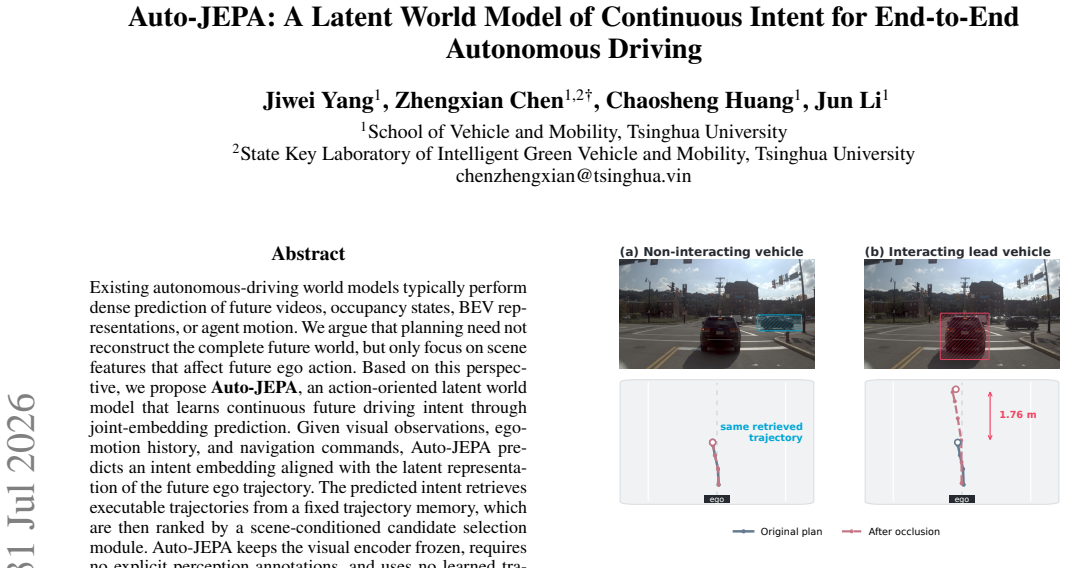
Existing autonomous-driving world models typically perform dense prediction of future videos, occupancy states, BEV representations, or agent motion. We argue that planning need not reconstruct the complete future world, but only focus on scene features that affect future ego action. Based on this perspective, we propose Auto-JEPA, an action-oriented latent world model that learns continuous future driving intent through joint-embedding prediction. Given visual observations, egomotion history, and navigation commands, Auto-JEPA predicts an intent embedding aligned with the latent representation of the future ego trajectory. The predicted intent retrieves executable trajectories from a fixed trajectory memory, which are then ranked by a scene-conditioned candidate selection module. Auto-JEPA keeps the visual encoder frozen, requires no explicit perception annotations, and uses no learned trajectory generator. By optimizing only task-specific modules for trajectory representation, intent prediction, and candidate selection, Auto-JEPA achieves 91.3 PDMS on NAVSIM v1 and 89.1 EPDMS on NAVSIM v2. Semantic occlusion experiments show that masking dynamic-agent regions induces an average intent change 2.97x that of equal-area random masking. Moreover, occluding vehicles that affect future driving substantially changes the predicted intent and selected trajectory, whereas both remain essentially unchanged when non-influential vehicles are occluded. These results show that future-intent prediction encourages the model to focus on planning-relevant visual features and supports high-quality planning without dense future-world modeling.
Figures


Reference graph
Works this paper leans on
-
[1]
arXiv preprint arXiv:2311.17918 , year =
Yuqi Wang and Jiawei He and Lue Fan and Hongxin Li and Yuntao Chen and Zhaoxiang Zhang , title =. arXiv preprint arXiv:2311.17918 , year =
-
[2]
arXiv preprint arXiv:2311.16038 , year =
Wenzhao Zheng and Weiliang Chen and Yuanhui Huang and Borui Zhang and Yueqi Duan and Jiwen Lu , title =. arXiv preprint arXiv:2311.16038 , year =
-
[3]
Refaat and Rami Al-Rfou and Benjamin Sapp , title =
Ari Seff and Brian Cera and Dian Chen and Mason Ng and Aurick Zhou and Nigamaa Nayakanti and Khaled S. Refaat and Rami Al-Rfou and Benjamin Sapp , title =. Proceedings of the IEEE/CVF International Conference on Computer Vision , year =
-
[4]
Proceedings of the IEEE/CVF International Conference on Computer Vision , year =
Mahmoud Assran and Quentin Duval and Ishan Misra and Piotr Bojanowski and Pascal Vincent and Michael Rabbat and Yann LeCun and Nicolas Ballas , title =. Proceedings of the IEEE/CVF International Conference on Computer Vision , year =
-
[5]
arXiv preprint arXiv:2404.08471 , year =
Adrien Bardes and Quentin Garrido and Jean Ponce and Xinlei Chen and Michael Rabbat and Yann LeCun and Mahmoud Assran and Nicolas Ballas , title =. arXiv preprint arXiv:2404.08471 , year =
-
[6]
Advances in Neural Information Processing Systems , year =
Daniel Dauner and Marcel Hallgarten and Tianyu Li and Xinshuo Weng and Zhiyu Huang and Zetong Yang and Hongyang Li and Igor Gilitschenski and Boris Ivanovic and Marco Pavone and Andreas Geiger and Kashyap Chitta , title =. Advances in Neural Information Processing Systems , year =
-
[7]
arXiv preprint arXiv:2605.10564 , year =
Lingjun Zhang and Changjie Wu and Linzhe Shi and Jiangyang Li and Jiaxin Liu and Lei Yang and Hang Zhang and Mu Xu and Hong Wang , title =. arXiv preprint arXiv:2605.10564 , year =
-
[8]
arXiv preprint arXiv:2602.06521 , year =
Feiyang Jia and Lin Liu and Ziying Song and Caiyan Jia and Hangjun Ye and Xiaoshuai Hao and Long Chen , title =. arXiv preprint arXiv:2602.06521 , year =
-
[9]
arXiv preprint arXiv:2601.22032 , year =
Linhan Wang and Zichong Yang and Chen Bai and Guoxiang Zhang and Xiaotong Liu and Xiaoyin Zheng and Xiao-Xiao Long and Chang-Tien Lu and Cheng Lu , title =. arXiv preprint arXiv:2601.22032 , year =
-
[10]
arXiv preprint arXiv:2601.05611 , year =
Chengen Xie and Bin Sun and Tianyu Li and Junjie Wu and Zhihui Hao and XianPeng Lang and Hongyang Li , title =. arXiv preprint arXiv:2601.05611 , year =
-
[11]
arXiv preprint arXiv:2309.17080 , year =
Anthony Hu and Lloyd Russell and Hudson Yeo and Zak Murez and George Fedoseev and Alex Kendall and Jamie Shotton and Gianluca Corrado , title =. arXiv preprint arXiv:2309.17080 , year =
-
[12]
arXiv preprint arXiv:2309.09777 , year =
Xiaofeng Wang and Zheng Zhu and Guan Huang and Xinze Chen and Jiagang Zhu and Jiwen Lu , title =. arXiv preprint arXiv:2309.09777 , year =
-
[13]
Advances in Neural Information Processing Systems , year =
Shenyuan Gao and Jiazhi Yang and Li Chen and Kashyap Chitta and Yihang Qiu and Andreas Geiger and Jun Zhang and Hongyang Li , title =. Advances in Neural Information Processing Systems , year =
-
[14]
arXiv preprint arXiv:2312.17655 , year =
Zetong Yang and Li Chen and Yanan Sun and Hongyang Li , title =. arXiv preprint arXiv:2312.17655 , year =
-
[15]
International Conference on Learning Representations , year =
Yingyan Li and Lue Fan and Jiawei He and Yuqi Wang and Yuntao Chen and Zhaoxiang Zhang and Tieniu Tan , title =. International Conference on Learning Representations , year =
-
[16]
Proceedings of the IEEE/CVF International Conference on Computer Vision , year =
Yupeng Zheng and Pengxuan Yang and Zebin Xing and Qichao Zhang and Yuhang Zheng and Yinfeng Gao and Pengfei Li and Teng Zhang and Zhongpu Xia and Peng Jia and Dongbin Zhao , title =. Proceedings of the IEEE/CVF International Conference on Computer Vision , year =
-
[17]
arXiv preprint arXiv:2605.15120 , year =
Sining Ang and Yuguang Yang and Canyu Chen and Yan Wang , title =. arXiv preprint arXiv:2605.15120 , year =
-
[18]
arXiv preprint arXiv:2506.09985 , year =
Mahmoud Assran and Adrien Bardes and David Fan and Quentin Garrido and Russell Howes and Matthew Muckley and others , title =. arXiv preprint arXiv:2506.09985 , year =
-
[19]
arXiv preprint arXiv:2402.13243 , year =
Bo Jiang and Shaoyu Chen and Hao Gao and Bencheng Liao and Qian Zhang and Wenyu Liu and Xinggang Wang , title =. arXiv preprint arXiv:2402.13243 , year =
-
[20]
Zhiqi Li and Kaidong Li and Shijie Wang and Shiyi Lan and Zhe Yu and Y. Ji and Z. Li and Z. Zhu and Jan Kautz and others , title =. arXiv preprint arXiv:2406.06978 , year =
-
[21]
Proceedings of the IEEE/CVF Conference on Computer Vision and Pattern Recognition , pages =
Bencheng Liao and others , title =. Proceedings of the IEEE/CVF Conference on Computer Vision and Pattern Recognition , pages =
-
[22]
Zhang and Y
Zebin Xing and X. Zhang and Y. Hu and B. Jiang and T. He and Q. Zhang and X. Long and W. Yin , title =. Proceedings of the IEEE/CVF Conference on Computer Vision and Pattern Recognition , pages =
-
[23]
K. Guo and H. Liu and X. Wu and J. Pan and C. Lv , title =. arXiv preprint arXiv:2505.15111 , year =
-
[24]
Advances in Neural Information Processing Systems , year =
Yuriy Biktairov and Maxim Stebelev and Irina Rudenko and Oleh Shliazhko and Boris Yangel , title =. Advances in Neural Information Processing Systems , year =
-
[25]
arXiv preprint arXiv:2603.29163 , year =
Wenchao Sun and Xuewu Lin and Keyu Chen and Zixiang Pei and Xiang Li and Yining Shi and Sifa Zheng , title =. arXiv preprint arXiv:2603.29163 , year =
-
[26]
and Zhang, Yun and Huang, Zhiyu and Zhou, Bolei and Ma, Jiaqi , booktitle =
Zhou, Zewei and Cai, Tianhui and Zhao, Seth Z. and Zhang, Yun and Huang, Zhiyu and Zhou, Bolei and Ma, Jiaqi , booktitle =
-
[27]
IEEE Transactions on Pattern Analysis and Machine Intelligence , volume =
TransFuser: Imitation with Transformer-Based Sensor Fusion for Autonomous Driving , author =. IEEE Transactions on Pattern Analysis and Machine Intelligence , volume =
-
[28]
Weng, Xinshuo and Ivanovic, Boris and Wang, Yan and Wang, Yue and Pavone, Marco , booktitle =
-
[29]
Chen, Yuntao and Wang, Yuqi and Zhang, Zhaoxiang , booktitle =
-
[30]
End-to-End Driving with Online Trajectory Evaluation via
Li, Yingyan and Wang, Yuqi and Liu, Yingfei and He, Jiaqi and Fan, Lue and Zhang, Zhaoxiang , booktitle =. End-to-End Driving with Online Trajectory Evaluation via
-
[31]
Proceedings of the IEEE/CVF International Conference on Computer Vision , year =
Epona: Autoregressive Diffusion World Model for Autonomous Driving , author =. Proceedings of the IEEE/CVF International Conference on Computer Vision , year =
-
[32]
International Conference on Learning Representations , year =
RecogDrive: A Reinforced Cognitive Framework for End-to-End Autonomous Driving , author =. International Conference on Learning Representations , year =
-
[33]
Luo, Yuechen and Li, Fang and Xu, Shaoqing and Lai, Zhiyi and Yang, Lei and Chen, Qimao and Luo, Ziang and Xie, Zixun and Jiang, Shengyin and Liu, Jiaxin and others , journal =
-
[34]
Devil Is in Narrow Policy: Unleashing Exploration in Driving
Chen, Canyu and Yang, Yuguang and Tan, Zhewen and Wang, Yizhi and Zhan, Ruiyi and Liu, Haiyan and Mao, Xuanyao and Bao, Jason and Tang, Xinyue and Yang, Linlin and Sun, Bingchuan and Wang, Yan and Zhang, Baochang , journal =. Devil Is in Narrow Policy: Unleashing Exploration in Driving
-
[35]
, journal =
Li, Kailin and Li, Zhenxin and Lan, Shiyi and Xie, Yuan and Zhang, Zhizhong and Liu, Jiayi and Wu, Zuxuan and Yu, Zhiding and Alvarez, Jose M. , journal =
-
[36]
and Wu, Zuxuan , journal =
Yao, Wenhao and Li, Zhenxin and Lan, Shiyi and Wang, Zi and Sun, Xinglong and Alvarez, Jose M. and Wu, Zuxuan , journal =
-
[37]
Zhou, Xingcheng and Han, Xuyuan and Yang, Feng and Ma, Yunpu and Tresp, Volker and Knoll, Alois , journal =
-
[38]
Li, Yingyan and Shang, Shuyao and Liu, Weisong and Zhan, Bing and Wang, Haochen and Wang, Yuqi and Chen, Yuntao and Wang, Xiaoman and An, Yasong and Tang, Chufeng and Hou, Lu and Fan, Lue and Zhang, Zhaoxiang , booktitle =
-
[39]
Gomez and Lukasz Kaiser and Illia Polosukhin , title =
Ashish Vaswani and Noam Shazeer and Niki Parmar and Jakob Uszkoreit and Llion Jones and Aidan N. Gomez and Lukasz Kaiser and Illia Polosukhin , title =. Advances in Neural Information Processing Systems , year =
-
[40]
arXiv preprint arXiv:1807.03748 , year =
Aaron van den Oord and Yazhe Li and Oriol Vinyals , title =. arXiv preprint arXiv:1807.03748 , year =
-
[41]
Communication, Simulation, and Intelligent Agents: Implications of Personal Intelligent Machines for Medical Education
Clancey, William J. Communication, Simulation, and Intelligent Agents: Implications of Personal Intelligent Machines for Medical Education. Proceedings of the Eighth International Joint Conference on Artificial Intelligence (IJCAI-83)
-
[42]
Classification Problem Solving
Clancey, William J. Classification Problem Solving. Proceedings of the Fourth National Conference on Artificial Intelligence
-
[43]
, title =
Robinson, Arthur L. , title =. 1980 , doi =. https://science.sciencemag.org/content/208/4447/1019.full.pdf , journal =
1980
-
[44]
New Ways to Make Microcircuits Smaller---Duplicate Entry
Robinson, Arthur L. New Ways to Make Microcircuits Smaller---Duplicate Entry. Science
-
[45]
Clancey and Glenn Rennels , abstract =
Diane Warner Hasling and William J. Clancey and Glenn Rennels , abstract =. Strategic explanations for a diagnostic consultation system , journal =. 1984 , issn =. doi:https://doi.org/10.1016/S0020-7373(84)80003-6 , url =
-
[46]
and Rennels, Glenn R
Hasling, Diane Warner and Clancey, William J. and Rennels, Glenn R. and Test, Thomas. Strategic Explanations in Consultation---Duplicate. The International Journal of Man-Machine Studies
-
[47]
Poligon: A System for Parallel Problem Solving
Rice, James. Poligon: A System for Parallel Problem Solving
-
[48]
Transfer of Rule-Based Expertise through a Tutorial Dialogue
Clancey, William J. Transfer of Rule-Based Expertise through a Tutorial Dialogue
-
[49]
The Engineering of Qualitative Models
Clancey, William J. The Engineering of Qualitative Models
-
[50]
2023 , eprint=
Attention Is All You Need , author=. 2023 , eprint=
2023
-
[51]
Pluto: The 'Other' Red Planet
NASA. Pluto: The 'Other' Red Planet
discussion (0)
Sign in with ORCID, Apple, or X to comment. Anyone can read and Pith papers without signing in.