REVIEW 4 major objections 5 minor 70 references
Laser-Synthesized Amorphous PdSe$_{\mathrm{2-x}}$ Nanoparticles: A Defect-Rich Platform for High-Efficiency SERS, Photocatalysis, and Photothermal Conversion
T0 review · 4 major / 5 minor · reviewed 2026-08-06 · deepseek-v4-flash
Pith's one-line read Femtosecond laser ablation in liquid converts crystalline PdSe2 into amorphous, selenium-deficient PdSe2-x nanoparticles whose defect states simultaneously deliver plasmon-free SERS enhancement above $10^6$, a fifty-fold rise in…
desk verdict Credible synthesis of amorphous PdSe2-x, but the SERS 'plasmon-free' claim and the headline EF rest on a missing aluminum control and a concentration-normalization artifact; the paper deserves peer review but needs major revision. read the letter →
The pith
A machine-rendered reading of the paper's core claim, the machinery that carries it, and where it could break.
The reading
What carries the argument
The central object is the amorphous, non-stoichiometric nanoparticle phase PdSe2-x produced by femtosecond laser ablation in liquid, a disordered palladium selenide in which the selenium-to-palladium ratio drops from about 2:1 to about 1:1. The mechanism the authors invoke is a high density of selenium vacancies and coordinatively unsaturated surface sites created by amorphization. These defects do two jobs: they introduce mid-gap electronic states that align with adsorbed dye molecules for resonant charge-transfer SERS and broaden optical absorption for photocatalysis and photoheating, and they act as adsorption anchors and local dielectric-confinement hotspots in aggregates that concentrate the Raman field without plasmon resonances.
What would settle it
A decisive test would take the same PdSe2-x colloid, remove or passivate the surface oxide without changing the amorphous core (for example by a brief dilute-acid wash or mild reduction), and re-measure the SERS enhancement factor, the mass-normalized photocatalytic rate, and the photothermal conversion efficiency. If the 50-fold photocatalytic advantage and the near-83% photothermal efficiency survive oxide removal, the amorphous selenium-vacancy network is doing the work; if the numbers collapse, the oxide surface is the true functional layer.
Extended reading notes
Core claim
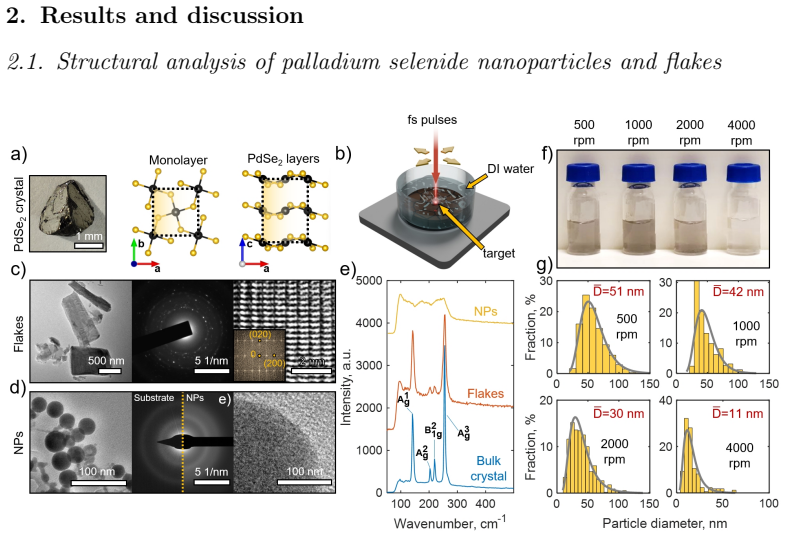
The paper's central discovery is that pulsed laser ablation in liquid can stabilize an amorphous palladium selenide phase that the crystalline PdSe2 precursor does not possess. The ablated nanoparticles are not merely smaller crystals: electron diffraction shows amorphous halos, Raman shows broad bands instead of the sharp A1g and A3g modes, and the composition shifts from roughly two selenium atoms per palladium to roughly one, corresponding to PdSe2-x with x about 1. That selenium deficit and the associated coordinatively unsaturated sites are presented as the microscopic origin of three emergent functions: SERS enhancement factors up to about $1.2 \times 10^6$ for crystal violet at $10^{-9}$ M, pseudo-first-order methylene blue photodegradation whose mass-normalized rate constant is about fifty times that of crystalline flakes, and photothermal conversion efficiency rising from 72% for 51 nm particles to 82-83% for 11 nm particles under 830 nm illumination. The paper argues these functions arise from a synergy of defect-state charge transfer, dielectric-confinement hotspots at particle aggregates, and broad sub-gap absorption, all absent in the ordered precursor.
Load-bearing premise
The load-bearing premise is that selenium vacancies and coordinatively unsaturated sites in the amorphous PdSe2-x phase, rather than the substantial Pd-O and Se-O surface oxides or any residual crystalline domains seen in the XPS and EDX data, are what drive the SERS, photocatalytic, and photothermal gains.
Editorial extensions
If this is right
- A single femtosecond-laser run produces colloids that remain stable for at least a month, so the defect-rich state can be stored without ligands or inert atmosphere.
- Differential centrifugation tunes mean particle size from about 51 nm down to 11 nm and raises photothermal conversion efficiency from 72% to about 83%, giving size-tunable heat agents from one synthesis.
- Detection limits reach $10^{-9}$ M for crystal violet, rhodamine 6G, rhodamine B, and methyl orange, with enhancement factors above $10^6$ for crystal violet.
- Mass-normalized photocatalytic methylene blue degradation is about 50 times faster for the nanoparticles than for crystalline flakes, even though the nanoparticle loading is 30 times lower.
- Because ablation starts from a bulk target and works in water, the route is compatible with continuous-flow reactors, which the paper identifies as the scaling path.
Reading between the lines
- An untested corollary is that mildly annealing or re-selenizing the nanoparticles should erase the selenium vacancies and, if the paper's mechanism is right, sharply lower the SERS, photocatalytic, and photothermal performance; this would provide a clean control experiment.
- The XPS data show substantial Pd-O and Se-O bonding, so credit for the functions may belong partly to a surface oxide layer; the paper does not separate the two contributions.
- The same laser-amorphization route may extend to other platinum-group dichalcogenides, where crystalline phases are also thermodynamically favored and a defect-rich amorphous phase could be similarly functional.
- The near-83% photothermal ceiling at small particle size suggests absorption by the amorphous defect network, not Mie scattering, dominates; comparing measured PCE with Mie-theory predictions for crystalline PdSe2 of the same sizes would test that reading.
Signed reviews
Editorial analysis
A structured set of objections, weighed in public.
Referee Report
Summary. This manuscript reports the femtosecond laser ablation in liquid (PLAL) of a crystalline PdSe2 target to produce amorphous, non-stoichiometric PdSe2-x nanoparticles (x ≈ 1). The authors characterize the product by TEM/SAED, Raman, EDX, XPS, and photoluminescence, and they measure three functionalities: SERS with reported enhancement factors up to 10^6, photocatalytic degradation of methylene blue with a claimed 50-fold improvement in mass-normalized activity over crystalline flakes, and photothermal conversion efficiencies up to 83% under 830 nm illumination. The central claim is that selenium vacancies and coordinatively unsaturated sites created by amorphization are responsible for the enhanced performance, and that the nanoparticles constitute a defect-rich, plasmon-free multifunctional platform.
Significance. If fully substantiated, the work would provide a simple, scalable route to defect-engineered amorphous TMDC nanoparticles with simultaneous SERS, photocatalytic, and photothermal functionality. The structural evidence for amorphization (SAED halos, Raman band broadening, XPS shifts, EDX stoichiometry) is credible and well presented. The comparison between amorphous nanoparticles and crystalline flakes for SERS and photocatalysis is a useful design principle, and the photothermal study includes a literature benchmark and size-fraction measurements. The main weakness is that the SERS claim currently rests on substrates fabricated on metallic aluminum without a bare-aluminum control, so the 'plasmon-free' mechanism is not established. In addition, the attribution of the functional gains to selenium vacancies is confounded by the substantial Pd-O and Se-O bonding revealed by XPS, and the photocatalytic 50-fold claim depends on an unverified linearity assumption in mass normalization. These issues are fixable with additional control experiments and analysis, but they directly affect the paper's headline claims.
major comments (4)
- [Section 4.2.5 and Section 2.3] The SERS substrates are prepared by drop-casting the nanoparticle colloid onto an aluminum surface (Section 4.2.5), yet no baseline measurement on bare aluminum with the same dye deposition is reported. At 532 and 633 nm, a rough aluminum film can provide electromagnetic enhancement, and it can also act as a back-reflector. Without a bare-Al control, or without comparable SERS measurements on a non-metallic substrate (e.g., glass or silicon), the observed enhancement factors cannot be assigned to the amorphous PdSe2-x defect states. The 'plasmon-free' label in the abstract and Section 2.3 is therefore unsupported. Table 1 also shows that the derived EF increases monotonically as dye concentration decreases (e.g., CV at 1617 cm^-1 from 170 at 10^-4 M to 1.23×10^6 at 10^-9 M), which is a concentration-normalized analytical factor rather than a fixed per-molecule enhancement; the absence of film thickness and coverage characterization further prevents a quantitative assignment of the enhancement mechanism.
- [Section 2.1, Figs. 2f and 2g] The XPS data show new Pd 3d peaks assigned to PdO2 (343.70 eV and 337.90 eV) and a Se 3d peak assigned to Se-O (58.50 eV), and the EDX data reveal a significant oxygen content. The manuscript attributes the SERS, photocatalytic, and photothermal performance to selenium vacancies and coordinatively unsaturated sites, but it does not separate the contribution of the surface oxide phases from the proposed amorphous defect network. Since surface oxides can themselves act as charge-transfer mediators or active sites, the central mechanistic claim that the 'defect-rich platform' is the cause of the observed enhancements is not uniquely established. Additional experiments (e.g., controlled surface etching, comparison with deliberately oxidized crystalline PdSe2, or oxide-free synthesis conditions) would be needed to support the attribution.
- [Section 2.4 and Section 4.2.6] The 50-fold photocatalytic enhancement is obtained by normalizing the pseudo-first-order rate constant by catalyst mass concentration: k = 0.0244 min^-1 at 0.022 mg/mL for nanoparticles versus k = 0.0138 min^-1 at 0.66 mg/mL for flakes. This normalization assumes that the rate constant is linear in catalyst loading over the studied range, an assumption that is not tested or justified. If the reaction is limited by light absorption, surface area, or mass transfer, the mass-normalized comparison may overstate the intrinsic activity difference. The manuscript should include loading-dependent rate measurements or another justification for the normalization before the factor-of-50 claim is accepted.
- [Section 2.2 and Fig. 3d] The photothermal conversion efficiency (PCE) of 83% is a headline result, but the main text does not provide the heating/cooling curves, the model equation, or the experimental parameters used to extract PCE; these are deferred to Supplementary Note 2. The zero-size asymptote of the experimental PCE curve (η ≈ 0.83) is attributed to nanoparticle agglomeration, but no agglomeration data are presented. Since the abstract reports this value without qualification, the reliability of the PCE extraction should be demonstrated in the main text or the claim should be softened to the measured values for specific size fractions (e.g., 82% for 11 nm).
minor comments (5)
- [Section 2.4] The text says the nanoparticles exhibit 'two orders of magnitude higher specific activity,' but the reported values (1.11 versus 0.021 min^-1 mL/mg) give a factor of roughly 53, which is one and a half orders of magnitude; please correct this overstatement.
- [Figure 5b caption] The caption uses 'C0/Ct' while the text and kinetics equations use 'Ct/C0'; the axis label and caption should be made consistent.
- [Section 2.3 references] References [58] and [59] are cited for the Raman spectra of crystal violet and rhodamine B, but these references are about laser-induced periodic surface structures and appear mismatched; please verify the citations and replace them with appropriate SERS spectral references.
- [Section 4.2.5 and keywords] There are minor typographical issues: '2µl' should be '2 µL', 'drop casted' should be 'drop-cast', and the keyword 'nanoparicles' is misspelled as 'nanoparticles'.
- [Section 2.1] The XPS discussion states 'binding energies of Pd 3d3/2 (341.97 eV), Pd 3d5/2 (336.69 eV PdOx/Pd)', which is ambiguous because the PdOx/Pd label appears only for one peak; clarify the assignment.
Circularity Check
No significant circularity: the headline metrics are measured or compared against independent benchmarks, and the self-citations are contextual, not load-bearing.
full rationale
The derivation chain is not circular. The SERS enhancement factors are obtained from directly measured spectra via the standard ratio EF = I_SERS/I_RS × C_RS/C_SERS (Section 2.3, Table 1), with crystalline PdSe2 flakes as an independent control; no parameter is fitted to force the >10^6 result. The photothermal efficiencies (η = 72–82%) come from heating/cooling measurements at 830 nm (Section 4.2.4), while the theoretical PCE curves in Fig. 3d are stated to use literature refractive-index data (Supplementary Note 3), so the theory is not fitted to the measured PCE. The photocatalytic 50-fold comparison is a transparent calculation from measured pseudo-first-order rate constants and independently weighed concentrations (Section 2.4). The self-citations [30,38,44] supply synthesis context, Raman peak references, or a bandgap value that is also supported by independent references [21,39]; none is load-bearing for the central defect-based mechanism, and no uniqueness theorem or ansatz is imported from prior work by the same authors. The main caveat is experimental rather than circular: Section 4.2.5 states that SERS substrates were drop-cast onto an aluminum surface, and no bare-aluminum control is reported, so the 'plasmon-free' attribution is under-supported. That gap is a confounding-control issue, not a reduction of the conclusion to its own inputs, and it does not change the circularity score.
Assumptions & free parameters
assumptions (6)
- standard math Lambert-Beer law converts absorbance at 665 nm to MB concentration.
- domain assumption The amorphous phase is stable and is the cause of the enhanced properties.
- domain assumption SERS enhancement is chemical and defect-mediated, not an artifact of aggregation, fluorescence, or residual crystallinity.
- domain assumption Photodegradation of MB is photocatalytic rather than adsorption or photolysis.
- domain assumption Photothermal PCE model in Supplementary Note 2 correctly separates absorption, scattering, and heat losses.
- ad hoc to paper The zero-size PCE asymptote of about 0.83 is due to agglomeration.
Cite this review
Pith. "Pith review of Laser-Synthesized Amorphous PdSe$_{\mathrm{2-x}}$ Nanoparticles: A Defect-Rich Platform for High-Efficiency SERS, Photocatalysis, and Photothermal Conversion." pith.science (2026). https://pith.science/paper/2JABGYWK
@misc{pith2026250721918,
  author       = {Pith},
  title        = {Pith review of: Laser-Synthesized Amorphous PdSe$_\mathrm2-x$ Nanoparticles: A Defect-Rich Platform for High-Efficiency SERS, Photocatalysis, and Photothermal Conversion},
  year         = {2026},
  howpublished = {\url{https://pith.science/paper/2JABGYWK}},
  note         = {Machine review of arXiv:2507.21918}
}
abstract
The control of material properties at the atomic scale remains a central challenge in materials science. Transition metal dichalcogenides (TMDCs) offer remarkable electronic and optical properties, but their functionality is largely dictated by their stable crystalline phases. Here we demonstrate a single-step, ligand-free strategy using femtosecond laser ablation in liquid to transform crystalline, stoichiometric palladium diselenide (PdSe$_{\mathrm{2}}$) into highly stable, amorphous, and non-stoichiometric nanoparticles (PdSe$_{\mathrm{2-x}}$, with x$\approx$1). This laser-driven amorphization creates a high density of selenium vacancies and coordinatively unsaturated sites, which unlock a range of emergent functions absent in the crystalline precursor, including plasmon-free surface-enhanced Raman scattering with an enhancement factor exceeding 10$^\mathrm{6}$, a 50-fold increase in photocatalytic activity, and near-infrared photothermal conversion efficiency reaching 83$\%$. Our findings establish laser-induced amorphization as a powerful top-down approach for defect-engineered TMDCs and advances their practical usage in optics, catalysis, and nanomedicine.
Figures


Figures from the paper (2 more)


Reference graph
Works this paper leans on
-
[1]
D. L. Duong, S. J. Yun, Y. H. Lee, van der waals layered materials: opportunities and challenges, ACS nano 11 (12) (2017) 11803–11830. 21
work page 2017
-
[2]
Y. Gogotsi, B. Anasori, The rise of mxenes, in: MXenes, Jenny Stanford Publishing, 2023, pp. 3–11
work page 2023
-
[3]
M. F. Hossen, S. Shendokar, S. Aravamudhan, Defects and defect en- gineering of two-dimensional transition metal dichalcogenide (2d tmdc) materials, Nanomaterials 14 (5) (2024) 410
work page 2024
- [4]
-
[5]
J. Sun, H. Shi, T. Siegrist, D. J. Singh, Electronic, transport, and op- tical properties of bulk and mono-layer pdse2, Applied Physics Letters 107 (15) (2015)
work page 2015
-
[6]
Y.Qi, M.A.Sadi, D.Hu, M.Zheng, Z.Wu, Y.Jiang, Y.P.Chen, Recent progress in strain engineering on van der waals 2d materials: Tunable electrical, electrochemical, magnetic, and optical properties, Advanced Materials 35 (12) (2023) 2205714
work page 2023
- [7]
- [8]
Show all 70 references
-
[9]
L. Zeng, D. Wu, J. Jie, X. Ren, X. Hu, S. P. Lau, Y. Chai, Y. H. Tsang, Van der waals epitaxial growth of mosaic-like 2d platinum ditelluride layers for room-temperature mid-infrared photodetection up to 10.6µm, Advanced materials 32 (52) (2020) 2004412
2020
-
[10]
A. D. Alfieri, M. J. Motala, M. Snure, J. Lynch, P. Kumar, H. Zhang, S. Post, T. Bowen, C. Muratore, J. A. Robinson, et al., Ultrathin broad- band metasurface superabsorbers from a van der waals semimetal, Ad- vanced Optical Materials 11 (4) (2023) 2202011
2023
-
[11]
Y. Gu, H. Cai, J. Dong, Y. Yu, A. N. Hoffman, C. Liu, A. D. Oyedele, Y.-C. Lin, Z. Ge, A. A. Puretzky, et al., Two-dimensional palladium 22 diselenide with strong in-plane optical anisotropy and high mobility grown by chemical vapor deposition, Advanced Materials 32 (19) (2020...
2020
-
[12]
A. D. Oyedele, S. Yang, L. Liang, A. A. Puretzky, K. Wang, J. Zhang, P. Yu, P. R. Pudasaini, A. W. Ghosh, Z. Liu, et al., Pdse2: pentagonal two-dimensional layers with high air stability for electronics, Journal of the American Chemical Society 139 (40) (2017) 14090–14097
2017
-
[13]
Liang, Q
Q. Liang, Q. Wang, Q. Zhang, J. Wei, S. X. Lim, R. Zhu, J. Hu, W. Wei, C. Lee, C. Sow, et al., High-performance, room temperature, ultra-broadband photodetectors based on air-stable pdse2, Advanced Materials 31 (24) (2019) 1807609
2019
-
[14]
L.-H. Zeng, D. Wu, S.-H. Lin, C. Xie, H.-Y. Yuan, W. Lu, S. P. Lau, Y. Chai, L.-B. Luo, Z.-J. Li, et al., Controlled synthesis of 2d palladium diselenide for sensitive photodetector applications, Advanced Functional Materials 29 (1) (2019) 1806878
2019
-
[15]
Y. Wang, J. Pang, Q. Cheng, L. Han, Y. Li, X. Meng, B. Ibarlucea, H. Zhao, F. Yang, H. Liu, et al., Applications of 2d-layered palladium diselenide and its van der waals heterostructures in electronics and op- toelectronics, Nano-Micro Letters 13 (1) (2021) 143
2021
-
[16]
Z. Hu, N. Yang, Y. Feng, L. Xu, C. Hu, H. Liu, S. Tian, J. Yang, Synthe- sis of unconventional pd–se nanoparticles for phase-dependent ethanol electrooxidation, Chemical Communications 59 (27) (2023) 4020–4023
2023
-
[17]
Kukunuri, K
S. Kukunuri, K. Naik, S. Sampath, Effects of composition and nanos- tructuring of palladium selenide phases, pd 4 se, pd 7 se 4 and pd 17 se 15, on orr activity and their use in mg–air batteries, Journal of Materials Chemistry A 5 (9) (2017) 4660–4670
2017
-
[18]
Zhang, L
Z.Lin, B.Xiao, Z.Wang, W.Tao, S.Shen, L.Huang, J.Zhang, F.Meng, Q. Zhang, L. Gu, et al., Planar-coordination pdse2 nanosheets as highly active electrocatalyst for hydrogen evolution reaction, Advanced Func- tional Materials 31 (32) (2021) 2102321
2021
-
[19]
Y. Qin, W. Zhang, F. Wang, J. Li, J. Ye, X. Sheng, C. Li, X. Liang, P. Liu, X. Wang, et al., Extraordinary p–d hybridization interaction in 23 heterostructural pd-pdse nanosheets boosts c- c bond cleavage of ethy- lene glycol electrooxidation, Angewandte Chemie International E...
2022
-
[20]
Z. Lei, X. Zhang, Y. Zhao, A. Wei, L. Tao, Y. Yang, Z. Zheng, L. Tao, P. Yu, J. Li, Enhanced raman scattering on two-dimensional palladium diselenide, Nanoscale 14 (11) (2022) 4181–4187
2022
-
[21]
T. Jena, M. T. Hossain, U. Nath, M. Sarma, H. Sugimoto, M. Fujii, P. Giri, Evidence for intrinsic defects and nanopores as hotspots in 2d pdse2 dendrites for plasmon-free sers substrate with a high enhancement factor, npj 2D Materials and Applications 7 (1) (2023) 8
2023
-
[22]
Zhang, Z
X. Zhang, Z. Lei, Z. Pan, J. Hu, L. Tao, Z. Zheng, X. Feng, J. Xue, L. Tao, Y. Zhao, A general approach to hybrid platform of au nanoparti- cles on monolayer semiconductor for ultrasensitive raman enhancement of 2d materials and molecule detection, Journal of Alloys and Com- p...
2023
-
[23]
Ibrahim, K
K. Ibrahim, K. C. Matthews, M. Coupin, J. H. Warner, Phase engi- neering of palladium selenide using chalcogen flux control, Chemistry of Materials 34 (22) (2022) 9982–9988
2022
-
[24]
V. V. Singh, G. K. Rao, A. Kumar, A. K. Singh, Palladium (ii)– selenoether complexes as new single source precursors: First synthesis of pd 4 se and pd 7 se 4 nanoparticles, Dalton transactions 41 (4) (2012) 1142–1145
2012
-
[25]
B. Wu, X. Liu, P. Liu, G. Wu, L. Tian, X. Han, J. Li, X. Hong, Syn- thesis of amorphous metal oxides via a crystalline to amorphous phase transition strategy, Nature Synthesis (2025) 1–10
2025
-
[26]
Z. Yu, S. Lv, Q. Yao, N. Fang, Y. Xu, Q. Shao, C.-W. Pao, J.-F. Lee, G. Li, L.-M. Yang, et al., Low-coordinated pd site within amorphous palladium selenide for active, selective, and stable h2o2 electrosynthesis, Advanced Materials 35 (6) (2023) 2208101
2023
-
[27]
M. Wu, X. Li, D.-F. Yin, W. Chen, J. Qi, M. Hu, J. Xu, Y. Cheng, Real-time spectroscopic monitoring of continuous-flow synthesis of zinc oxide nano-structures in femtosecond laser fabricated 3d microfluidic 24 microchannels with integrated on-chip fiber probe array, Lab on a C...
2023
-
[28]
Chavalekvirat, W
P. Chavalekvirat, W. Hirunpinyopas, K. Deshsorn, K. Jitapunkul, P. Iamprasertkun, Liquid phase exfoliation of 2d materials and its elec- trochemical applications in the data-driven future, Precision Chemistry 2 (7) (2024) 300–329
2024
-
[29]
Soulard, X
C. Soulard, X. Rocquefelte, P.-E. Petit, M. Evain, S. Jobic, J.-P. Itié, P. Munsch, H.-J. Koo, M.-H. Whangbo, Experimental and theoretical investigation on the relative stability of the pds2-and pyrite-type struc- tures of pdse2, Inorganic chemistry 43 (6) (2004) 1943–1949
2004
-
[30]
G. I. Tselikov, G. A. Ermolaev, A. A. Popov, G. V. Tikhonowski, D. A. Panova, A. S. Taradin, A. A. Vyshnevyy, A. V. Syuy, S. M. Klimen- tov, S. M. Novikov, et al., Transition metal dichalcogenide nanospheres for high-refractive-index nanophotonics and biomedical theranostics, ...
2022
-
[31]
T. Jena, G. Choudhary, M. T. Hossain, U. Nath, M. Sarma, P. Giri, Salt-catalyzed directed growth of bilayer palladium diselenide (pdse2) dendrites and pd nanoparticle-decorated pdse2–pd2se3 junction exhibit- ing very high surface enhanced raman scattering sensitivity, Chemistr...
2024
-
[32]
Abdul-Aziz, D
O. Abdul-Aziz, D. Wolverson, C. J. Sayers, E. Carpene, F. Parmigiani, H. Hedayat, P. H. van Loosdrecht, Resonance-induced anomalies in temperature-dependent raman scattering of pdse 2, Journal of Mate- rials Chemistry C 12 (30) (2024) 11402–11411
2024
-
[33]
M. A. Livshits, E. Khomyakova, E. G. Evtushenko, V. N. Lazarev, N. A. Kulemin, S. E. Semina, E. V. Generozov, V. M. Govorun, Isolation of exosomes by differential centrifugation: Theoretical analysis of a com- monly used protocol, Scientific reports 5 (1) (2015) 17319
2015
-
[34]
Zheng, S
Z. Zheng, S. Cong, W. Gong, J. Xuan, G. Li, W. Lu, F. Geng, Z. Zhao, Semiconductor sers enhancement enabled by oxygen incorporation, Na- ture communications 8 (1) (2017) 1993. 25
2017
-
[35]
S. Cong, Y. Yuan, Z. Chen, J. Hou, M. Yang, Y. Su, Y. Zhang, L. Li, Q. Li, F. Geng, et al., Noble metal-comparable sers enhancement from semiconducting metal oxides by making oxygen vacancies, Nature com- munications 6 (1) (2015) 7800
2015
-
[36]
I. V. Chepkasov, V. S. Baidyshev, A. V. Iosimovska, I. S. Zamulin, A.G.Kvashnin, Adsorptionpropertiesofcrystallineandamorphouspdir nanoparticles. a systematic first-principles study, Journal of Catalysis (2025) 116102
2025
-
[37]
Q.Fu, L.W.Wong, F.Zheng, X.Zheng, C.S.Tsang, K.H.Lai, W.Shen, T. H. Ly, Q. Deng, J. Zhao, Unraveling and leveraging in situ surface amorphization for enhanced hydrogen evolution reaction in alkaline me- dia, Nature communications 14 (1) (2023) 6462
2023
-
[38]
Volkov, A
V. Volkov, A. Slavich, G. Ermolaev, N. Pak, D. Grudinin, K. Kravtsov, M. Tatmyshevskiy, V. Semkin, A. Syuy, A. Mazitov, et al., All-in- one van der waals material for light detection, guiding and modu- lation, Research Square [Preprint] (11 March 2025) Available from: https://...
2025 doi
-
[39]
M. Wei, J. Lian, Y. Zhang, C. Wang, Y. Wang, Z. Xu, Layer-dependent optical and dielectric properties of centimeter-scale pdse2 films grown by chemical vapor deposition, npj 2D Materials and Applications 6 (1) (2022) 1
2022
-
[40]
A. N. Hoffman, Y. Gu, L. Liang, J. D. Fowlkes, K. Xiao, P. D. Rack, Exploringtheairstabilityofpdse2viaelectricaltransportmeasurements and defect calculations, npj 2D Materials and Applications 3 (1) (2019) 50
2019
-
[41]
G. Zhou, J. Ji, Z. Chen, J. Shuai, Q. Liang, Q. Zhang, Scalable electronic and optoelectronic devices based on 2d tmds, Materials Futures 3 (4) (2024) 042701
2024
-
[42]
Liang, Q
Q. Liang, Q. Zhang, J. Gou, T. Song, Arramel, H. Chen, M. Yang, S. X. Lim, Q. Wang, R. Zhu, et al., Performance improvement by ozone treatment of 2d pdse2, ACS nano 14 (5) (2020) 5668–5677
2020
-
[43]
Ayala-Orozco, C
C. Ayala-Orozco, C. Urban, M. W. Knight, A. S. Urban, O. Neumann, S. W. Bishnoi, S. Mukherjee, A. M. Goodman, H. Charron, T. Mitchell, 26 et al., Au nanomatryoshkas as efficient near-infrared photothermal transducers for cancer treatment: benchmarking against nanoshells, ACS n...
2014
-
[44]
Ushkov, D
A. Ushkov, D. Dyubo, N. Belozerova, I. Kazantsev, D. Yakubovsky, A. Syuy, G. V. Tikhonowski, D. Tselikov, I. Martynov, G. Ermolaev, et al., Tungsten diselenide nanoparticles produced via femtosecond ab- lationforsersandtheranosticsapplications, Nanomaterials15(1)(2024) 4
2024
-
[45]
X. Li, L. Liu, S. Li, Y. Wan, J.-X. Chen, S. Tian, Z. Huang, Y.-F. Xiao, X. Cui, C. Xiang, et al., Biodegradable π-conjugated oligomer nanoparticles with high photothermal conversion efficiency for cancer theranostics, Acs Nano 13 (11) (2019) 12901–12911
2019
-
[46]
Jiang, X
Y. Jiang, X. Duan, J. Bai, H. Tian, D. Ding, Y. Geng, Polymerization- induced photothermy: A non-donor-acceptor approach to highly effec- tive near-infrared photothermal conversion nanoparticles, Biomaterials 255 (2020) 120179
2020
-
[47]
J. Zhou, Z. Lu, X. Zhu, X. Wang, Y. Liao, Z. Ma, F. Li, Nir photother- mal therapy using polyaniline nanoparticles, Biomaterials 34 (37) (2013) 9584–9592
2013
-
[48]
Xiao, S.-X
J.-W. Xiao, S.-X. Fan, F. Wang, L.-D. Sun, X.-Y. Zheng, C.-H. Yan, Porous pd nanoparticles with high photothermal conversion efficiency for efficient ablation of cancer cells, Nanoscale 6 (8) (2014) 4345–4351
2014
-
[49]
D. Xi, M. Xiao, J. Cao, L. Zhao, N. Xu, S. Long, J. Fan, K. Shao, W. Sun, X. Yan, et al., Nir light-driving barrier-free group rotation in nanoparticles with an 88.3% photothermal conversion efficiency for photothermal therapy, Advanced Materials 32 (11) (2020) 1907855
2020
-
[50]
Zhu, H.-Y
X.-M. Zhu, H.-Y. Wan, H. Jia, L. Liu, J. Wang, Porous pt nanopar- ticles with high near-infrared photothermal conversion efficiencies for photothermal therapy, Advanced Healthcare Materials 5 (24) (2016) 3165–3172
2016
-
[51]
J. Song, F. Wang, X. Yang, B. Ning, M. G. Harp, S. H. Culp, S. Hu, P. Huang, L. Nie, J. Chen, et al., Gold nanoparticle coated carbon nan- otuberingwithenhancedramanscatteringandphotothermalconversion 27 property for theranostic applications, Journal of the American Chemical S...
2016
-
[52]
F. Ye, A. Ayub, R. Karimi, S. Wettig, J. Sanderson, K. P. Musselman, Defect-rich mose2 2h/1t hybrid nanoparticles prepared from femtosec- ond laser ablation in liquid and their enhanced photothermal conversion efficiencies, Advanced Materials 35 (30) (2023) 2301129
2023
-
[53]
Pan, W.-X
S.-F. Pan, W.-X. Xia, W.-L. Feng, L. Ma, S.-J. Ding, X.-B. Chen, En- hanced photothermal conversion in res2/bi2se3 nanoflowers for solar- driven thermoelectric power generation and water evaporation, Journal of Alloys and Compounds 1020 (2025) 179390
2025
-
[54]
H. Xie, M. Liu, B. You, G. Luo, Y. Chen, B. Liu, Z. Jiang, P. K. Chu, J. Shao, X.-F. Yu, Biodegradable bi2o2se quantum dots for photoacous- tic imaging-guided cancer photothermal therapy, Small 16 (1) (2020) 1905208
2020
-
[55]
W. Feng, L. Chen, M. Qin, X. Zhou, Q. Zhang, Y. Miao, K. Qiu, Y.Zhang, C.He, Flower-likepegylatedmos2nanoflakesfornear-infrared photothermal cancer therapy, Scientific reports 5 (1) (2015) 17422
2015
-
[56]
K.E.Jebakumari, N.Murugasenapathi, T.Palanisamy, Engineeredtwo- dimensional nanostructures as sers substrates for biomolecule sensing: A review, Biosensors 13 (1) (2023) 102
2023
-
[57]
Q. Lv, J. Tan, Z. Wang, L. Yu, B. Liu, J. Lin, J. Li, Z.-H. Huang, F. Kang, R. Lv, Femtomolar-level molecular sensing of monolayer tung- sten diselenide induced by heteroatom doping with long-term stability, Advanced Functional Materials 32 (34) (2022) 2200273
2022
-
[58]
Bonse, S
J. Bonse, S. V. Kirner, J. Krüger, Laser-induced periodic surface struc- tures(lipss), Handbookoflasermicro-andnano-engineering(2020)1–59
2020
-
[59]
M. J. Becher, J. Jagosz, C. Bock, A. Ostendorf, E. L. Gurevich, For- mation of low-and high-spatial frequency laser-induced periodic surface structures (lipsss) in ald-deposited mos2, Frontiers in Nanotechnology 5 (2023) 1227025. 28
2023
-
[60]
X. N. He, Y. Gao, M. Mahjouri-Samani, P. Black, J. Allen, M. Mitchell, W. Xiong, Y. Zhou, L. Jiang, Y. Lu, Surface-enhanced raman spec- troscopy using gold-coated horizontally aligned carbon nanotubes, Nan- otechnology 23 (20) (2012) 205702
2012
-
[61]
B. N. J. Persson, K. Zhao, Z. Zhang, Chemical contribution to surface- enhanced raman scattering, Physical review letters 96 (20) (2006) 207401
2006
-
[62]
J. Kang, F. Li, Z. Xu, X. Chen, M. Sun, Y. Li, X. Yang, L. Guo, How amorphous nanomaterials enhanced electrocatalytic, sers, and mechan- ical properties, JACS Au 3 (10) (2023) 2660–2676
2023
-
[63]
D. Majumdar, 2d material-based surface-enhanced raman spectroscopy platforms (either alone or in nanocomposite form)- from a chemical en- hancement perspective, ACS omega 9 (38) (2024) 40242–40258
2024
-
[64]
N. Zhao, Y. Jin, G. Chen, A. Zhu, Y. Zhang, W. Xie, Metallic and semiconductor nanomaterials for surface-enhanced raman spectroscopy, Chemical Communications (2025)
2025
-
[65]
G. Xu, R. Dong, D. Gu, H. Tian, L. Xiong, Z. Wang, W. Wang, Y. Shao, W. Li, G. Li, et al., Selenium vacancies and synergistic effect of near- and far-field-enabled ultrasensitive surface-enhanced raman-scattering- active substrates for malaria detection, The Journal of Physica...
2022
-
[66]
Berestennikov, H
A. Berestennikov, H. Hu, A. Tittl, Molecular spectroscopies with semi- conductor metasurfaces: towards dual optical/chemical sers, Journal of Materials Chemistry C 13 (23) (2025) 11499–11514
2025
-
[67]
M. V. Canamares, C. Chenal, R. L. Birke, J. R. Lombardi, Dft, sers, and single-molecule sers of crystal violet, The Journal of Physical Chemistry C 112 (51) (2008) 20295–20300
2008
-
[68]
Laguna, S
H. Laguna, S. Loera, I. A. Ibarra, E. Lima, M. A. Vera, V. Lara, Azoic dyeshostedonhydrotalcite-likecompounds: Non-toxichybridpigments, Microporous and Mesoporous Materials 98 (1-3) (2007) 234–241. 29
2007
-
[69]
S. Sil, N. Kuhar, S. Acharya, S. Umapathy, Is chemically synthesized graphene ‘really’a unique substrate for sers and fluorescence quenching?, Scientific Reports 3 (1) (2013) 3336
2013
-
[70]
H.Watanabe, N.Hayazawa, Y.Inouye, S.Kawata, Dftvibrationalcalcu- lations of rhodamine 6g adsorbed on silver: analysis of tip-enhanced ra- man spectroscopy, The Journal of Physical Chemistry B 109 (11) (2005) 5012–5020. 30
2005
Reviewed August 6, 2026 · model on record in the stance chip above.
Discussion (0). Continue with ORCID to comment.