REVIEW 5 major objections 3 minor 114 references
This paper argues that pruning diffusion models should be guided by spatial importance maps—where the prompt matters—rather than uniform reconstruction error, and shows that reweighting the OBS Hessian with such maps preserves subject fidel
Reviewed by Pith at T0; open to challenge. T0 means a machine referee read the full paper against a public rubric. the ladder, T0–T4 →
T0 review · deepseek-v4-flash
2026-08-01 10:55 UTC pith:2JY23BPS
load-bearing objection A genuinely new tweak to OBS pruning for diffusion models—weight the Hessian by a spatial importance map—with consistent but small gains, and a causal story that needs a semantic-content control before it fully lands. the 5 major comments →
Importance-Aware OBS Pruning for Diffusion Models
The pith
A machine-rendered reading of the paper's core claim, the machinery that carries it, and where it could break.
Core claim
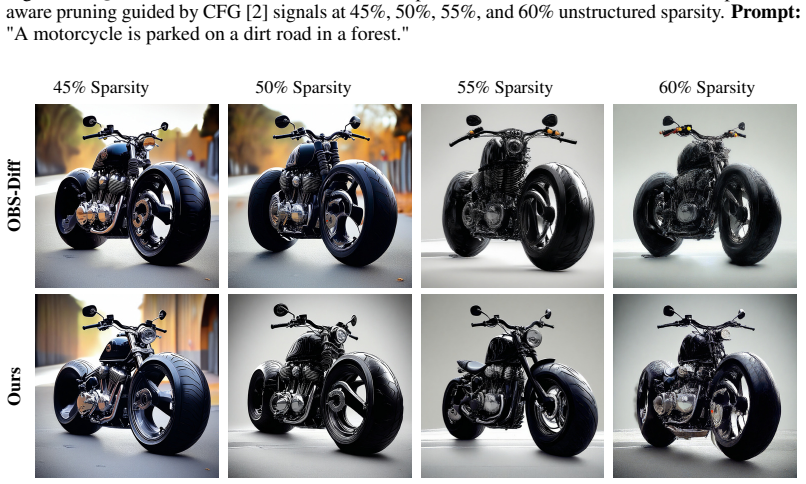
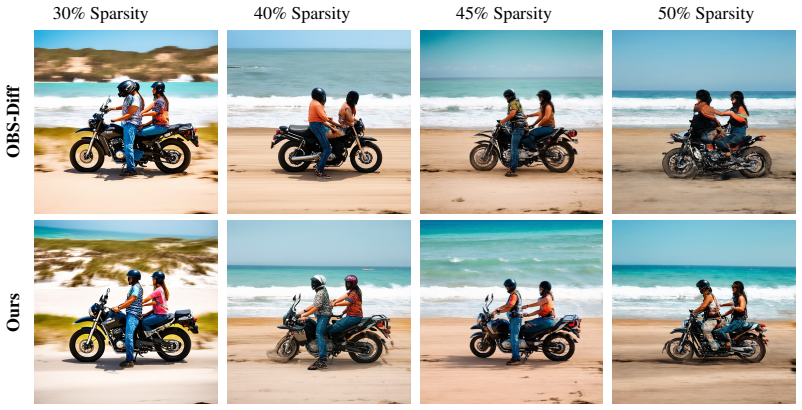
The paper's central claim is that injecting external spatial importance signals into the OBS saliency computation produces a pruning criterion aligned with perceptual relevance. Formally, for token-wise linear layers, replacing the reconstruction objective with a spatially weighted version is equivalent to a standard OBS problem on importance-filtered activations, giving a Hessian accumulated from these filtered activations. Parameters with activations concentrated in high-importance regions accumulate larger curvature and are preferentially retained. The paper reports consistent improvements over OBS-Diff on two text-to-image backbones at 40–60 percent sparsity, with the largest gains on hu
What carries the argument
The central object is the spatial importance map M_t, computed as the channel-averaged magnitude of the classifier-free guidance delta, normalized per sample and timestep, and scaled into a weighting map A_t. The argument turns on the identity that for token-wise linear layers, weighting the reconstruction error by A_t is equivalent to replacing activations X with importance-filtered X' in the OBS Hessian. This one substitution changes which parameters are deemed salient—those whose influence concentrates in important spatial regions—while preserving the closed-form OBS weight-update structure and its computational complexity.
Load-bearing premise
The argument assumes the spatial importance map—typically the CFG delta—reliably marks where the content of the image matters; if the map is noisy, incomplete, or mislocalized, as the authors concede for abstract prompts, small objects, and cluttered scenes, the reweighted Hessian can direct pruning toward the wrong parameters.
What would settle it
Find or construct a prompt whose CFG map is concentrated on a distractor region (e.g., a busy background) while human-rated importance lies on the subject; if pruning guided by that map degrades the subject more than uniform OBS does, the central claim fails. More directly, measure per-region reconstruction error after pruning: the paper's mechanism predicts errors concentrate in low-importance regions, and a violation of that prediction would refute the claim.
If this is right
- If the claim is right, one-shot, training-free pruning of text-to-image models can be steered toward preserving prompt-relevant content, reducing the visible collapse of subjects at sparsity levels where uniform-error pruning fails.
- Because the importance signal is plug-in, the same pipeline can preserve edge structure, object-focused content, or user-specified categories just by swapping the map or the calibration set.
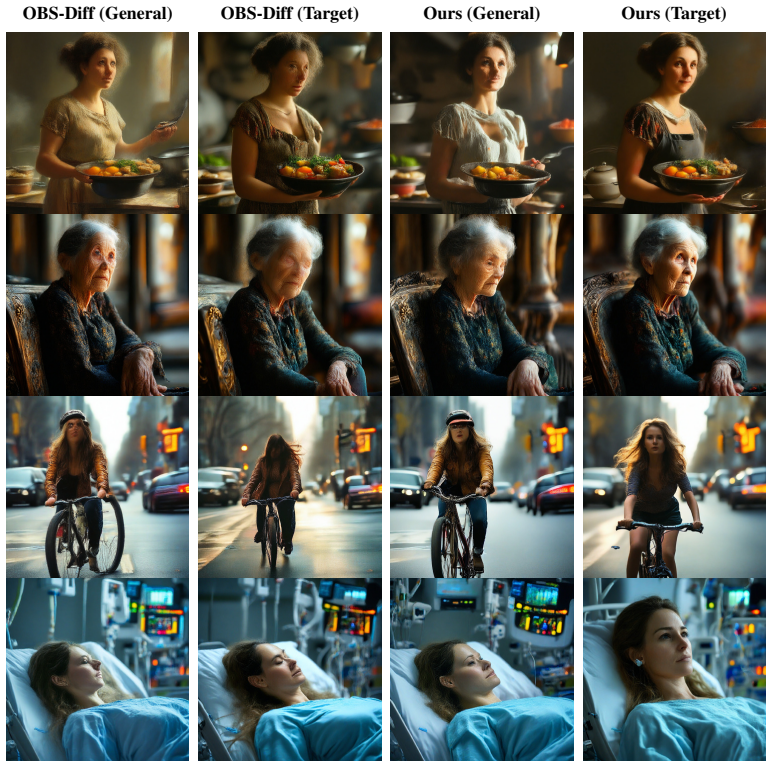
- Category-targeted calibration plus spatial guidance offers a practical way to specialize a compressed model for a domain—such as preserving people or vehicles—at the cost of other content.
- The principle generalizes beyond pruning: any objective that weights reconstruction by perceptual importance should shift compression artifacts away from salient regions.
- The method inherits the OBS pipeline, so it can be combined with other acceleration techniques like token merging or quantization for further speedups.
Where Pith is reading between the lines
- The exact equivalence between spatially weighted reconstruction error and importance-filtered activations holds for token-wise linear layers only; for convolutions and patch-embedding layers it is an approximation, so the theoretical grounding is strongest for transformer blocks.
- A natural stress test is to measure where reconstruction error actually concentrates after pruning: the mechanism implies errors shift into low-importance regions, and a violation of that prediction would refute the mechanism.
- Because CFG maps are computed during sampling, the approach could be extended to per-prompt or per-image adaptive pruning, re-ranking weights for each generation at some extra cost.
- The framework suggests a broader principle for generative-model compression—objectives should be content-aware—which might also be applied to quantization or distillation, not just pruning.
Editorial analysis
A structured set of objections, weighed in public.
Referee Report
Summary. The paper proposes importance-aware OBS pruning for text-to-image diffusion models. It extends the OBS-Diff framework by reweighting the per-layer Hessian with a spatial importance map derived from classifier-free guidance (CFG) deltas (Eqs. 3–8). The resulting saliency scores (Eq. 9) are claimed to align pruning with perceptual relevance rather than uniform reconstruction error. Experiments on SD3-Medium and PixArt-Σ report improvements over OBS-Diff in CLIP Score, ImageReward, and MUSIQ for unstructured, structured, and category-targeted pruning, plus a small user study in Appendix A. The derivation in Appendix C is a standard OBS derivation with the Hessian computed on importance-filtered activations.
Significance. If the central claim were established, the contribution would be a simple, training-free, modular extension to a state-of-the-art pruning method: one only needs to substitute X_{l,t} with A_t⊙X_{l,t} in the Hessian. The paper is honest about limitations (Sec. 5), includes a user study, and the algebraic derivation is internally consistent for token-wise linear layers. However, the significance is currently limited by the lack of a control for the semantic content of the importance map and by weak statistical evidence: all headline tables report single-run means, and the ablation (Table 6) does not support the λ value used in the main experiments.
major comments (5)
- [§4.2, Tables 1–5] All headline quantitative results are single-run means with no error bars, confidence intervals, or significance tests. ImageReward deltas are typically 0.03–0.09 (e.g., Table 1: 0.71→0.76 at 50%; Table 2: 0.49→0.52 at 60%), which is within the noise one would expect from the stochastic sampling and calibration procedure. Without repeated runs or paired statistics, the claimed consistent improvements are not established. Please add multiple seeds/runs and report standard errors or confidence intervals, ideally with paired tests across the same prompts.
- [§4.6, Table 6 vs. §4.1] The main experiments set λ=1.0 for all results, but the ablation in Table 6 shows that λ∈[0.1,0.3] gives the best ImageReward (0.54–0.55) while λ=1.0 gives 0.52. Thus the reported numbers use a suboptimal hyperparameter relative to the authors' own ablation. This also affects the interpretation: a strong non-uniform mask at λ=1.0 can produce large effects even if its spatial layout is semantically meaningless. Please either tune λ on a validation split and report results at the tuned value, or justify why λ=1.0 is the appropriate operating point despite the ablation.
- [§3.2, §3.3, Eqs. (3)–(8)] The central scientific claim is that the semantic content of the CFG-delta map M_t, not merely the act of non-uniformly weighting the Hessian, drives the improvements. The paper only compares against uniform OBS-Diff. To support the semantic-content interpretation, the authors should include a non-semantic control: e.g., a random permutation of the same M_t per sample/timestep, or a mask with identical spatial statistics but shuffled locations. If any non-uniform reweighting improves over OBS-Diff, the reported gains could instead arise from reweighting as a regularizer or an effective calibration-distribution shift. This control is essential to the abstract's claim that the method produces saliency estimates 'aligned with perceptual relevance rather than uniform reconstruction error.'
- [§3.3, Eq. (8), and Appendix C] The identity ‖A_t⊙(ΔW X_{l,t})‖² = ‖ΔW(A_t⊙X_{l,t})‖² is exact only for token-wise linear layers, as the paper notes in passing. However, the experimental sections do not specify how A_t is handled in convolutional layers, patch embeddings, or other non-token-wise operations in SD3-Medium and PixArt-Σ. If pruning is applied to such layers, the derivation does not directly apply. Please state explicitly which layer types are pruned and how the importance map is aligned or resampled for each, or restrict the method's claim to the layers where Eq. (8) is exact.
- [§4.4, Table 4] The category-targeted results are not uniformly consistent with the paper's claim of improvement. For example, in the Airplane row, Ours (target) has CLIP 28.76 vs. OBS-Diff (general) 29.35, and in the Cat row, Ours (target) has ImageReward 0.34 vs. Ours (general) 0.41. The MUSIQ gains are also mixed (e.g., Cat: Ours general 69.52 vs. Ours target 71.64, but Airplane: Ours general 68.19 vs. Ours target 70.81, with reversed CLIP/ImageReward trends). The text says these results 'support' the hypothesis, but the table shows trade-offs rather than a consistent win. Please discuss these trade-offs and add significance testing for the category-targeted setting.
minor comments (3)
- [Throughout] Repeated typos: 'resutls' in several figure captions (e.g., Figs. 7–41), 'ImgRw.' in Table 6, and inconsistent naming ('GCC3M' vs. the referenced Conceptual Captions dataset [108]).
- [Appendix A, Table 8] The per-sample alignment table shows ImageReward agrees with human preference in only 50% of the 20 samples, and MUSIQ in 70%. This is a useful honesty check, but it also undermines the paper's emphasis on ImageReward as a 'human-aligned perceptual quality metric.' Please contextualize these alignment rates and avoid over-relying on ImageReward in the main claims.
- [§4.1] The hyperparameter setting says CFG scale during pruning is 7.0 and 4.5 for SD3-Medium and PixArt-Σ, respectively, and 7.0 for both during testing. This asymmetry is not motivated; please explain why the pruning-time CFG scale differs from the test-time scale, or use a consistent setting.
Circularity Check
No significant circularity: the importance-weighted Hessian is an explicit algebraic extension of OBS, and the empirical claims are tested against an external baseline.
full rationale
The derivation chain is self-contained. The method modifies the layer-wise reconstruction objective of Eq. (1) by inserting a spatial importance weighting At, giving Eq. (7). For token-wise linear layers the key step Wl(At ⊙ Xl,t) = At ⊙ (Wl Xl,t) is stated in §3.3 and derived in Appendix C, yielding the importance-filtered Hessian of Eqs. (8) and the saliency of Eq. (9). This is an explicit algebraic substitution, not a quantity fitted from the evaluation metrics (CLIP Score, ImageReward, MUSIQ), so there is no fitted-input-called-prediction reduction. The only scalar hyperparameter λ is set to 1.0 across all main experiments (§4.1), and the ablation in Table 6 actually shows that value is not the tuned optimum (λ ∈ [0.1, 0.3] is better), which works against cherry-picking rather than constituting circularity. The paper contains self-citations ([12], [14], [90] include an author of the present paper), but they appear only in background and motivation; they are not used to derive the saliency formula, to forbid alternatives, or to supply a load-bearing uniqueness claim. The paper also openly acknowledges in §5 that CFG-based importance maps can be noisy or incomplete for abstract prompts and cluttered scenes; this is an honest validity caveat, not a circular step. The central empirical claim is evaluated against OBS-Diff [1] on MS-COCO and with human-aligned metrics, so the reported improvements are not equivalent by construction to the method's inputs. Overall, no circularity is found; at most there are non-load-bearing self-citations.
Axiom & Free-Parameter Ledger
free parameters (3)
- λ (importance mask weight) =
1.0 (main experiments); ablation optimum 0.1-0.3
- α_t (timestep weighting schedule) =
Logarithmically decreasing, per OBS-Diff [1]
- CFG scale during pruning =
7.0 (SD3-Medium), 4.5 (PixArt-Σ)
axioms (4)
- domain assumption Layer-wise OBS approximation: each output row is pruned independently and cross-layer error propagation is ignored.
- domain assumption The quadratic surrogate is an accurate proxy for the true generation loss of the diffusion model.
- ad hoc to paper CFG delta magnitude |ϵθ(x,t,c)−ϵθ(x,t,∅)| measures perceptual importance of spatial regions.
- standard math For linear layers, spatial weighting can be absorbed into activations (X' = A⊙X).
read the original abstract
We propose importance-aware pruning for diffusion models, a training-free framework that prioritizes preserving parameters critical to semantically salient image regions. To do so, we incorporate spatial importance maps -- derived from conditioning signals or model attention -- into the pruning objective. This produces parameter rankings aligned with perceptual relevance rather than uniform reconstruction error. On MS-COCO dataset, our proposed approach consistently retains subject fidelity and structural correctness at high compression ratios where conventional pruning causes visible degradation. These results demonstrate that content-aware objectives are key to perceptually faithful compression of generative models.
Figures







Reference graph
Works this paper leans on
-
[1]
OBS-diff: Accurate pruning for diffusion models in one-shot,
J. Zhu, H. Wang, M. Su, Z. Wang, and H. Wang, “OBS-diff: Accurate pruning for diffusion models in one-shot,” inThe Fourteenth International Conference on Learning Representations,
-
[2]
Classifier-free diffusion guidance,
J. Ho and T. Salimans, “Classifier-free diffusion guidance,”arXiv preprint arXiv:2207.12598, 2022
Pith/arXiv arXiv 2022
-
[3]
Diffusion models beat gans on image synthesis,
P. Dhariwal and A. Nichol, “Diffusion models beat gans on image synthesis,”Advances in neural information processing systems, vol. 34, pp. 8780–8794, 2021
2021
-
[5]
Scaling rectified flow transformers for high-resolution image synthesis,
P. Esser, S. Kulal, A. Blattmann, R. Entezari, J. Müller, H. Saini, Y . Levi, D. Lorenz, A. Sauer, F. Boeselet al., “Scaling rectified flow transformers for high-resolution image synthesis,” in Forty-first international conference on machine learning, 2024
2024
-
[6]
Z. Li, J. Zhang, Q. Lin, J. Xiong, Y . Long, X. Deng, Y . Zhang, X. Liu, M. Huang, Z. Xiaoet al., “Hunyuan-dit: A powerful multi-resolution diffusion transformer with fine-grained chinese understanding,”arXiv preprint arXiv:2405.08748, 2024
Pith/arXiv arXiv 2024
-
[7]
Efficient scaling of diffusion transformers for text-to-image generation,
H. Li, S. Lal, Z. Li, Y . Xie, Y . Wang, Y . Zou, O. Majumder, R. Manmatha, Z. Tu, S. Ermon et al., “Efficient scaling of diffusion transformers for text-to-image generation,”arXiv preprint arXiv:2412.12391, 2024
Pith/arXiv arXiv 2024
-
[8]
Exploring the deep fusion of large language models and diffusion transformers for text-to-image synthesis,
B. Tang, B. Zheng, S. Paul, and S. Xie, “Exploring the deep fusion of large language models and diffusion transformers for text-to-image synthesis,” inProceedings of the Computer Vision and Pattern Recognition Conference, 2025, pp. 28 586–28 595
2025
-
[9]
E. Xie, J. Chen, Y . Zhao, J. Yu, L. Zhu, C. Wu, Y . Lin, Z. Zhang, M. Li, J. Chenet al., “Sana 1.5: Efficient scaling of training-time and inference-time compute in linear diffusion transformer,”arXiv preprint arXiv:2501.18427, 2025
Pith/arXiv arXiv 2025
-
[10]
Flux.1 kontext: Flow matching for in-context image generation and editing in latent space,
B. F. Labs, S. Batifol, A. Blattmann, F. Boesel, S. Consul, C. Diagne, T. Dockhorn, J. English, Z. English, P. Esser, S. Kulal, K. Lacey, Y . Levi, C. Li, D. Lorenz, J. Müller, D. Podell, R. Rombach, H. Saini, A. Sauer, and L. Smith, “Flux.1 kontext: Flow matching for in-context image generation and editing in latent space,” 2025. [Online]. Available: htt...
Pith/arXiv arXiv 2025
-
[11]
Second order derivatives for network pruning: Optimal brain surgeon,
B. Hassibi and D. G. Stork, “Second order derivatives for network pruning: Optimal brain surgeon,” inNeural Information Processing Systems, 1992. [Online]. Available: https://api.semanticscholar.org/CorpusID:7057040
1992
-
[12]
Learning to weight parameters for training data attribution,
S. Li, H. Le, J. Xu, and M. Salzmann, “Learning to weight parameters for training data attribution,” inThe Fourteenth International Conference on Learning Representations, 2026. [Online]. Available: https://openreview.net/forum?id=EhUkQp9Yah
2026
-
[13]
A model of saliency-based visual attention for rapid scene analysis,
L. Itti, C. Koch, and E. Niebur, “A model of saliency-based visual attention for rapid scene analysis,”IEEE Trans. Pattern Anal. Mach. Intell., vol. 20, pp. 1254–1259, 1998. [Online]. Available: https://api.semanticscholar.org/CorpusID:3108956
1998
-
[14]
Few-shot personalized scanpath prediction,
R. Xue, J. Xu, S. Mondal, H. Le, G. J. Zelinsky, M. Hoai, and D. Samaras, “Few-shot personalized scanpath prediction,”2025 IEEE/CVF Conference on Computer Vision and Pattern Recognition (CVPR), pp. 13 497–13 507, 2025. [Online]. Available: https://api.semanticscholar.org/CorpusID:277627903 10
2025
-
[15]
A computational approach to edge detection,
J. F. Canny, “A computational approach to edge detection,”IEEE Transactions on Pattern Analysis and Machine Intelligence, vol. PAMI-8, pp. 679–698, 1986. [Online]. Available: https://api.semanticscholar.org/CorpusID:13284142
1986
-
[16]
Yolov8: A novel object detection algorithm with enhanced perfor- mance and robustness,
R. Varghese and S. M., “Yolov8: A novel object detection algorithm with enhanced perfor- mance and robustness,” in2024 International Conference on Advances in Data Engineering and Intelligent Computing Systems (ADICS), 2024, pp. 1–6
2024
-
[17]
Deep unsupervised learning using nonequilibrium thermodynamics,
J. Sohl-Dickstein, E. Weiss, N. Maheswaranathan, and S. Ganguli, “Deep unsupervised learning using nonequilibrium thermodynamics,” inInternational conference on machine learning. PMLR, 2015, pp. 2256–2265
2015
-
[18]
Denoising diffusion probabilistic models,
J. Ho, A. Jain, and P. Abbeel, “Denoising diffusion probabilistic models,”Advances in neural information processing systems, vol. 33, pp. 6840–6851, 2020
2020
-
[19]
Denoising diffusion implicit models,
J. Song, C. Meng, and S. Ermon, “Denoising diffusion implicit models,”arXiv preprint arXiv:2010.02502, 2020
Pith/arXiv arXiv 2010
-
[20]
High-resolution image synthesis with latent diffusion models,
R. Rombach, A. Blattmann, D. Lorenz, P. Esser, and B. Ommer, “High-resolution image synthesis with latent diffusion models,” inProceedings of the IEEE/CVF Conference on Computer Vision and Pattern Recognition, 2022, pp. 10 684–10 695
2022
-
[21]
Photorealistic text-to-image diffusion models with deep language understanding,
C. Saharia, W. Chan, S. Saxena, L. Li, J. Whang, E. Denton, S. K. S. Ghasemipour, B. K. Ayan, S. S. Mahdavi, R. G. Lopeset al., “Photorealistic text-to-image diffusion models with deep language understanding,”arXiv preprint arXiv:2205.11487, 2022
Pith/arXiv arXiv 2022
-
[22]
Scalable diffusion models with transformers,
W. Peebles and S. Xie, “Scalable diffusion models with transformers,” inProceedings of the IEEE/CVF International Conference on Computer Vision, 2023, pp. 4195–4205
2023
-
[23]
Pixart-α: Fast training of diffusion transformer for photorealistic text-to-image synthesis,
J. Chen, J. Yu, C. Ge, L. Yao, E. Xie, Y . Wu, Z. Wang, J. Kwok, P. Luo, H. Lu, and Z. Li, “Pixart-α: Fast training of diffusion transformer for photorealistic text-to-image synthesis,” 2023
2023
-
[24]
Hierarchical text-conditional image generation with clip latents,
A. Ramesh, P. Dhariwal, A. Nichol, C. Chu, and M. Chen, “Hierarchical text-conditional image generation with clip latents,”ArXiv, vol. abs/2204.06125, 2022. [Online]. Available: https://api.semanticscholar.org/CorpusID:248097655
Pith/arXiv arXiv 2022
-
[25]
Glide: Towards photorealistic image generation and editing with text-guided diffusion models,
A. Nichol, P. Dhariwal, A. Ramesh, P. Shyam, P. Mishkin, B. McGrew, I. Sutskever, and M. Chen, “Glide: Towards photorealistic image generation and editing with text-guided diffusion models,”arXiv preprint arXiv:2112.10741, 2021
Pith/arXiv arXiv 2021
-
[26]
Learned representation-guided diffusion models for large-image generation,
A. Graikos, S. Yellapragada, M.-Q. Le, S. Kapse, P. Prasanna, J. Saltz, and D. Samaras, “Learned representation-guided diffusion models for large-image generation,” inProceedings of the IEEE/CVF Conference on Computer Vision and Pattern Recognition, 2024, pp. 8532– 8542
2024
-
[27]
Sdedit: Guided image synthesis and editing with stochastic differential equations,
C. Meng, Y . He, Y . Song, J. Song, J. Wu, J.-Y . Zhu, and S. Ermon, “Sdedit: Guided image synthesis and editing with stochastic differential equations,”arXiv preprint arXiv:2108.01073, 2021
Pith/arXiv arXiv 2021
-
[28]
Raphael: Text-to-image generation via large mixture of diffusion paths,
Z. Xue, G. Song, Q. Guo, B. Liu, Z. Zong, Y . Liu, and P. Luo, “Raphael: Text-to-image generation via large mixture of diffusion paths,”Advances in Neural Information Processing Systems, vol. 36, 2024
2024
-
[29]
ediff-i: Text-to-image diffusion models with an ensemble of expert denoisers,
Y . Balaji, S. Nah, X. Huang, A. Vahdat, J. Song, Q. Zhang, K. Kreis, M. Aittala, T. Aila, S. Laineet al., “ediff-i: Text-to-image diffusion models with an ensemble of expert denoisers,” arXiv preprint arXiv:2211.01324, 2022
Pith/arXiv arXiv 2022
-
[30]
Guiding a diffusion model with a bad version of itself,
T. Karras, M. Aittala, T. Kynkäänniemi, J. Lehtinen, T. Aila, and S. Laine, “Guiding a diffusion model with a bad version of itself,”Advances in Neural Information Processing Systems, vol. 37, pp. 52 996–53 021, 2025
2025
-
[31]
Make-a-video: Text-to-video generation without text-video data,
U. Singer, A. Polyak, T. Hayes, X. Yin, J. An, S. Zhang, Q. Hu, H. Yang, O. Ashual, O. Gafni et al., “Make-a-video: Text-to-video generation without text-video data,”arXiv preprint arXiv:2209.14792, 2022. 11
Pith/arXiv arXiv 2022
-
[32]
Stable video diffusion: Scaling latent video diffusion models to large datasets,
A. Blattmann, T. Dockhorn, S. Kulal, D. Mendelevitch, M. Kilian, D. Lorenz, Y . Levi, Z. English, V . V oleti, A. Lettset al., “Stable video diffusion: Scaling latent video diffusion models to large datasets,”arXiv preprint arXiv:2311.15127, 2023
Pith/arXiv arXiv 2023
-
[33]
Animatediff: Animate your personalized text-to-image diffusion models without specific tuning,
Y . Guo, C. Yang, A. Rao, Z. Liang, Y . Wang, Y . Qiao, M. Agrawala, D. Lin, and B. Dai, “Animatediff: Animate your personalized text-to-image diffusion models without specific tuning,”arXiv preprint arXiv:2307.04725, 2023
Pith/arXiv arXiv 2023
-
[34]
Open-sora: Democratizing efficient video production for all,
Z. Zheng, X. Peng, T. Yang, C. Shen, S. Li, H. Liu, Y . Zhou, T. Li, and Y . You, “Open-sora: Democratizing efficient video production for all,” March 2024. [Online]. Available: https://github.com/hpcaitech/Open-Sora
2024
-
[35]
P.-Y . Lab and T. A. etc., “Open-sora-plan,” Apr. 2024. [Online]. Available: https: //doi.org/10.5281/zenodo.10948109
-
[36]
Video generation models as world simulators. 2024,
T. Brooks, B. Peebles, C. Holmes, W. DePue, Y . Guo, L. Jing, D. Schnurr, J. Taylor, T. Luhman, E. Luhmanet al., “Video generation models as world simulators. 2024,”URL https://openai. com/research/video-generation-models-as-world-simulators, vol. 3, 2024
2024
-
[37]
Dreamfusion: Text-to-3d using 2d diffusion,
B. Poole, A. Jain, J. T. Barron, and B. Mildenhall, “Dreamfusion: Text-to-3d using 2d diffusion,” arXiv preprint arXiv:2209.14988, 2022
Pith/arXiv arXiv 2022
-
[38]
Zero-1-to-3: Zero-shot one image to 3d object,
R. Liu, R. Wu, B. Van Hoorick, P. Tokmakov, S. Zakharov, and C. V ondrick, “Zero-1-to-3: Zero-shot one image to 3d object,” inProceedings of the IEEE/CVF international conference on computer vision, 2023, pp. 9298–9309
2023
-
[39]
Wonder3d: Single image to 3d using cross-domain diffusion,
X. Long, Y .-C. Guo, C. Lin, Y . Liu, Z. Dou, L. Liu, Y . Ma, S.-H. Zhang, M. Habermann, C. Theobaltet al., “Wonder3d: Single image to 3d using cross-domain diffusion,” inProceed- ings of the IEEE/CVF Conference on Computer Vision and Pattern Recognition, 2024, pp. 9970–9980
2024
-
[40]
Zero123++: a single image to consistent multi-view diffusion base model,
R. Shi, H. Chen, Z. Zhang, M. Liu, C. Xu, X. Wei, L. Chen, C. Zeng, and H. Su, “Zero123++: a single image to consistent multi-view diffusion base model,”arXiv preprint arXiv:2310.15110, 2023
Pith/arXiv arXiv 2023
-
[41]
G. Li, H. Zheng, C. Wang, C. Li, C. Zheng, and D. Tao, “3ddesigner: Towards photore- alistic 3d object generation and editing with text-guided diffusion models,”arXiv preprint arXiv:2211.14108, 2022
Pith/arXiv arXiv 2022
-
[42]
Diffusion probabilistic models for 3d point cloud generation,
S. Luo and W. Hu, “Diffusion probabilistic models for 3d point cloud generation,” inPro- ceedings of the IEEE/CVF conference on computer vision and pattern recognition, 2021, pp. 2837–2845
2021
-
[43]
Point-e: A system for generating 3d point clouds from complex prompts,
A. Nichol, H. Jun, P. Dhariwal, P. Mishkin, and M. Chen, “Point-e: A system for generating 3d point clouds from complex prompts,”arXiv preprint arXiv:2212.08751, 2022
Pith/arXiv arXiv 2022
-
[44]
Diffwave: A versatile diffusion model for audio synthesis,
Z. Kong, W. Ping, J. Huang, K. Zhao, and B. Catanzaro, “Diffwave: A versatile diffusion model for audio synthesis,”arXiv preprint arXiv:2009.09761, 2020
Pith/arXiv arXiv 2009
-
[45]
Make- an-audio: Text-to-audio generation with prompt-enhanced diffusion models,
R. Huang, J. Huang, D. Yang, Y . Ren, L. Liu, M. Li, Z. Ye, J. Liu, X. Yin, and Z. Zhao, “Make- an-audio: Text-to-audio generation with prompt-enhanced diffusion models,” inInternational Conference on Machine Learning. PMLR, 2023, pp. 13 916–13 932
2023
-
[46]
Magicfusion: Boosting text-to-image gener- ation performance by fusing diffusion models,
J. Zhao, H. Zheng, C. Wang, L. Lan, and W. Yang, “Magicfusion: Boosting text-to-image gener- ation performance by fusing diffusion models,” inProceedings of the IEEE/CVF International Conference on Computer Vision, 2023, pp. 22 592–22 602
2023
-
[47]
High-fidelity person-centric subject-to-image synthesis,
Y . Wang, W. Zhang, J. Zheng, and C. Jin, “High-fidelity person-centric subject-to-image synthesis,” inProceedings of the IEEE/CVF Conference on Computer Vision and Pattern Recognition, 2024, pp. 7675–7684
2024
-
[48]
Würstchen: An efficient architecture for large-scale text-to-image diffusion models,
P. Pernias, D. Rampas, M. L. Richter, C. J. Pal, and M. Aubreville, “Würstchen: An efficient architecture for large-scale text-to-image diffusion models,”arXiv preprint arXiv:2306.00637, 2023. 12
Pith/arXiv arXiv 2023
-
[49]
On architectural compression of text-to- image diffusion models,
B.-K. Kim, H.-K. Song, T. Castells, and S. Choi, “On architectural compression of text-to- image diffusion models,” 2023
2023
-
[50]
Structural pruning for diffusion models,
G. Fang, X. Ma, and X. Wang, “Structural pruning for diffusion models,” inAdvances in Neural Information Processing Systems, 2023
2023
-
[51]
Mobilediffusion: Subsecond text-to-image generation on mobile devices,
Y . Zhao, Y . Xu, Z. Xiao, and T. Hou, “Mobilediffusion: Subsecond text-to-image generation on mobile devices,”arXiv preprint arXiv:2311.16567, 2023
Pith/arXiv arXiv 2023
-
[52]
Diffusion probabilistic model made slim,
X. Yang, D. Zhou, J. Feng, and X. Wang, “Diffusion probabilistic model made slim,” in Proceedings of the IEEE/CVF Conference on computer vision and pattern recognition, 2023, pp. 22 552–22 562
2023
-
[53]
Snapfusion: Text-to-image diffusion model on mobile devices within two seconds,
Y . Li, H. Wang, Q. Jin, J. Hu, P. Chemerys, Y . Fu, Y . Wang, S. Tulyakov, and J. Ren, “Snapfusion: Text-to-image diffusion model on mobile devices within two seconds,”Advances in Neural Information Processing Systems, vol. 36, 2024
2024
-
[54]
Progressive distillation for fast sampling of diffusion models,
T. Salimans and J. Ho, “Progressive distillation for fast sampling of diffusion models,”arXiv preprint arXiv:2202.00512, 2022
Pith/arXiv arXiv 2022
-
[55]
On distillation of guided diffusion models,
C. Meng, R. Rombach, R. Gao, D. Kingma, S. Ermon, J. Ho, and T. Salimans, “On distillation of guided diffusion models,” inProceedings of the IEEE/CVF Conference on Computer Vision and Pattern Recognition, 2023, pp. 14 297–14 306
2023
-
[56]
Adversarial diffusion distillation,
A. Sauer, D. Lorenz, A. Blattmann, and R. Rombach, “Adversarial diffusion distillation,” in European Conference on Computer Vision. Springer, 2025, pp. 87–103
2025
-
[57]
Instaflow: One step is enough for high-quality diffusion-based text-to-image generation,
X. Liu, X. Zhang, J. Ma, J. Penget al., “Instaflow: One step is enough for high-quality diffusion-based text-to-image generation,” inThe Twelfth International Conference on Learn- ing Representations, 2023
2023
-
[58]
Clockwork diffusion: Efficient generation with model-step distillation,
A. Habibian, A. Ghodrati, N. Fathima, G. Sautiere, R. Garrepalli, F. Porikli, and J. Petersen, “Clockwork diffusion: Efficient generation with model-step distillation,” inProceedings of the IEEE/CVF Conference on Computer Vision and Pattern Recognition, 2024, pp. 8352–8361
2024
-
[59]
Y . Song, P. Dhariwal, M. Chen, and I. Sutskever, “Consistency models,”arXiv preprint arXiv:2303.01469, 2023
Pith/arXiv arXiv 2023
-
[60]
Latent consistency models: Synthesizing high-resolution images with few-step inference,
S. Luo, Y . Tan, L. Huang, J. Li, and H. Zhao, “Latent consistency models: Synthesizing high-resolution images with few-step inference,”arXiv preprint arXiv:2310.04378, 2023
Pith/arXiv arXiv 2023
-
[61]
Pseudo numerical methods for diffusion models on manifolds,
L. Liu, Y . Ren, Z. Lin, and Z. Zhao, “Pseudo numerical methods for diffusion models on manifolds,”arXiv preprint arXiv:2202.09778, 2022
Pith/arXiv arXiv 2022
-
[62]
Dpm-solver: A fast ode solver for diffusion probabilistic model sampling in around 10 steps,
C. Lu, Y . Zhou, F. Bao, J. Chen, C. Li, and J. Zhu, “Dpm-solver: A fast ode solver for diffusion probabilistic model sampling in around 10 steps,”Advances in Neural Information Processing Systems, vol. 35, pp. 5775–5787, 2022
2022
-
[63]
Dpm-solver++: Fast solver for guided sampling of diffusion probabilistic models,
——, “Dpm-solver++: Fast solver for guided sampling of diffusion probabilistic models,” arXiv preprint arXiv:2211.01095, 2022
Pith/arXiv arXiv 2022
-
[64]
Deepcache: Accelerating diffusion models for free,
X. Ma, G. Fang, and X. Wang, “Deepcache: Accelerating diffusion models for free,” in Proceedings of the IEEE/CVF Conference on Computer Vision and Pattern Recognition, 2024, pp. 15 762–15 772
2024
-
[65]
Cache me if you can: Accelerating diffusion models through block caching,
F. Wimbauer, B. Wu, E. Schoenfeld, X. Dai, J. Hou, Z. He, A. Sanakoyeu, P. Zhang, S. Tsai, J. Kohleret al., “Cache me if you can: Accelerating diffusion models through block caching,” inProceedings of the IEEE/CVF Conference on Computer Vision and Pattern Recognition, 2024, pp. 6211–6220
2024
-
[66]
Delta- dit: A training-free acceleration method tailored for diffusion transformers,
P. Chen, M. Shen, P. Ye, J. Cao, C. Tu, C.-S. Bouganis, Y . Zhao, and T. Chen, “Delta- dit: A training-free acceleration method tailored for diffusion transformers,”arXiv preprint arXiv:2406.01125, 2024. 13
Pith/arXiv arXiv 2024
-
[67]
Real-time video generation with pyramid attention broadcast,
X. Zhao, X. Jin, K. Wang, and Y . You, “Real-time video generation with pyramid attention broadcast,”arXiv preprint arXiv:2408.12588, 2024
Pith/arXiv arXiv 2024
-
[68]
Adaptive caching for faster video generation with diffusion transformers,
K. Kahatapitiya, H. Liu, S. He, D. Liu, M. Jia, M. S. Ryoo, and T. Xie, “Adaptive caching for faster video generation with diffusion transformers,”arXiv preprint arXiv:2411.02397, 2024
Pith/arXiv arXiv 2024
-
[69]
Frdiff: Feature reuse for universal training-free acceleration of diffusion models,
J. So, J. Lee, and E. Park, “Frdiff: Feature reuse for universal training-free acceleration of diffusion models,”arXiv preprint arXiv:2312.03517, 2023
Pith/arXiv arXiv 2023
-
[70]
Fastercache: Training-free video diffusion model acceleration with high quality,
Z. Lv, C. Si, J. Song, Z. Yang, Y . Qiao, Z. Liu, and K.-Y . K. Wong, “Fastercache: Training-free video diffusion model acceleration with high quality,”arXiv preprint arXiv:2410.19355, 2024
Pith/arXiv arXiv 2024
-
[71]
Faster diffusion: Rethinking the role of unet encoder in diffusion models,
S. Li, T. Hu, F. S. Khan, L. Li, S. Yang, Y . Wang, M.-M. Cheng, and J. Yang, “Faster diffusion: Rethinking the role of unet encoder in diffusion models,”CoRR, 2023
2023
-
[72]
Q-diffusion: Quantizing diffusion models,
X. Li, Y . Liu, L. Lian, H. Yang, Z. Dong, D. Kang, S. Zhang, and K. Keutzer, “Q-diffusion: Quantizing diffusion models,” inProceedings of the IEEE/CVF International Conference on Computer Vision, 2023, pp. 17 535–17 545
2023
-
[73]
Q-dit: Accurate post-training quantization for diffusion transformers,
L. Chen, Y . Meng, C. Tang, X. Ma, J. Jiang, X. Wang, Z. Wang, and W. Zhu, “Q-dit: Accurate post-training quantization for diffusion transformers,”arXiv preprint arXiv:2406.17343, 2024
Pith/arXiv arXiv 2024
-
[74]
Ptqd: Accurate post-training quantization for diffusion models,
Y . He, L. Liu, J. Liu, W. Wu, H. Zhou, and B. Zhuang, “Ptqd: Accurate post-training quantization for diffusion models,”Advances in Neural Information Processing Systems, vol. 36, 2024
2024
-
[75]
Quest: Low-bit diffusion model quantization via efficient selective finetuning,
H. Wang, Y . Shang, Z. Yuan, J. Wu, J. Yan, and Y . Yan, “Quest: Low-bit diffusion model quantization via efficient selective finetuning,”arXiv preprint arXiv:2402.03666, 2024
Pith/arXiv arXiv 2024
-
[76]
Vq4dit: Efficient post-training vector quantization for diffusion transformers,
J. Deng, S. Li, Z. Wang, H. Gu, K. Xu, and K. Huang, “Vq4dit: Efficient post-training vector quantization for diffusion transformers,”arXiv preprint arXiv:2408.17131, 2024
Pith/arXiv arXiv 2024
-
[77]
Temporal dynamic quantization for diffusion models,
J. So, J. Lee, D. Ahn, H. Kim, and E. Park, “Temporal dynamic quantization for diffusion models,”Advances in Neural Information Processing Systems, vol. 36, 2024
2024
-
[78]
Object- centric diffusion for efficient video editing,
K. Kahatapitiya, A. Karjauv, D. Abati, F. Porikli, Y . M. Asano, and A. Habibian, “Object- centric diffusion for efficient video editing,” inEuropean Conference on Computer Vision. Springer, 2025, pp. 91–108
2025
-
[79]
Token merging for fast stable diffusion,
D. Bolya and J. Hoffman, “Token merging for fast stable diffusion,”2023 IEEE/CVF Conference on Computer Vision and Pattern Recognition Workshops (CVPRW), pp. 4599–4603, 2023. [Online]. Available: https://api.semanticscholar.org/CorpusID:257833518
2023
-
[80]
Token merging: Your vit but faster,
D. Bolya, C.-Y . Fu, X. Dai, P. Zhang, C. Feichtenhofer, and J. Hoffman, “Token merging: Your vit but faster,”ArXiv, vol. abs/2210.09461, 2022. [Online]. Available: https://api.semanticscholar.org/CorpusID:252968113
Pith/arXiv arXiv 2022
-
[81]
Token fusion: Bridging the gap between token pruning and token merging,
M. Kim, S. Gao, Y .-C. Hsu, Y . Shen, and H. Jin, “Token fusion: Bridging the gap between token pruning and token merging,” inProceedings of the IEEE/CVF Winter Conference on Applications of Computer Vision, 2024, pp. 1383–1392
2024
discussion (0)
Sign in with ORCID, Apple, or X to comment. Anyone can read and Pith papers without signing in.