REVIEW 3 major objections 6 minor 37 references
Optical switching of magnetic order in few-layer CrSBr
T0 review · 3 major / 6 minor · reviewed 2026-08-04 · deepseek-v4-flash
Pith's one-line read A few microwatts of continuous-wave laser light can switch the magnetic order of few-layer CrSBr at near-critical magnetic fields, enabling local and remote control of magnetic domains and deterministic preparation of a zero-field magnetic
desk verdict CW optical switching in few-layer CrSBr is a real advance and deserves full refereeing; the main control that rules out heating is only reported as 'data not shown,' so the paper needs raw data and that control before the headline claim is fully convincing. read the letter →
The pith
A machine-rendered reading of the paper's core claim, the machinery that carries it, and where it could break.
The reading
What carries the argument
The central objects are the strongly bound magneto-excitons of CrSBr, whose absorption and photoluminescence energies are sensitive to the interlayer magnetic configuration. They serve as both the readout (the energy shifts with FM, AFM, and metastable phases) and the actuator: non-resonant excitation at 1.450 eV creates excitons whose relaxation launches phonons and magnons that transfer energy to the spin lattice and lower the effective switching barrier near the critical field. The effect requires the external field to be near-critical, and its strength is tied to the exciton absorption cross-section, as evidenced by lower switching powers when exciting resonantly into the XB transition.
What would settle it
A concrete falsifier is to perform the same illumination sequence on a CrSBr flake while directly measuring the magnetization with a local probe (e.g., magneto-optical Kerr effect that is not exciton-based) or measuring the lattice temperature via a separate temperature-dependent signal; if the apparent switching persists under cross-polarized illumination (which should not create excitons) at the same absorbed power, or if the exciton energy shift occurs without any actual change in magnetic order, the central claim would be refuted.
Extended reading notes
Core claim
The central claim is that in CrSBr, a layered A-type antiferromagnet, exciton absorption provides a channel through which continuous-wave laser light transfers energy to the spin lattice and drives spin-flip transitions between magnetic configurations. At fields just below the critical value, a laser power as low as a few microwatts switches the bilayer from antiferromagnetic (AFM) to ferromagnetic (FM) order, and the trilayer from one antiferromagnetic configuration to another via a metastable state. This optical switching is local, affecting a single illuminated spot, and also remote, switching connected domains through lateral exchange bias. Because the magnetic configuration is read out
Load-bearing premise
The entire interpretation rests on the claim that the exciton energy shifts used to read out the magnetic state track the magnetic phase and not a non-magnetic optical effect such as local heating, photo-doping, or strain; the paper's control experiments for heating are described only as data not shown.
Editorial extensions
If this is right
- Optical writing of magnetic states in CrSBr can be done with microwatt-scale cw lasers, orders of magnitude lower than typical ultrafast all-optical switching schemes.
- Local illumination can switch extended magnetic domains, and connected domains switch remotely through lateral exchange bias, enabling domain-level control without scanning the entire device.
- The zero-field magnetic configuration can be deterministically set and read out non-invasively, providing a concrete memory-bit functionality in a two-dimensional magnet.
- The mechanism generalizes across the different spin-flip transitions in bi- and trilayer CrSBr, including AFM-FM, AFMA-MS, and MS-AFMB transitions, suggesting multiple addressable states.
- The switching energy is lower for the trilayer's metastable transition, hinting that engineered metastable states can further reduce optical switching power.
Reading between the lines
- The exciton-mediated optical switching mechanism likely scales with the exciton absorption cross-section and spin-lattice coupling, so devices that enhance light-matter interaction (cavities, waveguides) could lower switching powers further or enable field-free operation.
- The lateral exchange bias coupling between multilayer regions implies that optical switching can write domain walls deterministically, which could be used to encode information in the spatial arrangement of magnetic domains rather than only in the global configuration.
- The authors' anticipation that twist-tuned hysteresis could enable field-free all-optical switching is a natural extension: if twisting modifies the critical fields, optical illumination alone might suffice without an external field.
- A direct test of whether the effect is truly magnetic rather than thermal could be made by measuring the local lattice temperature with a separate thermometer (e.g., Raman or phonon luminescence) while the laser is on; if the temperature remains below the magnetic ordering scale while switching still occurs, the magnetic-photon coupling claim is strengthened.
Editorial analysis
A structured set of objections, weighed in public.
Referee Report
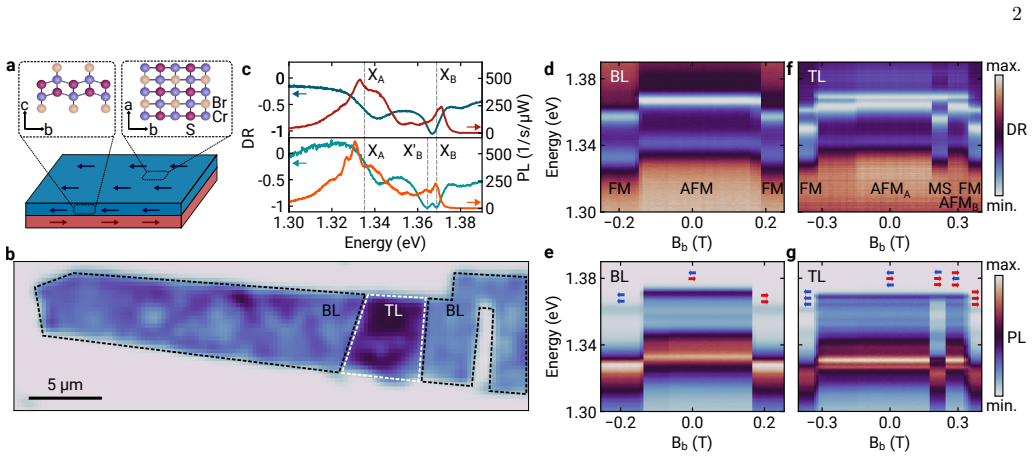
Summary. The paper reports optical switching of magnetic order in bilayer and trilayer CrSBr at 4 K using a continuous-wave laser. The authors use exciton PL and differential reflectance to read out magnetic configurations (AFM, FM, and MS/AFMA/AFMB states). At near-critical magnetic fields, they observe power-dependent switching of the exciton energy, interpreted as spin-flip magnetic transitions. They demonstrate local switching of extended domains (Fig. 4c,d), remote switching of connected bilayer/trilayer regions via lateral exchange bias (Fig. 4g,h), power-dependent lowering of critical fields (Fig. 3e), and deterministic zero-field state preparation and readout (Fig. 5). They claim very low switching power (few microwatts, or one order lower under resonant excitation) and attribute the mechanism to exciton-generated phonons/magnons, excluding heating and photo-doping. However, a key thermal/polarization control is described only as 'data not shown,' and the resonant-power claim is not directly presented. Refs 19/23 provide the prior assignment of optical signatures to magnetic phases, and the paper relies on that mapping rather than on direct magnetization measurements.
Significance. If the claims hold, this is a significant advance: it would demonstrate low-power, cw-laser optical control of magnetic order in a two-dimensional antiferromagnet, including deterministic preparation of a zero-field configuration, with potential device relevance for magneto-optics and memory. The paper also suggests remote domain switching via lateral exchange bias, which is a useful concept. Strengths include a systematic power/field phase interplay (Figs. 2–3), spatially resolved maps showing local and remote switching (Fig. 4), and a clear proof-of-principle memory-protocol sequence (Fig. 5). The reliance on an established spectroscopic mapping between exciton energy and magnetic phase is reasonable given the prior literature, but the central claim would be materially strengthened by direct controls demonstrating a non-thermal, exciton-mediated mechanism.
major comments (3)
- [p.3, 'Optical switching ... spin-flip transitions'] The decisive control excluding a thermal mechanism is not shown: 'the absence of optical switching under laser illumination cross-polarized to the dipole axis of the quasi one-dimensional excitons [21] (data not shown)'. This is load-bearing for the claim that switching is mediated by exciton absorption rather than trivial heating. The paper also cites 'constant exciton energy and linewidth for all laser powers' (Figs. 2b,d) as evidence against heating, but this is ambiguous because the energy jumps at the switching threshold; before threshold, a constant energy is equally compatible with a threshold-based thermal or photo-doping mechanism. I request that the cross-polarized control be shown in a main or supplementary figure, together with a quantitative statement of the absorbed-power difference and the resulting upper bound on the local temperature rise.
- [Fig. 3e; Abstract] The quantitative claims 'a few microwatts' and 'one order of magnitude lower switching powers' under resonant excitation are not supported by the displayed data. Fig. 3e plots critical fields versus power, but no threshold power values, repetitions, or error/statistics are given for Pcrit; the 0.48 µW value in Fig. 3e appears without measurement uncertainty or a definition of how it was extracted. The resonant XB measurement is described only in text ('we observed that one order of magnitude lower switching powers were required') with no corresponding data. These numbers are central to the abstract. Please provide the resonant-power dataset or, if it is measurement-noise limited, state that explicitly and avoid the quantitative claim.
- [Figs. 1–3; readout interpretation] The identification of the PL-energy redshift with a magnetic spin-flip transition is inherited from refs [19,23] and is not independently verified here. Given the role of this mapping in every figure, the paper should at least state explicitly in the Results text what prior evidence establishes the FM/AFM/MS sequence for the specific fields/powers used, and whether the possibility of an optically induced change in interlayer coupling or local carrier density that mimics an energy shift can be excluded by the data. The currently shown data are consistent with the magnetic interpretation, but the thermal-control issue in the first comment is what makes this non-circular concern relevant.
minor comments (6)
- [Fig. 1c caption] The PL/DR color labeling is confusing: the text says 'Spectra of bilayer PL (red line) and DR (blue line)' and 'Trilayer PL (orange line) and DR (light green line)', but the caption says 'Top panel: Bilayer PL (red line) and DR (blue line)' and 'Bottom panel: Trilayer PL (orange line) and DR (light green line)' — check that the colors and line orders are consistent across text and figure.
- [p.3, 'intermediate power regime of 7−12 µW'] The sentence 'In an intermediate power regime of 7−12 µW, two distinct critical-field values emerge, with switching occurring randomly at either value' would benefit from a definition of 'randomly' (e.g., run-to-run statistics or a statement of how many sweeps were performed).
- [Fig. 3e] The labels 'Bl_crit' and 'Bu_crit' are defined in the caption but not in the figure itself; consider adding them to the figure or defining them in the text before the figure is referenced.
- [p.4, 'zero-field magnetic configuration'] In Fig. 5b-c, the statement 'at positive fields, [the MS state] heralds the zero-field magnetic configuration of AFMA' is clear only after reading Fig. 5a; consider adding a short sentence in the text explaining the hysteresis direction and why the MS state appears only after AFMA initialization.
- [Methods] The sentence 'To avoid heating effects caused by magnetic field ramps with ramp speeds of 1 mT/s and step sizes between 2.5 and 10 mT' is slightly unclear: does 'waiting times' refer to waiting after each field step before acquiring the spectrum? Please specify the waiting time and how it was determined, since it is relevant to the control argument.
- [References] Ref. [7] (Rev. Mod. Phys. 98, 025003 (2026)) and Ref. [22] (Nat. Mater. (2026)) appear to be very recent; please check page/article numbers and ensure all references are published/arXiv with identifiers, as appropriate.
Circularity Check
No significant circularity: the optical switching observation is a new experimental result; the magnetic-phase readout is inherited from external prior work, not from fitted outputs of this paper.
full rationale
The paper is an experimental demonstration rather than a derivation, and I find no circular step in which a prediction or first-principles result is equivalent to its inputs by construction. The central claim—that cw laser power at near-critical fields switches the magnetic configuration of few-layer CrSBr—rests on interpreting PL/DR energy shifts as reports of the magnetic phase. That mapping is taken from prior publications (e.g., refs. [19,23]) and is used to label the phases in Fig. 1d–g; it is external benchmark information, not a parameter fitted in this paper and then renamed as a prediction. The same applies to the lateral-exchange-bias interpretation of remote switching (refs. [29,30]). The paper does contain evidence gaps that a referee should weigh, but these are not circularity: the key control against substrate heating is only asserted as "data not shown" ("we exclude the trivial effect of substrate heating due to the absence of optical switching under laser illumination cross-polarized to the dipole axis of the quasi one-dimensional excitons [21] (data not shown)"), and the claim of "one order of magnitude lower switching powers" for resonant XB excitation is stated without shown data. These omissions weaken the support for the excitonic mechanism, but they do not make the derivation circular: the observed PL-intensity maps, power-dependent hysteresis, and field-dependent critical-field shifts are new measurements presented as data, not quantities forced by the inputs. No fitted parameter is later relabeled as a prediction, no uniqueness theorem from the authors is invoked to forbid alternatives, and no ansatz is smuggled in via self-citation. The self-citations that do appear (e.g., ref. [23] for exciton assignments) are load-bearing only in the sense of providing an external calibration of the readout, and they are independently falsifiable outside the fitted values of this work. Under the rubric that honest non-finding is expected when warranted, I set the circularity score to 0.
Assumptions & free parameters
assumptions (3)
- domain assumption Exciton PL energy and DR spectra uniquely encode the CrSBr magnetic configuration (FM/AFM/MS).
- domain assumption The absence of heating/photo-doping is established by constant linewidth and the cross-polarized illumination control.
- domain assumption Lateral exchange bias between connected multilayer regions couples domain switching across the crystal.
Cite this review
Pith. "Pith review of Optical switching of magnetic order in few-layer CrSBr." pith.science (2026). https://pith.science/paper/2KN4B32Y
@misc{pith2026260802337,
  author       = {Pith},
  title        = {Pith review of: Optical switching of magnetic order in few-layer CrSBr},
  year         = {2026},
  howpublished = {\url{https://pith.science/paper/2KN4B32Y}},
  note         = {Machine review of arXiv:2608.02337}
}
read the original abstract
Manipulating magnetism with light is crucial for both fundamental understanding and technological advancements of information storage devices. The layered antiferromagnet CrSBr, part of the recently emerging class of two-dimensional van der Waals magnets, offers a unique path towards optical control of magnetism via magneto-excitons, which allow optical readout of the spin alignment and also provide a strong absorption channel. Here, we use exciton absorption and photoluminescence to demonstrate optical switching of the magnetic order in bi- and trilayer CrSBr. Using a continuous-wave laser with a power as low as a few microwatts at near-critical external magnetic fields, we demonstrate both local and remote switching of the magnetic configuration in extended lateral domains and further employ this mechanism to deterministically prepare the zero-field magnetic configuration. Our results establish optical switching as a useful means of controlling magnetism in CrSBr, with potential applications in magneto-optoelectronic devices.
Figures


Figures from the paper (2 more)


Reference graph
Works this paper leans on
-
[21]
Klein, J.et al.The Bulk van der Waals Layered Magnet CrSBr is a Quasi-1D Material.ACS Nano17, 5316–5328 (2023)
2023
-
[1]
Kirilyuk, A., Kimel, A. V. & Rasing, T. Ultrafast optical manipulation of magnetic order.Rev. Mod. Phys.82, 2731–2784 (2010)
2010
-
[2]
Sander, D.et al.The 2017 Magnetism Roadmap.J. Phys. D: Appl. Phys.50, 363001 (2017)
2017
-
[3]
Kimel, A. V. & Li, M. Writing magnetic memory with ul- trashort light pulses.Nat. Rev. Mater.4, 189–200 (2019)
2019
-
[4]
H.et al.Heat Assisted Magnetic Recording
Kryder, M. H.et al.Heat Assisted Magnetic Recording. Proc. IEEE96, 1810–1835 (2008)
2008
-
[5]
Gibertini, M., Koperski, M., Morpurgo, A. F. & Novoselov, K. S. Magnetic 2D materials and heterostruc- tures.Nat. Nanotechnol.14, 408–419 (2019)
2019
-
[6]
Jiang, X.et al.Recent progress on 2D magnets: Funda- mental mechanism, structural design and modification. Appl. Phys. Rev.8, 031305 (2021)
2021
-
[7]
Park, J.-G.et al.2D van der Waals magnets: From fundamental physics to applications.Rev. Mod. Phys. 98, 025003 (2026)
2026
Show all 37 references
-
[8]
& Mak, K
Jiang, S., Shan, J. & Mak, K. F. Electric-field switching of two-dimensional van der Waals magnets.Nat. Mater. 17, 406–410 (2018)
2018
-
[9]
& Feng, Y
Zhang, L., Zhou, J., Li, H., Shen, L. & Feng, Y. P. Recent progressandchallengesinmagnetictunneljunctionswith 2Dmaterialsforspintronicapplications.Appl. Phys. Rev. 8, 021308 (2021)
2021
-
[10]
Zhang, B., Lu, P., Tabrizian, R., Feng, P. X.-L. & Wu, Y. 2D Magnetic heterostructures: Spintronics and quantum future.npj Spintronics2, 6 (2024)
2024
-
[11]
K.et al.Tunable nanophotonic devices and cavities based on a two-dimensional magnet.Nat
Demir, A. K.et al.Tunable nanophotonic devices and cavities based on a two-dimensional magnet.Nat. Pho- ton.19, 1006–1012 (2025)
2025
-
[12]
Dirnberger, F.et al.Magneto-optics in a van der Waals magnet tuned by self-hybridized polaritons.Nature620, 533–537 (2023)
2023
-
[13]
Wang, T.et al.Magnetically-dressed CrSBr exciton- polaritons in ultrastrong coupling regime.Nat. Commun. 14, 5966 (2023)
2023
-
[14]
D.et al.Electrical excitation of self-hybridized exciton polaritons in a van der Waals antiferromagnet
Ziegler, J. D.et al.Electrical excitation of self-hybridized exciton polaritons in a van der Waals antiferromagnet. Sci. Adv.11, eadz6724 (2025)
2025
-
[15]
& Qian, X
Wang, H., Qi, J. & Qian, X. Electrically tunable high Curie temperature two-dimensional ferromagnetism in van der Waals layered crystals.Appl. Phys. Lett.117, 083102 (2020)
2020
-
[16]
Lee, K.et al.Magnetic Order and Symmetry in the 2D Semiconductor CrSBr.Nano Lett.21, 3511–3517 (2021)
2021
-
[17]
A.et al.Dynamic magnetic crossover at the origin of the hidden-order in van der Waals antifer- romagnet CrSBr.Nat
López-Paz, S. A.et al.Dynamic magnetic crossover at the origin of the hidden-order in van der Waals antifer- romagnet CrSBr.Nat. Commun.13, 4745 (2022)
2022
-
[18]
E.et al.CrSBr: An Air-Stable, Two- Dimensional Magnetic Semiconductor.Nano Lett.24, 4319–4329 (2024)
Ziebel, M. E.et al.CrSBr: An Air-Stable, Two- Dimensional Magnetic Semiconductor.Nano Lett.24, 4319–4329 (2024)
2024
-
[19]
P.et al.Interlayer electronic coupling on demand in a 2D magnetic semiconductor.Nat
Wilson, N. P.et al.Interlayer electronic coupling on demand in a 2D magnetic semiconductor.Nat. Mater. 20, 1657–1662 (2021)
2021
-
[20]
J.et al.Exciton-coupled coherent magnons in a 2D semiconductor.Nature609, 282–286 (2022)
Bae, Y. J.et al.Exciton-coupled coherent magnons in a 2D semiconductor.Nature609, 282–286 (2022)
2022
-
[22]
C.et al.Excitons in van der Waals magnetic 7 materials.Nat
Adak, P. C.et al.Excitons in van der Waals magnetic 7 materials.Nat. Mater.(2026)
2026
-
[23]
Commun.15, 4735 (2024)
Tabataba-Vakili, F.et al.Doping-control of excitons and magnetism in few-layer CrSBr.Nat. Commun.15, 4735 (2024)
2024
-
[24]
Mater.21, 1373–1378 (2022)
Zhang, P.et al.All-optical switching of magnetization in atomically thin CrI3.Nat. Mater.21, 1373–1378 (2022)
2022
-
[25]
Liu, B.et al.Light-Tunable Ferromagnetism in Atomi- callyThinFe3GeTe2DrivenbyFemtosecondLaserPulse. Phys. Rev. Lett.125, 267205 (2020)
2020
-
[26]
Nan- otechnol.17, 256–261 (2022)
Cenker, J.et al.Reversible strain-induced magnetic phase transition in a van der Waals magnet.Nat. Nan- otechnol.17, 256–261 (2022)
2022
-
[27]
Jo, J.et al.Nonvolatile Electric Control of Antiferro- magnet CrSBr.Nano Lett.24, 4471–4477 (2024)
2024
-
[28]
Commun.16, 9498 (2025)
Hong, C.et al.Charge transfer governed interlayer mag- netic coupling and symmetry breaking in a van der Waals magnet.Nat. Commun.16, 9498 (2025)
2025
-
[29]
Commun.16, 9725 (2025)
Pellet-Mary, C.et al.Lateral exchange bias for Néel- vector control in atomically thin antiferromagnets.Nat. Commun.16, 9725 (2025)
2025
-
[30]
Sun, Z.et al.Resolving and routing magnetic poly- morphs in a 2D layered antiferromagnet.Nat. Mater. 24, 226–233 (2025)
2025
-
[31]
Śmiertka, M.et al.Distinct magneto-optical response of Frenkel and Wannier excitons in CrSBr.Nat. Commun. 17, 1777 (2026)
2026
-
[32]
Nanotechnol.21, 65–70 (2026)
Dirnberger, F.et al.Exciton transport driven by spin excitations in an antiferromagnet.Nat. Nanotechnol.21, 65–70 (2026)
2026
-
[33]
Lin, K.et al.Strong Exciton–Phonon Coupling as a Fin- gerprint of Magnetic Ordering in van der Waals Layered CrSBr.ACS Nano18, 2898–2905 (2024)
2024
-
[34]
M.et al.Tunable interaction between exci- tons and hybridized magnons in a layered semiconductor
Diederich, G. M.et al.Tunable interaction between exci- tons and hybridized magnons in a layered semiconductor. Nat. Nanotechnol.18, 23–28 (2023)
2023
-
[35]
Commun.17, 5984 (2026)
Mondal, P.et al.Twist-tuned exchange and hysteresis in a bilayer van der Waals magnet.Nat. Commun.17, 5984 (2026)
2026
-
[36]
Rogers, C.et al.Coherent feedback control of two- dimensional excitons.Phys. Rev. Res.2, 012029 (2020)
2020
-
[37]
Horng, J.et al.Perfect Absorption by an Atomically Thin Crystal.Phys. Rev. Appl.14, 024009 (2020)
2020
Reviewed August 4, 2026 · model on record in the stance chip above.
Discussion (0). Continue with ORCID to comment.