REVIEW 3 major objections 5 minor 48 references
Holographic (Eternal) Inflation
T0 review · 3 major / 5 minor · reviewed 2026-08-12 · deepseek-v4-flash
Pith's one-line read Complex mass deformations of ABJM theory specify the amplitude of an eternally inflating universe as a Hartle-Hawking no-boundary state with a subleading tunneling contribution.
desk verdict A serious top-down holographic model of the no-boundary wave function whose main prediction depends on an asserted equal-weight saddle sum; send to review. read the letter →
The pith
A machine-rendered reading of the paper's core claim, the machinery that carries it, and where it could break.
The reading
What carries the argument
The load-bearing object is the dS/CFT correspondence in its inverse partition-function form, $\Psi[h_{ij},\phi] = Z^{-1}_{QFT}[\tilde{h}_{ij},\zeta] \exp(iS_{st}/\hbar)$, with complex sources $\zeta$. Combined with the Freedman-Pufu family of BPS solutions of Euclidean four-dimensional supergravity (the consistent truncation dual to ABJM theory), this dictionary converts the regularized on-shell action $I_{reg}[c] = 4\pi^2 L^2 (1-c)/(1+c)$ into a wave function over the effective inflaton boundary value $\phi_B$. The identity $I_{c \to 1/c} = -I$ organizes the two saddle contributions, producing the Hartle-Hawking/tunneling superposition, while the supersymmetric surface term (3.1) modifies the measure relative to the bottom-up $\cosh$ model. The exclusion of large fields is carried by the Kontsevich-Segal-Witten convergence criterion for complex metrics together with the dynamical cobordism condition that the final boundary be cobordant to nothing.
What would settle it
Calculate the exact large-N ABJM partition function on $S^3$ for complex mass deformations in the range $|\phi_B| > 2\sqrt{6}$; if it is real and well-defined, with real R-charge, for those sources, the paper's exclusion of the large-field regime is wrong. On the bulk side, locate a complex-c saddle with $|\phi_B|$ in $(2\sqrt{6}, 2\sqrt{12})$ whose full complex metric satisfies the Kontsevich-Segal-Witten convergence criterion and whose boundary surface is cobordant to nothing; the existence of such a saddle would falsify the claim that all large-field saddles must be excluded.
Extended reading notes
Core claim
The paper's central claim is that the partition function of a one-parameter family of complex homogeneous mass deformations of ABJM theory, via the dS/CFT dictionary (1.1), equals the semiclassical wave function of an eternally inflating universe on the minisuperspace of homogeneous, isotropic, asymptotically de Sitter geometries. For boundary field value $\phi_B$, the wave function takes the form $\Psi[\phi_B] \sim (\exp(I_+[\phi_B]) + \exp(I_-[\phi_B])) \exp(iS_{st})$, with $I_\pm = \pm 4\pi^2 L^2 \sqrt{1 - (\phi_B/(2\sqrt{6}))^2}$; this is a Hartle-Hawking saddle plus a subleading tunneling contribution for $|\phi_B| < 2\sqrt{6}$. The dual partition function is well-defined only in that small-field regime: for $|\phi_B| > 2\sqrt{6}$ the bulk saddles have complex interiors, violate the Kontsevich-Segal-Witten convergence criterion beyond $|\phi_B| = 2\sqrt{12}$, and are argued to be excluded. The paper further finds that this exclusion coincides exactly with the range in which the bottom-up no-boundary wave function predicts classical evolution, and that the holographic no-boundary measure differs slightly from the standard $\cosh$-potential measure because of a supersymmetry-required surface term.
Load-bearing premise
The entire construction assumes the conjectured dictionary (1.1) that relates the wave function of the universe to the inverse partition function of a complex-deformed boundary field theory; if that dictionary is not the correct form of holography for cosmology, the Hartle-Hawking-plus-tunneling prediction and the large-field exclusion do not follow.
Editorial extensions
If this is right
- The no-boundary measure over homogeneous inflationary universes is fixed by a computable boundary partition function, so the prior over slow-roll zero modes becomes a holographic prediction rather than an imposed ansatz.
- The stochastic regime of eternal inflation is effectively excised and replaced by boundary field-theory degrees of freedom, which could sharpen predictions for the spectral properties of CMB fluctuations if the construction extends to realistic inflationary potentials.
- The configuration space of the wave function is cut off at $|\phi_B| = 2\sqrt{6}$, and this cutoff coincides with the classicality condition, the swampland distance scale, and the breakdown of dynamical cobordism.
- A subleading tunneling contribution appears whenever the dual adopts mixed boundary conditions; in this model it is exponentially suppressed but may affect questions of normalizability and fluctuations.
- The supersymmetric surface term slightly broadens the holographic no-boundary measure compared with the bottom-up cosh-potential measure, indicating that the microscopic origin of inflation can alter predictions.
- The paper itself frames its model as a theory of initial conditions, not a description of the eternal-inflation regime itself.
- The paper's stated exclusion of the large-field regime relies on the conjecture that the corresponding saddles are not valid no-boundary saddles; this is flagged in Section 2 and reiterated in Section 3.
- The paper notes an error in a cited comparison, namely that the classicality condition in [28] is $\phi_1 < \sqrt{3}/\lambda$, not $\phi_1 < \sqrt{3/2}/\lambda$ as stated there.
Reading between the lines
- One could test the dictionary directly by computing the full large-N ABJM partition function, including fermions, for these complex mass sources; if the degeneracy between the two saddles is lifted, the superposition in (3.4) would become a conditional statement about coarse-grained observables.
- The same mechanism may generalize to other AdS/CFT duals with light scalars and mixed boundary conditions, producing swampland-like bounds on inflaton ranges in a wider class of top-down cosmological models.
- The identification of the $|\phi_B| > 2\sqrt{6}$ regime with a failure of dynamical cobordism suggests a general bulk criterion for holographic cosmologies: the final boundary surface must be dynamically cobordant to nothing.
- A direct saddle-point evaluation of the ABJM matrix model for complex masses, if it reproduced (3.3), would be a nontrivial check that the inverse partition-function dictionary is the correct form of holography for cosmology.
Editorial analysis
A structured set of objections, weighed in public.
Referee Report
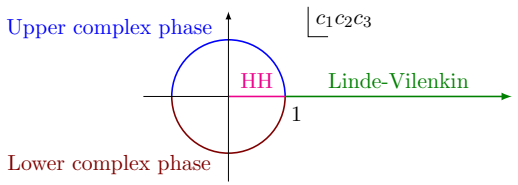
Summary. This paper constructs a top-down holographic model of eternal inflation by considering complex homogeneous mass deformations of ABJM theory on S^3, following the Freedman-Pufu consistent truncation of four-dimensional Euclidean supergravity. The authors identify a one-parameter family of complexified FP solutions whose complex time contours produce an asymptotically dS, inflationary, no-boundary-type saddle. Using the regularized FP action (with the SUSY surface term), they write the semiclassical bulk wave function as a sum of two saddles with opposite actions, leading to a Hartle-Hawking-dominant amplitude with a subleading 'tunneling' contribution for |φ_B| < 2√6, and an oscillatory, allegedly excluded contribution for |φ_B| > 2√6. The paper connects this exclusion to the KSW criterion, the dynamical cobordism conjecture, the swampland distance conjecture, and the classicality condition of the no-boundary wave function. The central object is Eq. (3.4), Ψ[φ_B] ∼ (exp(I_+[φ_B]) + exp(I_−[φ_B])) exp(iS_st), with I± = ±4π²L²√(1 − (φ_B/(2√6))²).
Significance. If the construction holds, this is a rare top-down example in which a boundary partition function (complex-deformed ABJM) supplies a holographic no-boundary measure over a minisuperspace of inflationary universes, including a specific prediction of a subleading tunneling contribution and a dynamical exclusion of large-field configurations. The paper gives a concrete, parameter-light setup: the only free parameter is the product c = c1 c2 c3, and the quantitative action input comes from the exact FP result I_reg[c] = 4π²L²(1−c)/(1+c), not from data fitting. The authors are also transparent about the conjectural status of the dS/CFT dictionary and about the fact that the large-field exclusion is a conjecture. These strengths make the paper worth serious consideration. The main weakness is that the advertised prediction (3.4) is an equal-weight superposition of two saddles asserted without a saddle-point contour or fluctuation analysis, so the existence and size of the tunneling term is not established at the level of rigor the paper's claims require.
major comments (3)
- [§3, Eq. (3.4)] The wave function is written as an equal-weight superposition of the two saddles with actions I+ and I−, corresponding to c and 1/c at the same boundary value φ_B. In a saddle-point evaluation, the relative phase and weight of the two saddles are fixed by the integration contour (Lefschetz thimble) and by one-loop fluctuation determinants; the paper does not provide this analysis. The advertised subleading 'tunneling' contribution exists only if the I− saddle lies on the relevant contour with a nonzero, order-one coefficient. If the correct contour selects only the I+ saddle, the tunneling term disappears. The caveat later in §3 that a full analysis including the fermionic sector might lift the degeneracy does not replace the missing bosonic contour/determinant computation, and the claim in the abstract therefore remains unsupported at a load-bearing step.
- [§1, Eq. (1.1)] The central prediction inherits the conjectural dS/CFT dictionary Ψ[h, φ] = Z^{-1}_{QFT}[h̃, ζ] exp(iS_st) with an inverse partition function and complex sources. The paper states that gauge-gravity duality 'conjectures' this relation; it is not derived from ABJM or from the bulk path integral. The specific results—the Hartle-Hawking saddle with subleading tunneling, and the dependence on φ_B through I±—depend on this dictionary and on the assumed analytic continuation to complex ζ. The manuscript should either provide a derivation or explicitly frame Eq. (3.4) as conditional on this dictionary, with a discussion of which conclusions would change under alternative forms of the dictionary (for example, a different analytic continuation in the source).
- [§2–§3, large-field exclusion] The exclusion of the large-field regime |φ_B| > 2√6 is load-bearing for the paper's claimed coincidence between holography, the classicality condition, and swampland principles. However, the argument is a consistency web rather than a derivation: the KSW criterion, the dynamical cobordism conjecture, and the reality of R-charges are imposed as selection criteria, and the paper itself says that 'we conjecture that the semiclassical wave function vanishes for large φ_B'. The statement that the full range of deformations for which the dual partition function is 'reasonable and well-defined' exactly matches the classicality domain is not demonstrated from the ABJM partition function itself. The manuscript should separate definitional criteria from conjectural ones and state what would happen to Eqs. (3.3)–(3.4) if each criterion were relaxed.
minor comments (5)
- [§3, paragraph after Fig. 7] The sentence 'the semiclassical wave function should indeed be taken to vanish for |φ_B| ≤ 2√6' appears to have the inequality reversed; the context requires |φ_B| > 2√6 (or ≥) for the large-field exclusion.
- [Footnote on p. 4] There is a typo in 'the holography iof vacuum decay in AdS'; it should read 'holography of vacuum decay in AdS'.
- [§3, Fig. 7 and preceding paragraph] The text states that KSW violation occurs for complex c with phase outside [−π/2, π/2], while Fig. 7 says the zeroes are at |φ_B| = 2√12, 'exactly the threshold beyond which the saddles don't satisfy the KSW criterion'; the relation between the phase condition and the field-value threshold should be spelled out explicitly.
- [§1 and §4] The phrase 'at least with the fermionic sector integrated out' is stated in the introduction and discussion but is not defined or derived in the main computation of §3; the manuscript should specify which fermionic contributions are being integrated out and what changes when they are included.
- [§2, around Eq. (2.18)] The paragraph describing the two options for achieving real φ_B—real positive c versus complex c with |c|=1—is difficult to parse, especially the sentence about the upper and lower half unit circle covering the same range of boundary values; it should be rewritten for clarity.
Circularity Check
No significant circularity: the holographic wave function is obtained by substituting the external FP/ABJM regularized action into the explicitly conjectural dS/CFT dictionary, not by fitting parameters or by redefining the target result.
full rationale
The derivation chain is self-contained given its stated assumptions. The paper assumes the dS/CFT dictionary in eq. (1.1), labeling it a conjecture, and takes the regularized FP action I_reg[c] = 4π²L²(1−c)/(1+c) from Freedman–Pufu, an external computation matched to the ABJM partition function. Re-expressing c in terms of the boundary field φ_B via eq. (2.18) yields eq. (3.3); the two signs are exactly the c ↔ 1/c symmetry of the FP action, which the paper explicitly notes. Summing the two saddles with the same φ_B gives eq. (3.4). Each of these steps is a substitution or standard saddle-point sum; no output is identical to an input merely by definition, and no parameter is fitted to the claimed prediction. The large-field exclusion |φ_B| > 2√6 is supported by the KSW criterion, the cobordism conjecture, and the behavior of the dual partition function, and the paper explicitly calls the exclusion a conjecture. Self-citations (e.g., refs. [6], [9], [28]) supply the conjectural dictionary and the comparison no-boundary calculation, but the quantitative core is external to the present authors. The main weaknesses are that eq. (1.1) is an unproven conjecture and that the equal-weight, equal-phase superposition in eq. (3.4) is asserted without a contour or one-loop analysis; the paper itself notes the fermionic sector might lift the degeneracy. These are correctness risks, not circular reductions.
Assumptions & free parameters
free parameters (1)
- c = c1 c2 c3 (product of three FP solution constants) =
Varies; labels the one-parameter minisuperspace
assumptions (5)
- domain assumption dS/CFT dictionary, eq. (1.1): Psi[h,phi] = Z^{-1}_{QFT}[h_tilde,zeta] exp(iS_st/hbar)
- domain assumption Euclidean AdS/CFT extends to complex relevant deformations, and the FP saddles admit a valid complex analytic continuation
- domain assumption The consistent truncation with six complex scalars and the FP regularized action I_reg[c] = 4 pi^2 L^2 (1-c)/(1+c) remain correct for complex sources
- ad hoc to paper The KSW criterion and complex R-charge validity are appropriate criteria for excluding saddles
- standard math Semiclassical saddle-point approximation and large-volume limit
invented entities (1)
-
End-of-the-world brane used to excise the eternal inflation regime
Cite this review
Pith. "Pith review of Holographic (Eternal) Inflation." pith.science (2026). https://pith.science/paper/2KUHC36V
@misc{pith2026241118396,
  author       = {Pith},
  title        = {Pith review of: Holographic (Eternal) Inflation},
  year         = {2026},
  howpublished = {\url{https://pith.science/paper/2KUHC36V}},
  note         = {Machine review of arXiv:2411.18396}
}
read the original abstract
We identify a minisuperspace of complex deformations of ABJM theory for which the partition function specifies the amplitude of an eternally inflating universe. The boundary theory predicts that the bosonic bulk is effectively in the Hartle-Hawking no-boundary state, with a subleading 'tunneling' contribution. This holographic model of inflation also reveals a close connection between the swampland distance and cobordism conjectures, and the condition for the asymptotic wave function to predict classical behavior in geometry and fields.
Figures


Figures from the paper (5 more)




Reference graph
Works this paper leans on
-
[1]
Nonperturbative Amplifications of Inhomogeneities in a Self-Reproducing Universe
A. D. Linde, D. A. Linde, and A. Mezhlumian, “Nonperturbative amplifications of inhomogeneities in a selfreproducing universe,” Phys. Rev. D 54 (1996) 2504–2518, arXiv:gr-qc/9601005
work page Pith review arXiv 1996
-
[2]
Mass, entropy and holography in asymptotically de Sitter spaces,
V. Balasubramanian, J. de Boer, and D. Minic, “Mass, entropy and holography in asymptotically de Sitter spaces,” Phys.Rev. D65 (2002) 123508, arXiv:hep-th/0110108 [hep-th]
arXiv 2002
-
[3]
A. Strominger, “The dS / CFT correspondence,” JHEP 0110 (2001) 034, arXiv:hep-th/0106113 [hep-th]
arXiv 2001
-
[4]
Non-Gaussian features of primordial fluctuations in single field inflationary models,
J. M. Maldacena, “Non-Gaussian features of primordial fluctuations in single field inflationary models,” JHEP 0305 (2003) 013, arXiv:astro-ph/0210603 [astro-ph]
arXiv 2003
-
[5]
Operator Dictionaries and Wave Functions in AdS/CFT and dS/CFT,
D. Harlow and D. Stanford, “Operator Dictionaries and Wave Functions in AdS/CFT and dS/CFT,” arXiv:1104.2621 [hep-th]
-
[7]
On graviton non-Gaussianities during inflation,
J. M. Maldacena and G. L. Pimentel, “On graviton non-Gaussianities during inflation,” JHEP 09 (2011) 045, arXiv:1104.2846 [hep-th]
arXiv 2011
-
[8]
Higher Spin Realization of the dS/CFT Correspondence,
D. Anninos, T. Hartman, and A. Strominger, “Higher Spin Realization of the dS/CFT Correspondence,” arXiv:1108.5735 [hep-th]. – 18 –
-
[9]
Holographic Tunneling Wave Function
G. Conti, T. Hertog, and E. van der Woerd, “Holographic Tunneling Wave Function,” JHEP 12 (2015) 025, arXiv:1506.07374 [hep-th]
work page Pith review arXiv 2015
Show all 48 references
-
[10]
Timelike T duality, de Sitter space, large N gauge theories and topological field theory,
C. Hull, “Timelike T duality, de Sitter space, large N gauge theories and topological field theory,” JHEP 07 (1998) 021, arXiv:hep-th/9806146
1998 arXiv
-
[11]
Negative Branes, Supergroups and the Signature of Spacetime,
R. Dijkgraaf, B. Heidenreich, P. Jefferson, and C. Vafa, “Negative Branes, Supergroups and the Signature of Spacetime,” JHEP 02 (2018) 050, arXiv:1603.05665 [hep-th]
2018 arXiv
-
[12]
Pseudo-supersymmetry and a tale of alternate realities,
E. Bergshoeff, J. Hartong, A. Ploegh, J. Rosseel, and D. Van den Bleeken, “Pseudo-supersymmetry and a tale of alternate realities,” JHEP 07 (2007) 067, arXiv:0704.3559 [hep-th]
2007 arXiv
-
[13]
Domain-wall/cosmology correspondence in adS/dS supergravity,
K. Skenderis, P. K. Townsend, and A. Van Proeyen, “Domain-wall/cosmology correspondence in adS/dS supergravity,” JHEP 08 (2007) 036, arXiv:0704.3918 [hep-th]
2007 arXiv
-
[14]
Quantum Probabilities for Inflation from Holography,
J. B. Hartle, S. Hawking, and T. Hertog, “Quantum Probabilities for Inflation from Holography,” JCAP 1401 no. 01, (2014) 015, arXiv:1207.6653 [hep-th]
2014 arXiv
-
[15]
Microscopics of de Sitter entropy from precision holography,
N. Bobev, T. Hertog, J. Hong, J. Karlsson, and V. Reys, “Microscopics of de Sitter entropy from precision holography,” arXiv:2211.05907 [hep-th]
-
[16]
Inflation and the dS / CFT correspondence,
A. Strominger, “Inflation and the dS / CFT correspondence,” JHEP 11 (2001) 049, arXiv:hep-th/0110087
2001 arXiv
-
[17]
Holography for Cosmology,
P. McFadden and K. Skenderis, “Holography for Cosmology,” Phys.Rev. D81 (2010) 021301, arXiv:0907.5542 [hep-th]
2010 arXiv
-
[18]
Holography for inflation using conformal perturbation theory,
A. Bzowski, P. McFadden, and K. Skenderis, “Holography for inflation using conformal perturbation theory,” JHEP 04 (2013) 047, arXiv:1211.4550 [hep-th]
2013 arXiv
-
[19]
Multi-field inflation from holography,
J. Garriga, K. Skenderis, and Y. Urakawa, “Multi-field inflation from holography,” JCAP 01 (2015) 028, arXiv:1410.3290 [hep-th]
2015 arXiv
-
[20]
From Planck data to Planck era: Observational tests of Holographic Cosmology,
N. Afshordi, C. Coriano, L. Delle Rose, E. Gould, and K. Skenderis, “From Planck data to Planck era: Observational tests of Holographic Cosmology,” Phys. Rev. Lett. 118 no. 4, (2017) 041301, arXiv:1607.04878 [astro-ph.CO]
2017 arXiv
-
[21]
N=6 superconformal Chern-Simons-matter theories, M2-branes and their gravity duals,
O. Aharony, O. Bergman, D. L. Jafferis, and J. Maldacena, “N=6 superconformal Chern-Simons-matter theories, M2-branes and their gravity duals,” JHEP 10 (2008) 091, arXiv:0806.1218 [hep-th]
2008 arXiv
-
[22]
Superconformal Chern-Simons Theories and AdS(4)/CFT(3) Correspondence,
M. Benna, I. Klebanov, T. Klose, and M. Smedback, “Superconformal Chern-Simons Theories and AdS(4)/CFT(3) Correspondence,” JHEP 09 (2008) 072, arXiv:0806.1519 [hep-th]
2008 arXiv
-
[23]
Exact Results for Wilson Loops in Superconformal Chern-Simons Theories with Matter,
A. Kapustin, B. Willett, and I. Yaakov, “Exact Results for Wilson Loops in Superconformal Chern-Simons Theories with Matter,” JHEP 03 (2010) 089, arXiv:0909.4559 [hep-th]
2010 arXiv
-
[24]
From weak to strong coupling in ABJM theory,
N. Drukker, M. Marino, and P. Putrov, “From weak to strong coupling in ABJM theory,” Commun. Math. Phys. 306 (2011) 511–563, arXiv:1007.3837 [hep-th]
2011 arXiv
-
[25]
Towards the F-Theorem: N=2 Field Theories on the Three-Sphere,
D. L. Jafferis, I. R. Klebanov, S. S. Pufu, and B. R. Safdi, “Towards the F-Theorem: N=2 Field Theories on the Three-Sphere,” JHEP 06 (2011) 102, arXiv:1103.1181 [hep-th]
2011 arXiv
-
[26]
The holography of F -maximization,
D. Z. Freedman and S. S. Pufu, “The holography of F -maximization,” JHEP 03 (2014) 135, arXiv:1302.7310 [hep-th]. – 19 –
2014 arXiv
-
[27]
The Classical Universes of the No-Boundary Quantum State,
J. B. Hartle, S. Hawking, and T. Hertog, “The Classical Universes of the No-Boundary Quantum State,” Phys. Rev. D 77 (2008) 123537, arXiv:0803.1663 [hep-th]
2008 arXiv
-
[28]
Real no-boundary wave function in lorentzian quantum cosmology,
J. D. Dorronsoro, J. Halliwell, J. Hartle, T. Hertog, and O. Janssen, “Real no-boundary wave function in lorentzian quantum cosmology,” Physical Review D 96 no. 4, (Aug, 2017) . http://dx.doi.org/10.1103/PhysRevD.96.043505
2017 doi
-
[29]
On the Geometry of the String Landscape and the Swampland,
H. Ooguri and C. Vafa, “On the Geometry of the String Landscape and the Swampland,” Nucl. Phys. B 766 (2007) 21–33, arXiv:hep-th/0605264
2007 arXiv
-
[30]
Super-Planckian Spatial Field Variations and Quantum Gravity,
D. Klaewer and E. Palti, “Super-Planckian Spatial Field Variations and Quantum Gravity,” JHEP 01 (2017) 088, arXiv:1610.00010 [hep-th]
2017 arXiv
-
[31]
On the Cosmological Implications of the String Swampland,
P. Agrawal, G. Obied, P. J. Steinhardt, and C. Vafa, “On the Cosmological Implications of the String Swampland,” Phys. Lett. B 784 (2018) 271–276, arXiv:1806.09718 [hep-th]
2018 arXiv
-
[32]
Vacuum decay into Anti de Sitter space,
J. Maldacena, “Vacuum decay into Anti de Sitter space,” arXiv:1012.0274 [hep-th]
-
[33]
The Boundary Proposal,
B. Friedrich and A. Hebecker, “The Boundary Proposal,” arXiv:2403.18892 [hep-th]
-
[34]
Cobordism Classes and the Swampland,
J. McNamara and C. Vafa, “Cobordism Classes and the Swampland,” arXiv:1909.10355 [hep-th]
1909 arXiv
-
[35]
Dynamical tadpoles, stringy cobordism, and the SM from spontaneous compactification,
G. Buratti, M. Delgado, and A. M. Uranga, “Dynamical tadpoles, stringy cobordism, and the SM from spontaneous compactification,” JHEP 06 (2021) 170, arXiv:2104.02091 [hep-th]
2021 arXiv
-
[36]
Dynamical Cobordism and Swampland Distance Conjectures,
G. Buratti, J. Calder´ on-Infante, M. Delgado, and A. M. Uranga, “Dynamical Cobordism and Swampland Distance Conjectures,” JHEP 10 (2021) 037, arXiv:2107.09098 [hep-th]
2021 arXiv
-
[37]
Dynamical Cobordism Conjecture: solutions for end-of-the-world branes,
R. Blumenhagen, C. Kneissl, and C. Wang, “Dynamical Cobordism Conjecture: solutions for end-of-the-world branes,” JHEP 05 (2023) 123, arXiv:2303.03423 [hep-th]
2023 arXiv
-
[38]
Wick Rotation and the Positivity of Energy in Quantum Field Theory,
M. Kontsevich and G. Segal, “Wick Rotation and the Positivity of Energy in Quantum Field Theory,” Quart. J. Math. Oxford Ser. 72 no. 1-2, (2021) 673–699, arXiv:2105.10161 [hep-th]
2021 arXiv
-
[39]
A Note On Complex Spacetime Metrics,
E. Witten, “A Note On Complex Spacetime Metrics,” arXiv:2111.06514 [hep-th]
-
[40]
Holographic No-Boundary Measure,
T. Hertog and J. Hartle, “Holographic No-Boundary Measure,” JHEP 05 (2012) 095, arXiv:1111.6090 [hep-th]
2012 arXiv
-
[41]
No rescue for the no boundary proposal: Pointers to the future of quantum cosmology,
J. Feldbrugge, J.-L. Lehners, and N. Turok, “No rescue for the no boundary proposal: Pointers to the future of quantum cosmology,” Phys. Rev. D 97 no. 2, (2018) 023509, arXiv:1708.05104 [hep-th]
2018 arXiv
-
[42]
No-boundary proposal in biaxial Bianchi IX minisuperspace,
O. Janssen, J. J. Halliwell, and T. Hertog, “No-boundary proposal in biaxial Bianchi IX minisuperspace,” Phys. Rev. D 99 no. 12, (2019) 123531, arXiv:1904.11602 [gr-qc]
2019 arXiv
-
[43]
Damped perturbations in the no-boundary state,
J. Diaz Dorronsoro, J. J. Halliwell, J. B. Hartle, T. Hertog, O. Janssen, and Y. Vreys, “Damped perturbations in the no-boundary state,” Phys. Rev. Lett. 121 no. 8, (2018) 081302, arXiv:1804.01102 [gr-qc]
2018 arXiv
-
[44]
Remarks on 2D quantum cosmology,
D. Anninos, C. Baracco, and B. M¨ uhlmann, “Remarks on 2D quantum cosmology,” arXiv:2406.15271 [hep-th]
-
[45]
Wave function of Vasiliev’s universe: A few slices thereof,
D. Anninos, F. Denef, and D. Harlow, “Wave function of Vasiliev’s universe: A few slices thereof,” Phys. Rev. D88 no. 8, (2013) 084049, arXiv:1207.5517 [hep-th]. – 20 –
2013 arXiv
-
[46]
Supersymmetric dS/CFT,
T. Hertog, G. Tartaglino-Mazzucchelli, T. Van Riet, and G. Venken, “Supersymmetric dS/CFT,” JHEP 02 (2018) 024, arXiv:1709.06024 [hep-th]
2018 arXiv
-
[47]
Higher Spin de Sitter Hilbert Space,
D. Anninos, F. Denef, R. Monten, and Z. Sun, “Higher Spin de Sitter Hilbert Space,” JHEP 10 (2019) 071, arXiv:1711.10037 [hep-th]
2019 arXiv
-
[48]
Spinors in Supersymmetric dS/CFT,
T. Hertog, G. Tartaglino-Mazzucchelli, and G. Venken, “Spinors in Supersymmetric dS/CFT,” JHEP 10 (2019) 117, arXiv:1905.01322 [hep-th]
2019 arXiv
-
[49]
Consistent reductions of IIB* / M* theory and de Sitter supergravity,
J. T. Liu, W. Sabra, and W. Wen, “Consistent reductions of IIB* / M* theory and de Sitter supergravity,” JHEP 01 (2004) 007, arXiv:hep-th/0304253. – 21 –
2004 arXiv
Reviewed August 12, 2026 · model on record in the stance chip above.
Discussion (0). Continue with ORCID to comment.