REVIEW 3 major objections 5 minor 38 references
MOSS: Multi-Objective Optimization for Stable Rule Sets
T0 review · 3 major / 5 minor · reviewed 2026-08-07 · deepseek-v4-flash
Pith's one-line read MOSS jointly optimizes rule-set sparsity, accuracy, and stability in one integer program, and traces the full accuracy-stability Pareto frontier.
desk verdict MOSS has a genuinely useful formulation and a strong empirical section, but the headline claim about computing the entire Pareto frontier is false as stated, and the proof of Proposition 1 needs correction. read the letter →
The pith
A machine-rendered reading of the paper's core claim, the machinery that carries it, and where it could break.
The reading
What carries the argument
The machinery has three parts. First, the in-sample stability objective $H_1(z)=\sum_i \Pi_i z_i$ is built from selection proportions $\Pi_i$, the frequencies with which candidate rules appear across random-forest bootstrap fits. Second, the accuracy objective $H_2(z)=\frac12 y^\top (I_n + \gamma \sum_i z_i M_i M_i^\top)^{-1} y$ is regularized in-sample loss re-expressed as a convex function of the binary selection vector $z$. Third, an outer-approximation cutting-plane algorithm solves each epsilon-constrained problem as a sequence of integer linear programs, and an Efficient Pareto Method reuses cutting planes across nested epsilon levels. Convexity of $H_2$ is what makes the cutting planes valid and gives finite convergence of the algorithm.
What would settle it
Run a bootstrap perturbation study on a held-out set: for each training fold, refit the random forest many times, record the rules MOSS selects at each epsilon value, and measure the average pairwise Dice-Sorensen coefficient of the actual selected rule sets. If solutions with higher $H_1$ do not systematically show higher empirical DSC than solutions with lower $H_1$, or if MOSS's high-epsilon rule sets are not at least as stable as SIRUS's on most of the 30 datasets, the proxy claim is falsified.
Extended reading notes
Core claim
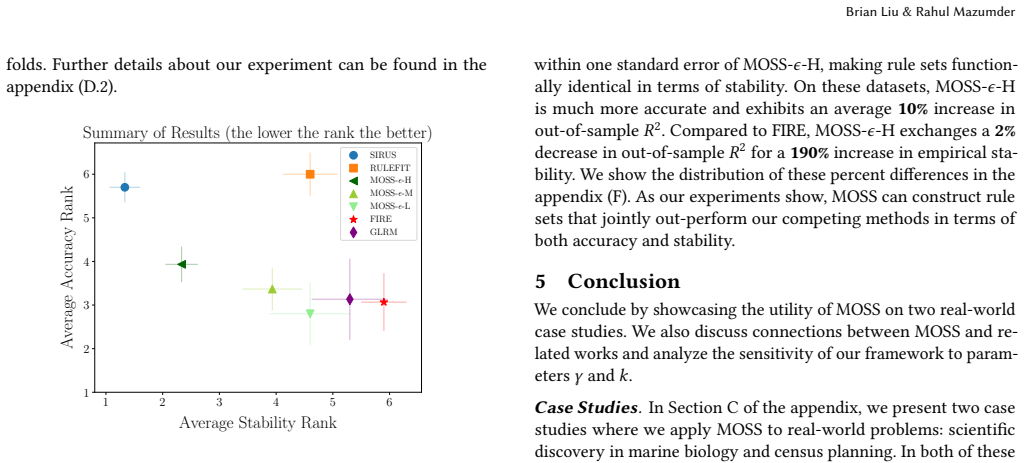
The central discovery is that the accuracy-stability trade-off for sparse rule sets can be computed rather than only acknowledged. Concretely, the paper claims that solutions slightly below the stability-selection optimum can be substantially more accurate out-of-sample while retaining nearly the same empirical stability, and that these solutions can be found efficiently by solving a binary integer program for a descending sequence of stability thresholds. The empirical evidence is that MOSS at a high stability setting has the best average combined accuracy-stability rank, 3.13, against 3.51 for stability-only SIRUS and worse ranks for the accuracy-oriented baselines. On 24 of 30 datasets, the MOSS rule sets match SIRUS in empirical stability within one standard error while improving out-of-sample R-squared by about 10 percent on average.
Load-bearing premise
The central bet is that the frequency with which a rule appears in random-forest bootstrap fits, measured on the same training data, faithfully predicts how often that rule would appear under fresh data perturbations; if this proxy diverges from the Dice-Sorensen empirical stability, the Pareto frontier is optimizing the wrong quantity.
Editorial extensions
If this is right
- Practitioners can choose where to sit on the accuracy-stability frontier instead of committing to a stability-only or accuracy-only rule-construction algorithm.
- MOSS at a high stability setting appears to be a strong default: it nearly matches SIRUS on stability on most datasets while delivering a roughly 10 percent R-squared improvement on those datasets.
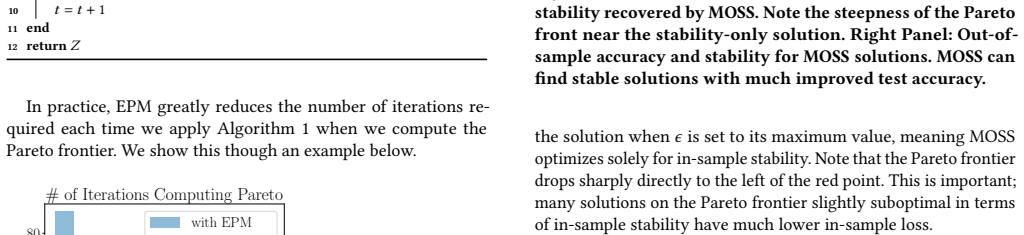
- The stability-selection optimum is far from the whole story; solutions slightly suboptimal in in-sample stability can have much lower in-sample loss and better out-of-sample accuracy without sacrificing measured stability.
- The same algorithm scales to candidate pools of thousands of rules beyond the reach of commercial solvers, with the cut-reuse scheme giving up to an order-of-magnitude speedup when computing the full Pareto frontier.
- Accuracy-focused rule-set methods pay for their accuracy with dramatically lower stability; MOSS can take about a 2 percent R-squared cost relative to the most accurate baseline while increasing empirical stability by about 190 percent.
Reading between the lines
- If the selection-proportion proxy is trustworthy, the same Pareto machinery should transfer to other rule-generation schemes that produce selection frequencies, such as boosting stumps or randomized split ensembles, not just random forests.
- The reported numbers suggest that accuracy-focused baselines sit on the steep low-stability end of the same frontier, so MOSS is effectively letting practitioners pick the knee of a curve that other methods force them to choose one point from.
- A testable extension the paper leaves implicit is to replace $H_1$ with an ensemble-averaged holdout Dice-Sorensen estimate inside the objective; the appendix shows ranking insensitivity across stability metrics, but not whether the proxy itself can be improved.
Editorial analysis
A structured set of objections, weighed in public.
Referee Report
Summary. The paper introduces MOSS, a multi-objective optimization framework for constructing sparse sets of decision rules that jointly account for stability, accuracy, and sparsity. Stability is measured in-sample as the weighted sum of selection proportions (H1), and accuracy as a ridge-regularized least-squares loss (H2). The framework is formulated as a bi-objective integer program (Problem 5), converted to an epsilon-constraint problem (Problem 9), and solved with an outer-approximation cutting-plane method (Algorithm 1) plus an efficient Pareto method (Algorithm 2) that reuses cutting planes across a sequence of epsilon values. Experiments on 30 OpenML regression datasets compare MOSS variants against SIRUS, FIRE, GLRM, and RuleFit, reporting that MOSS-epsilon-H has the best average combined accuracy-stability rank (3.13).
Significance. The problem addressed is relevant: stability is an underexplored objective in interpretable rule-set learning, and a tool that lets practitioners trade off accuracy and stability in sparse rule sets would be practically valuable. The paper has several strengths: the epsilon-constraint formulation is natural, the convexity argument for H2 is standard and correct, the outer-approximation framework is appropriate for the problem class, the EPM warm-starting idea is sensible, and the experimental comparison covers a broad set of datasets and competing methods. A public code repository is referenced in the appendix. However, the central algorithmic claim that the rolling-window epsilon sequence yields the complete Pareto frontier is false as stated, and the derivation of the main reformulation contains an algebraic error; these issues currently prevent the paper from delivering on its headline promise.
major comments (3)
- [§3.1.2 and Appendix A.1, Eq. (8)] The claim that solving Problem 9 for every epsilon in the rolling-window sequence E computes the entire Pareto frontier 'with complete granularity' is false. A Pareto-optimal set can have an H1 value that is a subset sum of the selection proportions but not a rolling-window sum. For example, with k=2 and Pi=(0.9,0.7,0.6,0.5), E={1.6,1.3,1.1}, but the subset {0.9,0.6} has H1=1.5. If H2({0.9,0.6})=2, H2({0.9,0.5})=1, and every subset with H1>=1.5 other than {0.9,0.6} has H2>2, then {0.9,0.6} is Pareto-optimal; solving at epsilon=1.6 makes it infeasible, while solving at epsilon=1.3 returns {0.9,0.5} because that point has lower H2. Such orderings are compatible with the ridge-regularized loss, since H2 is monotone with respect to set inclusion but not with respect to H1. The completeness statement should therefore be removed or replaced with a precise characterization of when the rolling-window sequence suffices; otherwise the method should be described as computing an approximate or partial Pareto frontier. This does not invalidate the specific epsilon comparisons in the experiments, but it is a load-bearing overstatement of the algorithmic contribution.
- [Algorithm 1, lines 2-3] The derivation of the binary reformulation contains an algebraic error. For the objective in Eq. (4), min_w 1/2||y-Mw||^2 + (gamma/2)||w||^2, the stationary point is w*=(M^T M + gamma I)^{-1} M^T y, not (I/gamma - M^T M)^{-1} M^T y as written in Appendix A.1. The resulting reduced loss is 1/2 y^T (I + gamma^{-1} sum_i z_i M_i M_i^T)^{-1} y, whereas Eq. (8) has gamma in place of 1/gamma. Since Problem 9 is built on Eq. (8), the reformulation as stated is not justified. The authors should correct the algebra or redefine the regularization parameter consistently; the same gamma versus 1/gamma inconsistency appears again in Eq. (11) of §3.5.
- [Algorithm 1, lines 2-3] The pseudocode for the core cutting-plane algorithm is not executable as written. It initializes nu0 to H2(z0) and then loops while H2(z_t) > nu; at t=0 this condition is false, so the algorithm returns the warm start without adding any cutting plane or solving the ILP. Presumably nu should be initialized to a valid lower bound (for example, -infinity or a bound inherited from a previous epsilon solve in EPM), and the indexing of nu and z should be clarified. This is a central algorithmic description and needs to be corrected for reproducibility.
minor comments (5)
- [§2.4 and Appendix A.1] The expression for empirical stability is missing a reciprocal factor: the displayed formula T(T-1)/2 times the sum over i != j gives a number much larger than an average when T>2; the intended definition should be (2/T(T-1)) times the sum over i<j of DSC(R_i,R_j).
- [§4.2 and Appendix F] There are small notational errors: in §2.4 the response variable is said to be in R^m but should be R^n, and in Appendix A.1 the matrix M_s is described as a sub-matrix with 'rows' selected when it should be columns.
- [§5 and Appendix D.2] The dataset count is inconsistent: the text says 30 OpenML regression datasets, then mentions '24 out of the 31 datasets', and Appendix F says 'One 24 out of 30'; the list in Appendix D.1 contains 30 datasets, so the count in the main text should be fixed to match.
- [Throughout] The appendix states both that code is available at github.com/brianliu12437/MOSS and, in D.2, that the implementation 'will be open-sourced after the review period'; this should be clarified so readers know what is currently available.
- [Throughout] There are several typos and infelicities: 'sample algorithm' in §2.2, 'uncover insights' in §5, 'One 24 out of 30' in Appendix F, and '10 percent increase of 10 R2'. A careful proofread would improve readability.
Circularity Check
No significant circularity: the paper's derivations are self-contained, and its stability proxy is validated against a different out-of-sample metric rather than fitted to it.
full rationale
The paper's central derivation chain is not circular. The in-sample stability objective H1(z)=sum_i Pi_i z_i is introduced as a proxy for empirical stability, measured separately by average pairwise Dice-Sorensen coefficient across CV folds; the two quantities are not equated or fitted to one another, so there is no self-definitional reduction. The reformulation of H2(z) in Proposition 1 follows from a standard linear-algebra identity and is proven in the appendix. Convergence of the cutting-plane algorithm is attributed to Fletcher and Leyffer (1994), an external, non-self-cited source. The self-citations to FIRE (Liu and Mazumder 2023) and L0Learn (Hazimeh, Mazumder, Nonet 2023) are used for baselines and algorithmic context, not as load-bearing support for the correctness of the MOSS derivation. The epsilon-constraint method is standard and the EPM warm-starting argument relies only on the nesting of the feasible sets for decreasing epsilon, which the paper states explicitly. Even if the Section 3.3.1 claim that the rolling-window sequence E computes the entire Pareto frontier with complete granularity is questionable from a correctness standpoint, a potentially false algorithmic guarantee is not circularity: no equation in the paper reduces to an input fitted from the target results, and no load-bearing argument collapses into a self-citation. Therefore the appropriate circularity score is 0.
Assumptions & free parameters
free parameters (4)
- gamma =
recommended 1e-3 to 1e-2
- k =
15 in main experiments; 10-20 recommended
- lambda1, lambda2 =
null
- epsilon operating points (3rd and 40th elements of E) =
E_3 and E_40 in main experiments
assumptions (5)
- domain assumption H1(z) = sum_i Pi_i z_i, with Pi from SIRUS-style random-forest selection proportions, is a valid proxy for out-of-sample empirical stability.
- domain assumption H2(z), the ridge-regularized in-sample loss of the selected rules, proxies out-of-sample predictive error.
- domain assumption The random-forest candidate rule pool of size m approximately 10^3 contains all rules relevant for the Pareto frontier.
- standard math Outer-approximation convergence (Fletcher and Leyffer 1994) applies to Problem 9 because H2 is convex.
- ad hoc to paper The rolling-window sums E cover all Pareto-relevant H1 levels.
Cite this review
Pith. "Pith review of MOSS: Multi-Objective Optimization for Stable Rule Sets." pith.science (2026). https://pith.science/paper/2MM3S3F4
@misc{pith2026250608030,
  author       = {Pith},
  title        = {Pith review of: MOSS: Multi-Objective Optimization for Stable Rule Sets},
  year         = {2026},
  howpublished = {\url{https://pith.science/paper/2MM3S3F4}},
  note         = {Machine review of arXiv:2506.08030}
}
read the original abstract
We present MOSS, a multi-objective optimization framework for constructing stable sets of decision rules. MOSS incorporates three important criteria for interpretability: sparsity, accuracy, and stability, into a single multi-objective optimization framework. Importantly, MOSS allows a practitioner to rapidly evaluate the trade-off between accuracy and stability in sparse rule sets in order to select an appropriate model. We develop a specialized cutting plane algorithm in our framework to rapidly compute the Pareto frontier between these two objectives, and our algorithm scales to problem instances beyond the capabilities of commercial optimization solvers. Our experiments show that MOSS outperforms state-of-the-art rule ensembles in terms of both predictive performance and stability.
Figures


Figures from the paper (11 more)




Reference graph
Works this paper leans on
- [1]
-
[2]
Vijay Arya, Rachel K. E. Bellamy, Pin-Yu Chen, Amit Dhurandhar, Michael Hind, Samuel C. Hoffman, Stephanie Houde, Q. Vera Liao, Ronny Luss, Aleksandra Mojsilović, Sami Mourad, Pablo Pedemonte, Ramya Raghavendra, John Richards, Prasanna Sattigeri, Karthikeyan Shanmugam, Moninder Singh, Kush R. Varshney, Dennis Wei, and Yunfeng Zhang. One explanation does n...
work page 2019
-
[3]
Clément Bénard, Gérard Biau, Sébastien Da Veiga, and Erwan Scornet. Sirus: Stable and interpretable rule set for classification.Electronic Journal of Statistics, 15:427–505, 2021
work page 2021
-
[4]
Sparse high-dimensional regression.The Annals of Statistics, 48(1):300–323, 2020
Dimitris Bertsimas and Bart Van Parys. Sparse high-dimensional regression.The Annals of Statistics, 48(1):300–323, 2020
2020
-
[5]
Dimitris Bertsimas, Jean Pauphilet, and Bart Van Parys. Sparse classification: a scalable discrete optimization perspective.Machine Learning, 110:3177–3209, 2021
work page 2021
-
[6]
Cambridge university press, 2004
Stephen Boyd and Lieven Vandenberghe.Convex optimization. Cambridge university press, 2004
2004
-
[7]
Random forests.Machine learning, 45:5–32, 2001
Leo Breiman. Random forests.Machine learning, 45:5–32, 2001
2001
-
[8]
API design for machine learning software: experiences from the scikit-learn project
Lars Buitinck, Gilles Louppe, Mathieu Blondel, Fabian Pedregosa, Andreas Mueller, Olivier Grisel, Vlad Niculae, Peter Prettenhofer, Alexandre Gramfort, Jaques Grobler, Robert Layton, Jake VanderPlas, Arnaud Joly, Brian Holt, and Gaël Varoquaux. API design for machine learning software: experiences from the scikit-learn project. InECML PKDD Workshop: Langu...
work page 2013
Show all 38 references
-
[9]
Efficient exploration of the rashomon set of rule-set models
Martino Ciaperoni, Han Xiao, and Aristides Gionis. Efficient exploration of the rashomon set of rule-set models. InProceedings Of The 30th ACM SIGKDD Conference On Knowledge Discovery And Data Mining, pages 478–489, 2024
2024
-
[10]
An outer-approximation algorithm for a class of mixed-integer nonlinear programs.Mathematical programming, 36: 307–339, 1986
Marco A Duran and Ignacio E Grossmann. An outer-approximation algorithm for a class of mixed-integer nonlinear programs.Mathematical programming, 36: 307–339, 1986
1986
-
[11]
A tutorial on multiobjective op- timization: fundamentals and evolutionary methods.Natural computing, 17: 585–609, 2018
Michael TM Emmerich and André H Deutz. A tutorial on multiobjective op- timization: fundamentals and evolutionary methods.Natural computing, 17: 585–609, 2018
2018
-
[12]
The low response score (lrs) a metric to locate, predict, and manage hard-to-survey populations.Public Opinion Quarterly, 81 (1):144–156, 2017
Chandra Erdman and Nancy Bates. The low response score (lrs) a metric to locate, predict, and manage hard-to-survey populations.Public Opinion Quarterly, 81 (1):144–156, 2017
2017
-
[13]
Solving mixed integer nonlinear programs by outer approximation.Mathematical programming, 66:327–349, 1994
Roger Fletcher and Sven Leyffer. Solving mixed integer nonlinear programs by outer approximation.Mathematical programming, 66:327–349, 1994
1994
-
[14]
Predictive learning via rule ensembles
Jerome H Friedman and Bogdan E Popescu. Predictive learning via rule ensembles. 2008
2008
-
[15]
Seabird trophic position across three ocean regions tracks ecosystem differences.Frontiers in Marine Science, 5:317, 2018
Tyler O Gagné, K David Hyrenbach, Molly E Hagemann, Oron L Bass, Stuart L Pimm, Mark MacDonald, Brian Peck, and Kyle S Van Houtan. Seabird trophic position across three ocean regions tracks ecosystem differences.Frontiers in Marine Science, 5:317, 2018
2018
-
[16]
Gurobi Optimizer Reference Manual, 2024
Gurobi Optimization, LLC. Gurobi Optimizer Reference Manual, 2024. URL https://www.gurobi.com
2024
-
[17]
Longfei Han, Senlin Luo, Jianmin Yu, Limin Pan, and Songjing Chen. Rule extraction from support vector machines using ensemble learning approach: an application for diagnosis of diabetes.IEEE journal of biomedical and health informatics, 19(2):728–734, 2014
2014
-
[18]
An introduction to glmnet
Trevor Hastie, Junyang Qian, and Kenneth Tay. An introduction to glmnet. CRAN R Repositary, 5:1–35, 2021
2021
-
[19]
L0learn: A scalable package for sparse learning using l0 regularization.Journal of Machine Learning Research, 24(205):1–8, 2023
Hussein Hazimeh, Rahul Mazumder, and Tim Nonet. L0learn: A scalable package for sparse learning using l0 regularization.Journal of Machine Learning Research, 24(205):1–8, 2023
2023
-
[20]
The 2020 census & the environment: How census data are used for environmental justice & climate action
Jae June Lee and Cara Brumfield. The 2020 census & the environment: How census data are used for environmental justice & climate action. November
2020
-
[21]
Fire: An optimization approach for fast inter- pretable rule extraction
Brian Liu and Rahul Mazumder. Fire: An optimization approach for fast inter- pretable rule extraction. InProceedings of the 29th ACM SIGKDD Conference on Knowledge Discovery and Data Mining, pages 1396–1405, 2023
2023
-
[22]
URL https://www.georgetownpoverty.org/issues/the-2020-census-and- the-environment/
2020
-
[23]
Subset selection with shrinkage: Sparse linear modeling when the snr is low.Operations Research, 71 (1):129–147, 2023
Rahul Mazumder, Peter Radchenko, and Antoine Dedieu. Subset selection with shrinkage: Sparse linear modeling when the snr is low.Operations Research, 71 (1):129–147, 2023
2023
-
[24]
Computing the collection of good models for rule lists.arXiv preprint arXiv:2204.11285, 2022
Kota Mata, Kentaro Kanamori, and Hiroki Arimura. Computing the collection of good models for rule lists.arXiv preprint arXiv:2204.11285, 2022
2022 arXiv
-
[25]
Definitions, methods, and applications in interpretable machine learning
W James Murdoch, Chandan Singh, Karl Kumbier, Reza Abbasi-Asl, and Bin Yu. Definitions, methods, and applications in interpretable machine learning. Proceedings of the National Academy of Sciences, 116(44):22071–22080, 2019
2019
-
[26]
Stability selection.Journal of the Royal Statistical Society Series B: Statistical Methodology, 72(4):417–473, 2010
Nicolai Meinshausen and Peter Bühlmann. Stability selection.Journal of the Royal Statistical Society Series B: Statistical Methodology, 72(4):417–473, 2010
2010
-
[27]
Routledge, 2005
Karl Popper.The logic of scientific discovery. Routledge, 2005
2005
-
[28]
On the stability of feature selection algorithms.Journal of Machine Learning Research, 18(174):1–54, 2018
Sarah Nogueira, Konstantinos Sechidis, and Gavin Brown. On the stability of feature selection algorithms.Journal of Machine Learning Research, 18(174):1–54, 2018
2018
-
[29]
Census Bureau
U.S. Census Bureau. Planning database, 2023. URL https://www.census.gov/ data/developers/data-sets/planning-database.html. Accessed: 2025-02-09
2023
-
[30]
Algorithms for interpretable machine learning
Cynthia Rudin. Algorithms for interpretable machine learning. InProceedings of the 20th ACM SIGKDD international conference on Knowledge discovery and data mining, pages 1519–1519, 2014
2014
-
[31]
Generalized linear rule models
Dennis Wei, Sanjeeb Dash, Tian Gao, and Oktay Gunluk. Generalized linear rule models. InInternational conference on machine learning, pages 6687–6696. PMLR, 2019
2019
-
[32]
van Rijn, Bernd Bischl, and Luis Torgo
Joaquin Vanschoren, Jan N. van Rijn, Bernd Bischl, and Luis Torgo. Openml: Networked science in machine learning.SIGKDD Explorations, 15(2):49–60, 2013. doi: 10.1145/2641190.2641198. URL http://doi.acm.org/10.1145/2641190.2641198
2013
-
[33]
Stability
Bin Yu. Stability. 2013
2013
-
[34]
Exploring the whole rashomon set of sparse decision trees.Advances in neural information processing systems, 35:14071–14084, 2022
Rui Xin, Chudi Zhong, Zhi Chen, Takuya Takagi, Margo Seltzer, and Cynthia Rudin. Exploring the whole rashomon set of sparse decision trees.Advances in neural information processing systems, 35:14071–14084, 2022
2022
-
[35]
Veridical data science
Bin Yu. Veridical data science. InProceedings of the 13th international conference on web search and data mining, pages 4–5, 2020. Brian Liu & Rahul Mazumder Appendix Our appendix can be found below. Code to reproduce our experi- ments can be found in this repository: github.c...
1994
-
[36]
Three principles of data science: predictability, computability, and stability (pcs)
Bin Yu. Three principles of data science: predictability, computability, and stability (pcs). 2018
2018
-
[38]
We take the scenario with the lower objective value as the solution for Problem 3
If𝑤𝑘 ≠0, we have that: 𝑤∗ 𝑘 = 𝑀 ⊺ 𝑘𝑟 𝑀 ⊺ 𝑘𝑀𝑘+ 1 𝛾 , and that the objective is equal to 1 2||𝑟−𝑀 𝑘𝑤∗ 𝑘|| 2 2+ 1 2𝛾(𝑤∗ 𝑘)2+𝜆 1−Π𝑘𝜆2. We take the scenario with the lower objective value as the solution for Problem 3. For our CD heuristic, we sweep through coordinates𝑘∈{ 1...𝑚} wh...
2018
-
[2019]
URL http://docs.mosek.com/9.0/toolbox/index.html
Reviewed August 7, 2026 · model on record in the stance chip above.
Discussion (0). Continue with ORCID to comment.