REVIEW 3 major objections 6 minor 67 references
SimProcess: High Fidelity Simulation of Noisy ICS Physical Processes
T0 review · 3 major / 6 minor · reviewed 2026-08-07 · deepseek-v4-flash
Pith's one-line read A new framework benchmarks how realistically simulations mimic the noise of real power grids and reaches perfect recall on real samples
desk verdict SimProcess is a plausible new benchmarking pipeline for ICS simulation noise, but its central metric rests on an unvalidated Kalman residual and in-sample tuning, so the specific noise ranking is conditional, not established. read the letter →
The pith
A machine-rendered reading of the paper's core claim, the machinery that carries it, and where it could break.
The reading
What carries the argument
The load-bearing mechanism is the seven-stage pipeline: collect the noisy signal $\hat{x}(t)$; estimate noise by $\tilde{n}(t)=\hat{x}(t)-f(\hat{x}(t))$ with a Kalman filter as $f$; slide overlapping windows; prune windows whose values deviate more than $\epsilon$ from the window mean, so transient events do not masquerade as noise; extract features that characterize variation rather than level (approximate entropy, Lempel-Ziv complexity, standard-deviation and variance ratios, and other automatically selected statistical and spectral features); classify each window as real or simulated with a random forest or comparable model; and average the per-window predicted probability of being real into a fidelity score for each candidate simulation. The design avoids mean-like features on raw signals that would encode the process level, forcing the classifier to work from noise character.
What would settle it
Take a clean simulated power-grid trace, add noise of a known distribution, and feed real EPIC traces plus both simulated traces through SimProcess; the claim predicts the noise-added trace is ranked closer to the real traces and real-sample recall stays near 1.0, and it also predicts that replacing the Kalman filter with a deliberately mismatched filter does not flip the ranking. If either prediction fails, the residual-based noise estimate is not faithfully measuring noise fidelity.
Extended reading notes
Core claim
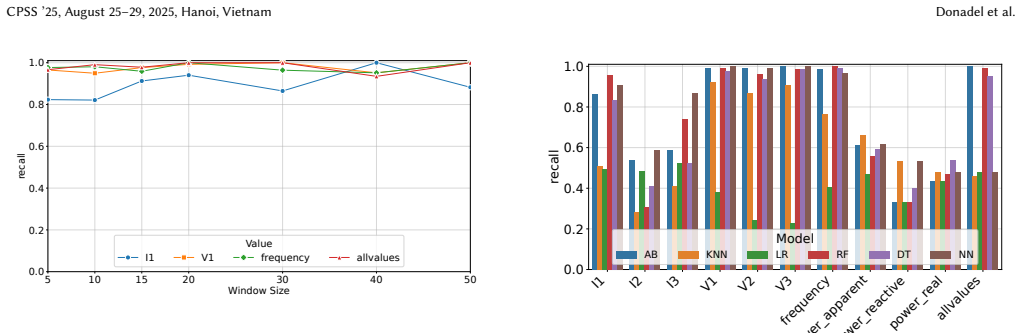
The paper's central claim is that the fidelity of an ICS physical-process simulation can be benchmarked by the statistical profile of its noise, estimated without access to the underlying physics. For the EPIC power-grid testbed, the paper shows that binary classifiers trained on features of the noise-estimation residual separate real windows from simulated windows with recall up to 1.0, and that the resulting fidelity scores identify Gaussian noise as the best match for current measurements, Gaussian mixture noise and an autoencoder-generated noise as best for voltages, and the Gaussian mixture best overall when all measurements are pooled. The paper presents this as evidence that a noise-centric, model-free benchmark can tell a honeypot developer which simulated process would be hardest for an attacker to distinguish from the real plant.
Load-bearing premise
The framework assumes that subtracting a filtered version of the measured signal leaves the true noise; if the filter's model does not match the real physical process, what remains is process dynamics, not noise, and every downstream score reflects that artifact.
Editorial extensions
If this is right
- A honeypot developer can rank candidate noise models without knowing the plant's equations, using only a recording from the real system.
- The same fingerprinting signal that classifies real versus simulated windows can be applied in real time, so high-interaction honeypots that change state (for example, a switch opening) can still be scored; the paper's dynamic-scenario tests show the ranking is mostly preserved.
- Because similar measurements share their best noise (currents cluster around Gaussian, voltages around GMM and autoencoder), a faithful honeypot should apply different noise per signal rather than a single distribution to everything.
- The framework's ground truth is only the real data used for training, so it can be applied to any ICS domain where a trustworthy measurement series exists, including nonlinear time-invariant processes.
Reading between the lines
- If the noise estimate is obtained with a filter that does not match the real process, the ranking may reflect the filter's modeling error instead of true noise fidelity; a testable consequence is that the best-noise ranking would shift when the Kalman filter is replaced by another filter.
- Read backwards, the same machinery gives an attacker a honeypot-fingerprinting tool: collect sensor readings from an unknown device, extract the noise profile, and compare it against known simulation noise signatures.
- The noise-residual method could also serve as a data-quality diagnostic for public ICS datasets: traces whose residual fails to separate from simulated noise are either extremely clean or contain process dynamics that the filter failed to remove.
Editorial analysis
A structured set of objections, weighed in public.
Referee Report
Summary. The paper proposes SimProcess, a seven-stage pipeline for ranking the fidelity of ICS physical-process simulations without requiring differential equations. The pipeline estimates the noise component of a measured time series by subtracting a filtered version (Kalman filter, Eq. 1), extracts windowed features from both the raw signal and the noise estimate, trains a binary classifier on real versus simulated windows, and converts the classifier's probabilities into an averaged fidelity score per simulation. The EPIC power-grid case study compares two simulators (Pandapower and Mosaik) with several static noise distributions and a variational recurrent autoencoder, reporting recall up to 1.0 and identifying GMM, Gaussian, and autoencoder noise as the best matches. A dynamic load-switch experiment is used to show that the ranking is stable under process changes.
Significance. If the methodology is sound, SimProcess addresses a real gap: it offers a model-free, data-only way to benchmark how closely a simulated ICS physical process resembles a real one in terms of noise, which is directly relevant to building harder-to-detect ICS honeypots. The paper's strengths include public code and data, the use of real EPIC measurements, two independent simulators, a broad set of candidate noise models, and a dynamic test that goes beyond static classification. The central quantitative claims are not yet fully established, however, because the fidelity score depends on an unvalidated noise-estimation step and on classifier and hyperparameter choices made on the same EPIC dataset used for the final evaluation.
major comments (3)
- [Section 4.1.2, Eq. (1)] The noise estimate n_tilde(t) = x_hat(t) - f(x_hat(t)) is the foundation of the entire pipeline, but the Kalman filter's state-space model is never specified, and the residual is never validated as noise. If the filter's internal model does not match the EPIC process, the residual contains process dynamics and filter tracking error rather than sensor/process noise, and those artifacts propagate into the windowed features (Section 4.1.5), the VRAE training (Section 5.1.3), and the final fidelity ranking (Section 5.3.2). The paper should provide the filter equations and parameters, and it should validate the residual with, for example, whiteness and stationarity tests, synthetic experiments with known injected noise, or a sensitivity analysis across filter settings. This is load-bearing because the framework's central quantity is defined by this residual.
- [Sections 5.2.1-5.2.4 and 5.3.2] The balancing ratio, window size (N=20), number of features (11), and model choice are all selected on the same EPIC dataset that is later used to produce the fidelity scores and the 'best noise' conclusions. No nested cross-validation or a fully independent held-out set for model selection is described. The dynamic load-switch experiment in Section 5.3.3 is a useful stability check, but it does not test generalization to unseen noise families or new operating conditions. The paper should report the ranking under a proper train/validation/test protocol, or at minimum explicitly state which choices were made on training data only and quantify the sensitivity of the ranking to those choices.
- [Section 4.1.7 and Figure 10] The fidelity score is defined as the average probability assigned by a binary classifier trained to separate real windows from simulated windows. As such, the score measures separability under that particular classifier and feature set, not an absolute 'distance' between the simulation and the real process. The paper should state this limitation explicitly and provide an external check that the ranking reflects perceptual or statistical fidelity rather than only the classifier's decision boundary. For instance, a leave-one-simulation-out evaluation, an analysis of which noise properties drive the ranking, or a comparison with a non-ML statistical distance would strengthen the central claim.
minor comments (6)
- [Section 1] The text contains a typo: 'High interaction honepots' should be 'honeypots'.
- [Section 4.1.2] The notation uses x_hat(t) for the measured noisy signal and also for the filtered signal inside f(x_hat(t)); this should be clarified to avoid confusion between the noisy observation and the filtered estimate.
- [Section 5.2] The Kalman filter is introduced only as 'a Kalman filter [33]' with epsilon values 'based on our tests'; the exact filter configuration, state matrices, and parameter values should be given in the appendix or in the public repository for reproducibility.
- [Figure 4] The caption states that simulations without noise are 'almost flat and, for the most part, superimposed by others,' but this is difficult to see in the figure; using distinct line styles or a zoomed panel would improve readability.
- [Section 5.3.3] The description of the load change ('connecting a load requesting 4 A or disconnecting a load absorbing 3 A') would benefit from stating the direction and magnitude of the resulting current step, since the dynamic experiment's interpretation depends on it.
- [Appendix A.1] The list of hand-picked features is useful, but the paper should clarify which of these features were used for all measurements and whether the same feature set was applied to both the raw signal and the noise estimate.
Circularity Check
The fidelity ranking is a fitted classifier's own confidence, and the VRAE candidate is trained on the same Kalman residual later used for scoring, so the 'best noise' result is partly by construction.
-
fitted input called prediction
[Section 5.1.3 (Noise Simulation) with Section 4.1.2 (Noise Estimation), Eq. 1]
"We trained our VRAE employing the same architecture of Chung et al. [14] on the noise estimation generated as depicted in Section 4.1.2."
Section 4.1.2 defines the noise estimate as n_tilde(t) = x_hat(t) - f(x_hat(t)), with f a Kalman filter. The VRAE is trained to reproduce that residual. In the evaluation pipeline, the same Eq. 1 is applied to the VRAE-generated signal, and the classifier's most important features (Figure 9) are extracted from this same residual. Hence the VRAE's high fidelity scores (0.265 for V1; best for V2 and V3 in Table 2) measure how well it regenerates the filter residual it was trained on, not an independently validated match to the true process noise. The paper never validates that the Kalman residual is actual noise, so this link is circular by construction.
-
fitted input called prediction
[Sections 4.1.6-4.1.7 and 5.3.2]
"The features extracted in this pipeline are then fed to a ML model trained to differentiate between real physical processes and simulations. ... The final score for each data source (and, therefore, on each noise) is computed by averaging the probabilities on every window associated with it."
The fidelity score is by definition the mean posterior probability of the 'real' class assigned by a classifier trained on real-vs-simulated windows and on the same candidate noises that it later ranks. A noise is ranked high exactly when the trained classifier is uncertain, so the ranking is the classifier's own separability/calibration re-labeled as a fidelity score. The held-out test split and the dynamic-scenario experiment provide partial out-of-sample support, preventing a fully forced identity; but the headline result that GMM, Gaussian2, and the autoencoder are the best noises is the classifier's output on data of the same type used to fit it, not an independent fidelity measurement.
full rationale
The paper does not rely on a load-bearing self-citation chain; self-citations appear in background and related work and are not used to forbid alternatives. The central issue is operational circularity in the pipeline. Eq. 1 defines the noise estimate as a Kalman residual without independent validation; the VRAE is trained on that residual, and then the framework's classifier scores the VRAE using features extracted from the same residual. In addition, the 'fidelity score' is literally the trained classifier's averaged probability on windows from each candidate noise, so the ranking of noises is a re-description of how separable the trained classifier finds them. The dynamic load-switch experiment (Section 5.3.3) is a genuinely out-of-sample test and shows ranking stability, which is why the score is 6 rather than 8 or 10. The remaining difficulty is that the residual's status as true noise is assumed, not proven, so the whole ranking is conditional on an unverified filter model. This is a correctness risk as well as a partial circularity, but the paper's contribution is still a concrete, reproducible pipeline with real EPIC data, so it is not entirely vacuous.
Assumptions & free parameters
free parameters (7)
- Window filtering epsilon values =
0.1 for individual value filter, 0.3 for all-value filter
- Window size N =
20 samples
- Number of tsfresh features =
11
- Dataset balancing ratio =
not explicitly stated (high ratio preferred)
- Noise standard deviations =
gaussian1 sigma=0.01, gaussian2 sigma=0.05, GMM sigma=0.02, Poisson lambda=1.5, etc.
- VRAE input weight and training epochs =
input_weight=0.99, 11 epochs
- EPIC base values =
base current 20 A, base voltage 240 V, base frequency 50 Hz
assumptions (6)
- domain assumption The measured signal is the sum of a clean process signal and noise: x_hat(t)=x(t)+n(t).
- domain assumption The Kalman filter residual is a valid estimate of the true noise.
- domain assumption EPIC testbed measurements are a suitable real-world representative of an ICS physical process.
- ad hoc to paper Pruning windows with Equation 2 removes only transient process events and preserves all relevant noise.
- ad hoc to paper The hand-picked nine features plus tsfresh-selected features capture noise statistics without profiling the underlying process.
- domain assumption Classifier probabilities can be averaged across windows to produce a meaningful fidelity score.
Cite this review
Pith. "Pith review of SimProcess: High Fidelity Simulation of Noisy ICS Physical Processes." pith.science (2026). https://pith.science/paper/2NRHN43T
@misc{pith2026250522638,
  author       = {Pith},
  title        = {Pith review of: SimProcess: High Fidelity Simulation of Noisy ICS Physical Processes},
  year         = {2026},
  howpublished = {\url{https://pith.science/paper/2NRHN43T}},
  note         = {Machine review of arXiv:2505.22638}
}
read the original abstract
Industrial Control Systems (ICS) manage critical infrastructures like power grids and water treatment plants. Cyberattacks on ICSs can disrupt operations, causing severe economic, environmental, and safety issues. For example, undetected pollution in a water plant can put the lives of thousands at stake. ICS researchers have increasingly turned to honeypots -- decoy systems designed to attract attackers, study their behaviors, and eventually improve defensive mechanisms. However, existing ICS honeypots struggle to replicate the ICS physical process, making them susceptible to detection. Accurately simulating the noise in ICS physical processes is challenging because different factors produce it, including sensor imperfections and external interferences. In this paper, we propose SimProcess, a novel framework to rank the fidelity of ICS simulations by evaluating how closely they resemble real-world and noisy physical processes. It measures the simulation distance from a target system by estimating the noise distribution with machine learning models like Random Forest. Unlike existing solutions that require detailed mathematical models or are limited to simple systems, SimProcess operates with only a timeseries of measurements from the real system, making it applicable to a broader range of complex dynamic systems. We demonstrate the framework's effectiveness through a case study using real-world power grid data from the EPIC testbed. We compare the performance of various simulation methods, including static and generative noise techniques. Our model correctly classifies real samples with a recall of up to 1.0. It also identifies Gaussian and Gaussian Mixture as the best distribution to simulate our power systems, together with a generative solution provided by an autoencoder, thereby helping developers to improve honeypot fidelity. Additionally, we make our code publicly available.
Figures


Figures from the paper (5 more)



Reference graph
Works this paper leans on
-
[1]
Sridhar Adepu, Nandha Kumar Kandasamy, and Aditya Mathur. 2019. Epic: An electric power testbed for research and training in cyber physical systems security. InComputer Security: ESORICS 2018 International Workshops, CyberICPS 2018 and SECPRE 2018, Barcelona, Spain, September 6–7, 2018, Revised Selected Papers 2. Springer, 37–52
work page 2019
-
[2]
Chuadhry Mujeeb Ahmed and Aditya P Mathur. 2017. Hardware identification via sensor fingerprinting in a cyber physical system. In2017 IEEE International Conference on Software Quality, Reliability and Security Companion (QRS-C). IEEE, 517–524
work page 2017
-
[3]
Chuadhry Mujeeb Ahmed, Jianying Zhou, and Aditya P Mathur. 2018. Noise matters: Using sensor and process noise fingerprint to detect stealthy cyber at- tacks and authenticate sensors in cps. InProceedings of the 34th Annual Computer Security Applications Conference. 566–581
work page 2018
-
[4]
Daniele Antonioli and Nils Ole Tippenhauer. 2015. MiniCPS: A toolkit for security research on CPS networks. InProceedings of the First ACM workshop on cyber- physical systems-security and/or privacy. 91–100
work page 2015
-
[5]
Wissam Aoudi, Mikel Iturbe, and Magnus Almgren. 2018. Truth will out: Departure-based process-level detection of stealthy attacks on control systems. In Proceedings of the 2018 ACM SIGSAC conference on computer and communications security. 817–831
work page 2018
-
[6]
R Baldick, KA Clements, Z Pinjo-Dzigal, and PW Davis. 1997. Implementing nonquadratic objective functions for state estimation and bad data rejection.IEEE Transactions on Power Systems12, 1 (1997), 376–382
work page 1997
-
[7]
Giovanni Barbieri, Mauro Conti, Nils Ole Tippenhauer, and Federico Turrin. 2021. Assessing the use of insecure ics protocols via ixp network traffic analysis. In 2021 international conference on computer communications and networks (icccn). IEEE, 1–9
work page 2021
-
[8]
Giuseppe Bernieri, Mauro Conti, and Federico Turrin. 2019. Evaluation of machine learning algorithms for anomaly detection in industrial networks. In2019 IEEE International Symposium on Measurements & Networking (M&N). IEEE, 1–6
work page 2019
Show all 67 references
-
[9]
Michael Brown, Milan Biswal, Sukumar Brahma, Satish J Ranade, and Huiping Cao. 2016. Characterizing and quantifying noise in PMU data. In2016 IEEE Power and Energy Society General Meeting (PESGM). IEEE, 1–5
2016
-
[10]
Nitesh V Chawla, Kevin W Bowyer, Lawrence O Hall, and W Philip Kegelmeyer
-
[11]
Tengpeng Chen, Lu Sun, Keck-Voon Ling, and Weng Khuen Ho. 2019. Robust power system state estimation using t-distribution noise model.IEEE Systems Journal14, 1 (2019), 771–781
2019
-
[12]
Chen-Ching Liu Chih-Che Sun, Adam Hahn. 2018. Cyber security of a power grid: State-of-the-art.International Journal of Electrical Power & Energy Systems 99 (2018), 45–56
2018
-
[13]
Maximilian Christ, Nils Braun, Julius Neuffer, and Andreas W Kempa-Liehr. 2018. Time Series FeatuRe Extraction on basis of Scalable Hypothesis tests (tsfresh – A Python package).Neurocomputing307 (2018), 72–77. doi:10.1016/j.neucom.2018. 03.067
2018 doi
-
[14]
Junyoung Chung, Kyle Kastner, Laurent Dinh, Kratarth Goel, Aaron C Courville, and Yoshua Bengio. 2015. A recurrent latent variable model for sequential data. Advances in neural information processing systems28 (2015)
2015
-
[15]
Tommaso Coletta, Bassam Bamieh, and Ph Jacquod. 2018. Transient performance of electric power networks under colored noise. In2018 IEEE Conference on Decision and Control (CDC). IEEE, 6163–6167
2018
-
[16]
Mauro Conti, Denis Donadel, and Federico Turrin. 2021. A survey on industrial control system testbeds and datasets for security research.IEEE Communications Surveys & Tutorials23, 4 (2021), 2248–2294
2021
-
[17]
Mauro Conti, Francesco Trolese, and Federico Turrin. 2022. Icspot: A high- interaction honeypot for industrial control systems. In2022 International Sympo- sium on Networks, Computers and Communications (ISNCC). IEEE, 1–4
2022
-
[18]
Stefan Čubonović, Dragan Ćetenović, and Aleksandar Ranković. 2024. Impact of the non-Gaussian measurement noise on the performance of state-of-the-art state estimators for distribution systems.Serbian Journal of Electrical Engineering 21, 1 (2024), 113–133
2024
-
[19]
Himanshu Dehra. 2018. Characterization of noise in power systems. In2018 International Conference on Power Energy, Environment and Intelligent Control (PEEIC). IEEE, 320–329
2018
-
[20]
Nicolas Falliere, Liam O Murchu, Eric Chien, et al. 2011. W32. stuxnet dossier. White paper, symantec corp., security response5, 6 (2011), 29. CPSS ’25, August 25–29, 2025, Hanoi, Vietnam Donadel et al
2011
-
[21]
Javier Franco, Ahmet Aris, Berk Canberk, and A Selcuk Uluagac. 2021. A survey of honeypots and honeynets for internet of things, industrial internet of things, and cyber-physical systems.IEEE Communications Surveys & Tutorials23, 4 (2021), 2351–2383
2021
-
[22]
Ángel Luis Perales Gómez, Lorenzo Fernández Maimó, Alberto Huertas Celdrán, Félix J García Clemente, Cristian Cadenas Sarmiento, Carlos Javier Del Canto Masa, and Rubén Méndez Nistal. 2019. On the generation of anomaly detection datasets in industrial control systems.IEEE Acce...
2019
-
[23]
Qingqing Huang, Leilai Shao, and Na Li. 2015. Dynamic detection of transmission line outages using hidden Markov models.IEEE Transactions on power systems 31, 3 (2015), 2026–2033
2015
-
[24]
Alshaibi Ahmed Jamal, Al-Ani Mustafa Majid, Anton Konev, Tatiana Kosachenko, and Alexander Shelupanov. 2023. A review on security analysis of cyber physical systems using Machine learning.Materials today: proceedings80 (2023), 2302– 2306
2023
-
[25]
Arthur Jicha, Mark Patton, and Hsinchun Chen. 2016. SCADA honeypots: An in-depth analysis of Conpot. In2016 IEEE conference on intelligence and security informatics (ISI). IEEE, 196–198
2016
-
[26]
Nandha Kumar Kandasamy. 2019. An investigation on feasibility and security for cyberattacks on generator synchronization process.IEEE Transactions on Industrial Informatics16, 9 (2019), 5825–5834
2019
-
[27]
Petar Kovač, Ardian Pantina, Stjepan Groš, and Damir Sumina. 2023. Develop- ment of Programmable Logic Controller Emulator With QEMU. InIEEE EURO- CON 2023-20th International Conference on Smart Technologies. IEEE, 770–775
2023
-
[28]
Maryna Krotofil and Dieter Gollmann. 2013. Industrial control systems security: What is happening?. In2013 11th IEEE International Conference on Industrial Informatics (INDIN). IEEE, 670–675
2013
-
[29]
Paula Lamo, Gustavo A Ruiz, Francisco J Azcondo, Alberto Pigazo, and Christian Brañas. 2023. Impact of the noise on the emulated grid voltage signal in hardware- in-the-loop used in power converters.Electronics12, 4 (2023), 787
2023
-
[30]
Efrén López-Morales, Carlos Rubio-Medrano, Adam Doupé, Yan Shoshitaishvili, Ruoyu Wang, Tiffany Bao, and Gail-Joon Ahn. 2020. Honeyplc: A next-generation honeypot for industrial control systems. InProceedings of the 2020 ACM SIGSAC Conference on Computer and Communications Sec...
2020
-
[31]
Marco Lucchese, Francesco Lupia, Massimo Merro, Federica Paci, Nicola Zannone, and Angelo Furfaro. 2023. Honeyics: A high-interaction physics-aware honeynet for industrial control systems. InProceedings of the 18th International Conference on A vailability, Reliability and Sec...
2023
-
[32]
Yuan Luo, Long Cheng, Yu Liang, Jianming Fu, and Guojun Peng. 2021. Deepnoise: Learning sensor and process noise to detect data integrity attacks in CPS.China Communications18, 9 (2021), 192–209
2021
-
[33]
Alfian Ma’arif, Iswanto Iswanto, Aninditya Anggari Nuryono, and Rio Ikhsan Alfian. 2019. Kalman filter for noise reducer on sensor readings.Signal and Image Processing Letters1, 2 (2019), 50–61
2019
-
[34]
Jan Machowski, Zbigniew Lubosny, Janusz W Bialek, and James R Bumby. 2020. Power system dynamics: stability and control. John Wiley & Sons
2020
-
[35]
David Makovoz. 2006. Noise variance estimation in signal processing. In2006 IEEE International Symposium on Signal Processing and Information Technology. IEEE, 364–369
2006
-
[36]
R Martínez-Parrales, CR Fuerte-Esquivel, and BA Alcaide-Moreno. 2020. Analysis of bad data in power system state estimation under non-Gaussian measurement noise.Electric Power Systems Research186 (2020), 106424
2020
-
[37]
Daisuke Mashima, Muhammad M Roomi, Bennet Ng, Zbigniew Kalberczyk, SM Suhail Hussain, and Ee-chien Chang. 2023. Towards automated generation of smart grid cyber range for cybersecurity experiments and training. In2023 53rd Annual IEEE/IFIP International Conference on Dependabl...
2023
-
[38]
Tsega Y Melesse, Valentina Di Pasquale, and Stefano Riemma. 2020. Digital twin models in industrial operations: a systematic literature review.Procedia Manufacturing42 (2020), 267–272
2020
-
[39]
Ariana Mirian, Zane Ma, David Adrian, Matthew Tischer, Thasphon Chuenchujit, Tim Yardley, Robin Berthier, Joshua Mason, Zakir Durumeric, J Alex Halderman, et al. 2016. An internet-wide view of ICS devices. In2016 14th Annual Conference on Privacy, Security and Trust (PST). IEE...
2016
-
[40]
Sinil Mubarak, Mohamed Hadi Habaebi, Md Rafiqul Islam, Farah Diyana Abdul Rahman, and Mohammad Tahir. 2021. Anomaly Detection in ICS Datasets with Machine Learning Algorithms.Computer Systems Science & Engineering37, 1 (2021)
2021
-
[41]
Shengyi Pan, Thomas Morris, and Uttam Adhikari. 2015. Developing a hybrid in- trusion detection system using data mining for power systems.IEEE Transactions on Smart Grid6, 6 (2015), 3104–3113
2015
-
[42]
Fabian Pedregosa, Gaël Varoquaux, Alexandre Gramfort, Vincent Michel, Bertrand Thirion, Olivier Grisel, Mathieu Blondel, Peter Prettenhofer, Ron Weiss, Vincent Dubourg, et al . 2011. Scikit-learn: Machine learning in Python.the Journal of machine Learning research12 (2011), 2825–2830
2011
-
[43]
Niels Provos. 2003. Honeyd-a virtual honeypot daemon. In10th dfn-cert workshop, hamburg, germany, Vol. 2. 4
2003
-
[44]
Rajkumar, L
R. Rajkumar, L. Lee, I. Sha, and J. A. Stankovic. 2010. Cyber-physical systems: the next computing revolution. InDAC. ACM, 731–736
2010
-
[45]
Luis Salazar, Sebastián R Castro, Juan Lozano, Keerthi Koneru, Emmanuele Zam- bon, Bing Huang, Ross Baldick, Marina Krotofil, Alonso Rojas, and Alvaro A Cardenas. 2024. A tale of two Industroyers: It was the season of darkness. In2024 IEEE Symposium on Security and Privacy (SP...
2024
-
[46]
Luis Salazar, Efren López-Morales, Juan Lozano, Carlos Rubio-Medrano, and Alvaro A Cardenas. 2024. ICSNet: A Hybrid-Interaction Honeynet for Industrial Control Systems. InProceedings of the Sixth Workshop on CPS&IoT Security and Privacy. 68–79
2024
-
[47]
Steffen Schütte, Stefan Scherfke, and Martin Tröschel. 2011. Mosaik: A framework for modular simulation of active components in smart grids. In2011 IEEE First International Workshop on Smart Grid Modeling and Simulation (SGMS). IEEE, 55–60
2011
-
[48]
Di Shi, Daniel J Tylavsky, and Naim Logic. 2012. An adaptive method for detection and correction of errors in PMU measurements.IEEE Transactions on Smart Grid 3, 4 (2012), 1575–1583
2012
-
[49]
Siddhant Shrivastava. 2016. Blackenergy-malware for cyber-physical attacks. Singapore74 (2016), 115
2016
-
[50]
Ahnaf Siddiqi, Nils Ole Tippenhauer, Daisuke Mashima, and Binbin Chen. 2018. On Practical Threat Scenario Testing in an Electric Power ICS Testbed. InPro- ceedings of the 4th ACM Workshop on Cyber-Physical System Security (CPSS ’18). Association for Computing Machinery, 15–21
2018
-
[51]
Joseph Slowik. 2019. Evolution of ICS attacks and the prospects for future disruptive events.Threat Intelligence Centre Dragos Inc(2019)
2019
-
[52]
Shreyas Srinivasa, Jens Myrup Pedersen, and Emmanouil Vasilomanolakis. 2023. Gotta catch’em all: a multistage framework for honeypot fingerprinting.Digital Threats: Research and Practice4, 3 (2023), 1–28
2023
-
[53]
Yanbin Sun, Xiaojun Pan, Chao Xu, Penggang Sun, Quanlong Guan, Mohan Li, and Men Han. 2020. Identifying Honeypots from ICS Devices Using Lightweight Fuzzy Testing.Computers, Materials & Continua65, 2 (2020)
2020
-
[54]
Heng Chuan Tan, Md Adeeb Hossain, Daisuke Mashima, and Zbigniew Kalbar- czyk. 2024. High-fidelity Intrusion Detection Datasets for Smart Grid Cybersecu- rity Research. In2024 IEEE International Conference on Communications, Control, and Computing Technologies for Smart Grids (...
2024
-
[55]
Vanessa Tay, Xinran Li, Daisuke Mashima, Bennet Ng, Phuong Cao, Zbigniew Kalbarczyk, and Ravishankar K Iyer. 2023. Taxonomy of fingerprinting tech- niques for evaluation of smart grid honeypot realism. In2023 IEEE International Conference on Communications, Control, and Comput...
2023
-
[56]
Leon Thurner, Alexander Scheidler, Florian Schäfer, Jan-Hendrik Menke, Julian Dollichon, Friederike Meier, Steffen Meinecke, and Martin Braun. 2018. pan- dapower—an open-source python tool for convenient modeling, analysis, and optimization of electric power systems.IEEE Trans...
2018
-
[57]
Praveen Tripathy, Suresh C Srivastava, and Sri Niwas Singh. 2009. A divide-by- difference-filter based algorithm for estimation of generator rotor angle utilizing synchrophasor measurements.IEEE Transactions on Instrumentation and Mea- surement59, 6 (2009), 1562–1570
2009
-
[58]
Shaobu Wang, Junbo Zhao, Zhenyu Huang, and Ruisheng Diao. 2017. Assess- ing Gaussian assumption of PMU measurement error using field data.IEEE Transactions on Power Delivery33, 6 (2017), 3233–3236
2017
-
[59]
Thomas J Witt and Yi-hua Tang. 2005. Investigations of noise in measurements of electronic voltage standards.IEEE transactions on instrumentation and mea- surement54, 2 (2005), 567–570
2005
-
[60]
Yunhao Xu, Chao Li, Daiqi Gu, Zhewei Zhang, Zhe Sun, and Yanfei Song. 2024. A Novel Method for Honeypot Anti-Identification against Modbus Fuzz Testing in Industrial Control Systems. In2024 IEEE 9th International Conference on Data Science in Cyberspace (DSC). IEEE, 599–606
2024
-
[61]
Mohammad-Reza Zamiri-Gourabi, Ali Razmjoo Qalaei, and Babak Amin Azad
-
[62]
Jinghe Zhang, Greg Welch, Gary Bishop, and Zhenyu Huang. 2013. A two-stage Kalman filter approach for robust and real-time power system state estimation. IEEE Transactions on Sustainable Energy5, 2 (2013), 629–636
2013
-
[63]
2014.Capturing dynamics in the power grid: Formulation of dynamic state estimation through data assimilation
Ning Zhou, Zhenyu Huang, Da Meng, Stephen T Elbert, Shaobu Wang, and Ruisheng Diao. 2014.Capturing dynamics in the power grid: Formulation of dynamic state estimation through data assimilation. Technical Report. Pacific Northwest National Lab.(PNNL), Richland, WA (United States)
2014
-
[64]
Hengye Zhu, Mengxiang Liu, Binbin Chen, Xin Che, Peng Cheng, and Ruilong Deng. 2024. HoneyJudge: A PLC Honeypot Identification Framework Based on Device Memory Testing.IEEE Transactions on Information Forensics and Security (2024)
2024
-
[65]
Tetiana Zubatiuk and Olexandr Isayev. 2021. Development of multimodal machine learning potentials: toward a physics-aware artificial intelligence.Accounts of Chemical Research54, 7 (2021), 1575–1585. SimProcess: High Fidelity Simulation of Noisy ICS Physical Processes CPSS ’25...
2021
-
[2002]
SMOTE: synthetic minority over-sampling technique.Journal of artificial intelligence research16 (2002), 321–357
2002
-
[2019]
Studying the fingerprintability of ICS honeypots in the wild
Gas what? I can see your GasPots. Studying the fingerprintability of ICS honeypots in the wild. InProceedings of the fifth annual industrial control system security (icss) workshop. 30–37
Reviewed August 7, 2026 · model on record in the stance chip above.
Discussion (0). Sign in to comment.