REVIEW 3 minor 30 references
DynaWM: Dynamics-Aware Distillation with World Model and Momentum Targets for Smooth Locomotion over Continuous Stairs
T0 review · 0 major / 3 minor · reviewed 2026-06-26 · grok-4.3
Pith's one-line read A world model as regularizer plus momentum targets in distillation yields dynamics-aware encoders that let bipedal-wheeled robots cross continuous stairs with greater smoothness.
desk verdict DynaWM adds a world-model regularizer and momentum targets to a distillation pipeline for bipedal-wheeled stair traversal, with PCA checks and sim-to-real results that line up internally. read the letter →
The pith
A machine-rendered reading of the paper's core claim, the machinery that carries it, and where it could break.
The reading
What carries the argument
World model employed as regularizer to enforce forward-dynamics awareness, paired with momentum target encoder to supply stable distillation targets.
What would settle it
A side-by-side run in which robots trained with DynaWM show no gain in smoothness metrics or fail to complete the same stair sequences that the baseline already traverses, or in which PCA plots fail to display hierarchical terrain structure.
Extended reading notes
Core claim
DynaWM adds a world model as regularizer to enforce forward-dynamics awareness and preserve comprehensive terrain geometry encoding, together with a momentum target encoder that supplies consistent distillation targets and prevents dimensional collapse from non-stationary teacher updates. The resulting encoder hierarchically captures terrain geometry with higher encoding capability, which the paper states produces enhanced terrain adaptability and motion smoothness, allowing bipedal-wheeled robots to overcome diverse continuous stairs in both simulation and real hardware.
Load-bearing premise
That the world model regularizer will enforce forward-dynamics awareness and keep full terrain geometry encoding without creating new failure modes or needing extra labeled data.
Editorial analysis
A structured set of objections, weighed in public.
Referee Report
Summary. The paper proposes DynaWM, a dynamics-aware representation learning framework for bipedal-wheeled robots to traverse continuous stairs. It introduces a world model as a regularizer to enforce forward-dynamics awareness and preserve terrain geometry encoding, along with a momentum target encoder to stabilize knowledge distillation from a teacher policy. The learned representations are evaluated via PCA visualization and quantitative metrics, which the authors claim demonstrate hierarchical terrain geometry capture; this is said to yield improved terrain adaptability and motion smoothness, with supporting results from simulation and real-hardware experiments.
Significance. If the empirical claims hold, the framework offers a practical way to inject dynamics awareness into distillation-based locomotion policies without requiring extra labeled data. The explicit use of a world model regularizer and momentum targets, combined with PCA-based assessment of hierarchical encoding, could serve as a template for improving representation quality in other sim-to-real control settings involving complex terrains.
minor comments (3)
- The abstract references Fig. 1 for real-hardware results but does not describe the quantitative metrics used to support the 'higher terrain encoding capability' claim; adding a brief definition or reference to the specific metric (e.g., reconstruction error or prediction accuracy) would strengthen the evaluation section.
- The description of the momentum target encoder preventing 'dimensional collapse' would benefit from a short statement of the collapse metric employed or a citation to the relevant literature on collapse in self-supervised learning.
- The manuscript would be improved by explicitly stating the baselines against which 'superior terrain adaptability' is measured (e.g., standard teacher-student distillation without the world-model term).
Simulated Author's Rebuttal
We thank the referee for the thorough and positive review of our manuscript. We appreciate the recognition of DynaWM's contributions to dynamics-aware representation learning for bipedal-wheeled robots and the recommendation for minor revision. Since the report contains no specific major comments requiring point-by-point rebuttal, we provide a brief overall response below.
Circularity Check
No significant circularity detected
full rationale
The paper describes an empirical framework (DynaWM) that adds a world-model regularizer and momentum-target encoder to a teacher-student distillation pipeline for bipedal locomotion. Claims rest on measured outcomes: PCA visualizations, quantitative terrain-encoding metrics, and sim-to-real locomotion results. No equation or result is shown to reduce by construction to its own inputs, no fitted parameter is relabeled as a prediction, and no load-bearing premise depends on a self-citation chain. The derivation chain is therefore self-contained experimental design rather than tautological.
Assumptions & free parameters
Cite this review
Pith. "Pith review of DynaWM: Dynamics-Aware Distillation with World Model and Momentum Targets for Smooth Locomotion over Continuous Stairs." pith.science (2026). https://pith.science/paper/2NUXDYF4
@misc{pith2026260624089,
  author       = {Pith},
  title        = {Pith review of: DynaWM: Dynamics-Aware Distillation with World Model and Momentum Targets for Smooth Locomotion over Continuous Stairs},
  year         = {2026},
  howpublished = {\url{https://pith.science/paper/2NUXDYF4}},
  note         = {Machine review of arXiv:2606.24089}
}
read the original abstract
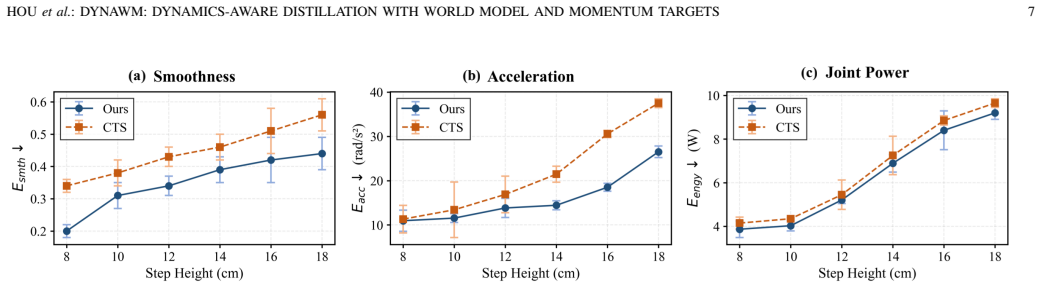
Recent advances in control have enabled bipedal-wheeled robots to traverse slopes and single-step obstacles, yet long staircase traversal remains challenging as current teacher-student frameworks suffer from weakened dynamics-aware representations and incomplete terrain geometry encoding. To bridge this gap, we propose DynaWM, a dynamics-aware representation learning framework. To enhance terrain encoding capability and enable transparent assessment, we introduce a world model as a regularizer to enforce forward-dynamics awareness, preserving comprehensive terrain geometry while facilitating hierarchical encoding visualization. To stabilize knowledge transfer, we employ a momentum target encoder to provide consistent distillation targets, preventing dimensional collapse from non-stationary teacher updates. Evaluation of the learned representations through Principal Component Analysis (PCA) visualization and quantitative metrics reveals that our encoder hierarchically captures terrain geometry with higher terrain encoding capability, leading to enhanced terrain adaptability and motion smoothness. Experimental results in simulation and real hardware demonstrate that our method achieves superior terrain adaptability and motion smoothness, enabling bipedal-wheeled robots to overcome diverse continuous stairs, as shown in Fig. 1.
Figures


Figures from the paper (4 more)



Reference graph
Works this paper leans on
-
[1]
A Multimode Two-Wheel-Legged Land-Air Locomotion Robot and Its Cooperative Control,
J. G. et al., “A Multimode Two-Wheel-Legged Land-Air Locomotion Robot and Its Cooperative Control,”IEEE/ASME Trans. Mechatronics, vol. 29, no. 4, pp. 2557–2568, 2024
2024
-
[2]
Ascento: A two-wheeled jumping robot,
V . K. et al., “Ascento: A two-wheeled jumping robot,” in2019 IEEE Int. Conf. Robot. Automat. (ICRA), pp. 7515–7521, 2019
2019
-
[3]
Compliant Motion Control of Wheel-Legged Humanoid Robot on Rough Terrains,
L. Z. et al., “Compliant Motion Control of Wheel-Legged Humanoid Robot on Rough Terrains,”IEEE/ASME Trans. Mechatronics, vol. 29, no. 3, pp. 1949–1959, 2024
1949
-
[4]
Reinforcement learning for blind stair climbing with legged and wheeled-legged robots,
S. Chamorro, V . Klemm, M. de La Iglesia Valls, C. Pal, and R. Sieg- wart, “Reinforcement learning for blind stair climbing with legged and wheeled-legged robots,” in2024 IEEE Int. Conf. Robot. Automat. (ICRA), pp. 8081–8087, 2024
2024
-
[5]
S. Y . et al., “Multi-loco: Unifying multi-embodiment legged locomo- tion via reinforcement learning augmented diffusion,”arXiv preprint arXiv:2506.11470, 2025
-
[6]
TWIST: Teacher-student world model distillation for efficient sim-to-real transfer,
J. Y . et al., “TWIST: Teacher-student world model distillation for efficient sim-to-real transfer,” in2024 IEEE Int. Conf. Robot. Automat. (ICRA), pp. 9190–9196, 2024
2024
-
[7]
Learning perceptive humanoid locomotion over challenging terrain,
W. S. et al., “Learning perceptive humanoid locomotion over challenging terrain,”arXiv preprint arXiv:2503.00692, 2025
-
[8]
Not only rewards but also constraints: Applications on legged robot locomotion,
Y . K. et al., “Not only rewards but also constraints: Applications on legged robot locomotion,”IEEE Trans. Robot., vol. 40, pp. 2984–3003, 2024
2024
Show all 30 references
-
[9]
A reduction of imitation learning and structured prediction to no-regret online learning,
S. R. et al., “A reduction of imitation learning and structured prediction to no-regret online learning,”Journal of Machine Learning Research, vol. 15, pp. 627–635, 2011
2011
-
[10]
Unitracker: Learning universal whole-body motion tracker for humanoid robots,
K. Y . et al., “Unitracker: Learning universal whole-body motion tracker for humanoid robots,”arXiv preprint arXiv:2507.07356, 2025
2025
-
[11]
RMA: Rapid motor adaptation for legged robots,
A. K. et al., “RMA: Rapid motor adaptation for legged robots,” inProc. Robot.: Sci. Syst., pp. 1–10, 2021
2021
-
[12]
CTS: Concurrent teacher-student reinforcement learning for legged locomotion,
H. W. et al., “CTS: Concurrent teacher-student reinforcement learning for legged locomotion,”IEEE Robot. Automat. Lett., vol. 9, no. 11, pp. 9191–9198, 2024
2024
-
[13]
Dynamics-aware embeddings,
W. F. W. et al., “Dynamics-aware embeddings,” inInt. Conf. Learn. Represent. (ICLR), 2020
2020
-
[14]
A closer look at multimodal representation collapse,
A. C. et al., “A closer look at multimodal representation collapse,” in Proc. 42nd Int. Conf. Mach. Learn. (ICML), vol. 267 ofProc. Mach. Learn. Res., pp. 7555–7577, 2025
2025
-
[15]
Task-recency bias strikes back: Adapting covariances in exemplar-free class incremental learning,
G. R. et al., “Task-recency bias strikes back: Adapting covariances in exemplar-free class incremental learning,” inAdv. Neural Inf. Process. Syst. (NeurIPS), vol. 37, 2024
2024
-
[16]
Robust distillation for compute-in-memory: Realizing reliable intelligence using imperfect memristors,
Y . G. et al., “Robust distillation for compute-in-memory: Realizing reliable intelligence using imperfect memristors,”Res. Square, 2025
2025
-
[17]
Hallucinative topological memory for zero-shot visual planning,
K. L. et al., “Hallucinative topological memory for zero-shot visual planning,” inProc. 37th Int. Conf. Mach. Learn. (ICML), vol. 119 of Proc. Mach. Learn. Res., pp. 6259–6270, 2020
2020
-
[18]
Track any motions under any disturbances,
Z. Z. et al., “Track any motions under any disturbances,”arXiv preprint arXiv:2509.13833, 2025
2025
-
[19]
Liii. on lines and planes of closest fit to systems of points in space,
K. Pearson, “Liii. on lines and planes of closest fit to systems of points in space,”Philos. Mag., vol. 2, no. 11, pp. 559–572, 1901
1901
-
[20]
Field performance of novel citrus rootstocks grafted with ’valencia’ orange and their response to systemic delivery of oxytetracy- cline,
C. T. et al., “Field performance of novel citrus rootstocks grafted with ’valencia’ orange and their response to systemic delivery of oxytetracy- cline,”Plants, vol. 14, no. 19, 2025
2025
-
[21]
Preharvest uva-led enhancing growth and antioxidant properties of chinese cabbage microgreens: A comparative study of single versus fractionated irradiation patterns,
J. A. et al., “Preharvest uva-led enhancing growth and antioxidant properties of chinese cabbage microgreens: A comparative study of single versus fractionated irradiation patterns,”F oods, vol. 14, no. 23, 2025
2025
-
[22]
Deep residual learning for image recognition,
K. H. et al., “Deep residual learning for image recognition,” inProc. IEEE Conf. Comput. Vis. Pattern Recognit. (CVPR), pp. 770–778, 2016
2016
-
[23]
Bootstrap your own latent: A new approach to self- supervised learning,
J.-B. G. et al., “Bootstrap your own latent: A new approach to self- supervised learning,” inAdv. Neural Inf. Process. Syst. (NeurIPS), vol. 33, pp. 21271–21284, 2020
2020
-
[24]
Learning Humanoid Standing-up Control across Diverse Postures,
T. H. et al., “Learning Humanoid Standing-up Control across Diverse Postures,” inProc. Robot.: Sci. Syst., 2025
2025
-
[25]
Isaac gym: High performance gpu based physics simulation for robot learning,
V . M. et al., “Isaac gym: High performance gpu based physics simulation for robot learning,” inAdv. Neural Inf. Process. Syst. (NeurIPS), vol. 34, pp. 10482–10495, 2021
2021
-
[26]
Sim-to-real transfer of robotic control with dynamics randomization,
X. B. P. et al., “Sim-to-real transfer of robotic control with dynamics randomization,” in2018 IEEE Int. Conf. Robot. Automat. (ICRA), pp. 3803–3810, 2018
2018
-
[27]
Domain randomization for transferring deep neural networks from simulation to the real world,
J. T. et al., “Domain randomization for transferring deep neural networks from simulation to the real world,” in2017 IEEE/RSJ Int. Conf. Intell. Robots Syst. (IROS), pp. 23–30, 2017
2017
-
[28]
Principal component analysis,
M. G. et al., “Principal component analysis,”Nat. Rev. Methods Primers, vol. 2, p. 100, Dec. 2022
2022
-
[29]
Understanding intermediate layers using linear classifier probes,
G. Alain and Y . Bengio, “Understanding intermediate layers using linear classifier probes,” inInt. Conf. Learn. Represent. (ICLR), 2017
2017
-
[30]
Canonical correlation analysis: Review,
A. Bykhovskaya and V . Gorin, “Canonical correlation analysis: Review,” arXiv preprint arXiv:2411.15625, 2025
2025
Reviewed June 26, 2026 · model on record in the stance chip above.
Discussion (0). Sign in to comment.