REVIEW 3 major objections 6 minor 101 references
Last Layer Hamiltonian Monte Carlo
T0 review · 3 major / 6 minor · reviewed 2026-08-06 · deepseek-v4-flash
Pith's one-line read This paper argues that confining Hamiltonian Monte Carlo to a pre-trained network's last layer preserves the uncertainty-estimation benefits of full HMC at a fraction of its cost, and that on three driver action and intention recognition…
desk verdict Honest empirical comparison of last-layer HMC, but the headline 'competitive' claim is inflated by per-seed test-set tuning and the paper's own fixed-config results show the advantage mostly disappears. read the letter →
The pith
A machine-rendered reading of the paper's core claim, the machinery that carries it, and where it could break.
The reading
What carries the argument
The two-phase procedure is the core mechanism. Phase 1 trains the full network with a standard optimizer. Phase 2 freezes the encoder, extracts the penultimate-layer latent representation $z$ for each input, and runs HMC with the NUTS sampler over the last-layer weights $\theta_{LL}$ only, treating $\theta_{LL}$ as positions in a Hamiltonian system with an auxiliary momentum variable, using prior scale, burn-in, target acceptance probability, and number of chains as hyperparameters. The machinery's work is cost reduction: it converts HMC from a whole-network expense into a per-head expense whose marginal cost is negligible compared with computing $z$, while preserving a nonparametric, asymptotically exact posterior over the last layer.
What would settle it
Take one of the paper's datasets, fine-tune the ViT-Base backbone, and build an OOD set by perturbing video frames with noise that alters intermediate activations while leaving penultimate-layer features similar; if full-network HMC separates this set from in-distribution inputs with a clearly higher ROC-AUC than LL–HMC, then the last-layer-only posterior is not sufficient for OOD detection, directly contradicting the paper's central sufficiency claim.
Extended reading notes
Core claim
The paper's central claim is that HMC's expensive posterior sampling can be confined to the last layer of a pre-trained deep network without sacrificing competitive behavior: after ordinary optimization trains the backbone, the last layer is re-sampled with NUTS-based HMC, and the resulting posterior over last-layer weights yields predictive uncertainty that separates in-distribution from out-of-distribution driving maneuvers about as well as, or better than, five alternative last-layer probabilistic methods, while each additional parameter sample costs only thousands of FLOPs compared with the backbone's hundreds of billions. The paper further shows that additional samples plateau for classification accuracy but can still improve OOD detection, and that running multiple chains or starting from multiple initializations does not deliver consistent gains. These results are presented as evidence that LL–HMC is a computationally viable uncertainty estimator for data-intensive, resource-limited applications such as driver action and intention recognition.
Load-bearing premise
The paper assumes that all task-relevant predictive uncertainty lives in the last layer of a fixed, pre-trained feature extractor, so that sampling only those weights is enough for reliable uncertainty estimates; if uncertainty in the backbone's feature extraction matters, as it may for out-of-distribution inputs that activate the network differently, LL–HMC misses it.
Editorial extensions
If this is right
- LL–HMC gives safety-critical perception systems a practical route to probabilistic last-layer uncertainty: every additional posterior sample adds roughly $7.68\times 10^{3}$ FLOPs per video versus $361\times 10^{9}$ for the backbone.
- In-distribution classification performance plateaus after roughly 5–10 posterior samples, so small sample counts suffice for ordinary recognition tasks.
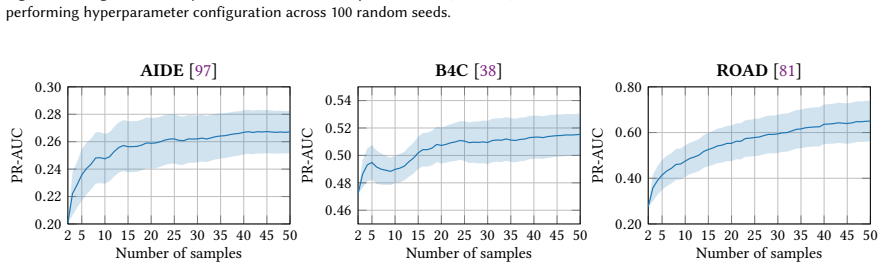
- Adding more samples from the same chain can improve OOD detection (for example, PR-AUC in the OOD-min setting) even after classification performance has saturated.
- Multiple chains or additional starting positions do not reliably help, so a single chain from one initialization is sufficient in practice.
- No single last-layer probabilistic method dominates across datasets; LL–HMC is competitive but not uniformly best, with performance-sensitive behavior on smaller and noisier datasets.
Reading between the lines
- The plateau of classification gains while OOD detection still improves suggests uncertainty information accrues more slowly than mean prediction, so sample count can be tuned separately for the two objectives; a conservative system might keep more samples only when OOD risk is high.
- The method inherits a structural blind spot: uncertainty about the feature representations themselves is unmodeled, so OOD inputs that shift the backbone's internal activations may be missed; combining LL–HMC with a feature-density method like DDU would be a natural test of whether the last layer is sufficient for feature-level shifts.
- Because the performance caveats concentrate on small and noisy datasets, LL–HMC's competitiveness likely depends on a well-trained, high-quality backbone; on poorly fine-tuned or out-of-domain features the posterior over the last layer may be overconfident.
Editorial analysis
A structured set of objections, weighed in public.
Referee Report
Summary. The paper proposes Last Layer Hamiltonian Monte Carlo (LL-HMC), which confines HMC/NUTS sampling to the final layer of a frozen, pre-trained DNN to estimate predictive uncertainty at low marginal cost. The method is evaluated on three video datasets for driver action and intention recognition (AIDE, B4C, ROAD), comparing classification accuracy/F1, calibration (ACE, rAULC), and OOD detection (ROC-AUC, PR-AUC, FPR95) against a deterministic softmax baseline, a deep ensemble, and five last-layer probabilistic baselines (BBB-LL, PE-LL, SE, VBLL, DDU). The authors report that LL-HMC achieves competitive in-distribution and OOD performance under top-per-seed hyperparameter configurations, that additional posterior samples do not improve classification but can improve OOD detection, and that multiple chains/starting positions yield no consistent gains. The paper also includes toy examples, an intermediate-layer analysis, and MCMC diagnostics such as ESS and R-hat.
Significance. If the empirical claims were robust, the paper would make a useful practical contribution: it shows that a gold-standard MCMC sampler can be restricted to the last layer at negligible marginal FLOPs compared with the backbone, and it provides a careful comparison on safety-relevant driving datasets. The authors deserve credit for releasing code, reporting multiple seeds, including MCMC diagnostics, and openly acknowledging the fixed-representation limitation and the fragility of the grid-search results. The significance is currently conditional, however: the central claim of competitiveness rests on per-seed test-set hyperparameter selection, and the paper's own fixed-configuration results show large degradations, especially on ROAD and in several OOD scenarios. Because the experimental protocol does not support the abstract's headline claim as stated, the paper's value depends on whether the authors can re-establish the claim under a proper nested or pre-registered evaluation.
major comments (3)
- [Section 4.4 / Tables 2 and 3] The headline competitiveness is not established because the reported top performance is selected per random seed on the test set. The LL-HMC grid in Section 4.4 contains 6 prior SDs × 5 burn-in values × 3 acceptance rates × 2 chains × 11 sample counts = 1980 configurations, and Table 2 averages the best configuration per seed, evaluated on the test split. This is a form of test-set overfitting. The paper's own Table 3, which uses the single best average configuration across seeds, shows LL-HMC F1 dropping from 83.87 to 82.69 on AIDE, from 95.00 to 90.17 on B4C, and from 54.18 to 32.03 on ROAD; the OOD PR-AUC for AIDE OOD-min drops from 0.58 in Table 5 to 0.18 in Table 6. Because LL-HMC's grid is much larger than those of the comparisons (e.g., BBB-LL has 450 configurations per Table 1), its per-seed top result has more opportunities for selection bias. A nested validation scheme, or a pre-registered fixed configuration per method, is required before the abstract's claim of competitive performance can be accepted.
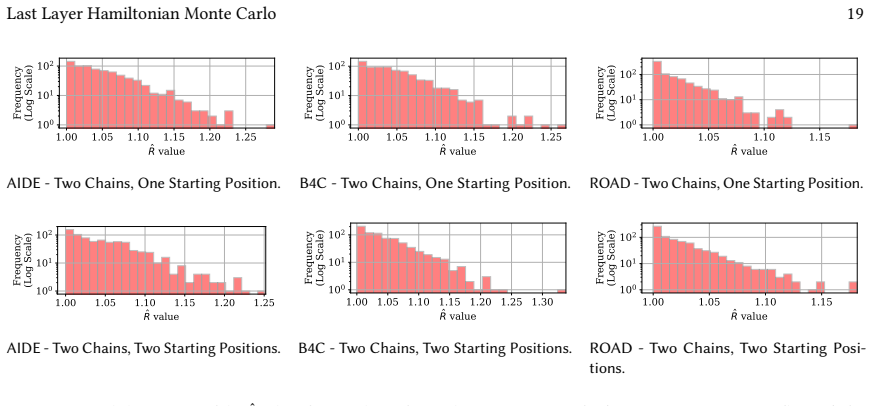
- [Section 5.1 / Figure 9] The MCMC diagnostics in Figure 9 show that for nearly all last-layer parameters the effective sample size (ESS) is below about 30, with a large fraction under 10, even though 50 samples are stored. The paper later interprets Figure 13 as showing that 'additional samples improve OOD detection,' but with this level of autocorrelation the additional draws carry little new information. Reporting the effective number of independent samples, or applying thinning as in Appendix A, would clarify whether the improvement comes from more posterior information or simply from averaging a longer autocorrelated chain. As written, the claim that additional sampled last-layer parameters can improve OOD detection is not supported by statistically independent samples.
- [Section 6 / Section 3.1] The paper itself concedes in Section 6 that 'its reliance on fixed pre-trained representations comes at the cost of not capturing the uncertainty inherent in the feature extraction layers of a deep neural network (DNN).' This is not a minor caveat; it defines the scope of the OOD claim. The toy experiments in Section 3.1 already illustrate that LL-HMC's uncertainty saturates and does not match full HMC in unobserved regions. Consequently, the OOD results in Tables 5–7 should be framed as evidence about last-layer uncertainty conditional on a frozen backbone, not as general OOD detection performance. The conclusions should be tempered accordingly, and the limitations should appear in the abstract or introduction if the empirical claims are to be interpreted correctly.
minor comments (6)
- [Section 2.1] Two nearly identical paragraphs discuss the computational cost and memory requirements of full HMC; they should be merged to avoid redundancy.
- [Section 2.1] The sentence 'how unlikely a particular parameter value is particular parameter value is given the observed data' contains a duplicated phrase and should read 'how unlikely a particular parameter value is given the observed data.'
- [Section 4.2] Equation (8) defines 2SEM, but the text sometimes refers to 'two standard errors' without specifying 'of the mean'; please be consistent.
- [Figure 5] The legend lists 'DE Regular,' which is ambiguous; use separate labels for 'DE (N=5)' and 'Regular.'
- [Appendix A] The thinning analysis is not referenced from the main text; add a pointer where ESS is discussed in Section 5.1.
- [Throughout] The manuscript mixes 'FLOPs' and 'FLOPS'; standardize to one spelling.
Circularity Check
No significant circularity: the paper is an empirical comparison with transparent grid-search limitations; test-set tuning is a selection-bias concern, not a circular derivation.
full rationale
This paper contains no derivation chain whose output reduces to its inputs. LL-HMC is defined by a concrete two-phase procedure (Algorithm 1): an optimization-trained backbone provides frozen latent representations, and NUTS-based HMC samples only the last-layer parameters from a posterior conditioned on those representations. The in-distribution and OOD evaluations are run on held-out test and OOD instances, so the reported metrics are not constructed from the method's definition. The main validity concern is that hyperparameter configurations are selected per random seed on the test data, and Section 5.1 itself discloses the fragility of this choice: 'Table 3 reveals that using the average hyperparameter configuration across seeds leads to significantly lower average in-distribution classification performance.' That is an experimental selection-bias problem, not a circularity of the kind defined here, because the paper does not rename a fitted quantity as an independent prediction. The self-citations are non-load-bearing: Vellenga et al. [89] is invoked only as a consistency remark about low ESS, and Vellenga et al. [90] describes the fine-tuning setup; neither supplies an unexamined premise that forces the central empirical claim. There is no imported uniqueness theorem, no ansatz smuggled in by citation, and no renaming of a known result as a new organization. The stated limitation in Section 6, that relying on fixed pre-trained representations omits feature-extraction uncertainty, is an acknowledged scope restriction rather than a hidden circular step. Accordingly, no circular step can be exhibited with a quote, and the honest finding is no significant circularity.
Assumptions & free parameters
free parameters (6)
- Last-layer prior standard deviation =
0.01 to 10 (grid searched)
- Burn-in samples =
10, 25, 50, 100, 200 (grid searched)
- Target acceptance probability =
0.6, 0.7, 0.8 (grid searched)
- Number of HMC chains =
1 or 2 (grid searched)
- Number of collected samples =
2, 5, 10, ..., 50 (grid searched)
- Backbone fine-tuning learning rate and epochs =
5e-5, 20 epochs (fixed)
assumptions (4)
- domain assumption The frozen pre-trained ViT-Base backbone provides a sufficient feature representation for driver action and intention recognition.
- domain assumption The posterior over last-layer parameters is approximately Gaussian-shaped enough for NUTS to sample it, and the samples are used as an approximate predictive distribution.
- domain assumption Predictive entropy is a valid uncertainty score for OOD detection.
- domain assumption Removing the most or least frequent classes from training and test sets creates a valid OOD evaluation.
Cite this review
Pith. "Pith review of Last Layer Hamiltonian Monte Carlo." pith.science (2026). https://pith.science/paper/2O56DF7R
@misc{pith2026250708905,
  author       = {Pith},
  title        = {Pith review of: Last Layer Hamiltonian Monte Carlo},
  year         = {2026},
  howpublished = {\url{https://pith.science/paper/2O56DF7R}},
  note         = {Machine review of arXiv:2507.08905}
}
read the original abstract
We explore the use of Hamiltonian Monte Carlo (HMC) sampling as a probabilistic last layer approach for deep neural networks (DNNs). While HMC is widely regarded as a gold standard for uncertainty estimation, the computational demands limit its application to large-scale datasets and large DNN architectures. Although the predictions from the sampled DNN parameters can be parallelized, the computational cost still scales linearly with the number of samples (similar to an ensemble). Last layer HMC (LL-HMC) reduces the required computations by restricting the HMC sampling to the final layer of a DNN, making it applicable to more data-intensive scenarios with limited computational resources. In this paper, we compare LL-HMC against five last layer probabilistic deep learning (LL-PDL) methods across three real-world video datasets for driver action and intention. We evaluate the in-distribution classification performance, calibration, and out-of-distribution (OOD) detection. Due to the stochastic nature of the probabilistic evaluations, we performed five grid searches for different random seeds to avoid being reliant on a single initialization for the hyperparameter configurations. The results show that LL-HMC achieves competitive in-distribution classification and OOD detection performance. Additional sampled last layer parameters do not improve the classification performance, but can improve the OOD detection. Multiple chains or starting positions did not yield consistent improvements.
Figures


Figures from the paper (13 more)






Reference graph
Works this paper leans on
-
[1]
Taiga Abe, Estefany Kelly Buchanan, Geoff Pleiss, Richard Zemel, and John P Cunningham. 2022. Deep ensembles work, but are they necessary? Advances in Neural Information Processing Systems35 (2022), 33646–33660
2022
-
[2]
Julyan Arbel, Konstantinos Pitas, Mariia Vladimirova, and Vincent Fortuin. 2023. A primer on Bayesian neural networks: review and debates. arXiv preprint arXiv:2309.16314(2023)
arXiv 2023
-
[3]
Anurag Arnab, Mostafa Dehghani, Georg Heigold, Chen Sun, Mario Lučić, and Cordelia Schmid. 2021. Vivit: A video vision transformer. In Proceedings of the IEEE/CVF International Conference on Computer Vision. 6836–6846
2021
-
[4]
Arsenii Ashukha, Alexander Lyzhov, Dmitry Molchanov, and Dmitry Vetrov. 2020. Pitfalls of In-Domain Uncertainty Estimation and Ensembling in Deep Learning. InInternational Conference on Learning Representations
2020
-
[5]
Mohini P Barde and Prajakt J Barde. 2012. What to use to express the variability of data: Standard deviation or standard error of mean?Perspectives in clinical research3, 3 (2012), 113–116
2012
-
[6]
Yoshua Bengio, Geoffrey Hinton, Andrew Yao, Dawn Song, Pieter Abbeel, Trevor Darrell, Yuval Noah Harari, Ya-Qin Zhang, Lan Xue, Shai Shalev-Shwartz, et al. 2024. Managing extreme AI risks amid rapid progress.Science384, 6698 (2024), 842–845
2024
-
[7]
Maximilian Benker, Lukas Furtner, Thomas Semm, and Michael F Zaeh. 2021. Utilizing uncertainty information in remaining useful life estimation via Bayesian neural networks and Hamiltonian Monte Carlo.Journal of Manufacturing Systems61 (2021), 799–807
2021
-
[8]
Leonard Berrada, Sumanth Dathathri, Krishnamurthy Dvijotham, Robert Stanforth, Rudy R Bunel, Jonathan Uesato, Sven Gowal, and M Pawan Kumar. 2021. Make sure you’re unsure: A framework for verifying probabilistic specifications.Advances in Neural Information Processing Systems 34 (2021), 11136–11147
2021
Show all 101 references
-
[9]
Michael Betancourt. 2017. A conceptual introduction to Hamiltonian Monte Carlo.arXiv preprint arXiv:1701.02434(2017)
2017 arXiv
-
[10]
Chen, Martin Jankowiak, Fritz Obermeyer, Neeraj Pradhan, Theofanis Karaletsos, Rohit Singh, Paul Szerlip, Paul Horsfall, and Noah D
Eli Bingham, Jonathan P. Chen, Martin Jankowiak, Fritz Obermeyer, Neeraj Pradhan, Theofanis Karaletsos, Rohit Singh, Paul Szerlip, Paul Horsfall, and Noah D. Goodman. 2018. Pyro: Deep Universal Probabilistic Programming.Journal of Machine Learning Research(2018)
2018
-
[11]
David M Blei, Alp Kucukelbir, and Jon D McAuliffe. 2017. Variational inference: A review for statisticians.Journal of the American statistical Association112, 518 (2017), 859–877
2017
-
[12]
Charles Blundell, Julien Cornebise, Koray Kavukcuoglu, and Daan Wierstra. 2015. Weight uncertainty in neural network. InInternational Conference on Machine Learning. PMLR, 1613–1622
2015
-
[13]
Xavier Bouthillier, César Laurent, and Pascal Vincent. 2019. Unreproducible research is reproducible. InInternational Conference on Machine Learning. PMLR, 725–734
2019
-
[14]
Changyou Chen, Nan Ding, and Lawrence Carin. 2015. On the convergence of stochastic gradient MCMC algorithms with high-order integrators. Advances in neural information processing systems28 (2015)
2015
-
[15]
Tianqi Chen, Emily Fox, and Carlos Guestrin. 2014. Stochastic gradient hamiltonian monte carlo. InInternational conference on machine learning. PMLR, 1683–1691
2014
-
[16]
Adam D Cobb and Brian Jalaian. 2021. Scaling Hamiltonian Monte Carlo inference for Bayesian neural networks with symmetric splitting. In Uncertainty in Artificial Intelligence. PMLR, 675–685. 24 Vellenga et al
2021
-
[17]
Adam D Cobb, Stephen J Roberts, and Yarin Gal. 2018. Loss-calibrated approximate inference in Bayesian neural networks.arXiv preprint arXiv:1805.03901(2018)
2018 arXiv
-
[18]
Yimian Dai, Fabian Gieseke, Stefan Oehmcke, Yiquan Wu, and Kobus Barnard. 2021. Attentional feature fusion. InProceedings of the IEEE/CVF winter conference on applications of computer vision. 3560–3569
2021
-
[19]
Armen Der Kiureghian and Ove Ditlevsen. 2009. Aleatory or epistemic? Does it matter?Structural safety31, 2 (2009), 105–112
2009
-
[20]
Nikita Durasov, Nik Dorndorf, Hieu Le, and Pascal Fua. 2024. ZigZag: Universal Sampling-free Uncertainty Estimation Through Two-Step Inference. Transactions on Machine Learning Research(2024)
2024
-
[21]
Gianni Franchi, Olivier Laurent, Maxence Leguéry, Andrei Bursuc, Andrea Pilzer, and Angela Yao. 2024. Make Me a BNN: A Simple Strategy for Estimating Bayesian Uncertainty from Pre-trained Models. InProceedings of the IEEE/CVF Conference on Computer Vision and Pattern Recogniti...
2024
-
[22]
Yarin Gal and Zoubin Ghahramani. 2016. Dropout as a Bayesian approximation: Representing model uncertainty in deep learning.International conference on machine learning(2016), 1050–1059
2016
-
[23]
Jakob Gawlikowski, Cedrique Rovile Njieutcheu Tassi, Mohsin Ali, Jongseok Lee, Matthias Humt, Jianxiang Feng, Anna Kruspe, Rudolph Triebel, Peter Jung, Ribana Roscher, et al. 2023. A survey of uncertainty in deep neural networks.Artificial Intelligence Review56, Suppl 1 (2023)...
2023
-
[24]
Patrick Gebert, Alina Roitberg, Monica Haurilet, and Rainer Stiefelhagen. 2019. End-to-end prediction of driver intention using 3D convolutional neural networks. In2019 IEEE Intelligent Vehicles Symposium (IV). IEEE, 969–974
2019
-
[25]
Andrew Gelman and Donald B Rubin. 1992. Inference from iterative simulation using multiple sequences.Statistical science7, 4 (1992), 457–472
1992
-
[26]
Charles J Geyer. 1992. Practical Markov Chain Monte Carlo.Statistical science(1992), 473–483
1992
-
[27]
Charles J Geyer. 2011. Introduction to Markov chain Monte Carlo.Handbook of Markov chain Monte Carlo(2011)
2011
-
[28]
Chuan Guo, Geoff Pleiss, Yu Sun, and Kilian Q Weinberger. 2017. On calibration of modern neural networks. InInternational Conference on Machine Learning. PMLR, 1321–1330
2017
-
[29]
Maryam Habibpour, Hassan Gharoun, Mohammadreza Mehdipour, AmirReza Tajally, Hamzeh Asgharnezhad, Afshar Shamsi, Abbas Khosravi, and Saeid Nahavandi. 2023. Uncertainty-aware credit card fraud detection using deep learning.Engineering Applications of Artificial Intelligence123 (...
2023
-
[30]
James Harrison, John Willes, and Jasper Snoek. 2024. Variational Bayesian last layers.The Twelfth International Conference on Learning Representations(2024)
2024
-
[31]
W Keith Hastings. 1970. Monte Carlo sampling methods using Markov chains and their applications. (1970)
1970
-
[32]
Dan Hendrycks, Nicholas Carlini, John Schulman, and Jacob Steinhardt. 2021. Unsolved problems in ml safety.arXiv preprint arXiv:2109.13916 (2021)
2021 arXiv
-
[33]
Matthew D Hoffman, David M Blei, Chong Wang, and John Paisley. 2013. Stochastic variational inference.Journal of Machine Learning Research (2013)
2013
-
[34]
Matthew D Hoffman, Andrew Gelman, et al. 2014. The No-U-Turn sampler: adaptively setting path lengths in Hamiltonian Monte Carlo.J. Mach. Learn. Res.15, 1 (2014), 1593–1623
2014
-
[35]
Eyke Hüllermeier, Sébastien Destercke, and Mohammad Hossein Shaker. 2022. Quantification of credal uncertainty in machine learning: A critical analysis and empirical comparison. InUncertainty in Artificial Intelligence. PMLR, 548–557
2022
-
[36]
Eyke Hüllermeier and Willem Waegeman. 2021. Aleatoric and epistemic uncertainty in machine learning: An introduction to concepts and methods.Machine learning110, 3 (2021), 457–506
2021
-
[37]
Pavel Izmailov, Sharad Vikram, Matthew D Hoffman, and Andrew Gordon Gordon Wilson. 2021. What are Bayesian neural network posteriors really like?. InInternational conference on machine learning. PMLR, 4629–4640
2021
-
[38]
Ashesh Jain, Hema S Koppula, Bharad Raghavan, Shane Soh, and Ashutosh Saxena. 2015. Car that knows before you do: Anticipating maneuvers via learning temporal driving models. InProceedings of the IEEE International Conference on Computer Vision. 3182–3190
2015
-
[39]
Michael I Jordan, Zoubin Ghahramani, Tommi S Jaakkola, and Lawrence K Saul. 1999. An introduction to variational methods for graphical models. Machine learning37, 2 (1999), 183–233
1999
-
[40]
Laurent Valentin Jospin, Hamid Laga, Farid Boussaid, Wray Buntine, and Mohammed Bennamoun. 2022. Hands-on Bayesian neural networks—A tutorial for deep learning users.IEEE Computational Intelligence Magazine17, 2 (2022), 29–48
2022
-
[41]
Will Kay, Joao Carreira, Karen Simonyan, Brian Zhang, Chloe Hillier, Sudheendra Vijayanarasimhan, Fabio Viola, Tim Green, Trevor Back, Paul Natsev, et al. 2017. The kinetics human action video dataset.arXiv preprint arXiv:1705.06950(2017)
2017 arXiv
-
[42]
Diederik P Kingma and Max Welling. 2014. Auto-encoding variational bayes.International Conference on Learning Representations(2014)
2014
-
[43]
Vignesh Kothapalli. 2023. Neural Collapse: A Review on Modelling Principles and Generalization.Transactions on Machine Learning Research (2023)
2023
-
[44]
2022.Bayesian-Torch: Bayesian neural network layers for uncertainty estimation
Ranganath Krishnan, Pi Esposito, and Mahesh Subedar. 2022.Bayesian-Torch: Bayesian neural network layers for uncertainty estimation. doi:10. 5281/zenodo.5908307
2022
-
[45]
Balaji Lakshminarayanan, Alexander Pritzel, and Charles Blundell. 2017. Simple and scalable predictive uncertainty estimation using deep ensembles.Advances in neural information processing systems30 (2017)
2017
-
[46]
Olivier Laurent, Emanuel Aldea, and Gianni Franchi. 2024. A Symmetry-Aware Exploration of Bayesian Neural Network Posteriors. InThe Twelfth International Conference on Learning Representations. Last Layer Hamiltonian Monte Carlo 25
2024
-
[47]
Olivier Laurent, Adrien Lafage, Enzo Tartaglione, Geoffrey Daniel, Jean-marc Martinez, Andrei Bursuc, and Gianni Franchi. 2023. Packed Ensembles for efficient uncertainty estimation. InThe Eleventh International Conference on Learning Representations
2023
-
[48]
Stefan Lee, Senthil Purushwalkam, Michael Cogswell, David Crandall, and Dhruv Batra. 2015. Why m heads are better than one: Training a diverse ensemble of deep networks.arXiv preprint arXiv:1511.06314(2015)
2015 arXiv
-
[49]
Zhize Li, Tianyi Zhang, Shuyu Cheng, Jun Zhu, and Jian Li. 2019. Stochastic gradient hamiltonian monte carlo with variance reduction for bayesian inference.Machine Learning108, 8 (2019), 1701–1727
2019
-
[50]
Phillip Lippe. 2022. UvA Deep Learning Tutorials. https://uvadlc-notebooks.readthedocs.io/en/latest/
2022
-
[51]
Ilya Loshchilov and Frank Hutter. 2018. Decoupled Weight Decay Regularization. InInternational Conference on Learning Representations
2018
-
[52]
Will Maddern, Geoff Pascoe, Chris Linegar, and Paul Newman. 2017. 1 Year, 1000km: The Oxford RobotCar Dataset.The International Journal of Robotics Research (IJRR)36, 1 (2017), 3–15. doi:10.1177/0278364916679498 arXiv:http://ijr.sagepub.com/content/early/2016/11/28/02783649166...
2017 doi
-
[53]
Wesley J Maddox, Pavel Izmailov, Timur Garipov, Dmitry P Vetrov, and Andrew Gordon Wilson. 2019. A simple baseline for Bayesian uncertainty in deep learning.Advances in Neural Information Processing Systems32 (2019), 13153–13164
2019
-
[54]
Andrey Malinin and Mark Gales. 2018. Predictive uncertainty estimation via prior networks.Advances in neural information processing systems31 (2018)
2018
-
[55]
Shireen Kudukkil Manchingal and Fabio Cuzzolin. 2025. Position: Epistemic Artificial Intelligence is Essential for Machine Learning Models to Know When They Do Not Know.arXiv preprint arXiv:2505.04950(2025)
2025 arXiv
-
[56]
Lassi Meronen, Martin Trapp, Andrea Pilzer, Le Yang, and Arno Solin. 2024. Fixing overconfidence in dynamic neural networks. InProceedings of the IEEE/CVF winter conference on applications of computer vision. 2680–2690
2024
-
[57]
Nicholas Metropolis, Arianna W Rosenbluth, Marshall N Rosenbluth, Augusta H Teller, and Edward Teller. 1953. Equation of state calculations by fast computing machines.The journal of chemical physics21, 6 (1953), 1087–1092
1953
-
[58]
Grégoire Montavon, Mikio L Braun, and Klaus-Robert Müller. 2011. Kernel Analysis of Deep Networks.Journal of Machine Learning Research12, 9 (2011)
2011
-
[59]
Bálint Mucsányi, Michael Kirchhof, and Seong Joon Oh. 2024. Benchmarking uncertainty disentanglement: Specialized uncertainties for specialized tasks.Advances in neural information processing systems37 (2024), 50972–51038
2024
-
[60]
Jishnu Mukhoti, Andreas Kirsch, Joost van Amersfoort, Philip HS Torr, and Yarin Gal. 2023. Deep deterministic uncertainty: A new simple baseline. InProceedings of the IEEE/CVF Conference on Computer Vision and Pattern Recognition. 24384–24394
2023
-
[61]
Mahdi Pakdaman Naeini, Gregory Cooper, and Milos Hauskrecht. 2015. Obtaining well calibrated probabilities using bayesian binning. In Proceedings of the AAAI conference on artificial intelligence, Vol. 29
2015
-
[62]
1996.Bayesian learning for neural networks
Radford M Neal. 1996.Bayesian learning for neural networks. Springer Science & Business Media. 29–53 pages
1996
-
[63]
Khanh TP Nguyen, Kamal Medjaher, and Christian Gogu. 2022. Probabilistic deep learning methodology for uncertainty quantification of remaining useful lifetime of multi-component systems.Reliability Engineering & System Safety222 (2022), 108383
2022
-
[64]
Jeremy Nixon, Michael W Dusenberry, Linchuan Zhang, Ghassen Jerfel, and Dustin Tran. 2019. Measuring Calibration in Deep Learning.. InCVPR Workshops, Vol. 2
2019
-
[65]
Chihiro Noguchi and Toshihiro Tanizawa. 2023. Ego-Vehicle Action Recognition based on Semi-Supervised Contrastive Learning. InProceedings of the IEEE/CVF Winter Conference on Applications of Computer Vision. 5988–5998
2023
-
[66]
Theodore Papamarkou, Maria Skoularidou, Konstantina Palla, Laurence Aitchison, Julyan Arbel, David Dunson, Maurizio Filippone, Vincent Fortuin, Philipp Hennig, et al. 2024. Position: Bayesian Deep Learning is Needed in the Age of Large-Scale AI. InForty-first International Con...
2024
-
[67]
Vardan Papyan, XY Han, and David L Donoho. 2020. Prevalence of neural collapse during the terminal phase of deep learning training.Proceedings of the National Academy of Sciences117, 40 (2020), 24652–24663
2020
-
[68]
Fabian Pedregosa, Gaël Varoquaux, Alexandre Gramfort, Vincent Michel, Bertrand Thirion, Olivier Grisel, Mathieu Blondel, Peter Prettenhofer, Ron Weiss, Vincent Dubourg, et al. 2011. Scikit-learn: Machine learning in Python.the Journal of machine Learning research12 (2011), 2825–2830
2011
-
[69]
Luis Moniz Pereira et al. 2013. State-of-the-art of intention recognition and its use in decision making.AI Communications26, 2 (2013), 237–246
2013
-
[70]
Luís Moniz Pereira and The Anh Han. 2009. Elder care via intention recognition and evolution prospection. InInternational Conference on Applications of Declarative Programming and Knowledge Management. Springer, 170–187
2009
-
[71]
Gábor Pituk, Vik Shirvaikar, and Tom Rainforth. 2025. Do Bayesian Neural Networks Actually Behave Like Bayesian Models?. InForty-second International Conference on Machine Learning
2025
-
[72]
Janis Postels, Mattia Segù, Tao Sun, Luca Daniel Sieber, Luc Van Gool, Fisher Yu, and Federico Tombari. 2022. On the Practicality of Deterministic Epistemic Uncertainty. InInternational Conference on Machine Learning. PMLR, 17870–17909
2022
-
[73]
Lorena Qendro, Alexander Campbell, Pietro Lio, and Cecilia Mascolo. 2021. Early exit ensembles for uncertainty quantification. InMachine Learning for Health. PMLR, 181–195
2021
-
[74]
Jing Qi, Li Ma, Zhenchao Cui, and Yushu Yu. 2024. Computer vision-based hand gesture recognition for human-robot interaction: a review. Complex & Intelligent Systems10, 1 (2024), 1581–1606
2024
-
[75]
Yao Rong, Zeynep Akata, and Enkelejda Kasneci. 2020. Driver Intention Anticipation Based on In-Cabin and Driving Scene Monitoring. In2020 IEEE 23rd International Conference on Intelligent Transportation Systems (ITSC). IEEE, 1–8. 26 Vellenga et al
2020
-
[76]
Cynthia Rudin. 2019. Stop explaining black box machine learning models for high stakes decisions and use interpretable models instead.Nature machine intelligence1, 5 (2019), 206–215
2019
-
[77]
Fariba Sadri. 2011. Logic-based approaches to intention recognition. InHandbook of research on ambient intelligence and smart environments: Trends and perspectives. IGI Global, 346–375
2011
-
[78]
Tim Salimans, Diederik Kingma, and Max Welling. 2015. Markov chain monte carlo and variational inference: Bridging the gap. InInternational conference on machine learning. PMLR, 1218–1226
2015
-
[79]
Glenn Shafer and Vladimir Vovk. 2008. A tutorial on conformal prediction.Journal of Machine Learning Research9, 3 (2008)
2008
-
[80]
Olger Siebinga, Arkady Zgonnikov, and David Abbink. 2023. Uncovering variability in human driving behavior through automatic extraction of similar traffic scenes from large naturalistic datasets. In2023 IEEE International Conference on Systems, Man, and Cybernetics (SMC). IEEE...
2023
-
[81]
Gurkirt Singh, Stephen Akrigg, Manuele Di Maio, Valentina Fontana, Reza Javanmard Alitappeh, Suman Saha, Kossar Jeddisaravi, Farzad Yousefi, Jacob Culley, Tom Nicholson, et al. 2022. ROAD: The ROad event Awareness Dataset for autonomous Driving.IEEE Transactions on Pattern Ana...
2022
-
[82]
Lewis Smith and Yarin Gal. 2018. Understanding measures of uncertainty for adversarial example detection.arXiv preprint arXiv:1803.08533(2018)
2018 arXiv
-
[83]
Jasper Snoek, Oren Rippel, Kevin Swersky, Ryan Kiros, Nadathur Satish, Narayanan Sundaram, Mostofa Patwary, Mr Prabhat, and Ryan Adams
-
[84]
Sylvain Gugger, Lysandre Debut, Thomas Wolf, Philipp Schmid, Zachary Mueller, Sourab Mangrulkar, Marc Sun, Benjamin Bossan. 2022. Accelerate: Training and inference at scale made simple, efficient and adaptable. https://github.com/huggingface/accelerate
2022
-
[85]
Zhan Tong, Yibing Song, Jue Wang, and Limin Wang. 2022. Videomae: Masked autoencoders are data-efficient learners for self-supervised video pre-training.Advances in neural information processing systems35 (2022), 10078–10093
2022
-
[86]
Matias Valdenegro-Toro. 2023. Sub-ensembles for fast uncertainty estimation in neural networks. InProceedings of the IEEE/CVF International Conference on Computer Vision. 4119–4127
2023
-
[87]
Joost Van Amersfoort, Lewis Smith, Yee Whye Teh, and Yarin Gal. 2020. Uncertainty estimation using a single deep deterministic neural network. InInternational conference on machine learning. PMLR, 9690–9700
2020
-
[88]
Florian D van Leeuwen and Sara van Erp. 2025. To MCMC or not to MCMC: Evaluating non-MCMC methods for Bayesian penalized regression. arXiv preprint arXiv:2510.20947(2025)
2025
-
[89]
Koen Vellenga, Alexander Karlsson, H Joe Steinhauer, Göran Falkman, and Anders Sjögren. 2024. PT-HMC: Optimization-based Pre-Training with Hamiltonian Monte-Carlo Sampling for Driver Intention Recognition.ACM Transactions on Probabilistic Machine Learning(2024)
2024
-
[90]
Koen Vellenga, H Joe Steinhauer, Göran Falkman, and Tomas Björklund. 2024. Evaluation of Video Masked Autoencoders’ Performance and Uncertainty Estimations for Driver Action and Intention Recognition. InProceedings of the IEEE/CVF Winter Conference on Applications of Computer ...
2024
-
[91]
Koen Vellenga, H Joe Steinhauer, Alexander Karlsson, Göran Falkman, Asli Rhodin, and Ashok Chaitanya Koppisetty. 2022. Driver intention recognition: State-of-the-art review.IEEE Open Journal of Intelligent Transportation Systems(2022)
2022
-
[92]
Kaizheng Wang, Fabio Cuzzolin, Keivan Shariatmadar, David Moens, and Hans Hallez. 2024. Credal Wrapper of Model Averaging for Uncertainty Estimation in Classification. InThe Thirteenth International Conference on Learning Representations
2024
-
[93]
Yixuan Wang, Ruochen Jiao, Simon Sinong Zhan, Chengtian Lang, Chao Huang, Zhaoran Wang, Zhuoran Yang, and Qi Zhu. [n. d.]. Empowering Autonomous Driving with Large Language Models: A Safety Perspective. InICLR 2024 Workshop on Large Language Model (LLM) Agents
2024
-
[94]
Joe Watson, Jihao Andreas Lin, Pascal Klink, Joni Pajarinen, and Jan Peters. 2021. Latent Derivative Bayesian Last Layer Networks. InInternational Conference on Artificial Intelligence and Statistics. PMLR, 1198–1206
2021
-
[95]
Max Welling and Yee W Teh. 2011. Bayesian learning via stochastic gradient Langevin dynamics. InProceedings of the 28th international conference on machine learning (ICML-11). Citeseer, 681–688
2011
-
[96]
Andrew G Wilson and Pavel Izmailov. 2020. Bayesian deep learning and a probabilistic perspective of generalization.Advances in neural information processing systems(2020), 4697–4708
2020
-
[97]
Dingkang Yang, Shuai Huang, Zhi Xu, Zhenpeng Li, Shunli Wang, Mingcheng Li, Yuzheng Wang, Yang Liu, Kun Yang, Zhaoyu Chen, et al. 2023. Aide: A vision-driven multi-view, multi-modal, multi-tasking dataset for assistive driving perception. InProceedings of the IEEE/CVF Internat...
2023
-
[98]
Jingkang Yang, Kaiyang Zhou, Yixuan Li, and Ziwei Liu. 2024. Generalized out-of-distribution detection: A survey.International Journal of Computer Vision132, 12 (2024), 5635–5662
2024
-
[99]
Xinlei Zhou, Han Liu, Farhad Pourpanah, Tieyong Zeng, and Xizhao Wang. 2022. A survey on epistemic (model) uncertainty in supervised learning: Recent advances and applications.Neurocomputing(2022), 449–465
2022
-
[100]
Ke Zou, Zhihao Chen, Xuedong Yuan, Xiaojing Shen, Meng Wang, and Huazhu Fu. 2023. A review of uncertainty estimation and its application in medical imaging.Meta-Radiology1, 1 (2023), 100003. Last Layer Hamiltonian Monte Carlo 27 0.50 0.25 0.00 0.25 0.50 0.75 1.00 1.25 1.50 Obs...
2023
-
[2015]
InInternational conference on machine learning
Scalable Bayesian optimization using deep neural networks. InInternational conference on machine learning. PMLR, 2171–2180
Reviewed August 6, 2026 · model on record in the stance chip above.
Discussion (0). Continue with ORCID to comment.