REVIEW 6 minor 1 cited by
On the accuracy of symplectic integrators for secularly evolving planetary systems
T0 review · 0 major / 6 minor · reviewed 2026-08-14 · deepseek-v4-flash
Pith's one-line read Symplectic correctors cut energy error 1000x but not secular frequencies
desk verdict A solid methods paper: it convincingly shows energy error alone misjudges symplectic integrators for secular dynamics, and the WHC result should change how the field validates long integrations. read the letter →
The pith
A machine-rendered reading of the paper's core claim, the machinery that carries it, and where it could break.
The reading
What carries the argument
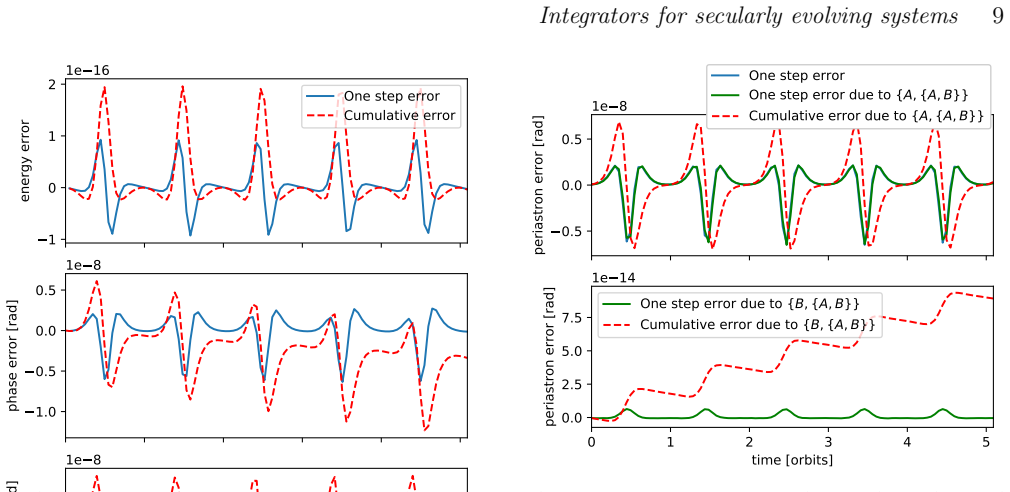
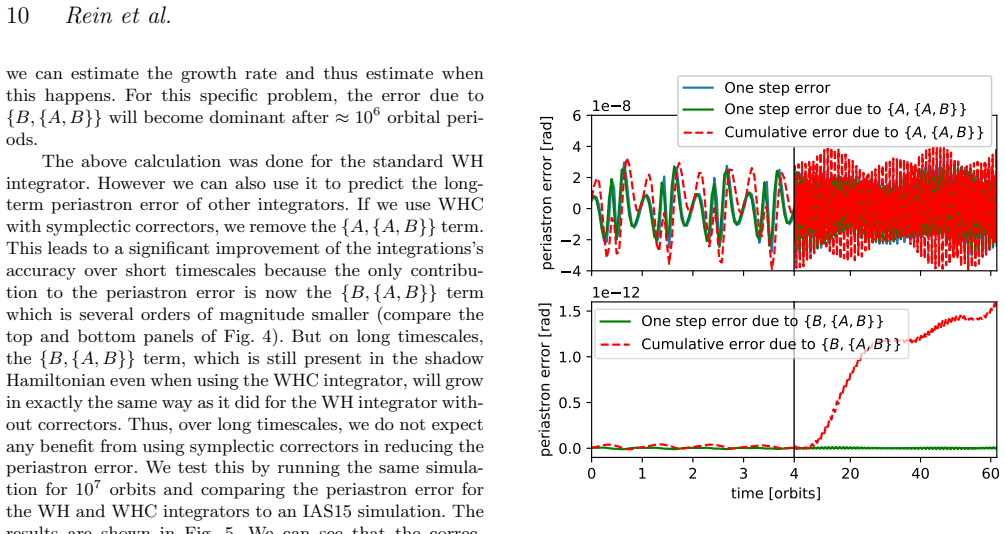
The machinery is the shadow Hamiltonian of the split integrator plus a composition-operator method that evaluates the effect of an individual Poisson-bracket term on any observable without computing derivatives. For WH, the shadow Hamiltonian contains $t^{2}$ {A,{A,B}} and $t^{2}$ {B,{A,B}} at order $t^{3}$. The paper constructs operators C^AAB_t and C^BAB_t from the already-available Kepler and kick evolutions, which reproduce to leading order the evolution generated by {A,{A,B}} and {B,{A,B}}. These operators let the authors compute periastron and phase errors due to each term, show that the {B,{A,B}} errors accumulate linearly, and predict the crossover timescale without running long integrations.
What would settle it
In the same 20-Myr inner Solar System setup, replace IAS15 with an independent high-accuracy reference, such as an even tighter-tolerance IAS15 or a different high-order integrator, and compare WH versus WHC at timesteps around 8 to 20 days: if WHC's g1 or g2 error becomes clearly smaller than WH's once the reference changes, the central paradox disappears.
Extended reading notes
Core claim
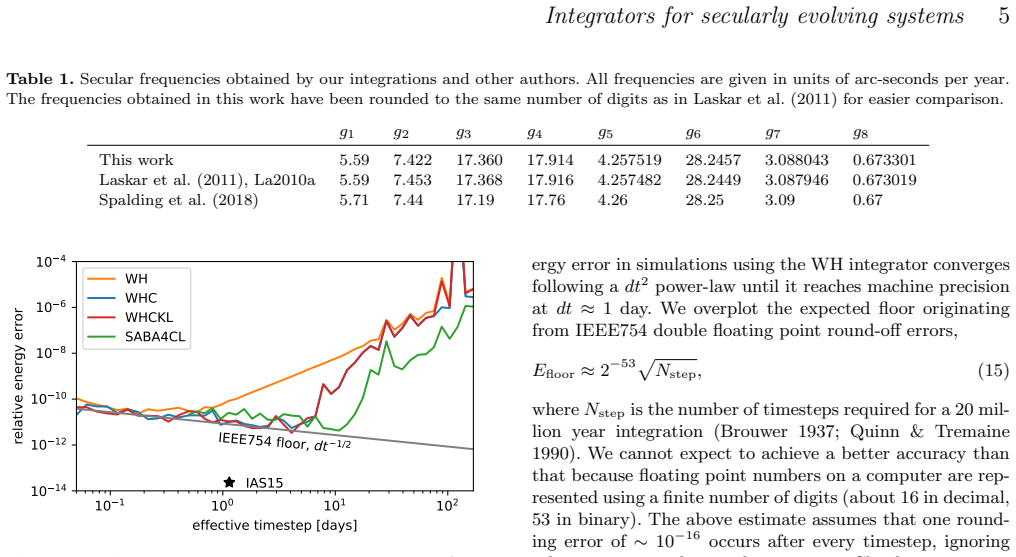
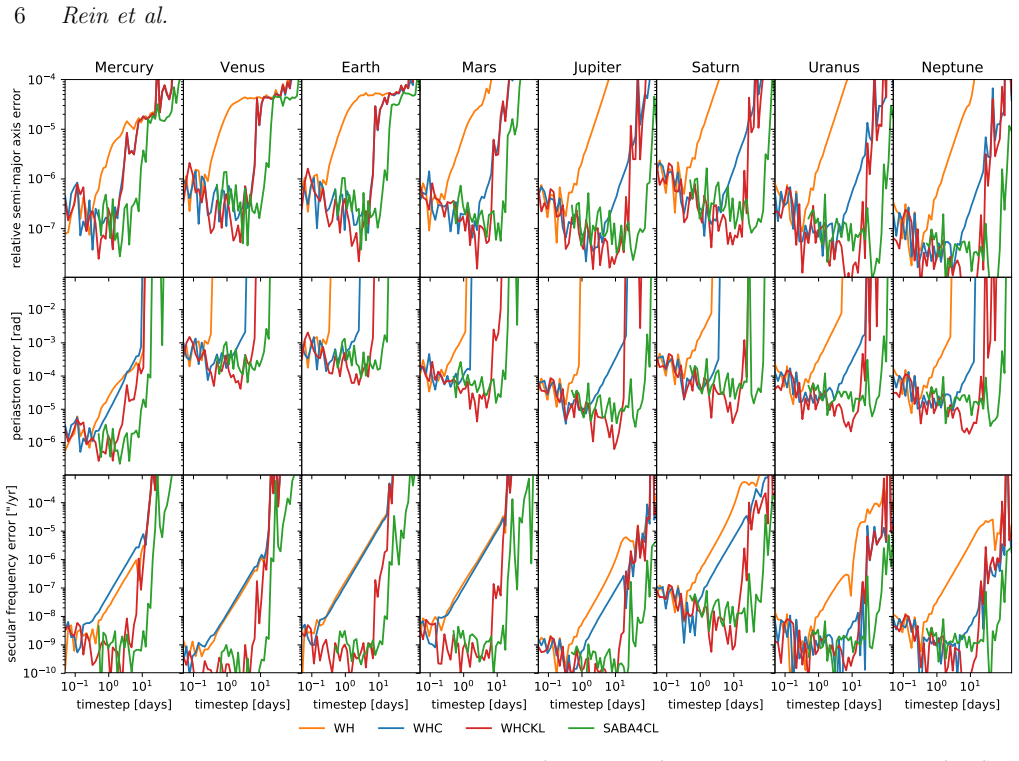
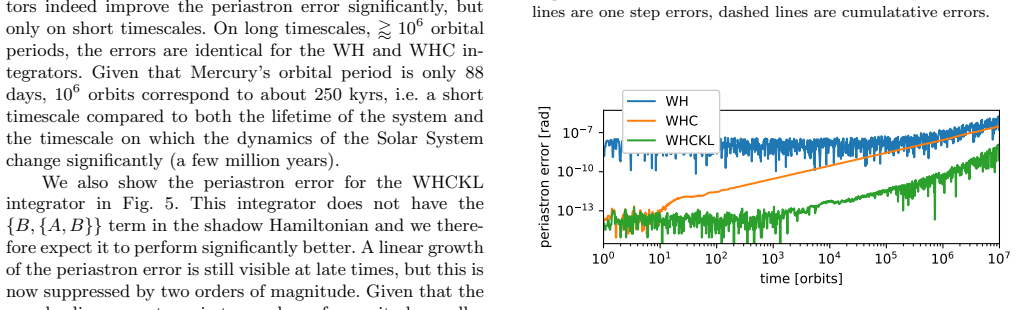
The central discovery is that the error of a symplectic integrator in a secularly evolving planetary system is controlled not by the size of the shadow-Hamiltonian terms but by whether a given term produces oscillatory or secular errors. For the Wisdom-Holman split H=A+B, the leading correction {A,{A,B}} (order ϵ $dt^{2}$) oscillates and averages out in the periastron, so removing it with correctors does not help long-term secular accuracy. The smaller term {B,{A,B}} (order $ϵ^{2}$ $dt^{2}$) generates a non-oscillatory, linearly growing periastron error that dominates after roughly $10^{5}$ to $10^{6}$ orbits; once it dominates, standard WH and corrected WHC have the same secular-frequency error despite a $10^{3}$ difference in energy error. Integrators that explicitly remove {B,{A,B}}, namely WHCKL and SABACL4, restore the expected gain in secular accuracy.
Load-bearing premise
The reference 'true solution' is the IAS15 integration; if IAS15 itself had appreciable secular-frequency error, the measured ordering of the methods could be distorted.
Editorial extensions
If this is right
- Energy conservation alone is not a sufficient convergence test for secularly evolving planetary systems; round-off-level energy error does not mean the trajectory has converged.
- For inner Solar System secular frequencies over about 20 Myr, WHC buys nothing over WH near their recommended timestep, despite a 10^3 smaller energy error.
- WHCKL and SABACL4, which remove the {B,{A,B}} term, deliver substantially better periastron and secular-frequency accuracy.
- With such methods at a 10-day timestep, about eight steps per Mercury period, Mercury's secular frequency g1 can be determined to 10^-9 arc-seconds per year in this model.
- Over very long timescales the error budget is a sum of oscillatory discretization error, secularly growing discretization error, round-off error, and chaotic divergence; the composition operators identify which term dominates.
Reading between the lines
- The same composition-operator technique could be applied to other observables, such as resonant angles, tidal or general-relativistic precession rates, to identify non-oscillatory error terms that energy checks miss.
- For exoplanet stability surveys that use WH-family integrators, this suggests a validation protocol: check convergence of the system's secular frequencies, not just energy, because artificial periastron precession could bias resonance boundaries.
- A testable extension would vary the planet mass ratio epsilon and orbital period in a two-planet system to map where the {B,{A,B}} crossover time falls, giving a practical rule for when correctors are worthwhile.
- The framework implies that labels like 'higher-order' or 'corrector-enhanced' do not guarantee long-term accuracy unless the specific non-oscillatory term in the shadow Hamiltonian is removed.
Signed reviews
Editorial analysis
A structured set of objections, weighed in public.
Referee Report
Summary. The paper performs 20 Myr integrations of the Solar System with REBOUND using the WH, WHC, WHCKL, and SABACL4 symplectic integrators and an IAS15 reference solution. It compares energy error, semi-major axis error, periastron error, and the g-mode secular frequencies. The central finding is that adding high-order symplectic correctors to WH reduces energy error by orders of magnitude but does not improve the accuracy of the inner-planet secular frequencies, and can even slightly degrade g1. Using the BCH expansion of the shadow Hamiltonian, the authors identify the {B,{A,B}} term as responsible: it contributes negligibly to the energy but produces a non-oscillatory, secularly growing periastron error. They develop a composition-operator method to isolate individual shadow-Hamiltonian terms without computing Poisson brackets, verify the mechanism on one-planet GR and two-planet Mercury-Saturn problems, and show that WHCKL and SABACL4, which remove this term, do improve secular-frequency accuracy. The paper concludes that energy conservation alone is an insufficient convergence metric for secularly evolving systems.
Significance. This is a substantive and counterintuitive result for long-term N-body simulation: a three-order-of-magnitude improvement in energy conservation does not translate into improved secular-frequency accuracy for WHC. The paper's main strength is that the empirical convergence study is paired with a parameter-free, falsifiable mechanistic explanation. The composition-operator construction is simple, uses only already implemented evolution operators, and makes quantitative predictions that are independently confirmed on reduced test problems before being used to interpret the full Solar System runs. The manuscript is also reproducible in practice, as it relies on the open-source REBOUND and REBOUNDx packages. If the conclusions hold, the paper establishes an important methodological lesson: the convergence metric must match the physical quantities of interest, and integral-of-motion diagnostics can be misleading. The authors are appropriately cautious about the physical meaning of ultra-precise secular frequencies and about the role of chaos.
minor comments (6)
- [Eq. 22] Equation (22) is missing the identity subtraction: the correct relation is phi[{A,{A,B}}]_t(y0) = Id(y0) + t^{-2}(C^AAB_t(y0) - Id(y0)) + O(t^2). As printed, the formula contains a spurious O(t^{-2}) term and is inconsistent with Eq. (19). Although the subsequent applications use the composition directly rather than this formula, the typo should be corrected.
- [Eqs. 23 and 24] The error terms in Eqs. (23) and (24) appear to be misstated: since H(y0)-H(C^AAB_{alpha t}(y0)) is of order t^3, the remainder should be O(t^4), not O(t^2). As written, the claimed error term dominates the leading contribution, which would make the approximation useless. Please verify and correct the order notation.
- [Eq. 17] In Eq. (17), the expansion of exp(t(LA+LB)) contains the term (t^3/6)(LA+LB)^3, not (LA+LB)^6. The exponent 6 appears to be a typographical error; as written it spoils the Taylor expansion.
- [Abstract and Sec. 5] The abstract states that symplectic correctors do not improve the accuracy of secular frequencies compared with WH, but Fig. 2 and Sec. 4.6 show that for the outer Solar System modes g5-g8 the correctors do improve accuracy. The abstract should explicitly say 'for the inner Solar System', as Sec. 5 does, to avoid overgeneralization.
- [Appendix A] The argument in Appendix A that IAS15 can be taken as the true solution rules out a dominant random round-off error in the reference solution, but it does not directly exclude a systematic bias in IAS15's secular frequencies at the level of the differences being measured in Fig. 2. The manuscript would be strengthened by stating the IAS15 tolerance settings and by reporting a direct check, e.g., comparing g-mode frequencies obtained with IAS15 at two different error tolerances.
- [Fig. 2 and Sec. 2.6] There are two minor presentation issues: the figure legend uses 'SABA4CL' while the text uses 'SABACL4' for the same method, and the statement in Sec. 2.6 that a standard Fourier transform determines the frequency 'to within one Nyquist frequency' should read 'to within one frequency bin (1/T)'.
Circularity Check
No significant circularity: the BCH-based error analysis is self-contained and tested against independent simulations.
full rationale
The paper derives its central explanation from the symmetric Baker-Campbell-Hausdorff expansion of the leapfrog splitting, identifying the {B,{A,B}} shadow-Hamiltonian term as the source of secular periastron drift. No fitted parameters are introduced: the error operator is constructed directly from the Lie derivatives of the chosen Hamiltonian splitting, and the composition operators CAAB and CBAB are defined from the exact evolution operators phi[A] and phi[B] already used in the integrator. The claim that WHC does not improve secular frequencies over WH is an empirical convergence result, and the mechanism is independently verified by comparing the composition-operator estimates with actual long-term integrations in the one-planet GR test and the two-planet test (Figs. 4-7). Those comparisons are genuine predictions rather than identities: the short-time estimates are extrapolated to predict crossover timescales that are then confirmed by running the integrations. The use of IAS15 as the true solution is explicitly identified as a model-reference assumption, not a fitted result; Appendix A gives independent evidence for its adequacy by noting that the error curves for different integrators do not collapse onto one another at small timesteps, and the secular frequencies are also compared against the externally published values of Laskar et al. (2011). Self-citations to REBOUND and prior integrator implementations are used only to identify software components and are not load-bearing for the derivation; the numerical results are reproducible against independent references. No quantity in the argument is defined in terms of the target conclusion, and no prediction is equivalent to its input by construction.
Assumptions & free parameters
assumptions (5)
- standard math The Baker-Campbell-Hausdorff expansion and Lie derivative formalism correctly describe the splitting error.
- domain assumption The shadow Hamiltonian series can be truncated at leading order for the analysis.
- domain assumption The Solar System model (8 point-mass planets, Earth-Moon as one body, GR as a 1/r^3 potential, JPL Horizons initial conditions) is a sufficient testbed.
- domain assumption The IAS15 integration is an accurate true solution of the model.
- domain assumption Laskar's S matrix and the modified Fourier transform correctly isolate the secular modes for the convergence comparison.
Cite this review
Pith. "Pith review of On the accuracy of symplectic integrators for secularly evolving planetary systems." pith.science (2026). https://pith.science/paper/2O6KLLPB
@misc{pith2026190803468,
  author       = {Pith},
  title        = {Pith review of: On the accuracy of symplectic integrators for secularly evolving planetary systems},
  year         = {2026},
  howpublished = {\url{https://pith.science/paper/2O6KLLPB}},
  note         = {Machine review of arXiv:1908.03468}
}
read the original abstract
Symplectic integrators have made it possible to study the long-term evolution of planetary systems with direct N-body simulations. In this paper we reassess the accuracy of such simulations by running a convergence test on 20Myr integrations of the Solar System using various symplectic integrators. We find that the specific choice of metric for determining a simulation's accuracy is important. Only looking at metrics related to integrals of motions such as the energy error can overestimate the accuracy of a method. As one specific example, we show that symplectic correctors do not improve the accuracy of secular frequencies compared to the standard Wisdom-Holman method without symplectic correctors, despite the fact that the energy error is three orders of magnitudes smaller. We present a framework to trace the origin of this apparent paradox to one term in the shadow Hamiltonian. Specifically, we find a term that leads to negligible contributions to the energy error but introduces non-oscillatory errors that result in artificial periastron precession. This term is the dominant error when determining secular frequencies of the system. We show that higher order symplectic methods such as the Wisdom-Holman method with a modified kernel or the SABAC family of integrators perform significantly better in secularly evolving systems because they remove this specific term.
Figures
Figures from the paper (3 more)

Forward citations
Cited by 1 Pith paper
-
REBOUNDx: A Library for Adding Conservative and Dissipative Forces to Otherwise Symplectic N-body Integrations
Symplectic splitting techniques and their correctors work for dissipative forces, but first-order Euler inclusion of conservative velocity-dependent forces such as post-Newtonian corrections produces secular energy er...
Reference graph
Works this paper leans on
-
[1]
2016, matplotlib: matplotlib v1.5.1
Thomas, I., Evans, J., Ivanov, P., Whitaker, J., Hobson, P., mdehoon, & Giuca, M. 2016, matplotlib: matplotlib v1.5.1
work page 2016
-
[2]
Hairer, E., Lubich, C., & Wanner, G. 2006, Geometric nu- merical integration: structure-preserving algorithms for ordinary differential equations, Vol. 31 (Springer Science & Business Media)
work page 2006
-
[3]
Hunter, J. D. 2007, Computing In Science & Engineering, 9, 90
2007
-
[4]
2016, Positioning and Power in Aca- demic Publishing: Players, Agents and Agendas, 87
Kluyver, T., Ragan-Kelley, B., P´ erez, F., Granger, B., Bus- sonnier, M., Frederic, J., Kelley, K., Hamrick, J., Grout, J., Corlay, S., et al. 2016, Positioning and Power in Aca- demic Publishing: Players, Agents and Agendas, 87
work page 2016
-
[5]
1988, Astronomy and Astrophysics, 198, 341
Laskar, J. 1988, Astronomy and Astrophysics, 198, 341
work page 1988
- [6]
-
[7]
Laskar, J. 1990, Icarus, 88, 266 —. 1993, Physica D: Nonlinear Phenomena, 67, 257 —. 2003, arXiv:math/0305364
arXiv 1990
-
[8]
Laskar, J., Fienga, A., Gastineau, M., & Manche, H. 2011, A&A, 532, A89
work page 2011
Show all 24 references
-
[9]
& Gastineau, M
Laskar, J. & Gastineau, M. 2009, Nat, 459, 817
2009
-
[10]
& Robutel, P
Laskar, J. & Robutel, P. 2001, Celestial Mechanics and Dynamical Astronomy, 80, 39
2001
-
[11]
M., & Carpino, M
Milani, A., Nobili, A. M., & Carpino, M. 1987, A&A, 172, 265
1987
-
[12]
Murray, C. D. & Dermott, S. F. 2000, Solar System Dy- namics (Cambridge University Press)
2000
-
[13]
& Roxburgh, I
Nobili, A. & Roxburgh, I. W. 1986, in IAU Symposium, Vol. 114, Relativity in Celestial Mechanics and Astrome- try. High Precision Dynamical Theories and Observational Verifications, ed. J. Kovalevsky & V. A. Brumberg, 105– 110
1986
-
[14]
S., Folkner, W
Park, R. S., Folkner, W. M., Konopliv, A. S., Williams, J. G., Smith, D. E., & Zuber, M. T. 2017, The Astronom- ical Journal, 153, 121 P´ erez, F. & Granger, B. E. 2007, Computing in Science and Engineering, 9, 21
2017
-
[15]
& Tremaine, S
Quinn, T. & Tremaine, S. 1990, AJ, 99, 1016
1990
-
[16]
& Liu, S.-F
Rein, H. & Liu, S.-F. 2012, A&A, 537, A128
2012
-
[17]
& Spiegel, D
Rein, H. & Spiegel, D. S. 2015, MNRAS, 446, 1424
2015
-
[18]
& Tamayo, D
Rein, H. & Tamayo, D. 2015, MNRAS, 452, 376 —. 2017, MNRAS, 467, 2377
2015
-
[19]
2019b, arXiv e-prints, arXiv:1907.11335 ˇSidlichovsk´ y, M
Rein, H., Tamayo, D., & Brown, G. 2019b, arXiv e-prints, arXiv:1907.11335 ˇSidlichovsk´ y, M. & Nesvorn´ y, D. 1996, Celestial Mechanics and Dynamical Astronomy, 65, 137
1907 arXiv
-
[20]
W., & Laughlin, G
Spalding, C., Fischer, W. W., & Laughlin, G. 2018, ApJ, 869, L19
2018
-
[21]
2018, MNRAS, 474, 3273
Wisdom, J. 2018, MNRAS, 474, 3273
2018
-
[22]
& Holman, M
Wisdom, J. & Holman, M. 1991, AJ, 102, 1528
1991
-
[23]
1996, Fields Insti- tute Communications, Vol
Wisdom, J., Holman, M., & Touma, J. 1996, Fields Insti- tute Communications, Vol. 10, p. 217, 10, 217
1996
-
[24]
1990, Physics Letters A, 150, 262 c© 0000 RAS, MNRAS 000, 000–000
Yoshida, H. 1990, Physics Letters A, 150, 262 c© 0000 RAS, MNRAS 000, 000–000
1990
Reviewed August 14, 2026 · model on record in the stance chip above.
Discussion (0). Continue with ORCID to comment.