REVIEW 4 major objections 3 minor 112 references
Structural Alignment in Link Prediction
T0 review · 4 major / 3 minor · reviewed 2026-08-15 · deepseek-v4-flash
Pith's one-line read This thesis argues that knowledge graph learning and link prediction can be modelled entirely from graph structural features, and presents two systems, TWIG and TWIG-I, that instantiate this claim.
desk verdict A careful, open-sourced PhD thesis proposing a structure-first view of link prediction; the framework is coherent but the local-level claim is undercut by the thesis's own seed-sensitivity result. read the letter →
The pith
A machine-rendered reading of the paper's core claim, the machinery that carries it, and where it could break.
The reading
What carries the argument
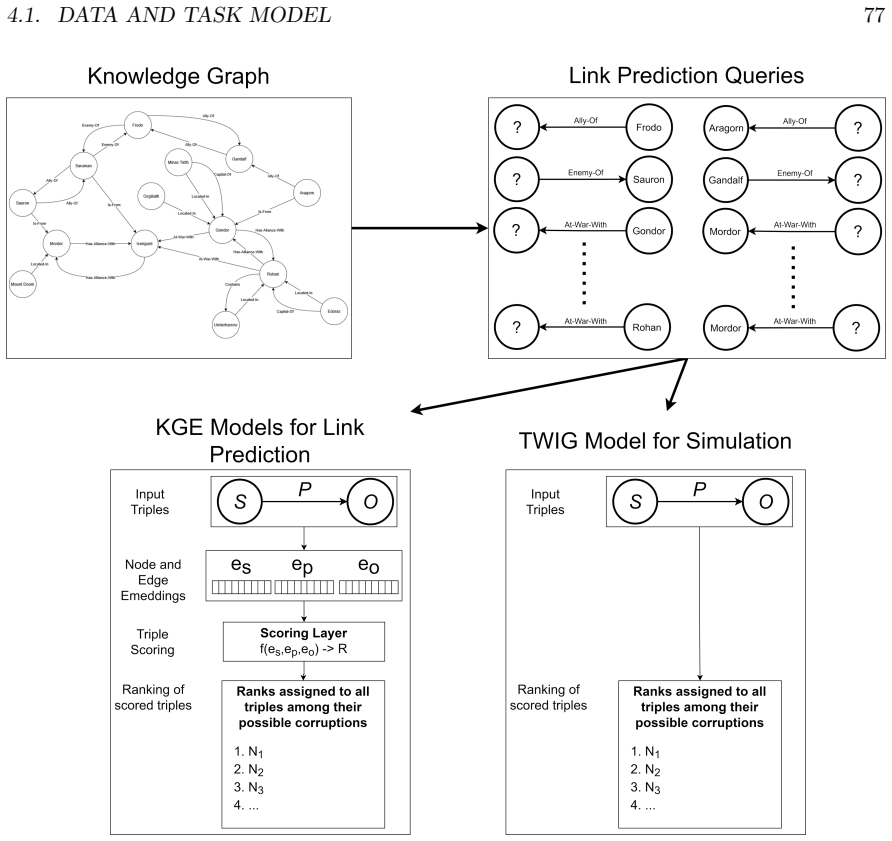
The load-bearing object is the 22-dimensional structural feature vector defined in Table 3.1. Six fine-grained features describe the core triple directly: subject degree, object degree, predicate frequency, subject-predicate co-frequency, object-predicate co-frequency, and subject-object co-frequency. Sixteen coarse-grained features summarise the neighbourhoods of the subject and object: min, max, and mean neighbour degree; number of distinct neighbours; min, max, and mean frequency of incident edges; and number of distinct incident edges. All features are computed from the training split only, in a position-aware way, so that directionality is preserved and no test information leaks. This vector turns a triple into a fixed-size, label-free representation; TWIG and TWIG-I are then neural networks that map these representations, together with hyperparameters in TWIG's case, to predicted ranks and plausibility scores.
What would settle it
Take two triples in a knowledge graph that receive identical 22-dimensional structural feature vectors but whose correct completions differ; if an embedding model ranks both correctly while a structure-only predictor cannot, the claim that the chosen structural features are sufficient for link prediction is refuted.
Extended reading notes
Core claim
Structural Alignment is the claim that the structural features of a training knowledge graph, such as node degrees, relation frequencies, co-frequencies, and neighbourhood summaries, can model hyperparameter preference and link prediction performance, and that link prediction can be performed from those features alone, without learned embeddings. The thesis instantiates this claim in two systems. TWIG takes KG structure plus a hyperparameter configuration and predicts the ranks an embedding model would produce, and experiments on three KGEMs and five KGs report that global performance is highly predictable from structure, with MRR correlations above 0.99 across random seeds. TWIG-I replaces learned embeddings with a fixed 22-dimensional structural feature vector for each candidate triple and learns to score triples directly; the reported results show it is competitive with embedding baselines and that pre-training on KGs from other domains improves its accuracy, making cross-KG transfer viable. The author states the aim is feasibility, not optimality, and concludes that a structure-first view of link prediction is viable and useful.
Load-bearing premise
The load-bearing premise is that the 22 hand-selected structural features, computed only from the training split, capture the information a triple and its neighbourhood carry for link prediction; if multi-hop paths, global topology, or label-derived semantics carry essential signal, the central claim gives way.
Editorial extensions
If this is right
- Hyperparameter search for embedding models could be shortcut by predicting performance from structure plus hyperparameters, skipping expensive training runs.
- Structure-based link prediction can act as a strong, faster baseline alongside embedding models, with competitive accuracy on standard benchmark KGs.
- Cross-KG and cross-domain transfer learning works for link prediction when triples are represented by structural features rather than KG-specific embeddings.
- KGEM outputs can be simulated from structure, meaning at least part of what embedding models learn is expressible in structural terms.
- KG construction and curation could be guided by structural learnability, since low-degree and low-frequency elements are the hard cases.
Reading between the lines
- A direct test the thesis leaves implicit: permute node and relation labels while preserving all 22 structural features; a purely structural predictor would give identical predictions, so any accuracy change on the relabelled graph would reveal label-derived signal the features miss.
- The feature set is deliberately local; extending it with multi-hop path counts, motif frequencies, or global degree distributions is a natural next test and could close cases where co-frequency vectors collapse.
- Because structural encodings are label-free and graph-agnostic, they are a concrete candidate input representation for graph foundation models aiming at cross-graph transfer; the thesis notes the connection but does not build such a model.
Signed reviews
Editorial analysis
A structured set of objections, weighed in public.
Referee Report
Summary. The thesis proposes Structural Alignment, a hypothesis that knowledge-graph learning and link prediction can be modelled as a function of graph structure without learned node or edge embeddings. It instantiates this idea with 22 structural features (six fine-grained and sixteen coarse-grained, all computed only from the training split), and presents two systems: TWIG, which takes structural features and KGEM hyperparameters and predicts KGEM link-prediction performance both globally (MRR) and locally (per-query ranks), and TWIG-I, a structure-based link predictor intended to show that link prediction can be performed directly from structural features and that cross-KG transfer learning is viable. The thesis reports that KGEM hyperparameter preference and performance are determined by structure, that TWIG can predict KGEM output, and that TWIG-I is competitive with state-of-the-art predictors. All code and data are open-sourced, and the thesis includes a bilingual English/Irish presentation.
Significance. If the main claims hold, the work would be a significant reorientation of link prediction research: it would show that embedding-free, structure-only models can both explain KGEM behaviour and perform link prediction, with the additional practical benefit of cross-KG transferability. The manuscript has real strengths: the MRR stability check across random seeds (Section 4.2.1) is a careful reliability control; the worked examples of structural feature computation are concrete; and the open-sourced code and data (TWIG, TWIG-I, PyPI packages, Figshare data) materially support reproducibility. The intended distinction between structural features and learned embeddings is also clearly drawn. However, the local-level claim of TWIG is undercut by the manuscript's own near-zero cross-seed rank correlation result, and the decisive TWIG-I quantitative results are not present in the supplied text. Both issues are load-bearing for the thesis's central conclusions.
major comments (4)
- [Section 4.2.1 and Section 4.1.3] The manuscript reports that per-query ranked lists are nearly uncorrelated across random seeds ("the correlation of ranked lists trained with different random initialisations, but identical hyperparameters, was near 0"), while global MRR is very stable (correlation > 0.99 across runs). This directly contradicts the local half of Claim 1 as instantiated by TWIG. TWIG's data model (Section 4.1.3) pairs each query's structural features with the rank assigned by a single KGEM run, and Section 1.1 states that TWIG simulates KGEM output 'both locally and globally'. Since the random seed is not among TWIG's inputs, a target that is essentially seed-specific noise cannot be a deterministic function of the structural features and hyperparameters TWIG receives. Global MRR stability does not rescue local prediction, because an aggregate over many queries can be stable while individual ranks are dominated by noise. The thesis needs either to train TWIG on seed-averaged ranks and demonstrate that those averages are structurally determined, or to explicitly retract the local-level simulation claim; without one of these, the local half of Claim 1 is not supported by the reported evidence.
- [Section 5.2.1 and Section 5.4] The supplied version of the manuscript does not contain the quantitative results of the TWIG-I experiments, nor the transfer-learning results. The abstract and summary assert that structure-based link prediction is 'highly effective compared to state-of-the-art approaches' and that cross-KG transfer learning becomes viable, but Section 5.2.1 and Section 5.4 are presented only as headings or descriptions in the text available for review. These numbers are load-bearing for Claim 2 and for one of the thesis's three stated impacts. The manuscript must include the actual results, or must clearly indicate where in the submitted version they appear, before the claims can be verified.
- [Section 3.2.1 and Section 6] The Structural Alignment Hypothesis is stated in general terms ('KG learning and link prediction can be modelled as a function of graph structure'), but the experiments instantiate only a single set of 22 hand-selected, 1-hop, frequency-based features. Multi-hop paths, global topological statistics, and label-derived semantic information are excluded by the feature definition. The conclusion that 'link prediction can be understood and modelled as a structural task' is therefore broader than the evidence supplied. For a feasibility claim this scope restriction may be acceptable, but the thesis should either explicitly formulate the validated hypothesis as restricted to this feature family, or add experiments with richer structural features (e.g., path counts, graphlet counts, or global statistics) to show that the omitted information is not needed.
- [Section 4.1.2 and Section 4.3] The hyperparameter grid in Table 4.1 fixes batch size, optimiser, and regulariser, and the case-study uses a single KGEM (ComplEx) on a single KG (UMLS). Sections 4.3 and 4.4 are described as extending this to other KGEMs and KGs, but the generalisation claim in Chapter 6 (that Structural Alignment explains KGEM learning 'in the general case') rests on a small set of three KGEMs and five benchmark KGs. This is not necessarily a flaw for a feasibility study, but the general-case phrasing should be tempered to match the empirical coverage, and the effect of the fixed hyperparameters on the conclusions should be discussed explicitly.
minor comments (3)
- [Section 3.2.2] In the worked example for (Gondor, At-War-With, Isengard), the subject-side node degrees are listed as 1 (Osgiliath), 2 (Minas Tirith), 2 (Aragorn), 7 (Rohan), and 5 (Isengard), but the text reports the minimum degree as 2; the correct minimum is 1.
- [Section 2.4.2] In the summary of Mohamed et al. (2019), the second category of loss functions is labelled 'Pointwise losses' but the sentence describes pairwise losses; this should read 'Pairwise losses' for consistency with the surrounding text.
- [Section 4.2.1] The near-zero ranked-list correlation result is reported through a figure and a sentence; a brief table reporting the mean and median correlation across the four runs would make the severity of the local-level noise easier for readers to assess.
Circularity Check
No significant circularity: the structure-based models are tested on held-out hyperparameters and KGs, and the reported local-seed instability is an empirical limitation rather than a circular derivation.
full rationale
The paper's central derivation chain is empirical rather than definitional. TWIG is trained to map structural features and hyperparameters to KGEM performance, and its main evidence comes from held-out hyperparameter combinations and unseen KGs (Section 4.3), not from re-reporting its training targets. TWIG-I is evaluated as a link predictor on standard benchmark KGs and compared against external KGEM baselines via PyKEEN, so the central claims are not forced by construction. Structural features are computed from the training split only (Section 3.2.1 and Section 4.1.1), while target ranks and MRR come from KGEM evaluation on validation/test splits; no target information is baked into the feature representation. The self-citation in Chapter 4 ('some of the data and methods contained in this chapter have been published in peer-reviewed venues by the author [80, 82]') is a normal reference to prior work and is not load-bearing, since the thesis provides open code, data, and independent evaluations against external benchmarks. The near-zero cross-seed correlation of local ranked lists reported in Section 4.2.1 is a substantive correctness risk for the local half of Claim 1, because per-query ranks appear to be dominated by random seed rather than by the structural features and hyperparameters TWIG receives. However, this is an empirical failure of determinism, not a circularity: no equation in the paper reduces a reported 'prediction' to the fitted input, and the global MRR signal remains independently evaluated. The hand-selected 22-feature set is an ansatz grounded in prior literature, not a renamed version of the target results. Overall, the derivation chain is self-contained and externally testable, so the circularity burden is minimal.
Assumptions & free parameters
free parameters (4)
- KGEM training epochs =
100
- Hyperparameter grid ranges =
see Table 4.1
- Structural feature aggregation choice
- TWIG/TWIG-I neural network architecture hyperparameters
assumptions (5)
- domain assumption Knowledge graphs are incomplete and link prediction is evaluated under the Open World Assumption.
- standard math Rank-based metrics such as MRR and Hits@K are valid and sufficient measures of link prediction performance.
- domain assumption The four frequency-based features (degree, relation frequency, node-relation co-frequency, node-node co-frequency) are the core structural features relevant to link prediction.
- ad hoc to paper The fixed 22-feature local representation of a triple and its neighbourhood is sufficient for modelling KGEM performance and link prediction.
- ad hoc to paper Observations on ComplEx, DistMult, TransE and a small set of benchmark KGs generalise to KGEMs and KGs in general.
invented entities (1)
-
Structural Alignment Framework
Cite this review
Pith. "Pith review of Structural Alignment in Link Prediction." pith.science (2026). https://pith.science/paper/2O6KWNH5
@misc{pith2026250504939,
  author       = {Pith},
  title        = {Pith review of: Structural Alignment in Link Prediction},
  year         = {2026},
  howpublished = {\url{https://pith.science/paper/2O6KWNH5}},
  note         = {Machine review of arXiv:2505.04939}
}
read the original abstract
While Knowledge Graphs (KGs) have become increasingly popular across various scientific disciplines for their ability to model and interlink huge quantities of data, essentially all real-world KGs are known to be incomplete. As such, with the growth of KG use has been a concurrent development of machine learning tools designed to predict missing information in KGs, which is referred to as the Link Prediction Task. The majority of state-of-the-art link predictors to date have followed an embedding-based paradigm. In this paradigm, it is assumed that the information content of a KG is best represented by the (individual) vector representations of its nodes and edges, and that therefore node and edge embeddings are particularly well-suited to performing link prediction. This thesis proposes an alternative perspective on the field's approach to link prediction and KG data modelling. Specifically, this work re-analyses KGs and state-of-the-art link predictors from a graph-structure-first perspective that models the information content of a KG in terms of whole triples, rather than individual nodes and edges. Following a literature review and two core sets of experiments, this thesis concludes that a structure-first perspective on KGs and link prediction is both viable and useful for understanding KG learning and for enabling cross-KG transfer learning for the link prediction task. This observation is used to create and propose the Structural Alignment Hypothesis, which postulates that link prediction can be understood and modelled as a structural task. All code and data used for this thesis are open-sourced. This thesis was written bilingually, with the main document in English and an informal extended summary in Irish. An Irish-language translation dictionary of machine learning terms (the Focl\'oir Tr\'achtais) created for this work is open-sourced as well.
Figures


Figures from the paper (27 more)






Reference graph
Works this paper leans on
-
[1]
Optuna: A next-generation hyperparameter optimization framework
Akiba, Takuya, Sano, Shotaro, Yanase, Toshihiko, Ohta, Takeru, and Koyama, Masa- nori. “Optuna: A next-generation hyperparameter optimization framework”. In: Pro- ceedings of the 25th ACM SIGKDD international conference on knowledge discovery & data mining . 2019, pp. 2623–2631
2019
-
[2]
Ali, Mehdi, Berrendorf, Max, Hoyt, Charles Tapley, Vermue, Laurent, Galkin, Mikhail, Sharifzadeh, Sahand, Fischer, Asja, Tresp, Volker, and Lehmann, Jens. “Bringing Light Into the Dark: A Large-Scale Evaluation of Knowledge Graph Embedding Models Under a Unified Framework”. In:IEEE Transactions on Pattern Analysis and Machine Intelligence 44.12 (2022), pp...
arXiv 2022
-
[3]
PyKEEN 1.0: A Python Library for Training and Evaluating Knowledge Graph Embeddings
Ali, Mehdi, Berrendorf, Max, Hoyt, Charles Tapley, Vermue, Laurent, Sharifzadeh, Sahand, Tresp, Volker, and Lehmann, Jens. “PyKEEN 1.0: A Python Library for Training and Evaluating Knowledge Graph Embeddings”. In: Journal of Machine Learning Research 22.82 (2021), pp. 1–6. url: http://jmlr.org/papers/v22/20- 825.html
2021
-
[4]
Neural methods for logical reasoning over knowledge gra-phs
Amayuelas, Alfonso, Zhang, Shuai, Rao, Xi Susie, and Zhang, Ce. “Neural methods for logical reasoning over knowledge gra-phs”. In: International Conference on Learning Representations. 2022
2022
-
[5]
Gephi: an open source software for exploring and manipulating networks
Bastian, Mathieu, Heymann, Sebastien, and Jacomy, Mathieu. “Gephi: an open source software for exploring and manipulating networks”. In:Proceedings of the international AAAI conference on web and social media . Vol. 3. 1. 2009, pp. 361–362
2009
-
[6]
Bio2RDF: +Towards A Mashup To Build Bioinformatics Knowl- edge System
Belleau, Fran¸ cois, Nolin, Marc-Alexandre, Tourigny, Nicole, Rigault, Philippe, and Morissette, Jean. “Bio2RDF: +Towards A Mashup To Build Bioinformatics Knowl- edge System”. In: Journal of biomedical informatics 41 (Apr. 2008), pp. 706–16. doi: 10.1016/j.jbi.2008.03.004
-
[7]
Adver- sarial Attacks on Knowledge Graph Embeddings via Instance Attribution Methods
Bhardwaj, Peru, Kelleher, John, Costabello, Luca, and O’Sullivan, Declan. “Adver- sarial Attacks on Knowledge Graph Embeddings via Instance Attribution Methods”. In: Proceedings of the 2021 Conference on Empirical Methods in Natural Language Processing. 2021, pp. 8225–8239
2021
-
[8]
Poisoning Knowledge Graph Embeddings via Relation Inference Patterns
Bhardwaj, Peru, Kelleher, John, Costabello, Luca, and O’Sullivan, Declan. “Poisoning Knowledge Graph Embeddings via Relation Inference Patterns”. In: Proceedings of the 59th Annual Meeting of the Association for Computational Linguistics and the 11th International Joint Conference on Natural Language Processing (Volume 1: Long Papers). 2021, pp. 1875–1888...
2021
Show all 112 references
-
[9]
Impli- cations of topological imbalance for representation learning on biomedical knowledge graphs
Bonner, Stephen, Kirik, Ufuk, Engkvist, Ola, Tang, Jian, and Barrett, Ian P. “Impli- cations of topological imbalance for representation learning on biomedical knowledge graphs”. In: Briefings in Bioinformatics 23.5 (July 2022). bbac279. issn: 1477-4054. doi: 10.1093/bib/bbac2...
2022 doi
-
[10]
A semantic matching energy function for learning with multi-relational data: Application to word- sense disambiguation
Bordes, Antoine, Glorot, Xavier, Weston, Jason, and Bengio, Yoshua. “A semantic matching energy function for learning with multi-relational data: Application to word- sense disambiguation”. In: Machine learning 94 (2014), pp. 233–259
2014
-
[11]
Translating embeddings for modeling multi-relational data
Bordes, Antoine, Usunier, Nicolas, Garcia-Duran, Alberto, Weston, Jason, and Yakh- nenko, Oksana. “Translating embeddings for modeling multi-relational data”. In: Ad- vances in neural information processing systems 26 (2013)
2013
-
[12]
Torchkge: Knowledge graph embedding in python and pytorch
Boschin, Armand. “Torchkge: Knowledge graph embedding in python and pytorch”. In: arXiv preprint arXiv:2009.02963 (2020)
2020 arXiv
-
[13]
On Approximate Reason- ing Capabilities of Low-Rank Vector Spaces
Bouchard, Guillaume, Singh, Sameer, and Trouillon, Th´ eo. “On Approximate Reason- ing Capabilities of Low-Rank Vector Spaces”. In: AAAI Spring Symposia . 2015. url: https://api.semanticscholar.org/CorpusID:13955854
2015
-
[14]
OpenBioLink: a benchmarking framework for large-scale biomedical lin prkediction
Breit, Anna, Ott, Simon, Agibetov, Asan, and Samwald, Matthias. “OpenBioLink: a benchmarking framework for large-scale biomedical lin prkediction”. In: Bioinformat- ics 36.13 (2020), pp. 4097–4098
2020
-
[15]
DL-Learner—A frame- work for inductive learning on the Semantic Web
B¨ uhmann, Lorenz, Lehmann, Jens, and Westphal, Patrick. “DL-Learner—A frame- work for inductive learning on the Semantic Web”. In: Journal of Web Semantics 39 (2016), pp. 15–24
2016
-
[17]
Evaluation of knowledge graph embedding approaches for drug- drug interaction prediction in realistic settings
Celebi, Remzi, Uyar, Huseyin, Yasar, Erkan, Gumus, Ozgur, Dikenelli, Oguz, and Dumontier, Michel. “Evaluation of knowledge graph embedding approaches for drug- drug interaction prediction in realistic settings”. In: BMC bioinformatics 20 (2019), pp. 1–14
2019
-
[18]
Building a knowledge graph to enable precision medicine
Chandak, Payal, Huang, Kexin, and Zitnik, Marinka. “Building a knowledge graph to enable precision medicine”. In: Scientific Data 10.1 (2023), p. 67. REFERENCES 215
2023
-
[19]
Hyperparameter search in machine learning
Claesen, Marc and De Moor, Bart. “Hyperparameter search in machine learning”. In: arXiv preprint arXiv:1502.02127 (2015)
2015 arXiv
-
[20]
The Linked Open Data Cloud
Cloud, The LoD. The Linked Open Data Cloud . url: https : / / lod - cloud . net/ (visited on 09/23/2024)
2024
-
[21]
AmpliGraph: a library for representation learning on knowledge graphs
Costabello, Luca, Pai, Sumit, Le Van, Chan, McGrath, Rory, McCarthy, Nicholas, and Tabacof, Pedro. “AmpliGraph: a library for representation learning on knowledge graphs”. In: Retrieved Oct 10 (2019), p. 2019
2019
-
[22]
Towards Understanding the Impact of Graph Structure on Knowledge Graph Embeddings
Dave, Brandon, Christou, Antrea, and Shimizu, Cogan. “Towards Understanding the Impact of Graph Structure on Knowledge Graph Embeddings”. In: International Con- ference on Neural-Symbolic Learning and Reasoning. Springer. 2024, pp. 41–50
2024
-
[23]
The compara- tive toxicogenomics database: update 2019
Davis, Allan Peter, Grondin, Cynthia J, Johnson, Robin J, Sciaky, Daniela, McMorran, Roy, Wiegers, Jolene, Wiegers, Thomas C, and Mattingly, Carolyn J. “The compara- tive toxicogenomics database: update 2019”. In: Nucleic acids research 47.D1 (2019), pp. D948–D954
2019
-
[24]
Con- volutional 2d knowledge graph embeddings
Dettmers, Tim, Minervini, Pasquale, Stenetorp, Pontus, and Riedel, Sebastian. “Con- volutional 2d knowledge graph embeddings”. In: Proceedings of the AAAI conference on artificial intelligence . Vol. 32. 1. 2018
2018
-
[25]
Centrality Measures in multi-layer Knowledge Graphs
D¨ orpinghaus, Jens, Weil, Vera, D¨ uing, Carsten, and Sommer, Martin W. “Centrality Measures in multi-layer Knowledge Graphs”. In: Annals of Computer Science and Information Systems (2022)
2022
-
[26]
BOHB: Robust and efficient hyper- parameter optimization at scale
Falkner, Stefan, Klein, Aaron, and Hutter, Frank. “BOHB: Robust and efficient hyper- parameter optimization at scale”. In: International conference on machine learning . PMLR. 2018, pp. 1437–1446
2018
-
[27]
Weighted Random Search for Hyperpa- rameter Optimization
Florea, Adrian-Catalin and Andonie, Razvan. “Weighted Random Search for Hyperpa- rameter Optimization”. In: INTERNATIONAL JOURNAL OF COMPUTERS COM- MUNICATIONS & CONTROL 14.2 (2019), pp. 154–169
2019
-
[28]
Fast rule mining in ontological knowledge bases with AMIE+
Gal´ arraga, Luis, Teflioudi, Christina, Hose, Katja, and Suchanek, Fabian M. “Fast rule mining in ontological knowledge bases with AMIE+”. In: The VLDB Journal 24.6 (2015), pp. 707–730
2015
-
[29]
Quantum embedding of knowledge for reason- ing
Garg, Dinesh, Ikbal, Shajith, Srivastava, Santosh K, Vishwakarma, Harit, Karanam, Hima, and Subramaniam, L Venkata. “Quantum embedding of knowledge for reason- ing”. In: Advances in Neural Information Processing Systems 32 (2019). 216 REFERENCES
2019
-
[30]
Predicting gene disease as- sociations with knowledge graph embeddings for diseases with curtailed information
Gualdi, Francesco, Oliva, Baldomero, and Pi˜ nero, Janet. “Predicting gene disease as- sociations with knowledge graph embeddings for diseases with curtailed information”. In: NAR Genomics and Bioinformatics 6.2 (2024), lqae049
2024
-
[31]
Elec- tronic health records data summarization for graph machine learning
Gu´ eret, Christophe Dominique Marie, Costabello, Luca, and Sardina, Jeffrey. Elec- tronic health records data summarization for graph machine learning . US Patent App. 18/333,875. Dec. 2024
2024
-
[32]
Systematic integration of biomedical knowledge prioritizes drugs for repurposing
Himmelstein, Daniel Scott, Lizee, Antoine, Hessler, Christine, Brueggeman, Leo, Chen, Sabrina L, Hadley, Dexter, Green, Ari, Khankhanian, Pouya, and Baranzini, Sergio E. “Systematic integration of biomedical knowledge prioritizes drugs for repurposing”. In: Elife 6 (2017), e26726
2017
-
[33]
Knowledge Graphs
Hogan, Aidan, Blomqvist, Eva, Cochez, Michael, D’amato, Claudia, Melo, Gerard De, Gutierrez, Claudio, Kirrane, Sabrina, Gayo, Jos´ e Emilio Labra, Navigli, Roberto, Neumaier, Sebastian, Ngomo, Axel-Cyrille Ngonga, Polleres, Axel, Rashid, Sabbir M., Rula, Anisa, Schmelzeisen, L...
2021
-
[34]
Pygraft: Configurable generation of synthetic schemas and knowledge graphs at your fingertips
Hubert, Nicolas, Monnin, Pierre, d’Aquin, Mathieu, Monticolo, Davy, and Brun, Armelle. “Pygraft: Configurable generation of synthetic schemas and knowledge graphs at your fingertips”. In: European Semantic Web Conference. Springer. 2024, pp. 3–20
2024
-
[35]
Im- proving knowledge graph embeddings with ontological reasoning
Jain, Nitisha, Tran, Trung-Kien, Gad-Elrab, Mohamed H, and Stepanova, Daria. “Im- proving knowledge graph embeddings with ontological reasoning”. In: International Semantic Web Conference. Springer. 2021, pp. 410–426
2021
-
[36]
Knowledge base comple- tion: Baseline strikes back (again)
Jain, Prachi, Rathi, Sushant, Chakrabarti, Soumen, et al. “Knowledge base comple- tion: Baseline strikes back (again)”. In: arXiv preprint arXiv:2005.00804 (2020)
2020 arXiv
-
[37]
Co-embedding of nodes and edges with graph neural networks
Jiang, Xiaodong, Zhu, Ronghang, Li, Sheng, and Ji, Pengsheng. “Co-embedding of nodes and edges with graph neural networks”. In: IEEE Transactions on Pattern Analysis and Machine Intelligence (2020)
2020
-
[38]
Knowledge Base Completion: Baselines Strike Back
Kadlec, Rudolf, Bajgar, Ondrej, and Kleindienst, Jan. “Knowledge Base Completion: Baselines Strike Back”. In: ACL 2017 (2017), p. 69
2017
-
[39]
KEGG: Kyoto Encyclopedia of Genes and Ge-nomes
Kanehisa, Minoru and Goto, Susumu. “KEGG: Kyoto Encyclopedia of Genes and Ge-nomes”. In: Nucleic acids research 28.1 (2000), pp. 27–30
2000
-
[40]
Extending siena to support more expressive and flexible subscriptions
Keeney, John, Roblek, Dominik, Jones, Dominic, Lewis, David, and O’Sullivan, De- clan. “Extending siena to support more expressive and flexible subscriptions”. In: REFERENCES 217 Proceedings of the second international conference on Distributed event-based systems. 2008, pp. 35–46
2008
-
[41]
Knowledge graphs: A practical review of the research landscape
Kejriwal, Mayank. “Knowledge graphs: A practical review of the research landscape”. In: Information 13.4 (2022), p. 161
2022
-
[42]
Learning systems of concepts with an infinite relational model
Kemp, Charles, Tenenbaum, Joshua B, Griffiths, Thomas L, Yamada, Takeshi, and Ueda, Naonori. “Learning systems of concepts with an infinite relational model”. In: AAAI. Vol. 3. 2006, p. 5
2006
-
[43]
Adam: A method for stochastic optimization
Kingma, Diederik P and Ba, Jimmy. “Adam: A method for stochastic optimization”. In: arXiv preprint arXiv:1412.6980 (2014)
2014 arXiv
-
[44]
Variational graph auto-encoders
Kipf, Thomas N and Welling, Max. “Variational graph auto-encoders”. In: arXiv pre- print arXiv:1611.07308 (2016)
2016 arXiv
-
[45]
Analysis of the Impact of Negative Sampling on Link Prediction in Knowledge Graphs
Kotnis, Bhushan and Nastase, Vivi. “Analysis of the Impact of Negative Sampling on Link Prediction in Knowledge Graphs”. In: (Aug. 2017)
2017
-
[46]
EL Embed- dings: Geometric construction of models for the description logic EL++
Kulmanov, Maxat, Liu-Wei, Wang, Yan, Yuan, and Hoehndorf, Robert. “EL Embed- dings: Geometric construction of models for the description logic EL++”. In: Proceed- ings of the Twenty-Eighth International Joint Conference on Artificial Intelligence. In- ternational Joint Confere...
2019
-
[47]
Canonical tensor de- composition for knowledge base completion
Lacroix, Timoth´ ee, Usunier, Nicolas, and Obozinski, Guillaume. “Canonical tensor de- composition for knowledge base completion”. In:International Conference on Machine Learning. PMLR. 2018, pp. 2863–2872
2018
-
[48]
Knowledge Graphs Can be Learned with Just Intersection Fea- tures
Le, Duy, Zhong, Shaochen, Liu, Zirui, Xu, Shuai, Chaudhary, Vipin, Zhou, Kaixiong, and Xu, Zhaozhuo. “Knowledge Graphs Can be Learned with Just Intersection Fea- tures”. In: Forty-first International Conference on Machine Learning
-
[49]
A survey of the link prediction on static and temporal knowledge graph
Le, Thanh, Nguyen, Hoang, and Le, Bac. “A survey of the link prediction on static and temporal knowledge graph”. In: Journal of Research and Development on Information and Communication Technology 2021.2 (2021), pp. 1–34
2021
-
[50]
Pytorch-biggraph: A large scale graph embedding system
Lerer, Adam, Wu, Ledell, Shen, Jiajun, Lacroix, Timothee, Wehrstedt, Luca, Bose, Abhijit, and Peysakhovich, Alex. “Pytorch-biggraph: A large scale graph embedding system”. In: Proceedings of Machine Learning and Systems 1 (2019), pp. 120–131
2019
-
[51]
Towards a managed extensible control plane for knowledge-based networking
Lewis, David, Keeney, John, O’Sullivan, Declan, and Guo, Song. “Towards a managed extensible control plane for knowledge-based networking”. In: Large Scale Manage- ment of Distributed Systems: 17th IFIP/IEEE International Workshop on Distributed 218 REFERENCES Systems: Operati...
2006
-
[52]
Towards graph foundation models: A survey and beyond
Liu, Jiawei, Yang, Cheng, Lu, Zhiyuan, Chen, Junze, Li, Yibo, Zhang, Mengmei, Bai, Ting, Fang, Yuan, Sun, Lichao, Yu, Philip S, et al. “Towards graph foundation models: A survey and beyond”. In: arXiv preprint arXiv:2310.11829 (2023)
2023 arXiv
-
[53]
Neural multi-hop reasoning with logical rules on biomedical knowledge graphs
Liu, Yushan, Hildebrandt, Marcel, Joblin, Mitchell, Ringsquandl, Martin, Raissouni, Rime, and Tresp, Volker. “Neural multi-hop reasoning with logical rules on biomedical knowledge graphs”. In: The Semantic Web: 18th International Conference, ESWC 2021, Virtual Event, June 6–10...
2021
-
[54]
A knowledge base from multilingual Wikipedias–yago3
Mahdisoltani, Farzane, Biega, Joanna, and Suchanek, Fabian M. “A knowledge base from multilingual Wikipedias–yago3”. In: Technical report, Telecom ParisTech(2014)
2014
-
[55]
Yago3: A knowl- edge base from multilingual wikipedias
Mahdisoltani, Farzaneh, Biega, Joanna, and Suchanek, Fabian M. “Yago3: A knowl- edge base from multilingual wikipedias”. In: CIDR. 2013
2013
-
[56]
Aggregating UMLS se- mantic types for reducing conceptual complexity
McCray, Alexa T, Burgun, Anita, and Bodenreider, Olivier. “Aggregating UMLS se- mantic types for reducing conceptual complexity”. In: Studies in health technology and informatics 84.0 1 (2001), p. 216
2001
-
[57]
Anytime Bottom-Up Rule Learning for Knowledge Graph Com- pletion
Meilicke, Christian, Chekol, Melisachew Wudage, Ruffinelli, Daniel, and Stucken- schmidt, Heiner. “Anytime Bottom-Up Rule Learning for Knowledge Graph Com- pletion”. In: Proceedings of the Twenty-Eighth International Joint Conference on Ar- tificial Intelligence . Internationa...
2019
-
[58]
Pop- ularity agnostic evaluation of knowledge graph embeddings
Mohamed, Aisha, Parambath, Shameem, Kaoudi, Zoi, and Aboulnaga, Ashraf. “Pop- ularity agnostic evaluation of knowledge graph embeddings”. In: Conference on Un- certainty in Artificial Intelligence (UAI) . PMLR. 2020, pp. 1059–1068
2020
-
[59]
Biological applications of knowledge graph embedding models
Mohamed, Sameh K, Nounu, Aayah, and Nov´ aˇ cek, V´ ıt. “Biological applications of knowledge graph embedding models”. In: Briefings in bioinformatics 22.2 (2021), pp. 1679–1693
2021
-
[60]
Discovering protein drug targets using knowledge graph embeddings
Mohamed, Sameh K, Nov´ aˇ cek, V´ ıt, and Nounu, Aayah. “Discovering protein drug targets using knowledge graph embeddings”. In: Bioinformatics 36.2 (2020), pp. 603– 610
2020
-
[61]
Loss Functions in Knowledge Graph Embedding Models
Mohamed, Sameh K., Nov´ acek, V´ ıt, Vandenbussche, Pierre-Yves, and Mu˜ noz, Emir. “Loss Functions in Knowledge Graph Embedding Models”. In: DL4KG@ESWC. 2019. REFERENCES 219
2019
-
[62]
A Re- view of Relational Machine Learning for Knowledge Graphs
Nickel, Maximilian, Murphy, Kevin, Tresp, Volker, and Gabrilovich, Evgeniy. “A Re- view of Relational Machine Learning for Knowledge Graphs”. In: Proceedings of the IEEE 104.1 (2016), pp. 11–33. doi: 10.1109/JPROC.2015.2483592
2016
-
[63]
BioPortal: ontologies and integrated data resources at the click of a mouse
Noy, Natalya F, Shah, Nigam H, Whetzel, Patricia L, Dai, Benjamin, Dorf, Michael, Griffith, Nicholas, Jonquet, Clement, Rubin, Daniel L, Storey, Margaret-Anne, Chute, Christopher G, et al. “BioPortal: ontologies and integrated data resources at the click of a mouse”. In: Nucle...
2009
-
[64]
Investigating Robustness and Interpretability of Link Prediction via Adversarial Modifications
Pezeshkpour, Pouya, Tian, Yifan, and Singh, Sameer. “Investigating Robustness and Interpretability of Link Prediction via Adversarial Modifications”. In: Proceedings of the 2019 Conference of the North American Chapter of the Association for Computa- tional Linguistics: Human ...
2019
-
[65]
The RDF2vec family of knowledge graph embed- ding methods
Portisch, Jan and Paulheim, Heiko. “The RDF2vec family of knowledge graph embed- ding methods”. In: Semantic Web Preprint (2024), pp. 1–32
2024
-
[66]
RNNLogic: Learning Logic Rules for Reasoning on Knowledge Graphs
Qu, Meng, Chen, Junkun, Xhonneux, Louis-Pascal, Bengio, Yoshua, and Tang, Jian. “RNNLogic: Learning Logic Rules for Reasoning on Knowledge Graphs”. In: Interna- tional Conference on Learning Representations. 2020
2020
-
[67]
Query2box: Reasoning Over Knowl- edge Graphs In Vector Space Using Box Embeddings
Ren, Hongyu, Hu, Weihua, and Leskovec, Jure. “Query2box: Reasoning Over Knowl- edge Graphs In Vector Space Using Box Embeddings”. In: International Conference on Learning Representations (ICLR). 2020
2020
-
[68]
RDF2Vec: RDF graph embeddings and their applications
Ristoski, Petar, Rosati, Jessica, Di Noia, Tommaso, De Leone, Renato, and Paulheim, Heiko. “RDF2Vec: RDF graph embeddings and their applications”. In: Semantic Web 10.4 (2019), pp. 721–752
2019
-
[69]
A neuro- symbolic system over knowledge graphs for link prediction
Rivas, Ariam, Collarana, Diego, Torrente, Maria, and Vidal, Maria-Esther. “A neuro- symbolic system over knowledge graphs for link prediction”. In: Semantic Web 15.4 (2024), pp. 1307–1331
2024
-
[70]
Knowledge Graph Embedding for Link Prediction: A Comparative Anal- ysis
Rossi, Andrea, Barbosa, Denilson, Firmani, Donatella, Matinata, Antonio, and Meri- aldo, Paolo. “Knowledge Graph Embedding for Link Prediction: A Comparative Anal- ysis”. In: ACM Transactions on Knowledge Discovery from Data 15 (Jan. 2021), pp. 1–
2021
-
[71]
Knowledge graph embeddings: Are relation- learning models learning relations?
Rossi, Andrea and Matinata, Antonio. “Knowledge graph embeddings: Are relation- learning models learning relations?” In: EDBT/ICDT Workshops. Vol. 2578. 2020
2020
-
[72]
The wisdom hierarchy: representations of the DIKW hierarchy
Rowley, Jennifer. “The wisdom hierarchy: representations of the DIKW hierarchy”. In: Journal of information science 33.2 (2007), pp. 163–180. 220 REFERENCES
2007
-
[73]
doi: 10.1145/3424672
-
[74]
Embedding knowledge graphs attentive to positional and centrality qualities
Sadeghi, Afshin, Collarana, Diego, Graux, Damien, and Lehmann, Jens. “Embedding knowledge graphs attentive to positional and centrality qualities”. In: Joint European Conference on Machine Learning and Knowledge Discovery in Databases . Springer. 2021, pp. 548–564
2021
-
[75]
CoDEx: A Comprehensive Knowledge Graph Com- pletion Benchmark
Safavi, Tara and Koutra, Danai. “CoDEx: A Comprehensive Knowledge Graph Com- pletion Benchmark”. In: Proceedings of the 2020 Conference on Empirical Methods in Natural Language Processing (EMNLP). 2020
2020
-
[76]
You CAN Teach an Old Dog New Tricks! On Training Knowledge Graph Embeddings
Ruffinelli, Daniel, Broscheit, Samuel, and Gemulla, Rainer. “You CAN Teach an Old Dog New Tricks! On Training Knowledge Graph Embeddings”. In: ICLR. 2020
2020
-
[77]
Veni, Vidi, Vici: Solving the Myriad of Challenges before Knowledge Graph Learning
Sardina, Jeffrey, Costabello, Luca, and Gu´ eret, Christophe. “Veni, Vidi, Vici: Solving the Myriad of Challenges before Knowledge Graph Learning”. In: 2024 IEEE 18th International Conference on Semantic Computing (ICSC) . IEEE. 2024, pp. 197–203
2024
-
[78]
NamE: Capturing Biological Context in KGEs via Contextual Named Graph Em- beddings
Sardina, Jeffrey, Costabello, Luca, Gu´ eret, Christophe, and Mohammadi, Hossein. “NamE: Capturing Biological Context in KGEs via Contextual Named Graph Em- beddings”. In: 2024 46th Annual International Conference of the IEEE Engineering in Medicine and Biology Society (EMBC) ...
2024
-
[79]
Systems and methods for enhancing an artificial intelligence model via a multi-field embedding approach
Sardina, Jeffrey, Bernardi, Alberto, and Gu´ eret, Christophe. Systems and methods for enhancing an artificial intelligence model via a multi-field embedding approach . US Patent App. 18/351,959. Jan. 2025
2025
-
[80]
Extending TWIG: Zero- Shot Predictive Hyperparameter Selection for KGEs based on Graph Structure
Sardina, Jeffrey, Kelleher, John D, and O’Sullivan, Declan. “Extending TWIG: Zero- Shot Predictive Hyperparameter Selection for KGEs based on Graph Structure”. In: Irish Conference on Artificial Intelligence and Cognitive Science . Springer. 2024
2024
-
[81]
A Survey on Knowledge Graph Structure and Knowledge Graph Embeddings
Sardina, Jeffrey, Kelleher, John D, and O’Sullivan, Declan. “A Survey on Knowledge Graph Structure and Knowledge Graph Embeddings”. In: 2025 IEEE 19th Interna- tional Conference on Semantic Computing (ICSC) . IEEE. 2025
2025
-
[82]
TWIG-I: Embedding-Free Link Prediction and Cross-KG Transfer Learning Using a Small Neu- ral Architecture
Sardina, Jeffrey, Debnath, Alok, Kelleher, John D, and O’Sullivan, Declan. “TWIG-I: Embedding-Free Link Prediction and Cross-KG Transfer Learning Using a Small Neu- ral Architecture”. In: Knowledge Graphs in the Age of Language Models and Neuro- Symbolic AI. IOS Press, 2024, p...
2024
-
[83]
Structural Characteristics of Knowledge Gra-phs Determine the Quality of Knowledge Graph Embeddings Across Model and Hyperparameter Choices
Sardina, Jeffrey and O’Sullivan, Declan. “Structural Characteristics of Knowledge Gra-phs Determine the Quality of Knowledge Graph Embeddings Across Model and Hyperparameter Choices”. In: SeWeBMeDA-2022@ESWC. 2022
2022
-
[84]
Analysis of attention mechanisms in box-embedding systems
Sardina, Jeffrey, Sardina, Callie, Kelleher, John D, and O’Sullivan, Declan. “Analysis of attention mechanisms in box-embedding systems”. In:Irish Conference on Artificial Intelligence and Cognitive Science . Springer. 2022, pp. 68–80
2022
-
[85]
TWIG: Towards pre-hoc Hyperparameter Optimisation and Cross-Graph Generalisation via Simulated KGE Models
Sardina, Jeffrey, Kelleher, John D, and O’Sullivan, Declan. “TWIG: Towards pre-hoc Hyperparameter Optimisation and Cross-Graph Generalisation via Simulated KGE Models”. In: 2024 IEEE 18th International Conference on Semantic Computing (IC- SC). IEEE. 2024, pp. 122–129. REFERENCES 221
2024
-
[86]
Combining rules and embeddings via neuro-symbolic ai for knowledge base completion
Sen, Prithviraj, Carvalho, Breno WSR, Abdelaziz, Ibrahim, Kapanipathi, Pavan, Luus, Francois, Roukos, Salim, and Gray, Alexander. “Combining rules and embeddings via neuro-symbolic ai for knowledge base completion”. In: arXiv preprint arXiv:2109.- 09566 (2021)
2021
-
[87]
Dif- ferentiable neuro-symbolic reasoning on large-scale knowledge graphs
Shengyuan, Chen, Cai, Yunfeng, Fang, Huang, Huang, Xiao, and Sun, Mingming. “Dif- ferentiable neuro-symbolic reasoning on large-scale knowledge graphs”. In: Advances in Neural Information Processing Systems 36 (2023), pp. 28139–28154
2023
-
[88]
Modeling relational data with graph convolutional net- works
Schlichtkrull, Michael, Kipf, Thomas N, Bloem, Peter, Van Den Berg, Rianne, Titov, Ivan, and Welling, Max. “Modeling relational data with graph convolutional net- works”. In: The semantic web: 15th international conference, ESWC 2018, Heraklion, Crete, Greece, June 3–7, 2018, ...
2018
-
[89]
Applying network link prediction in drug discovery: an overview of the literature
Son, Jeongtae and Kim, Dongsup. “Applying network link prediction in drug discovery: an overview of the literature”. In: Expert Opinion on Drug Discovery 19.1 (2024), pp. 43–56
2024
-
[90]
Conceptnet 5.5: An open mul- tilingual graph of general knowledge
Speer, Robyn, Chin, Joshua, and Havasi, Catherine. “Conceptnet 5.5: An open mul- tilingual graph of general knowledge”. In: Proceedings of the AAAI conference on artificial intelligence. Vol. 31. 1. 2017
2017
-
[91]
Open-world knowledge graph completion
Shi, Baoxu and Weninger, Tim. “Open-world knowledge graph completion”. In: Pro- ceedings of the AAAI conference on artificial intelligence . Vol. 32. 1. 2018
2018
-
[92]
The Fellowship of the Ring
Tolkien, John Ronald Reuel. The Fellowship of the Ring . HarperCollins Publishers, 2008
2008
-
[93]
Observed versus latent features for knowl- edge base and text inference
Toutanova, Kristina and Chen, Danqi. “Observed versus latent features for knowl- edge base and text inference”. In: Proceedings of the 3rd Workshop on Continuous Vector Space Models and their Compositionality. Ed. by Alexandre Allauzen, Edward Grefenstette, Karl Moritz Hermann...
2015 doi
-
[94]
A benchmarking study of embedding-based entity align- ment for knowledge graphs
Sun, Zequn, Zhang, Qingheng, Hu, Wei, Wang, Chengming, Chen, Muhao, Akrami, Farahnaz, and Li, Chengkai. “A benchmarking study of embedding-based entity align- ment for knowledge graphs”. In: Proceedings of the VLDB Endowment 13.12 (2020)
2020
-
[95]
Compo- sition-based Multi-Relational Graph Convolutional Networks
Vashishth, Shikhar, Sanyal, Soumya, Nitin, Vikram, and Talukdar, Partha. “Compo- sition-based Multi-Relational Graph Convolutional Networks”. In: International Con- ference on Learning Representations. 2019
2019
-
[96]
A survey on knowledge graph em- beddings for link prediction
Wang, Meihong, Qiu, Linling, and Wang, Xiaoli. “A survey on knowledge graph em- beddings for link prediction”. In: Symmetry 13.3 (2021), p. 485
2021
-
[97]
Complex embeddings for simple link prediction
Trouillon, Th´ eo, Welbl, Johannes, Riedel, Sebastian, Gaussier, ´Eric, and Bouchard, Guillaume. “Complex embeddings for simple link prediction”. In: International con- ference on machine learning . PMLR. 2016, pp. 2071–2080
2016
-
[98]
Knowledge graph embedding by translating on hyperplanes
Wang, Zhen, Zhang, Jianwen, Feng, Jianlin, and Chen, Zheng. “Knowledge graph embedding by translating on hyperplanes”. In: Proceedings of the AAAI conference on artificial intelligence . Vol. 28. 1. 2014
2014
-
[99]
DrugBank 5.0: a major update to the DrugBank database for 2018
Wishart, David S, Feunang, Yannick D, Guo, An C, Lo, Elvis J, Marcu, Ana, Grant, Jason R, Sajed, Tanvir, Johnson, Daniel, Li, Carin, Sayeeda, Zinat, et al. “DrugBank 5.0: a major update to the DrugBank database for 2018”. In: Nucleic acids research 46.D1 (2018), pp. D1074–D1082
2018
-
[100]
Knowledge Graph Embed- ding: A Survey of Approaches and Applications
Wang, Quan, Mao, Zhendong, Wang, Bin, and Guo, Li. “Knowledge Graph Embed- ding: A Survey of Approaches and Applications”. In: IEEE Transactions on Knowl- edge and Data Engineering 29.12 (2017), pp. 2724–2743. doi: 10.1109/TKDE.2017. 2754499
2017 doi
-
[101]
OpenGraph: Towards Open Graph Foundation Models
Xia, Lianghao, Kao, Ben, and Huang, Chao. “OpenGraph: Towards Open Graph Foundation Models”. In: Findings of the Association for Computational Linguistics: EMNLP 2024. 2024, pp. 2365–2379
2024
-
[102]
Em- bedding Entities and Relations for Learning and Inference in Knowledge Bases
Yang, Bishan, Yih, Scott Wen-tau, He, Xiaodong, Gao, Jianfeng, and Deng, Li. “Em- bedding Entities and Relations for Learning and Inference in Knowledge Bases”. In: Proceedings of the International Conference on Learning Representations (ICLR)
-
[103]
An on- tology model for climatic data analysis
Wu, Jiantao, Orlandi, Fabrizio, O’Sullivan, Declan, and Dev, Soumyabrata. “An on- tology model for climatic data analysis”. In: 2021 IEEE International Geoscience and Remote Sensing Symposium IGARSS . IEEE. 2021, pp. 5739–5742
2021
-
[104]
Data poisoning attack against knowledge graph embedding
Zhang, Hengtong, Zheng, Tianhang, Gao, Jing, Miao, Chenglin, Su, Lu, Li, Yaliang, and Ren, Kui. “Data poisoning attack against knowledge graph embedding”. In: Pro- ceedings of the 28th International Joint Conference on Artificial Intelligence . 2019, pp. 4853–4859
2019
-
[105]
Drug repurposing for COVID-19 via knowledge graph comple- tion
Zhang, Rui, Hristovski, Dimitar, Schutte, Dalton, Kastrin, Andrej, Fiszman, Marcelo, and Kilicoglu, Halil. “Drug repurposing for COVID-19 via knowledge graph comple- tion”. In: Journal of biomedical informatics 115 (2021), p. 103696
2021
-
[106]
ADADELTA: an adaptive learning rate method
Zeiler, Matthew D. “ADADELTA: an adaptive learning rate method”. In: arXiv pre- print arXiv:1212.5701 (2012). REFERENCES 223
2012 arXiv
-
[107]
Iteratively learning embeddings and rules for knowledge graph reasoning
Zhang, Wen, Paudel, Bibek, Wang, Liang, Chen, Jiaoyan, Zhu, Hai, Zhang, Wei, Bern- stein, Abraham, and Chen, Huajun. “Iteratively learning embeddings and rules for knowledge graph reasoning”. In: The world wide web conference. 2019, pp. 2366–2377
2019
-
[108]
PharmKG: a dedicated knowledge graph benchmark for bomedical data mining
Zheng, Shuangjia, Rao, Jiahua, Song, Ying, Zhang, Jixian, Xiao, Xianglu, Fang, Evan- dro Fei, Yang, Yuedong, and Niu, Zhangming. “PharmKG: a dedicated knowledge graph benchmark for bomedical data mining”. In: Briefings in bioinformatics 22.4 (2021), bbaa344
2021
-
[109]
Knowledge graph reasoning with logics and embeddings: Survey and perspective
Zhang, Wen, Chen, Jiaoyan, Li, Juan, Xu, Zezhong, Pan, Jeff Z, and Chen, Huajun. “Knowledge graph reasoning with logics and embeddings: Survey and perspective”. In: 2024 IEEE International Conference on Knowledge Graph (ICKG) . IEEE. 2024, pp. 492–499
2024
-
[110]
The probability of edge existence due to node degree: a baseline for network-based predictions
Zietz, Michael, Himmelstein, Daniel S, Kloster, Kyle, Williams, Christopher, Nagle, Michael W, and Greene, Casey S. “The probability of edge existence due to node degree: a baseline for network-based predictions”. In: GigaScience 13 (2024), giae001
2024
-
[112]
Graph neural networks: A review of methods and applications
Zhou, Jie, Cui, Ganqu, Hu, Shengding, Zhang, Zhengyan, Yang, Cheng, Liu, Zhiyuan, Wang, Lifeng, Li, Changcheng, and Sun, Maosong. “Graph neural networks: A review of methods and applications”. In: AI open 1 (2020), pp. 57–81
2020
- [300]
-
[2006]
Springer
Proceedings 17. Springer. 2006, pp. 98–111
2006
Reviewed August 15, 2026 · model on record in the stance chip above.
Discussion (0). Continue with ORCID to comment.