REVIEW 3 major objections 4 minor 34 references
Autonomous agents will force transaction-oriented recommender systems to switch from predicting clicks to executing explicit, verifiable task constraints.
Reviewed by Pith at T0; open to challenge. T0 means a machine referee read the full paper against a public rubric. the ladder, T0–T4 →
T0 review · deepseek-v4-flash
2026-08-01 20:32 UTC pith:2OCTEKEK
load-bearing objection A useful, clearly scoped position paper that gives a formal skeleton to client-side agents as RecSys end-users; the 'must rebuild' claim overreaches but the framing is worth taking seriously. the 3 major comments →
A Position Paper on Recommender Systems in the Era of Autonomous Agents
The pith
A machine-rendered reading of the paper's core claim, the machinery that carries it, and where it could break.
Core claim
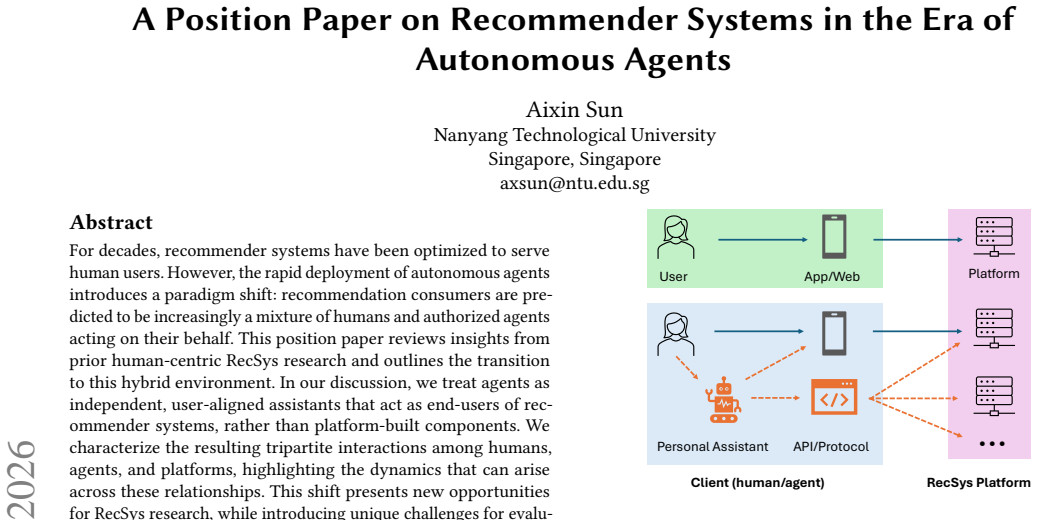
On its own terms, the paper's central claim is that the recommendation task itself changes when an authorized agent can be the requester. Formally, the task becomes ⟨e, t, g_t, ((U∪A)×I)_{≤t}, s(I_{≤t}, g_t)⟩ → R^e_t, where e is either the human or their unique agent, g_t is an explicit goal prompt, and the candidate set is filtered by the constraint s(I, g_t). When e is an agent, the platform must return a dense, verifiable data structure rather than a persuasive layout, and the agent can assemble a cross-platform candidate set R̃_t = f_{a_u}({R_{p,t}}, g_t, h_cross_t) using interaction history no single platform possesses. The paper claims this makes recommendation a constraint-satisfactio
What carries the argument
The paper's central object is a reformulated transaction-oriented recommendation task (Eq. 2) that inserts an explicit goal parameter g_t and lets the requesting entity be either a human u or that user's authorized agent a_u, with the platform's output constrained by s(I, g_t). The companion aggregation equation (Eq. 3) positions the agent as a cross-platform broker that merges responses from multiple platforms plus cross-platform history h_cross_t. These two equations carry the argument: they turn recommendation from preference inference into verifiable constraint satisfaction, and they give the agent an informational vantage point no single platform has.
Load-bearing premise
The scenario assumes platforms will let a user's agent see offers and histories across many platforms at once, through APIs or automation; if platforms refuse or block that access, the cross-platform brokerage picture and the constraint-satisfaction reformulation lose their central premise.
What would settle it
Watch actual deployments of consumer shopping agents over the next few years: if no major transaction platform gives agents a sanctioned machine-readable interface—or if GUI automation is systematically blocked—so that a single agent cannot query and compare offers across at least two platforms, the paper's near-future mixed ecosystem and its constraint-satisfaction reformulation do not take the predicted form.
If this is right
- Transaction-oriented platforms will need to support two output modes: persuasive interfaces for humans and high-density, verifiable data structures for agents, drawing on the same item pool.
- Ranking functions must be redesigned to jointly optimize constraint satisfiability, which an agent can check, and latent user utility, which the platform must still infer from history and the stated goal.
- Evaluation must move from Recall@K and NDCG on static logs to interactive, protocol-level benchmarks that measure end-to-end task completion, allow multi-turn constraint revisions, and test for adversarial metadata manipulation.
- Cross-platform brokerage becomes a research problem: detecting platform-side bias in returned candidates, weighting cross-platform behavioral evidence, and designing machine-readable protocols that resist gaming.
- Human–agent alignment requires lightweight elicitation dialogues so that a loosely specified goal like "buy a reliable laptop" is refined into a constraint set any competent agent could execute faithfully.
Where Pith is reading between the lines
- If the paper is right, content-oriented recommenders (video, music, news) are likely to remain human-facing much longer, because the value of consumption is in the experience itself; a testable corollary is that agent-driven changes should appear first in e-commerce, travel, and food delivery rather than entertainment feeds.
- The scenario implies an information-asymmetry reversal: a single agent may know a user across platforms better than any individual platform does. A likely defensive reaction, hinted at in the paper, is platforms optimizing metadata or inferring the user's global state from the request; an extension would be studying this as an adversarial game between agent and platform.
- The benchmark proposal could be operationalized by measuring constraint-satisfaction rate and end-to-end task-completion rate of an agent with a ground-truth utility function against simulated platforms, including mid-task revisions—a natural successor to offline ranking benchmarks.
- The human–agent alignment problem can be modeled as cost-sensitive active elicitation: given a sparse cross-platform transaction history and a vague prompt, find the minimal dialogue that brings goal misalignment below a measurable threshold, turning an HCI concern into a formally optimizable quantity.
Editorial analysis
A structured set of objections, weighed in public.
Referee Report
Summary. This position paper argues that the rapid deployment of autonomous personal assistants acting on behalf of users will create a mixed ecosystem in which recommender systems must serve both human users and software intermediaries. The author distinguishes client-side, user-aligned agents from platform-side agentic recommender systems, restricts the argument to transaction-oriented platforms, and formalizes the recommendation task with an explicit goal parameter g_t (Eq. 2) and a cross-platform agent-side aggregation function (Eq. 3). The paper then identifies three interaction frontiers—human–platform, agent–platform, human–agent—reviews methodological blind spots in human-centric RecSys research, and proposes four research directions: task execution, protocol-level evaluation, cross-platform brokerage, and preference elicitation. The central conclusion is that the agentic era requires rebuilding transaction-oriented recommender systems around explicit, verifiable, constraint-based task execution.
Significance. If the premise is accepted, the paper provides a useful conceptual framework and vocabulary for a plausible near-future mode of recommendation interaction. Its strengths are the explicit formalization of the task and cross-platform aggregation, the clear scope restriction to transaction-oriented systems, and the honest acknowledgment of key assumptions and limitations (footnote 1, the one-agent-per-user assumption, and privacy risks). The paper also usefully connects the proposed shift to existing critiques of offline evaluation and dataset-task misalignment. However, the central claim is normative/predictive rather than demonstrated, and the main value lies in the research agenda it articulates rather than in any empirical or formal proof. The paper ships no code or data, which is acceptable for a position paper but limits the strength of the conclusions.
major comments (3)
- [Section 2.1 (after Definition 2.2)] The assertion that the platform's output 'must transition from a visually persuasive layout ... to a high-density, verifiable data structure' is load-bearing for the paper's 'must rebuild' conclusion, but it does not follow from the paper's own premises. Section 1 explicitly states that agents can 'visually navigate and execute tasks directly through the web or mobile application interface.' An agent that parses rendered pages and extracts item attributes can use the existing human-facing interface without any platform-side change; the paper offers no argument that such GUI-based consumption is infeasible, unreliable, or insufficiently verifiable. The 'must' is therefore either a design preference ('should') or an economic prediction about platform incentives, and footnote 1's speculation about agent-native business models is the only support offered. Please either soften the claim to a
- [Section 5 (Conclusion)] The conclusion overgeneralizes the scope established in Section 2. The paper explicitly restricts its argument to transaction-oriented RecSys and states that 'content-oriented RecSys will primarily continue to serve human users directly.' Yet the conclusion says 'recommender systems must simultaneously serve both human users and software intermediaries' and calls on 'the community that built RecSys for humans' to 'rebuild it for a world in which the consumer is not always human.' This unqualified phrasing claims applicability to content-oriented systems that the body of the paper does not support. Please qualify the conclusion to 'transaction-oriented recommender systems' or provide an argument for extending the thesis to content-oriented systems.
- [Equation (3) and Section 2.2] The cross-platform brokerage layer, and hence the proposed research direction of 'cross-platform brokerage,' relies on the agent having programmatic access to multiple platforms, either via API or GUI automation. The paper acknowledges in footnote 1 that 'existing RecSys platforms may be reluctant to provide such API access,' and that GUI automation can be blocked or economically deterred. This is not a minor caveat: if platforms refuse API access or prevent automation, the agent's aggregate candidate set in Eq. (3) collapses, and the constraint-verification framing loses its central premise. The paper treats this as a self-evident near-future scenario, but it is a contested empirical and strategic question. I would ask for a more explicit conditional treatment: under what access assumptions does the thesis hold, and what alternative dynamics arise if platforms deny or heavily restrict a
minor comments (4)
- [Figure 1 and Section 1] The figure caption and text refer to 'top left-panel' and 'bottom-left panel,' but the figure appears to have a single panel per row. Please clarify the figure layout.
- [Figure 1] The label 'RecSys PlatformsClient (human/agent)' is confusingly worded; consider 'Platforms' and 'Client (human/agent)' as separate labels.
- [Section 2.1] The sentence 'Consequently, the platform's output must transition ... (for agents)' conflates the agent's interface modality (API vs. GUI) with the identity of the requester. It is unclear whether the transition is argued for all agent requests or only those made via API. Please disambiguate.
- [Section 4] The four research directions are each introduced with 'From ... to ...' headings, but the second direction is labeled 'From Offline Prediction to Interactive, Protocol-level Evaluation' and the section text discusses benchmarks; the label 'protocol-level' may be too narrow since the proposed evaluation is not necessarily tied to a specific protocol. Consider a more general heading.
Circularity Check
No circular derivation: the paper is a position argument with no fitted parameters or predictions derived from fitted inputs, and its load-bearing assumption is explicitly flagged rather than smuggled in.
full rationale
The paper makes no quantitative predictions and fits no parameters. Equations 1-3 formalize the described setting rather than deriving the conclusions from them. The central claim—that agent end-users motivate a shift to explicit, verifiable, constraint-based output—is argued from plausibility, and the paper itself conditions the 'must transition' on the API/Protocol interaction mode: 'when the requesting entity is an agent (the case of e=a_u) interacting with the platform through an API/Protocol, g_t becomes a programmatic constraint... Consequently, the platform's output R^{a_u}_t must transition from a visually persuasive layout (for humans) to a high-density, verifiable data structure (for agents).' Footnote 1 explicitly concedes that 'Existing RecSys platforms may be reluctant to provide such API access,' so the gap noted by a skeptic is a correctness/overreach concern, not circularity: no equation or parameter is defined in terms of the conclusion, and the agent's ability to use the existing human-facing UI is acknowledged in Section 1. The self-citations ([25,29] for the transaction/content taxonomy, [4,14,21] for evaluation critiques) are used as framing inputs from prior independent work, not as outputs of this paper's argument; the conclusions do not reduce to them. Thus no circular step is present.
Axiom & Free-Parameter Ledger
axioms (4)
- domain assumption Client-side autonomous agents will be widely deployed and authorized to perform transactions on behalf of users.
- domain assumption Agents can access multiple platforms via API or GUI automation and assemble a cross-platform view (Eq. 3).
- domain assumption Content-oriented consumption cannot be meaningfully delegated to agents; only transaction-oriented tasks will be agent-mediated.
- domain assumption Each user authorizes at most one agent across all platforms (footnote to Definition 2.2).
read the original abstract
For decades, recommender systems have been optimized to serve human users. However, the rapid deployment of autonomous agents introduces a paradigm shift: recommendation consumers are predicted to be increasingly a mixture of humans and authorized agents acting on their behalf. This position paper reviews insights from prior human-centric RecSys research and outlines the transition to this hybrid environment. In our discussion, we treat agents as independent, user-aligned assistants that act as end-users of recommender systems, rather than platform-built components. We characterize the resulting tripartite interactions among humans, agents, and platforms, highlighting the dynamics that can arise across these relationships. This shift presents new opportunities for RecSys research, while introducing unique challenges for evaluation, alignment, and system design.
Figures
Reference graph
Works this paper leans on
-
[1]
Gediminas Adomavicius and Alexander Tuzhilin. 2005. Toward the Next Gener- ation of Recommender Systems: A Survey of the State-of-the-Art and Possible Extensions.IEEE Transactions on Knowledge and Data Engineering17, 6 (2005), 734–749. doi:10.1109/TKDE.2005.99
-
[2]
Figueroa, Yash Kanoria, and Akshit Kumar
Amine Allouah, Omar Besbes, Josué D. Figueroa, Yash Kanoria, and Akshit Kumar
-
[3]
Martin Bichler. 2026. Agentic markets.Electronic Markets36 (June 2026). doi:10. 1007/s12525-026-00906-y
2026
-
[4]
Yu-Chen Fan, Yitong Ji, Jie Zhang, and Aixin Sun. 2024. Our Model Achieves Excellent Performance on MovieLens: What Does It Mean?ACM Transactions on Information Systems42, 6, Article 159 (Oct. 2024), 25 pages. doi:10.1145/3675163
doi:10.1145/3675163 2024
-
[5]
Maurizio Ferrari Dacrema, Paolo Cremonesi, and Dietmar Jannach. 2019. Are we really making much progress? A worrying analysis of recent neural recommen- dation approaches. InProceedings of the 13th ACM Conference on Recommender Systems(Copenhagen, Denmark)(RecSys ’19). Association for Computing Ma- chinery, New York, NY, USA, 101–109. doi:10.1145/3298689.3347058
arXiv 2019
-
[6]
Yaxin Gong, Chongming Gao, Chenxiao Fan, Wenjie Wang, Fuli Feng, and Xi- angnan He. 2026. Breaking User-Centric Agency: A Tri-Party Framework for Agent-Based Recommendation.arXiv(2026). doi:10.48550/arXiv.2603.10673
-
[7]
Gillian K. Hadfield and Andrew Koh. 2025. An Economy of AI Agents.arXiv (2025). doi:10.48550/arXiv.2509.01063
-
[8]
Chengkai Huang, Hongtao Huang, Tong Yu, Kaige Xie, Junda Wu, Shuai Zhang, Julian Mcauley, Dietmar Jannach, and Lina Yao. 2025. A Survey of Founda- tion Model-Powered Recommender Systems: From Feature-Based, Generative to Agentic Paradigms.arXiv(2025). doi:10.48550/arXiv.2504.16420
-
[9]
Rossi, Branislav Kveton, Dongruo Zhou, Julian McAuley, and Lina Yao
Chengkai Huang, Junda Wu, Yu Xia, Zixu Yu, Ruhan Wang, Tong Yu, Ruiyi Zhang, Ryan A. Rossi, Branislav Kveton, Dongruo Zhou, Julian McAuley, and Lina Yao
-
[10]
Xu Huang, Jianxun Lian, Yuxuan Lei, Jing Yao, Defu Lian, and Xing Xie. 2025. Recommender AI Agent: Integrating Large Language Models for Interactive Recommendations.ACM Transactions on Information Systems43, 4, Article 96 (June 2025), 33 pages. doi:10.1145/3731446
doi:10.1145/3731446 2025
-
[11]
Veronika Ivanova, Oleg Lashinin, Marina Ananyeva, and Sergey Kolesnikov
-
[12]
Dietmar Jannach and Li Chen. 2026. Recommender Systems in Industry: Ap- plications, Challenges, and the Academia-Industry Gap.ACM Transactions on Recommender Systems(July 2026). doi:10.1145/3827915
-
[13]
Dietmar Jannach and Michael Jugovac. 2019. Measuring the Business Value of Recommender Systems.ACM Transactions on Management Information Systems 10, 4, Article 16 (Dec. 2019), 23 pages. doi:10.1145/3370082
doi:10.1145/3370082 2019
-
[14]
Yitong Ji, Aixin Sun, Jie Zhang, and Chenliang Li. 2023. A Critical Study on Data Leakage in Recommender System Offline Evaluation.ACM Transactions on Information Systems41, 3, Article 75 (Feb. 2023), 27 pages. doi:10.1145/3569930
doi:10.1145/3569930 2023
-
[15]
Huy Hoang Le, Yang Liu, Alan Medlar, and Dorota Glowacka. 2025. Don’t Get Ahead of Yourself: A Critical Study on Data Leakage in Offline Evaluation of Sequential Recommenders. InProceedings of the 19th ACM Conference on Recommender Systems (RecSys ’25). Association for Computing Machinery, New York, NY, USA, 1164–1168. doi:10.1145/3705328.3759329
arXiv 2025
-
[16]
Daming Li, Simeng Han, and Jialu Zhang. 2026. Do Recommendation Algorithms Work When Users Are LLM Agents? A Case Study on Moltbook.arXiv(2026). doi:10.48550/arXiv.2606.29762
work page internal anchor Pith review Pith/arXiv arXiv doi:10.48550/arxiv.2606.29762 2026
-
[17]
Xinyu Lin, Yashar Deldjoo, Sunhao Dai, Honghui Bao, Xiaopeng Ye, Fatemeh Nazary, Wenjie Wang, Tommaso Di Noia, Jun Xu, and Tat-Seng Chua. 2026. Au- tonomous Information Seeking: A Roadmap for Agentic Recommender Systems. arXiv(2026). doi:10.48550/arXiv.2607.04433
work page internal anchor Pith review Pith/arXiv arXiv doi:10.48550/arxiv.2607.04433 2026
-
[18]
Brendan Lucier, Nicole Immorlica, Markus Mobius, Aleksandrs Slivkins, Daniel G. Goldstein, Jake M. Hofman, Sonia Jaffe, and David M. Rothschild. 2026. Agentic Markets: Equilibrium Effects of Improving Consumer Search.arXiv(2026). doi:10. 48550/arXiv.2603.25893
-
[19]
Saab Mansour, Leonardo Perelli, Lorenzo Mainetti, George Davidson, and Stefano D’Amato. 2025. PAARS: Persona Aligned Agentic Retail Shoppers. InProceed- ings of the 1st Workshop for Research on Agent Language Models (REALM 2025), Ehsan Kamalloo, Nicolas Gontier, Xing Han Lu, Nouha Dziri, Shikhar Murty, and Alexandre Lacoste (Eds.). Association for Computa...
-
[20]
Dickerson, and Colin White
Duncan McElfresh, Sujay Khandagale, Jonathan Valverde, John P. Dickerson, and Colin White. 2022. On the generalizability and predictability of recommender systems. InProceedings of the 36th International Conference on Neural Information Processing Systems(New Orleans, LA, USA)(NIPS ’22). Curran Associates Inc., Red Hook, NY, USA, Article 319, 17 pages
2022
-
[21]
Tze-Kean Ng, Joshua Teng-Khing Khoo, and Aixin Sun. 2026. RecNextEval: A Reference Implementation for Temporal Next-Batch Recommendation Evaluation. InProceedings of the 49th International ACM SIGIR Conference on Research and Development in Information Retrieval(Australia)(SIGIR ’26). Association for Computing Machinery, New York, NY, USA, 5187–5191. doi:...
-
[22]
Alexander Ploshkin, Vladislav Tytskiy, Alexey Pismenny, Vladimir Baikalov, Evgeny Taychinov, Artem Permiakov, Daniil Burlakov, and Eugene Krofto. 2025. Yambda-5B — A Large-Scale Multi-Modal Dataset for Ranking and Retrieval. In Proceedings of the 19th ACM Conference on Recommender Systems (RecSys ’25). Association for Computing Machinery, New York, NY, US...
arXiv 2025
-
[23]
Steffen Rendle, Walid Krichene, Li Zhang, and John Anderson. 2020. Neural Collaborative Filtering vs. Matrix Factorization Revisited. InProceedings of the 14th ACM Conference on Recommender Systems(Virtual Event, Brazil)(RecSys ’20). Association for Computing Machinery, New York, NY, USA, 240–248. doi:10. 1145/3383313.3412488
arXiv 2020
-
[24]
Jonathan Stray, Alon Halevy, Parisa Assar, Dylan Hadfield-Menell, Craig Boutilier, Amar Ashar, Chloe Bakalar, Lex Beattie, Michael Ekstrand, Claire Leibowicz, Connie Moon Sehat, Sara Johansen, Lianne Kerlin, David Vickrey, Spandana Singh, Sanne Vrijenhoek, Amy Zhang, McKane Andrus, Natali Helberger, Polina Proutskova, Tanushree Mitra, and Nina Vasan. 2024...
2024
-
[25]
Aixin Sun. 2026. A Task-Centric Perspective on Recommender Systems.Commun. ACM69, 7 (June 2026), 82–90. doi:10.1145/3793909
-
[26]
Eva Zangerle and Christine Bauer. 2022. Evaluating Recommender Systems: Survey and Framework.Comput. Surveys55, 8, Article 170 (Dec. 2022), 38 pages. doi:10.1145/3556536
doi:10.1145/3556536 2022
-
[27]
Yu Zhang, Shutong Qiao, Jiaqi Zhang, Tzu-Heng Lin, Chen Gao, and Yong Li. 2025. A Survey of Large Language Model Empowered Agents for Recommendation and Search: Towards Next-Generation Information Retrieval.arXiv(2025). doi:10. 48550/arXiv.2503.05659
-
[28]
Yu, and Yongfeng Zhang
Xi Zhu, Yu Wang, Hang Gao, Wujiang Xu, Chen Wang, Zhiwei Liu, Kun Wang, Mingyu Jin, Linsey Pang, Qingsong Weng, Philip S. Yu, and Yongfeng Zhang
-
[29]
Kuan Zou and Aixin Sun. 2025. A Survey of Real-World Recommender Systems: Challenges, Constraints, and Industrial Perspectives.arXiv(2025). doi:10.48550/ arXiv.2509.06002
-
[30]
Kuan Zou, Aixin Sun, Yitong Ji, Hao Zhang, Jing Wang, Zhuohao (Jerry) Zhang, and Xuemeng Jiang. 2026. Hesitation and Tolerance in Recommender Systems. In Proceedings of the 2026 CHI Conference on Human Factors in Computing Systems (Barcelona, Spain)(CHI ’26). Association for Computing Machinery, New York, NY, USA, Article 1544, 20 pages. doi:10.1145/37723...
arXiv 2026
-
[32]
Foundations and Trends in Privacy and Security7, 4 (05 2025), 247–396
Recommender Systems Meet Large Language Model Agents: A Survey. Foundations and Trends in Privacy and Security7, 4 (05 2025), 247–396. doi:10. 1561/3300000050
2025
-
[2023]
InProceedings of the 13th International Workshop on Bibliometric-enhanced Information Retrieval at ECIR23 (CEUR Workshop Proceedings, Vol
RecBaselines2023: a new dataset for choosing baselines for recommender models. InProceedings of the 13th International Workshop on Bibliometric-enhanced Information Retrieval at ECIR23 (CEUR Workshop Proceedings, Vol. 3617). CEUR, Dublin, Ireland, 52–65. ISSN: 1613-0073. https://ceur-ws.org/Vol-3617/#paper-06
-
[2025]
Towards Agentic Recommender Systems in the Era of Multimodal Large Language Models.arXiv(2025). doi:10.48550/arXiv.2503.16734
-
[2026]
InProceedings of the ACM Web Conference 2026(United Arab Emirates)(WWW ’26)
What Is Your AI Agent Buying? Evaluation, Biases, Model Dependence, & Emerging Implications of Agentic E-Commerce. InProceedings of the ACM Web Conference 2026(United Arab Emirates)(WWW ’26). Association for Computing Machinery, New York, NY, USA, 8697–8700. doi:10.1145/3774904.3792943
arXiv 2026
discussion (0)
Sign in with ORCID, Apple, or X to comment. Anyone can read and Pith papers without signing in.