REVIEW 2 major objections 2 minor 64 references
Reviewed by Pith at T0; open to challenge.
T0 means a machine referee read the full paper against a public rubric. The mark states how deep the mechanical check went, never who wrote it. the ladder, T0–T4 →
T0 review · grok-4.3
Kriging and neural network models outperform empirical formulas for pressure losses across perforated plates.
2026-06-30 01:39 UTC pith:2OIYB4O4
load-bearing objection Kriging and NN models trained on two literature datasets beat empirical formulas for perforated-plate pressure loss and integrate cleanly into RANS, but the work is a straightforward application on limited data. the 2 major comments →
Kriging and neural network models for pressure losses across perforated plates
The pith
A machine-rendered reading of the paper's core claim, the machinery that carries it, and where it could break.
Core claim
The authors establish that kriging and neural-network regressions trained on two existing experimental datasets produce pressure-loss predictions that agree with measurements and exceed the accuracy of commonly used empirical relations for the majority of plate geometries in those datasets. When the models are implemented as momentum source terms inside two-dimensional RANS channel-flow computations, the simulated pressure drops remain consistent with the standalone model outputs, showing that the approach can be used inside existing CFD solvers.
What carries the argument
Kriging interpolation and neural-network regression functions fitted to experimental pressure-drop data, serving as replacements for empirical pressure-loss correlations.
Load-bearing premise
The two published experimental datasets capture enough variety in plate geometry and flow conditions that the trained models will give reliable results for other perforated plates.
What would settle it
Direct comparison of the model predictions against new laboratory measurements of pressure loss for a perforated plate whose porosity, hole diameter, or thickness lies outside the range of the original training data.
If this is right
- The proposed models can be coded directly into CFD software for routine engineering calculations.
- Both kriging and neural-network versions remain viable even when trained on small experimental collections.
- The RANS results confirm that the new source-term implementation reproduces the expected pressure loss without additional tuning.
- The framework offers an alternative modelling route whenever new perforated-plate data become available.
Where Pith is reading between the lines
- Extending the training set with measurements from additional plate geometries would likely improve generalization to unseen designs.
- The same data-driven strategy could be applied to pressure losses in other flow-obstructing components such as screens or grids.
- In three-dimensional simulations the models might reveal how hole arrangement affects overall system performance beyond the two-dimensional tests shown.
- Because the data are scarce, the current models may need periodic retraining as more experiments are published.
Editorial analysis
A structured set of objections, weighed in public.
Referee Report
Summary. The paper proposes kriging and neural network models trained on two experimental datasets from the literature to predict pressure losses across perforated plates with circular perforations in turbulent flows. It claims these data-driven models consistently outperform widely used empirical formulae for most configurations in the datasets, show good agreement with measurements, and can be implemented as source terms in RANS simulations of 2D channel flows where the predictions match the model outputs.
Significance. If the outperformance claims are supported by rigorous quantitative validation, the work offers a practical data-driven alternative for pressure-loss modeling in CFD where empirical correlations have known limitations. The explicit RANS implementation and acknowledgment of data scarcity strengthen the applicability argument for engineering use cases.
major comments (2)
- [Abstract / Results] Abstract and results: The central claim of consistent outperformance over empirical models lacks any quantitative metrics (e.g., RMSE, MAE, R², or error bars) or details on data partitioning/cross-validation; without these, the assertion cannot be evaluated and is load-bearing for the paper's main conclusion.
- [Methods] Methods / validation: No information is provided on how the two datasets were split for training/testing, hyperparameter selection for the NN, or kriging kernel choice; this is required to assess whether the reported agreement reflects genuine predictive capability rather than interpolation on limited data.
minor comments (2)
- [Abstract] The abstract could specify the number of data points, ranges of porosity/Re, and exact empirical models used for comparison to improve clarity.
- [Numerical results] Figure captions for the RANS results should explicitly state the mesh resolution and turbulence model employed.
Simulated Author's Rebuttal
We thank the referee for the constructive comments, which help strengthen the validation and transparency of our work. We address each major comment below and will revise the manuscript accordingly.
read point-by-point responses
-
Referee: [Abstract / Results] Abstract and results: The central claim of consistent outperformance over empirical models lacks any quantitative metrics (e.g., RMSE, MAE, R², or error bars) or details on data partitioning/cross-validation; without these, the assertion cannot be evaluated and is load-bearing for the paper's main conclusion.
Authors: We agree that quantitative metrics are necessary to rigorously support the outperformance claims. In the revised manuscript, we will add explicit values for RMSE, MAE, and R² comparing the kriging and NN models to the empirical formulae on both datasets. We will also report the data partitioning approach and any cross-validation results to allow proper evaluation of predictive performance versus interpolation. revision: yes
-
Referee: [Methods] Methods / validation: No information is provided on how the two datasets were split for training/testing, hyperparameter selection for the NN, or kriging kernel choice; this is required to assess whether the reported agreement reflects genuine predictive capability rather than interpolation on limited data.
Authors: We acknowledge the lack of methodological detail. The revised manuscript will specify the training/testing split for each dataset, the procedure for NN hyperparameter selection, and the kriging kernel type with parameter optimization details. This will clarify the models' generalization capability. revision: yes
Circularity Check
No significant circularity
full rationale
The paper trains kriging and neural-network models on two external experimental datasets drawn from the literature, then evaluates predictive performance against empirical formulae on those same configurations. No derivation step reduces a claimed prediction to a fitted parameter or self-citation by construction; the central claim is simply that the data-driven models outperform the baselines on the training data, which is a standard and non-circular supervised-learning result. The text explicitly notes data scarcity and does not invoke any uniqueness theorem, ansatz smuggling, or renaming of known results. The derivation chain is therefore self-contained against external benchmarks.
Axiom & Free-Parameter Ledger
read the original abstract
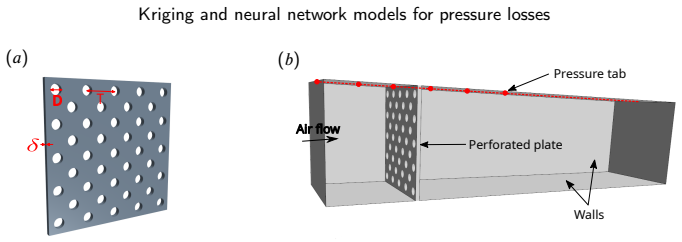
In this paper, two novel data-driven models based on kriging and neural networks (NN) are proposed to predict pressure losses across perforated plates with circular perforations in turbulent flows. The models are developed using two sets of experimental data available in the literature. The predictive performance of the proposed models is assessed and compared against widely used empirical formulae. It is found that the proposed models consistently outperform existing empirical models for most perforated plate configurations contained in the experimental datasets. Besides, the predicted pressure losses generally show good agreement with experimental measurements, demonstrating that data-driven approaches based on kriging and NN provide a feasible framework for modelling pressure losses across perforated plates. Overall, both approaches are promising, despite being trained on a relatively limited amount of experimental data, owing to the scarcity of measurements reported in the literature. To demonstrate the applicability of the proposed models in numerical simulations, two-dimensional channel flows are simulated using the Reynolds-averaged Navier-Stokes (RANS) equations, in which the new pressure-loss models are implemented as a source term in the momentum equations. The RANS predictions are found to be in excellent agreement with the model predictions, confirming the suitability of the proposed approaches for practical computational fluid dynamics applications.
Figures


Reference graph
Works this paper leans on
-
[1]
Ahmimache, M
Y. Ahmimache, M. Fénot, F. Plourde, L. Descamps, Heat transfer and flow velocity study of a row of jets emerging from a perforated pipe at a low reynolds number, International Journal of Heat and Mass Transfer 183 (2022) 122067
2022
-
[2]
D. H. Lee, Y. M. Lee, Y. T. Kim, S. Y. Won, Y. S. Chung, Heat transfer enhancement by the perforated plate installed between an impinging jet and the target plate, International Journal of Heat and Mass Transfer 45 (1) (2002) 213–217
2002
-
[3]
McMahon, R
H. McMahon, R. Bowen, G. Bleyle Jr, A perforated-plate heat exchanger, Transactions of the American Society of Mechanical Engineers 72 (5) (1950) 623–632
1950
-
[4]
Shevyakova, V
S. Shevyakova, V. Orlov, Study of hydraulic resistance and heat transfer in perforated-plate heat exchangers, Inzhenerno-Fizicheskij Zhurnal 45 (1) (1983) 32–36
1983
-
[5]
C. F. Kutscher, Heat exchange effectiveness and pressure drop for air flow through perforated plates with and without crosswind, Journal of Heat Transfer 116 (2) (1994) 391–399
1994
-
[6]
White, G
M. White, G. Nellis, S. Klein, W. Zhu, Y. Gianchandani, An experimentally validated numerical modeling technique for perforated plate heat exchangers, Journal of heat transfer 132 (11) (2010)
2010
-
[7]
Tomić, P
M. Tomić, P. Živković, M. Vukić, S. Ayed, The methodology for determination of perforated plate heat transfer coefficient, in: International Conference Powerplants, 2014
2014
-
[8]
V. K. Arghode, Y. Joshi, Experimental investigation of air flow through a perforated tile in a raised floor data center, Journal of electronic packaging 137 (1) (2015)
2015
-
[9]
L. R. Raju, S. S. Kumar, K. Chowdhury, T. Nandi, Heat transfer and flow friction correlations for perforated plate matrix heat exchangers, in: IOP Conference Series: Materials Science and Engineering, Vol. 171, IOP Publishing, 2017, p. 012085
2017
-
[10]
M. A. Tomić, S. K. Ayed, Ž. Ž. Stevanović, P. S. Ðekić, P. M. Živković, M. V. Vukić, Perforated plate convective heat transfer analysis, International Journal of Thermal Sciences 124 (2018) 300–306
2018
-
[11]
Husin, M
H. Husin, M. Faisal, A. Gani, R. Sardjono, R. Mamat, The modification of the perforated plate in the fluidized-bed combustor to analyze heat convection rate and temperature, Journal of Combustion 2021 (2021) 1–8
2021
-
[12]
E.Laws,A.Ouazzane,Afurtherinvestigationintoflowconditionerdesignyieldingcompactinstallationsfororificeplateflowmetering,Flow Measurement and Instrumentation 6 (3) (1995) 187–199
1995
-
[13]
Spearman, J
E. Spearman, J. Sattary, M. Reader-Harris, Comparison of velocity and turbulence profiles downstream of perforated plate flow conditioners, Flow measurement and Instrumentation 7 (3-4) (1996) 181–199
1996
-
[14]
B.Laribi,P.Wauters,M.Aichouni,Comparativestudyofaerodynamicbehaviourofthreeflowconditioners,Europeanjournalofmechanical and environmental engineering 48 (1) (2003) 21–30
2003
-
[15]
Xiong, K
W. Xiong, K. Kalkühler, W. Merzkirch, Velocity and turbulence measurements downstream of flow conditioners, Flow Measurement and Instrumentation 14 (6) (2003) 249–260
2003
-
[16]
Hoffmann-Vocke, J
J. Hoffmann-Vocke, J. Neale, M. Walmsley, The effect of inlet conditions on the air side hydraulic resistance and flow maldistribution in industrial air heaters, International journal of heat and fluid flow 32 (4) (2011) 834–845
2011
-
[17]
W.Yaïci,M.Ghorab,E.Entchev,3dcfdanalysisoftheeffectofinletairflowmaldistributiononthefluidflowandheattransferperformances of plate-fin-and-tube laminar heat exchangers, International Journal of Heat and Mass Transfer 74 (2014) 490–500
2014
-
[18]
Laribi, A
B. Laribi, A. A. Hadj, Discharge coefficient behaviour in presence of four perforated plates flow conditioners-numerical investigation part 1, in: 17th International Congress of Metrology, EDP Sciences, 2015, p. 03005
2015
-
[19]
Noiray, D
N. Noiray, D. Durox, T. Schuller, S. Candel, Passive control of combustion instabilities involving premixed flames anchored on perforated plates, Proceedings of the Combustion Institute 31 (1) (2007) 1283–1290
2007
-
[20]
S.Oh,Y.Shin,Y.Kim,Stabilizationeffectsofperforatedplatesonthecombustioninstabilityinaleanpremixedcombustor,AppliedThermal Engineering 107 (2016) 508–515
2016
-
[21]
S. S. Rashwan, A. H. Ibrahim, T. W. Abou-Arab, M. A. Nemitallah, M. A. Habib, Experimental study of atmospheric partially premixed oxy-combustion flames anchored over a perforated plate burner, Energy 122 (2017) 159–167
2017
-
[22]
J. Kim, A. Satija, R. P. Lucht, J. P. Gore, Effects of turbulent flow regime on perforated plate stabilized piloted lean premixed flames, Combustion and Flame 211 (2020) 158–172
2020
-
[23]
Younesian, M
H. Younesian, M. Shahmardan, Experimental study of flame quenching phenomenon of mixed methane and air in the presence of perforated plates and porous barriers in a closed chamber, Fuel and Combustion 14 (2) (2021) 87–100
2021
-
[24]
Younesian, M
H. Younesian, M. Nazari, M. M. Shahmardan, Visualization of flame propagation and quenching of methane/air mixture in a cubic enclosure with perforated plates: Experimental study, Combustion Science and Technology (2022) 1–20
2022
-
[25]
D. Naot, F. Kreith, On the penetration of turbulence through perforated flat plates, International Journal of Heat and Mass Transfer 23 (4) (1980) 566–568
1980
-
[26]
R. Liu, D. S. Ting, G. W. Rankin, On the generation of turbulence with a perforated plate, Experimental thermal and fluid science 28 (4) (2004) 307–316
2004
-
[27]
R. Liu, D. S.-K. Ting, Turbulent flow downstream of a perforated plate: sharp-edged orifice versus finite-thickness holes, Journal of Fluids Engineering 129 (9) (2007) 1164–1171. S Li et al.:Preprint submitted to ElsevierPage 14 of 15 Kriging and neural network models for pressure losses
2007
-
[28]
S.Dhineshkumar,B.Prakash,S.Balakrishnan,Largeturbulencecreationinsideagasturbinecombustionchamberusingperforatedplate,Int. J. Eng. Sci. Res. Technol 2 (2013) 937–942
2013
-
[29]
Sakaliyski, J
K. Sakaliyski, J. Hileman, Z. Spakovszky, Aero-acoustics of perforated drag plates for quiet transport aircraft, in: 45th AIAA Aerospace Sciences Meeting and Exhibit, 2007, p. 1032
2007
-
[30]
Rubio Carpio, F
A. Rubio Carpio, F. Avallone, D. Ragni, M. Snellen, S. Van Der Zwaag, Mechanisms of broadband noise generation on metal foam edges, Physics of Fluids 31 (10) (2019) 105110
2019
-
[31]
P.Laffay,S.Moreau,M.C.Jacob,J.Regnard,Experimentalinvestigationofthenoiseradiatedbyaductedairflowdischargethoughdiaphragms and perforated plates, Journal of Sound and Vibration 472 (2020) 115177
2020
-
[32]
C.Sumesh,T.Jothi,Aerodynamicnoisefromanasymmetricairfoilwithperforatedextensionplatesatthetrailingedge,InternationalJournal of Aeroacoustics 20 (1-2) (2021) 88–108
2021
-
[33]
R.Zamponi,A.R.Carpio,F.Avallone,D.Ragni,Noisesourceanalysisofporousfairingsinascaledlandinggearmodel,AerospaceScience and Technology 158 (2025) 109885
2025
-
[34]
D. S. Miller, Internal flow systems, Vol. 5, BHRA (Information services) Bedford, UK, 1990
1990
-
[35]
J. C. Pacio, C. A. Dorao, A study of the effect of flow maldistribution on heat transfer performance in evaporators, Nuclear Engineering and Design 240 (11) (2010) 3868–3877
2010
-
[36]
K. K. Nielsen, K. Engelbrecht, C. R. Bahl, The influence of flow maldistribution on the performance of inhomogeneous parallel plate heat exchangers, International Journal of heat and Mass transfer 60 (2013) 432–439
2013
-
[37]
L.Beckedorff,R.DaSilva,G.Martins,K.dePaiva,J.Oliveira,A.Oliveira,Flowmaldistributionandheattransfercharacteristicsinplateand shell heat exchangers, International Journal of Heat and Mass Transfer 195 (2022) 123182
2022
-
[38]
Yavuzkurt, G
S. Yavuzkurt, G. L. Catchen, Dependence of pressure losses on angle of attack for flow through perforated plates, in: ASME International Mechanical Engineering Congress and Exposition, Vol. 37165, 2003, pp. 435–440
2003
-
[39]
F. Méry, D. Sebbane, Aerodynamic characterisation of porous fairings: pressure drop and laser doppler velocimetry measurements, Scientific Data 10 (1) (2023) 39
2023
-
[40]
Y.Bayazit,E.M.Sparrow,D.D.Joseph,Perforatedplatesforfluidmanagement:Plategeometryeffectsandflowregimes,InternationalJournal of Thermal Sciences 85 (2014) 104–111
2014
-
[41]
Y. Bae, Y. I. Kim, Numerical modeling of anisotropic drag for a perforated plate with cylindrical holes, Chemical Engineering Science 149 (2016) 78–87
2016
-
[42]
I. E. Idelchik, Handbook of hydraulic resistance, Washington (1986)
1986
-
[43]
I. E. Idelchik, Handbook of hydraulic resistance, 2nd edn, CRC, Boca Raton, FL (1994)
1994
-
[44]
Kast, Pressure drop in single phase flow, vdi heat atlas (2010)
W. Kast, Pressure drop in single phase flow, vdi heat atlas (2010)
2010
-
[45]
G. Holt, D. Maynes, J. Blotter, Cavitation at sharp edge multi-hole baffle plates, in: ASME International Mechanical Engineering Congress and Exposition, Vol. 54921, 2011, pp. 401–410
2011
-
[46]
Pressure losses across orifice plates, perforated plates and thick orifice plates in ducts, Tech
Engineering Sciences Data Unit (ESDU), Flow of liquids. Pressure losses across orifice plates, perforated plates and thick orifice plates in ducts, Tech. rep., London, UK: Internal Flow and Physical Properties Group; Report no. 81039 (1981)
1981
-
[47]
Malavasi, G
S. Malavasi, G. Messa, U. Fratino, A. Pagano, On the pressure losses through perforated plates, Flow measurement and instrumentation 28 (2012) 57–66
2012
-
[48]
S. Li, L. Davidson, S.-H. Peng, A pressure-loss model for flow-through round-hole perforated plates of moderate porosity and thickness in laminar and turbulent flow regimes, International Journal of Heat and Mass Transfer 226 (2024) 125490
2024
-
[49]
Tanner, J
P. Tanner, J. Gorman, E. Sparrow, Flow–pressure drop characteristics of perforated plates, International Journal of Numerical Methods for Heat & Fluid Flow 29 (11) (2019) 4310–4333
2019
-
[50]
Minotti, F
A. Minotti, F. Simon, F. Gantié, Characterization of an acoustic liner by means of laser doppler velocimetry in a subsonic flow, Aerospace Science and Technology 12 (5) (2008) 398–407
2008
-
[51]
D. R. Jones, A taxonomy of global optimization methods based on response surfaces, Journal of global optimization 21 (4) (2001) 345–383
2001
- [52]
-
[53]
P. N. Okolo, K. Zhao, J. Kennedy, G. J. Bennett, Numerical modeling of wire screens for flow and noise control, in: 23rd AIAA/CEAS Aeroacoustics Conference, 2017, p. 3700
2017
-
[54]
W. Zhu, Z. Xiao, S. Fu, Numerical modeling screen for flow and noise control around tandem cylinders, AIAA Journal 58 (6) (2020) 2504– 2516
2020
-
[55]
S.Li,L.Davidson,S.-H.Peng,Numericalmodelingofawiremeshforaerodynamicnoisereduction,PhysicsofFluids35(1)(2023)015103
2023
-
[56]
S. Li, L. Davidson, S.-H. Peng, A. R. Carpio, D. Ragni, F. Avallone, A. Koutsoukos, On the mitigation of landing gear noise using a solid fairing and a dense wire mesh, Aerospace Science and Technology 153 (2024) 109465
2024
-
[57]
S.Li,L.Davidson,S.-H.Peng,A.RubioCarpio,D.Ragni,F.Avallone,Numericalandexperimentalinvestigationofthemitigationoflanding gear noise using diamond lattice fairings, in: 30th AIAA/CEAS Aeroacoustics Conference (2024), 2024, p. 3283
2024
-
[58]
2022.1 (Siemens 2022)
Siemens Digital Industries Software, Simcenter STAR-CCM+ User Guide v. 2022.1 (Siemens 2022)
2022
-
[59]
Siemens Digital Industries Software, Simcenter STAR-CCM+, version 2022.1 (Siemens 2022)
2022
- [60]
-
[61]
Shahzad, S
H. Shahzad, S. Hickel, D. Modesti, Permeability and turbulence over perforated plates, Flow, Turbulence and Combustion 109 (4) (2022) 1241–1254
2022
-
[62]
S. Lee, J. Yang, Modeling of darcy-forchheimer drag for fluid flow across a bank of circular cylinders, International journal of heat and mass transfer 40 (13) (1997) 3149–3155
1997
-
[63]
P.P.Doerffer,R.Bohning,Modellingofperforatedplateaerodynamicsperformance,AerospaceScienceandTechnology4(8)(2000)525–534
2000
-
[64]
Fratino, Hydraulic and cavitation characteristics of multihole orifices, in: Proceedings of the hydraulic machinery and system 20th IAHR symposium, 2000, pp
U. Fratino, Hydraulic and cavitation characteristics of multihole orifices, in: Proceedings of the hydraulic machinery and system 20th IAHR symposium, 2000, pp. 6–9. S Li et al.:Preprint submitted to ElsevierPage 15 of 15
2000
discussion (0)
Sign in with ORCID, Apple, or X to comment. Anyone can read and Pith papers without signing in.