REVIEW 3 major objections 1 minor 14 references
Reviewed by Pith at T0; open to challenge.
T0 means a machine referee read the full paper against a public rubric. The mark states how deep the mechanical check went, never who wrote it. the ladder, T0–T4 →
T0 review · grok-4.3
Clavius' 1567 eclipse report requires the solar radius to have been at most 696200 km.
2026-07-03 04:52 UTC pith:2OMQUPMF
load-bearing objection Clavius reports give a concrete 1567 R_Sun upper bound and narrow Delta T window, but the step from 'slender circle' wording to specific limb geometry lacks shown sensitivity checks. the 3 major comments →
Analyses on Christoph Clavius' Reports of Total Solar Eclipses in 1560 and 1567: Key References for the Centennial Variations of the Earth's Rotation Speed and the Solar Radius
The pith
A machine-rendered reading of the paper's core claim, the machinery that carries it, and where it could break.
Core claim
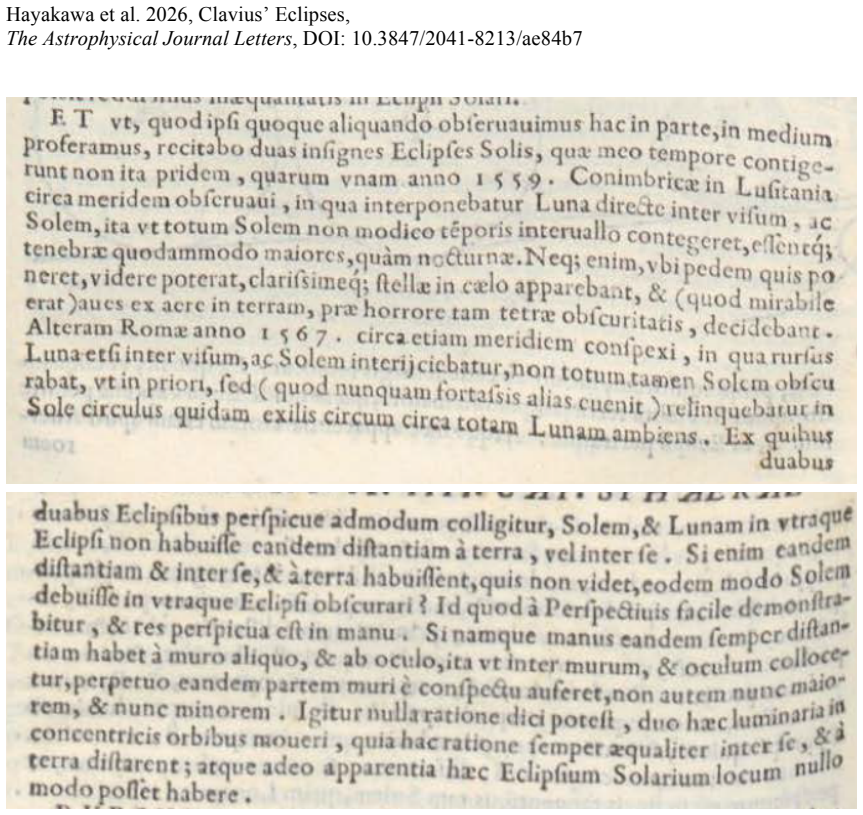
Clavius described an explicit totality in 1560 and a slender circle around the Moon in 1567. With modern lunar limb profiles and ephemerides, these qualitative reports yield Delta T intervals of -492 s to 200 s in 1560 and 140 s to 151 s in 1567. The local totality condition in 1567 imposes an upper solar-radius bound of 696200 km, showing no linear secular shrinkage but permitting centennial oscillations.
What carries the argument
Translation of Clavius' qualitative eclipse descriptions into quantitative solar-radius and Delta T bounds via lunar limb profiles and ephemerides.
Load-bearing premise
The analysis assumes Clavius' 'slender circle' description accurately records the actual eclipse geometry without rhetorical exaggeration or memory error.
What would settle it
An independent historical record or modern reconstruction showing the 1567 solar radius exceeded 696200 km, or a Delta T value outside the stated intervals that still matches the reported visibility, would falsify the derived limits.
If this is right
- The solar radius showed no linear secular decrease between the sixteenth century and the present.
- Centennial oscillations in solar radius remain compatible with the eclipse data.
- Historical qualitative reports can supply absolute solar-size references before direct measurements began.
- Earth's rotation-rate changes can be bounded at the specific dates of the two eclipses.
Where Pith is reading between the lines
- The same method of combining narrative descriptions with precise lunar topography could be applied to other pre-modern eclipse accounts to extend the radius record.
- If solar radius oscillates on century scales, the mechanism may connect to known longer-term solar magnetic cycles.
- The derived radius bound supplies a concrete anchor point for models that link solar size to historical climate variations.
Editorial analysis
A structured set of objections, weighed in public.
Referee Report
Summary. The paper reanalyzes Christoph Clavius' qualitative reports of the 1560 (Coimbra, explicit totality) and 1567 (Rome, slender circle) solar eclipses using modern lunar topography and ephemeris data. It revises the ΔT intervals to -492 s ≤ ΔT ≤ 200 s (1560) and 140 s ≤ ΔT ≤ 151 s (1567) under Auwers' canonical R_Sun, then derives an upper bound R_Sun ≤ 696200 km (959.92 arcsec) for 1567 under the local-totality scenario, concluding against linear secular shrinkage but allowing centennial oscillations. Three interpretive scenarios for the 1567 description are considered, with annularity deemed unlikely.
Significance. If the visibility-to-geometry mapping proves robust, the work supplies pre-1715 absolute R_Sun anchors that complement post-1715 eclipse records and bear on solar magnetic activity and possible climate linkages. The incorporation of updated lunar limb profiles and ephemerides is a clear methodological advance over earlier qualitative discussions.
major comments (3)
- [Abstract] Abstract: the 11-second ΔT window (140–151 s) for 1567 is obtained by matching the 'slender circle' description to lunar topography, yet no quantitative threshold is stated for what fraction of the solar limb must remain visible to qualify as 'slender' rather than total; this mapping is load-bearing for both the ΔT interval and the subsequent R_Sun ≤ 696200 km bound.
- [Abstract] Abstract and 1567 analysis section: the R_Sun upper limit of 696200 km is derived only after fixing Auwers' reference radius and adopting the totality scenario; the manuscript provides no sensitivity tests on alternative visibility thresholds, reference radii, or site/time uncertainties that could widen the allowed R_Sun range and thereby weaken the 'no linear secular shrinkage' claim.
- [Methods] Methods (implied by abstract claims): the revised ΔT intervals and R_Sun bound are presented without error propagation, Monte-Carlo sampling of ephemeris or topography uncertainties, or explicit handling of lunar limb profile variations, leaving the numerical precision of the central results unquantified.
minor comments (1)
- [Abstract] The abstract lists three interpretive scenarios for the 1567 report but does not name or tabulate them; a short table or enumerated list would improve clarity.
Simulated Author's Rebuttal
We thank the referee for the careful reading and constructive suggestions. The comments correctly identify areas where additional rigor can strengthen the quantitative aspects of the analysis. We will revise the manuscript to incorporate the requested clarifications, sensitivity tests, and uncertainty quantification while preserving the core conclusions based on the Clavius descriptions and updated ephemerides. Point-by-point responses follow.
read point-by-point responses
-
Referee: [Abstract] Abstract: the 11-second ΔT window (140–151 s) for 1567 is obtained by matching the 'slender circle' description to lunar topography, yet no quantitative threshold is stated for what fraction of the solar limb must remain visible to qualify as 'slender' rather than total; this mapping is load-bearing for both the ΔT interval and the subsequent R_Sun ≤ 696200 km bound.
Authors: We agree that an explicit quantitative definition of the 'slender circle' visibility threshold would improve transparency. In the revised version we will introduce a specific criterion (e.g., maximum residual solar-limb arc length or fractional visibility derived from historical eclipse terminology and modern photographic analogs) and re-derive the ΔT interval under that definition. This will be presented in a new subsection of the 1567 analysis. revision: yes
-
Referee: [Abstract] Abstract and 1567 analysis section: the R_Sun upper limit of 696200 km is derived only after fixing Auwers' reference radius and adopting the totality scenario; the manuscript provides no sensitivity tests on alternative visibility thresholds, reference radii, or site/time uncertainties that could widen the allowed R_Sun range and thereby weaken the 'no linear secular shrinkage' claim.
Authors: The referee is correct that the present bound is tied to the adopted reference radius and the local-totality interpretation. We will add a dedicated sensitivity section that varies (i) the visibility threshold, (ii) the reference solar radius within its historical uncertainty, and (iii) plausible site/time offsets. The resulting range of allowed R_Sun values will be reported explicitly so that readers can assess the robustness of the conclusion against linear secular shrinkage. revision: yes
-
Referee: [Methods] Methods (implied by abstract claims): the revised ΔT intervals and R_Sun bound are presented without error propagation, Monte-Carlo sampling of ephemeris or topography uncertainties, or explicit handling of lunar limb profile variations, leaving the numerical precision of the central results unquantified.
Authors: We acknowledge the absence of formal uncertainty quantification. In the revision we will implement a Monte-Carlo procedure that samples ephemeris uncertainties, lunar-limb profile variations from the LRO/LOLA dataset, and timing/site errors. The resulting distributions for ΔT and the R_Sun upper limit will be shown, together with 1σ and 2σ bounds, in updated figures and tables. revision: yes
Circularity Check
No significant circularity; derivation matches independent data to external canonical reference
full rationale
The paper assumes Auwers' external canonical R_Sun value solely to tighten Delta T bounds from Clavius' qualitative reports against independent lunar topography and ephemeris. It then applies those Delta T windows to derive an upper R_Sun limit consistent with the 1567 'slender circle' description. This does not presuppose the target bound in the inputs, invoke self-citations for uniqueness, or rename a fitted result as a prediction. The central claim rests on cross-matching historical visibility against separate astronomical datasets rather than reducing by construction to its own assumptions.
Axiom & Free-Parameter Ledger
axioms (2)
- domain assumption Auwers' canonical solar radius value is the appropriate reference for historical comparisons
- domain assumption Clavius' descriptions of totality and slender circle can be mapped directly to geometric visibility conditions
read the original abstract
Variations in solar radius (hereafter R_Sun) is a key reference for solar magnetic activity in time. The sunlight amount may have varied with R_Sun and had an effect on the Earth's climate in the past. Eclipse observations offer a unique opportunity to measure the absolute R_Sun value before modern direct observations. The scientific community has discussed a possible long-term R_Sun variability from 1715 onward. Prior to their coverage, Clavius' eclipse reports had been subjected to qualitative debates regarding the local eclipse visibility and a possible secular R_Sun trend. This study leverages the recent dramatic developments of lunar topography data and ephemeris data to provide an effective resolution of this debate. Clavius' eclipse reports described an explicit totality in 1560 at Coimbra and a "slender circle" around the eclipsing Moon in 1567 at Rome. Our study revised the {\Delta}T constraints of -492 s =< {\Delta}T =< 200 s in 1560 and 140 s =< {\Delta}T =< 151 s in 1567 to satisfy Clavius' descriptions, considering the lunar limb profile and assuming Auwers' canonical R_Sun. This study constrains the R_Sun margin of 1567, utilising three scenarios to interpret Clavius' account. The local totality requires an upper R_Sun limit of 1567 as R_Sun =< 696200 km in absolute size (959.92" in angular size), indicating no linear secular R_Sun shrinkage but possible R_Sun oscillations on a centennial timescale. Conversely, the annularity scenario is considered unlikely because it requires an R_Sun decrease of 7.5" within 3 centuries, even beyond the capacity of extreme shrinking-Sun hypotheses.
Figures


Reference graph
Works this paper leans on
-
[2]
Introduction The size of a star is an emergence property that is governed by physical processes taking place in the stellar interior. The size of our Sun has been a classic topic of interest in astronomy and astrophysics and our ability to measure the solar radius with high precision has led to it being used as a reference in other astronomical studies. S...
work page 2012
-
[3]
and the modern standard (helioseismic) value of 695780 km (Takata and Gough, 2024). These R☉ values have been widely used to develop a variety of studies in astronomy, astrophysics, and geophysics. The question of how R☉ evolves over time has long been debated2. Eddy et al. (1980, hereafter E+80) raised the possibility of a steep decrease in R☉ of 0.1% pe...
work page 2024
-
[5]
Their results have been heavily debated in contemporaneous studies (Dunham et al., 1980, 2016, hereafter D+80 and D+16; Parkinson et al., 1980; Sofia et al., 1983, hereafter S+83). This question has been occasionally debated even recently, if not intensively (Pap et al., 2001; Sofia et al., 2013; Hiremath et al., 2020). However, the scientific community h...
work page 1980
-
[8]
His description of the first eclipse states that the Moon covered the whole Sun for a considerable interval of time, whereas his account of the second precisely stresses the opposite point: the Sun was not entirely obscured, and “a certain slender circle” remained around the Moon. The corrected chronology accords well with Clavius’ known itinerary: he had...
work page 1994
-
[9]
Commentary on the Sphere of Johannes de Sacrobosco
As documented above, Clavius was attached to Colégio de Jesus of the University of Coimbra 5 This title is translated as “Commentary on the Sphere of Johannes de Sacrobosco”. 6 Clavius later adopted this correction, changing the year to 1560 in the Mainz edition of In Sphaeram (Hiraoka, 2005, pp. 104–105). Besides, SJM97 reasonably corrected the date of t...
work page 2005
-
[15]
made this scenario more plausible by allowing the Moon to hide the entire photosphere from Collegio Romano. This hypothesis sounds attractive, as the inner corona looks much brighter near the edge of the totality path (Littmann et al., 2008, pp. 136–137). This interpretation is challenged by the alleged absence of this structure in the 1560 eclipse. The i...
work page 2008
-
[16]
Third, this circular structure may be associated with the chromosphere
generally indicates their possible loss in the grand minima, the 1560 eclipse occurred following the end of the Spörer Minimum in the early to mid 16th century (Usoskin et al., 2021). Third, this circular structure may be associated with the chromosphere. The chromosphere extends up to 1000–5000 km above the photosphere (Figures 2–4 of Carlsson et al. (20...
-
[17]
1581, In sphaeram Ioannis de Sacro Bosco commentarius, Romæ, Ex Officina Dominici Basæ
DOI: 10.3847/1538-4357/ac7045 Clavius, C. 1581, In sphaeram Ioannis de Sacro Bosco commentarius, Romæ, Ex Officina Dominici Basæ. DOI: 10.3931/e-rara-12493 Clette, F., Lefèvre, L., Chatzistergos, T. et al. 2023, Re-calibration of the Sunspot Number: Status Report, Solar Physics, 298,
-
[18]
DOI: 10.1007/s11207-023-02136-3 DeForest, C. E. 2007, On the Size of Structures in the Solar Corona, The Astrophysical Journal, 661, 532-542. DOI: 10.1086/515561 Dunham, D. W., Sofia, S., Fiala, A. D., Herald, D., Muller, P. M. 1980, Observations of a Probable Change in the Solar Radius between 1715 and 1979, Science, 210, 1243-1245. DOI: 10.1126/science....
-
[19]
J., Meng, J., Sôma, M., Lockwood, M
DOI: 10.1051/swsc/2020035 Hayakawa, H., Owens, M. J., Meng, J., Sôma, M., Lockwood, M. 2025, Analyses of the Ancient Chinese Report on the Total Solar Eclipse in 709 BCE: Implications for the Contemporaneous Earth’s Rotation Speed and Solar Cycles, The Astrophysical Journal Letters, 995, L1. DOI: 10.3847/2041-8213/ae0461 Hiraoka, R. 2005, Jesuit Cosmologi...
-
[20]
DOI: 10.3847/1538-4357/ab6d08 Kilcik, A., Sigismondi, C., Rozelot, J. P., Guhl, K. 2009, Solar Radius Determination from Total Solar Eclipse Observations on 29 March 2006, Solar Physics, 257, 237-250. DOI: 10.1007/s11207-009-9378-x Kubo, Y. 1993, Position and Radius of the Sun Determined by Solar Eclipses in Combination with Lunar Occultations, Publicatio...
-
[21]
DOI: 10.1038/s41550-017-0190 Pevtsov, A. A. 2012, Complex Magnetic Evolution and Magnetic Helicity in the Solar Atmosphere, in: Obridko, V., Georgieva, K., Nagovitsyn, Y. (eds) The Sun: New Challenges. Astrophysics and Space Science Proceedings, 30, 83-91 Springer, Berlin, Heidelberg, DOI: 10.1007/978-3-642-29417-4_8 Prša, A., Harmanec, P., Torres, G., et...
-
[22]
DOI: 10.3847/0004-6256/152/2/41 Quaglia, L., Irwin, J., Emmanouilidis, K., Pessi, A. 2021, Estimation of the Eclipse Solar Radius by Flash Spectrum Video Analysis, The Astrophysical Journal Supplement Series, 256,
-
[23]
How big is the Sun: Solar diameter changes over time
DOI: 10.3847/1538-4365/ac1279 Rekier, J., Chao, B. F., Chen, J., Dehant, V., Rosat, S., Zhu, P. 2022, Earth's Rotation: Observations and Relation to Deep Interior, Surveys in Geophysics, 43, 149-175. DOI: Hayakawa et al. 2026, Clavius’ Eclipses, The Astrophysical Journal Letters, DOI: 10.3847/2041-8213/ae84b7 19 10.1007/s10712-021-09669-x Ribas I. 2009, T...
work page internal anchor Pith review Pith/arXiv arXiv doi:10.3847/1538-4365/ac1279 2022
discussion (0)
Sign in with ORCID, Apple, or X to comment. Anyone can read and Pith papers without signing in.