REVIEW 3 major objections 6 minor 32 references
L3A: Label-Augmented Analytic Adaptation for Multi-Label Class Incremental Learning
T0 review · 3 major / 6 minor · reviewed 2026-08-07 · deepseek-v4-flash
Pith's one-line read L3A shows that a multi-label classifier can be updated phase by phase from a closed-form recursive rule, without storing past images, and still beat replay-based methods on MS-COCO and PASCAL VOC.
desk verdict The paper has a genuinely interesting idea and strong reported results, but Theorem 3.1 as printed is dimensionally inconsistent and drops the pseudo-label term, so the load-bearing equivalence isn't proven. read the letter →
The pith
A machine-rendered reading of the paper's core claim, the machinery that carries it, and where it could break.
The reading
What carries the argument
The central object is the weighted analytic classifier: a linear head trained by weighted ridge regression whose solution is a closed-form matrix expression. The recursion is carried by the autocorrelation matrix $R_t = (X^\top_{1:t} \Omega_{1:t} X_{1:t} + \gamma I)^{-1}$, which compresses all past feature/weight statistics into a single matrix and is updated by the Woodbury identity so no historical samples are needed. The pseudo-label module generates augmented labels through a confidence threshold $\eta$, and together these pieces let Theorem 3.1 update $\bar{W}_t$ using only $\bar{W}_{t-1}$, $R_t$, and current data, making the update equivalent to joint training on the augmented label set.
What would settle it
Corrupt the pseudo-label stream on MS-COCO B0-C10 by flipping each predicted historical label with probability 0.1, 0.2, and 0.3 and measure last mAP; if the method degrades sharply even though true labels are untouched, that confirms the recursive update is storing pseudo-label errors rather than correcting them.
Extended reading notes
Core claim
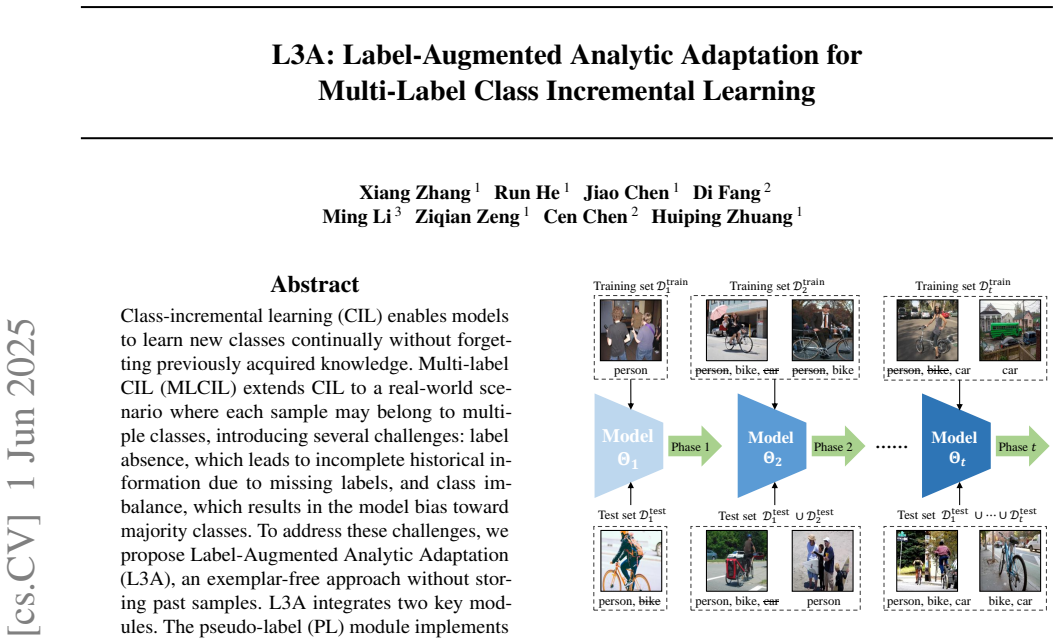
The discovery is that the two signature problems of multi-label continual learning, label absence and class imbalance, can both be handled inside an analytic (closed-form) classifier update. For label absence, the old classifier $\bar{W}_{t-1}$ is run on current images to produce binary pseudo-labels for historical classes, and these are merged with the current phase's true labels into an augmented label matrix. For imbalance, each sample is weighted by the average of inverse-square-root class frequencies across its active labels. The paper's Theorem 3.1 then shows the weighted ridge-regression classifier $\bar{W}_t$ can be updated recursively from $\bar{W}_{t-1}$ and the current features, with the autocorrelation matrix $R_t$ updated by the Woodbury identity; this update is algebraically identical to retraining on all augmented data so far. On MS-COCO B0-C10 and B40-C10 this yields last mAP of 77.6% and 78.8%, and on VOC B0-C4 and B10-C2 it reaches 94.1% and 94.0%, exceeding the compared replay and prompt baselines.
Load-bearing premise
The whole label-completion benefit rests on the previous-phase classifier producing mostly correct pseudo-labels for old classes on new images; when it is wrong, the errors become permanent because no historical data is kept to correct them.
Editorial extensions
If this is right
- Storing no images becomes compatible with top multi-label accuracy: the autocorrelation matrix replaces the replay buffer.
- The recursive update is exactly joint training on all augmented labels, so the method's gains are attributable to label completion and reweighting rather than approximate memory.
- Because the backbone stays frozen and the classifier update is algebraic, each phase adds only a matrix inversion, so the cost of adding classes does not grow with the number of old samples.
- On the reported benchmarks, the margins over replay-based baselines suggest rehearsal can be dropped in multi-label streams without losing accuracy.
Reading between the lines
- The recursion cannot correct pseudo-label errors: any systematic mistake of $\bar{W}_{t-1}$ on current images is written into the augmented labels and then into $\bar{W}_t$, so performance should track the reliability of old labels on new data.
- The inverse-frequency weighting is a natural candidate for other imbalanced continual-learning settings, since it is a simple plug-in and does not depend on multi-label structure.
- Because the feature extractor is frozen, the method's ceiling is set by the pretrained representation; adapting the backbone would break the closed form, so comparisons to prompt-based methods reflect a specific accuracy-versus-adaptability trade-off.
- The equivalence in Theorem 3.1 is exact for the linear weighted head only; any extension to deep feature learning would lose the joint-training equivalence.
Editorial analysis
A structured set of objections, weighed in public.
Referee Report
Summary. L3A proposes an exemplar-free multi-label class-incremental learning (MLCIL) method. It combines a pseudo-label module, which uses the previous-phase classifier to label historical classes on current-phase data, with a weighted analytic ridge-regression classifier that is updated recursively from the previous classifier, the current features, and an autocorrelation matrix. Theorem 3.1 claims that the recursive update is equivalent to joint training on all augmented labels, and experiments on MS-COCO and PASCAL VOC report state-of-the-art mAP against both replay-free and replay-based methods. The paper includes ablations for the regularization coefficient, buffer-layer size, pseudo-label threshold, and weighting scheme, and it releases code.
Significance. If the theoretical claim and the empirical comparisons hold, L3A would be a valuable exemplar-free MLCIL baseline: it offers a closed-form recursion with no replay memory, and the reported gains over CSC and MULTI-LANE are substantial. The paper ships code and covers the main hyperparameters in ablations. However, the central recursive formula as printed is not the joint-training solution, and the empirical validation selects hyperparameters directly on the test benchmarks without variance reporting, so the current evidence is not yet at the level of confidence the SOTA claim requires.
major comments (3)
- [§3.5, Theorem 3.1, Eq. (12), Appendix A, Eqs. (14)-(15)] Equation (12) as printed is not a valid update. W_{t-1} has d × |C_{1:t-1}| columns and Yhat_t has |C_{1:t}| columns, so the block row [W_{t-1} - R_t X_t^T Ω_t X_t W_{t-1}, R_t X_t^T Ω_t Yhat_t] has d × (|C_{1:t-1}| + |C_{1:t}|) columns, not d × |C_{1:t}|. The same dimensional problem appears in the proof's Eqs. (14)-(15), where blocks X_i^T Ω_i Yhat_i of widths |C_{1:i}| are concatenated as if they were compatible. Zero-padding the historical label blocks to the current class width gives W_t = [W_{t-1} - R_t X_t^T Ω_t X_t W_{t-1} + R_t X_t^T Ω_t Ytilde_t, R_t X_t^T Ω_t Y_t]. Eq. (12) therefore drops the pseudo-label contribution to the old-class columns and cannot be equivalent to Eq. (10). Please correct Theorem 3.1, the proof, and Algorithm 1, and verify the recurrence numerically on a small synthetic problem.
- [§4.1.3 and Tables 5-8] The hyperparameters γ=1000, buffer size 8192, η=0.7, and the 1/sqrt(f) weighting form are selected by running ablations directly on the MS-COCO and PASCAL VOC test mAP, with no validation split reported. This makes the reported SOTA comparisons optimistic and provides no error estimate; all results appear to be single-run. Please add a validation protocol (e.g., a held-out split of the training data) and report mean ± std over multiple seeds for the final configuration.
- [§3.3 and §4.4] The PL module is a self-referential pseudo-labeling loop: W_{t-1} produces Ytilde_t, and Ytilde_t is then used as ground truth in Eq. (10). If W_{t-1} is biased on historical classes, those errors are baked into the augmented labels and cannot be corrected without stored data. Section 4.4, which the paper says 'analyses why the pseudo-label module works,' contains only a qualitative assertion; the only empirical evidence is the threshold sweep in Table 7. The authors should measure pseudo-label precision/recall (e.g., by comparing Ytilde_t with ground-truth historical labels on a held-out split in an offline simulation) and report sensitivity of final mAP to pseudo-label noise.
minor comments (6)
- [Captions of Tables 1 and 3] The word 'examplar-free' should be 'exemplar-free', and 'Datain bold' should be split as 'Data in bold'.
- [Eq. (6)] The sample-specific weight ω_{t,i} divides by the number of active labels in the augmented label vector; if a sample has no active labels in Yhat_t, this weight is undefined and should be handled explicitly.
- [Table 6] The text says 'once the size reaches 8196' while the table lists buffer sizes 8192; the text and table should agree.
- [Figure 2(c)] The figure labels the analytic classifier as 'Weight Matrix Ω_t', but Ω_t denotes the sample-weight diagonal matrix in Eq. (7) while the classifier is W_t; this is confusing and should be corrected.
- [Table 3] The upper-bound row reports no average mAP; because L3A's average mAP of 96.7 on VOC B0-C4 is higher than the upper-bound's last mAP of 94.7, the authors should state explicitly how the upper-bound is computed (e.g., which classifier is trained and how per-phase averages are obtained) so that readers can verify it is an upper bound.
- [Appendix A] The proof of Theorem 3.1 should use explicit zero-padding notation for label blocks; as written, Eqs. (14) and (15) concatenate blocks with different column counts and are not valid matrix products.
Circularity Check
No significant circularity: the analytic update is a direct algebraic derivation, and the remaining concerns are correctness or evaluation-selection issues rather than circular reductions.
full rationale
The paper's central analytic claim (Theorem 3.1, Eq. 12) is presented as a recursive least-squares manipulation of the weighted ridge closed-form solution (Eq. 10). The proof expresses W_t in terms of W_{t-1}, the current features X_t, the weight matrix Omega_t, and the augmented labels Yhat_t via the Woodbury identity; this is a derivation from the stated objective, not an assumption of the conclusion. The pseudo-label module (Eqs. 2-3) does use the previous classifier's outputs to construct training labels, but the final evaluation is on ground-truth test labels, so whether the self-training loop helps is an empirical question rather than a definitional circularity. The self-citations to prior ACL works (Zhuang et al., 2022; 2023; 2024a; 2024b) provide background and design elements, but the current theorem is argued inside the paper rather than imported as an unverified premise. The hyperparameters (gamma, buffer size, eta, weighting form) are selected in the ablation study on the same benchmark sets, which weakens the strength of the SOTA claim as an independent prediction, but this is a test-set selection concern, not a derivation-level circularity: the reported mAP is an observed outcome, not an equation forced by the fitted values. Separately, the proof in Section A contains a dimensional-inconsistency problem (Eq. 15 concatenates blocks of incompatible widths), which is a correctness risk for the stated equivalence, but a mathematical error is not a circular reduction to the paper's own inputs.
Assumptions & free parameters
free parameters (4)
- gamma (regularization coefficient) =
1000
- eta (pseudo-label confidence threshold) =
0.7
- buffer layer size =
8192
- weighting form for sample-specific weights =
1/sqrt(f)
assumptions (4)
- domain assumption Frozen backbone assumption
- domain assumption Pseudo-label accuracy assumption
- domain assumption Linear separability of augmented features
- standard math Woodbury matrix identity
Cite this review
Pith. "Pith review of L3A: Label-Augmented Analytic Adaptation for Multi-Label Class Incremental Learning." pith.science (2026). https://pith.science/paper/2P7KU5WC
@misc{pith2026250600816,
  author       = {Pith},
  title        = {Pith review of: L3A: Label-Augmented Analytic Adaptation for Multi-Label Class Incremental Learning},
  year         = {2026},
  howpublished = {\url{https://pith.science/paper/2P7KU5WC}},
  note         = {Machine review of arXiv:2506.00816}
}
read the original abstract
Class-incremental learning (CIL) enables models to learn new classes continually without forgetting previously acquired knowledge. Multi-label CIL (MLCIL) extends CIL to a real-world scenario where each sample may belong to multiple classes, introducing several challenges: label absence, which leads to incomplete historical information due to missing labels, and class imbalance, which results in the model bias toward majority classes. To address these challenges, we propose Label-Augmented Analytic Adaptation (L3A), an exemplar-free approach without storing past samples. L3A integrates two key modules. The pseudo-label (PL) module implements label augmentation by generating pseudo-labels for current phase samples, addressing the label absence problem. The weighted analytic classifier (WAC) derives a closed-form solution for neural networks. It introduces sample-specific weights to adaptively balance the class contribution and mitigate class imbalance. Experiments on MS-COCO and PASCAL VOC datasets demonstrate that L3A outperforms existing methods in MLCIL tasks. Our code is available at https://github.com/scut-zx/L3A.
Figures


Reference graph
Works this paper leans on
-
[1]
write newline
" write newline "" before.all 'output.state := FUNCTION n.dashify 't := "" t empty not t #1 #1 substring "-" = t #1 #2 substring "--" = not "--" * t #2 global.max substring 't := t #1 #1 substring "-" = "-" * t #2 global.max substring 't := while if t #1 #1 substring * t #2 global.max substring 't := if while FUNCTION format.date year duplicate empty "emp...
-
[2]
Dark experience for general continual learning: a strong, simple baseline
Buzzega, P., Boschini, M., Porrello, A., Abati, D., and CALDERARA, S. Dark experience for general continual learning: a strong, simple baseline. In Advances in Neural Information Processing Systems, volume 33, pp.\ 15920--15930. Curran Associates, Inc., 2020
work page 2020
-
[3]
Chaudhry, A., Dokania, P. K., Ajanthan, T., and Torr, P. H. S. Riemannian walk for incremental learning: Understanding forgetting and intransigence. In Computer Vision -- ECCV 2018, pp.\ 556--572, Cham, 2018. Springer International Publishing. ISBN 978-3-030-01252-6. doi:10.1007/978-3-030-01252-6_33
-
[4]
Less is more: Summarizing patch tokens for efficient multi-label class-incremental learning
De Min, T., Mancini, M., Lathuili \`e re, S., Roy, S., and Ricci, E. Less is more: Summarizing patch tokens for efficient multi-label class-incremental learning. In Conference on Lifelong Learning Agents. PMLR, 2024
work page 2024
-
[5]
Knowledge restore and transfer for multi-label class-incremental learning
Dong, S., Luo, H., He, Y., Wei, X., Cheng, J., and Gong, Y. Knowledge restore and transfer for multi-label class-incremental learning. In Proceedings of the IEEE/CVF International Conference on Computer Vision, pp.\ 18711--18720, October 2023. doi:10.1109/ICCV51070.2023.01715
arXiv 2023
-
[6]
PODNet : Pooled outputs distillation for small-tasks incremental learning
Douillard, A., Cord, M., Ollion, C., Robert, T., and Valle, E. PODNet : Pooled outputs distillation for small-tasks incremental learning. In Computer Vision -- ECCV 2020, pp.\ 86--102, Cham, 2020. Springer International Publishing. ISBN 978-3-030-58565-5. doi:10.1007/978-3-030-58565-5_6
-
[7]
Confidence self-calibration for multi-label class-incremental learning
Du, K., Zhou, Y., Lyu, F., Li, Y., Lu, C., and Liu, G. Confidence self-calibration for multi-label class-incremental learning. In Computer Vision -- ECCV 2024, pp.\ 234--252, Cham, 2025. Springer Nature Switzerland. ISBN 978-3-031-72751-1. doi:10.1007/978-3-031-72751-1_14
-
[8]
Everingham, M., Van Gool, L., Williams, C. K. I., Winn, J., and Zisserman, A. The pascal visual object classes ( VOC ) challenge. International Journal of Computer Vision, 88 0 (2): 0 303--338, Jun 2010. ISSN 1573-1405. doi:10.1007/s11263-009-0275-4
Show all 32 references
-
[9]
AIR : Analytic imbalance rectifier for continual learning, 2024
Fang, D., Zhu, Y., Lin, Z., Chen, C., Zeng, Z., and Zhuang, H. AIR : Analytic imbalance rectifier for continual learning, 2024. URL https://arxiv.org/abs/2408.10349
2024 arXiv
-
[10]
and Lyu, M
Guo, P. and Lyu, M. R. A pseudoinverse learning algorithm for feedforward neural networks with stacked generalization applications to software reliability growth data. Neurocomputing, 56: 0 101--121, January 2004. ISSN 0925-2312. doi:10.1016/S0925-2312(03)00385-0
2004 doi
-
[11]
REAL : Representation enhanced analytic learning for exemplar-free class-incremental learning, March 2024
He, R., Zhuang, H., Fang, D., Chen, Y., Tong, K., and Chen, C. REAL : Representation enhanced analytic learning for exemplar-free class-incremental learning, March 2024
2024
-
[12]
Distilling the knowledge in a neural network, March 2015
Hinton, G., Vinyals, O., and Dean, J. Distilling the knowledge in a neural network, March 2015. URL https://arxiv.org/abs/1503.02531
2015 arXiv
-
[13]
D., Jeong, J., and Kim, G
Kim, C. D., Jeong, J., and Kim, G. Imbalanced continual learning with partitioning reservoir sampling. In ECCV, pp.\ 411--428. Springer, 2020
2020
-
[14]
A., Milan, K., Quan, J., Ramalho, T., Grabska-Barwinska, A., Hassabis, D., Clopath, C., Kumaran, D., and Hadsell, R
Kirkpatrick, J., Pascanu, R., Rabinowitz, N., Veness, J., Desjardins, G., Rusu, A. A., Milan, K., Quan, J., Ramalho, T., Grabska-Barwinska, A., Hassabis, D., Clopath, C., Kumaran, D., and Hadsell, R. Overcoming catastrophic forgetting in neural networks. Proceedings of the Nat...
2017 doi
-
[15]
and Hoiem, D
Li, Z. and Hoiem, D. Learning without forgetting. IEEE Transactions on Pattern Analysis and Machine Intelligence, 40 0 (12): 0 2935--2947, December 2017. ISSN 1939-3539. doi:10.1109/TPAMI.2017.2773081
2017
-
[16]
and Li, W.-J
Liang, Y.-S. and Li, W.-J. Optimizing class distribution in memory for multi-label online continual learning, 2022. URL https://arxiv.org/abs/2209.11469
2022 arXiv
-
[17]
Lin, T.-Y., Maire, M., Belongie, S., Hays, J., Perona, P., Ramanan, D., Doll \'a r, P., and Zitnick, C. L. Microsoft COCO : Common objects in context. In Computer Vision -- ECCV 2014, pp.\ 740--755, Cham, 2014. Springer International Publishing. ISBN 978-3-319-10602-1. doi:10....
2014 doi
-
[18]
and Cohen, N
McCloskey, M. and Cohen, N. J. Catastrophic interference in connectionist networks: The sequential learning problem. In Psychology of Learning and Motivation, volume 24, pp.\ 109--165. Academic Press, 1989. doi:10.1016/S0079-7421(08)60536-8
1989 doi
-
[19]
Connectionist models of recognition memory: Constraints imposed by learning and forgetting functions
Ratcliff, R. Connectionist models of recognition memory: Constraints imposed by learning and forgetting functions. Psychological Review, 97 0 (2): 0 285--308, 1990. doi:10.1037/0033-295X.97.2.285
1990 doi
-
[20]
Rebuffi, S.-A., Kolesnikov, A., Sperl, G., and Lampert, C. H. iCaRL : Incremental classifier and representation learning. In Proceedings of the IEEE Conference on Computer Vision and Pattern Recognition (CVPR), pp.\ 5533--5542, July 2017. doi:10.1109/CVPR.2017.587
2017 doi
-
[21]
Asymmetric loss for multi-label classification
Ridnik, T., Ben-Baruch, E., Zamir, N., Noy, A., Friedman, I., Protter, M., and Zelnik-Manor, L. Asymmetric loss for multi-label classification. In Proceedings of the IEEE/CVF International Conference on Computer Vision, pp.\ 82--91, 2021. doi:10.1109/ICCV48922.2021.00015
2021
-
[22]
Experience replay for continual learning
Rolnick, D., Ahuja, A., Schwarz, J., Lillicrap, T., and Wayne, G. Experience replay for continual learning. In Advances in Neural Information Processing Systems, volume 32. Curran Associates, Inc., December 2019
2019
-
[23]
W., Pascanu, R., and Hadsell, R
Schwarz, J., Czarnecki, W., Luketina, J., Grabska-Barwinska, A., Teh, Y. W., Pascanu, R., and Hadsell, R. Progress & compress: A scalable framework for continual learning. In International Conference on Machine Learning, pp.\ 4528--4537. PMLR, 2018
2018
-
[25]
Topology-preserving class-incremental learning
Tao, X., Chang, X., Hong, X., Wei, X., and Gong, Y. Topology-preserving class-incremental learning. In Computer Vision -- ECCV 2020, pp.\ 254--270, Cham, 2020. Springer International Publishing. ISBN 978-3-030-58529-7. doi:10.1007/978-3-030-58529-7_16
2020 doi
-
[26]
Learning to prompt for continual learning
Wang, Z., Zhang, Z., Lee, C.-Y., Zhang, H., Sun, R., Ren, X., Su, G., Perot, V., Dy, J., and Pfister, T. Learning to prompt for continual learning. In Proceedings of the IEEE/CVF Conference on Computer Vision and Pattern Recognition (CVPR), pp.\ 139--149, June 2022. doi:10.110...
2022
-
[27]
Large scale incremental learning
Wu, Y., Chen, Y., Wang, L., Ye, Y., Liu, Z., Guo, Y., and Fu, Y. Large scale incremental learning. In Proceedings of the IEEE/CVF Conference on Computer Vision and Pattern Recognition (CVPR), pp.\ 374--382, June 2019. doi:10.1109/CVPR.2019.00046
2019
-
[28]
Expandable subspace ensemble for pre-trained model-based class-incremental learning
Zhou, D.-W., Sun, H.-L., Ye, H.-J., and Zhan, D.-C. Expandable subspace ensemble for pre-trained model-based class-incremental learning. In Proceedings of the IEEE/CVF Conference on Computer Vision and Pattern Recognition (CVPR), pp.\ 23554--23564, June 2024 a . doi:10.1109/CV...
2024
-
[29]
Class-incremental learning: A survey
Zhou, D.-W., Wang, Q.-W., Qi, Z.-H., Ye, H.-J., Zhan, D.-C., and Liu, Z. Class-incremental learning: A survey. IEEE Transactions on Pattern Analysis and Machine Intelligence, 46 0 (12): 0 9851--9873, December 2024 b . ISSN 1939-3539. doi:10.1109/TPAMI.2024.3429383
2024
-
[30]
ACIL : Analytic class-incremental learning with absolute memorization and privacy protection
Zhuang, H., Weng, Z., Wei, H., Xie, R., Toh, K.-A., and Lin, Z. ACIL : Analytic class-incremental learning with absolute memorization and privacy protection. In Advances in Neural Information Processing Systems, volume 35, pp.\ 11602--11614. Curran Associates, Inc., 2022
2022
-
[31]
GKEAL : Gaussian kernel embedded analytic learning for few-shot class incremental task
Zhuang, H., Weng, Z., He, R., Lin, Z., and Zeng, Z. GKEAL : Gaussian kernel embedded analytic learning for few-shot class incremental task. In 2023 IEEE/CVF Conference on Computer Vision and Pattern Recognition (CVPR), pp.\ 7746--7755, June 2023. doi:10.1109/CVPR52729.2023.00748
2023
-
[32]
GACL : Exemplar-free generalized analytic continual learning
Zhuang, H., Chen, Y., Fang, D., He, R., Tong, K., Wei, H., Zeng, Z., and Chen, C. GACL : Exemplar-free generalized analytic continual learning. In Advances in Neural Information Processing Systems. Curran Associates, Inc., December 2024 a
2024
-
[33]
DS-AL : A dual-stream analytic learning for exemplar-free class-incremental learning
Zhuang, H., He, R., Tong, K., Zeng, Z., Chen, C., and Lin, Z. DS-AL : A dual-stream analytic learning for exemplar-free class-incremental learning. Proceedings of the AAAI Conference on Artificial Intelligence, 38 0 (15): 0 17237--17244, March 2024 b . doi:10.1609/aaai.v38i15.29670
2024 doi
Reviewed August 7, 2026 · model on record in the stance chip above.
Discussion (0). Sign in to comment.