Eight loop form factors, amplitudes and patterns in planar mathcal{N}=4 super-Yang-Mills theory
Pith reviewed 2026-06-26 10:15 UTC · model grok-4.3
The pith
The three-point form factor of tr φ³ has been computed to eight loops and shares the same restricted polylogarithm space as the tr φ² form factor.
A machine-rendered reading of the paper's core claim, the machinery that carries it, and where it could break.
Core claim
We have computed the three-point form factor of the operator tr φ³ to eight loops. This form factor lives in the same restricted space of polylogarithms as the tr φ² form factor. We also report all-order patterns for sequences of coefficients in the symbols of these polylogarithmic results, for the leading discontinuity of the tr φ³ form factor.
What carries the argument
The restricted space of polylogarithms shared by the tr φ² and tr φ³ form factors, which supports the use of antipodal duality to relate them to amplitudes.
If this is right
- The eight-loop tr φ³ result supplies new data that can be compared directly against duality predictions and bootstrap constraints.
- The identified all-order patterns in symbol coefficients can be used to predict terms at higher loop orders without new computations.
- The leading discontinuity of the tr φ³ form factor obeys the same coefficient sequences seen at lower orders.
- Computations of related form factors or amplitudes can reuse the same polylogarithm space and duality relations.
Where Pith is reading between the lines
- The shared space suggests that multiple protected operators may generate form factors inside one common polylog family.
- The coefficient patterns may reflect an underlying algebraic structure that organizes the entire perturbative series.
- If the patterns persist, they could allow conjectural reconstruction of the form factor to all loops from a finite set of data.
Load-bearing premise
The tr φ³ form factor lives inside the same restricted space of polylogarithms already identified for the tr φ² form factor.
What would settle it
An independent eight-loop computation of the tr φ³ form factor whose symbol contains an entry forbidden by the restrictions observed in the tr φ² case.
Figures
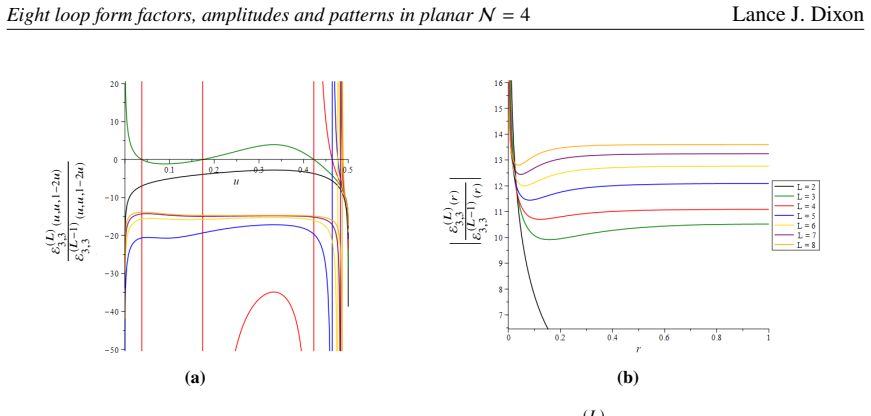
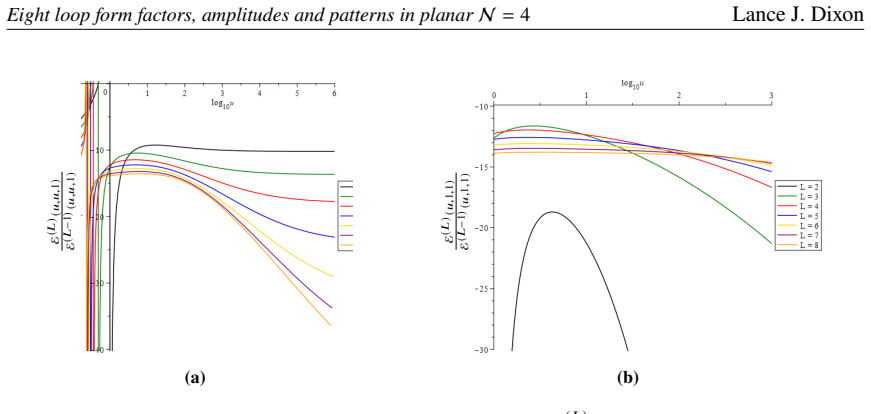
read the original abstract
The simplest nontrivial amplitude in planar $\mathcal{N}=4$ super-Yang-Mills theory is six-gluon scattering in the maximally-helicity-violating configuration. It has been computed to 8 loops with the help of antipodal duality, which relates it to the three-point form factor of a protected operator, the chiral stress tensor super-multiplet, represented also as ${\rm tr} \phi^2$. In this talk, we describe the computation to 8 loops of another three-point form factor, for the operator ${\rm tr}\phi^3$. This form factor lives in the same restricted space of polylogarithms as the ${\rm tr}\phi^2$ form factor. We also report on all-order patterns for sequences of coefficients in the symbols of these polylogarithmic results, for the leading discontinuity of the ${\rm tr}\phi^3$ form factor.
Editorial analysis
A structured set of objections, weighed in public.
Referee Report
Summary. The manuscript computes the three-point form factor of the operator tr φ³ to eight loops in planar N=4 super-Yang-Mills theory. It states that this form factor occupies the same restricted space of polylogarithms as the previously computed tr φ² form factor (related to the six-gluon MHV amplitude via antipodal duality), enabling the eight-loop result. The paper also extracts all-order patterns in sequences of coefficients appearing in the symbols of these polylogarithms, including for the leading discontinuity of the tr φ³ form factor.
Significance. If the space-equivalence claim holds and the patterns are independently verified, the work would extend the reach of explicit higher-loop computations in N=4 SYM and identify candidate all-order structures in the symbol coefficients. This could strengthen the case for using antipodal duality and bootstrap methods more broadly, provided the function space is shown to be identical rather than assumed.
major comments (2)
- [Abstract] Abstract: the central claim that the tr φ³ form factor 'lives in the same restricted space of polylogarithms as the tr φ² form factor' is load-bearing for both the eight-loop computation and the reported coefficient patterns. No explicit verification is supplied (e.g., a count of the basis dimension at weight 8, confirmation that the alphabet is identical, or a low-order cross-check showing that no new letters appear). Without this, the direct transfer of methods from the tr φ² case remains an assumption rather than a demonstrated fact.
- [Abstract] The reliance on antipodal duality (previously established only for the tr φ² case) to reach eight loops for tr φ³ inherits the same space restriction. If the function space for tr φ³ is strictly larger, the reported eight-loop expression would be under-constrained and the extracted all-order patterns would require re-derivation.
minor comments (1)
- [Abstract] The abstract refers to 'all-order patterns for sequences of coefficients in the symbols'; the manuscript should clarify whether these patterns are derived from the eight-loop data alone or require additional assumptions.
Simulated Author's Rebuttal
We thank the referee for their careful reading of the manuscript and for identifying the need for greater explicitness regarding the function-space claim. We address each major comment below.
read point-by-point responses
-
Referee: [Abstract] Abstract: the central claim that the tr φ³ form factor 'lives in the same restricted space of polylogarithms as the tr φ² form factor' is load-bearing for both the eight-loop computation and the reported coefficient patterns. No explicit verification is supplied (e.g., a count of the basis dimension at weight 8, confirmation that the alphabet is identical, or a low-order cross-check showing that no new letters appear). Without this, the direct transfer of methods from the tr φ² case remains an assumption rather than a demonstrated fact.
Authors: We agree that the abstract is too terse on this point. The full manuscript describes the bootstrap construction for the tr φ³ form factor, which employs the identical 31-letter alphabet and the same weight-by-weight basis dimensions previously determined for the tr φ² case. Low-order results (through four loops) were cross-checked against independent Feynman-integral evaluations and match exactly, with no additional letters required. At eight loops the ansatz remained fully constrained by the same number of conditions as in the tr φ² computation. In the revised version we will add a short paragraph (and accompanying table) in Section 2 that tabulates the basis dimensions at each weight up to 8 and explicitly states that the alphabet is unchanged. revision: yes
-
Referee: [Abstract] The reliance on antipodal duality (previously established only for the tr φ² case) to reach eight loops for tr φ³ inherits the same space restriction. If the function space for tr φ³ is strictly larger, the reported eight-loop expression would be under-constrained and the extracted all-order patterns would require re-derivation.
Authors: Antipodal duality is invoked only to motivate the initial ansatz; the actual eight-loop result is obtained by solving the bootstrap equations directly for the tr φ³ form factor. Because the symbol alphabet and the number of independent coefficients at each weight are taken from the tr φ² analysis, any additional letters or functions would have manifested as an under-determined system or as inconsistencies with the known lower-loop data. No such inconsistencies appeared. The all-order coefficient patterns are extracted from the explicit eight-loop symbols we computed; they are therefore independent of the duality itself. We will add a clarifying sentence in the introduction and in the discussion of the patterns to emphasize that the space restriction was verified a posteriori by the consistency of the bootstrap. revision: partial
Circularity Check
No significant circularity; derivation extends prior methods with independent verification of function space.
full rationale
The paper states that the tr φ³ form factor lives in the same restricted polylog space as the tr φ² case and uses this to enable the 8-loop computation plus extraction of coefficient patterns. This is presented as a result of performing the computation rather than an unverified assumption that forces the outcome. The antipodal duality is referenced from prior work but is not load-bearing for a self-referential reduction here; the new computation provides its own check by saturating the space without exceeding it. No equations or steps equate outputs to inputs by construction, no fitted parameters are renamed as predictions, and the reported all-order patterns are observational sequences extracted from the explicit results. The derivation chain remains self-contained against the external benchmark of the prior tr φ² computations.
Axiom & Free-Parameter Ledger
axioms (1)
- domain assumption Antipodal duality maps the six-gluon MHV amplitude to the three-point form factor of a protected operator.
Reference graph
Works this paper leans on
-
[1]
Space-time S-matrix and Flux-tube S-matrix at Finite Coupling
B. Basso, A. Sever and P. Vieira, Phys. Rev. Lett.111(2013) no.9, 091602 doi:10.1103/PhysRevLett.111.091602 [arXiv:1303.1396 [hep-th]]
work page internal anchor Pith review Pith/arXiv arXiv doi:10.1103/physrevlett.111.091602 2013
-
[2]
A. V. Kotikov and L. N. Lipatov, [arXiv:hep-ph/0112346 [hep-ph]]
-
[3]
DGLAP and BFKL evolution equations in the N=4 supersymmetric gauge theory
A.V.KotikovandL.N.Lipatov,Nucl.Phys.B661(2003),19-61[erratum: Nucl.Phys.B685 (2004), 405-407] doi:10.1016/S0550-3213(03)00264-5 [arXiv:hep-ph/0208220 [hep-ph]]. 9 Eight loop form factors, amplitudes and patterns in planarN=4Lance J. Dixon
work page internal anchor Pith review Pith/arXiv arXiv doi:10.1016/s0550-3213(03)00264-5 2003
-
[4]
A.V.Kotikov,L.N.Lipatov,A.I.OnishchenkoandV.N.Velizhanin,Phys.Lett.B595(2004), 521-529 [erratum: Phys. Lett. B632(2006), 754-756] doi:10.1016/j.physletb.2004.05.078 [arXiv:hep-th/0404092 [hep-th]]
work page internal anchor Pith review Pith/arXiv arXiv doi:10.1016/j.physletb.2004.05.078 2004
-
[5]
Z. Bern, L. J. Dixon and V. A. Smirnov, Phys. Rev. D72(2005), 085001 doi:10.1103/PhysRevD.72.085001 [arXiv:hep-th/0505205 [hep-th]]
work page internal anchor Pith review Pith/arXiv arXiv doi:10.1103/physrevd.72.085001 2005
-
[6]
L.F.Alday,D.GaiottoandJ.Maldacena,JHEP09(2011),032doi:10.1007/JHEP09(2011)032 [arXiv:0911.4708 [hep-th]]
work page internal anchor Pith review Pith/arXiv arXiv doi:10.1007/jhep09(2011)032 2011
-
[7]
L. J. Dixon, M. von Hippel and A. J. McLeod, JHEP01(2016), 053 doi:10.1007/JHEP01(2016)053 [arXiv:1509.08127 [hep-th]]
work page internal anchor Pith review Pith/arXiv arXiv doi:10.1007/jhep01(2016)053 2016
-
[8]
S.Caron-Huot,L.J.Dixon,A.McLeodandM.vonHippel,Phys.Rev.Lett.117(2016)no.24, 241601 doi:10.1103/PhysRevLett.117.241601 [arXiv:1609.00669 [hep-th]]
work page internal anchor Pith review Pith/arXiv arXiv doi:10.1103/physrevlett.117.241601 2016
-
[9]
L. J. Dixon, A. J. McLeod and M. Wilhelm, JHEP04(2021), 147 doi:10.1007/JHEP04(2021)147 [arXiv:2012.12286 [hep-th]]
-
[10]
L. J. Dixon, Ö. Gürdoğan, A. J. McLeod and M. Wilhelm, JHEP07(2022), 153 doi:10.1007/JHEP07(2022)153 [arXiv:2204.11901 [hep-th]]
-
[11]
B.Basso,L.J.DixonandA.G.Tumanov,JHEP02(2025),034doi:10.1007/JHEP02(2025)034 [arXiv:2410.22402 [hep-th]]
-
[12]
A.B.Goncharov,M.Spradlin,C.VerguandA.Volovich,Phys.Rev.Lett.105(2010),151605 doi:10.1103/PhysRevLett.105.151605 [arXiv:1006.5703 [hep-th]]
work page internal anchor Pith review Pith/arXiv arXiv doi:10.1103/physrevlett.105.151605 2010
-
[13]
A. Sever, A. G. Tumanov and M. Wilhelm, Phys. Rev. Lett.126(2021) no.3, 031602 doi:10.1103/PhysRevLett.126.031602 [arXiv:2009.11297 [hep-th]]
-
[14]
A. Sever, A. G. Tumanov and M. Wilhelm, JHEP10(2021), 071 doi:10.1007/JHEP10(2021)071 [arXiv:2105.13367 [hep-th]]
-
[15]
A. Sever, A. G. Tumanov and M. Wilhelm, JHEP03(2022), 128 doi:10.1007/JHEP03(2022)128 [arXiv:2112.10569 [hep-th]]
-
[16]
B. Basso and A. G. Tumanov, JHEP02(2024), 022 doi:10.1007/JHEP02(2024)022 [arXiv:2308.08432 [hep-th]]
-
[17]
L. J. Dixon, Ö. Gürdoğan, A. J. McLeod and M. Wilhelm, Phys. Rev. Lett.128(2022) no.11, 11 doi:10.1103/PhysRevLett.128.111602 [arXiv:2112.06243 [hep-th]]
-
[18]
S. Caron-Huot, L. J. Dixon, F. Dulat, M. von Hippel, A. J. McLeod and G. Papathanasiou, JHEP08(2019), 016 doi:10.1007/JHEP08(2019)016 [arXiv:1903.10890 [hep-th]]
-
[19]
L. J. Dixon and Y.-T. Liu, JHEP09(2023), 098 doi:10.1007/JHEP09(2023)098 [arXiv:2308.08199 [hep-th]]. 10 Eight loop form factors, amplitudes and patterns in planarN=4Lance J. Dixon
-
[20]
The Eight-Loop Three-Point Form Factor oftr𝜙3 in PlanarN=4 Super-Yang-Mills Theory
L. J. Dixon and Z. Li, “The Eight-Loop Three-Point Form Factor oftr𝜙3 in PlanarN=4 Super-Yang-Mills Theory”, to appear
-
[21]
The last of the simple remainders
A. Brandhuber, B. Penante, G. Travaglini and C. Wen, JHEP08(2014), 100 doi:10.1007/JHEP08(2014)100 [arXiv:1406.1443 [hep-th]]
work page internal anchor Pith review Pith/arXiv arXiv doi:10.1007/jhep08(2014)100 2014
-
[22]
G. Lin, G. Yang and S. Zhang, Phys. Rev. Lett.127(2021) no.17, 171602 doi:10.1103/PhysRevLett.127.171602 [arXiv:2106.05280 [hep-th]]
-
[23]
G. Lin, G. Yang and S. Zhang, JHEP03(2022), 061 doi:10.1007/JHEP03(2022)061 [arXiv:2111.03021 [hep-th]]
-
[24]
J. M. Henn, J. Lim and W. J. Torres Bobadilla, JHEP02(2025), 085 doi:10.1007/JHEP02(2025)085 [arXiv:2410.22465 [hep-th]]
-
[25]
Analytic two-loop form factors in N=4 SYM
A. Brandhuber, G. Travaglini and G. Yang, JHEP05(2012), 082 doi:10.1007/JHEP05(2012)082 [arXiv:1201.4170 [hep-th]]
work page internal anchor Pith review Pith/arXiv arXiv doi:10.1007/jhep05(2012)082 2012
-
[26]
Hopf algebras, coproducts and symbols: an application to Higgs boson amplitudes
C. Duhr, JHEP08(2012), 043 doi:10.1007/JHEP08(2012)043 [arXiv:1203.0454 [hep-ph]]
work page internal anchor Pith review Pith/arXiv arXiv doi:10.1007/jhep08(2012)043 2012
-
[27]
X. Chen, X. Guan and B. Mistlberger, [arXiv:2504.06490 [hep-ph]]
-
[28]
L. J. Dixon, J. M. Drummond and J. M. Henn, JHEP11(2011), 023 doi:10.1007/JHEP11(2011)023 [arXiv:1108.4461 [hep-th]]
work page internal anchor Pith review Pith/arXiv arXiv doi:10.1007/jhep11(2011)023 2011
-
[29]
L. J. Dixon, J. M. Drummond, C. Duhr and J. Pennington, JHEP06(2014), 116 doi:10.1007/JHEP06(2014)116 [arXiv:1402.3300 [hep-th]]
work page internal anchor Pith review Pith/arXiv arXiv doi:10.1007/jhep06(2014)116 2014
-
[30]
J. M. Drummond, G. Papathanasiou and M. Spradlin, JHEP03(2015), 072 doi:10.1007/JHEP03(2015)072 [arXiv:1412.3763 [hep-th]]
work page internal anchor Pith review Pith/arXiv arXiv doi:10.1007/jhep03(2015)072 2015
-
[31]
S. He, X. Jiang, X. Li and J. Liu, [arXiv:2511.09669 [hep-th]]
-
[32]
S. Caron-Huot, L. J. Dixon, F. Dulat, M. Von Hippel, A. J. McLeod and G. Papathanasiou, JHEP09(2019), 061 doi:10.1007/JHEP09(2019)061 [arXiv:1906.07116 [hep-th]]
-
[33]
Cluster adjacency properties of scattering amplitudes
J. Drummond, J. Foster and Ö. Gürdoğan, Phys. Rev. Lett.120(2018) no.16, 161601 doi:10.1103/PhysRevLett.120.161601 [arXiv:1710.10953 [hep-th]]
work page internal anchor Pith review Pith/arXiv arXiv doi:10.1103/physrevlett.120.161601 2018
-
[34]
E. Remiddi and J. A. M. Vermaseren, Int. J. Mod. Phys. A15(2000), 725-754 doi:10.1142/S0217751X00000367 [arXiv:hep-ph/9905237 [hep-ph]]
work page internal anchor Pith review Pith/arXiv arXiv doi:10.1142/s0217751x00000367 2000
-
[35]
Li,SparseRREFprime solver, at https://github.com/munuxi/SparseRREF
Z. Li,SparseRREFprime solver, at https://github.com/munuxi/SparseRREF
-
[36]
N.Beisert,B.EdenandM.Staudacher,J.Stat.Mech.0701(2007),P01021doi:10.1088/1742- 5468/2007/01/P01021 [arXiv:hep-th/0610251 [hep-th]]. 11
work page internal anchor Pith review Pith/arXiv arXiv doi:10.1088/1742- 2007
discussion (0)
Sign in with ORCID, Apple, or X to comment. Anyone can read and Pith papers without signing in.