Gravitational Waves from hybrid defects as probe of Flavor symmetry breaking: Machine-Learning Approach
Pith reviewed 2026-06-28 20:53 UTC · model grok-4.3
The pith
A network of cosmic strings bounding domain walls from gauged flavor symmetry breaking produces a detectable gravitational wave background with a distinctive low-frequency slope.
A machine-rendered reading of the paper's core claim, the machinery that carries it, and where it could break.
Core claim
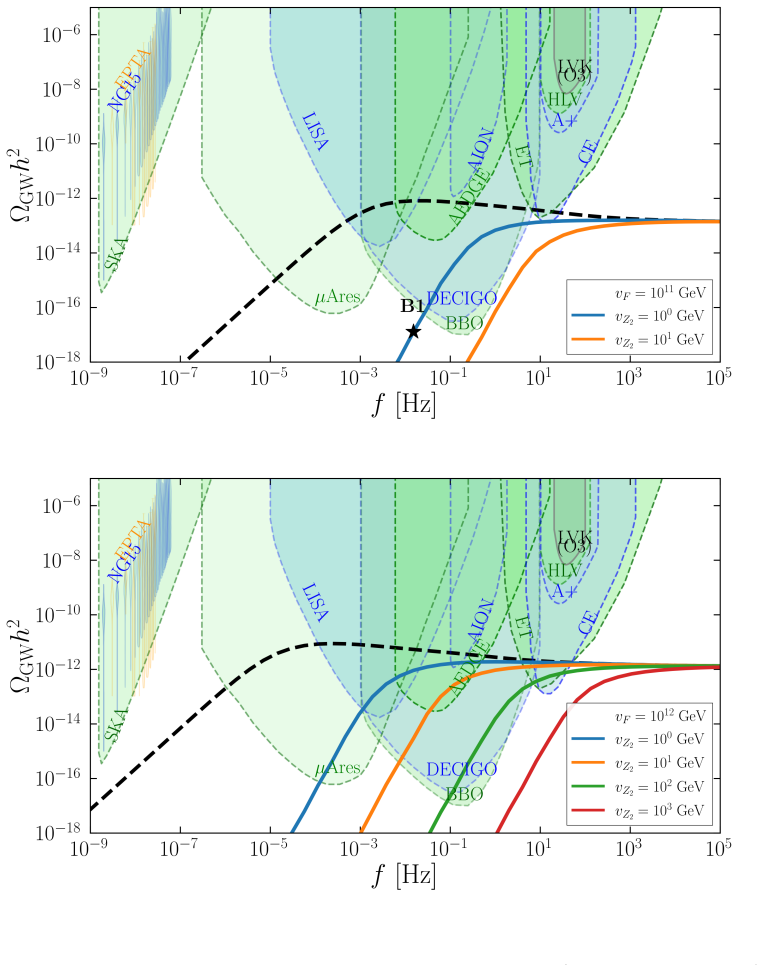
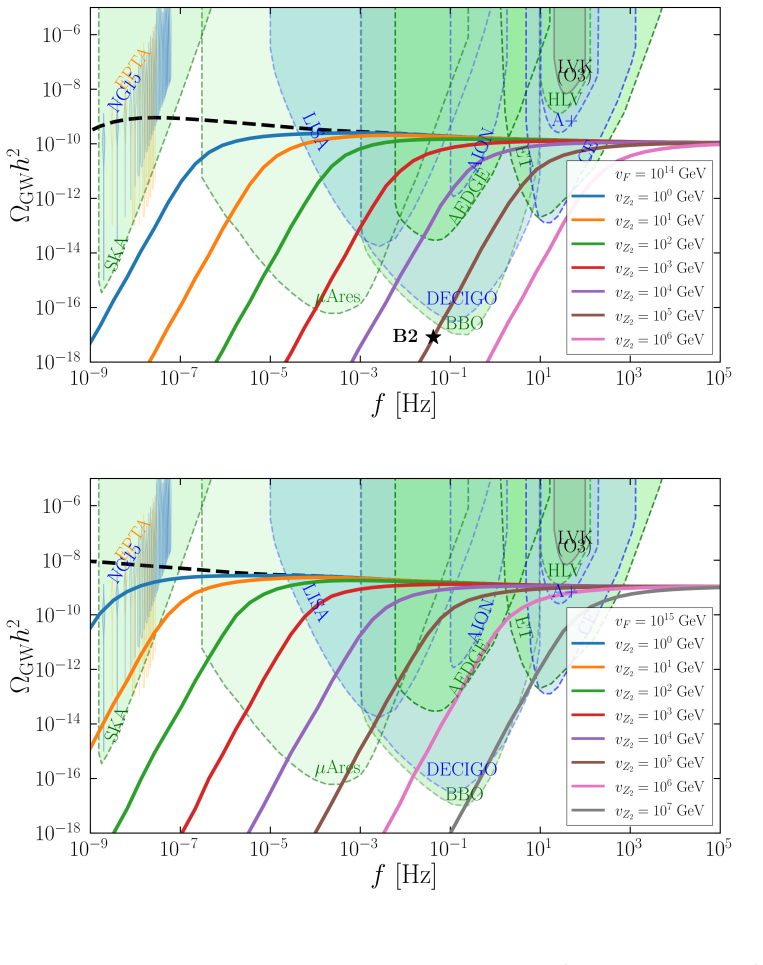
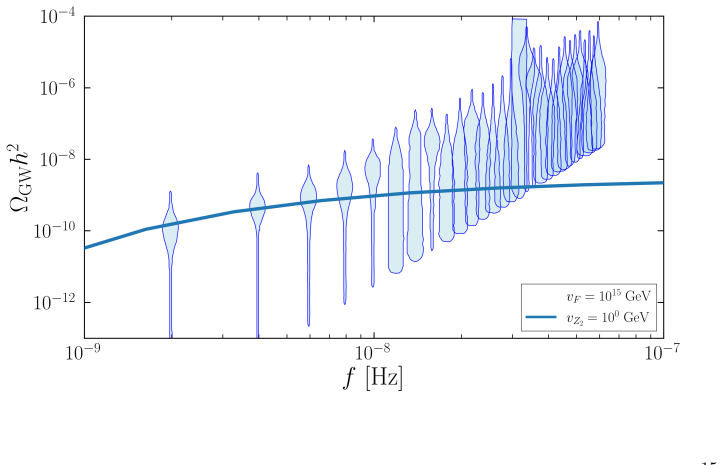
A network of domain walls bounded by cosmic strings, formed after the spontaneous breaking of a gauged U(1)_F flavor symmetry and a subsequent Z2 symmetry, generates a stochastic gravitational wave background. For sufficiently high U(1)_F breaking scales this background lies within the sensitivity reach of LISA, ET and SKA. In the microhertz-to-hertz band the spectrum exhibits a steeper infrared slope than the standard cosmic-string case. A multilayer perceptron trained on exact numerical spectra serves as a fast surrogate for computing detector signal-to-noise ratios, enabling efficient parameter scans and discrimination from pure cosmic-string signals.
What carries the argument
The string-bounded-wall network whose evolution follows standard scaling after two successive symmetry-breaking transitions, together with a multilayer perceptron surrogate that maps numerical spectra to detector signal-to-noise ratios.
If this is right
- Detection of the predicted spectrum would directly constrain the scale of gauged flavor symmetry breaking.
- The infrared slope difference supplies a concrete discriminant between hybrid defects and stable cosmic strings in the same detectors.
- Rapid machine-learning evaluation of signal-to-noise ratios makes exhaustive scans over flavor-model parameters feasible.
- Laboratory flavor observables can be combined with the gravitational-wave signal to test the same symmetry-breaking sequence.
- Non-observation at the quoted sensitivities would exclude high-scale realizations of the U(1)_F plus Z2 scenario.
Where Pith is reading between the lines
- The same machine-learning surrogate technique could be retrained on spectra from other hybrid defect models to accelerate their observational forecasts.
- Absence of the signal would tighten bounds on flavor models that rely on a high-scale U(1)_F breaking to generate dark-matter candidates via the Z2.
- Future pulsar-timing arrays or space-based interferometers could be re-optimized to exploit the distinctive infrared slope rather than assuming a pure cosmic-string template.
Load-bearing premise
The hybrid defect network forms and then evolves according to the same scaling laws that are assumed for ordinary cosmic strings and domain walls.
What would settle it
A measurement of the stochastic gravitational-wave spectrum between 10^{-6} Hz and 1 Hz that either shows or fails to show an infrared slope steeper than the cosmic-string prediction.
Figures
read the original abstract
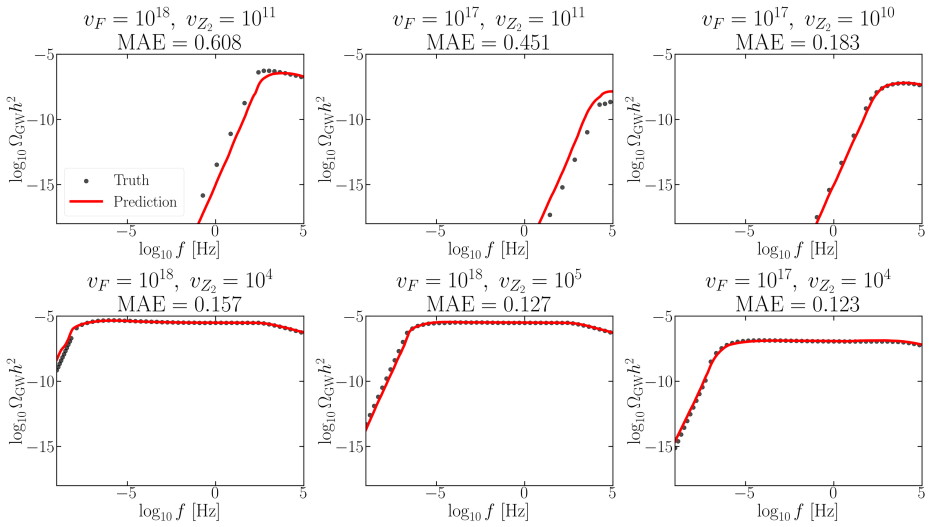
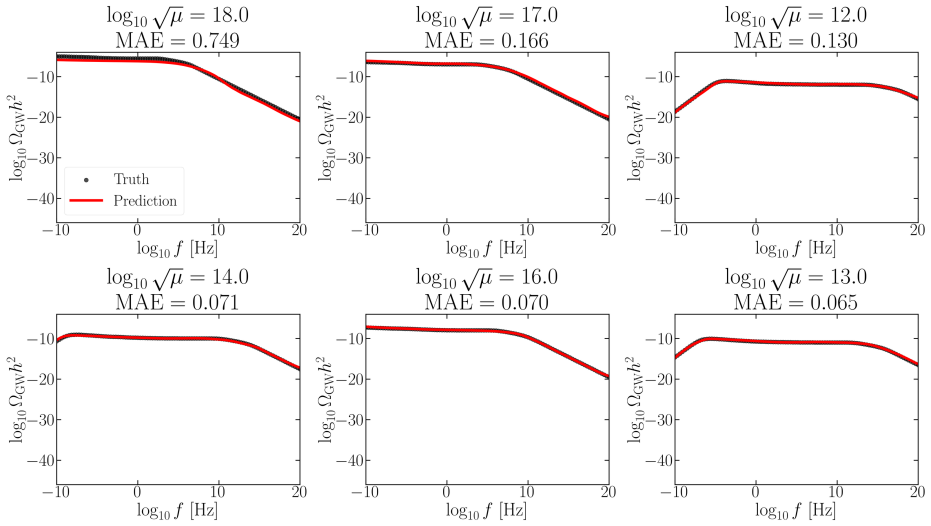
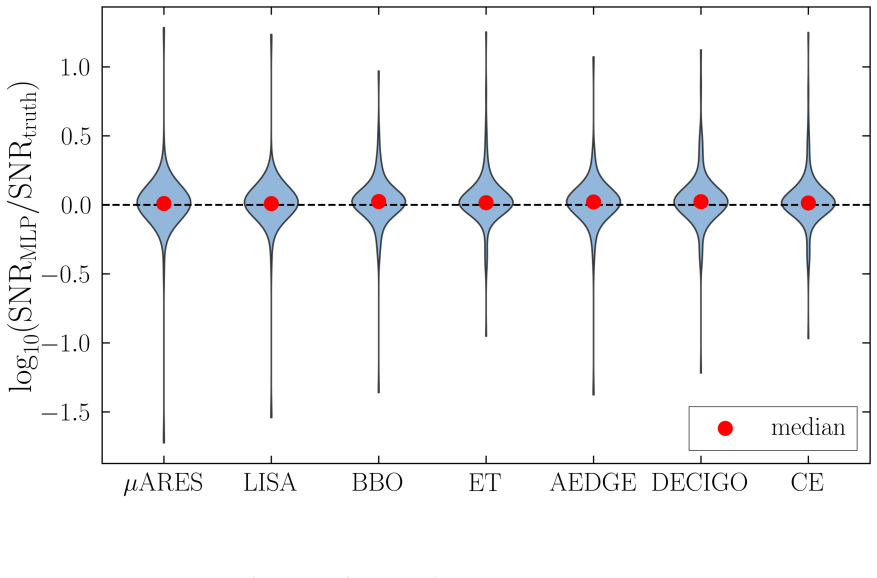
We present a novel possibility that a network of domain walls bounded by cosmic strings generates a stochastic gravitational wave background (SWGB) signal originating from the spontaneous breaking of a gauged $U(1)_F$ flavor symmetry and the subsequent breaking of discrete $Z_2$ symmetry that accommodates dark matter. The gravitational wave (GW) spectrum produced by the string-bounded-wall network can be detected for high $U(1)_F$ breaking scales in forthcoming GW detectors including LISA, ET and SKA. The GW signal exhibits a distinctive frequency slope, in the infrared, compared to the standard cosmic-string case, in the frequency range between micro-hertz and hertz. We develop a possible strategy to distinguish and characterize GW spectrum of the hybrid defect from from other defects, such as stable cosmic strings, via employing the exact calculation with a machine-learning surrogate, based on a multilayer perceptron (MLP), trained on spectra obtained from the full numerical treatment. This is then used for rapid inference in the detector-specific signal-to-noise ratio (SNR) computation which also makes the process fast and efficient. We also discuss some possible complementarity between GW searches and Flavor observables in the laboratory.
Editorial analysis
A structured set of objections, weighed in public.
Referee Report
Summary. The paper claims that a network of domain walls bounded by cosmic strings, formed after successive spontaneous breaking of a gauged U(1)_F flavor symmetry and a discrete Z_2 symmetry (accommodating dark matter), generates a stochastic gravitational wave background. This signal is asserted to be detectable in forthcoming detectors (LISA, ET, SKA) for sufficiently high U(1)_F breaking scales and to exhibit a distinctive infrared frequency slope relative to standard cosmic-string networks. Spectra are obtained via full numerical treatment of the hybrid defects and used to train a multilayer perceptron (MLP) surrogate model that enables rapid, detector-specific signal-to-noise ratio (SNR) inference; complementarity with laboratory flavor observables is also discussed.
Significance. If the central claims hold, the work would identify a new class of GW source tied to flavor symmetry breaking, potentially distinguishable by its infrared slope and offering a complementary probe to collider or precision flavor experiments. The MLP surrogate approach is a clear strength, providing computational efficiency for parameter scans and SNR calculations that would otherwise be prohibitive.
major comments (2)
- [Methods / network evolution description (near Eq. for GW spectrum)] The detectability and distinctive infrared slope claims rest on the assumption that the hybrid string-bounded-wall network reaches and maintains standard scaling regimes (string energy density ~1/t², wall density ~1/t) after the two successive phase transitions. No independent derivation, lattice simulation, or analytic justification specific to the gauged U(1)_F → Z_2 sequence is supplied to confirm that loop chopping, wall collapse, or friction regimes remain unaltered; this assumption is load-bearing for the reported spectra and SNR results.
- [§ on MLP training and SNR computation] The U(1)_F and Z_2 breaking scales are treated as free parameters chosen to place the GW spectrum inside detector bands; because the MLP is trained exclusively on spectra generated from the same parameter choices, the rapid SNR inference largely reproduces the input assumptions rather than providing an independent test of detectability.
minor comments (2)
- [Abstract] The abstract states that the spectrum is detectable and has a distinctive slope yet supplies neither the explicit network evolution equations nor the numerical method used to obtain the spectra; a concise summary of the evolution equations and integration scheme should be added in the main text or an appendix.
- [Notation / parameter definitions] Notation for the hybrid defect parameters (tension, wall tension, correlation lengths) is introduced without a dedicated table or equation block; a compact parameter table would improve readability.
Simulated Author's Rebuttal
We thank the referee for their careful reading of the manuscript and for highlighting these important points regarding the scaling assumptions and the role of the MLP surrogate. We respond to each major comment below.
read point-by-point responses
-
Referee: [Methods / network evolution description (near Eq. for GW spectrum)] The detectability and distinctive infrared slope claims rest on the assumption that the hybrid string-bounded-wall network reaches and maintains standard scaling regimes (string energy density ~1/t², wall density ~1/t) after the two successive phase transitions. No independent derivation, lattice simulation, or analytic justification specific to the gauged U(1)_F → Z_2 sequence is supplied to confirm that loop chopping, wall collapse, or friction regimes remain unaltered; this assumption is load-bearing for the reported spectra and SNR results.
Authors: We agree that the scaling behavior is a central assumption underlying the reported spectra. Our numerical treatment of the hybrid defects adopts the standard scaling regimes established in the cosmic-string and domain-wall literature, as the topological properties and energy-loss mechanisms (loop chopping for strings, collapse for walls) remain analogous in the gauged U(1)_F followed by Z_2 sequence. No new friction or collapse channels are introduced by the specific symmetry-breaking pattern. To strengthen the presentation we will add an explicit paragraph in the methods section, with supporting references to prior hybrid-defect studies, clarifying why the standard scaling is expected to hold. revision: yes
-
Referee: [§ on MLP training and SNR computation] The U(1)_F and Z_2 breaking scales are treated as free parameters chosen to place the GW spectrum inside detector bands; because the MLP is trained exclusively on spectra generated from the same parameter choices, the rapid SNR inference largely reproduces the input assumptions rather than providing an independent test of detectability.
Authors: The MLP is constructed strictly as a computational surrogate to enable rapid, detector-specific SNR evaluation once the underlying spectra have already been obtained from the full numerical simulations. The parameter choices that place the signal inside detector bands are part of mapping the physically viable region; detectability itself is determined by comparing those numerically computed spectra to the detector noise curves. The MLP performs interpolation and does not generate or validate new spectra. We will revise the relevant section to make this distinction explicit and to state that the MLP serves only as an efficiency tool. revision: yes
Circularity Check
No significant circularity detected
full rationale
The paper assumes standard scaling regimes for cosmic-string and domain-wall networks after successive U(1)_F and Z_2 breakings, then generates spectra numerically and trains an MLP surrogate for rapid SNR evaluation. No quoted equation or step reduces the claimed GW spectrum, infrared slope, or detectability to a fitted parameter or self-citation by construction; the scaling laws are imported as external inputs rather than defined in terms of the output. The MLP is a standard surrogate technique, not a self-referential fit. The derivation chain therefore remains independent of its own results.
Axiom & Free-Parameter Ledger
free parameters (3)
- U(1)_F breaking scale
- Z2 breaking scale
- Network scaling parameters
axioms (2)
- domain assumption Hybrid string-wall networks obey the same scaling laws derived for ordinary cosmic strings and domain walls.
- domain assumption The infrared slope difference is a robust, model-independent signature of the hybrid topology.
Reference graph
Works this paper leans on
-
[1]
and atmospheric (∆m2
-
[2]
This allows us to determine the coefficients in front of theϵparameter in the charged-lepton and neutrino mass matrices presented in Eq
mass splittings at 1012 GeV, which were generated via two-loop RGE running using PDG data ye = 2.80×10 −6, y µ = 5.89×10 −4, y τ = 1.00×10 −2, θ21 = 33.4o,∆m 2 21 = 7.48×10 −5eV 2, θ23 = 49.1o,∆m 2 31 = 2.53×10 −3eV 2 (12) θ13 ≈8.6 o. This allows us to determine the coefficients in front of theϵparameter in the charged-lepton and neutrino mass matrices pr...
-
[3]
sufficiently high
and integrating out the heavy Φ at an energy scale below vF we obtain: V(H, S) =−µ 2H †H+λ(H †H)2 −m 2S∗S+ +λ 2(S∗S)2 +λ 3(H †H)(S ∗S) + m12vF 2 (S2 + (S∗)2) (15) We assume that all dimensionless quartic couplingsλ,λ 2 andλ 3 are real.m 12 denotes a complex mass parameter. We adopt the following notation: µ2 =M 2 1 − 1 2 λ3v2 F m2 =M 2 3 − 1 2 λ5v2 F (16)...
2048
-
[4]
domain walls bounded by cosmic strings
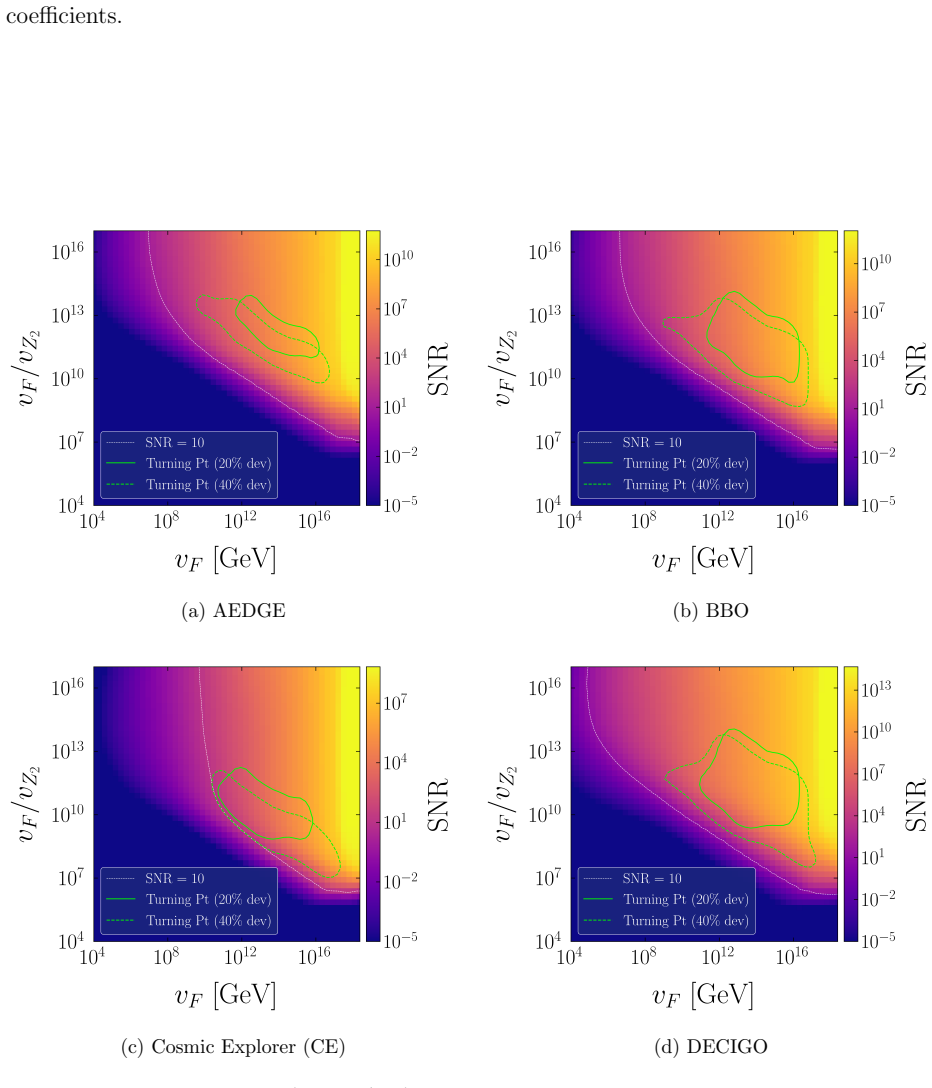
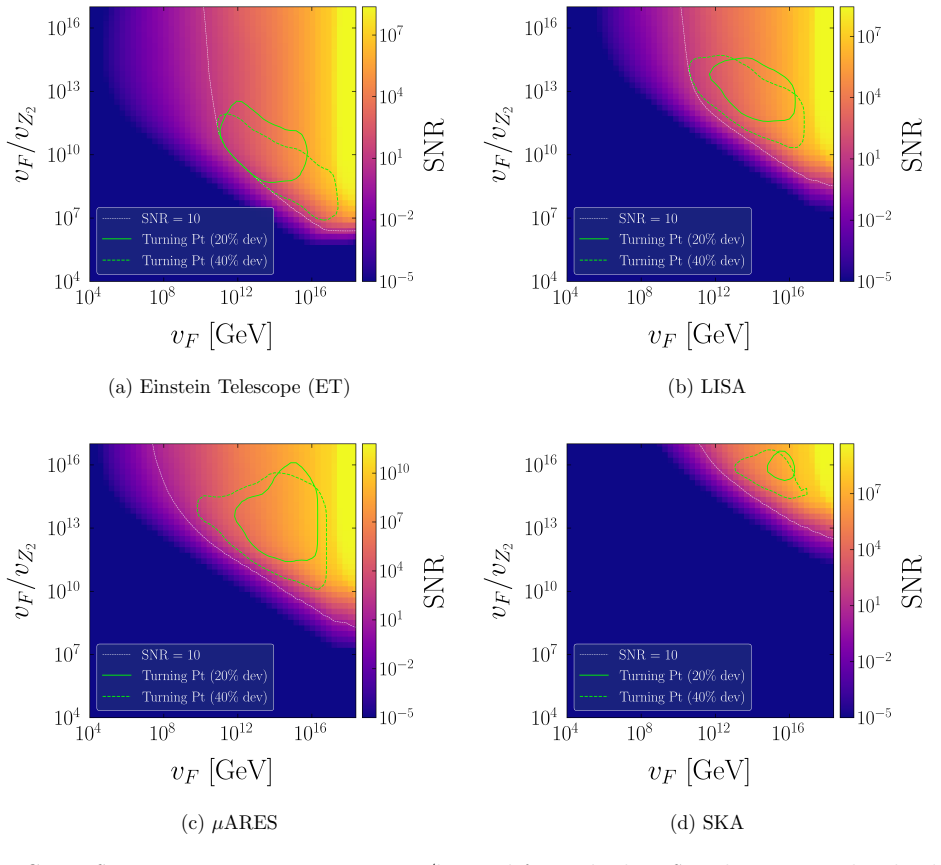
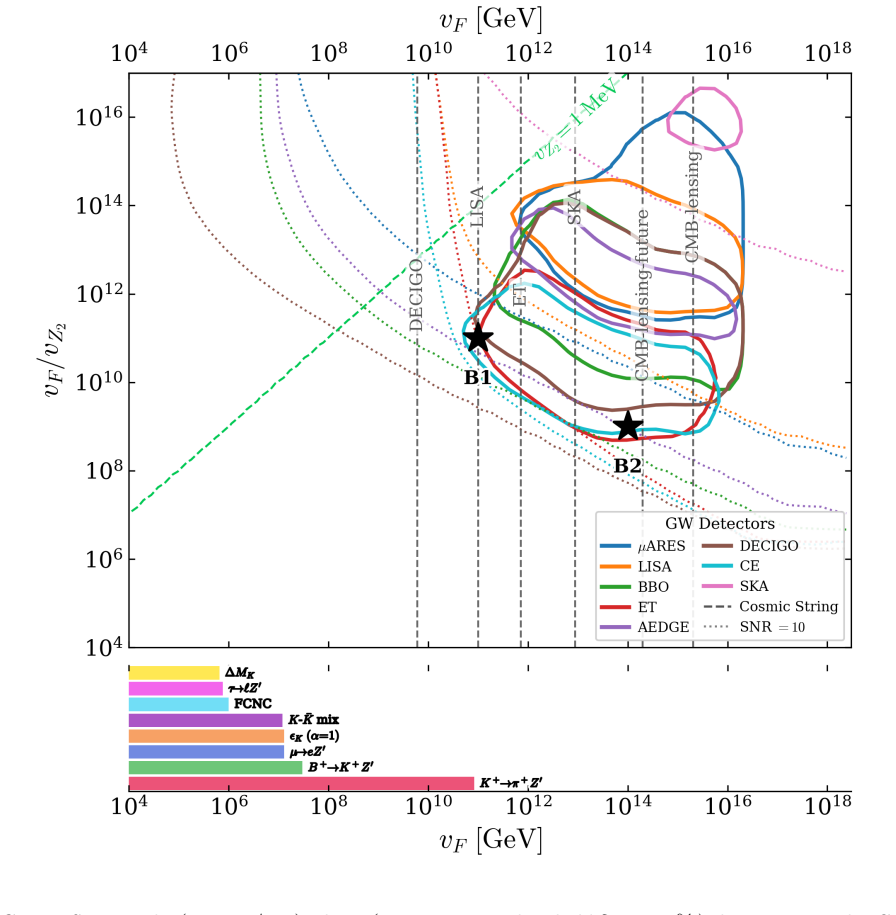
SNR≥10 computed over the full detector band, and 2.f turn ∈[f min, fmax] (i.e. the deviation occurs within the detector band). In Figs. 8 and 9, the white dashed curve denotes SNR = 10. The green contours show the subset of points where the turning-point criterion is satisfied in the same detector band, for 32 δth = 20% (solid) andδ th = 40% (dashed). The...
-
[5]
C. D. Froggatt and H. B. Nielsen, Nucl. Phys. B147, 277 (1979)
1979
-
[6]
Z. G. Berezhiani, Phys. Lett. B129, 99 (1983)
1983
-
[7]
Dimopoulos, Phys
S. Dimopoulos, Phys. Lett. B129, 417 (1983). 39
1983
-
[8]
V. Barger, P. Langacker, M. McCaskey, M. Ramsey-Musolf, and G. Shaughnessy, Phys. Rev. D79, 015018 (2009), arXiv:0811.0393 [hep-ph]
Pith/arXiv arXiv 2009
-
[9]
M. Gonderinger, H. Lim, and M. J. Ramsey-Musolf, Phys. Rev. D86, 043511 (2012), arXiv:1202.1316 [hep-ph]
Pith/arXiv arXiv 2012
-
[10]
C. Gross, O. Lebedev, and T. Toma, Phys. Rev. Lett.119, 191801 (2017), arXiv:1708.02253 [hep-ph]
Pith/arXiv arXiv 2017
-
[11]
T. W. B. Kibble, J. Phys. A9, 1387 (1976)
1976
-
[12]
T. W. B. Kibble, Phys. Rept.67, 183 (1980)
1980
-
[13]
T. W. B. Kibble, G. Lazarides, and Q. Shafi, Phys. Rev. D26, 435 (1982)
1982
-
[14]
A. E. Everett and A. Vilenkin, Nucl. Phys. B207, 43 (1982)
1982
-
[15]
G. Lazarides, Q. Shafi, and A. Tiwari, JHEP05, 119 (2023), arXiv:2303.15159 [hep-ph]
arXiv 2023
-
[16]
D. I. Dunsky, A. Ghoshal, H. Murayama, Y. Sakakihara, and G. White, Phys. Rev. D106, 075030 (2022), arXiv:2111.08750 [hep-ph]
arXiv 2022
-
[17]
R. Maji, W.-I. Park, and Q. Shafi, Phys. Lett. B845, 138127 (2023), arXiv:2305.11775 [hep-ph]
arXiv 2023
-
[18]
G. Lazarides, R. Maji, and Q. Shafi, Phys. Rev. D108, 095041 (2023), arXiv:2306.17788 [hep-ph]
arXiv 2023
-
[19]
B. Fu, A. Ghoshal, S. F. King, and M. H. Rahat, JHEP08, 237 (2024), arXiv:2404.16931 [hep-ph]
arXiv 2024
-
[20]
Janssen et al., PoSAASKA14, 037 (2015), arXiv:1501.00127 [astro-ph.IM]
G. Janssen et al., PoSAASKA14, 037 (2015), arXiv:1501.00127 [astro-ph.IM]
Pith/arXiv arXiv 2015
-
[21]
A. Sesana et al., Exper. Astron.51, 1333 (2021), arXiv:1908.11391 [astro-ph.IM]
Pith/arXiv arXiv 2021
-
[22]
P. Amaro-Seoane et al. (LISA), (2017), arXiv:1702.00786 [astro-ph.IM]
Pith/arXiv arXiv 2017
-
[23]
H. Kudoh, A. Taruya, T. Hiramatsu, and Y. Himemoto, Phys. Rev. D73, 064006 (2006), arXiv:gr-qc/0511145
Pith/arXiv arXiv 2006
-
[24]
Kawamura et al., PTEP2021, 05A105 (2021), arXiv:2006.13545 [gr-qc]
S. Kawamura et al., PTEP2021, 05A105 (2021), arXiv:2006.13545 [gr-qc]
Pith/arXiv arXiv 2021
-
[25]
G. M. Harry, P. Fritschel, D. A. Shaddock, W. Folkner, and E. S. Phinney, Class. Quant. Grav.23, 4887 (2006), [Erratum: Class.Quant.Grav. 23, 7361 (2006)]
2006
-
[26]
Y. A. El-Neaj et al. (AEDGE), EPJ Quant. Technol.7, 6 (2020), arXiv:1908.00802 [gr-qc]
arXiv 2020
-
[27]
Badurina et al., JCAP05, 011 (2020), arXiv:1911.11755 [astro-ph.CO]
L. Badurina et al., JCAP05, 011 (2020), arXiv:1911.11755 [astro-ph.CO]
arXiv 2020
-
[28]
B. P. Abbott et al. (LIGO Scientific), Class. Quant. Grav.34, 044001 (2017), arXiv:1607.08697 [astro-ph.IM]. 40
Pith/arXiv arXiv 2017
-
[29]
S. Hild, S. Chelkowski, and A. Freise, (2008), arXiv:0810.0604 [gr-qc]
Pith/arXiv arXiv 2008
-
[30]
R. Abbott et al. (LIGO Scientific, KAGRA, VIRGO), Astrophys. J.966, 137 (2024), arXiv:2210.10931 [astro-ph.HE]
arXiv 2024
-
[31]
R. Abbott et al. (KAGRA, Virgo, LIGO Scientific), Phys. Rev. D104, 022004 (2021), arXiv:2101.12130 [gr-qc]
arXiv 2021
-
[32]
Y. Jiang and Q.-G. Huang, JCAP02, 026 (2023), arXiv:2210.09952 [astro-ph.CO]
arXiv 2023
-
[33]
G. Agazie et al. (NANOGrav), Astrophys. J. Lett.951, L8 (2023), arXiv:2306.16213 [astro- ph.HE]
Pith/arXiv arXiv 2023
-
[34]
A. Afzal et al. (NANOGrav), Astrophys. J. Lett.951, L11 (2023), [Erratum: Astro- phys.J.Lett. 971, L27 (2024), Erratum: Astrophys.J. 971, L27 (2024)], arXiv:2306.16219 [astro-ph.HE]
Pith/arXiv arXiv 2023
-
[35]
J. Antoniadis et al. (EPTA), Astron. Astrophys.678, A48 (2023), arXiv:2306.16224 [astro- ph.HE]
arXiv 2023
-
[36]
J. Antoniadis et al. (EPTA, InPTA:), Astron. Astrophys.678, A50 (2023), arXiv:2306.16214 [astro-ph.HE]
Pith/arXiv arXiv 2023
- [37]
-
[38]
S. Antusch, K. Hinze, and S. Saad, Phys. Rev. D112, 035043 (2025), arXiv:2503.05868 [hep-ph]
arXiv 2025
-
[39]
I. Baldes, T. Konstandin, and G. Servant, JHEP12, 073 (2016), arXiv:1608.03254 [hep-ph]
Pith/arXiv arXiv 2016
- [40]
- [41]
-
[42]
Navas et al
S. Navas et al. (Particle Data Group), Phys. Rev. D110, 030001 (2024)
2024
-
[43]
P. Binetruy and P. Ramond, Phys. Lett. B350, 49 (1995), arXiv:hep-ph/9412385
Pith/arXiv arXiv 1995
-
[44]
P. Binetruy, S. Lavignac, and P. Ramond, Nucl. Phys. B477, 353 (1996), arXiv:hep- ph/9601243
arXiv 1996
-
[45]
K. S. Babu, I. Gogoladze, and K. Wang, Nucl. Phys. B660, 322 (2003), arXiv:hep- ph/0212245
arXiv 2003
-
[46]
K. S. Babu, T. Enkhbat, and I. Gogoladze, Nucl. Phys. B678, 233 (2004), arXiv:hep- ph/0308093. 41
arXiv 2004
-
[47]
Minkowski, Phys
P. Minkowski, Phys. Lett. B67, 421 (1977)
1977
-
[48]
Yanagida, Conf
T. Yanagida, Conf. Proc. C7902131, 95 (1979)
1979
-
[49]
M. Gell-Mann, P. Ramond, and R. Slansky, Conf. Proc. C790927, 315 (1979), arXiv:1306.4669 [hep-th]
Pith/arXiv arXiv 1979
-
[50]
R. N. Mohapatra and G. Senjanovic, Phys. Rev. Lett.44, 912 (1980)
1980
-
[51]
M. Aker et al. (KATRIN), Nature Phys.18, 160 (2022), arXiv:2105.08533 [hep-ex]
arXiv 2022
-
[52]
M. Aker et al. (KATRIN), Science388, adq9592 (2025), arXiv:2406.13516 [nucl-ex]
arXiv 2025
-
[53]
M. J. Dolinski, A. W. P. Poon, and W. Rodejohann, Ann. Rev. Nucl. Part. Sci.69, 219 (2019), arXiv:1902.04097 [nucl-ex]
arXiv 2019
- [54]
-
[55]
V. Barger, P. Langacker, M. McCaskey, M. J. Ramsey-Musolf, and G. Shaughnessy, Phys. Rev. D77, 035005 (2008), arXiv:0706.4311 [hep-ph]
Pith/arXiv arXiv 2008
-
[56]
S. Profumo, M. J. Ramsey-Musolf, C. L. Wainwright, and P. Winslow, Phys. Rev. D91, 035018 (2015), arXiv:1407.5342 [hep-ph]
Pith/arXiv arXiv 2015
-
[57]
S. I. Godunov, A. N. Rozanov, M. I. Vysotsky, and E. V. Zhemchugov, Eur. Phys. J. C76, 1 (2016), arXiv:1503.01618 [hep-ph]
Pith/arXiv arXiv 2016
-
[58]
S. L. Adler, Phys. Rev.177, 2426 (1969)
1969
-
[59]
J. S. Bell and R. Jackiw, Nuovo Cim. A60, 47 (1969)
1969
-
[60]
E. Dudas, S. Pokorski, and C. A. Savoy, Phys. Lett. B356, 45 (1995), arXiv:hep-ph/9504292
Pith/arXiv arXiv 1995
-
[61]
M.-C. Chen, D. R. T. Jones, A. Rajaraman, and H.-B. Yu, Phys. Rev. D78, 015019 (2008), arXiv:0801.0248 [hep-ph]
Pith/arXiv arXiv 2008
-
[62]
B. C. Allanach, J. Davighi, and S. Melville, JHEP02, 082 (2019), [Erratum: JHEP 08, 064 (2019)], arXiv:1812.04602 [hep-ph]
arXiv 2019
-
[63]
Q. Bonnefoy, E. Dudas, and S. Pokorski, JHEP01, 191 (2020), arXiv:1909.05336 [hep-ph]
arXiv 2020
-
[64]
Tavartkiladze, (2025), arXiv:2512.24804 [hep-ph]
Z. Tavartkiladze, (2025), arXiv:2512.24804 [hep-ph]
Pith/arXiv arXiv 2025
-
[65]
Z. Tavartkiladze, Phys. Rev. D106, 115002 (2022), arXiv:2209.14404 [hep-ph]
arXiv 2022
-
[66]
K. S. Babu, S. C. Chandrasekar, and Z. Tavartkiladze, (2026), arXiv:2602.24253 [hep-ph]
arXiv 2026
-
[67]
Griest and M
K. Griest and M. Kamionkowski, Phys. Rev. Lett.64, 615 (1990)
1990
-
[68]
Y. Meng et al. (PandaX-4T), Phys. Rev. Lett.127, 261802 (2021), arXiv:2107.13438 [hep-ex]
arXiv 2021
-
[69]
J. Aalbers et al. (LZ), Phys. Rev. Lett.131, 041002 (2023), arXiv:2207.03764 [hep-ex]
Pith/arXiv arXiv 2023
-
[70]
E. Aprile et al. (XENON), Phys. Rev. Lett.131, 041003 (2023), arXiv:2303.14729 [hep-ex]. 42
arXiv 2023
-
[71]
Y. Abe, T. Toma, and K. Tsumura, JHEP05, 057 (2020), arXiv:2001.03954 [hep-ph]
arXiv 2020
- [72]
- [73]
-
[74]
G. Arcadi, C. Gross, O. Lebedev, S. Pokorski, and T. Toma, Phys. Lett. B769, 129 (2017), arXiv:1611.09675 [hep-ph]
Pith/arXiv arXiv 2017
-
[75]
J. L. Feng, I. Galon, F. Kling, and S. Trojanowski, Phys. Rev. D97, 055034 (2018), arXiv:1710.09387 [hep-ph]
Pith/arXiv arXiv 2018
-
[76]
A. Ariga et al. (FASER), Phys. Rev. D99, 095011 (2019), arXiv:1811.12522 [hep-ph]
Pith/arXiv arXiv 2019
-
[77]
A. Ariga et al. (FASER), (2018), arXiv:1812.09139 [physics.ins-det]
Pith/arXiv arXiv 2018
- [78]
- [79]
-
[80]
J. M. Berryman, A. de Gouvea, P. J. Fox, B. J. Kayser, K. J. Kelly, and J. L. Raaf, JHEP 02, 174 (2020), arXiv:1912.07622 [hep-ph]
arXiv 2020
discussion (0)
Sign in with ORCID, Apple, or X to comment. Anyone can read and Pith papers without signing in.