REVIEW 5 major objections 6 minor 13 references
Enhancing Neural Function Approximation: The XNet Outperforming KAN
T0 review · 5 major / 6 minor · reviewed 2026-08-09 · deepseek-v4-flash
Pith's one-line read The paper claims that a single-layer network built from Cauchy kernels approximates smooth functions at an arbitrarily fast polynomial rate, outpacing MLPs and B-spline KANs in accuracy and speed.
desk verdict Unproved theory plus asymmetric experiments leave the XNet superiority claim unsupported, though the idea is worth tracking. read the letter →
The pith
A machine-rendered reading of the paper's core claim, the machinery that carries it, and where it could break.
The reading
What carries the argument
The load-bearing object is the Cauchy activation function $\phi_a(x)=\lambda_1 x/(x^2+d^2)+\lambda_2/(x^2+d^2)$, derived from the Cauchy kernel $1/(\xi-z)$ and carrying the approximation rate: a finite sum of such kernels forms a single-layer network whose error bound is $\varepsilon=O(N^{-p})$ for any $p>0$. The same kernels give explicit derivative formulas and a localized response with decay at both ends, which the paper uses to explain smooth handling of discontinuities and stability in training. Their known downside, a dense interaction matrix with condition number $\kappa(A)=O(N)$, is acknowledged but argued to be manageable in a single-layer setting.
What would settle it
Train XNet and a degree-$k$ B-spline KAN on the same smooth analytic target with matched parameter counts and the same optimizer, and measure error versus the number of basis functions $N$; if XNet's error decays no faster than a fixed polynomial degree, or the empirical convergence exponent cannot be increased by raising $p$, the central claim is wrong.
Extended reading notes
Core claim
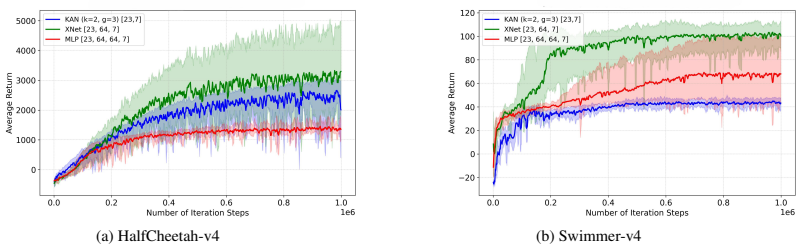
The paper's central claim is that networks built from Cauchy kernels, activation functions of the form $\phi_a(x)=\lambda_1 x/(x^2+d^2)+\lambda_2/(x^2+d^2)$, approximate analytic functions with error $\|f-f_N\|=O(N^{-p})$ for any fixed $p>0$, whereas B-spline KANs are stuck at $\|f-f_N\|=O(N^{-k})$, with $k$ the spline degree. This rate, imported from the Cauchy Approximation Theorem, is what lets a single-layer XNet match or beat deeper architectures. The empirical part of the paper reports that XNet achieves MSE $3.69\times10^{-9}$ on a heat-equation PINN compared to $1.51\times10^{-7}$ for KAN, and rewards of $3298.52$ on HalfCheetah-v4 versus $2010.52$ for KAN-based PPO, which the authors read as evidence that the theoretical rate translates into practical accuracy and speed.
Load-bearing premise
The load-bearing premise is that the ideal $O(N^{-p})$ rate proven for sums of Cauchy kernels is actually realized by a single-layer XNet trained with Adam on finitely many samples; if training does not deliver that rate, the theoretical superiority over B-splines does not apply to the trained models being compared.
Editorial extensions
If this is right
- If the $O(N^{-p})$ rate transfers to trained networks, achieving a target error $\varepsilon$ requires only $O(\varepsilon^{-1/p})$ Cauchy basis functions, so accuracy can be tuned by raising $p$ rather than deepening the network.
- XNet-based PINNs solve the heat and Poisson equations with substantially smaller MSE than KAN or MLP under the same loss setup, implying cheaper and more accurate PDE surrogates.
- XNet-based PPO reaches 3298.52 on HalfCheetah-v4, 64 percent above KAN and 142 percent above MLP, which would mean better continuous-control policies for the same training budget.
- On discontinuous targets like the Heaviside step, XNet reports MSE 8.99e-8 versus 5.98e-4 for KAN, indicating that the localized Cauchy response avoids the overshoot that plagues spline bases.
Reading between the lines
- The strongest theoretical rate is stated for analytic functions, so the Heaviside-step success goes beyond the stated theorem; either the mechanism extends past analyticity or the comparison is dominated by B-spline overshoot, and the paper does not separate these.
- The experiments use Adam for XNet and L-BFGS for KAN, so part of the reported speed and accuracy gap may reflect optimizer choice rather than the basis functions alone; swapping optimizers would isolate the architectural effect.
- A direct scaling-law test on analytic targets, error versus $N$ with increasing $p$, would turn the theoretical claim into a measurable prediction; the paper does not report such a curve.
- If the transfer holds, other single-layer kernel families with explicit rational forms could inherit the same tunable convergence, with the $O(N)$ condition number as the practical ceiling on $p$.
Editorial analysis
A structured set of objections, weighed in public.
Referee Report
Summary. The paper introduces XNet, a single-layer network whose activation functions are Cauchy-type rational functions, and claims that this architecture achieves arbitrary-order polynomial convergence O(N^{-p}) for any p>0, making it fundamentally superior to MLPs and B-spline-based KANs. Section 2 states this as Theorem 1, attributing it to the authors' earlier preprint Li et al. (2024), and Appendix A.1 restates the rate without proof. The experimental sections compare XNet with KAN and MLP on function approximation (including a discontinuous Heaviside step function, high-dimensional benchmarks, and noisy time series), on PINN solutions of the heat and Poisson equations, and on PPO reinforcement learning in HalfCheetah-v4 and Swimmer-v4. The paper reports error reductions up to roughly 50,000x and reward improvements up to 64% over KAN, and concludes that XNet is a highly efficient and broadly applicable architecture.
Significance. If the central theoretical claim were established, the paper would identify a simple parametric family of rational activations with very fast approximation rates, which would be significant for scientific computing and control. The breadth of the evaluation—function approximation, PDEs, and RL—is a strength, as is the clear architectural comparison to KAN. However, the load-bearing theorem is not proved in this manuscript, its connection to the implemented XNet basis is not demonstrated, and the experimental comparisons use asymmetric configurations without repeated runs. As submitted, the reported quantitative claims are not supported, so the significance of the contribution remains unestablished.
major comments (5)
- [Section 2, Theorem 1 and Eq. (2); Appendix A.1, Eq. (11)] The central claim that Cauchy-kernel approximations satisfy ||f - f_N|| = O(N^{-p}) for any p > 0 is never proved here. Appendix A.1 only restates the bound as "follows from Cauchy approximations theorem" and refers to Li et al. (2024), a preprint by two of the same authors. Because this theorem is the sole theoretical basis for the conclusion that XNet "fundamentally outperforms" KAN and MLP, the manuscript needs a self-contained proof or an explicit statement that the result is an imported assumption; the current presentation makes the paper's main claim unverifiable.
- [Section 2, Eq. (1) and the definition of phi_a(x)] Even if the Cauchy Approximation Theorem is true for sums of kernels lambda_k / ((xi_1^k - z_1) ... (xi_d^k - z_d)), the paper does not show that the implemented XNet basis phi_a(x) = lambda_1 x/(x^2+d^2) + lambda_2/(x^2+d^2) belongs to the same approximation class. The theorem allows arbitrary complex poles xi_k, while the implemented activations have poles restricted to the imaginary axis (and no linear term in the denominator). The transfer from Eq. (1) to the actual XNet parameterization is asserted rather than derived, so the approximation rate is not linked to the architecture that is trained.
- [Section 3.1.3, Table 4] The Heaviside step function is discontinuous, whereas Theorem 1 assumes analyticity and the rate O(N^{-p}) is stated for sufficiently smooth functions. The reported 1000-fold MSE improvement on this discontinuous example therefore cannot be explained by the theorem. Using this example as evidence for the theoretical claim is internally inconsistent, and the result should be presented as an empirical observation only, not as a consequence of the stated approximation rate.
- [Tables 4-6, 8, and 10; Sections 3.1.4 and 3.3] The empirical comparisons are not controlled: XNet is used with 64 or 5000 basis functions while KAN uses small grids (e.g., G = 3, 5, 10, 20, 50); XNet is trained with Adam and KAN with L-BFGS; the reported numbers are single runs with no seeds, error bars, or variance estimates. This is especially problematic for the PPO results in Table 10, where policy-gradient training is stochastic and single-run scores cannot support the claimed 64% and 142% improvements. Without matched configurations and repeated runs, the observed differences cannot be attributed to the architecture's approximation power.
- [Table 2 and Abstract] The headline "reducing approximation error by up to 50000 times" is based on comparing XNet [2,200,1] to the weakest MLP [2,20,1], not to a KAN. Against the best KAN in the same table (KAN [2,20,1]), the MSE reduction for XNet [2,200,1] is approximately 12x, and XNet [2,20,1] is roughly comparable to that KAN. As stated, the abstract and Section 4 overstate the advantage over KAN, and the comparison base should be reported in the abstract and in the main text.
minor comments (6)
- [Section 3.1.3] The heading contains a typo: "apprxiamtion" should be "approximation." Similar encoding artifacts appear throughout the text, e.g., "XNetˆaC™s" in Sections 1 and 4.2.
- [Appendix A.3] The appendix contains incomplete sentences: "For 2d functions, loss function" and "for high-dimensional functions, loss functions" are followed by no content. These should be completed or removed.
- [Section 3.2.1] The viscosity coefficient is listed as "ν = 001"; this should presumably be 0.01. Please correct the typo.
- [Equation (7)] The derivative notation "d/d(d2)" is nonstandard and likely intended to be the derivative with respect to d^2; please rewrite the equation using a clear variable, e.g., y = d^2.
- [Figure 5] Both panels of Figure 5 are labeled "(a)"; the second panel should be labeled "(b)" and referenced accordingly in the text.
- [Table 2] Table 2 is presented before the corresponding experimental section and uses "Error Reduction" relative to an MLP baseline without explaining this in the main text; add a pointer to the table and clarify the baseline in the caption.
Circularity Check
The central O(N^{-p}) approximation-rate claim is imported verbatim from a same-author preprint; the appendix 'proof' merely restates the theorem, so the advertised theoretical advantage reduces to an unverified self-citation.
-
self citation load bearing
[Section 2 (Theorem 1, Eq. (2)) and Appendix A.1 (Eq. (11))]
"Theorem 1. Cauchy Approximation Theorem (from Li et al. (2024)). ... It was shown in Li et al. (2024) that ... the approximation error satisfies ε = O(N −p) for any fixed integer p ... This highlights that Cauchy kernels can achieve arbitrarily fast convergence ... The complete proof is provided in Appendix A.1. ... For any fixed integer p, if f is C p smooth, the error bound follows from Cauchy approximations theorem: ∥f − fN ∥∞ ≤ C(p)N −p, ∀p >0 (11)."
Equation (2), the central claim of arbitrarily fast convergence, is stated as a consequence of the same-authors' prior work (Li et al. 2024) and is not re-derived in this paper. The appendix's 'derivation' repeats the bound verbatim as Eq. (11), prefaced with 'the error bound follows from Cauchy approximations theorem,' and then only rearranges it into N = O(ε^{-1/p}). Thus the proof reduces to the very theorem being cited. Since Li et al. (2024) shares two of the three authors and is not machine-checked or independently verified, the load-bearing rate is a self-citation rather than an independent mathematical result.
full rationale
The paper's advertised theoretical contribution—that Cauchy kernels achieve ∥f−f_N∥ = O(N^{-p}) for any p>0—is introduced as 'Theorem 1 ... from Li et al. (2024)' and the promised proof in Appendix A.1 is a restatement: Eq. (11) is the same bound, justified by 'the error bound follows from Cauchy approximations theorem,' followed by algebraic rearrangement to N = O(ε^{-1/p}). Because Li et al. (2024) is a preprint by the same authors and is not independently verified, this central premise is load-bearing self-citation rather than an independent derivation. The paper then invokes this imported rate to claim XNet 'fundamentally outperform[s]' traditional MLPs and KANs, and to explain superior RL and PDE results, so the theoretical and interpretive core is circular in the sense of resting on the authors' own prior unproven assertion. The empirical benchmark comparisons themselves are not circular—they are external evaluations against KAN and MLP—so the score is not maximal. However, disparities such as XNet with 5000 basis functions versus KAN with small grids, and Adam versus L-BFGS, are experimental-fairness concerns rather than circularity evidence, and do not affect this verdict.
Assumptions & free parameters
free parameters (1)
- Per-basis Cauchy parameters lambda1, lambda2, d =
Learned during training; values not reported
assumptions (4)
- ad hoc to paper Cauchy Approximation Theorem: finite sums of N Cauchy kernels approximate analytic functions with error O(N^-p) for any fixed p>0
- standard math B-spline approximation error is O(N^-k) for a spline of degree k
- domain assumption A trained single-layer XNet realizes the near-best approximation rate of the Cauchy basis
- domain assumption The rate theorem applies to the test functions used, including the discontinuous Heaviside step
invented entities (1)
-
Cauchy activation function phi_a(x) = lambda1 x/(x^2+d^2) + lambda2/(x^2+d^2)
Cite this review
Pith. "Pith review of Enhancing Neural Function Approximation: The XNet Outperforming KAN." pith.science (2026). https://pith.science/paper/2QW6CKQL
@misc{pith2026250118959,
  author       = {Pith},
  title        = {Pith review of: Enhancing Neural Function Approximation: The XNet Outperforming KAN},
  year         = {2026},
  howpublished = {\url{https://pith.science/paper/2QW6CKQL}},
  note         = {Machine review of arXiv:2501.18959}
}
read the original abstract
XNet is a single-layer neural network architecture that leverages Cauchy integral-based activation functions for high-order function approximation. Through theoretical analysis, we show that the Cauchy activation functions used in XNet can achieve arbitrary-order polynomial convergence, fundamentally outperforming traditional MLPs and Kolmogorov-Arnold Networks (KANs) that rely on increased depth or B-spline activations. Our extensive experiments on function approximation, PDE solving, and reinforcement learning demonstrate XNet's superior performance - reducing approximation error by up to 50000 times and accelerating training by up to 10 times compared to existing approaches. These results establish XNet as a highly efficient architecture for both scientific computing and AI applications.
Figures


Figures from the paper (12 more)




Reference graph
Works this paper leans on
-
[8]
Vinod Nair and Geoffrey E Hinton
URL https://arxiv.org/ abs/2404.19756. Vinod Nair and Geoffrey E Hinton. Rectified linear units improve restricted boltzmann machines. In Proceedings of the 27th international conference on machine learning (ICML-10), pp. 807–814,
-
[13]
Chao Yu, Jiming Liu, Shamim Nemati, and Guosheng Yin
URL https://arxiv.org/abs/2402.02366. Chao Yu, Jiming Liu, Shamim Nemati, and Guosheng Yin. Reinforcement learning in healthcare: A survey. ACM Computing Surveys (CSUR), 55(1):1–36,
-
[1956]
On the training of a kolmogorov network
Mario K¨oppen. On the training of a kolmogorov network. In Artificial Neural NetworksˆaC”ICANN 2002: International Conference Madrid, Spain, August 28ˆaC“30, 2002 Proceedings, volume 12, pp. 474–479. Springer,
work page 2002
-
[2002]
Ming-Jun Lai and Zhaiming Shen. The kolmogorov superposition theorem can break the curse of dimen- sionality when approximating high dimensional functions. arXiv preprint arXiv:2112.09963,
-
[2009]
Sparse autoencoders find highly interpretable features in language models
Hoagy Cunningham, Aidan Ewart, Logan Riggs, Robert Huben, and Lee Sharkey. Sparse autoencoders find highly interpretable features in language models. arXiv preprint arXiv:2309.08600,
-
[2010]
Review of deep reinforcement learning for robot manipulation
Hai Nguyen and Hung La. Review of deep reinforcement learning for robot manipulation. In 2019 Third IEEE international conference on robotic computing (IRC), pp. 590–595. IEEE,
work page 2019
-
[2013]
Cauchy activation function and xnet
13 Xin Li, Zhihong Xia, and Hongkun Zhang. Cauchy activation function and xnet. arXiv preprint arXiv:2409.19221,
-
[2018]
URL https://www.sciencedirect.com/science/article/pii/S0021999118305525
doi: 10.1016/j.jcp.2018.08.029. URL https://www.sciencedirect.com/science/article/pii/S0021999118305525. David A Sprecher and Sorin Draghici. Space-filling curves and kolmogorov superposition-based neural networks. Neural Networks, 15(1):57–67,
Show all 13 references
-
[2019]
URL https: //www.sciencedirect.com/science/article/pii/S0021999118307125
doi: 10.1016/j.jcp.2018.10.045. URL https: //www.sciencedirect.com/science/article/pii/S0021999118307125. John Schulman, Filip Wolski, Prafulla Dhariwal, Alec Radford, and Oleg Klimov. Proximal policy opti- mization algorithms. arXiv preprint arXiv:1707.06347,
2018 arXiv
-
[2021]
URL https://www.nature.com/articles/ s42256-021-00302-5
doi: 10.1038/s42256-021-00302-5. URL https://www.nature.com/articles/ s42256-021-00302-5 . Victor A Kich, Jair A Bottega, Raul Steinmetz, Ricardo B Grando, Ayano Yorozu, and Akihisa Ohya. Kolmogorov-arnold networks for online reinforcement learning. In 2024 24th International ...
-
[2022]
Tkan: Temporal kolmogorov-arnold networks
Remi Genet and Hugo Inzirillo. Tkan: Temporal kolmogorov-arnold networks. arXiv preprint arXiv:2405.07344,
-
[2023]
org/abs/2307.11833
URL https://arxiv. org/abs/2307.11833. A Appendix A.1 Mathematical Analysis Derivation of Approximation Rate. For any fixed integer p, if f is C p smooth, the error bound follows from Cauchy approximations theorem: ∥f − fN ∥∞ ≤ C(p)N −p, ∀p >0, (11) 14 where C(p) is a constant...
-
[2024]
Mastering diverse domains through world models
Danijar Hafner, Jurgis Pasukonis, Jimmy Ba, and Timothy Lillicrap. Mastering diverse domains through world models. arXiv preprint arXiv:2301.04104,
Reviewed August 9, 2026 · model on record in the stance chip above.
Discussion (0). Continue with ORCID to comment.