Search for L4 Earth Trojan asteroids with the 2.5-meter Wide Field Survey Telescope
Pith reviewed 2026-07-01 03:24 UTC · model grok-4.3
The pith
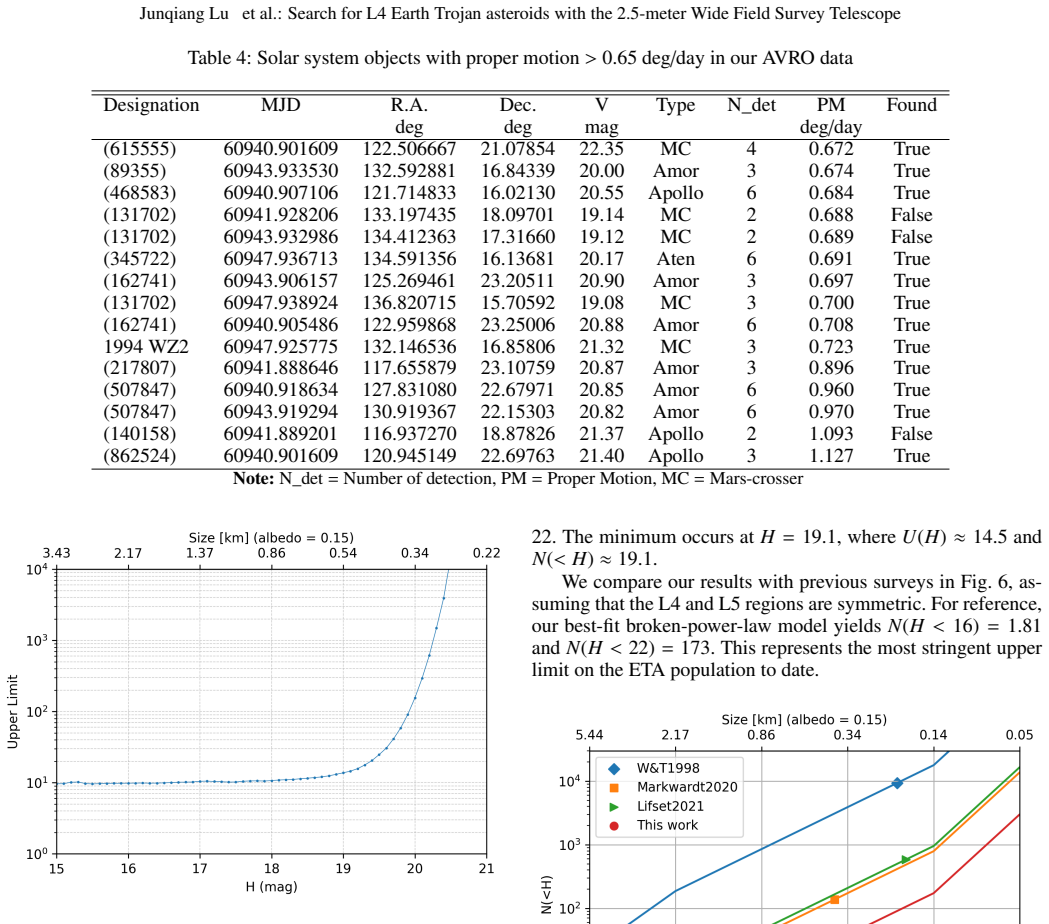
Largest L4 survey finds no new Earth Trojan asteroids and sets upper limit of fewer than 19 objects with H less than 19.1
A machine-rendered reading of the paper's core claim, the machinery that carries it, and where it could break.
Core claim
No new ETAs were detected in our survey. We place a cumulative upper limit of N(H < 19.1) < 19 on the stable population of objects larger than ~520 m (for an assumed albedo of 0.15). This represents the most stringent constraint on the ETA population to date.
What carries the argument
Non-detection in a survey that covers 33.24 percent of the probability-weighted sky area for dynamically stable L4 ETAs, converted to a population upper limit through the assumed albedo and H-to-size relation.
If this is right
- The number of large stable Earth Trojans is smaller than earlier surveys permitted.
- Only the two known temporary Earth Trojans are currently confirmed, with no evidence for a substantial stable population at these sizes.
- Models of early solar-system dynamics must accommodate the scarcity of large objects trapped at L4.
- Deeper or wider surveys will be required to test whether any stable ETAs exist below the current magnitude threshold.
Where Pith is reading between the lines
- If the limit is correct, any primordial Earth Trojans at L4 were likely removed by dynamical instabilities early in solar-system history.
- The result can be checked by repeating the survey at fainter magnitudes or with different assumed albedos to see whether the count remains below 19.
- Connecting the limit to numerical simulations of Trojan stability could show whether L4 is dynamically less hospitable than L5.
Load-bearing premise
The upper limit holds only if the surveyed area truly samples 33.24 percent of the stable L4 probability distribution and if an albedo of 0.15 correctly converts the magnitude limit into physical size.
What would settle it
Discovery of 20 or more stable L4 Earth Trojans brighter than H=19.1 across the full probability region would exceed the reported limit.
Figures

read the original abstract
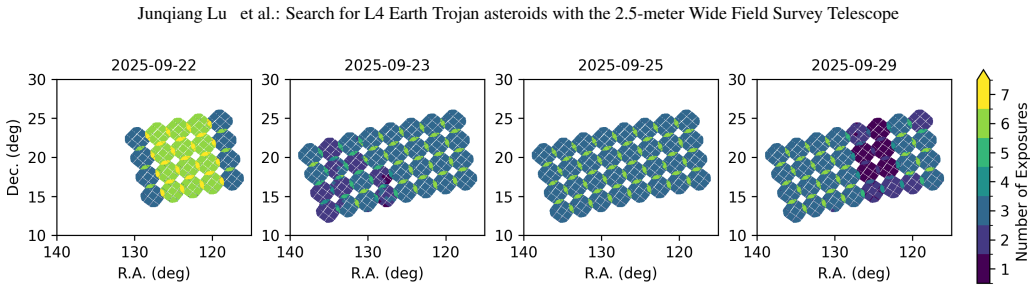
Earth Trojan asteroids (ETAs) are a mysterious population, and dynamically stable ETAs, if primordial, could be "living fossils" of the early solar system. To date, there are only two known ETAs, but both are temporary ETAs. The aim of our survey is to discover new temporary or stable ETAs; in the absence of detections, we derive upper limits on the population of stable ETAs. We conducted the largest wide-area survey of the Earth's L4 Lagrange point region so far using the Wide Field Survey Telescope, covering about 236.74 deg^2, corresponding to 33.24% of the probability coverage for sky regions where dynamically stable L4 ETAs are likely to reside. No new ETAs were detected in our survey. We place a cumulative upper limit of N(H < 19.1) < 19 on the stable population of objects larger than ~520 m (for an assumed albedo of 0.15). This represents the most stringent constraint on the ETA population to date.
Editorial analysis
A structured set of objections, weighed in public.
Referee Report
Summary. The manuscript reports results from the largest wide-area survey to date of the L4 Earth Trojan asteroid region, conducted with the 2.5 m Wide Field Survey Telescope over 236.74 deg². This area is stated to correspond to 33.24% of the probability coverage for dynamically stable L4 ETAs. No new ETAs were detected. From the non-detection the authors derive a cumulative upper limit N(H < 19.1) < 19 on the stable population (corresponding to diameters ≳520 m for an assumed albedo of 0.15) and claim this is the most stringent constraint to date.
Significance. If the dynamical probability coverage fraction, survey completeness, and false-positive rejection are robust, the non-detection supplies a useful new upper bound on the stable ETA population. Such limits help discriminate between models of primordial asteroid retention at Lagrange points and have implications for early solar-system dynamical evolution. The survey strategy and telescope aperture represent a clear observational advance over prior narrower searches.
major comments (2)
- [Methods / dynamical coverage calculation] The 33.24% probability coverage fraction (stated in the abstract and used to scale the Poisson upper limit) is derived from dynamical models, yet the manuscript supplies no information on the underlying N-body integrations, initial-condition sampling, integration length, or stability criteria. Because the reported N(H<19.1)<19 scales directly with this fraction, its derivation must be documented in sufficient detail for the limit to be reproducible and falsifiable.
- [Data analysis / detection efficiency] Section describing the detection pipeline and completeness: quantitative details on magnitude-dependent detection efficiency, false-positive rates, and how the zero-count result is converted to the stated Poisson upper limit are not provided. These quantities are load-bearing for converting the raw non-detection into the cumulative population limit.
minor comments (2)
- [Results] The conversion from H=19.1 to physical size (~520 m) should explicitly state the albedo value and phase function assumptions in the main text as well as the abstract.
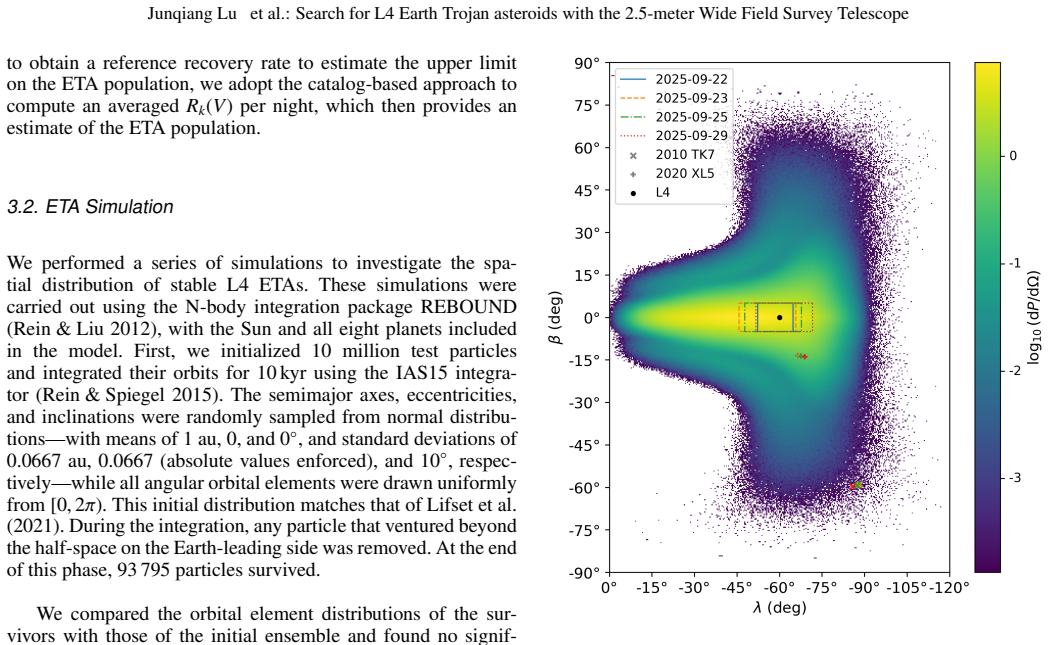
- [Observations] Figure showing the surveyed footprint would benefit from an overlay of the dynamical probability density contours to allow visual assessment of the 33.24% coverage claim.
Simulated Author's Rebuttal
We thank the referee for their positive assessment of the survey's significance and for the constructive major comments. We agree that additional methodological details are required for reproducibility and will revise the manuscript accordingly.
read point-by-point responses
-
Referee: [Methods / dynamical coverage calculation] The 33.24% probability coverage fraction (stated in the abstract and used to scale the Poisson upper limit) is derived from dynamical models, yet the manuscript supplies no information on the underlying N-body integrations, initial-condition sampling, integration length, or stability criteria. Because the reported N(H<19.1)<19 scales directly with this fraction, its derivation must be documented in sufficient detail for the limit to be reproducible and falsifiable.
Authors: We agree that the derivation of the 33.24% dynamical probability coverage fraction requires explicit documentation. We will add a dedicated subsection to the Methods section that describes the N-body integrations, including the initial-condition sampling strategy for test particles in the L4 region, the integration length and integrator employed, the stability criteria used to identify long-term stable orbits, and the procedure for computing the sky-position probability coverage within the surveyed area. This addition will allow independent verification of the scaling factor applied to the upper limit. revision: yes
-
Referee: [Data analysis / detection efficiency] Section describing the detection pipeline and completeness: quantitative details on magnitude-dependent detection efficiency, false-positive rates, and how the zero-count result is converted to the stated Poisson upper limit are not provided. These quantities are load-bearing for converting the raw non-detection into the cumulative population limit.
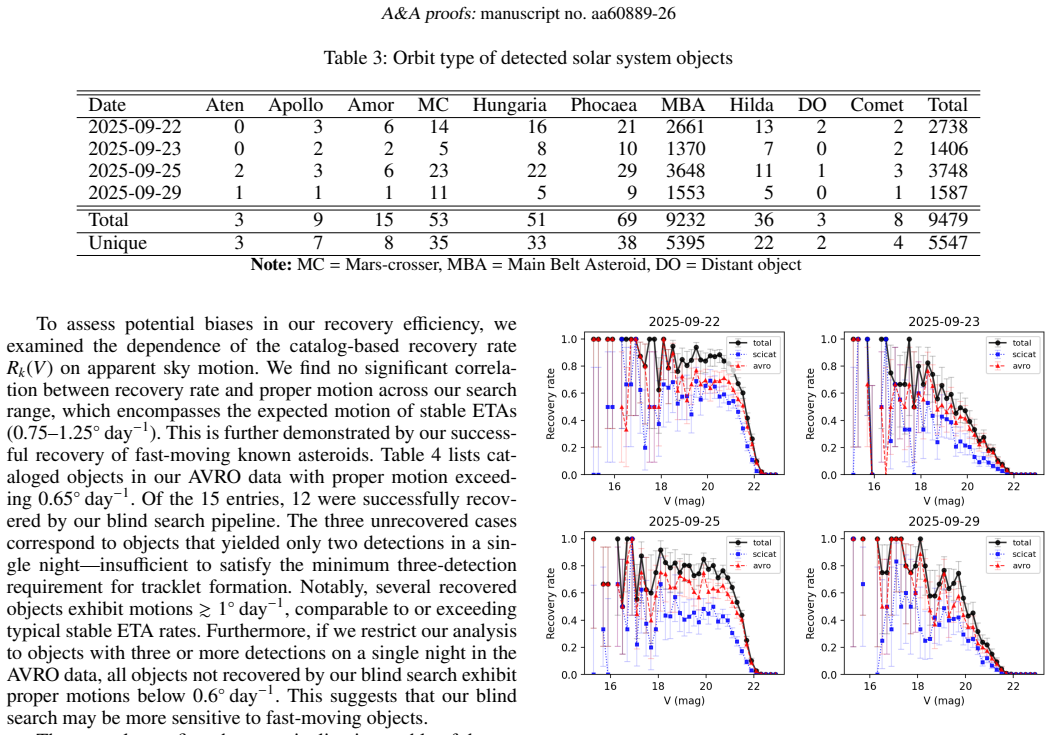
Authors: We acknowledge that the current manuscript does not supply the requested quantitative details on detection efficiency, false-positive rejection, and the exact conversion from zero detections to the Poisson upper limit. We will expand the data-analysis section to include the magnitude-dependent completeness (obtained from synthetic source injections), the criteria and measured rates for false-positive rejection, and the step-by-step application of Poisson statistics (including the effective number of trials after accounting for coverage and efficiency) that yields N(H < 19.1) < 19. A plot of the efficiency curve versus magnitude will be added to support the description. revision: yes
Circularity Check
No circularity: upper limit follows directly from zero detections scaled by external coverage fraction.
full rationale
The derivation consists of a direct non-detection (zero ETAs found in 236.74 deg²) converted to a Poisson upper bound, then divided by the stated 33.24% probability coverage and scaled by an assumed albedo of 0.15 to obtain N(H < 19.1) < 19. The coverage fraction is presented as an input derived from dynamical models of stable orbits, not fitted or defined from the survey data itself. No equations, self-citations, or ansatzes in the provided text reduce the reported limit to a quantity constructed from the same observations. The chain is therefore independent of its own outputs.
Axiom & Free-Parameter Ledger
free parameters (1)
- albedo =
0.15
axioms (1)
- domain assumption Dynamically stable L4 ETAs occupy sky regions whose probability coverage is known from prior dynamical simulations.
Reference graph
Works this paper leans on
-
[1]
& Gott Iii, J
Belbruno, E. & Gott Iii, J. R. 2005, AJ, 129, 1724
2005
-
[2]
1989, Application of Photometric Models to Asteroids
Bowell, E., Hapke, B., Domingue, D., et al. 1989, Application of Photometric Models to Asteroids. (Tucson, AZ: University of Arizona Press), 524–556
1989
-
[3]
2025, The 2.5-Meter Wide Field Survey Telescope Real-Time Data Processing Pipeline I: From Raw Data to Alert Distribution
Cai, M., Xu, Z., Fan, L., et al. 2025, The 2.5-Meter Wide Field Survey Telescope Real-Time Data Processing Pipeline I: From Raw Data to Alert Distribution
2025
-
[4]
W., et al
Cambioni, S., Malhotra, R., Hergenrother, C. W., et al. 2018, in 49th Annual Lunar and Planetary Science Conference, 1149
2018
-
[5]
2011, Nature, 475, 481 ´Cuk, M., Hamilton, D
Connors, M., Wiegert, P., & Veillet, C. 2011, Nature, 475, 481 ´Cuk, M., Hamilton, D. P., & Holman, M. J. 2012, MNRAS, 426, 3051
2011
-
[6]
2013, PASP, 125, 357
Denneau, L., Jedicke, R., Grav, T., et al. 2013, PASP, 125, 357
2013
-
[7]
2012, A&A, 541, A127
Dvorak, R., Lhotka, C., & Zhou, L. 2012, A&A, 541, A127
2012
-
[8]
J., Payne, M
Holman, M. J., Payne, M. J., Blankley, P., Janssen, R., & Kuindersma, S. 2018, AJ, 156, 135
2018
-
[9]
2022, Universe, 9, 7
Hu, M., Hu, L., Jiang, J.-a., et al. 2022, Universe, 9, 7
2022
-
[10]
A., Tholen, D
Hui, M.-T., Wiegert, P. A., Tholen, D. J., & Föhring, D. 2021, ApJL, 922, L25
2021
-
[11]
& Malhotra, R
Ito, T. & Malhotra, R. 2010, in AGU Fall Meeting Abstracts, V ol. 2010, P53C– 1537
2010
-
[12]
L., Slater, C
Jones, R. L., Slater, C. T., Moeyens, J., et al. 2018, Icarus, 303, 181
2018
-
[13]
2023, RAA, 23, 035013
Lei, L., Zhu, Q.-F., Kong, X., et al. 2023, RAA, 23, 035013
2023
-
[14]
J., Yoshida, F., Georgakarakos, N., & Li, X
Li, J., Xia, Z. J., Yoshida, F., Georgakarakos, N., & Li, X. 2023, A&A, 669, A68
2023
-
[15]
2021, AJ, 161, 282
Lifset, N., Golovich, N., Green, E., Armstrong, R., & Yeager, T. 2021, AJ, 161, 282
2021
-
[16]
2025, ApJS, 278, 29
Lin, J., Wang, T., Cai, M., et al. 2025, ApJS, 278, 29
2025
-
[17]
2022, MNRAS, 513, 2422
Lin, Z., Jiang, N., & Kong, X. 2022, MNRAS, 513, 2422
2022
-
[18]
2023, ApJ, 947, 59
Liu, Z.-Y ., Lin, Z.-Y ., Yu, J.-M., et al. 2023, ApJ, 947, 59
2023
-
[19]
2025, PASP, 137, 024401
Lu, J.-Q., Fan, L.-L., Cai, M.-X., et al. 2025, PASP, 137, 024401
2025
-
[20]
K., Masiero, J
Mainzer, A. K., Masiero, J. R., Abell, P. A., et al. 2023, PSJ, 4, 224
2023
-
[21]
2019, Nat
Malhotra, R. 2019, Nat. Astron., 3, 193
2019
-
[22]
W., Malhotra, R., et al
Markwardt, L., Gerdes, D. W., Malhotra, R., et al. 2020, MNRAS, 492, 6105
2020
-
[23]
& Scholl, H
Marzari, F. & Scholl, H. 2013, Celest. Mech. Dyn. Astron., 117, 91 Nesvorný, D., V okrouhlický, D., & Morbidelli, A. 2013, ApJ, 768, 45 Peña Zamudio, J. & Fuentes, C. 2021, in AAS/Division for Planetary Sciences Meeting Abstracts #53, V ol. 53, 306.03
2013
-
[24]
J., & Turrini, D
Pirani, S., Johansen, A., Bitsch, B., Mustill, A. J., & Turrini, D. 2019, A&A, 623, A169
2019
-
[25]
& Liu, S.-F
Rein, H. & Liu, S.-F. 2012, A&A, 537, A128
2012
-
[26]
& Spiegel, D
Rein, H. & Spiegel, D. S. 2015, MNRAS, 446, 1424
2015
-
[27]
& Tamayo, D
Rein, H. & Tamayo, D. 2015, MNRAS, 452, 376 Schunová-Lilly, E., Jedicke, R., Vereš, P., Denneau, L., & Wainscoat, R. J. 2017, Icarus, 284, 114
2015
-
[28]
2024, ApJ, 976, 155
Su, Z.-B., Cai, Z.-Y ., Wang, J.-X., et al. 2024, ApJ, 976, 155
2024
-
[29]
Sutton, P. J. 2009, Classical and Quantum Gravity, 26, 245007
2009
-
[30]
M., Ivezic, Z., Juric, M., & Lupton, R
Szabo, G. M., Ivezic, Z., Juric, M., & Lupton, R. 2007, MNRAS, 377, 1393
2007
-
[31]
Tabachnik, S. A. & Evans, N. W. 2000, MNRAS, 319, 63
2000
-
[32]
2025, MNRAS, 540, 2863
Wan, Z., Fan, L., Li, X., et al. 2025, MNRAS, 540, 2863
2025
-
[33]
2025, AJ, 169, 272
Wang, S.-H., Fu, B.-X., Lu, J.-Q., et al. 2025, AJ, 169, 272
2025
-
[34]
2023, Sci
Wang, T., Liu, G., Cai, Z., et al. 2023, Sci. China Phys. Mech. Astron., 66, 109512
2023
-
[35]
Whiteley, R. J. & Tholen, D. J. 1998, Icarus, 136, 154
1998
-
[36]
Wilson, E. B. 1927, Journal of the American Statistical Association, 22, 209
1927
-
[37]
& Holman, M
Wisdom, J. & Holman, M. 1991, AJ, 102, 1528
1991
-
[38]
& Golovich, N
Yeager, T. & Golovich, N. 2022, ApJ, 938, 9
2022
-
[39]
2024, ApJ, 961, 250
Yeager, T., Golovich, N., & Pruett, K. 2024, ApJ, 961, 250
2024
-
[40]
2018, in 49th Annual Lunar and Planetary Science Conference, 1771
Yoshikawa, M., Tsuda, Y ., Watanabe, S., et al. 2018, in 49th Annual Lunar and Planetary Science Conference, 1771
2018
-
[41]
2019, A&A, 622, A97 Article number, page 8
Zhou, L., Xu, Y .-B., Zhou, L.-Y ., Dvorak, R., & Li, J. 2019, A&A, 622, A97 Article number, page 8
2019
discussion (0)
Sign in with ORCID, Apple, or X to comment. Anyone can read and Pith papers without signing in.