TabChange: Precise Attribute Changes in Tabular Data
Pith reviewed 2026-06-28 19:03 UTC · model grok-4.3
The pith
TabChange removes attribute information from latent representations via adversarial training to enable precise minimal changes when editing tabular instances.
A machine-rendered reading of the paper's core claim, the machinery that carries it, and where it could break.
Core claim
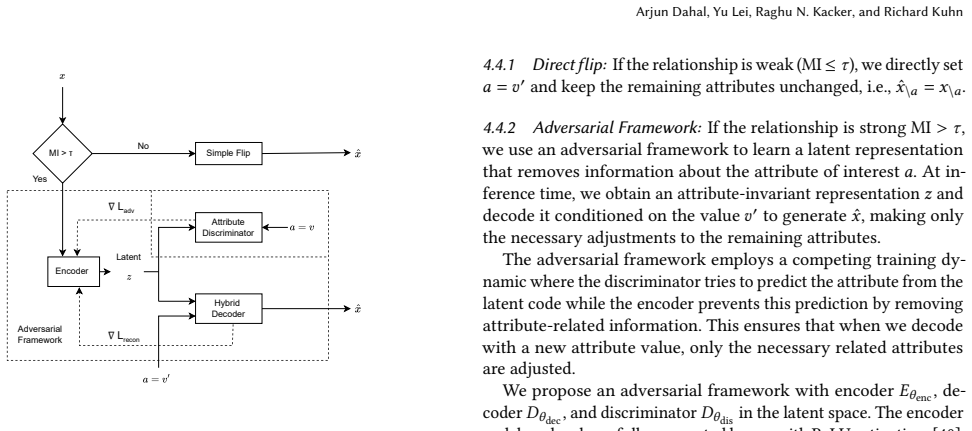
TabChange analyzes the relationship between the attribute of interest and other attributes in the dataset. If the relationship is weak, it simply flips the attribute; if it is strong, it uses an adversarial framework that removes information about the attribute in the latent space representation. This removal enables precise modifications, making only the necessary adjustments to maintain naturalness.
What carries the argument
The adversarial framework that removes information about the attribute of interest from the latent space representation when attribute relationships are strong.
If this is right
- When attribute relationships are weak, direct flipping produces valid edits without further adjustment.
- Removal of attribute information from the latent space prevents unnecessary modifications to correlated attributes.
- The generated counterfactuals remain comparable in naturalness to baselines while being more proximal to the original instances.
- Across seven datasets the method yields higher counts of valid counterfactuals and lower counts of invalid ones than existing approaches.
Where Pith is reading between the lines
- The conditional choice between flipping and adversarial removal could be tested as a general strategy for controlling edit precision in other generative models.
- If the removal step works without per-dataset retuning, the approach may lower the engineering cost of applying counterfactual methods to new tabular collections.
- Measuring residual mutual information between the edited attribute and the post-adversarial latent codes would provide a direct diagnostic for the success of the disentanglement step.
Load-bearing premise
The adversarial component successfully removes attribute information from the latent space without introducing new artifacts or requiring dataset-specific tuning that was not reported.
What would settle it
After adversarial training, train a downstream classifier on the latent representations alone and test whether it can still recover the target attribute value above chance level on held-out data.
Figures
read the original abstract
Modifying an attribute in tabular data often introduces an unnatural instance by breaking its relationships with other attributes. The modified instance must be both natural and minimally changed from the original instance. This paper addresses the challenge of generating such a modified instance. We identify key limitations in existing approaches: generative models either don't support instance-level attribute editing or, in the case of methods like CVAE, retain attribute information in the latent space, leading to unnecessary modifications. To solve this, we propose TabChange, an approach that analyzes the relationship between the attribute of interest and other attributes in the dataset. If the relationship is weak, it simply flips the attribute; if it is strong, it uses an adversarial framework that removes information about the attribute in the latent space representation. This removal enables precise modifications, making only the necessary adjustments to maintain naturalness. Our experiments across seven datasets show that TabChange generates counterfactuals in attributes that are comparable in naturalness and are more proximal to their original instances. This leads to a higher number of valid counterfactuals and a lower number of invalid counterfactuals compared to the baselines.
Editorial analysis
A structured set of objections, weighed in public.
Referee Report
Summary. The manuscript introduces TabChange, a method for precise attribute modification in tabular data. It first assesses the strength of the relationship between the target attribute and the rest of the dataset; a weak relationship triggers a simple attribute flip, while a strong relationship triggers an adversarial training step that removes information about the target attribute from the latent representation before editing. Experiments on seven datasets are reported to produce counterfactuals that match baselines in naturalness, improve proximity to the original instance, and yield higher valid and lower invalid counts.
Significance. If the reported gains can be reproduced with transparent metrics, baselines, and verification of the adversarial component, the method would offer a lightweight, relationship-aware alternative to existing generative approaches for tabular counterfactual generation. The absence of any such verification or experimental detail currently prevents assessment of whether the claimed mechanism is responsible for the gains.
major comments (2)
- [Abstract] Abstract and experimental results section: the central claim that TabChange outperforms baselines on seven datasets in naturalness, proximity, valid/invalid counts rests on an assertion that supplies no metric definitions, baseline implementations, statistical tests, or error bars, rendering the empirical contribution uninspectable.
- [Method (adversarial component)] Method description of the adversarial framework: the performance advantage is attributed to removal of attribute information from the latent space when relationships are strong, yet no post-hoc verification (classifier accuracy on latent codes, mutual-information estimates, or ablation of adversarial vs. non-adversarial training) is supplied; without this check the reported gains could arise from the simple-flip branch or baseline differences rather than the claimed mechanism.
minor comments (1)
- [Abstract] Abstract phrasing: 'generates counterfactuals in attributes' is unclear; rephrase to indicate generation of counterfactual instances with modified attributes.
Simulated Author's Rebuttal
We thank the referee for the constructive feedback. Below we respond point-by-point to the major comments, clarifying the current manuscript content and indicating revisions that will be made to improve transparency and verifiability.
read point-by-point responses
-
Referee: [Abstract] Abstract and experimental results section: the central claim that TabChange outperforms baselines on seven datasets in naturalness, proximity, valid/invalid counts rests on an assertion that supplies no metric definitions, baseline implementations, statistical tests, or error bars, rendering the empirical contribution uninspectable.
Authors: Abstracts are space-constrained and conventionally omit detailed metric definitions or statistical procedures. The experimental results section of the manuscript reports comparisons on seven datasets showing improved proximity and validity counts, but we agree that explicit definitions, baseline code references, error bars, and statistical tests are needed for full inspectability. In revision we will expand the experimental section with precise metric definitions (e.g., proximity as normalized L1 distance, validity as correct attribute change without violating data constraints), baseline implementation details, standard deviations across runs, and paired statistical tests where appropriate. revision: yes
-
Referee: [Method (adversarial component)] Method description of the adversarial framework: the performance advantage is attributed to removal of attribute information from the latent space when relationships are strong, yet no post-hoc verification (classifier accuracy on latent codes, mutual-information estimates, or ablation of adversarial vs. non-adversarial training) is supplied; without this check the reported gains could arise from the simple-flip branch or baseline differences rather than the claimed mechanism.
Authors: The method section describes the relationship-strength check that routes to either simple flipping or adversarial latent-space editing, with the latter intended to remove target-attribute information. We acknowledge that the original submission lacks explicit post-hoc verification of this removal. To confirm the mechanism drives the reported gains, the revised manuscript will add (i) a downstream classifier trained on the latent codes to quantify residual attribute predictability before versus after adversarial training and (ii) an ablation comparing the full model against a non-adversarial variant on the same datasets. revision: yes
Circularity Check
No circularity in derivation; TabChange is a procedural algorithm without self-referential reductions
full rationale
The paper describes TabChange as a conditional procedural method: analyze attribute relationships in the dataset, apply simple flip if weak or adversarial latent-space removal if strong. No equations, fitted parameters renamed as predictions, or self-citation chains appear in the provided text that would reduce the claimed counterfactual validity, proximity, or naturalness metrics to internal definitions or inputs by construction. The experimental results across seven datasets are presented as independent empirical outcomes rather than derivations forced by the method's own structure. This is the common case of a self-contained algorithmic proposal evaluated externally.
Axiom & Free-Parameter Ledger
Reference graph
Works this paper leans on
-
[1]
Roberto Battiti. 1994. Using mutual information for selecting features in su- pervised neural net learning.IEEE Transactions on neural networks5, 4 (1994), 537–550
1994
-
[2]
Barry Becker and Ronny Kohavi. 1996. Adult. UCI Machine Learning Repository. DOI: https://doi.org/10.24432/C5XW20
-
[3]
Rachel KE Bellamy, Kuntal Dey, Michael Hind, Samuel C Hoffman, Stephanie Houde, Kalapriya Kannan, Pranay Lohia, Jacquelyn Martino, Sameep Mehta, Aleksandra Mojsilović, et al. 2019. AI Fairness 360: An extensible toolkit for de- tecting and mitigating algorithmic bias.IBM Journal of Research and Development 63, 4/5 (2019), 4–1
2019
-
[4]
Martina Cinquini and Riccardo Guidotti. 2024. Causality-aware local inter- pretable model-agnostic explanations. InWorld Conference on Explainable Artifi- cial Intelligence. Springer, 108–124
2024
-
[5]
Michael Downs, Jonathan L Chu, Yaniv Yacoby, Finale Doshi-Velez, and Weiwei Pan. 2020. Cruds: Counterfactual recourse using disentangled subspaces.ICML WHI2020 (2020), 1–23
2020
-
[6]
Harrison Edwards and Amos Storkey. 2015. Censoring representations with an adversary.arXiv preprint arXiv:1511.05897(2015)
work page internal anchor Pith review Pith/arXiv arXiv 2015
-
[7]
Ming Fan, Wenying Wei, Wuxia Jin, Zijiang Yang, and Ting Liu. 2022. Explanation- guided fairness testing through genetic algorithm. InProceedings of the 44th International Conference on Software Engineering. 871–882
2022
- [8]
-
[9]
Jiawei Han, Jian Pei, and Yiwen Yin. 2000. Mining frequent patterns without candidate generation.ACM sigmod record29, 2 (2000), 1–12
2000
-
[10]
Hans Hofmann. 1994. Statlog (German Credit Data). UCI Machine Learning Repository. DOI: https://doi.org/10.24432/C5NC77
-
[11]
Robert L Jack, Andrew J Dunleavy, and C Patrick Royall. 2014. Information- theoretic measurements of coupling between structure and dynamics in glass- formers.arXiv preprint arXiv:1402.6867(2014)
work page internal anchor Pith review Pith/arXiv arXiv 2014
-
[12]
Shalmali Joshi, Oluwasanmi Koyejo, Warut Vijitbenjaronk, Been Kim, and Joy- deep Ghosh. 2019. Towards realistic individual recourse and actionable expla- nations in black-box decision making systems.arXiv preprint arXiv:1907.09615 TabChange: Precise Attribute Changes in Tabular Data (2019)
work page internal anchor Pith review Pith/arXiv arXiv 2019
-
[13]
Hyemi Kim, Seungjae Shin, JoonHo Jang, Kyungwoo Song, Weonyoung Joo, Wanmo Kang, and Il-Chul Moon. 2021. Counterfactual fairness with disentangled causal effect variational autoencoder. InProceedings of the AAAI Conference on Artificial Intelligence, Vol. 35. 8128–8136
2021
-
[14]
Akim Kotelnikov, Dmitry Baranchuk, Ivan Rubachev, and Artem Babenko. 2023. Tabddpm: Modelling tabular data with diffusion models. InInternational confer- ence on machine learning. PMLR, 17564–17579
2023
-
[15]
Guillaume Lample, Neil Zeghidour, Nicolas Usunier, Antoine Bordes, Ludovic Denoyer, and Marc’Aurelio Ranzato. 2017. Fader networks: Manipulating images by sliding attributes.Advances in neural information processing systems30 (2017)
2017
-
[16]
Christos Louizos, Kevin Swersky, Yujia Li, Max Welling, and Richard Zemel. 2015. The variational fair autoencoder.arXiv preprint arXiv:1511.00830(2015)
work page internal anchor Pith review Pith/arXiv arXiv 2015
-
[17]
Nishtha Madaan and Srikanta Bedathur. 2024. Navigating the Structured What- If Spaces: Counterfactual Generation via Structured Diffusion. In2024 IEEE Conference on Secure and Trustworthy Machine Learning (SaTML). IEEE, 710–722
2024
-
[18]
David Madras, Elliot Creager, Toniann Pitassi, and Richard Zemel. 2018. Learning adversarially fair and transferable representations. InInternational Conference on Machine Learning. PMLR, 3384–3393
2018
-
[19]
2021.On Computing Counterfactuals for Causal Fairness
Ayan Majumdar. 2021.On Computing Counterfactuals for Causal Fairness. Mas- ter’s Thesis. Saarland University, Saarbrücken. Advisor(s) Krishna P. Gummadi
2021
-
[20]
S. Moro, P. Rita, and P. Cortez. 2014. Bank Marketing. UCI Machine Learning Repository. DOI: https://doi.org/10.24432/C5K306
-
[21]
Ramaravind K Mothilal, Amit Sharma, and Chenhao Tan. 2020. Explaining machine learning classifiers through diverse counterfactual explanations. In Proceedings of the 2020 conference on fairness, accountability, and transparency. 607–617
2020
-
[22]
Amitabha Mukerjee, Rita Biswas, Kalyanmoy Deb, and Amrit P Mathur. 2002. Multi–objective evolutionary algorithms for the risk–return trade–off in bank loan management.International Transactions in operational research9, 5 (2002), 583–597
2002
-
[23]
Kieran A Murphy and Dani S Bassett. 2024. Information decomposition in complex systems via machine learning.Proceedings of the National Academy of Sciences121, 13 (2024), e2312988121
2024
- [24]
-
[25]
Emmanouil Panagiotou, Manuel Heurich, Tim Landgraf, and Eirini Ntoutsi. 2024. Tabcf: Counterfactual explanations for tabular data using a transformer-based vae. InProceedings of the 5th ACM International Conference on AI in Finance. 274–282
2024
-
[26]
Neha Patki, Roy Wedge, and Kalyan Veeramachaneni. 2016. The synthetic data vault. In2016 IEEE international conference on data science and advanced analytics (DSAA). IEEE, 399–410
2016
-
[27]
Martin Pawelczyk, Klaus Broelemann, and Gjergji Kasneci. 2020. Learning model- agnostic counterfactual explanations for tabular data. InProceedings of the web conference 2020. 3126–3132
2020
-
[28]
Guim Perarnau, Joost Van De Weijer, Bogdan Raducanu, and Jose M Álvarez. 2016. Invertible conditional gans for image editing.arXiv preprint arXiv:1611.06355 (2016)
work page internal anchor Pith review Pith/arXiv arXiv 2016
-
[29]
Florian Pfisterer. 2022. national-longitudinal-survey-binary (OpenML dataset 43892), version 1. https://www.openml.org/d/43892. Binarized extract from the U.S. Bureau of Labor Statistics National Longitudinal Surveys. Accessed: 2025-09-02
2022
-
[30]
Rafael Poyiadzi, Kacper Sokol, Raul Santos-Rodriguez, Tijl De Bie, and Peter Flach
-
[31]
InProceedings of the AAAI/ACM Conference on AI, Ethics, and Society
FACE: feasible and actionable counterfactual explanations. InProceedings of the AAAI/ACM Conference on AI, Ethics, and Society. 344–350
-
[32]
Machine Bias
ProPublica. 2016. propublica/compas-analysis: Data and analysis for “Machine Bias”. https://github.com/propublica/compas-analysis. Accessed: 2025-06-12
2016
-
[33]
Amirarsalan Rajabi and Ozlem Ozmen Garibay. 2022. Tabfairgan: Fair tabular data generation with generative adversarial networks.Machine Learning and Knowledge Extraction4, 2 (2022), 488–501
2022
-
[34]
Pedro Saleiro, Benedict Kuester, Loren Hinkson, Jesse London, Abby Stevens, Ari Anisfeld, Kit T Rodolfa, and Rayid Ghani. 2018. Aequitas: A bias and fairness audit toolkit.arXiv preprint arXiv:1811.05577(2018)
work page internal anchor Pith review Pith/arXiv arXiv 2018
-
[35]
Kihyuk Sohn, Honglak Lee, and Xinchen Yan. 2015. Learning structured output representation using deep conditional generative models.Advances in neural information processing systems28 (2015)
2015
-
[36]
Census Bureau
U.S. Census Bureau. 2018. American Community Survey (ACS) 1-Year Estimates, 2018: S2704 — Public Health Insurance Coverage by Type and Selected Charac- teristics (Alabama). https://data.census.gov/table/ACSST1Y2018.S2704. Subject Table S2704. Geography: Alabama (state). Accessed: 2025-09-02
2018
-
[37]
Berk Ustun, Alexander Spangher, and Yang Liu. 2019. Actionable recourse in linear classification. InProceedings of the conference on fairness, accountability, and transparency. 10–19
2019
-
[38]
Boris Van Breugel, Trent Kyono, Jeroen Berrevoets, and Mihaela Van der Schaar
-
[39]
Decaf: Generating fair synthetic data using causally-aware generative networks.Advances in Neural Information Processing Systems34 (2021), 22221– 22233
2021
-
[40]
Yisong Xiao, Aishan Liu, Tianlin Li, and Xianglong Liu. 2023. Latent imitator: Generating natural individual discriminatory instances for black-box fairness testing. InProceedings of the 32nd ACM SIGSOFT international symposium on software testing and analysis. 829–841
2023
-
[41]
Depeng Xu, Shuhan Yuan, Lu Zhang, and Xintao Wu. 2019. Fairgan+: Achieving fair data generation and classification through generative adversarial nets. In 2019 IEEE international conference on big data (Big Data). IEEE, 1401–1406
2019
-
[42]
Lei Xu, Maria Skoularidou, Alfredo Cuesta-Infante, and Kalyan Veeramacha- neni. 2019. Modeling tabular data using conditional gan.Advances in neural information processing systems32 (2019)
2019
-
[43]
Zeyu Yang, Han Yu, Peikun Guo, Khadija Zanna, Xiaoxue Yang, and Akane Sano
- [44]
-
[45]
Ziqiang Yin, Wentian Zhao, and Tian Song. 2024. Boundary-guided black-box fairness testing. In2024 IEEE 48th Annual Computers, Software, and Applications Conference (COMPSAC). IEEE, 1230–1239
2024
-
[46]
Rich Zemel, Yu Wu, Kevin Swersky, Toni Pitassi, and Cynthia Dwork. 2013. Learning fair representations. InInternational conference on machine learning. PMLR, 325–333
2013
-
[47]
Lingfeng Zhang, Yueling Zhang, and Min Zhang. 2021. Efficient white-box fairness testing through gradient search. InProceedings of the 30th ACM SIGSOFT International Symposium on Software Testing and Analysis. 103–114
2021
-
[48]
Peixin Zhang, Jingyi Wang, Jun Sun, Xinyu Wang, Guoliang Dong, Xingen Wang, Ting Dai, and Jin Song Dong. 2021. Automatic fairness testing of neural classifiers through adversarial sampling.IEEE Transactions on Software Engineering48, 9 (2021), 3593–3612
2021
-
[49]
Haibin Zheng, Zhiqing Chen, Tianyu Du, Xuhong Zhang, Yao Cheng, Shouling Ji, Jingyi Wang, Yue Yu, and Jinyin Chen. 2022. Neuronfair: Interpretable white-box fairness testing through biased neuron identification. InProceedings of the 44th International Conference on Software Engineering. 1519–1531
2022
discussion (0)
Sign in with ORCID, Apple, or X to comment. Anyone can read and Pith papers without signing in.