REVIEW 4 major objections 6 minor 86 references
FreeDNA: Endowing Domain Adaptation of Diffusion-Based Dense Prediction with Training-Free Domain Noise Alignment
T0 review · 4 major / 6 minor · reviewed 2026-08-06 · deepseek-v4-flash
Pith's one-line read Diffusion-based dense prediction models can be adapted to new domains without any training by rescaling the statistics of their noise predictions during sampling.
desk verdict Training-free noise-statistics alignment for diffusion-based dense prediction is a fresh and empirically promising idea, but the source-free variant as written is not computable and needs a correction before the claims hold. read the letter →
The pith
A machine-rendered reading of the paper's core claim, the machinery that carries it, and where it could break.
The reading
What carries the argument
The central object is the noise prediction $\varepsilon_\theta(x_t, t, c)$ of a conditional diffusion model and its L2-norm statistics. Domain Noise Alignment (DNA) computes the ratio $\Delta N(t)$ of source and target noise norms and turns the error accumulated across timesteps into a per-step scaling coefficient $\lambda_t$, applied to the predicted noise through the Noise Scaling formula. For source-free adaptation, the same ratio is computed against an estimate of source noise obtained by averaging over multiple sampling runs, where a variance map over the batch produces a high-confidence region mask $M_h$, and $\lambda_t$ is refined by a linear threshold schedule and a noise-consistency scaling term. This object carries the argument because all domain-transfer information the method uses is read off the magnitudes of the noise predictions.
What would settle it
Take a diffusion dense prediction model and a target domain whose gap is mostly content change, such as a synthetic-to-real layout shift rather than illumination: if aligning the noise-prediction L2 norms to source statistics fails to improve or degrades accuracy, while simply tuning the classifier-free guidance scale reproduces the paper's gains on day-to-night benchmarks, then the central claim fails. A more direct check is to measure whether the amplitude difference between source and target noise predictions is dominated by the conditioning image's style or by the predicted depth or flow content; if content dominates the amplitude, the alignment would distort the predictions.
Extended reading notes
Core claim
The paper's central claim is that a frozen diffusion-based dense prediction model can be adapted to an unseen target domain by rescaling, at each denoising step, the L2 norm of its noise prediction so that it matches source-domain statistics; this operation is called Domain Noise Alignment (DNA). In the source-available setting the source statistics are precomputed and the scaling coefficient $\lambda_t$ is derived from the ratio $\Delta N(t) = \|\varepsilon_\theta(x_t, t, c_s)\|_2 / \|\varepsilon_\theta(x_t, t, c_t)\|_2$, following a Noise Scaling-style schedule that spreads the adjustment across steps rather than applying it all at once. In the source-free setting the source statistics are estimated by sampling multiple initial noises, computing a per-pixel variance map, and taking statistics only from low-variance (high-confidence) regions, with a linear threshold schedule over timesteps and a noise-consistency correction. The paper argues that the estimated output $x_0$ shares stylistic information with the noise prediction and the conditioning image, so aligning noise statistics effectively aligns the style of the condition and the output toward the source domain without retraining the model.
Load-bearing premise
The load-bearing premise is that domain and style information in a diffusion dense prediction model lives in the L2-norm statistics of the noise prediction, so that rescaling those statistics moves predictions from the target domain back to the source domain without damaging the content being predicted.
Editorial extensions
If this is right
- Diffusion-based dense predictors such as Marigold, Lotus, DiffBIR, StableSR, Open-DDVM, and DDP models can be given unsupervised domain adaptation without retraining or fine-tuning any weights.
- The same sampling-time correction works across depth estimation, blind super-resolution, optical flow, and semantic segmentation, suggesting that noise-statistics alignment is a general property of conditional diffusion models rather than a task-specific trick.
- Source-free adaptation is possible using only multiple initial-noise samples and a high-confidence mask, removing the need for source data at test time.
- Because the adjustment is training-free, it can be combined with any existing DDP model and switched on at inference time, and it can complement rather than replace classifier-free guidance tuning.
- If the content-in-phase and style-in-amplitude split holds, the method's gains should be largest on domain gaps dominated by illumination and appearance shifts such as day-to-night, and smaller on gaps dominated by layout or semantic change.
Reading between the lines
- The paper does not develop it, but if the amplitude-phase separation is as clean as assumed, DNA could be combined with Fourier amplitude swapping to give a fully analytic, sampling-free domain adaptation: precompute source statistics once and match them at every step without multiple noise samples.
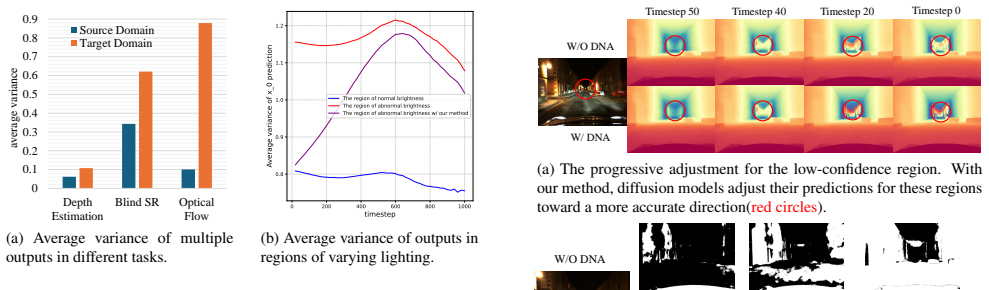
- The high-confidence region mask suggests a test-time uncertainty signal for DDP models: regions where repeated sampling disagrees may directly mark where the model is out-of-domain, which could be reused for failure detection in addition to adaptation.
- The method's reliance on the global L2 norm of the whole noise map may be too coarse for spatially varying domain shifts such as mixed illumination; a patch-wise or frequency-banded statistics alignment would be a natural next test.
- Because the adjusted predictions converge to source-domain statistics, the method might inadvertently reduce legitimate target-specific detail; this could be tested by measuring whether the variance of predictions on the target collapses relative to human-rated diversity.
Editorial analysis
A structured set of objections, weighed in public.
Referee Report
Summary. The paper proposes FreeDNA, a training-free domain adaptation method for diffusion-based dense prediction (DDP) models. The central idea is to adjust the L2-norm statistics of noise predictions during sampling: in the source-available setting, target-domain noise is scaled toward precomputed source-domain statistics using per-timestep coefficients lambda_t (Sec. 4.1); in the source-free setting, source statistics are approximated from high-confidence regions of target predictions, obtained by multiple initial-noise samples (Sec. 4.2). Experiments on depth estimation, blind super-resolution, optical flow, and semantic segmentation show consistent improvements over baselines and prior UDA methods (Tables 2-5).
Significance. If the claims hold, this is a significant contribution: a training-free, label-free domain adaptation mechanism for diffusion-based dense predictors, validated across four tasks. The paper does not fit parameters to target ground truth, and the ablation in Table 6 supports the need for the per-timestep schedule rather than direct scaling. The source-free extension is conceptually novel. However, several reproducibility gaps, especially the use of c_s in the source-free equations, currently prevent full confidence in the core mechanism. With those fixed, the work would be a solid step toward practical adaptation of diffusion-based dense prediction models.
major comments (4)
- [Sec. 4.1, Eqs. (2)-(3)] The source-available method is not fully specified as written. First, the definition of Delta N(t) requires a source condition c_s at inference time, but the paper does not state how c_s is selected or how 'pre-calculated statistics from the source domain' are aggregated (e.g., a fixed source image, a dataset mean, or a per-step expectation). Second, the derivation of lambda_t jumps from an integral expression to the discrete recurrence in Eq. (2) without specifying how the integral is discretized, and the indexing in Eqs. (2)-(3) is ambiguous; Eq. (3) then asserts lambda_t approximately equals lambda_{t+1} without an error analysis. Since lambda_t is the only mechanism that changes the sampling trajectory in the source-available method, an independent implementation is not currently possible.
- [Sec. 4.2, Eq. (5)] In the source-free setting, Eq. (5) defines Delta N(t) = ||epsilon_theta(x_t,t,c_s)|| / ||epsilon_theta(x_t,t,c_s)[M_h]||, which uses the source condition c_s that is by definition unavailable. The same issue appears in the 'Online Noise Alignment' paragraph, where x_0 is estimated using epsilon_theta(x_t,t,c_s). The intended formula is presumably based on c_t or a target-side proxy, but the corrected expression is not stated, and Algorithm 1 is deferred to an unavailable supplementary. Because the source-free results in Tables 2-5 depend on this computation, the source-free variant is not reproducible from the manuscript as written.
- [Sec. 5.2, Table 3] The DiffBIR comparison is confounded because the CFG scale is not held fixed between baselines and the proposed method. The text states 'we do not fix the CFG scale during comparisons' and that the goal is to simultaneously 'adjust the CFG scale to achieve a balance.' Without reporting the CFG values used for each entry and without a fixed-CFG ablation, the PSNR/LPIPS gains in Table 3 cannot be attributed to DNA alone. This matters because Table 3 is one of the four task-level supports for the central claim.
- [Sec. 4.2, Fig. 8] The source-free method rests on the assumption that low-variance (high-confidence) regions of target predictions have noise statistics close to the source domain. The main supporting evidence is Fig. 8, a single illustrative L2-norm curve for depth estimation; no quantitative measure (e.g., correlation over timesteps or error relative to true source statistics) is provided for the other tasks. Moreover, the hyperparameters B (number of initial noise samples) and the schedule for p are not reported in the main text, although they are load-bearing; Table 1 only compares mask schedules for depth. The authors should report these values and provide a sensitivity analysis, and ideally validate the proxy on all four tasks.
minor comments (6)
- [Sec. 5.1] The text refers to Fig. 8 for a visual comparison, but Fig. 8 is the L2-norm plot; the qualitative comparison appears in Fig. 9.
- [Table 4] The caption says the table reports depth estimation, but the entries are optical flow results on FCDN and Sintel; the caption should say 'optical flow'.
- [Table 2 and Fig. 5] The dataset name 'RobotCar' is misspelled as 'RoborCar' in Table 2 and in Figure 5 legends.
- [Sec. 5.3] The section starts with 'Omplementation'; this should read 'Implementation'.
- [Sec. 2.3] Reference [49] is cited twice in a row; the duplicate citation should be removed.
- [Table 6] The ablation row '+consistency scaling' is not presented as an incremental addition to the previous row, and the final 'ours' improves over both intermediate rows; the interaction between the components should be clarified.
Circularity Check
No significant circularity: source-available DNA is validated against external target benchmarks and nothing is fitted to target ground truth; the source-free branch is self-referential and its printed Eq. (5) is incomputable as written (it retains the inaccessible c_s), a reproducibility defect rather than a definitional circularity.
full rationale
The core derivation chain is self-contained against external benchmarks. In the source-available branch (Sec. 4.1), the statistic being aligned is ΔN(t)=||ε_θ(x_t,t,c_s)||_2/||ε_θ(x_t,t,c_t)||_2, i.e., the frozen model's noise predictions under source versus target conditions, and the per-step scaling λ_t (Eqs. 2-3) is the paper's own approximate recursion on that ratio; the Noise Scaling template comes from an external prior work [50], not from a self-citation. The claimed improvements (Tables 2-5) are measured on held-out target ground-truth metrics (AbsRel, δ1, EPE, PSNR), not on the norm statistic being aligned, so no parameter is fitted to target labels and no improvement is forced by construction. I find no load-bearing self-citation and no imported uniqueness theorem; the assumption that noise-statistic norms carry domain style (Sec. 4.1, Fig. 5) is an empirical claim supported by the paper's own Fourier analysis, not a definitional input. The one in-scope defect is in the source-free branch (Sec. 4.2): M_h is derived from the model's own prediction variance (Eq. 4), and Eq. (5) prints 'ΔN(t)=||ε_θ(x_t,t,c_s)||_2/||ε_θ(x_t,t,c_s)[M_h]||_2', which still uses the inaccessible source condition c_s in both numerator and denominator, so the printed formula cannot be evaluated in the source-free setting and the intended masked-target correction is unstated (Algorithm 1 is relegated to the supplementary). This blocks reproduction of the source-free results as written and makes the source estimate self-referential (the target is aligned to a statistic computed from its own confident regions), but because the reported gains are validated on external ground truth rather than on the aligned statistics themselves, this is a correctness/reproducibility barrier, not a circular reduction; it only minimally raises the circularity score.
Assumptions & free parameters
free parameters (4)
- high-confidence percentage threshold p (linear schedule over timestep t) =
not specified in main text; ablation shows 'larger in later steps' is best
- number of initial noise samples i (batch size B) =
not specified
- CFG scale for DiffBIR and StableSR inference =
not reported; adjusted for DiffBIR during comparison
- inference timestep =
50 for depth, SR, flow; 10 for segmentation
assumptions (4)
- domain assumption Exposure bias and domain bias share statistical characteristics, so adjusting noise prediction statistics can alleviate domain bias.
- domain assumption The noise prediction εθ is stylistically consistent with the condition image and the output x0, so aligning the variance of the noise aligns the style.
- domain assumption Regions with low variance across multiple initial-noise samplings are closer to the source domain and can proxy source statistics.
- domain assumption The amplitude component of the Fourier spectrum mainly carries domain and style information.
Cite this review
Pith. "Pith review of FreeDNA: Endowing Domain Adaptation of Diffusion-Based Dense Prediction with Training-Free Domain Noise Alignment." pith.science (2026). https://pith.science/paper/2RMHYWCW
@misc{pith2026250622509,
  author       = {Pith},
  title        = {Pith review of: FreeDNA: Endowing Domain Adaptation of Diffusion-Based Dense Prediction with Training-Free Domain Noise Alignment},
  year         = {2026},
  howpublished = {\url{https://pith.science/paper/2RMHYWCW}},
  note         = {Machine review of arXiv:2506.22509}
}
read the original abstract
Domain Adaptation(DA) for dense prediction tasks is an important topic, which enhances the dense prediction model's performance when tested on its unseen domain. Recently, with the development of Diffusion-based Dense Prediction (DDP) models, the exploration of DA designs tailored to this framework is worth exploring, since the diffusion model is effective in modeling the distribution transformation that comprises domain information. In this work, we propose a training-free mechanism for DDP frameworks, endowing them with DA capabilities. Our motivation arises from the observation that the exposure bias (e.g., noise statistics bias) in diffusion brings domain shift, and different domains in conditions of DDP models can also be effectively captured by the noise prediction statistics. Based on this, we propose a training-free Domain Noise Alignment (DNA) approach, which alleviates the variations of noise statistics to domain changes during the diffusion sampling process, thereby achieving domain adaptation. Specifically, when the source domain is available, we directly adopt the DNA method to achieve domain adaptation by aligning the noise statistics of the target domain with those of the source domain. For the more challenging source-free DA, inspired by the observation that regions closer to the source domain exhibit higher confidence meeting variations of sampling noise, we utilize the statistics from the high-confidence regions progressively to guide the noise statistic adjustment during the sampling process. Notably, our method demonstrates the effectiveness of enhancing the DA capability of DDP models across four common dense prediction tasks. Code is available at \href{https://github.com/xuhang07/FreeDNA}{https://github.com/xuhang07/FreeDNA}.
Figures


Figures from the paper (6 more)




Reference graph
Works this paper leans on
-
[1]
Ntire 2017 challenge on single image super-resolution: Dataset and study
Eirikur Agustsson and Radu Timofte. Ntire 2017 challenge on single image super-resolution: Dataset and study. InPro- ceedings of the IEEE conference on computer vision and pat- tern recognition workshops, pages 126–135, 2017. 7
2017
-
[2]
Tomer Amit, Tal Shaharbany, Eliya Nachmani, and Lior Wolf. Segdiff: Image segmentation with diffusion proba- bilistic models.arXiv preprint arXiv:2112.00390, 2021. 2
arXiv 2021
-
[3]
Test-time adaptation for optical flow estimation using motion vec- tors.IEEE Transactions on Image Processing, 32:4977– 4988, 2023
Seyed Mehdi Ayyoubzadeh, Wentao Liu, Irina Kezele, Yuan- hao Yu, Xiaolin Wu, Yang Wang, and Tang Jin. Test-time adaptation for optical flow estimation using motion vec- tors.IEEE Transactions on Image Processing, 32:4977– 4988, 2023. 7
2023
-
[4]
Fan Bao, Chongxuan Li, Jun Zhu, and Bo Zhang. Analytic- dpm: an analytic estimate of the optimal reverse vari- ance in diffusion probabilistic models.arXiv preprint arXiv:2201.06503, 2022. 3
arXiv 2022
-
[5]
Analysis of representations for domain adapta- tion.Advances in neural information processing systems, 19, 2006
Shai Ben-David, John Blitzer, Koby Crammer, and Fernando Pereira. Analysis of representations for domain adapta- tion.Advances in neural information processing systems, 19, 2006. 1
2006
-
[6]
One-shot unsupervised do- main adaptation with personalized diffusion models
Yasser Benigmim, Subhankar Roy, Slim Essid, Vicky Kalo- geiton, and St´ephane Lathuili`ere. One-shot unsupervised do- main adaptation with personalized diffusion models. InPro- ceedings of the IEEE/CVF conference on computer vision and pattern recognition, pages 698–708, 2023. 2
2023
-
[7]
Contrastive model adaptation for cross- condition robustness in semantic segmentation
David Br ¨uggemann, Christos Sakaridis, Tim Br ¨odermann, and Luc Van Gool. Contrastive model adaptation for cross- condition robustness in semantic segmentation. InProceed- ings of the IEEE/CVF International Conference on Com- puter Vision, pages 11378–11387, 2023. 7, 8
2023
-
[8]
A naturalistic open source movie for opti- cal flow evaluation
Daniel J Butler, Jonas Wulff, Garrett B Stanley, and Michael J Black. A naturalistic open source movie for opti- cal flow evaluation. InComputer Vision–ECCV 2012: 12th European Conference on Computer Vision, Florence, Italy, October 7-13, 2012, Proceedings, Part VI 12, pages 611–
2012
Show all 86 references
-
[9]
nuscenes: A multi- modal dataset for autonomous driving
Holger Caesar, Varun Bankiti, Alex H Lang, Sourabh V ora, Venice Erin Liong, Qiang Xu, Anush Krishnan, Yu Pan, Gi- ancarlo Baldan, and Oscar Beijbom. nuscenes: A multi- modal dataset for autonomous driving. InProceedings of the IEEE/CVF conference on computer vision and patter...
2020
-
[10]
Toward real-world single image super-resolution: A new benchmark and a new model
Jianrui Cai, Hui Zeng, Hongwei Yong, Zisheng Cao, and Lei Zhang. Toward real-world single image super-resolution: A new benchmark and a new model. InProceedings of the IEEE/CVF international conference on computer vision, pages 3086–3095, 2019. 7
2019
-
[11]
Progressive feature alignment for unsupervised do- main adaptation
Chaoqi Chen, Weiping Xie, Wenbing Huang, Yu Rong, Xinghao Ding, Yue Huang, Tingyang Xu, and Junzhou Huang. Progressive feature alignment for unsupervised do- main adaptation. InProceedings of the IEEE/CVF confer- ence on computer vision and pattern recognition, pages 627– 636, 2019. 6
2019
-
[12]
Amplitude-phase recombination: Rethink- ing robustness of convolutional neural networks in frequency domain
Guangyao Chen, Peixi Peng, Li Ma, Jia Li, Lin Du, and Yonghong Tian. Amplitude-phase recombination: Rethink- ing robustness of convolutional neural networks in frequency domain. InProceedings of the IEEE/CVF international con- ference on computer vision, pages 458–467, 2021. 2
2021
-
[13]
S2r-depthnet: Learning a generalizable depth-specific structural representation
Xiaotian Chen, Yuwang Wang, Xuejin Chen, and Wenjun Zeng. S2r-depthnet: Learning a generalizable depth-specific structural representation. InProceedings of the IEEE/CVF conference on computer vision and pattern recognition, pages 3034–3043, 2021. 6, 7
2021
-
[14]
Text-to-image diffusion mod- els are zero shot classifiers.Advances in Neural Information Processing Systems, 36:58921–58937, 2023
Kevin Clark and Priyank Jaini. Text-to-image diffusion mod- els are zero shot classifiers.Advances in Neural Information Processing Systems, 36:58921–58937, 2023. 1
2023
-
[15]
The cityscapes dataset for semantic urban scene understanding
Marius Cordts, Mohamed Omran, Sebastian Ramos, Timo Rehfeld, Markus Enzweiler, Rodrigo Benenson, Uwe Franke, Stefan Roth, and Bernt Schiele. The cityscapes dataset for semantic urban scene understanding. InProceed- ings of the IEEE conference on computer vision and pattern rec...
2016
-
[16]
Joint distribution optimal transportation for domain adaptation.Advances in neural information pro- cessing systems, 30, 2017
Nicolas Courty, R ´emi Flamary, Amaury Habrard, and Alain Rakotomamonjy. Joint distribution optimal transportation for domain adaptation.Advances in neural information pro- cessing systems, 30, 2017. 2
2017
-
[17]
Domain adaptation for visual applications: A comprehensive survey.arXiv preprint arXiv:1702.05374,
Gabriela Csurka. Domain adaptation for visual applications: A comprehensive survey.arXiv preprint arXiv:1702.05374,
-
[18]
Open-ddvm: A re- production and extension of diffusion model for optical flow estimation.arXiv preprint arXiv:2312.01746, 2023
Qiaole Dong, Bo Zhao, and Yanwei Fu. Open-ddvm: A re- production and extension of diffusion model for optical flow estimation.arXiv preprint arXiv:2312.01746, 2023. 7
2023 arXiv
-
[19]
Training generative neural networks via maximum mean discrepancy optimization.arXiv preprint arXiv:1505.03906, 2015
Gintare Karolina Dziugaite, Daniel M Roy, and Zoubin Ghahramani. Training generative neural networks via maximum mean discrepancy optimization.arXiv preprint arXiv:1505.03906, 2015. 2
2015 arXiv
-
[20]
A brief review of domain adaptation
Abolfazl Farahani, Sahar V oghoei, Khaled Rasheed, and Hamid R Arabnia. A brief review of domain adaptation. Advances in data science and information engineering: pro- ceedings from ICDATA 2020 and IKE 2020, pages 877–894,
2020
-
[21]
Virtual worlds as proxy for multi-object tracking anal- ysis
Adrien Gaidon, Qiao Wang, Yohann Cabon, and Eleonora Vig. Virtual worlds as proxy for multi-object tracking anal- ysis. InProceedings of the IEEE conference on computer vision and pattern recognition, pages 4340–4349, 2016. 4, 6
2016
-
[22]
Domain-adversarial training of neural networks.Journal of machine learning research, 17(59):1–35, 2016
Yaroslav Ganin, Evgeniya Ustinova, Hana Ajakan, Pas- cal Germain, Hugo Larochelle, Franc ¸ois Laviolette, Mario March, and Victor Lempitsky. Domain-adversarial training of neural networks.Journal of machine learning research, 17(59):1–35, 2016. 2
2016
-
[23]
Lotus: Diffusion-based visual foundation model for high-quality dense prediction.arXiv preprint arXiv:2409.18124, 2024
Jing He, Haodong Li, Wei Yin, Yixun Liang, Leheng Li, Kaiqiang Zhou, Hongbo Zhang, Bingbing Liu, and Ying- Cong Chen. Lotus: Diffusion-based visual foundation model for high-quality dense prediction.arXiv preprint arXiv:2409.18124, 2024. 1, 2, 6
2024 arXiv
-
[24]
Cross domain generative augmentation: domain generalization with latent diffusion models.arXiv preprint arXiv:2312.05387, 2023
Sobhan Hemati, Mahdi Beitollahi, Amir Hossein Estiri, Bas- sel Al Omari, Xi Chen, and Guojun Zhang. Cross domain generative augmentation: domain generalization with latent diffusion models.arXiv preprint arXiv:2312.05387, 2023. 1
2023 arXiv
-
[25]
Classifier-free diffusion guidance.arXiv preprint arXiv:2207.12598, 2022
Jonathan Ho and Tim Salimans. Classifier-free diffusion guidance.arXiv preprint arXiv:2207.12598, 2022. 7
2022 arXiv
-
[26]
Cascaded diffu- sion models for high fidelity image generation.Journal of Machine Learning Research, 23(47):1–33, 2022
Jonathan Ho, Chitwan Saharia, William Chan, David J Fleet, Mohammad Norouzi, and Tim Salimans. Cascaded diffu- sion models for high fidelity image generation.Journal of Machine Learning Research, 23(47):1–33, 2022. 2
2022
-
[27]
Daformer: Improving network architectures and training strategies for domain-adaptive semantic segmentation
Lukas Hoyer, Dengxin Dai, and Luc Van Gool. Daformer: Improving network architectures and training strategies for domain-adaptive semantic segmentation. InProceedings of the IEEE/CVF conference on computer vision and pattern recognition, pages 9924–9935, 2022. 7, 8
2022
-
[28]
Arbitrary style transfer in real-time with adaptive instance normalization
Xun Huang and Serge Belongie. Arbitrary style transfer in real-time with adaptive instance normalization. InProceed- ings of the IEEE international conference on computer vi- sion, pages 1501–1510, 2017. 3
2017
-
[29]
Dpbridge: La- tent diffusion bridge for dense prediction.arXiv preprint arXiv:2412.20506, 2024
Haorui Ji, Taojun Lin, and Hongdong Li. Dpbridge: La- tent diffusion bridge for dense prediction.arXiv preprint arXiv:2412.20506, 2024. 2
2024
-
[30]
Ddp: Diffusion model for dense visual prediction
Yuanfeng Ji, Zhe Chen, Enze Xie, Lanqing Hong, Xihui Liu, Zhaoqiang Liu, Tong Lu, Zhenguo Li, and Ping Luo. Ddp: Diffusion model for dense visual prediction. InProceedings of the IEEE/CVF International Conference on Computer Vi- sion, pages 21741–21752, 2023. 1, 2, 7, 8
2023
-
[31]
Repurpos- ing diffusion-based image generators for monocular depth estimation
Bingxin Ke, Anton Obukhov, Shengyu Huang, Nando Met- zger, Rodrigo Caye Daudt, and Konrad Schindler. Repurpos- ing diffusion-based image generators for monocular depth estimation. InProceedings of the IEEE/CVF Conference on Computer Vision and Pattern Recognition, pages 9492– ...
2024
-
[32]
Musiq: Multi-scale image quality transformer
Junjie Ke, Qifei Wang, Yilin Wang, Peyman Milanfar, and Feng Yang. Musiq: Multi-scale image quality transformer. InProceedings of the IEEE/CVF international conference on computer vision, pages 5148–5157, 2021. 7
2021
-
[33]
Domain generalisation via domain adaptation: An adversarial fourier amplitude approach.arXiv preprint arXiv:2302.12047,
Minyoung Kim, Da Li, and Timothy Hospedales. Domain generalisation via domain adaptation: An adversarial fourier amplitude approach.arXiv preprint arXiv:2302.12047,
-
[34]
Semi-supervised do- main adaptation via selective pseudo labeling and progres- sive self-training
Yoonhyung Kim and Changick Kim. Semi-supervised do- main adaptation via selective pseudo labeling and progres- sive self-training. In2020 25th International Conference on Pattern Recognition (ICPR), pages 1059–1066. IEEE, 2021. 6
2021
-
[35]
Ex- ploiting diffusion prior for generalizable dense prediction
Hsin-Ying Lee, Hung-Yu Tseng, and Ming-Hsuan Yang. Ex- ploiting diffusion prior for generalizable dense prediction. In Proceedings of the IEEE/CVF Conference on Computer Vi- sion and Pattern Recognition, pages 7861–7871, 2024. 1
2024
-
[36]
Your diffusion model is secretly a zero-shot classifier
Alexander C Li, Mihir Prabhudesai, Shivam Duggal, Ellis Brown, and Deepak Pathak. Your diffusion model is secretly a zero-shot classifier. InProceedings of the IEEE/CVF Inter- national Conference on Computer Vision, pages 2206–2217,
-
[37]
Maximum density divergence for domain adaptation.IEEE transactions on pattern analysis and machine intelligence, 43(11):3918–3930, 2020
Jingjing Li, Erpeng Chen, Zhengming Ding, Lei Zhu, Ke Lu, and Heng Tao Shen. Maximum density divergence for domain adaptation.IEEE transactions on pattern analysis and machine intelligence, 43(11):3918–3930, 2020. 2
2020
-
[38]
Alleviating exposure bias in diffusion mod- els through sampling with shifted time steps.arXiv preprint arXiv:2305.15583, 2023
Mingxiao Li, Tingyu Qu, Ruicong Yao, Wei Sun, and Marie- Francine Moens. Alleviating exposure bias in diffusion mod- els through sampling with shifted time steps.arXiv preprint arXiv:2305.15583, 2023. 1, 2
2023 arXiv
-
[39]
Unsupervised domain adap- tation with progressive adaptation of subspaces.Pattern Recognition, 132:108918, 2022
Weikai Li and Songcan Chen. Unsupervised domain adap- tation with progressive adaptation of subspaces.Pattern Recognition, 132:108918, 2022. 6
2022
-
[40]
Test- time domain adaptation for monocular depth estimation
Zhi Li, Shaoshuai Shi, Bernt Schiele, and Dengxin Dai. Test- time domain adaptation for monocular depth estimation. In 2023 IEEE International Conference on Robotics and Au- tomation (ICRA), pages 4873–4879. IEEE, 2023. 6, 7
2023
-
[41]
Swinir: Image restoration us- ing swin transformer
Jingyun Liang, Jiezhang Cao, Guolei Sun, Kai Zhang, Luc Van Gool, and Radu Timofte. Swinir: Image restoration us- ing swin transformer. InProceedings of the IEEE/CVF inter- national conference on computer vision, pages 1833–1844,
-
[42]
Common diffusion noise schedules and sample steps are flawed
Shanchuan Lin, Bingchen Liu, Jiashi Li, and Xiao Yang. Common diffusion noise schedules and sample steps are flawed. InProceedings of the IEEE/CVF winter conference on applications of computer vision, pages 5404–5411, 2024. 3
2024
-
[43]
Diff- bir: Toward blind image restoration with generative diffusion prior
Xinqi Lin, Jingwen He, Ziyan Chen, Zhaoyang Lyu, Bo Dai, Fanghua Yu, Yu Qiao, Wanli Ouyang, and Chao Dong. Diff- bir: Toward blind image restoration with generative diffusion prior. InEuropean Conference on Computer Vision, pages 430–448. Springer, 2024. 2, 7
2024
-
[44]
Stability and generalization in structured prediction.Journal of Machine Learning Research, 17(221):1–52, 2016
Ben London, Bert Huang, and Lise Getoor. Stability and generalization in structured prediction.Journal of Machine Learning Research, 17(221):1–52, 2016. 1
2016
-
[45]
Conditional adversarial domain adapta- tion.Advances in neural information processing systems, 31, 2018
Mingsheng Long, Zhangjie Cao, Jianmin Wang, and Michael I Jordan. Conditional adversarial domain adapta- tion.Advances in neural information processing systems, 31, 2018. 2
2018
-
[46]
Desc: Domain adaptation for depth estimation via semantic con- sistency.International Journal of Computer Vision, 131(3): 752–771, 2023
Adrian Lopez-Rodriguez and Krystian Mikolajczyk. Desc: Domain adaptation for depth estimation via semantic con- sistency.International Journal of Computer Vision, 131(3): 752–771, 2023. 6, 7
2023
-
[47]
Flowdiffuser: Advancing optical flow estimation with diffusion models
Ao Luo, Xin Li, Fan Yang, Jiangyu Liu, Haoqiang Fan, and Shuaicheng Liu. Flowdiffuser: Advancing optical flow estimation with diffusion models. InProceedings of the IEEE/CVF Conference on Computer Vision and Pattern Recognition, pages 19167–19176, 2024. 1
2024
-
[48]
1 year, 1000 km: The oxford robotcar dataset
Will Maddern, Geoffrey Pascoe, Chris Linegar, and Paul Newman. 1 year, 1000 km: The oxford robotcar dataset. The International Journal of Robotics Research, 36(1):3–15,
-
[49]
Generalization by adaptation: Diffusion-based domain extension for domain-generalized semantic segmentation
Joshua Niemeijer, Manuel Schwonberg, Jan-Aike Term¨ohlen, Nico M Schmidt, and Tim Fingscheidt. Generalization by adaptation: Diffusion-based domain extension for domain-generalized semantic segmentation. InProceedings of the IEEE/CVF Winter Conference on Applications of Comput...
2024
-
[50]
Elucidating the exposure bias in diffusion models.arXiv preprint arXiv:2308.15321, 2023
Mang Ning, Mingxiao Li, Jianlin Su, Albert Ali Salah, and Itir Onal Ertugrul. Elucidating the exposure bias in diffusion models.arXiv preprint arXiv:2308.15321, 2023. 1, 2, 3, 5
2023 arXiv
-
[51]
Input perturbation re- duces exposure bias in diffusion models.arXiv preprint arXiv:2301.11706, 2023
Mang Ning, Enver Sangineto, Angelo Porrello, Simone Calderara, and Rita Cucchiara. Input perturbation re- duces exposure bias in diffusion models.arXiv preprint arXiv:2301.11706, 2023. 1, 2, 3
2023 arXiv
-
[52]
Ren ´e Ranftl, Katrin Lasinger, David Hafner, Konrad Schindler, and Vladlen Koltun. Towards robust monocular depth estimation: Mixing datasets for zero-shot cross-dataset transfer.IEEE transactions on pattern analysis and machine intelligence, 44(3):1623–1637, 2020. 6
2020
-
[53]
Vi- sion transformers for dense prediction
Ren ´e Ranftl, Alexey Bochkovskiy, and Vladlen Koltun. Vi- sion transformers for dense prediction. InProceedings of the IEEE/CVF international conference on computer vision, pages 12179–12188, 2021. 1, 6
2021
-
[54]
Multi-step denoising scheduled sampling: Towards alleviating exposure bias for diffusion models
Zhiyao Ren, Yibing Zhan, Liang Ding, Gaoang Wang, Chaoyue Wang, Zhongyi Fan, and Dacheng Tao. Multi-step denoising scheduled sampling: Towards alleviating exposure bias for diffusion models. InProceedings of the AAAI Con- ference on Artificial Intelligence, pages 4667–4675, 2024. 3
2024
-
[55]
Hypersim: A photorealistic syn- thetic dataset for holistic indoor scene understanding
Mike Roberts, Jason Ramapuram, Anurag Ranjan, Atulit Kumar, Miguel Angel Bautista, Nathan Paczan, Russ Webb, and Joshua M Susskind. Hypersim: A photorealistic syn- thetic dataset for holistic indoor scene understanding. In Proceedings of the IEEE/CVF international conference o...
2021
-
[56]
High-resolution image synthesis with latent diffusion models
Robin Rombach, Andreas Blattmann, Dominik Lorenz, Patrick Esser, and Bj ¨orn Ommer. High-resolution image synthesis with latent diffusion models. InProceedings of the IEEE/CVF conference on computer vision and pattern recognition, pages 10684–10695, 2022. 2
2022
-
[57]
Universal domain adaptation through self supervi- sion.Advances in neural information processing systems, 33:16282–16292, 2020
Kuniaki Saito, Donghyun Kim, Stan Sclaroff, and Kate Saenko. Universal domain adaptation through self supervi- sion.Advances in neural information processing systems, 33:16282–16292, 2020. 2
2020
-
[58]
Christos Sakaridis, Dengxin Dai, and Luc Van Gool. Map- guided curriculum domain adaptation and uncertainty-aware evaluation for semantic nighttime image segmentation.IEEE Transactions on Pattern Analysis and Machine Intelligence, 44(6):3139–3153, 2020. 7
2020
-
[59]
Acdc: The adverse conditions dataset with correspondences for semantic driving scene understanding
Christos Sakaridis, Dengxin Dai, and Luc Van Gool. Acdc: The adverse conditions dataset with correspondences for semantic driving scene understanding. InProceedings of the IEEE/CVF international conference on computer vision, pages 10765–10775, 2021. 7
2021
-
[60]
The surprising effectiveness of diffusion models for optical flow and monocular depth estimation.Advances in Neural Information Processing Systems, 36:39443–39469, 2023
Saurabh Saxena, Charles Herrmann, Junhwa Hur, Abhishek Kar, Mohammad Norouzi, Deqing Sun, and David J Fleet. The surprising effectiveness of diffusion models for optical flow and monocular depth estimation.Advances in Neural Information Processing Systems, 36:39443–39469, 2023. 1
2023
-
[61]
Laion-5b: An open large-scale dataset for training next generation image-text models.Advances in neural in- formation processing systems, 35:25278–25294, 2022
Christoph Schuhmann, Romain Beaumont, Richard Vencu, Cade Gordon, Ross Wightman, Mehdi Cherti, Theo Coombes, Aarush Katta, Clayton Mullis, Mitchell Worts- man, et al. Laion-5b: An open large-scale dataset for training next generation image-text models.Advances in neural in- fo...
2022
-
[62]
Indoor segmentation and support inference from rgbd images
Nathan Silberman, Derek Hoiem, Pushmeet Kohli, and Rob Fergus. Indoor segmentation and support inference from rgbd images. InComputer Vision–ECCV 2012: 12th Eu- ropean Conference on Computer Vision, Florence, Italy, Oc- tober 7-13, 2012, Proceedings, Part V 12, pages 746–760. ...
2012
-
[63]
Diffusion guided do- main adaptation of image generators.arXiv preprint arXiv:2212.04473, 2022
Kunpeng Song, Ligong Han, Bingchen Liu, Dimitris Metaxas, and Ahmed Elgammal. Diffusion guided do- main adaptation of image generators.arXiv preprint arXiv:2212.04473, 2022. 2
2022 arXiv
-
[64]
Autoflow: Learning a better training set for optical flow
Deqing Sun, Daniel Vlasic, Charles Herrmann, Varun Jampani, Michael Krainin, Huiwen Chang, Ramin Zabih, William T Freeman, and Ce Liu. Autoflow: Learning a better training set for optical flow. InProceedings of the IEEE/CVF Conference on Computer Vision and Pattern Recognition...
2021
-
[65]
Unsupervised domain adaptation through self-supervision
Yu Sun, Eric Tzeng, Trevor Darrell, and Alexei A Efros. Unsupervised domain adaptation through self-supervision. arXiv preprint arXiv:1909.11825, 2019. 2
1909 arXiv
-
[66]
Distortion-aware convolutional filters for dense prediction in panoramic images
Keisuke Tateno, Nassir Navab, and Federico Tombari. Distortion-aware convolutional filters for dense prediction in panoramic images. InProceedings of the European Confer- ence on Computer Vision (ECCV), pages 707–722, 2018. 1
2018
-
[67]
Ntire 2017 challenge on single image super-resolution: Methods and results
Radu Timofte, Eirikur Agustsson, Luc Van Gool, Ming- Hsuan Yang, and Lei Zhang. Ntire 2017 challenge on single image super-resolution: Methods and results. InProceed- ings of the IEEE conference on computer vision and pattern recognition workshops, pages 114–125, 2017. 7
2017
-
[68]
Dacs: Domain adaptation via cross- domain mixed sampling
Wilhelm Tranheden, Viktor Olsson, Juliano Pinto, and Lennart Svensson. Dacs: Domain adaptation via cross- domain mixed sampling. InProceedings of the IEEE/CVF winter conference on applications of computer vision, pages 1379–1389, 2021. 7, 8
2021
-
[69]
Adversarial discriminative domain adaptation
Eric Tzeng, Judy Hoffman, Kate Saenko, and Trevor Darrell. Adversarial discriminative domain adaptation. InProceed- ings of the IEEE conference on computer vision and pattern recognition, pages 7167–7176, 2017. 2
2017
-
[70]
Undaf: A general unsupervised domain adapta- tion framework for disparity or optical flow estimation
Hengli Wang, Rui Fan, Peide Cai, Ming Liu, and Lujia Wang. Undaf: A general unsupervised domain adapta- tion framework for disparity or optical flow estimation. In 2022 International Conference on Robotics and Automation (ICRA), pages 01–07. IEEE, 2022. 7
2022
-
[71]
Exploiting diffusion prior for real-world image super-resolution.International Journal of Computer Vision, 132(12):5929–5949, 2024
Jianyi Wang, Zongsheng Yue, Shangchen Zhou, Kelvin CK Chan, and Chen Change Loy. Exploiting diffusion prior for real-world image super-resolution.International Journal of Computer Vision, 132(12):5929–5949, 2024. 7
2024
-
[72]
Deep visual domain adapta- tion: A survey.Neurocomputing, 312:135–153, 2018
Mei Wang and Weihong Deng. Deep visual domain adapta- tion: A survey.Neurocomputing, 312:135–153, 2018. 1
2018
-
[73]
Rethinking maxi- mum mean discrepancy for visual domain adaptation.IEEE Transactions on Neural Networks and Learning Systems, 34 (1):264–277, 2021
Wei Wang, Haojie Li, Zhengming Ding, Feiping Nie, Jun- yang Chen, Xiao Dong, and Zhihui Wang. Rethinking maxi- mum mean discrepancy for visual domain adaptation.IEEE Transactions on Neural Networks and Learning Systems, 34 (1):264–277, 2021. 2
2021
-
[74]
Pyramid vision transformer: A versatile backbone for dense prediction without convolutions
Wenhai Wang, Enze Xie, Xiang Li, Deng-Ping Fan, Kaitao Song, Ding Liang, Tong Lu, Ping Luo, and Ling Shao. Pyramid vision transformer: A versatile backbone for dense prediction without convolutions. InProceedings of the IEEE/CVF international conference on computer vision, pag...
2021
-
[75]
Component divide- and-conquer for real-world image super-resolution
Pengxu Wei, Ziwei Xie, Hannan Lu, Zongyuan Zhan, Qixi- ang Ye, Wangmeng Zuo, and Liang Lin. Component divide- and-conquer for real-world image super-resolution. InCom- puter Vision–ECCV 2020: 16th European Conference, Glas- gow, UK, August 23–28, 2020, Proceedings, Part VIII 1...
2020
-
[76]
Multi-block domain adaptation with central mo- ment discrepancy for fault diagnosis.Measurement, 169: 108516, 2021
Peng Xiong, Baoping Tang, Lei Deng, Minghang Zhao, and Xiaoxia Yu. Multi-block domain adaptation with central mo- ment discrepancy for fault diagnosis.Measurement, 169: 108516, 2021. 2
2021
-
[77]
Maniqa: Multi-dimension attention network for no-reference image quality assessment
Sidi Yang, Tianhe Wu, Shuwei Shi, Shanshan Lao, Yuan Gong, Mingdeng Cao, Jiahao Wang, and Yujiu Yang. Maniqa: Multi-dimension attention network for no-reference image quality assessment. InProceedings of the IEEE/CVF conference on computer vision and pattern recognition, pages...
2022
-
[78]
Learning to recover 3d scene shape from a single image
Wei Yin, Jianming Zhang, Oliver Wang, Simon Niklaus, Long Mai, Simon Chen, and Chunhua Shen. Learning to recover 3d scene shape from a single image. InProceed- ings of the IEEE/CVF Conference on Computer Vision and Pattern Recognition, pages 204–213, 2021. 1
2021
-
[79]
Optical flow domain adaptation via target style trans- fer
Jeongbeen Yoon, Sanghyun Kim, Suha Kwak, and Minsu Cho. Optical flow domain adaptation via target style trans- fer. InProceedings of the IEEE/CVF Winter Conference on Applications of Computer Vision, pages 2111–2121, 2024. 7
2024
-
[80]
Hrformer: High- resolution transformer for dense prediction.arXiv preprint arXiv:2110.09408, 2021
Yuhui Yuan, Rao Fu, Lang Huang, Weihong Lin, Chao Zhang, Xilin Chen, and Jingdong Wang. Hrformer: High- resolution transformer for dense prediction.arXiv preprint arXiv:2110.09408, 2021. 1
2021 arXiv
-
[81]
Central moment discrepancy (cmd) for domain-invariant representa- tion learning.arXiv preprint arXiv:1702.08811, 2017
Werner Zellinger, Thomas Grubinger, Edwin Lughofer, Thomas Natschl¨ager, and Susanne Saminger-Platz. Central moment discrepancy (cmd) for domain-invariant representa- tion learning.arXiv preprint arXiv:1702.08811, 2017. 2
2017 arXiv
-
[82]
Three things we need to know about trans- ferring stable diffusion to visual dense prediction tasks
Manyuan Zhang, Guanglu Song, Xiaoyu Shi, Yu Liu, and Hongsheng Li. Three things we need to know about trans- ferring stable diffusion to visual dense prediction tasks. In European Conference on Computer Vision, pages 128–145. Springer, 2024. 2
2024
-
[83]
Optical flow in the dark
Yinqiang Zheng, Mingfang Zhang, and Feng Lu. Optical flow in the dark. InProceedings of the IEEE/CVF con- ference on computer vision and pattern recognition, pages 6749–6757, 2020. 7
2020
-
[84]
Unsu- pervised cumulative domain adaptation for foggy scene op- tical flow
Hanyu Zhou, Yi Chang, Wending Yan, and Luxin Yan. Unsu- pervised cumulative domain adaptation for foggy scene op- tical flow. InProceedings of the IEEE/CVF conference on computer vision and pattern recognition, pages 9569–9578,
-
[85]
Conditional text image generation with diffu- sion models
Yuanzhi Zhu, Zhaohai Li, Tianwei Wang, Mengchao He, and Cong Yao. Conditional text image generation with diffu- sion models. InProceedings of the IEEE/CVF Conference on Computer Vision and Pattern Recognition, pages 14235– 14245, 2023. 2
2023
-
[86]
Flowie: Efficient image enhancement via rectified flow
Yixuan Zhu, Wenliang Zhao, Ao Li, Yansong Tang, Jie Zhou, and Jiwen Lu. Flowie: Efficient image enhancement via rectified flow. InProceedings of the IEEE/CVF Con- ference on Computer Vision and Pattern Recognition, pages 13–22, 2024. 2
2024
Reviewed August 6, 2026 · model on record in the stance chip above.
Discussion (0). Sign in to comment.