REVIEW 3 major objections 6 minor 12 references
Prompt Design at Scale: How Format, Instruction Count, and Context Length Shape Instruction Adherence and Hallucination in Large Language Models
T0 review · 3 major / 6 minor · reviewed 2026-08-01 · deepseek-v4-flash
Pith's one-line read Prompt format, instruction count, and context length interact so strongly that no format can be recommended in isolation: perfect instruction-following collapses to zero by 80 rules, and near a model's context limit the dominant failure is
desk verdict A genuinely useful prompt-design study that varies scale instead of treating format as fixed; the central claims hold up, but the contamination-freedom premise needs a closed-book probe and the reporting needs cleanup. read the letter →
The pith
A machine-rendered reading of the paper's core claim, the machinery that carries it, and where it could break.
The reading
What carries the argument
The central object is the Book of Veyra, a deterministically generated synthetic universe of 8,780 uniquely named entities with interlocking attributes, rendered byte-identically in four formats (markdown, plain text, prose, and a table) and sliced into a context ladder from 2k to 512k tokens. It is designed to be contamination-free so that any measured recall difference is attributable to format and context length rather than to parametric memory. The other key mechanism is the experimental design that crosses format with instruction count (10–160 rules) and context length, plus an anchor set of fixed questions re-asked at every rung to validate cross-rung comparisons.
What would settle it
Run the same recall and false-premise probes with the context removed entirely: if any model answers at above chance, then the corpus is not contamination-free and the format-by-scale effects are confounded by parametric memory. Alternatively, regenerate the entire corpus with a different seed and re-run the experiments; if the qualitative findings (floor at N=80, refusal-rise near ceiling) disappear, they were artifacts of the specific corpus rather than general phenomena.
Extended reading notes
Core claim
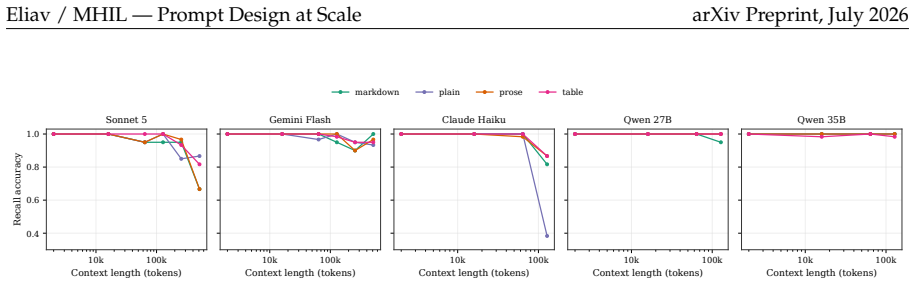
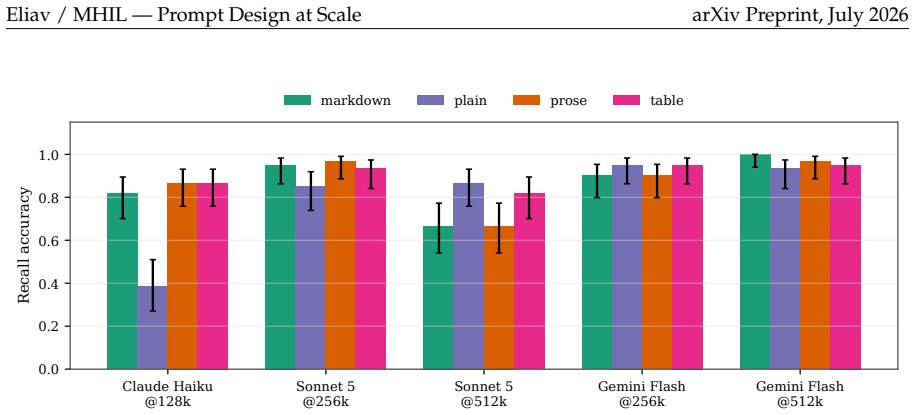
On its own terms, the paper's central claim is that format sensitivity in large language models is not an intrinsic property of the format but a function of the scale at which the format is deployed. The authors show that at small scale (few instructions, short context) formats are indistinguishable; at large scale, format effects appear but with no consistent winner across models or context rungs, and their direction can reverse between adjacent context lengths for the same model. The load-bearing empirical results are: perfect-response rate on verifiable instruction sets reaches zero by N=80 for every model, format, and placement; recall accuracy collapses format-dependently near each mode
Load-bearing premise
The results rest on the assumption that the Book of Veyra's synthetic entity names and attribute values are absent from every model's pretraining data; if any of them appear, the format effects and the zero-fabrication null could reflect memorized knowledge rather than what the model retrieved and reasoned about from context.
Editorial extensions
If this is right
- No prompt-format best practice is portable: the same format can be the best performer for one model and rung and the worst for another, so format recommendations must be conditioned on model, instruction count, context length, and placement.
- Instruction sets beyond roughly 40 simultaneous rules should be treated as a redesign point: every tested model sits on a steep decline by N=40 and is at a perfect-response floor by N=80, so rephrasing or reformatting a dense prompt is unlikely to help.
- Near a model's advertised context ceiling, monitoring should budget for refusal rather than hallucination: fabrication stayed at zero and sycophancy under 8.3%, while refusal rose to 79–90%.
- Where formats show genuine accuracy differences, token overhead (22–37% above plain text) is enough to reverse which format is the better value, so cost-adjusted accuracy should be checked in exactly those cases.
- Claims about which format is best are meaningless without specifying the instruction count or context length at which they were measured.
Reading between the lines
- If the refusal-cliff pattern generalizes, it may reflect alignment training that penalizes confident errors, effectively trading hallucination risk for abstention risk; comparing a base model against its own instruction-tuned counterpart on the same probes would separate training-induced from architectural causes.
- The zero-fabrication result may be specific to the simple attribute-lookup structure of the Veyra probes; it does not necessarily extrapolate to open-ended generation where unconstrained answers are possible.
- The N=80 floor suggests instruction-following capacity is a fixed resource independent of formatting; a testable extension is whether splitting the same rule set across multiple turns or tool calls restores adherence.
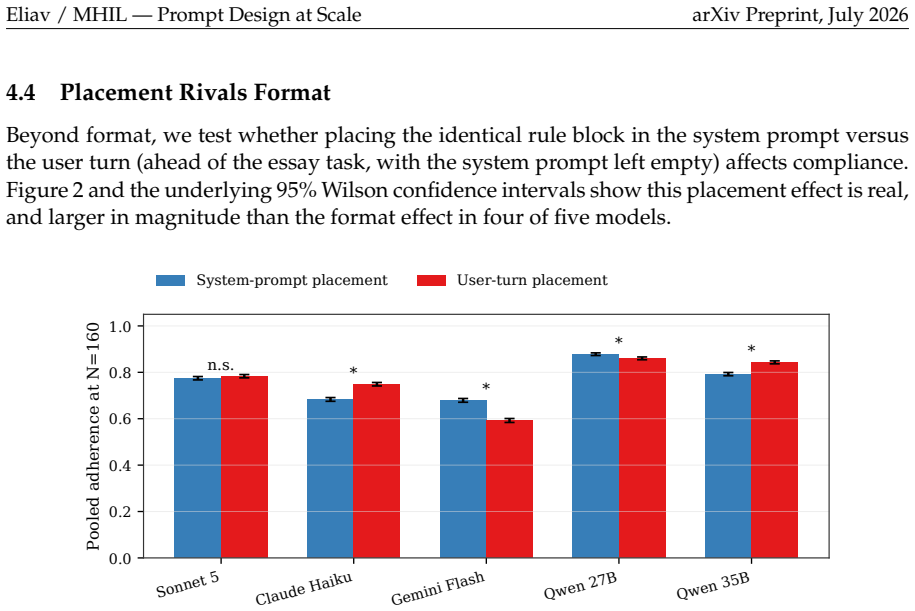
- The fact that placement (system vs. user turn) changed adherence by up to 8.7 percentage points, with direction model-specific, implies practitioners should treat placement as a free and untested lever before adjusting content.
Editorial analysis
A structured set of objections, weighed in public.
Referee Report
Summary. This paper reports two controlled experiments crossing prompt format (markdown, plain text, prose, table) with two scale axes — instruction count (N=10–160) and context length (2k–512k tokens) — across five models, using a synthetic deterministic corpus (the Book of Veyra) that the authors claim is contamination-free. Experiment 1 finds that perfect-response rate on verifiable instruction-following tasks collapses to (near) zero by N=80 for every model, format, and placement, and that system-prompt vs. user-turn placement often matters as much as format, with model-specific direction. Experiment 2 finds recall accuracy near ceiling through 64–128k tokens, then format-dependent degradation that tracks each model's own effective context ceiling; reports zero fabrication in 5,760 absent-fact probes and negligible sycophancy; and identifies refusal as the failure mode that rises near context ceilings. The authors release the harness, corpus generator, and raw results as VeyraBench.
Significance. If the results hold, the paper makes a useful, falsifiable contribution: it provides controlled evidence that prompt-format effects cannot be evaluated independently of instruction count and context length, that no universal format ordering exists, and that long-context failure near the ceiling is dominated by abstention rather than fabrication or sycophancy. The design has notable strengths: the corpus is deterministically regenerable, scoring is programmatic with no LLM-as-judge, the format arms hold content byte-identical, the anchor-set cross-check addresses a real compositional confound, and the public release should enable direct replication. These strengths make the main claims worth taking seriously, but two load-bearing issues — the untested contamination-freedom assumption and an unexplained discrepancy in the reported call counts — must be resolved before the empirical claims can be accepted at face value.
major comments (3)
- [Section 3.1 / Experiment 2] The contamination-freedom of the Book of Veyra is asserted, not demonstrated. Section 3.1 says entity names are 'novel combinations' and therefore 'cannot appear in any model’s pretraining corpus,' but this is a positive construction argument, not a test. For closed API models, token-level or substring-level coincidences cannot be ruled out, and attribute values (numbers, person names, unit phrases) are drawn from finite tables that may overlap natural text. The paper claims the chance baseline was 'confirmed directly' but gives no procedure, numbers, or closed-book control. Because the recall, format-spread, and refusal findings in Sections 5.2–5.5 are only interpretable as context-handling effects if parametric memory is excluded, the authors must add a closed-book condition: run the same probes with no corpus (or with a mismatched corpus) and report accuracy and refusal rates. Without
- [Section 5.1] The reported response counts do not reconcile. Section 5.1 states 5,520 calls per full-context model and a proportionally smaller count for the three shorter-context models, for '30,480 scored responses in total.' If the three shorter-context models are evaluated at 4 of 6 rungs (2k–128k), the expected total is 2×5,520 + 3×(5,520×4/6) = 22,080, not 30,480. If instead all models run all rungs, the total is 27,600. The 5,760 absent-fact probe denominator also needs reconciliation with the per-rung design (20 questions × 3 repeats × 4 formats × 24 model-rung cells gives 5,760, but then the total number of scored responses across all three probe types would be 17,280, not 30,480). The paper should provide a full count table by model, rung, format, probe type, and anchor-set inclusion, and correct the totals. This is essential for the credibility of the null results and for exact reproduction
- [Section 4.5 / footnote 3] The post-hoc re-scoring rule for Qwen responses is load-bearing for Experiment 1. After building an 'automated duplicate-content detector,' the authors extract and re-score 43 Qwen responses containing leaked planning text or verbatim duplicate regeneration, using two structural anchors. This rule is applied after inspecting the outputs and is not pre-registered. The authors state it 'adds at most a few tenths of a percentage point and changes no qualitative conclusion,' but they do not report the before/after cell-level values. Because the perfect-response floor at N=80 is a headline claim, the paper must show the sensitivity of every Experiment 1 table to this re-scoring decision, or pre-specify the recovery rule with inter-annotator agreement. As written, the instruction-following decay curves could be affected by a discretionary scoring step that is not transparently specified.
minor comments (6)
- [Abstract / Table 4] The abstract and Section 4.2 say perfect-response rate 'collapses to zero by N=80,' but Table 4 reports nonzero values at N=80 (Gemini Flash 0.019, Qwen 27B 0.006). Please either round with an explicit '≤0.02' or state 'near zero' and report the exact counts, since the floor claim is central.
- [Section 5.3] The phrase 'pre-registered' is used for the two format orderings, but no registration document, DOI, or timestamped repository is provided. If these were pre-registered, give the registration details; otherwise replace 'pre-registered' with 'pre-specified hypotheses' to avoid an unverifiable claim.
- [Section 3.1] The chance-baseline confirmation is described but not shown. For the scored probe set, please report the exact guess-rate calculation (e.g., 1/1,000 for names, 1/hundreds for numbers) and the empirical chance-level check. This is closely tied to the contamination concern in the major comments and should not be left as an in-text assertion.
- [Table 7 / Figure 5] Table 7 reports key accuracy spreads without confidence intervals. Since several spreads (e.g., 11.7pp at n=60) may be within sampling noise, include Wilson intervals (as in Figure 5) in the table or state which cells meet a pre-specified significance threshold. Otherwise the 'no format wins' conclusion rests partly on noise-level differences.
- [Section 3.3] Token overhead ratios are measured with o200k_base only. The paper acknowledges provider tokenizers may differ, but a one-line robustness check (e.g., applying a second tokenizer) would strengthen the cost-adjusted claims in Section 7.
- [Reference formatting] The Liu et al. (2024) reference contains a typo ('T ransactions'). Please fix and ensure all arXiv identifiers are consistent.
Circularity Check
No circular derivation: the headline results are direct measurements against an externally defined synthetic corpus, with no fitted parameter or self-citation chain standing in for the findings.
full rationale
This paper reports controlled measurements rather than a derivation, so the main circularity patterns do not arise. Experiment 1's instruction-count floor and Experiment 2's recall, fabrication, sycophancy, and refusal rates are observed frequencies scored by programmatic rules; they are not quantities fitted to a subset of data and then re-predicted. The pre-registered format orderings are treated as testable hypotheses and are rejected by the data, so they are not inputs masquerading as outputs. The cost-adjusted accuracy analysis is arithmetic over independently measured token counts and observed accuracy. No load-bearing self-citation appears: the paper cites external prior work and does not rely on the author's own previous results to justify its claims. The two genuine validity concerns are limitations, not circular steps: (1) Section 3.1 argues contamination-freedom by positive construction ('by construction cannot appear in any model's pretraining corpus') rather than by a closed-book test, which is an empirical risk for external validity but not a circular derivation; and (2) Section 5.4's footnote explicitly qualifies that the absent-probe null cannot distinguish correct abstention from reflexive refusal, which is an acknowledged interpretive caveat. Neither concern involves a claim that is equivalent to its input by definition. The findings stand as direct observations, so the appropriate circularity score is 0.
Assumptions & free parameters
free parameters (1)
- Logistic-decay knee N_50 (per model and placement) =
e.g., Claude Haiku ~98 vs ~104; Gemini Flash ~82 vs ~46
assumptions (6)
- domain assumption Book of Veyra entity names cannot appear in model pretraining corpora because they are synthetic syllable combinations
- domain assumption Programmatically verifiable rules and facts represent real prompt-design pressure
- domain assumption The o200k_base tokenizer approximates provider tokenizer token costs
- domain assumption Default sampling temperature with three repeats estimates cell accuracy
- ad hoc to paper Re-scoring Qwen responses after removing leaked planning text is faithful
- domain assumption The 20-question anchor set adequately controls for question-composition artifacts
Cite this review
Pith. "Pith review of Prompt Design at Scale: How Format, Instruction Count, and Context Length Shape Instruction Adherence and Hallucination in Large Language Models." pith.science (2026). https://pith.science/paper/2RRRSCHJ
@misc{pith2026260719257,
  author       = {Pith},
  title        = {Pith review of: Prompt Design at Scale: How Format, Instruction Count, and Context Length Shape Instruction Adherence and Hallucination in Large Language Models},
  year         = {2026},
  howpublished = {\url{https://pith.science/paper/2RRRSCHJ}},
  note         = {Machine review of arXiv:2607.19257}
}
read the original abstract
Practitioners make three prompt-design decisions with almost no controlled evidence behind them: how to format instructions and context (markdown, plain text, prose, or tabular), how many simultaneous instructions a system prompt can carry before compliance degrades, and how much context a model can hold before recall and honesty degrade. We report two controlled experiments crossing all three factors on one held, contamination-free synthetic corpus (the "Book of Veyra," 8,780 uniquely-named entities, deterministically regenerable from a fixed seed), evaluated across five models. Experiment 1 (960 calls/model) measures instruction-following decay as rule count N grows from 10 to 160, crossed with four formats and system-prompt vs. user-turn placement. Perfect-response rate collapses to zero by N=80 for every model, format, and placement. Placement produces effects at least as large as format at N=160 in most models, but the direction is model-specific. No model shows a reliable markdown advantage; one 35B model favors plain text instead. Experiment 2 (5,520 calls/model) measures recall accuracy, false-premise sycophancy, and absent-fact fabrication across a 2k-to-512k-token context ladder in the same four formats. Recall stays near ceiling through 64-128k tokens, then degrades sharply and format-dependently: one model's accuracy spread reaches 48 points at 128k tokens. Fabrication never occurs (0/5,760 probes), and sycophancy stays negligible (<=8.3%). What rises sharply near each model's context ceiling is outright refusal to answer (0% to 79-90%), distinct from sycophancy or fabrication. Neither pre-registered format ordering holds, and token overhead (+22% to +37% over plain text) further changes which format is preferable where accuracy spread is genuine. We release the full harness, corpus generator, and raw results (VeyraBench): https://github.com/iNetanel/veyrabench
Figures

Figures from the paper (3 more)


Reference graph
Works this paper leans on
-
[2]
URLhttps://arxiv.org/abs/2503.00353. Keno Harada, Yudai Yamazaki, Masachika Taniguchi, Edison Marrese-Taylor, Takeshi Kojima, Yusuke Iwasawa, and Yutaka Matsuo. When instructions multiply: Measuring and esti- mating LLM capabilities of multiple instructions following. InFindings of the Association for 20 Eliav / MHIL — Prompt Design at Scale arXiv Preprin...
arXiv 2026
-
[5]
trychroma.com/context-rot
URLhttps://research. trychroma.com/context-rot. Shomik Jain, Charlotte Park, Matt Viana, Ashia Wilson, and Dana Calacci. Interaction context often increases sycophancy in LLMs. InProceedings of the 2026 CHI Confer- ence on Human Factors in Computing Systems (CHI ’26), Barcelona, Spain,
2026
-
[7]
Mo Li, Songyang Zhang, Taolin Zhang, Haodong Duan, Yunxin Liu, and Kai Chen
URLhttps://arxiv.org/abs/ 2507.11538. Mo Li, Songyang Zhang, Taolin Zhang, Haodong Duan, Yunxin Liu, and Kai Chen. NeedleBench: Evaluating LLM retrieval and reasoning across varying information densi- ties. arXiv:2407.11963, July
- [8]
-
[10]
URLhttps://arxiv.org/abs/2508.15793. Jio Oh, Geon Heo, Seungjun Oh, Hyunjin Kim, JinYeong Bak, Jindong Wang, Xing Xie, and Steven Euijong Whang. Talking with tables for better LLM factual data interactions. arXiv:2412.17189, December
-
[11]
URLhttps://arxiv.org/abs/2412.17189. Karan Prasad. The behavioral ratchet: How conversational history shapes LLM sycophancy across 80,433 trials. Zenodo preprint, March
-
[12]
Melanie Sclar, Yejin Choi, Yulia Tsvetkov, and Alane Suhr
doi:10.5281/zenodo.19026682. Melanie Sclar, Yejin Choi, Yulia Tsvetkov, and Alane Suhr. Quantifying language models’ sensitivity to spurious features in prompt design or: How i learned to start worrying about prompt formatting. InInternational Conference on Learning Representations (ICLR),
-
[13]
Yijun Yang, Zeyu Huang, Wenhao Zhu, Zihan Qiu, Fei Yuan, Jeff Z
URL https://arxiv.org/abs/2310.11324. Yijun Yang, Zeyu Huang, Wenhao Zhu, Zihan Qiu, Fei Yuan, Jeff Z. Pan, and Ivan Titov. A controllable examination for long-context language models. arXiv:2506.02921,
Show all 12 references
-
[14]
Jeffrey Zhou, Tianjian Lu, Swaroop Mishra, Siddhartha Brahma, Sujoy Basu, Yi Luan, Denny Zhou, and Le Hou
URL https://arxiv.org/abs/2506.02921. Jeffrey Zhou, Tianjian Lu, Swaroop Mishra, Siddhartha Brahma, Sujoy Basu, Yi Luan, Denny Zhou, and Le Hou. Instruction-following evaluation for large language models. arXiv:2311.07911, November
-
[2023]
URLhttps://arxiv.org/abs/2311.07911. 21
-
[2024]
Kelly Hong, Anton Troynikov, and Jeff Huber
URLhttps://arxiv.org/abs/2411.10541. Kelly Hong, Anton Troynikov, and Jeff Huber. Context rot: How increasing input tokens im- pacts LLM performance. Technical report, Chroma, July
-
[2026]
doi:10.1145/3772318.3791915
ACM. doi:10.1145/3772318.3791915. Daniel Jaroslawicz, Brendan Whiting, Parth Shah, and Karime Maamari. How many instruc- tions can LLMs follow at once? arXiv:2507.11538, July
Reviewed August 1, 2026 · model on record in the stance chip above.
Discussion (0). Sign in to comment.