REVIEW 3 major objections 5 minor 52 references
Grouping factored MDP states by shared causal reasons for a property yields small abstractions that still support near-optimal policies.
Reviewed by Pith at T0; open to challenge. T0 means a machine referee read the full paper against a public rubric. the ladder, T0–T4 →
T0 review · grok-4.5
2026-07-30 21:07 UTC pith:2TKJOP4P
load-bearing objection Solid foundational pipeline for property-driven causal MDP abstraction; the full-solve prerequisite is openly admitted and caps practical impact, but does not erase the formal or empirical contribution. the 3 major comments →
Property-driven Causal Abstractions for Markov Decision Processes
The pith
A machine-rendered reading of the paper's core claim, the machinery that carries it, and where it could break.
Core claim
Property-driven feature causality on factored MDPs produces state-space partitions that, when aggregated into ordinary MDPs, interval MDPs, or stochastic games, retain enough structure that near-optimal policies for the original model can be recovered from the abstraction, and the same causes often generalize from small model variants to related large ones.
What carries the argument
Feature causes—minimal assignments over state-variable predicates sufficient for an effect set defined by value thresholds on the property—used to build one-shot, iterative, or causal-graph partitions, then aggregated by weighted average, interval bounds, or opponent choice in a stochastic game.
Load-bearing premise
The method currently requires an exact full analysis of the original MDP, and sometimes several reachability queries, just to discover the causes that will shrink it.
What would settle it
If, on the reported PRISM/Storm benchmarks, policies transferred from causal SG or IMDP abstractions consistently showed large normalized policy differences even under “good” effect sets and iterative partitions, or if causes from small models systematically failed to reduce large related models while preserving any policy quality, the central empirical claim would be false.
If this is right
- Small causal abstractions can replace full MDP solving for near-optimal policy extraction on several standard models.
- Causes computed on tiny parameter settings can be reused as partitions for much larger related MDPs without recomputing causality.
- Stochastic-game aggregation gives tighter value bounds and better transferred policies than interval or average aggregation.
- Effect sets focused on states near property satisfaction produce better partitions than those focused on violation.
- Iterative causal partitions outperform one-shot and causal-graph partitions on policy quality at higher computational cost.
Where Pith is reading between the lines
- If effect sets and causes can later be approximated from samples or from small solved instances, the same partition-and-aggregate pipeline could become a practical preprocessor for model checking and RL without ever solving the large MDP exactly.
- The edge of SG aggregation over intervals and averages suggests that preserving adversarial choice among concrete representatives carries more decision-relevant information than summary statistics alone.
- The method depends on factored variables that carry structural meaning; unstructured or highly synthetic state spaces where every variable is locally critical are unlikely to shrink usefully.
- Multi-objective or constrained MDPs could use the same machinery by defining effect sets from several value functions at once.
Editorial analysis
A structured set of objections, weighed in public.
Referee Report
Summary. The paper introduces feature causality for factored MDPs and a property-driven abstraction pipeline: effect/Valid sets are formed from reachability (or safety) values via thresholds, minimal causes over state-variable predicates are extracted, states are partitioned (one-shot PredPart/C-1, iterative C-IT, or causal-graph C-G), and partitions are aggregated into weighted-average MDPs, IMDPs, or stochastic games. Theorem 1 relates C-G and PredPart coarseness; Theorem 2 establishes that WA gives no value guarantees while IMDP/SG sandwich the original values (with appendix proofs). Experiments on PRISM/Storm benchmarks compare partitions and aggregations (RQ1–RQ3) and test small-to-large cause transfer (RQ4), reporting substantial size reduction and, on several models, near-optimal transferred policies, while openly noting that full-model analysis is currently required to obtain causes.
Significance. If the framework holds, it supplies a clean formal bridge from feature causality to state abstraction in factored MDPs, with three aggregation semantics and explicit value-bound theorems. Strengths include appendix proofs for Theorems 1–2 (standard VI/consistency arguments; SG bounds reuse Kattenbelt et al.), a reproducible implementation on Storm/PRISM with public code, and an unusually candid limitations discussion. The empirical picture is mixed but informative: C-IT-SG is most reliable, C-G often leaves the model unchanged, and causes can shrink large instances. The work is a solid foundational step for causal abstraction in formal verification and RL, even if practical scalability is deferred to approximation/transfer.
major comments (3)
- [Abstract; §I; §IV-B,C; §VII] Abstract, §I (Results/Limitations), and §VII claim that causal abstractions mitigate state-space explosion and yield small models supporting near-optimal original policies. Realizing any of C-1, C-IT, or C-G requires exact value analysis of the full concrete MDP to build Effect/Valid sets (§IV-B,C; Fig. 4), often plus multiple reachability queries for C-IT—precisely the analysis abstractions are meant to avoid. The only offered escape is small-to-large transfer (RQ4). This is acknowledged as future work, but the central scalability claim in the abstract and introduction is therefore stronger than what the present pipeline demonstrates and should be restated to match the foundational scope.
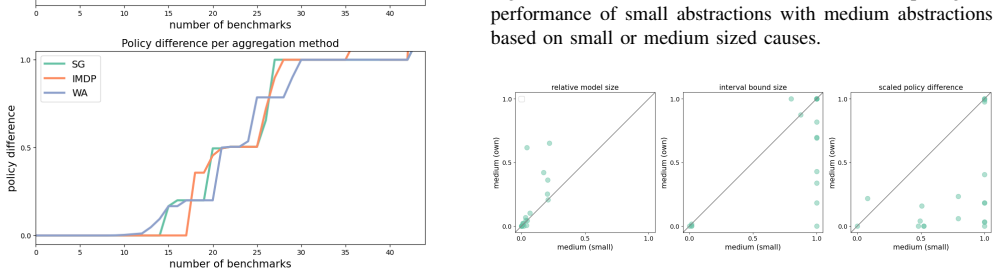
- [RQ4; Fig. 9; Abstract; §I] RQ4 and Fig. 9 report that causes from small models reliably shrink relative size of medium/large instances (<20%), yet “the policy difference often becomes worse, sometimes degrading to the worst possible policy.” The abstract’s phrasing that abstractions “often generalize to related large-scale MDP models” and the §I claim of near-optimal policies therefore overstate the quality half of transfer. The paper should quantify failure rates (e.g., fraction of benchmarks with policy difference near 0 vs near 1) and qualify the generalization claim accordingly, or restrict it to size only.
- [§VI RQ1; Appendix C-A; Table I] §VI and Appendix C show strong sensitivity to Effect/Valid semantics (“good” vs “bad” bands), threshold type (relative ε=0.1 preferred), and iteration count k for C-IT, with hyperparameters fixed after a small-model sweep. Free parameters (ε, k, Effect configuration) are load-bearing for the reported “best” C-IT-SG results. A clearer protocol—e.g., default settings justified a priori, or a small sensitivity table on held-out models—would make the empirical claims more robust and reproducible without re-tuning per benchmark family.
minor comments (5)
- [Fig. 3; Fig. 6; Appendix C] Fig. 3 and Fig. 6 are helpful but the taxi partition colors and the SG agent/opponent distinction would benefit from a short legend in the caption; several appendix figures (11–19) are referenced densely and hard to parse without higher resolution or clearer axis labels.
- [§IV-A; Example 5] Notation for ordinal predicates (X_i ≥ x_{i,k}) vs categorical (X_i = x_{i,k}) is clear in §IV-A, but the simplification “write X_i instead of X_i ≥ 1” for binary variables is easy to miss; a one-line reminder when battery/passenger appear in examples would help.
- [§II] Related work (§II) covers causal RL and bisimulation well; a brief pointer to how PredPart differs from standard predicate abstraction refinement loops (beyond the one sentence in the introduction) would situate the contribution more sharply for the FMCAD audience.
- [Table II; Remark 3] Table II lists benchmarks cleanly; stating explicitly which properties are reach-avoid vs pure reachability in the main text (currently only in Remark 3) would avoid confusion when reading RQ1–RQ3.
- [§IV-C; §II; §III-B] Minor typos: “fixate on states” (§IV-C), “Sim ˜ao” spacing, and occasional missing spaces before citations; “opt := min if opt = max” is standard but the dual notation opt/¯opt could be introduced once in a display.
Circularity Check
No derivation-chain circularity: causes, partitions, and abstractions are independently defined and evaluated against external MDP ground truth.
full rationale
The paper’s pipeline is Effect/Valid sets from exact reachability values V(s) → feature causes (Def. 4, adapted from prior feature-causality work) → PredPart / IterPredPart / CGPart → WA/IMDP/SG aggregation → comparison of abstract size, value bounds, and transferred-policy quality against the original MDP’s optimal value. None of these steps reduces by construction to its own input: causes are minimal sufficient predicate assignments for independently thresholded effect sets (Fig. 4; §IV-B,C); aggregation definitions (Defs. 5–7) and value-bound theorems (Thm. 2) are standard and proved with counter-examples and induction, not fitted; empirical metrics (relative size, interval width, normalized policy difference) are measured on the concrete MDP. Citation of the authors’ feature-causality line [8] supplies a definitional tool that is extended, not a uniqueness theorem that forces the abstraction claims. Hyperparameter choices after RQ1 are ordinary experimental selection, not parameters fitted then re-reported as predictions. The acknowledged limitation—that full-model solves are needed to obtain causes—is a practical scalability concern, not logical circularity of the claimed derivation. Score 0; steps empty.
Axiom & Free-Parameter Ledger
free parameters (3)
- relative/percentile threshold ε for Valid/Effect =
ε=0.1 (relative) used in main experiments
- number of iterative partition iterations k =
k=6
- Effect/Valid semantic configuration (good vs bad bands) =
Effect sets 3 and 4 (Fig. 4) for C-1; both good and bad retained for coverage
axioms (5)
- standard math Memoryless deterministic policies suffice for optimality of unbounded reachability/safety on finite MDPs.
- domain assumption Feature cause = assignment γ that is sufficient for Effect among Valid and subset-minimal (Def. 4 / [8]).
- domain assumption State variables are ordinal or categorical so Boolean predicates X_i ≥ x or X_i = x form an adequate feature set F_M.
- domain assumption Action-consistency and target-consistency of partitions may be enforced by splitting blocks without harming the intended abstraction use.
- ad hoc to paper Exact full-model value analysis to build Effect sets is an acceptable foundational cost; approximation/transfer is future work.
invented entities (3)
-
One-shot causal partition PredPart (C-1)
no independent evidence
-
Iterative causal partition IterPredPart (C-IT)
no independent evidence
-
Property-driven IMDP aggregation of a causal partition
independent evidence
read the original abstract
Markov Decision Processes (MDPs) are widely used as decision-making models, commonly specified over factored state spaces through state variables and their valuations. The exponential blowup in the number of states renders many reasoning tasks in MDPs challenging. Abstractions are promising techniques to reduce MDPs and thus mitigate scalability issues. In this work, we introduce a notion of causality on factored MDPs and a novel property-driven causal abstraction technique that retains many characteristics of the original MDP model. For this, we rely on causal relations over state variable predicates and identify those states that share the same reasons for fulfilling or violating a given abstraction property. We theoretically and empirically compare various causal MDP abstractions using different model types such as MDPs, interval MDPs, or stochastic games. Our evaluation demonstrates the potential of our approach: For several standard benchmarks, we obtain small abstractions that allow us to compute near-optimal policies for the original MDP. Furthermore, our causal abstractions often generalize to related large-scale MDP models.
Figures



Reference graph
Works this paper leans on
-
[1]
Efficient structure learning in factored-state mdps,
A. L. Strehl, C. Diuk, and M. L. Littman, “Efficient structure learning in factored-state mdps,” inAAAI, pp. 645–650, AAAI Press, 2007
2007
-
[2]
PRISM 4.0: Verifica- tion of probabilistic real-time systems,
M. Z. Kwiatkowska, G. Norman, and D. Parker, “PRISM 4.0: Verifica- tion of probabilistic real-time systems,” inCAV, vol. 6806 ofLecture Notes in Computer Science, pp. 585–591, Springer, 2011
2011
-
[3]
The probabilistic model checker storm,
C. Hensel, S. Junges, J. Katoen, T. Quatmann, and M. V olk, “The probabilistic model checker storm,”Int. J. Softw. Tools Technol. Transf., vol. 24, no. 4, pp. 589–610, 2022
2022
-
[4]
Construction of abstract state graphs with pvs,
S. Graf and H. Saidi, “Construction of abstract state graphs with pvs,” in Computer Aided Verification(O. Grumberg, ed.), (Berlin, Heidelberg), pp. 72–83, Springer Berlin Heidelberg, 1997
1997
-
[5]
Alwayssafe: Reinforcement learning without safety constraint violations during training,
T. D. Sim ˜ao, N. Jansen, and M. T. J. Spaan, “Alwayssafe: Reinforcement learning without safety constraint violations during training,” inAAMAS, pp. 1226–1235, ACM, 2021
2021
-
[6]
Pearl,Causality
J. Pearl,Causality. Cambridge University Press, 2 ed., 2009
2009
-
[7]
J. Y . Halpern,Actual Causality. The MIT Press, 08 2016
2016
-
[8]
Feature causality,
C. Dubslaff, K. Weis, C. Baier, and S. Apel, “Feature causality,”J. Syst. Softw., vol. 209, p. 111915, 2024
2024
-
[9]
Bounded-parameter Markov decision processes,
R. Givan, S. M. Leach, and T. L. Dean, “Bounded-parameter Markov decision processes,”Artif. Intell., vol. 122, no. 1-2, pp. 71–109, 2000
2000
-
[10]
A game- based abstraction-refinement framework for markov decision processes,
M. Kattenbelt, M. Z. Kwiatkowska, G. Norman, and D. Parker, “A game- based abstraction-refinement framework for markov decision processes,” Formal Methods Syst. Des., vol. 36, no. 3, pp. 246–280, 2010
2010
-
[11]
Eells,Probabilistic Causality
E. Eells,Probabilistic Causality. Cambridge Studies in Probability, Induction and Decision Theory, Cambridge University Press, 1991
1991
-
[12]
Peters, D
J. Peters, D. Janzing, and B. Sch ¨olkopf,Elements of Causal Inference: Foundations and Learning Algorithms. Cambridge, MA, USA: MIT Press, 2017
2017
-
[13]
A modification of the halpern-pearl definition of causal- ity,
J. Y . Halpern, “A modification of the halpern-pearl definition of causal- ity,” inIJCAI, pp. 3022–3033, AAAI Press, 2015. 10
2015
-
[14]
Causality in configurable software systems,
C. Dubslaff, K. Weis, C. Baier, and S. Apel, “Causality in configurable software systems,” inProceedings of the 44th International Conference on Software Engineering (ICSE), 2022
2022
-
[15]
Sufficient reasons for classifier decisions in the presence of domain constraints,
N. Gorji and S. Rubin, “Sufficient reasons for classifier decisions in the presence of domain constraints,”Proceedings of the AAAI Conference on Artificial Intelligence, vol. 36, pp. 5660–5667, Jun. 2022
2022
-
[16]
From verification to causality-based explications,
C. Baier, C. Dubslaff, F. Funke, S. Jantsch, R. Majumdar, J. Piribauer, and R. Ziemek, “From verification to causality-based explications,” inProceedings of the 48th International Colloquium on Automata, Languages, and Programming (ICALP), 2021
2021
-
[17]
Foundations of probability-raising causality in markov decision processes,
C. Baier, J. Piribauer, and R. Ziemek, “Foundations of probability-raising causality in markov decision processes,”Log. Methods Comput. Sci., vol. 20, no. 1, 2024
2024
-
[18]
Probability-raising causality for uncertain paramet- ric markov decision processes with PAC guarantees,
R. Oura and Y . Ito, “Probability-raising causality for uncertain paramet- ric markov decision processes with PAC guarantees,” inUAI, vol. 286 ofProceedings of Machine Learning Research, pp. 3300–3321, PMLR, 2025
2025
-
[19]
HyperPCTL: A temporal logic for probabilistic hyperproperties,
E. ´Abrah´am and B. Bonakdarpour, “HyperPCTL: A temporal logic for probabilistic hyperproperties,” inProc. of the 15th Intern. Conf. on Quantitative Evaluation of Systems (QEST), pp. 20–35, Springer, 2018
2018
-
[20]
Probabilistic Hyperproper- ties of Markov Decision Processes,
R. Dimitrova, B. Finkbeiner, and H. Torfah, “Probabilistic Hyperproper- ties of Markov Decision Processes,” inProc. of the 18th Intern. Symp. on Automated Technology for Verification and Analysis (ATVA), vol. 12302 ofLNCS, pp. 484–500, Springer, 2020
2020
-
[21]
Causal temporal reasoning for markov decision processes,
M. Kazemi, J. Lally, and N. Paoletti, “Causal temporal reasoning for markov decision processes,”Research Directions: Cyber-Physical Systems, vol. 3, p. e3, 2025
2025
-
[22]
Probabilistic causes in markov chains,
R. Ziemek, J. Piribauer, F. Funke, S. Jantsch, and C. Baier, “Probabilistic causes in markov chains,”Innov. Syst. Softw. Eng., vol. 18, no. 3, pp. 347–367, 2022
2022
-
[23]
A survey on causal reinforcement learning,
Y . Zeng, R. Cai, F. Sun, L. Huang, and Z. Hao, “A survey on causal reinforcement learning,”CoRR, vol. abs/2302.05209, 2023
Pith/arXiv arXiv 2023
-
[24]
Causal reinforcement learning: A survey,
Z. Deng, J. Jiang, G. Long, and C. Zhang, “Causal reinforcement learning: A survey,” 2023
2023
-
[25]
Bandits with unobserved confounders: A causal approach,
E. Bareinboim, A. Forney, and J. Pearl, “Bandits with unobserved confounders: A causal approach,” inNIPS, pp. 1342–1350, 2015
2015
-
[26]
Causal based q-learning,
A. M ´endez-Molina, I. Feliciano-Avelino, E. F. Morales, and L. E. Sucar, “Causal based q-learning,”Res. Comput. Sci., vol. 149, no. 3, pp. 95– 104, 2020
2020
-
[27]
Toward causal-aware RL: state-wise action-refined temporal difference,
H. Sun, “Toward causal-aware RL: state-wise action-refined temporal difference,”CoRR, vol. abs/2201.00354, 2022
Pith/arXiv arXiv 2022
-
[28]
Causal rein- forcement learning using observational and interventional data,
M. Gasse, D. Grasset, G. Gaudron, and P. Oudeyer, “Causal rein- forcement learning using observational and interventional data,”CoRR, vol. abs/2106.14421, 2021
Pith/arXiv arXiv 2021
-
[29]
Towards a unified theory of state abstraction for MDPs,
L. Li, T. J. Walsh, and M. L. Littman, “Towards a unified theory of state abstraction for MDPs,” inAI&M, 2006
2006
-
[30]
Bisimulation through probabilistic testing,
K. G. Larsen and A. Skou, “Bisimulation through probabilistic testing,” Information and Computation, vol. 94, no. 1, pp. 1–28, 1991
1991
-
[31]
Equivalence notions and model minimization in markov decision processes,
R. Givan, T. Dean, and M. Greig, “Equivalence notions and model minimization in markov decision processes,”Artificial Intelligence, vol. 147, no. 1, pp. 163–223, 2003. Planning with Uncertainty and Incomplete Information
2003
-
[32]
Metrics for finite markov de- cision processes,
N. Ferns, P. Panangaden, and D. Precup, “Metrics for finite markov de- cision processes,” inProceedings of the 20th Conference on Uncertainty in Artificial Intelligence, UAI ’04, (Arlington, Virginia, USA), pp. 162– 169, AUAI Press, 2004
2004
-
[33]
Representation discovery for mdps using bisimulation metrics,
S. S. Ruan, G. Comanici, P. Panangaden, and D. Precup, “Representation discovery for mdps using bisimulation metrics,” inProceedings of the Twenty-Ninth AAAI Conference on Artificial Intelligence, AAAI’15, pp. 3578–3584, AAAI Press, 2015
2015
-
[34]
Pric3: Property directed reachability for mdps,
K. Batz, S. Junges, B. L. Kaminski, J.-P. Katoen, C. Matheja, and P. Schr¨oer, “Pric3: Property directed reachability for mdps,” inComputer Aided Verification(S. K. Lahiri and C. Wang, eds.), (Cham), pp. 512– 538, Springer International Publishing, 2020
2020
-
[35]
Robust counterfactual inference in markov decision processes,
J. Lally, M. Kazemi, and N. Paoletti, “Robust counterfactual inference in markov decision processes,” 2026. accepted for publication at AAMAS 2026
2026
-
[36]
Invariant causal prediction for block mdps,
A. Zhang, C. Lyle, S. Sodhani, A. Filos, M. Kwiatkowska, J. Pineau, Y . Gal, and D. Precup, “Invariant causal prediction for block mdps,” inICML, vol. 119 ofProceedings of Machine Learning Research, pp. 11214–11224, PMLR, 2020
2020
-
[37]
Causal dynamics learning for task-independent state abstraction,
Z. Wang, X. Xiao, Z. Xu, Y . Zhu, and P. Stone, “Causal dynamics learning for task-independent state abstraction,” inICML, vol. 162 of Proceedings of Machine Learning Research, pp. 23151–23180, PMLR, 2022
2022
-
[38]
Building mini- mal and reusable causal state abstractions for reinforcement learning,
Z. Wang, C. Wang, X. Xiao, Y . Zhu, and P. Stone, “Building mini- mal and reusable causal state abstractions for reinforcement learning,” Proceedings of the AAAI Conference on Artificial Intelligence, vol. 38, 2024
2024
-
[39]
Test where de- cisions matter: Importance-driven testing for deep reinforcement learn- ing,
S. Pranger, H. Chockler, M. Tappler, and B. K ¨onighofer, “Test where de- cisions matter: Importance-driven testing for deep reinforcement learn- ing,” inAdvances in Neural Information Processing Systems(A. Glober- son, L. Mackey, D. Belgrave, A. Fan, U. Paquet, J. Tomczak, and C. Zhang, eds.), vol. 37, pp. 28103–28126, Curran Associates, Inc., 2024
2024
-
[40]
M. L. Puterman,Markov Decision Processes: Discrete Stochastic Dy- namic Programming. Wiley Series in Probability and Statistics, Wiley, 1994
1994
-
[41]
Baier and J.-P
C. Baier and J.-P. Katoen,Principles of model checking. MIT Press, 2008
2008
-
[42]
The complexity of stochastic games,
A. Condon, “The complexity of stochastic games,”Inf. Comput., vol. 96, no. 2, pp. 203–224, 1992
1992
-
[43]
Strategy synthesis for partially-known switched stochastic systems,
J. Jackson, L. Laurenti, E. W. Frew, and M. Lahijanian, “Strategy synthesis for partially-known switched stochastic systems,” inHSCC, pp. 6:1–6:11, ACM, 2021
2021
-
[44]
Value iteration,
K. Chatterjee and T. A. Henzinger, “Value iteration,” in25 Years of Model Checking, vol. 5000 ofLecture Notes in Computer Science, pp. 107–138, Springer, 2008
2008
-
[45]
Robust dynamic programming,
G. N. Iyengar, “Robust dynamic programming,”Mathematics of Oper- ations Research, vol. 30(2), pp. 257–280, 2005
2005
-
[46]
Implicit and incremental computation of primes and essential primes of boolean functions,
O. Coudert and J. C. Madre, “Implicit and incremental computation of primes and essential primes of boolean functions,” inDAC, pp. 36–39, IEEE Computer Society Press, 1992
1992
-
[47]
The revised practitioner’s guide to MDP model checking algorithms,
A. Hartmanns, S. Junges, T. Quatmann, and M. Weininger, “The revised practitioner’s guide to MDP model checking algorithms,”Int J Softw Tools Technol Transfer, 2026. 11 APPENDIXA PROOFS FORSECTIONIV A. Proof of Theorem 1 Intuitively, Theorem 1 claims that for a given MDPM withValid,Effect, and a cause-effect coverC, the cardinality ofPredPart(M, C)is alwa...
2026
-
[48]
Then, by definition,f i,k ̸⊂γ, k∈[1..|X i|, γ∈C]
Leti∈I irr be the index of an irrelevant feature. Then, by definition,f i,k ̸⊂γ, k∈[1..|X i|, γ∈C]. Otherwise, it would violate Definition 4, Item(C2). LetS CG ∈ CGPart(M, Iirr). By definition,∀s,s ′ ∈ SCG, the states only differ in irrelevant features, i.e.,∀i∈[1..n]\I irr : x ′ i =x i. Hence,γ(s) =γ(s ′)forallγ∈C, i.e.,s,s ′ are in the sameS P ∈PredPart...
-
[49]
If someS P ∈PredPart(M, C)is a superset of mul- tipleS CG ∈CGPart(M, Iirr), then|CGPart(M, I irr)|> |PredPart(M, C)|
If for all setsS CG there is a setS P such that SCG =S P , then|CGPart(M, Iirr)|=|PredPart(M, C)|. If someS P ∈PredPart(M, C)is a superset of mul- tipleS CG ∈CGPart(M, Iirr), then|CGPart(M, I irr)|> |PredPart(M, C)|. APPENDIXB PROOFS FORSECTIONV A. Proof of Theorem 2 - Item 1 We show that theWAabstraction can lead to arbitrarily wrong values using the cou...
-
[50]
We show that there exist interval policiesπ 2 that induce probability distributions giving upper and lower bounds on the values of the original MDP in Lemma 1
-
[51]
Then, we show that these interval distributions belong to MDPs consistent with the IMDP in Lemma 2
-
[52]
good” compared to “bad
Finally, we use these findings together with Remark 6 and Remark 7 to prove the inequalities of Item 2 by induction. The proof is analogous for all four inequalities. We include the full proof foropt = max,W(ˆs)≤V(s)and point out the differences where applicable for the three remaining cases. Necessary lemmas and their proofs. Lemma 1.There exist interval...
discussion (0)
Sign in with ORCID, Apple, or X to comment. Anyone can read and Pith papers without signing in.