REVIEW 5 major objections 6 minor 39 references
De-anonymization Attacks on Neuroimaging Datasets
T0 review · 5 major / 6 minor · reviewed 2026-08-14 · deepseek-v4-flash
Pith's one-line read Functional brain scans carry an individual-specific connectome signature that lets an attacker re-identify anonymized subjects with over 94 percent accuracy.
desk verdict Real cross-task fMRI de-anonymization, but the HCP headline numbers are inflated by within-cohort feature selection; the ADHD-200 result is the sturdy part. read the letter →
The pith
A machine-rendered reading of the paper's core claim, the machinery that carries it, and where it could break.
The reading
What carries the argument
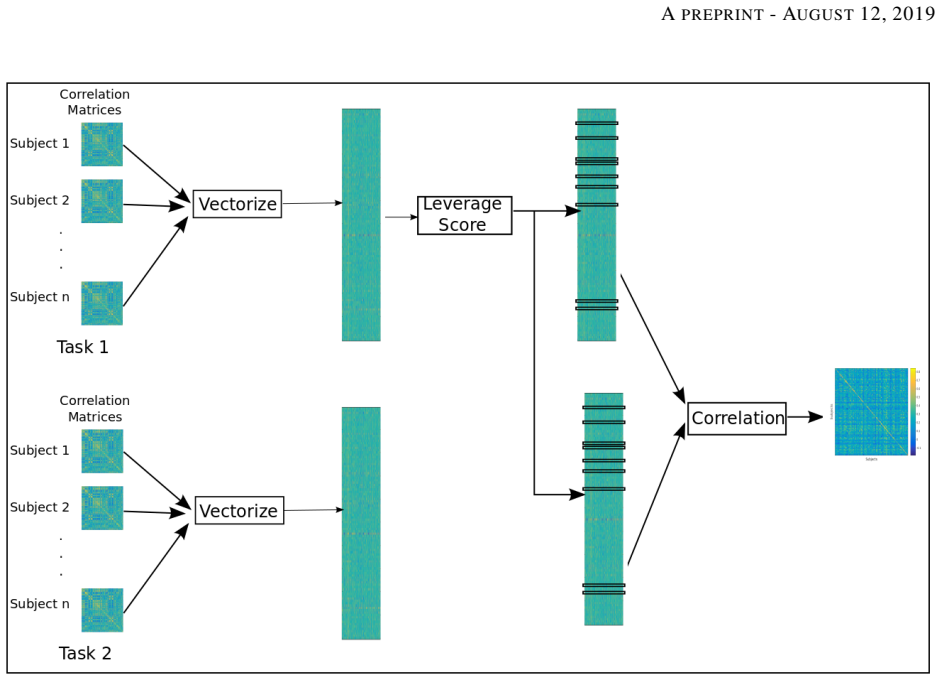
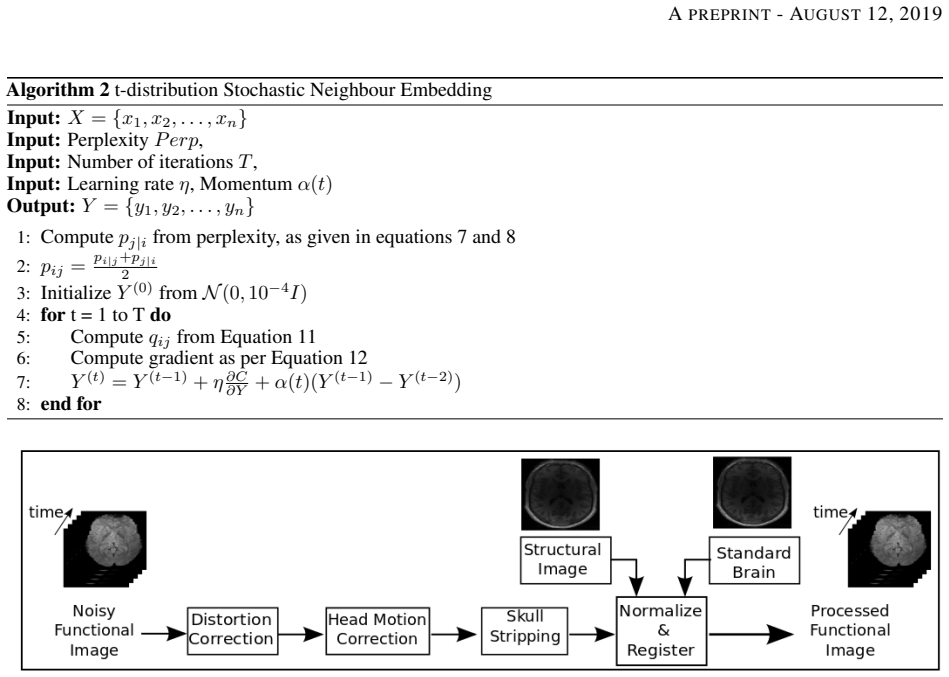
The central object is the functional connectome, built by averaging BOLD time-series over atlas parcels and computing all pairwise Pearson correlations between the 360 regions of the HCP cortical atlas (or the AAL2 atlas for ADHD-200). Each connectome is vectorized into a feature vector, and the group matrix's left singular vectors yield leverage scores per edge; keeping only the top-scoring edges (from 64,620 down to under 100) defines the principal features subspace used for matching. Matching is done by Pearson correlation between the reduced feature vectors of two datasets, and t-SNE is used separately to project the full connectomes into two dimensions for task clustering. The machinery's role is to show that identity information is concentrated in a small, computable set of correlations, making the attack both accurate and cheap.
What would settle it
Fix the feature set by computing top leverage-score edges from one cohort, then use only those edges to match scans of a disjoint cohort or a different scanner/site that were never involved in feature selection; if accuracy drops to chance the signature is not general. A second check: repeat the multi-site experiment using real scans from different institutions rather than Gaussian-corrupted copies.
Extended reading notes
Core claim
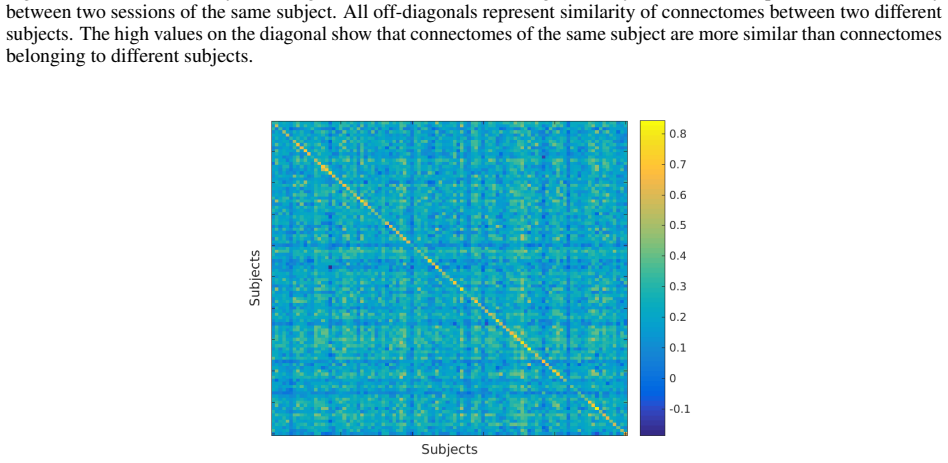
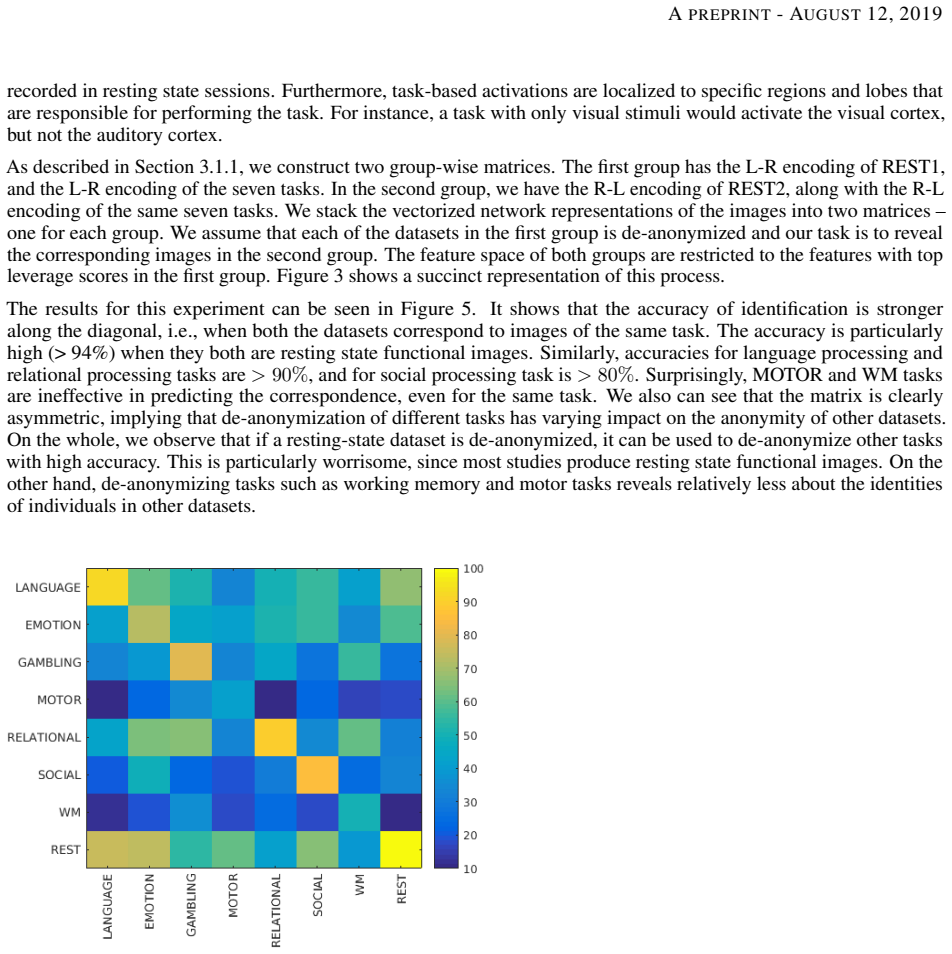
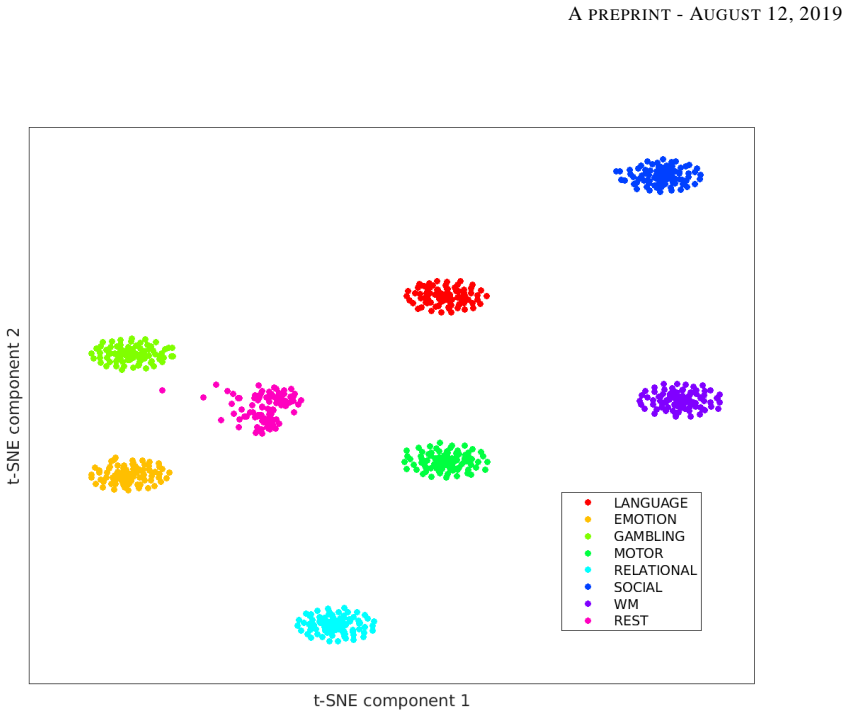
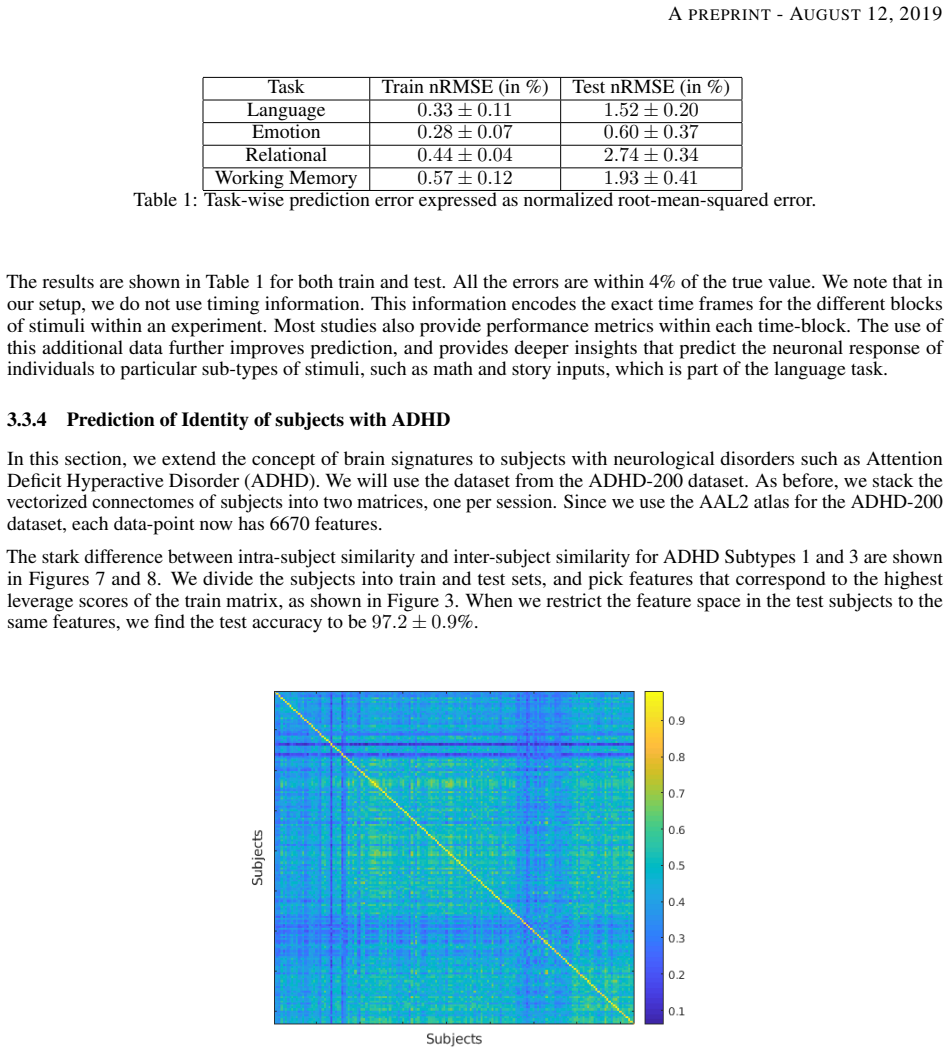
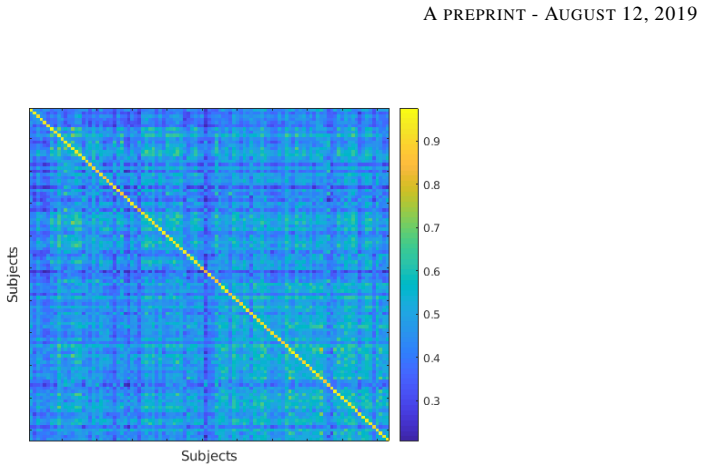
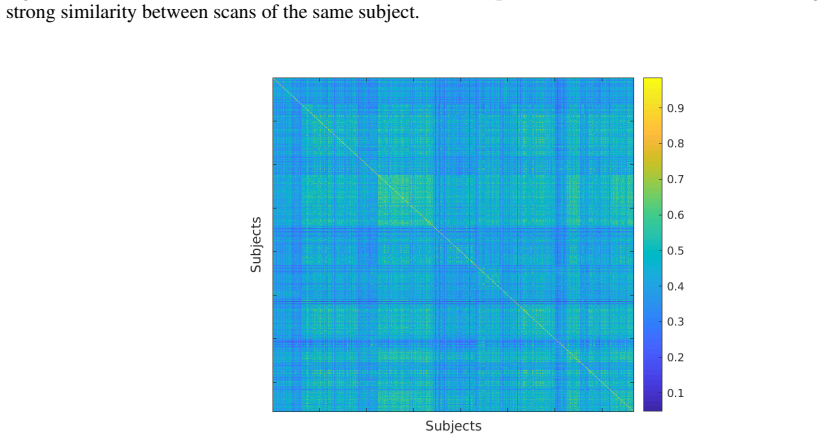
The paper's central claim is that a functional connectome, the matrix of Pearson correlations among regional BOLD time-series, acts as a brain fingerprint that is more similar within a person than between people, even when the two scans come from different sessions, tasks, or acquisition protocols. The authors show that restricting the connectome to the top leverage-score features makes the fingerprint compact and highly discriminative: resting-state de-anonymization in the HCP exceeds 94% accuracy, language and relational task matching exceed 90%, and social task matching exceeds 80%, while motor and working-memory scans transfer poorly to other tasks. In the ADHD-200 cohort, using a different atlas, identification accuracy reaches 97.2% for subtypes and 94.12% for a mixed case/control set, and simulated multi-site noise degrades accuracy gracefully. The paper also reports that t-SNE embeddings of connectomes form clean task clusters, giving about 100% task-identification accuracy, and that the leverage-score features predict per-task performance with normalized root-mean-square error under 4%.
Load-bearing premise
The attack's results stand or fall on the assumption that the discriminative features and brain parcellation are intrinsic to individuals rather than tuned to the specific population being de-anonymized; in the HCP experiments the atlas was built on the same dataset and the features were chosen from a matrix containing the very subjects later matched.
Editorial extensions
If this is right
- Removing names, demographic metadata, and facial features from fMRI does not anonymize the scan; the functional connectivity pattern itself is identifying.
- A single de-anonymized resting-state scan can be used to re-identify the same person in datasets where they performed other tasks, so one leaked record compromises other studies.
- The task a subject was performing is recoverable from the brain image, so anonymization must also protect behavioral context, not just identity.
- Task performance can be estimated from the same signature, implying that inferences about cognitive ability can be drawn from supposedly anonymous scans.
- Because accuracy survives moderate simulated acquisition noise across different sites, the threat applies to realistic multi-site and hospital-record settings.
Reading between the lines
- Editorial inference: the reported HCP accuracies may be optimistic because the atlas was developed on HCP data and the leverage-score features are selected from a group matrix containing the very subjects later matched; a fixed-feature, unseen-cohort evaluation would settle generalizability.
- Editorial inference: if the signature really lives in fewer than 100 region-pair correlations, a targeted defense that perturbs only those edges could block re-identification while preserving most connectomic content, though downstream utility is unknown.
- Editorial inference: the clean task clusters from t-SNE suggest task state dominates global connectome structure; separating task-discriminative from identity-discriminative components might yield more transferable fingerprints and better anonymization.
Signed reviews
Editorial analysis
A structured set of objections, weighed in public.
Referee Report
Summary. This paper proposes and evaluates de-anonymization attacks on fMRI datasets. The authors construct functional connectomes from resting-state and task fMRI, vectorize them, and apply leverage-score sampling to select a compact set of discriminative features; matching between a de-anonymized and an anonymous dataset is then done by Pearson correlation in the reduced feature space. They also use t-SNE for task classification and SVM regression for predicting task performance. Experiments on 100 HCP subjects report >94% resting-state de-anonymization accuracy, task-identification accuracy near 100%, and ADHD-200 de-anonymization accuracy around 94–97%; a simulated multi-site experiment adds Gaussian noise and reports robustness. The paper concludes that anonymized fMRI data can be re-linked across sessions, tasks, and cohorts, and discusses the implications for privacy and possible defenses.
Significance. If the reported accuracies hold under independent-cohort evaluation, the paper demonstrates a practical privacy threat: functional-connectome signatures are stable enough to re-identify individuals across sessions, tasks, and datasets without any metadata, including for a pediatric ADHD population. The ADHD-200 experiment is a genuine external validation, since it uses a different atlas (AAL2), a different subject cohort, and a subject-wise train/test split for feature selection. The paper also makes the claims falsifiable by reporting point accuracies and some error bars. At the same time, the headline HCP result is obtained with feature selection performed on the same subjects whose identities are sought, using an atlas developed on the same dataset; this could make the HCP accuracy an optimistic upper bound. If a fully independent HCP evaluation and a real multi-site test confirm the numbers, the paper would be an important contribution to the security and neuroimaging literatures.
major comments (5)
- [§3.1.2 and §3.3.1] The HCP de-anonymization experiment selects the top leverage-score features from the first group matrix, which contains the same 100 subjects whose identities are sought in the target matrix; consequently, feature selection can exploit subject-specific structure and the reported >94% accuracy may not generalize to a population in which the attacker does not already have scans of the same individuals. Please add a HCP experiment with a subject-wise train/test split, or a fully independent cohort, in which feature selection is performed only on training subjects and accuracy is reported on held-out subjects.
- [§3.2.2] The use of the Glasser atlas, which was developed on the same HCP dataset, creates an additional circularity for the HCP experiments; the ADHD-200 experiment uses AAL2 and a different cohort, which mitigates the concern for the general method but does not validate the specific HCP atlas/pipeline. The statement in Section 2 that the selected features are 'robust across populations' is also stronger than the evidence, since the ADHD-200 experiment re-selects features from the ADHD-200 training set rather than testing transfer of the HCP-selected features.
- [§3.3.5] The multi-site robustness experiment only adds Gaussian noise to the time-series of the second session, which does not model scanner hardware differences, pulse sequences, or site-specific artifacts; moreover, the ADHD-200 dataset is itself a multi-site acquisition (Section 3.2), so the authors could evaluate the method between actual imaging sites rather than relying on the unsupported assumption in Section 4 that low-variance Gaussian noise 'reasonably simulate[s] a multi-site acquisition.'
- [§3.3.2] The task-prediction experiment runs t-SNE on all 100 subjects, including the images whose task labels are to be predicted, and then assigns each unknown image the label of its nearest neighbor in the embedding; this is a transductive procedure in which the test images shape the low-dimensional geometry, so the reported 99–100% accuracy is not an inductive prediction accuracy. The authors should either exclude the test subjects from the embedding or explicitly frame the result as a clustering/transductive classification accuracy.
- [§3.1.2 and §3.3.1] The number of retained leverage-score features t is never reported, and the matching rule is not fully specified (e.g., whether a one-to-one assignment is enforced or whether each target column is independently matched to its highest-correlation source column); without these details the experiments are not reproducible and the sensitivity of the reported accuracies to t and to the matching rule cannot be assessed.
minor comments (6)
- [§3.3.1] The sentence 'The accuracy in de-anonymizing a dataset of resting-state functional MRIs in the HCP was found to be in excess of 94%, as shown in Figure 1' appears to reference the wrong figure; Figure 5 is the relevant accuracy heatmap.
- [§3.3.1] Figure 5 is presented without error bars or confidence intervals, so it is unclear whether the differences between tasks are statistically reliable.
- [§3.3.2] The t-SNE perplexity and optimization hyperparameters (learning rate, momentum, number of iterations) are not reported, making the task-prediction experiment difficult to reproduce.
- [§3.3.4] The ADHD-200 experiment does not state the number of subjects used in the train and test sets, the number of sessions, or how the reported 97.2±0.9% and 94.12±3.4% accuracies are computed; please provide the sample sizes and the exact decision rule.
- [§3.3.3] The abbreviation 'nRMSE' is not defined; the normalization denominator should be stated.
- [§1] The claim that the proposed methods 'have provide theoretical guarantees' is stronger than what the paper establishes, because Equations (2)–(4) are matrix-approximation bounds for randomized sampling, not bounds on de-anonymization accuracy, and the actual method uses deterministic top-t selection with no stated guarantee for the classification task.
Circularity Check
No constructional circularity; the within-cohort atlas/feature selection and transductive t-SNE evaluation are generalizability/leakage concerns, not input-output equivalence.
full rationale
The central de-anonymization claim is not equivalent to its inputs by construction. In the HCP experiments, leverage-score features are selected from the de-anonymized enrollment group and then evaluated by matching those same subjects' other scan encodings; this is the attack scenario rather than a tautology, and the paper's ADHD-200 experiment provides independent support by using a different atlas (AAL2), a different subject cohort, and a subject-wise train/test split for feature selection. The statements in Section 3.2.2 that the Glasser atlas 'was developed on the same HCP dataset' and that it is sufficient 'to capture patterns that are unique to individuals' (citing the authors' own Ravindra et al. 2018) are real concerns about overfitting and self-citation, but the current paper contains its own external validation, so the self-citation is not the load-bearing proof. Similarly, Section 3.3.2's t-SNE task-prediction evaluation embeds all 100 subjects together before assigning labels, which is a transductive/leakage limitation, and Section 3.3.5's multi-site simulation adds noise to the same scanner data rather than using a genuinely different site; both affect external validity, but neither makes a claimed result reduce to its input by definition. Therefore the paper has no significant constructional circularity, only flagged generalization/validation concerns that warrant a low score.
Assumptions & free parameters
free parameters (5)
- number of retained leverage-score features (t)
- t-SNE perplexity
- t-SNE optimization hyperparameters (learning rate, momentum, iterations)
- SVM regression hyperparameters
- Noise variance levels for multi-site simulation =
10%, 20%, 30%
assumptions (5)
- domain assumption An individual's functional-connectome pattern is stable across scan sessions and tasks.
- domain assumption The Glasser atlas provides a valid and sufficient parcellation for identity-relevant features for HCP data.
- standard math Leverage-score sampling theory (Drineas et al., Cohen et al.) provides guarantees for low-rank matrix approximation that are relevant to the identification task.
- domain assumption The t-SNE embedding preserves the cluster structure of the high-dimensional connectome data.
- ad hoc to paper Gaussian noise added to time-series reasonably approximates multi-site scanner differences.
Cite this review
Pith. "Pith review of De-anonymization Attacks on Neuroimaging Datasets." pith.science (2026). https://pith.science/paper/2TXRWODH
@misc{pith2026190803260,
  author       = {Pith},
  title        = {Pith review of: De-anonymization Attacks on Neuroimaging Datasets},
  year         = {2026},
  howpublished = {\url{https://pith.science/paper/2TXRWODH}},
  note         = {Machine review of arXiv:1908.03260}
}
read the original abstract
Advances in imaging technologies, combined with inexpensive storage, have led to an explosion in the volume of publicly available neuroimaging datasets. Effective analyses of these images hold the potential for uncovering mechanisms that govern functioning of the human brain, and understanding various neurological diseases and disorders. The potential significance of these studies notwithstanding, a growing concern relates to the protection of privacy and confidentiality of subjects who participate in these studies. In this paper, we present a de-anonymization attack rooted in the innate uniqueness of the structure and function of the human brain. We show that the attack reveals not only the identity of an individual, but also the task they are performing, and their efficacy in performing the tasks. Our attack relies on novel matrix analyses techniques that are used to extract discriminating features in neuroimages. These features correspond to individual-specific signatures that can be matched across datasets to yield highly accurate identification. We present data preprocessing, signature extraction, and matching techniques that are computationally inexpensive, and can scale to large datasets. We discuss implications of the attack and challenges associated with defending against such attacks.
Figures

Figures from the paper (6 more)
Reference graph
Works this paper leans on
-
[1]
Journal of Psychosomatic Research, 56 0 (5): 0 487 -- 496, 2004
Sleep and quantitative eeg in neurodegenerative disorders. Journal of Psychosomatic Research, 56 0 (5): 0 487 -- 496, 2004. ISSN 0022-3999. doi:https://doi.org/10.1016/j.jpsychores.2004.02.001. URL http://www.sciencedirect.com/science/article/pii/S0022399904000182
-
[2]
Spm8 manual: The fil methods groups. 2013
work page 2013
-
[3]
A wavelet-chaos methodology for analysis of eegs and eeg subbands to detect seizure and epilepsy
H Adeli, S Ghosh-Dastidar, and N Dadmehr. A wavelet-chaos methodology for analysis of eegs and eeg subbands to detect seizure and epilepsy. 54 0 (2): 0 205--211, 2007. ISSN 0018-9294
work page 2007
-
[4]
Christopher T. Anderson, Chad E. Carlson, Zhimin Li, and Manoj Raghavan. Magnetoencephalography in the preoperative evaluation for epilepsy surgery. Current Neurology and Neuroscience Reports, 14 0 (5): 0 446, Mar 2014. ISSN 1534-6293. doi:10.1007/s11910-014-0446-8. URL https://doi.org/10.1007/s11910-014-0446-8
-
[5]
Barch, Gregory C
Deanna M. Barch, Gregory C. Burgess, Michael P. Harms, Steven E. Petersen, Bradley L. Schlaggar, Maurizio Corbetta, Matthew F. Glasser, Sandra Curtiss, Sachin Dixit, Cindy Feldt, Dan Nolan, Edward Bryant, Tucker Hartley, Owen Footer, James M. Bjork, Russ Poldrack, Steve Smith, Heidi Johansen-Berg, Abraham Z. Snyder, and David C. Van Essen. Function in the...
2013
-
[6]
Pierre Bellec, Carlton Chu, François Chouinard-Decorte, Yassine Benhajali, Daniel S. Margulies, and R. Cameron Craddock. The neuro bureau adhd-200 preprocessed repository. NeuroImage, 144 0 (Pt B): 0 275--286, 2017. ISSN 1053-8119
work page 2017
-
[7]
A technique for the deidentification of structural brain mr images
Amanda Bischoff-Grethe, I Burak Ozyurt, Evelina Busa, Brian T Quinn, Christine Fennema-Notestine, Camellia P Clark, Shaunna Morris, Mark W Bondi, Terry L Jernigan, Anders M Dale, Gregory G Brown, and Bruce Fischl. A technique for the deidentification of structural brain mr images. Human brain mapping, 28 0 (9), 2007. ISSN 1065-9471
work page 2007
-
[8]
Acute effects of cocaine on human brain activity and emotion
Hans C Breiter, Randy L Gollub, Robert M Weisskoff, David N Kennedy, Nikos Makris, Joshua D Berke, Julie M Goodman, Howard L Kantor, David R Gastfriend, Jonn P Riorden, R.Thomas Mathew, Bruce R Rosen, and Steven E Hyman. Acute effects of cocaine on human brain activity and emotion. Neuron, 19 0 (3): 0 591 -- 611, 1997. ISSN 0896-6273. doi:https://doi.org/...
Show all 39 references
-
[9]
Preventing facial recognition when rendering mr images of the head in three dimensions
François Budin, Donglin Zeng, Arpita Ghosh, and Elizabeth Bullitt. Preventing facial recognition when rendering mr images of the head in three dimensions. Medical Image Analysis, 12 0 (3): 0 229--239, 2008. ISSN 1361-8415
2008
-
[10]
J. J. Chen , K. M. Siddiqui , L. Fort , R. Moffitt , K. Juluru , W. Kim , N. Safdar , and E. L. Siegel . Observer success rates for identification of 3D surface reconstructed facial images and implications for patient privacy and security . In Medical Imaging 2007: PACS and Im...
2007 doi
-
[11]
Cohen, Sam Elder, Cameron Musco, Christopher Musco, and Madalina Persu
Michael B. Cohen, Sam Elder, Cameron Musco, Christopher Musco, and Madalina Persu. Dimensionality reduction for k-means clustering and low rank approximation. In Proceedings of the Forty-seventh Annual ACM Symposium on Theory of Computing, STOC '15, pages 163--172, New York, N...
2015
-
[12]
Drineas, R
P. Drineas, R. Kannan, and M. W. Mahoney. Fast monte carlo algorithms for matrices I : Approximating matrix multiplication. SIAM J. Comput., 36 0 (1): 0 132--157, 2006
2006
-
[13]
Mahoney, and S
Petros Drineas, Michael W. Mahoney, and S. Muthukrishnan. Relative-error \ cur\ matrix decompositions. SIAM J. Matrix Anal. Appl., 30 0 (2): 0 844--881, September 2008. ISSN 0895-4798. doi:10.1137/07070471X. URL https://doi.org/10.1137/07070471X
2008 doi
-
[14]
Eisenberger, Matthew D
Naomi I. Eisenberger, Matthew D. Lieberman, and Ajay B. Satpute. Personality from a controlled processing perspective: An fmri study of neuroticism, extraversion, and self-consciousness. Cognitive, Affective, & Behavioral Neuroscience , 5 0 (2): 0 169--181, Jun 2005. ISSN 1531...
2005 doi
-
[15]
D. C. Van Essen, S. M. Smith, D. M. Barch, T. E.J. Behrens, E. Yacoub, and K. Ugurbil. The wu-minn human connectome project: An overview. NeuroImage, 80: 0 62 -- 79, 2013. ISSN 1053-8119. doi:https://doi.org/10.1016/j.neuroimage.2013.05.041. URL http://www.sciencedirect.com/sc...
2013 doi
-
[16]
E. S. Finn, Dustin Scheinost, D. M. Finn, X. Shen, X. Papademetris, and R. T. Constable. Can brain state be manipulated to emphasize individual differences in functional connectivity? NeuroImage, 160 0 (1): 0 140--151, 2017
2017
-
[17]
Helen Fisher, Arthur Aron, and Lucy L. Brown. Romantic love: An fmri study of a neural mechanism for mate choice. Journal of Comparative Neurology, 493 0 (1): 0 58--62, 2005. ISSN 0021-9967
2005
-
[18]
M. F. Glasser, T. S. Coalson, E. C. Robinson, C. D. Hacker, J. Harwell, E. Yacoub, K. Ugurbil, J. Andersson, C. F. Beckmann, M. Jenkinson, S. M. Smith, and D. C. Van Essen. A multi-modal parcellation of human cerebral cortex. Nature, 536: 0 171--178, 2016
2016
-
[19]
Glasser, Stamatios N
Matthew F. Glasser, Stamatios N. Sotiropoulos, J. Anthony Wilson, Timothy S. Coalson, Bruce Fischl, Jesper L. Andersson, Junqian Xu, Saad Jbabdi, Matthew Webster, Jonathan R. Polimeni, David C. Van Essen, and Mark Jenkinson. The minimal preprocessing pipelines for the human co...
2013 doi
-
[20]
Holmes, Angus MacDonald, Cameron S
Avram J. Holmes, Angus MacDonald, Cameron S. Carter, Deanna M. Barch, V. Andrew Stenger, and Jonathan D. Cohen. Prefrontal functioning during context processing in schizophrenia and major depression: An event-related fmri study. Schizophrenia Research, 76 0 (2): 0 199 -- 206, ...
2005 doi
-
[21]
Holmes, Marisa O
Avram J. Holmes, Marisa O. Hollinshead, Timothy M. O’keefe, Victor I. Petrov, Gabriele R. Fariello, Lawrence L. Wald, Bruce Fischl, Bruce R. Rosen, Ross W. Mair, Joshua L. Roffman, Jordan W. Smoller, and Randy L. Buckner. Brain genomics superstruct project initial data release...
2015
-
[22]
Jack Jr., Matt A
Clifford R. Jack Jr., Matt A. Bernstein, Nick C. Fox, Paul Thompson, Gene Alexander, Danielle Harvey, Bret Borowski, Paula J. Britson, Jennifer L. Whitwell, Chadwick Ward, Anders M. Dale, Joel P. Felmlee, Jeffrey L. Gunter, Derek L.G. Hill, Ron Killiany, Norbert Schuff, Sabrin...
2008
-
[23]
Obscuring surface anatomy in volumetric imaging data
Mikhail Milchenko and Daniel Marcus. Obscuring surface anatomy in volumetric imaging data. Neuroinformatics, 11 0 (1): 0 65--75, 2013. ISSN 1539-2791
2013
-
[24]
Rachel L. C. Mitchell, Rebecca Elliott, Martin Barry, Alan Cruttenden, and Peter W.R. Woodruff. Neural response to emotional prosody in schizophrenia and in bipolar affective disorder. British Journal of Psychiatry, 184 0 (3): 0 223–230, 2004. doi:10.1192/bjp.184.3.223
2004 doi
-
[25]
Chad H. Moritz. fmri reveals large-scale network activation in minimally conscious patients. Neurology, 65 0 (11): 0 1843--1843--a, 2005. ISSN 0028-3878. doi:10.1212/01.wnl.0000200030.64810.53. URL https://n.neurology.org/content/65/11/1843.2
2005
-
[26]
Provable deterministic leverage score sampling
Dimitris Papailiopoulos, Anastasios Kyrillidis, and Christos Boutsidis. Provable deterministic leverage score sampling. In Proceedings of the 20th ACM SIGKDD International Conference on Knowledge Discovery and Data Mining, KDD '14, pages 997--1006, New York, NY, USA, 2014. ACM...
2014
-
[27]
Breeze, Satrajit Ghosh, Krzysztof Gorgolewski, Yaroslav O
Jean-Baptiste Poline, Janis L. Breeze, Satrajit Ghosh, Krzysztof Gorgolewski, Yaroslav O. Halchenko, Michael Hanke, Christian Haselgrove, David B. Keator, Daniel S. Marcus, Russell A. Poldrack, Yannick Schwartz, John Ashburner, Karl G. Helmer, and David N. Kennedy. Data sharin...
2012
-
[28]
Constructing compact brain connectomes for individual fingerprinting
Vikram Ravindra, Petros Drineas, and Ananth Grama. Constructing compact brain connectomes for individual fingerprinting. CoRR, abs/1805.08649, 2018. URL http://arxiv.org/abs/1805.08649
2018 arXiv
-
[29]
Neural substrates of impaired categorical perception of phonemes in adult dyslexics: An fmri study
Serge Ruff, Nathalie Marie, Pierre Celsis, Dominique Cardebat, and Jean-François Démonet. Neural substrates of impaired categorical perception of phonemes in adult dyslexics: An fmri study. Brain and Cognition, 53 0 (2): 0 331 -- 334, 2003. ISSN 0278-2626. doi:https://doi.org/...
2003 doi
-
[30]
Brain response to visual sexual stimuli in homosexual pedophiles.(research paper/article de recherche)(report)
Boris Schiffer, Tillmann Krueger, Thomas Paul, Armin de Greiff, Michael Forsting, Norbert Leygraf, Manfred Schedlowski, and Elke Gizewski. Brain response to visual sexual stimuli in homosexual pedophiles.(research paper/article de recherche)(report). Journal of Psychiatry and ...
2008
-
[31]
S. M. Smith, C. F. Beckmann, J. Andersson, E. J. Auerbach, J. Bijsterbosch, G. Douaud, E. Duff, D. A. Feinberg, L. Griffanti, M. P. Harms, M. Kelly, T. Laumann, K. L. Miller, S. Moeller, S. Petersen, J. Power, G. Salimi-Khorshidi, A. Z. Snyder, A. T. Vu, M. W. Woolrich, J. Xu,...
2013 doi
-
[32]
The human connectome: A structural description of the human brain
Olaf Sporns, Giulio Tononi, and Rolf Kötter. The human connectome: A structural description of the human brain. PLOS Computational Biology, 1 0 (4), 09 2005. doi:10.1371/journal.pcbi.0010042. URL https://doi.org/10.1371/journal.pcbi.0010042
2005 doi
-
[33]
The confidentiality and privacy implications of functional magnetic resonance imaging
Stacey A Tovino. The confidentiality and privacy implications of functional magnetic resonance imaging. The Journal of Law, Medicine & Ethics, 33 0 (4): 0 844--850, 2005. ISSN 1073-1105
2005
-
[34]
The neural basis of hyperlexic reading: An fmri case study
Peter E Turkeltaub, D.Lynn Flowers, Alyssa Verbalis, Martha Miranda, Lynn Gareau, and Guinevere F Eden. The neural basis of hyperlexic reading: An fmri case study. Neuron, 41 0 (1): 0 11 -- 25, 2004. ISSN 0896-6273. doi:https://doi.org/10.1016/S0896-6273(03)00803-1. URL http:/...
2004 doi
-
[35]
Tzourio-Mazoyer, B
N. Tzourio-Mazoyer, B. Landeau, D. Papathanassiou, F. Crivello, O. Etard, N. Delcroix, B. Mazoyer, and M. Joliot. Automated anatomical labeling of activations in spm using a macroscopic anatomical parcellation of the mni mri single-subject brain. Neuroimage, 15 0 (1): 0 273--2...
2002
-
[36]
Visualizing data using t-sne
L van Der Maaten and G Hinton. Visualizing data using t-sne. Journal Of Machine Learning Research, 9: 0 2579--2605, 2008. ISSN 1532-4435
2008
-
[37]
Tamara Vanderwal, Jeffrey Eilbott, Emily S. Finn, R. Cameron Craddock, Adam Turnbull, and F. Xavier Castellanos. Individual differences in functional connectivity during naturalistic viewing conditions. NeuroImage, 157: 0 521--530, 2017. ISSN 1053-8119
2017
-
[38]
Evaluating the replicability, specificity, and generalizability of connectome fingerprints
Lea Waller, Henrik Walter, Johann Kruschwitz, Lucia Reuter, Sabine Müller, Susanne Erk, and Ilya Veer. Evaluating the replicability, specificity, and generalizability of connectome fingerprints. NeuroImage, 158, 2017. ISSN 10538119. URL http://search.proquest.com/docview/1943081981/
2017
-
[39]
Blagov, Keith Harenski, Clint Kilts, and Stephan Hamann
Drew Westen, Pavel S. Blagov, Keith Harenski, Clint Kilts, and Stephan Hamann. Neural bases of motivated reasoning: An fmri study of emotional constraints on partisan political judgment in the 2004 u.s. presidential election. Journal of Cognitive Neuroscience, 18 0 (11): 0 194...
2004 doi
Reviewed August 14, 2026 · model on record in the stance chip above.
Discussion (0). Continue with ORCID to comment.