REVIEW 2 major objections 4 minor 9 references
Betting on Moments: Legendre Jumper Martingales for Online Exchangeability Testing
T0 review · 2 major / 4 minor · reviewed 2026-07-14 · grok-4.5
Pith's one-line read Shifted Legendre polynomials turn the Simple Jumper into a scalable martingale that bets on variance, skewness and higher moments of conformal p-values.
desk verdict Clean, usable multi-moment extension of the Simple Jumper with a practical linear-cost variational form; math holds, empirics are narrow but honest. read the letter →
The pith
A machine-rendered reading of the paper's core claim, the machinery that carries it, and where it could break.
The reading
What carries the argument
The Variational Legendre Jumper: independent Simple Legendre sub-jumpers (one per degree) produce wealth-weighted consensus parameters; a single normalised product of the corresponding Legendre betting functions is then used as the global bet, guaranteeing a valid test martingale whose cost scales linearly in the number of degrees.
What would settle it
Run both the Product and Variational Legendre Jumpers with the same multi-degree set K on a controlled multi-moment shift (e.g., a known Beta or mixture sequence) and check whether the final log-wealth of the variational version falls more than a few percent below the exact product version; a large, systematic gap would falsify the “minimal power loss” claim.
Extended reading notes
Core claim
A family of conformal test martingales built from shifted Legendre polynomials—Simple, Product, Variational and Composite—extends the Simple Jumper from mean shifts to simultaneous higher-order moment deviations while preserving the martingale property and, in the variational case, reducing per-step cost from exponential to linear with negligible empirical power loss.
Load-bearing premise
That the mean-field consensus parameters keep essentially the same detection power as a fully joint product chain for the degrees people actually use, even though the paper leaves formal error bounds open and shows the claim on one real data set plus synthetic betas.
Editorial extensions
If this is right
- Practitioners can monitor real-time conformal streams for variance or skewness collapse without waiting for a mean shift.
- The Composite form (average over a grid of jumping rates) becomes the default online exchangeability test when the shift timescale is unknown.
- Higher-degree Legendre bets remain valid on any conformal p-value sequence, so the same code can be dropped into existing online conformal pipelines.
- The linear-cost variational construction makes it feasible to keep many polynomial degrees active simultaneously rather than committing to a single order in advance.
Reading between the lines
- The same mean-field factorisation could be applied to other orthogonal polynomial families or to sleeping/waking jumper architectures already used in conformal testing.
- A sequential model-selection rule that grows or shrinks the active degree set K on the fly would mirror classical data-driven smooth tests while staying inside the martingale framework.
- If formal approximation bounds can be obtained via variational divergence techniques, the method would supply explicit power guarantees for |K|≥3 rather than relying solely on empirical match.
Editorial analysis
A structured set of objections, weighed in public.
Referee Report
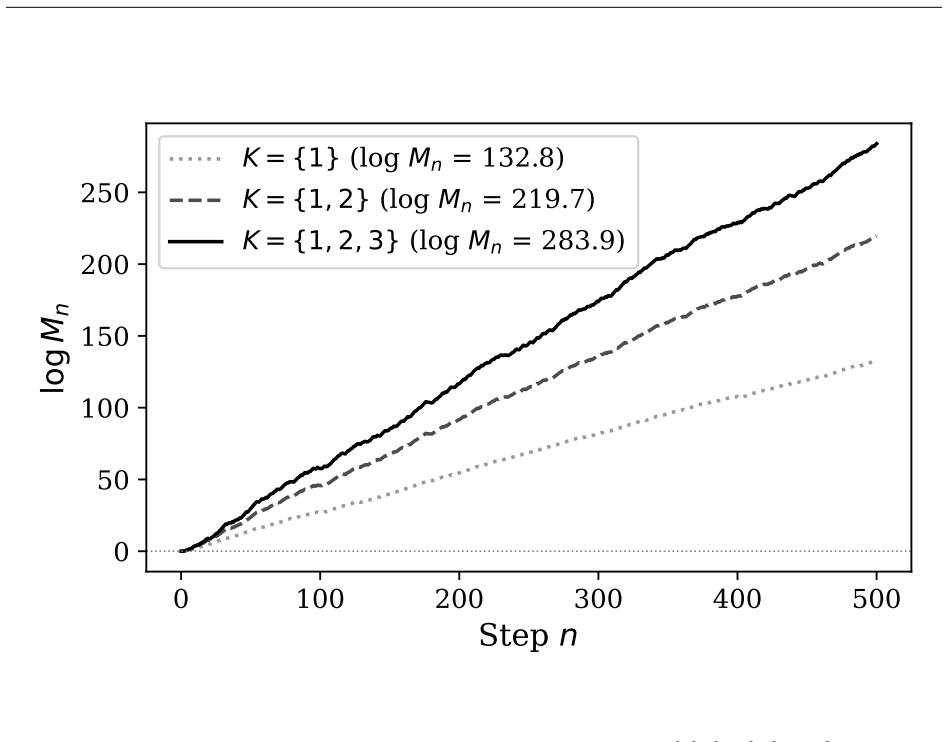
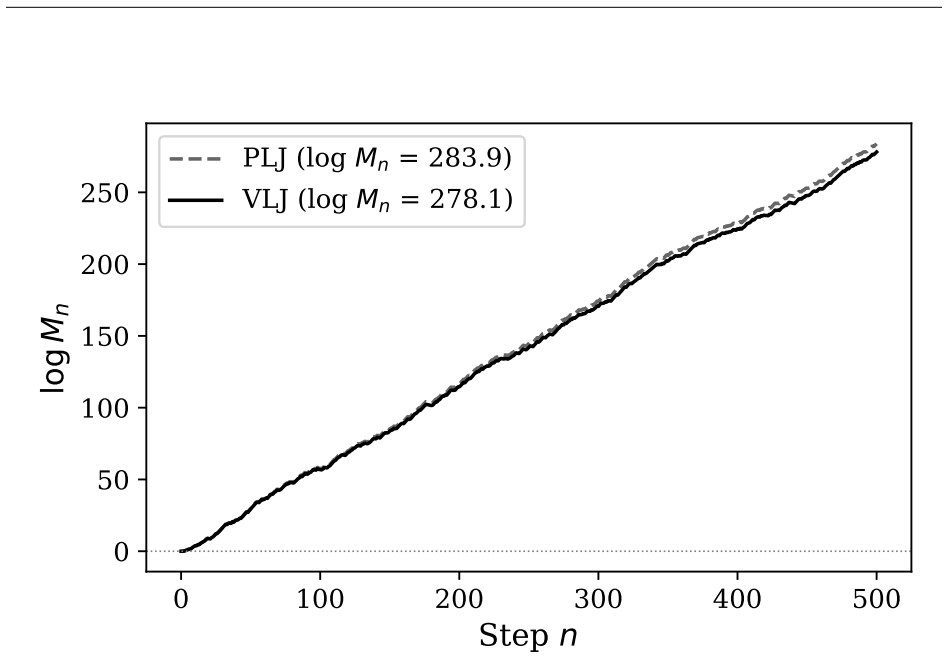
Summary. The paper generalises the Simple Jumper conformal test martingale by replacing its linear betting function with shifted Legendre polynomials. It defines the Simple Legendre Jumper (arbitrary single degree k), the Product Legendre Jumper (product over a set K of degrees, with explicit normalisation Z(ε) for higher-order cross terms), and the Variational Legendre Jumper (mean-field factorisation into independent sub-jumpers whose wealth-weighted consensus parameters are plugged into the product bet). A Composite variant averages over a grid of jumping rates. Validity under exchangeability follows from the integral constraint and predictability; non-negativity of the standard grid E for all degrees is established via |P_k|≤1. Empirical trajectories on synthetic beta alternatives and the Wine Quality dataset (four orderings) show that multi-degree PLJ/VLJ accumulate more capital than single-degree SLJ under multi-moment shifts, that VLJ closely tracks PLJ at linear rather than exponential cost, and that the composite form supplies a wealth floor and automatic rate adaptation.
Significance. If the constructions hold, the work supplies a practical, distribution-free tool for online multi-moment exchangeability testing that removes the Simple Jumper’s restriction to location shifts while remaining computationally feasible. The explicit link to Neyman’s smooth test, the closed-form treatment of Z(ε), the proof that the standard grid is safe for every degree, and the open-source implementation in online-cp are concrete strengths. The variational reduction of the “jumping tax” is a useful engineering contribution even without formal power bounds, and the composite recommendation is immediately usable by practitioners who do not know the shift timescale.
major comments (2)
- Section 9 and the empirical support for VLJ: the paper correctly flags that formal error bounds on the mean-field approximation remain open. The claim of “minimal power loss” (abstract, §5.1) rests on a single UCI stream (Wine Quality, four orderings) plus a handful of synthetic beta mixtures (Figs. 5–7). For |K|≥3 the approximation quality is therefore uncharacterised beyond these examples. Either additional controlled alternatives that isolate higher-order moments, or a quantitative statement of the observed relative log-capital gap, would be needed before VLJ can be presented as a drop-in default without caveat.
- Section 8 / Table 3: only one real-world dataset and a fixed nonconformity measure (1-NN ratio) are used. The hierarchy PLJ/VLJ ≫ SLJ(k=1) ≫ SLJ(k=2,3) may be specific to the red/white wine change-point structure. At least one additional stream (or a synthetic multi-moment change-point with known ground-truth moments) would strengthen the claim that multi-degree betting is systematically superior under realistic distributional shift.
minor comments (4)
- Abstract vs. body: the abstract states “constant time per step”; Algorithm 4 and §5.1 correctly give O(|K|·g). Align the wording.
- Figure 2 caption still reads f^{(1)}_ε while the plot is for k=2; likewise a few “decreses” / “comaratively” typos remain.
- Section 5: the derivation of Z(ε) for |K|≥3 is clear for K={1,2,3,4}, but a short remark on how the lookup table is built for larger K (or a pointer to the package) would help reproducibility.
- Notation: the same symbol E is used both for the ε-grid and for expectation; a brief disambiguation would avoid momentary confusion.
Circularity Check
No significant circularity; all constructions are valid CTMs by orthogonality of shifted Legendre polynomials plus predictability of consensus parameters, with empirical power comparisons measured on held-out orderings rather than fitted inputs.
full rationale
The derivation chain is self-contained and non-circular. Simple Legendre Jumper betting functions 1+εP̃k(p) integrate to 1 by the defining orthogonality ∫P̃k=0 (k≥1) and are non-negative on the standard grid E because |Pk|≤1 on [-1,1] (Section 7, Szegő). Product forms add the explicit finite normalisation Z(ε) whose closed-form Gaunt coefficients are pre-computed; the Markov mixture is the same as Vovk et al.’s Simple Jumper and therefore inherits the martingale property. Variational Legendre Jumper replaces the joint chain by independent marginal sub-jumpers whose wealth-weighted means ε̄k are fully determined before pn, so the product bet fK_ε̄(pn) remains a predictable valid betting function (Algorithm 4 and preceding paragraph). Composite averaging over rates is convexity. Empirical trajectories (Wine Quality orderings, synthetic betas) measure capital growth after the methods are fully specified; no parameter is fitted to the same quantity later called a “prediction.” Self-citations to Vovk supply only the background jumper infrastructure, not load-bearing uniqueness theorems that force the multi-moment claims. The open problem on mean-field error bounds (Section 9) is a limitation of power analysis, not a circularity in the validity argument.
Assumptions & free parameters
free parameters (3)
- ε-grid E = {-1/2,-1/4,0,1/4,1/2}
- jumping rate J (and composite set {10^{-4},...,1})
- degree set K
assumptions (4)
- domain assumption Under exchangeability, conformal p-values are i.i.d. Uniform[0,1] (Vovk et al., Theorem 11.1).
- standard math Ville’s inequality: P(∃n: S_n ≥ C) ≤ 1/C for non-negative martingales with S_0=1.
- standard math Shifted Legendre polynomials are orthogonal on [0,1] with ∫ P̃_k = 0 for k≥1 and |P_k|≤1 on [-1,1].
- ad hoc to paper Mean-field consensus parameters yield a predictable betting function whose product remains a valid CTM.
invented entities (2)
-
Variational Legendre Jumper (mean-field consensus product bet)
-
Jumping tax
Cite this review
Pith. "Pith review of Betting on Moments: Legendre Jumper Martingales for Online Exchangeability Testing." pith.science (2026). https://pith.science/paper/2VLRNQZZ
@misc{pith2026260620859,
  author       = {Pith},
  title        = {Pith review of: Betting on Moments: Legendre Jumper Martingales for Online Exchangeability Testing},
  year         = {2026},
  howpublished = {\url{https://pith.science/paper/2VLRNQZZ}},
  note         = {Machine review of arXiv:2606.20859}
}
read the original abstract
A fundamental assumption in statistics and machine learning is that ``the future looks like the past,'' formalized as exchangeability: the joint data distribution is order-invariant. In practice, this assumption is often violated due to distribution shifts over time. Early detection of exchangeability violations is crucial to prevent performance degradation and enable timely interventions like model retraining. Conformal test martingales offer a flexible, distribution-free framework for sequential exchangeability testing with guaranteed false-alarm rate control by betting against the uniformity of conformal p-values. While alternatives such as plug-in martingales and mixture-based strategies exist, computationally efficient baselines like the Simple Jumper are limited to detecting mean location shifts. We propose a family of conformal test martingales based on shifted Legendre polynomials that extend the Simple Jumper to higher-order moments. The Simple Legendre Jumper replaces linear betting functions with polynomials of arbitrary degree, enabling rapid detection of variance, skewness, and other higher-order deviations. The Product Legendre Jumper combines multiple polynomial degrees into a single betting function but suffers from exponential state-space growth, termed the jumping tax. To resolve this, we introduce the Variational Legendre Jumper, which employs a mean-field approximation to reduce complexity to constant time per step with minimal power loss, providing an expressive, scalable framework for real-time distribution shift monitoring.
Figures


Figures from the paper (6 more)



Reference graph
Works this paper leans on
-
[1]
doi: 10.1080/01621459.2017. 1285773. URLhttps://doi.org/10.1080/01621459.2017.1285773. Henrik Boström.An Investigation of Conformal Test Martingales, pp. 118–143. Springer Nature Switzerland, Cham,
-
[2]
doi: 10.1007/978-3-032-15120-9_7
ISBN 978-3-032-15120-9. doi: 10.1007/978-3-032-15120-9_7. URLhttps://doi.org/10. 1007/978-3-032-15120-9_7. Paulo Cortez, António Cerdeira, Fernando Almeida, Telmo Matos, and José Reis. Modeling wine preferences by data mining from physicochemical properties.Decision Support Systems, 47(4):547–553,
-
[3]
doi: 10.1016/j.dss.2009.05.016. Bruno De Finetti. La prévision: ses lois logiques, ses sources subjectives. InAnnales de l’institut Henri Poincaré, volume 7, pp. 1–68,
-
[4]
ISSN 00029947, 10886850. URLhttp://www. jstor.org/stable/1992999. Teresa Ledwina. Data-driven version of neyman’s smooth test of fit.Journal of the American Statistical Association, 89(427):1000–1005,
-
[5]
John CW Rayner and DJ Best.Smooth tests of goodness of fit
URLhttps://doi.org/10.1080/14786440009463897. John CW Rayner and DJ Best.Smooth tests of goodness of fit. Oxford University Press,
-
[6]
URLhttp://www.jstor.org/stable/2958889
ISSN 00905364, 21688966. URLhttp://www.jstor.org/stable/2958889. Gábor Szegő.Orthogonal polynomials, volume
-
[7]
Vladimir Vovk, Ilia Nouretdinov, and Alexander Gammerman
URLhttps: //arxiv.org/abs/2512.22162. Vladimir Vovk, Ilia Nouretdinov, and Alexander Gammerman. Testing exchangeability on-line.Proceedings of the Twentieth International Conference on Machine Learning (ICML-2003), pp. 768–775,
arXiv 2003
-
[8]
SpringerInternationalPublishing, 12022
VladimirVovk, AlexanderGammerman, andGlennShafer.Algorithmic Learning in a Random World, Second Edition. SpringerInternationalPublishing, 12022. ISBN9783031066498. doi: 10.1007/978-3-031-06649-8/ COVER. Martin J. Wainwright and Michael I. Jordan. Graphical models, exponential families, and variational in- ference.Foundations and Trends in Machine Learning...
Show all 9 references
-
[9]
doi: 10.1561/2200000001
ISSN 1935-8237. doi: 10.1561/2200000001. URLhttps://doi.org/10.1561/2200000001. 18
1935 doi
Reviewed July 14, 2026 · model on record in the stance chip above.
Discussion (0). Continue with ORCID to comment.