REVIEW 1 major objections 5 minor 26 references
For linear systems with affine safety constraints, a single linear feedback law can be both safe and stabilizing exactly when three matrix conditions hold.
Reviewed by Pith at T0; open to challenge. T0 means a machine referee read the full paper against a public rubric. the ladder, T0–T4 →
T0 review · deepseek-v4-flash
2026-08-01 06:37 UTC pith:2WFN3VBG
load-bearing objection Settles the linear-affine HOCBF safe-stabilization problem in closed form; the proof is tight and the scope limits are explicitly stated. the 1 major comments →
Safe Stabilizing Linear Feedback: Necessary and Sufficient Conditions, Optimality, and Margins
The pith
A machine-rendered reading of the paper's core claim, the machinery that carries it, and where it could break.
Core claim
The central result, Theorem 5, establishes that for the linear system ẋ=Ax+Bu with affine HOCBF constraints h_i(x)=c_iᵀx+d_i, there exists a gain K such that u=−Kx globally satisfies all HOCBF constraints and renders the origin globally exponentially stable if and only if: (1) d_i≥0 for each constraint, so the origin lies in every safe set; (2) for every linearly dependent constraint, the row c_iᵀΦ_i(A)−ℓ_iᵀK0 vanishes, a compatibility condition that aligns the constraint with the nominal safe gain; and (3) the pair (Γη, TηᵀBL⊥), equivalently (A−BK0, BL⊥), is stabilizable. Moreover, the set of all such gains is exactly {K=K0+L⊥K̃ : A−BK Hurwitz}. This settles the safe-stabilization problem f
What carries the argument
The carrying tool is the CBF output form, a linear coordinate transformation that treats the high-order barrier functions and their derivatives as output coordinates ψ and the remaining state as internal coordinates η. In these coordinates the closed-loop matrix becomes block-triangular: the ψ-block is the fixed Hurwitz matrix Ψ determined by the chosen class-K slopes α_i,j, while the η-block is Γη−TηᵀBL⊥K̃, freely adjustable through the part of the gain that does not affect the constraints. Stabilizability of (Γη, TηᵀBL⊥) is exactly the condition that this free block can be made Hurwitz, which is equivalent to stabilizability of (A−BK0, BL⊥). The companion decomposition u=Lν+L⊥ũ separates c
Load-bearing premise
The characterization assumes the HOCBF constraints must hold for every state in ℝⁿ, not just on the forward-invariant safe set; this global requirement forces the row-cancellation condition and is the premise on which the clean if-and-only-if rests.
What would settle it
Take a random instance (A,B,c,d,α), compute K0, and test whether (A−BK0, BL⊥) is stabilizable using the usual rank condition; then run a direct pole-placement search over K=K0+L⊥K̃. A single instance where the rank test says stabilizable but no direct search finds a Hurwitz A−BK would contradict Theorem 5. Conversely, an explicit system whose HOCBF constraints are satisfied globally by a linear controller outside the parameterization K0+L⊥K̃ would falsify Proposition 3.
If this is right
- Safe stabilization of linear systems with affine CBFs is decidable by checking d_i≥0, the compatibility equality, and a standard stabilizability rank test on (A−BK0, BL⊥).
- Every safe stabilizing linear controller has the form K0+L⊥K̃ with A−BK Hurwitz, so safety fixes K0 and all remaining design freedom lies in K̃.
- The optimal LQR controller within the safe class comes from one algebraic Riccati equation for the modified pair (A−BK0, BL⊥), with no need for nonlinear filtering.
- A convex LMI with the equality constraint L⊤Y=C̃X synthesizes a safe stabilizing gain with a certified input-sensitivity bound, hence explicit gain and phase margins.
- When m=p, K0 is the only safe linear gain, and it stabilizes the system if and only if the CBF internal dynamics Γη are naturally Hurwitz.
Where Pith is reading between the lines
- The global-satisfaction assumption is the price of the clean characterization; relaxing to constraint satisfaction only on the forward-invariant safe set is the natural next step and would likely enlarge the admissible gain set beyond K0+L⊥K̃.
- The slopes α_i,j appear in K0 and in Φ_i(A), so they reshape the safe gain set and the internal dynamics; Theorem 5 can therefore be read as a design rule for choosing α to meet the compatibility condition.
- For SISO systems the guaranteed margins from the bounded-real condition appear conservative, since the numerical example shows margins well above the certified lower bounds; quantifying this gap is a testable extension.
- The decoupling suggests a separation principle for safe linear design: enforce safety on the constraint-touching subspace, then use the orthogonal subspace for any downstream performance objective.
Editorial analysis
A structured set of objections, weighed in public.
Referee Report
Summary. The paper considers linear systems ẋ=Ax+Bu with affine high-order control barrier function (HOCBF) constraints h_i(x)=c_iᵀx+d_i and studies linear state feedback u=−Kx that globally satisfies all HOCBF constraints while rendering the origin globally exponentially stable. Propositions 2 and 3 characterize the set of gain matrices that globally satisfy the constraints: the constraints force the coefficient vectors c_iᵀΦ_i(A)−ℓ_iᵀK to vanish, leaving an affine family K=K0+L⊥K̃ under conditions d_i≥0 and a compatibility condition for linearly dependent constraint normals. Using a coordinate transformation into CBF output and internal dynamics (Lemma 4, Eq. (9)), Theorem 5 gives necessary and sufficient conditions for the existence of a stabilizing gain within this family, namely stabilizability of (Γη, TηᵀBL⊥) (equivalently (A−BK0, BL⊥)). The paper then formulates the LQR-optimal safe stabilizing controller via a generalized algebraic Riccati equation (Theorem 6) and margin-certified synthesis via an LMI (Proposition 7). A numerical example on roll-yaw aircraft dynamics illustrates the results.
Significance. If the results are correct, the paper settles the safe-stabilization problem for linear systems with affine HOCBF constraints: Problem 1 reduces to checking d_i≥0, a finite compatibility condition, and stabilizability of a derived pair, and the set of all safe stabilizing gains is explicitly parametrized. This is a useful and non-obvious characterization, and the extension to LQR and robust margin-certified design within that set is practically valuable. The proofs are mostly standard but the CBF output/internal dynamics decomposition is elegantly adapted from nonlinear theory. The main theorem is internally sound as far as a direct reading can tell; the principal weakness is in the statement/proof of the LMI result in Proposition 7, which needs correction.
major comments (1)
- [Section V, Proposition 7, Eq. (11a)] The displayed LMI (11a) is not a valid block matrix: the first row has two blocks (AX+XAᵀ−BY−YᵀBᵀ and B−Yᵀ) while the second and third rows have three blocks, so the matrix is not conformable. Moreover, the proof's derivation of (11a) from the bounded-real LMI is not reproducible. With P=X^{-1}/γ (so X=(γP)^{-1}), the congruence with blkdiag(X^{-1},I,I) followed by division by γ yields off-diagonal blocks with 1/γ or 1/γ² factors, not the −γI and I blocks shown. The standard bounded-real synthesis LMI for the sensitivity S_K(s)=I−K(sI−(A−BK))^{-1}B is [AX+XAᵀ−BY−YᵀBᵀ, B, −Yᵀ; Bᵀ, −γI, I; −Y, I, −γI] ≺0 with Y=KX, X≻0. As written, the result cannot be implemented or verified. Please correct the equation and align the proof with the intended LMI.
minor comments (5)
- [Section III.A, proof of Proposition 2] The notation '¯v⊤' is used for a column vector; the choice x=−t¯v is unclear because ¯v⊤ is a row. Use v for the column vector c_iᵀΦ_i(A)−ℓ_iᵀK.
- [Section IV.A, Eq. (9)] The definitions of Γψ, Γη, Γμ and  use ˜C, which was defined for the independent constraints only. It would help to explicitly state that these expressions are evaluated for the independent set, and that dependent constraints are handled through compatibility.
- [Section V, Proposition 7] In Eq. (11b), L and ˜C should be the full stacked matrices for all ¯p constraints (including dependent ones), not just the independent subset used in Section III. Please clarify the notation so that the equivalence with Proposition 3 is unambiguous.
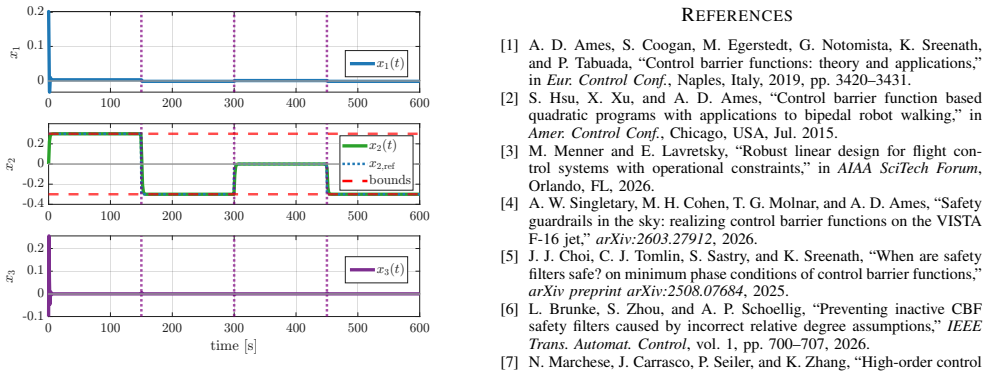
- [Section VI, Figure captions] Minor typos in the captions: 'k=0:50 k=1:00k=1:50 k=2:00' lacks spacing, and '3=0/ 3=20/' should likely be 'α=0/ α=20/' etc. Also, the figures are referenced but not shown in the text; if this is a draft, please ensure figures are embedded.
- [Section II.B, Problem 1] The global-satisfaction assumption is explicit and is the basis for the row-cancellation condition. It might be worth adding a sentence in the conclusions that the results are for global HOCBF satisfaction, and that for mere forward invariance of C̄ the conditions may be relaxed.
Circularity Check
No significant circularity: the main characterization is self-contained and externally grounded.
full rationale
The derivation chain in Theorem 5 does not reduce to its own inputs. Proposition 2's row-cancellation condition follows directly from requiring an affine expression to be nonnegative for all x: if the coefficient vector were nonzero, taking x along that vector would violate the constraint; then d_i >= 0 is forced at x=0. This is a genuine implication of the stated 'for all x in R^n' problem, not an input smuggled in. Proposition 3 merely extends the same argument to dependent constraints via the compatibility condition. Lemma 4 is an application of the standard vector-relative-degree argument from Isidori [13], not a self-citation. The block-triangular form in (10) is derived from the coordinate transformation, and because the Psi-block is Hurwitz, closed-loop stability reduces exactly to stabilizability of (Gamma_eta, T_eta^T B L_perp); the equivalence with (A-BK0, B L_perp) follows from the same invertible coordinate change, so the stabilizability condition is not defined by assuming the conclusion. The ARE and LMI results (Theorem 6, Proposition 7) are standard bounded-real/LQR syntheses applied to the computed safe class. The paper does cite prior work by the same authors, but those citations are motivational or supply simple algebraic formulas that are re-derived in the text; the load-bearing nonstandard steps use external references ([13], [14], [21], [24]) or are proved in the paper. The global-HOCBF assumption is explicit in Problem 1 and affects the strength of the necessary conditions, but that is a scope choice, not circularity. No fitted parameter is relabeled as a prediction, and no uniqueness result from the authors is invoked to force the answer.
Axiom & Free-Parameter Ledger
free parameters (1)
- α_i,j class-K slopes
axioms (5)
- domain assumption The system is linear (5) and the constraints are affine (6), invoked in Section II-B.
- domain assumption Relative-degree well-posedness: each h_i has relative degree r_i and the vectors {ℓ_i} are partitioned into an independent set plus combinations, invoked in Section III-B/Lemma 4.
- standard math Isidori's vector relative degree / input-output linearization facts (Lemma 5.1.1 and the invertible coordinate transformation), invoked in the proof of Lemma 4.
- standard math Strict bounded-real lemma, invoked in the proof of Proposition 7 and attributed to Boyd et al. [24, Sec. 2.7.3].
- standard math Stabilizability of (A_s,B_s) and positive-definiteness of the LQR cost matrix, giving existence/uniqueness of the ARE solution, invoked in Theorem 6.
read the original abstract
Control barrier functions (CBFs) have become an important controller design tool for autonomous systems subject to safety constraints. Despite their popularity, recent works have shown that CBF-based controllers can destabilize the internal dynamics of the system. In this paper, we consider linear systems with affine safety constraints and design linear feedback controllers that satisfy high-order CBF (HOCBF) constraints while rendering the origin globally exponentially stable. We first characterize the exact class of all linear gain matrices that globally satisfy the HOCBF constraints, including necessary and sufficient conditions for when this class is nonempty. Then, by leveraging the recently introduced notion of CBF output dynamics and CBF internal dynamics, we provide the necessary and sufficient conditions for the existence of stabilizing gain matrices within that class. Finally, we show that Linear Quadratic Regulator (LQR) and robust control problems can be solved while being constrained within this class of safe and stabilizing gain matrices, through standard linear control techniques such as algebraic Riccati equations (AREs) and Linear Matrix Inequalities (LMIs). We illustrate our results in a simulation example.
Figures

Reference graph
Works this paper leans on
-
[1]
Control barrier functions: theory and applications,
A. D. Ames, S. Coogan, M. Egerstedt, G. Notomista, K. Sreenath, and P. Tabuada, “Control barrier functions: theory and applications,” inEur. Control Conf., Naples, Italy, 2019, pp. 3420–3431
2019
-
[2]
Control barrier function based quadratic programs with applications to bipedal robot walking,
S. Hsu, X. Xu, and A. D. Ames, “Control barrier function based quadratic programs with applications to bipedal robot walking,” in Amer. Control Conf., Chicago, USA, Jul. 2015
2015
-
[3]
Robust linear design for flight con- trol systems with operational constraints,
M. Menner and E. Lavretsky, “Robust linear design for flight con- trol systems with operational constraints,” inAIAA SciTech Forum, Orlando, FL, 2026
2026
-
[4]
Safety guardrails in the sky: realizing control barrier functions on the VISTA F-16 jet,
A. W. Singletary, M. H. Cohen, T. G. Molnar, and A. D. Ames, “Safety guardrails in the sky: realizing control barrier functions on the VISTA F-16 jet,”arXiv:2603.27912, 2026
arXiv 2026
-
[5]
When are safety filters safe? on minimum phase conditions of control barrier functions,
J. J. Choi, C. J. Tomlin, S. Sastry, and K. Sreenath, “When are safety filters safe? on minimum phase conditions of control barrier functions,” arXiv preprint arXiv:2508.07684, 2025
Pith/arXiv arXiv 2025
-
[6]
Preventing inactive CBF safety filters caused by incorrect relative degree assumptions,
L. Brunke, S. Zhou, and A. P. Schoellig, “Preventing inactive CBF safety filters caused by incorrect relative degree assumptions,”IEEE Trans. Automat. Control, vol. 1, pp. 700–707, 2026
2026
-
[7]
High-order control barrier functions: safety can lead to instability,
N. Marchese, J. Carrasco, P. Seiler, and K. Zhang, “High-order control barrier functions: safety can lead to instability,” inEur. Control Conf., Thessaloniki, Greece, 2025, pp. 2148–2153
2025
-
[8]
Control barrier function-based safety filters: characterization of undesired equilibria, unbounded trajectories, and limit cycles,
P. Mestres, Y . Chen, E. Dall’Anese, and J. Cort ´es, “Control barrier function-based safety filters: characterization of undesired equilibria, unbounded trajectories, and limit cycles,”J. Nonlinear Sci., vol. 36, p. 41, 2026
2026
-
[9]
Dynamical properties of safety filters for linear systems and affine control barrier functions,
P. Mestres, S. S. Mousavi, and A. D. Ames, “Dynamical properties of safety filters for linear systems and affine control barrier functions,” IEEE Control Syst. Lett., vol. 10, pp. 979–984, 2026
2026
-
[10]
Stability analysis in multi-constraint safety filters for linear systems,
S. S. Mousavi, P. Mestres, and A. D. Ames, “Stability analysis in multi-constraint safety filters for linear systems,”arXiv preprint arXiv:2606.15942, 2026
arXiv 2026
-
[11]
Robust and exponential stability in barrier-certified systems via contracting piecewise smooth dynamics,
Z. Marvi, F. Bullo, and A. G. Alleyne, “Robust and exponential stability in barrier-certified systems via contracting piecewise smooth dynamics,”IEEE Control Syst. Lett., vol. 8, pp. 3279–3284, 2024
2024
-
[12]
Stability margins in CBF-QP safety filters: analysis and synthesis,
S. S. Mousavi, P. Mestres, and A. D. Ames, “Stability margins in CBF-QP safety filters: analysis and synthesis,”arXiv preprint arXiv:2604.04234, 2026
Pith/arXiv arXiv 2026
-
[13]
Isidori,Nonlinear Control Systems, 3rd ed., ser
A. Isidori,Nonlinear Control Systems, 3rd ed., ser. Communications and Control Engineering Series. Springer, 1995
1995
-
[14]
High-order control barrier functions,
W. Xiao and C. Belta, “High-order control barrier functions,”IEEE Trans. Automat. Control, vol. 67, no. 7, pp. 3655–3662, 2022
2022
-
[15]
Control barrier function- based quadratic programs introduce undesirable asymptotically stable equilibria,
M. F. Reis, A. P. Aguilar, and P. Tabuada, “Control barrier function- based quadratic programs introduce undesirable asymptotically stable equilibria,”IEEE Control Syst. Lett., vol. 5, no. 2, pp. 731–736, 2021
2021
-
[16]
High-order barrier functions: robustness, safety and performance-critical control,
X. Tan, W. S. Cortez, and D. V . Dimarogonas, “High-order barrier functions: robustness, safety and performance-critical control,”IEEE Trans. Automat. Control, vol. 67, no. 6, pp. 3021–3028, 2022
2022
-
[17]
Input-to-state safety with control barrier functions,
S. Kolathaya and A. D. Ames, “Input-to-state safety with control barrier functions,”IEEE Control Syst. Lett., vol. 3, no. 1, pp. 108– 113, 2019
2019
-
[18]
Skogestad and I
S. Skogestad and I. Postlethwaite,Multivariable Feedback Control Analysis and Design, 2nd ed. Wiley, 2005
2005
-
[19]
Robustness results in linear-quadratic Gaussian based multivariable control designs,
N. Lehtomaki, N. Sandell, and M. Athans, “Robustness results in linear-quadratic Gaussian based multivariable control designs,”IEEE Trans. Automat. Control, vol. 26, pp. 75–93, 1981
1981
-
[20]
R. A. Horn and C. R. Johnson,Matrix Analysis. New York, USA: Cambridge University Press, 2012
2012
-
[21]
Controllability and stabilizability of a class of continuous piecewise affine dynamical systems,
L. Q. Thuan and M. K. Camlibel, “Controllability and stabilizability of a class of continuous piecewise affine dynamical systems,”SIAM Journal on Control and Optimization, vol. 52, pp. 1914–1934, 2014
1914
-
[22]
B. D. O. Anderson and J. B. Moore,Optimal control: linear quadratic methods, 4th ed. Dover Publications, 1990
1990
-
[23]
K. Zhou, J. Doyle, and K. Glover,Robust and Optimal Control. Englewood Cliffs, NJ: Prentice Hall, 1995
1995
-
[24]
S. Boyd, L. E. Ghaoui, E. Feron, and V . Balakrishnan,Linear Matrix Inequalities in System and Control Theory, ser. Studies in Applied Mathematics. Philadelphia, Pennsylvania: SIAM, 1994, vol. 15
1994
-
[25]
Lavretsky and K
E. Lavretsky and K. A. Wise,Robust and Adaptive Control with Aerospace Applications. Springer, 2024
2024
-
[26]
Explicit control barrier function-based safety filters and their resource-aware computation,
P. Mestres, S. S. Mousavi, P. Ong, L. Yang, E. Das, J. W. Burdick, and A. D. Ames, “Explicit control barrier function-based safety filters and their resource-aware computation,”IFAC World Congress, 2026, to appear
2026
discussion (0)
Sign in with ORCID, Apple, or X to comment. Anyone can read and Pith papers without signing in.