REVIEW 5 major objections 5 minor 37 references
Enhancing Multi-view Open-set Learning via Ambiguity Uncertainty Calibration and View-wise Debiasing
T0 review · 5 major / 5 minor · reviewed 2026-08-06 · deepseek-v4-flash
Pith's one-line read A multi-view open-set training framework, MOCD, combines O-Mix ambiguity synthesis with HSIC debiasing to detect unknown classes while preserving known-class accuracy.
desk verdict A plausible method with a promising empirical setup, but the core soft-label equation is inconsistent and the ablation undercuts the "consistently improves" claim; worth sending to a serious referee, not citing yet. read the letter →
The pith
A machine-rendered reading of the paper's core claim, the machinery that carries it, and where it could break.
The reading
What carries the argument
The load-bearing mechanism is the O-Mix synthesis procedure combined with a statistical-independence regularizer. For a mixed sample, O-Mix defines masses on the focal elements $\{y_i\}$, $\{y_j\}$, $\{y_i,y_j\}$, and $\emptyset$, where $\emptyset$ represents uncertainty beyond the known class frame; entropy maximization fixes the ambiguous and unknown masses to be equal, $m(\{y_i,y_j\}) = m(\emptyset) = u/2$, with $u = c(1-|\lambda - 0.5|)$ growing as the Mixup coefficient nears $0.5$. These calibrated soft labels supervise an auxiliary branch, while the HSIC criterion $\mathrm{HSIC}(Z, \tilde{H}^v)$ penalizes dependence between the fused representation and each view's ambiguous features, removing the channel through which view-specific biases leak into the final prediction.
What would settle it
Hold out unknown classes that are semantically distant from the known classes and rerun the benchmark: if the O-Mix gain over vanilla Mixup vanishes or reverses, the synthetic ambiguity distribution is not representative of real unknowns. A more direct check is to compute the maximum mean discrepancy between the Ambiguity Perception Network features on O-Mix samples and the fused-representation features on genuine unknown test samples; a large discrepancy at the low false-positive thresholds where gains are claimed would contradict the calibration assumption.
Extended reading notes
Core claim
The central claim is that poor open-set behavior in multi-view learning comes from two fixable defects: models never see ambiguous examples during training, and they memorize static view-label correlations that do not generalize to unknown categories. MOCD attacks both simultaneously. O-Mix creates virtual samples by interpolating two known-class examples and distributing the resulting class mass, via Generalized Basic Probability Assignment, among the two source classes, an ambiguous subset, and an unknown mass, with the split chosen by maximum entropy and an adaptive budget tied to the Mixup coefficient. An auxiliary Ambiguity Perception Network learns from these samples, and an HSIC contrastive loss drives the fused multi-view representation toward statistical independence from the view-specific ambiguous features. The experiments are offered as evidence that this joint training separates known from unknown classes at inference while preserving closed-set classification performance.
Load-bearing premise
The method rests on the assumption that linearly interpolated known-class samples, labeled with a hand-designed split of ambiguity and unknown mass, behave enough like the real unknown and ambiguous inputs encountered at test time to transfer their training-time benefit.
Editorial extensions
If this is right
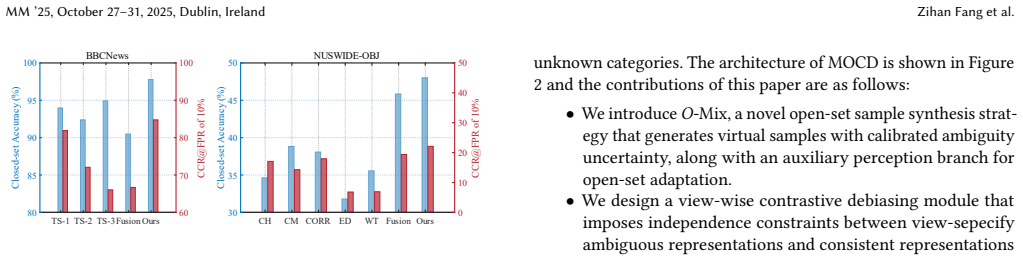
- The O-Mix component can be attached to existing multi-view encoders; the plug-in experiment shows it improves unknown-class rejection at the lowest false-positive thresholds without degrading closed-set accuracy.
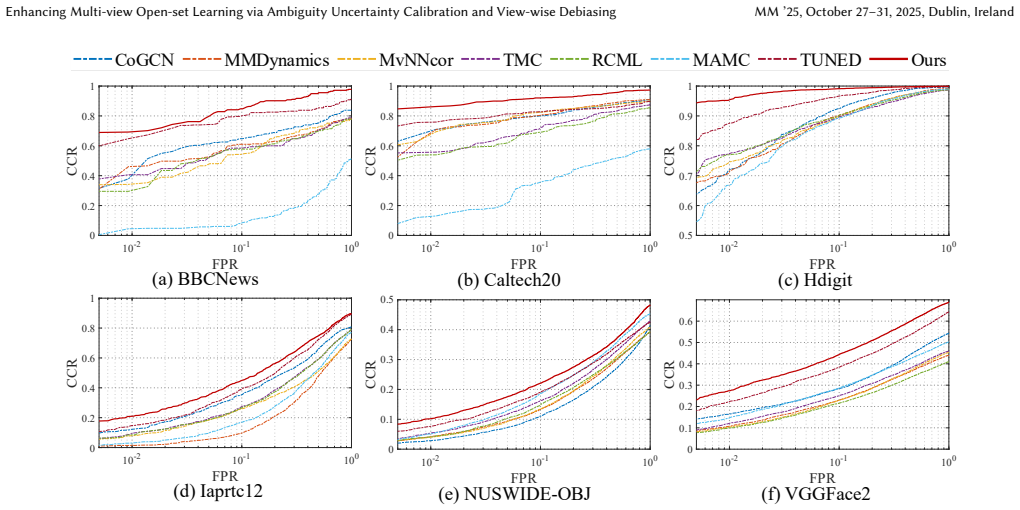
- The main gains sit in the low-FPR regime, which is exactly the operating range where a model must refuse unknown inputs rather than merely rank them.
- Because the debiasing term is an independence penalty, the approach does not need to enumerate or predefine the directions of view-induced bias.
- The openness study indicates the improvement persists as the fraction of unknown classes grows, so the mechanism is not specialized to a single open-set difficulty level.
Reading between the lines
- The entropy-maximizing rule sets ambiguous and unknown masses equal regardless of the views involved; a testable extension would let that split depend on cross-view disagreement, since conflicting views may carry more unknownness than the Mixup coefficient alone.
- An HSIC penalty removes all statistical dependence between fused and ambiguous features, so if a view's true class signal overlaps with its static bias, the method could discard useful information; measuring known-class accuracy on tasks with view-localized discriminative cues would reveal that trade-off.
- The surrogate-to-real transfer assumption can be checked directly: compare the feature distribution of O-Mix virtual samples with the distribution of held-out real unknown samples; if they diverge at the thresholds where gains are reported, the training-time calibration does not explain the inference-time improvement.
Editorial analysis
A structured set of objections, weighed in public.
Referee Report
Summary. The paper proposes MOCD, a multi-view open-set recognition framework built from three components: a Multi-view Semantic Alignment Network (MSAN) that fuses view-specific representations, an O-Mix synthesis strategy that generates virtual ambiguous samples with Dempster-Shafer / Generalized BPA uncertainty, and an HSIC-based contrastive debiasing loss that encourages independence between the fused representation and view-specific ambiguous features. Experiments on six multi-view datasets evaluate open-set performance through OSCR-style CCR-versus-FPR curves under an openness of 0.1, and the headline result is improved unknown-class detection, e.g., VGGFace2 CCR@FPR=1% rises to 27.40 from the best baseline value of 15.36, while closed-set accuracy is largely preserved. The paper also reports ablations, parameter sensitivity, compatibility with existing methods, and t-SNE visualizations.
Significance. If the technical inconsistencies are resolved, the empirical gains at low FPR on several datasets are practically interesting, and the combination of DS-theory uncertainty calibration with mixup-style synthesis is a reasonable direction for multi-view open-set learning. The paper ships source code, uses the standard OSCR protocol, and provides t-SNE and openness analyses, all of which help reproducibility and comparability. However, the significance is currently tempered by the absence of the direct multi-view open-set baseline OpenViewer, by an internal inconsistency between the soft-label definition and the perception loss, and by an ablation table that does not support the 'consistently enhances' claim.
major comments (5)
- [Section 3.2.1, Eq. (11) vs. Eq. (15)] The soft-label definition in Eq. (11) is not a probability distribution and is inconsistent with the loss in Eq. (15). Using the masses from Eq. (10) with a=u/2, the total weight of the label terms in Eq. (11) is (1-u) + u/2 + u^2/2 if '1' denotes the uniform distribution over known classes, or (1-u) + u/2 + K·u^2/2 if '1' denotes the all-ones vector; in either case the weights sum to something other than 1. Eq. (15) instead uses u/2 as the coefficient of the uniform term, i.e., it drops one factor of u. The two equations cannot both define the same training objective; please correct Eq. (11) or reconcile the notation so that the soft label is a valid distribution.
- [Section 4.4.1, Table 3] The ablation table contradicts the text's claim of consistent improvement. Replacing vanilla Mixup with O-Mix decreases CCR@FPR=10% on BBCNews (70.34 to 69.49), Caltech20 (86.64 to 84.54), and VGGFace2 (46.41 to 45.57), with improvements only on Hdigit, Iaprtc12, and NUSWIDE-OBJ. No standard deviations are reported, so even the improving cases may not be significant. The sentence in Section 4.4.1 that 'the improvement over vanilla Mixup further validates the importance of explicitly modeling uncertainty' is not supported by the table as presented. This ablation also does not isolate the HSIC debiasing loss, so the contribution of one of the two named components is left unverified.
- [Section 4.1.1 and Table 1] The only prior method specifically designed for multi-view open-set learning, OpenViewer [7], is cited but never included in the comparison. The seven reported baselines are closed-set multi-view classifiers adapted to open-set evaluation. Without OpenViewer, Table 1 does not establish that MOCD exceeds the state of the art for the exact task addressed, and the phrase 'consistently enhances unknown-class recognition' cannot be evaluated against the most relevant competitor. Please add this baseline and discuss the comparison.
- [Section 3.2.2 and Section 4.1.3] The adaptive uncertainty formula u = c·(1-|λ-0.5|) depends on a scaling factor c in [0,1], but the paper never reports the value of c used in the experiments, nor its sensitivity. This hyperparameter directly controls the uncertainty calibration of O-Mix, and without a reported value the experiments are not fully reproducible. Please specify the default c, the range tested, and, ideally, the distribution of u values actually induced during training.
- [Section 3.3 and Table 3] The view-wise debiasing claim is not directly evaluated. Table 3 compares only h_v, g_v, vanilla Mixup, and O-Mix; it does not include a row that disables the HSIC contrastive debiasing loss (e.g., β=0). Since the paper's title and contributions emphasize view-wise debiasing, the absence of an on/off ablation for this module is a load-bearing omission. The parameter analysis in Figure 5(a) shows robustness to α and β in a range, but it is not a substitute for a direct comparison of the full model with and without the HSIC term.
minor comments (5)
- [Section 4.3.1 heading] The heading 'Impact of Penalty Xoefficients' contains a typo; it should read 'Impact of Penalty Coefficients'.
- [Contributions, page 2] The second contribution bullet contains the typo 'view-sepecify'; it should be 'view-specific'.
- [Abstract and page 1] The sentence 'The source code are available' should be 'The source code is available'.
- [Eq. (11)] The symbol '1' is used to denote a uniform distribution over known classes, but this notation is nonstandard; please define it explicitly, e.g., as the vector (1/K, ..., 1/K) or by writing the entropy-regularized soft label in full.
- [Section 4.1.3] The values of the loss coefficients are stated as α=1 and β=1, but it would be helpful to report the exact grid searched in Figure 5(a) and the selected values for all datasets, especially since the text says the auxiliary loss is robust while the debiasing term may suppress discriminative cues.
Circularity Check
No significant circularity: O-Mix labels are construction choices, and OSCR results use held-out unknowns.
full rationale
The paper's derivation is self-contained with respect to the held-out OSCR evaluation. O-Mix soft labels (Eqs. 8-13) are constructed from the mixing coefficient lambda via GBPA mass assignments and a maximum-entropy allocation a=u/2; these are design choices, not parameters fitted to unknown-class test data. The adaptive uncertainty u=c(1-|lambda-0.5|) is likewise a defined schedule. The HSIC loss (Eq. 16) enforces independence between z and APN features by definition, and the OSCR metric (Eq. 19) is computed on held-out unknown classes not used in training. No prediction reported in Tables 1 or 3 reduces by construction to a fitted input. The self-citation [7] (OpenViewer) has overlapping authors, but it is used only as contextual motivation, not as load-bearing evidence or as a uniqueness theorem, and the paper's central contribution is evaluated against external baselines. Incompleteness concerns (OpenViewer absent from Table 1, c unspecified, the Eq. 11 vs Eq. 15 weight inconsistency, O-Mix below Mixup in some ablations) are empirical/correctness issues, not circularity.
Assumptions & free parameters
free parameters (4)
- c (uncertainty scaling factor)
- γ (balance factor) =
0.7
- α, β (loss penalty coefficients) =
α=1, β=1
- τ (Beta distribution shape) =
1
assumptions (4)
- domain assumption GBPA with an unknown focal element ∅ is an appropriate model for open-set uncertainty in multi-view mixing.
- ad hoc to paper Uniformly distributing the unknown mass over known classes (the m(∅)·u·1 term in Eq. (11)) is a valid way to represent open-set uncertainty.
- ad hoc to paper The adaptive uncertainty u = c*(1 - |λ - 0.5|) maps the Mixup coefficient to an appropriate uncertainty level.
- domain assumption Linearly interpolating multi-view feature vectors yields semantically meaningful ambiguous samples.
Cite this review
Pith. "Pith review of Enhancing Multi-view Open-set Learning via Ambiguity Uncertainty Calibration and View-wise Debiasing." pith.science (2026). https://pith.science/paper/2WG5IFBZ
@misc{pith2026250801227,
  author       = {Pith},
  title        = {Pith review of: Enhancing Multi-view Open-set Learning via Ambiguity Uncertainty Calibration and View-wise Debiasing},
  year         = {2026},
  howpublished = {\url{https://pith.science/paper/2WG5IFBZ}},
  note         = {Machine review of arXiv:2508.01227}
}
read the original abstract
Existing multi-view learning models struggle in open-set scenarios due to their implicit assumption of class completeness. Moreover, static view-induced biases, which arise from spurious view-label associations formed during training, further degrade their ability to recognize unknown categories. In this paper, we propose a multi-view open-set learning framework via ambiguity uncertainty calibration and view-wise debiasing. To simulate ambiguous samples, we design O-Mix, a novel synthesis strategy to generate virtual samples with calibrated open-set ambiguity uncertainty. These samples are further processed by an auxiliary ambiguity perception network that captures atypical patterns for improved open-set adaptation. Furthermore, we incorporate an HSIC-based contrastive debiasing module that enforces independence between view-specific ambiguous and view-consistent representations, encouraging the model to learn generalizable features. Extensive experiments on diverse multi-view benchmarks demonstrate that the proposed framework consistently enhances unknown-class recognition while preserving strong closed-set performance.
Figures

Figures from the paper (3 more)


Reference graph
Works this paper leans on
-
[7]
Shide Du, Zihan Fang, Yanchao Tan, Changwei Wang, Shiping Wang, and Wen- zhong Guo. 2025. OpenViewer: Openness-Aware Multi-View Learning. In Pro- ceedings of the AAAI Conference on Artificial Intelligence . 16389–16397
work page 2025
-
[1]
Qingsen Bao, Lei Chen, Feng Zhang, Jun Wang, and Changqing Zhang. 2024. Causal evidence learning for trusted open set recognition under covariate shift. IEEE Transactions on Circuits and Systems for Video Technology 34, 12 (2024), 13085–13098
work page 2024
-
[2]
Wentao Bao, Qi Yu, and Yu Kong. 2021. Evidential deep learning for open set action recognition. In Proceedings of the IEEE/CVF International Conference on Computer Vision. 13349–13358
work page 2021
-
[3]
Man-Sheng Chen, Tuo Liu, Chang-Dong Wang, Dong Huang, and Jian-Huang Lai. 2022. Adaptively-weighted integral space for fast multiview clustering. In Proceedings of the ACM International Conference on Multimedia . 3774–3782
work page 2022
-
[4]
Man-Sheng Chen, Chang-Dong Wang, Dong Huang, Jian-Huang Lai, and Philip S. Yu. 2024. Concept factorization based multiview clustering for large-scale data. IEEE Transactions on Knowledge and Data Engineering 36, 11 (2024), 5784–5796
work page 2024
-
[5]
Yong Deng. 2015. Generalized evidence theory. Applied Intelligence 43, 3 (2015), 530–543
work page 2015
-
[6]
Akshay Raj Dhamija, Manuel Günther, and Terrance Boult. 2018. Reducing network agnostophobia. Advances in Neural Information Processing Systems 31
work page 2018
-
[8]
Arthur Gretton, Olivier Bousquet, Alexander J. Smola, and Bernhard Schölkopf
Show all 37 references
-
[9]
Zongbo Han, Zhipeng Liang, Fan Yang, Liu Liu, Lanqing Li, Yatao Bian, Peilin Zhao, Bingzhe Wu, Changqing Zhang, and Jianhua Yao. 2022. Umix: Improving importance weighting for subpopulation shift via uncertainty-aware mixup. Advances in Neural Information Processing Systems 35...
2022
-
[10]
Zongbo Han, Fan Yang, Junzhou Huang, Changqing Zhang, and Jianhua Yao
-
[11]
Zongbo Han, Changqing Zhang, Huazhu Fu, and Joey Tianyi Zhou. 2021. Trusted multi-view classification. In International Conference on Learning Representations . 1–11
2021
-
[12]
Haojian Huang, Chuanyu Qin, Zhe Liu, Kaijing Ma, Jin Chen, Han Fang, Chao Ban, Hao Sun, and Zhongjiang He. 2025. Trusted unified feature-neighborhood dynamics for multi-view classification. In Proceedings of the AAAI Conference on Artificial Intelligence. 17413–17421
2025
-
[13]
Jiaqi Jin, Siwei Wang, Zhibin Dong, Xinwang Liu, and En Zhu. 2023. Deep incomplete multi-view clustering with cross-view partial sample and prototype alignment. In Proceedings of the IEEE Conference on Computer Vision and Pattern Recognition. 11600–11609
2023
-
[14]
Guanzhou Ke, Yang Yu, Guoqing Chao, Xiaoli Wang, Chenyang Xu, and Shengfeng He. 2023. Disentangling multi-view representations beyond inductive bias. In Proceedings of the ACM International Conference on Multimedia . 2582– 2590
2023
-
[15]
Thomas N Kipf and Max Welling. 2017. Semi-supervised classification with graph convolutional networks. In International Conference on Learning Representations . 1–14
2017
-
[16]
Zhiqiang Kou, Jing Wang, Yuheng Jia, and Xin Geng. 2024. Inaccurate Label Dis- tribution Learning. IEEE Transactions on Circuits and Systems for Video Technology 34, 10 (2024), 10237–10249
2024
-
[17]
Shu Li, Wen-Tao Li, and Wei Wang. 2025. Co-GCN for multi-view semi-supervised learning. In Proceedings of the AAAI Conference on Artificial Intelligence , Vol. 34. 4691–4698
2025
-
[18]
Xinyan Liang, Pinhan Fu, Yuhua Qian, Qian Guo, and Guoqing Liu. 2025. Trusted multi-View classification via evolutionary multi-view fusion. In International Conference on Learning Representations . 1–14
2025
-
[19]
Yuena Lin, Yiyuan Wang, Gengyu Lyu, Yongjian Deng, Haichun Cai, Huibin Lin, Haobo Wang, and Zhen Yang. 2025. Enhance multi-view classification through multi-scale alignment and expanded boundary. In Proceedings of the Thirteenth International Conference on Learning Representat...
2025
-
[20]
Suyuan Liu, Junpu Zhang, Yi Wen, Xihong Yang, Siwei Wang, Yi Zhang, En Zhu, Chang Tang, Long Zhao, and Xinwang Liu. 2024. Sample-level cross-view similarity learning for incomplete multi-view clustering. In Proceedings of the AAAI Conference on Artificial Intelligence . 14017–14025
2024
-
[21]
Renqiang Luo, Huafei Huang, Shuo Yu, Zhuoyang Han, Estrid He, Xiuzhen Zhang, and Feng Xia. 2024. FUGNN: Harmonizing Fairness and Utility Graph Neural Networks. In Proceedings of the ACM SIGKDD International Conference on Knowledge Discovery and Data Mining . 2072–2081
2024
-
[22]
Gengyu Lyu, Weiqi Kang, Haobo Wang, Zheng Li, Zhen Yang, and Songhe Feng
-
[23]
Feiping Nie, Xiaoqian Wang, and Heng Huang. 2014. Clustering and projected clustering with adaptive neighbors. In Proceedings of the ACM SIGKDD Interna- tional Conference on Knowledge Discovery and Data Mining . 977–986
2014
-
[24]
Kari Sentz and Scott Ferson. 2002. Combination of evidence in Dempster-Shafer theory. (2002)
2002
-
[25]
Binyi Su, Hua Zhang, and Zhong Zhou. 2023. HSIC-based moving weight averag- ing for few-shot open-set object detection. InProceedings of the ACM International Conference on Multimedia. 5358–5369
2023
-
[26]
Qianqian Wang, Zhiqiang Tao, Wei Xia, Quanxue Gao, Xiaochun Cao, and Licheng Jiao. 2023. Adversarial multiview clustering networks with adaptive fusion. IEEE Transactions on Neural Networks and Learning Systems 34 (2023), 7635–7647
2023
-
[27]
Xinxin Wang, Yongshan Zhang, and Yicong Zhou. 2025. Bidirectional Probabilis- tic Multi-Graph Learning and Decomposition for Multi-View Clustering. IEEE Transactions on Image Processing 34 (2025), 3609–3621
2025
-
[28]
Yi Wen, Siwei Wang, Ke Liang, Weixuan Liang, Xinhang Wan, Xinwang Liu, Suyuan Liu, Jiyuan Liu, and En Zhu. 2023. Scalable incomplete multi-view clustering with structure alignment. In Proceedings of the ACM International Conference on Multimedia. 3031–3040
2023
-
[29]
Cai Xu, Jiajun Si, Ziyu Guan, Wei Zhao, Yue Wu, and Xiyue Gao. 2024. Reliable conflictive multi-view learning. InProceedings of the AAAI Conference on Artificial Intelligence. 16129–16137
2024
-
[30]
Jinglin Xu, Wenbin Li, Xinwang Liu, Dingwen Zhang, Ji Liu, and Junwei Han
-
[31]
Zhi Zeng, Minnan Luo, Xiangzheng Kong, Huan Liu, Hao Guo, Hao Yang, Zihan Ma, and Xiang Zhao. 2024. Mitigating world biases: A multimodal multi-view debiasing framework for fake news video detection. In Proceedings of the ACM International Conference on Multimedia . 6492–6500
2024
-
[32]
Zhuo Zhang, Hongfei Wang, Jie Geng, Xinyang Deng, and Wen Jiang. 2023. A new data augmentation method based on mixup and dempster-shafer theory. IEEE Transactions on Multimedia 26 (2023), 4998–5013
2023
-
[33]
Fei Zhu, Zhen Cheng, Xu-Yao Zhang, and Cheng-Lin Liu. 2023. Openmix: Explor- ing outlier samples for misclassification detection. In Proceedings of the IEEE/CVF Conference on Computer Vision and Pattern Recognition . 12074–12083
2023
-
[2005]
In Algo- rithmic Learning Theory (Lecture Notes in Computer Science)
Measuring Statistical Dependence with Hilbert-Schmidt Norms. In Algo- rithmic Learning Theory (Lecture Notes in Computer Science) . 63–77
-
[2020]
In Proceedings of the AAAI Conference on Artificial Intelligence
Deep embedded complementary and interactive information for multi- view classification. In Proceedings of the AAAI Conference on Artificial Intelligence . 6494–6501
-
[2022]
In Proceedings of the IEEE/CVF Conference on Computer Vision and Pattern Recognition
Multimodal dynamics: Dynamical fusion for trustworthy multimodal classification. In Proceedings of the IEEE/CVF Conference on Computer Vision and Pattern Recognition. 20707–20717
-
[2024]
In Proceedings of the International Joint Conference on Artificial Intelligence
Common-individual semantic fusion for multi-view multi-label learning. In Proceedings of the International Joint Conference on Artificial Intelligence . 4715– 4723
Reviewed August 6, 2026 · model on record in the stance chip above.
Discussion (0). Sign in to comment.