REVIEW 2 major objections 4 minor 67 references
Nonlinear electrodynamics creates forbidden regions that reverse free-fall before tidal forces can diverge in multi-horizon black holes.
Reviewed by Pith at T0; open to challenge. T0 means a machine referee read the full paper against a public rubric. the ladder, T0–T4 →
T0 review · grok-4.5
2026-07-11 15:54 UTC pith:2WSPAO5D
load-bearing objection Solid classical-GR calculation on Gao multi-horizon NED metrics: multiple tidal zeros, exterior forbidden regions for radial free-fallers, and a clean critical-charge hierarchy; scope is narrow but the math holds. the 2 major comments →
Beyond the Bounce: Multiple Tidal Sign Reversals and Turning-Point Bifurcations in Multi-Horizon Black Holes
The pith
A machine-rendered reading of the paper's core claim, the machinery that carries it, and where it could break.
Core claim
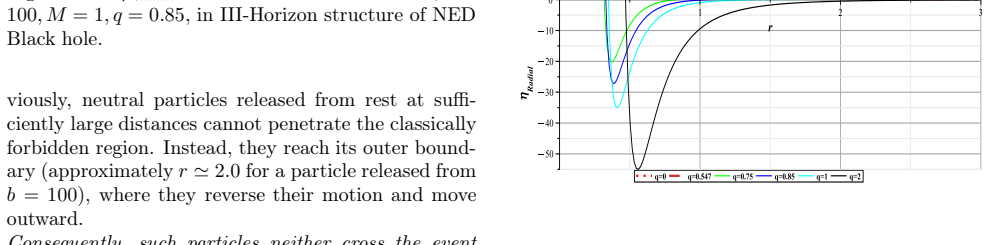
For neutral particles released from rest at large fixed radius in the three- and four-horizon NED black-hole solutions, the radial equation of motion develops classically forbidden regions bounded by bounce-back points. These regions prevent the particles from entering the spacetime domain in which the radial and angular tidal forces diverge. The same solutions admit a super-extremal regime in which the forbidden region can extend outside the event horizon. Critical charge values at which tidal-force zeros, additional horizons, and bounce-back points appear satisfy the hierarchical ordering q_rad < q_ang < q_H < q_TP for both the three- and four-horizon families.
What carries the argument
The radial energy equation (dr/dτ)^{2} = f(b) − f(r) together with the tidal eigenvalues η_radial = −½ f''(r) and η_angular = −f'(r)/(2r). Non-monotonicity of the NED-corrected metric function f(r) produces extra real roots that define both the bounce-back points and the multiple zero-crossings of the tidal components.
Load-bearing premise
Every dynamical conclusion is drawn only for neutral particles that fall radially from rest at one fixed large starting radius; the paper does not show that the forbidden-region barrier or the charge hierarchy survive for spinning, charged, or non-radial trajectories.
What would settle it
Compute the radial effective potential for the same NED metrics with nonzero angular momentum L and check whether a forbidden interval still appears that keeps an infalling particle outside the divergent-tidal domain for the same charge windows reported in Tables 1 and 2.
Editorial analysis
A structured set of objections, weighed in public.
Referee Report
Summary. The paper studies radial free-fall of neutral test particles and the associated tidal forces in the three- and four-horizon black-hole solutions of Einstein gravity coupled to nonlinear electrodynamics constructed by Gao. Using the standard radial equation (dr/d au)^{2} = f(b) − f(r) and the tidal eigenvalues η_radial = −½f″, η_angular = −f′/(2r), the authors show that the higher-order inverse-power terms in the metric functions produce multiple zero crossings of both tidal components and, above critical charges, classically forbidden intervals bounded by bounce-back points. For the restricted class of trajectories released from rest at fixed large b, these forbidden regions prevent the particle from reaching the domain where the tidal forces diverge; in a super-extremal window the outer turning point can even lie outside the event horizon. Numerical root-finding further reveals a hierarchical ordering of the critical charges at which radial zeros, angular zeros, additional horizons and turning points successively appear (q_rad < q_ang < q_H < q_TP). The results are presented for representative values of the NED couplings and are summarized in two extensive tables.
Significance. If the reported hierarchy and the protective role of the forbidden regions survive under modest generalizations of the initial conditions, the work supplies a concrete, observationally relevant signature that distinguishes multi-horizon NED geometries from both Schwarzschild and Reissner–Nordström spacetimes. The explicit demonstration that a classical singularity can remain kinematically inaccessible without being removed is of independent theoretical interest. The calculations themselves are standard and transparent; the numerical tables are internally consistent and the metric functions match the cited construction. The principal limitation is the restriction to a single, highly symmetric class of trajectories, which the authors repeatedly flag.
major comments (2)
- All dynamical conclusions (forbidden-region barrier, avoidance of divergent tides, super-extremal non-capture, and the hierarchy of Eq. (26)) rest exclusively on neutral radial free-fall from rest at fixed b = 100 M (Eq. (9) and Secs. 4.2–4.3, 5.1–5.2). The paper does not demonstrate that the same qualitative features persist for nonzero angular momentum, nonzero initial radial velocity, or charged test particles. While the restriction is repeatedly acknowledged, a short exploration of at least one neighboring class of trajectories (e.g., small L or E > √f(b)) would substantially strengthen the central claim that the NED field generically protects against divergent tides.
- The hierarchical ordering q_rad < q_ang < q_H < q_TP is established only for two fixed sets of NED couplings (α₂ = −0.004 for three horizons; α₂ = −0.0004, α₃ = 6.38736 × 10⁻⁷ for four horizons). Tables 1–2 therefore leave open whether the ordering is robust under variation of the free parameters. A brief scan over a modest range of α_i would clarify whether the sequence is a structural feature of the multi-horizon NED family or an artifact of the chosen numerical values.
minor comments (4)
- Several figure captions contain typographical inconsistencies (e.g., “r·2 function”, “VI-Horizon” instead of “IV-Horizon”, and repeated “ηRadial” labels on angular-force plots). These should be corrected for clarity.
- The geodesic-deviation solutions (21)–(22) and (24)–(25) are written but never used or plotted; either a short discussion of their physical content or their removal would improve focus.
- The phrase “preventing spaghettification” appears in the abstract and discussion; given the trajectory restriction it should be qualified more carefully (e.g., “along the trajectories considered here”).
- Self-citations [51–66] occupy a large fraction of the reference list; a few additional independent works on multi-horizon NED or tidal forces in regular black holes would better situate the contribution.
Circularity Check
No significant circularity: hierarchy and forbidden-region claims are numerical outputs of standard root-finding on external metrics, not inputs or self-fitted predictions.
full rationale
The derivation chain is self-contained and non-circular. Metric functions (17) and (23) are taken from the external reference Gao [67]; the tidal eigenvalues (7)–(8) and radial equation (9) are textbook projections of the Riemann tensor and Killing energy for the static spherical line element. Critical charges q_rad, q_ang, q_H, q_TP listed in Tables 1–2 and ordered in (26) are obtained by numerical root-finding on f(r)=0, f'(r)=0, f''(r)=0 and f(b)-f(r)=0 for fixed α_i, M, b=100; they are not fitted parameters that are later re-labeled as predictions. Self-citations [51–66] concern unrelated thermodynamic or WGC topics of the same group and are never invoked as premises for the tidal hierarchy or the existence of bounce-back points. No uniqueness theorem, ansatz, or definitional identity is smuggled in. The repeated qualifier “for the class of trajectories considered in this work” correctly limits the scope but does not create circularity. Score 0 is therefore required.
Axiom & Free-Parameter Ledger
free parameters (4)
- α₂ (three-horizon) =
-0.004
- α₂, α₃ (four-horizon) =
α₂=-0.0004, α₃=6.38736e-7
- release radius b =
100 M
- mass M =
1
axioms (4)
- domain assumption Einstein gravity coupled to the infinite-series NED Lagrangian of Gao yields the exact static spherical metrics (17) and (23) with the stated truncations α₃=4α₂², …
- standard math Tidal forces for a radially freely falling observer are exactly η_radial=−½f″(r) and η_angular=−f′(r)/(2r) in the orthonormal tetrad (3)–(6).
- ad hoc to paper Only neutral test particles released from rest at r=b are considered; angular momentum and charge of the test particle are set to zero.
- domain assumption Classical geodesic motion remains valid through the intermediate-horizon region; mass-inflation and quantum back-reaction at Cauchy-like horizons can be set aside for the bounce interpretation.
read the original abstract
We investigate the radial motion and tidal forces experienced by neutral test particles in multi-horizon black hole solutions arising from Einstein gravity coupled to nonlinear electrodynamics (NED). Focusing on the three- and four-horizon configurations, we examine how nonlinear electromagnetic corrections modify the causal structure, radial geodesic motion, and tidal-force profiles in comparison with the Schwarzschild and Reissner-Nordstrom (R-N) spacetimes. Our analysis shows that the NED field gives rise to multiple zero crossings in both the radial and angular tidal-force components, leading to successive transitions between stretching and compressive tidal regimes. More importantly, the radial equation of motion contains classically forbidden regions bounded by bounce-back points. For the class of trajectories considered in this work, these forbidden regions prevent particles from entering the spacetime domain where the tidal forces become divergent. In the super-extremal regime admitted by these solutions, the forbidden region may extend beyond the event horizon, preventing particles released from rest at sufficiently large distances from crossing the horizon. We further identify a systematic ordering of the critical charge values associated with the appearance of tidal-force zero crossings, additional horizons, and bounce-back points. For both the three- and four-horizon configurations, these critical values satisfy a hierarchical ordering, indicating that changes in the tidal-force structure precede the corresponding modifications of the horizon configuration. These results demonstrate that nonlinear electrodynamics can substantially modify the classical dynamics of neutral particles in multi-horizon black hole spacetimes through the combined effects of forbidden regions, multiple tidal transitions, and changes in the horizon structure.
Figures




Reference graph
Works this paper leans on
-
[1]
Q in the Solar System
Goldreich P, Soter S. Q in the Solar System. icarus. 1966 Jan 1;5(1-6):375-89
1966
-
[2]
Melting of Io by tidal dissipation
Peale SJ, Cassen P, Reynolds RT. Melting of Io by tidal dissipation. Science. 1979 Mar 2;203(4383):892-4
1979
-
[3]
Tidal forces in Kot- tler spacetimes
Vandeev VP, Semenova AN. Tidal forces in Kot- tler spacetimes. The European Physical Journal C. 2021 Jul;81(7):610. 17
2021
-
[4]
Tidal forces in Majumdar-Papapetrou spacetimes
Albacete E, Richartz M. Tidal forces in Majumdar-Papapetrou spacetimes. Universe. 2024 Jan 31;10(2):62., arXiv:2402.01634 [gr-qc]
Pith/arXiv arXiv 2024
-
[5]
Tidal forces in parametrized spacetime: Rezzolla-Zhidenko parametrization
Toshmatov B, Ahmedov B. Tidal forces in parametrized spacetime: Rezzolla-Zhidenko parametrization. Physical Review D. 2023 Oct 15;108(8):084035
2023
-
[6]
Relativistic tidal ten- sor: General solutions for stationary axisym- metric spacetimes and the Hills mass of naked singularities
Xin W, Mummery A. Relativistic tidal ten- sor: General solutions for stationary axisym- metric spacetimes and the Hills mass of naked singularities. Physical Review D. 2026 Feb 15;113(4):044036
2026
-
[7]
Introducing Einstein’s rel- ativity: a deeper understanding
d’Inverno R, Vickers J. Introducing Einstein’s rel- ativity: a deeper understanding. Oxford Univer- sity Press; 2022. Thorne KS, Misner CW, Wheeler JA. Gravita- tion. San Francisco: Freeman; 2000
2022
-
[8]
General relativity: an introduction for physicists
Hobson MP, Efstathiou GP, Lasenby AN. General relativity: an introduction for physicists. Cam- bridge university press; 2006 Feb 2. Wald RM. General relativity. University of Chicago press; 2010 May 15
2006
-
[9]
Tidal forces in Reissner–Nordström space- times
Crispino LC, Higuchi A, Oliveira LA, de Oliveira ES. Tidal forces in Reissner–Nordström space- times. The European Physical Journal C. 2016 Mar;76(3):168. arXiv:1602.07232 [gr-qc]
Pith/arXiv arXiv 2016
-
[10]
Tidal forces around the Letelier- Alencar cloud of strings black hole
Silva MV, Crispim TM, Landim RR, Olmo GJ, Gómez DS. Tidal forces around the Letelier- Alencar cloud of strings black hole. Physical Re- view D. 2026 Mar 15;113(6):064052
2026
-
[11]
Geodesic deviation in the q-metric
Idrissov A, Boshkayev K, Dialektopoulos KF, Urazalina A, Utepova D. Geodesic deviation in the q-metric. The European Physical Journal C. 2025 Mar 20;85(3):319
2025
-
[12]
Free-falling test particles in a charged Kalb-Ramond black hole: Gravitational Doppler effect and tidal forces
Cordeiro DS, Junior EL, Junior JT, Lobo FS, Rodrigues ME, Rubiera-Garcia D, da Silva LF, Vieira HA. Free-falling test particles in a charged Kalb-Ramond black hole: Gravitational Doppler effect and tidal forces. Physical Review D. 2025 Nov 15;112(10):104018
2025
-
[13]
Graviton noise on tidal forces and geodesic congruences
Cho HT, Hu BL. Graviton noise on tidal forces and geodesic congruences. Physical Review D. 2023 Apr 15;107(8):084005
2023
-
[14]
Exploring tidal force effects and shadow constraints for Schwarzschild- like black hole in Starobinsky–Bel-Robinson grav- ity
Arora D, Molla NU, Chaudhary H, Debnath U, Atamurotov F, Mustafa G. Exploring tidal force effects and shadow constraints for Schwarzschild- like black hole in Starobinsky–Bel-Robinson grav- ity. The European Physical Journal C. 2023 Nov 3;83(11):995
2023
-
[15]
Tidal forces in collapsing compact objects
Joshi AB, Dey D, Joshi PS, Tank VR. Tidal forces in collapsing compact objects. Physical Review D. 2024 Dec 15;110(12):124066
2024
-
[16]
Tidal effects in 4D Ein- stein–Gauss–Bonnet black hole spacetime
Li J, Chen S, Jing J. Tidal effects in 4D Ein- stein–Gauss–Bonnet black hole spacetime. The European Physical Journal C. 2021 Jul;81(7):590
2021
-
[17]
Tidal effects based on a GUP-induced effective metric
Hong ST, Kim YW, Park YJ. Tidal effects based on a GUP-induced effective metric. Com- munications in Theoretical Physics. 2024 Sep 1;76(9):095402
2024
-
[18]
Geodesic completeness, curva- ture singularities and infinite tidal forces
Zhang X, Gao S. Geodesic completeness, curva- ture singularities and infinite tidal forces. Chinese Physics C. 2025 Jul 7
2025
-
[19]
Tidal stretching and compression in black bounce backgrounds
Crispim TM, Silva MV, Alencar G, Gómez DS. Tidal stretching and compression in black bounce backgrounds. The European Physical Journal C. 2025 Oct 22;85(10):1186
2025
-
[20]
Tidal forces in dirty black hole spacetimes
Lima Junior HC, Corrêa MM, Macedo CF, Crispino LC. Tidal forces in dirty black hole spacetimes. The European Physical Journal C. 2022 May 24;82(5):479
2022
-
[21]
Tidal forces in Kiselev black hole
Shahzad MU, Jawad A. Tidal forces in Kiselev black hole. The European Physical Journal C. 2017 Jun;77(6):372
2017
-
[22]
Tidal forces in the charged Hayward black hole spacetime
Lima HC, Crispino LC. Tidal forces in the charged Hayward black hole spacetime. Interna- tional Journal of Modern Physics D. 2020 Aug 7;29(11):2041014
2020
-
[23]
Geodesic deviation, Ray- chaudhuri equation, and tidal forces in modified gravity<? format?> with an arbitrary curvature- matter coupling
Harko T, Lobo FS. Geodesic deviation, Ray- chaudhuri equation, and tidal forces in modified gravity<? format?> with an arbitrary curvature- matter coupling. Physical Review D—Particles, Fields, Gravitation, and Cosmology. 2012 Dec 15;86(12):124034
2012
-
[24]
Tidal effects in Schwarzschild black hole in holographic mas- sive gravity
Hong ST, Kim YW, Park YJ. Tidal effects in Schwarzschild black hole in holographic mas- sive gravity. Physics Letters B. 2020 Dec 10;811:135967
2020
-
[25]
Geodesic deviation, Raychaudhuri equation, Newtonian limit, and tidal forces in Weyl-type f (Q, T) gravity
Yang JZ, Shahidi S, Harko T, Liang SD. Geodesic deviation, Raychaudhuri equation, Newtonian limit, and tidal forces in Weyl-type f (Q, T) gravity. The European Physical Journal C. 2021 Feb;81(2):111
2021
-
[26]
Fresh look at the effects of gravitational tidal forces on a freely-falling quantum particle
Hammad F, Sadeghi P, Fleury N, Leblanc A. Fresh look at the effects of gravitational tidal forces on a freely-falling quantum particle. Inter- national Journal of Modern Physics D. 2022 Jan 30;31(01):2150121
2022
-
[27]
Geodesic deviation on symmetry axis in Taub–NUT metric
Vandeev VP, Semenova AN. Geodesic deviation on symmetry axis in Taub–NUT metric. Interna- tional Journal of Modern Physics D. 2022 Nov 20;31(15):2250108
2022
-
[28]
Tidal forces in f (R) theories of gravity
Lde la Cruz-Dombriz Á, Dunsby PK, Busti VC, Kandhai S. Tidal forces in f (R) theories of gravity. Physical Review D. 2014 Mar 15;89(6):064029. 18
2014
-
[29]
Tidal Forces in Dyonic Reissner-Nördstrom Black Hole
Sharif M, Kousar L. Tidal Forces in Dyonic Reissner-Nördstrom Black Hole. Communications in Theoretical Physics. 2018 Mar 1;69(3):257
2018
-
[30]
Curvature singularities, tidal forces and the viability of Pala- tini f (R) gravity
Barausse E, Sotiriou TP, Miller JC. Curvature singularities, tidal forces and the viability of Pala- tini f (R) gravity. Classical and Quantum Gravity. 2008 May 21;25(10):105008
2008
-
[31]
On- axis tidal forces in Kerr spacetime
Lima Junior HC, Crispino LC, Higuchi A. On- axis tidal forces in Kerr spacetime. The European Physical Journal Plus. 2020 Mar 30;135(3):334
2020
-
[32]
Tidal forces in Kerr-AdS and Grey galax- ies
Balivada A, Ranjan Padhi P, Virmani A. Tidal forces in Kerr-AdS and Grey galax- ies. Classical and Quantum Gravity. 2024 Jun 20;41(12):125008
2024
-
[33]
Tidal-disruption rate of stars by spin- ning supermassive black holes
Kesden M. Tidal-disruption rate of stars by spin- ning supermassive black holes. Physical Review D—Particles, Fields, Gravitation, and Cosmol- ogy. 2012 Jan 15;85(2):024037
2012
-
[34]
Ultraviolet de- tection of the tidal disruption of a star by a su- permassive black hole
Gezari S, Martin DC, Milliard B, Basa S, Halpern JP, Forster K, Friedman PG, Morrissey P, Neff SG, Schiminovich D, Seibert M. Ultraviolet de- tection of the tidal disruption of a star by a su- permassive black hole. The Astrophysical Journal Letters. 2006 Dec 10;653(1):L25-8
2006
-
[35]
Optical discovery of probable stellar tidal dis- ruption flares
Van Velzen S, Farrar GR, Gezari S, Morrell N, Zaritsky D, Östman L, Smith M, Gelfand J, Drake AJ. Optical discovery of probable stellar tidal dis- ruption flares. The Astrophysical Journal. 2011 Nov 10;741(2):73
2011
-
[36]
J. A. Wheeler, Mechanisms for jets, in Proceed- ings of a Study Week on Nuclei of Galaxies, ed. by D. J. K. O’Connell,p.539 (1971)
1971
-
[37]
Observa- tion of gravitational waves from a binary black hole merger
Abbott BP, Abbott R, Abbott TD, Abernathy MR, Acernese F, Ackley K, Adams C, Adams T, Addesso P, Adhikari RX, Adya VB. Observa- tion of gravitational waves from a binary black hole merger. Physical review letters. 2016 Feb 12;116(6):061102
2016
-
[38]
GW170104: ob- servation of a 50-solar-mass binary black hole co- alescence at redshift 0.2
Abbott BP, Abbott R, Abbott TD, Acernese F, Ackley K, Adams C, Adams T, Addesso P, Ad- hikari RX, Adya VB, Affeldt C. GW170104: ob- servation of a 50-solar-mass binary black hole co- alescence at redshift 0.2. Physical review letters. 2017 Jun 2;118(22):221101
2017
-
[39]
The noise of gravitons
Parikh M, Wilczek F, Zahariade G. The noise of gravitons. International Journal of Modern Physics D. 2020 Oct 21;29(14):2042001
2020
-
[40]
Quantum me- chanics of gravitational waves
Parikh M, Wilczek F, Zahariade G. Quantum me- chanics of gravitational waves. Physical Review Letters. 2021 Aug 20;127(8):081602
2021
-
[41]
Signatures of the quantization of gravity at gravitational wave detectors
Parikh M, Wilczek F, Zahariade G. Signatures of the quantization of gravity at gravitational wave detectors. Physical Review D. 2021 Aug 15;104(4):046021
2021
-
[42]
Tidal disruption of stars by supermas- sive black holes: Status of observations
Komossa S. Tidal disruption of stars by supermas- sive black holes: Status of observations. Journal of High Energy Astrophysics. 2015 Sep 1;7:148-57
2015
-
[43]
Tidal Disruption of Stars by Supermassive Black Holes and Naked Singulari- ties with Scalar Hair
Andre E, Tsirulev A. Tidal Disruption of Stars by Supermassive Black Holes and Naked Singulari- ties with Scalar Hair. Physics of Atomic Nuclei. 2024 Feb;87(1):56-64
2024
-
[44]
Tidal forces in naked singularity backgrounds
Goel A, Maity R, Roy P, Sarkar T. Tidal forces in naked singularity backgrounds. Physical Review D. 2015 May 15;91(10):104029
2015
-
[45]
Roche limit and stellar disruption in the Simpson–Visser spacetime
Silva MV. Roche limit and stellar disruption in the Simpson–Visser spacetime. arXiv preprint arXiv:2601.16082. 2026 Jan 22
Pith/arXiv arXiv 2026
-
[46]
Relativistic tidal divergences in circular orbits and the dynam- ics of light rings
Vieira VF, Bernar RP, Macedo CF. Relativistic tidal divergences in circular orbits and the dynam- ics of light rings. arXiv preprint arXiv:2510.15705. 2025 Oct 17
arXiv 2025
-
[47]
Particle motion and tidal force in a non-vacuum- charged naked singularity
Viththani DP, Joshi AB, Bhanja T, Joshi PS. Particle motion and tidal force in a non-vacuum- charged naked singularity. The European Physical Journal C. 2024 Apr 10;84(4):383
2024
-
[48]
Parametrized tidal dissipa- tion numbers of nonrotating black holes
Kobayashi H, Mukohyama S, Oshita N, Takahashi K, Yingcharoenrat V. Parametrized tidal dissipa- tion numbers of nonrotating black holes. Physical Review D. 2025 Oct 15;112(8):084061.Goswami R, Ellis GF. Tidal forces are gravitational waves. Classical and Quantum Gravity. 2021 Apr 22;38(8):085023
2025
-
[49]
Tidal forces are gravi- tational waves
Goswami R, Ellis GF. Tidal forces are gravi- tational waves. Classical and Quantum Gravity. 2021 Apr 22;38(8):085023
2021
-
[50]
Tidal force effects and periodic orbits in null naked singularity space- time
Madan S, Bambhaniya P. Tidal force effects and periodic orbits in null naked singularity space- time. arXiv preprint arXiv:2201.13163. 2022 Jan 31
Pith/arXiv arXiv 2022
-
[51]
Mechanisms behind the Aschenbach effect in non-rotating black hole spacetime
Afshar MA, Sadeghi J. Mechanisms behind the Aschenbach effect in non-rotating black hole spacetime. Annals of Physics. 2025 Mar 1;474:169953
2025
-
[52]
WGC as WCCC protector: The synergistic effects of various parameters in non-commutative black holes for identifying WGC candidate models
Afshar MA, Sadeghi J. WGC as WCCC protector: The synergistic effects of various parameters in non-commutative black holes for identifying WGC candidate models. Nuclear Physics B. 2025 May 1;1014:116872
2025
-
[53]
Kramer’s escape rate and phase transition dy- namics in AdS black holes
Afshar MA, Noori Gashti S, Alipour MR, Sadeghi J. Kramer’s escape rate and phase transition dy- namics in AdS black holes. The European Physi- cal Journal C. 2025 Sep 3;85(9):939
2025
-
[54]
Gashti, S.N., Afshar, M.A.S., Alipour, M.R. et al. Weak gravity conjecture in ModMax black holes: weak cosmic censorship and pho- ton sphere analysis. Eur. Phys. J. C 85, 1144 (2025). https://doi.org/10.1140/epjc/s10052-025- 14890-8 19
-
[55]
Thermodynamic insights into ModMax-AdS black holes: A bridge between elec- trodynamic corrections and black hole physics
Gashti SN, Afshar MA, Sekhmani Y, Shaymatov S, Jawad A, Alipour MR, Pourhassan B, Sadeghi J, Rayimbaev J. Thermodynamic insights into ModMax-AdS black holes: A bridge between elec- trodynamic corrections and black hole physics. Nuclear Physics B. 2025 Oct 3:117152
2025
-
[56]
A deep dive into classical and topological CFT thermodynamics in lifshitz and hyperscaling vio- lating black holes
Afshar MA, Alipour MR, Gashti SN, Sadeghi J. A deep dive into classical and topological CFT thermodynamics in lifshitz and hyperscaling vio- lating black holes. Fortschritte der Physik. 2025 Oct;73(9-10):e70030
2025
-
[57]
Thermodynamic scalar curvature and topological classification in accelerating charged AdS black holes under rainbow gravity
Gashti SN, Anand A, Singh A, Mishra A, Af- shar MA, Alipour MR, Sakallı İ, Pourhassan B, Sadeghi J. Thermodynamic scalar curvature and topological classification in accelerating charged AdS black holes under rainbow gravity. Physics of the Dark Universe. 2025 Oct 17:102136
2025
-
[58]
Alipour, M.R., Gashti, S.N., Afshar, M.A.S. et al. Cooling and heating regions of Joule-Thomson expansion for AdS black holes: Einstein- Maxwell-power-Yang-Mills and Kerr Sen black holes. Gen Relativ Gravit 57, 61 (2025). https://doi.org/10.1007/s10714-025-03393-2
-
[59]
Overcoming barriers: Kramers’ escape rate anal- ysis of metastable dynamics in first-order multi- phase transitions
Afshar MA, Gashti SN, Alipour MR, Sadeghi J. Overcoming barriers: Kramers’ escape rate anal- ysis of metastable dynamics in first-order multi- phase transitions. Journal of High Energy Physics. 2025 Nov;2025(11):163
2025
-
[60]
Weak gravity conjec- ture in ModMax black holes: weak cosmic censor- ship and photon sphere analysis
Gashti SN, Afshar MA, Alipour MR, Sakallı İ, Pourhassan B, Sadeghi J. Weak gravity conjec- ture in ModMax black holes: weak cosmic censor- ship and photon sphere analysis. The European Physical Journal C. 2025 Oct;85(10):1-5
2025
-
[61]
Thermodynamic signatures in black hole geometry and harmonic oscillations with non- linear electromagnetic fields and phantom global monopole
Gashti SN, Sekhmani Y, Afshar MA, Alipour MR, Masouleh MK, Pourhassan B, Sadeghi J, Ray- imbaev J. Thermodynamic signatures in black hole geometry and harmonic oscillations with non- linear electromagnetic fields and phantom global monopole. Nuclear Physics B. 2025 Dec 4:117244
2025
-
[62]
Afshar MA, Sadeghi J. The Influence of Stable Photon Sphere Advent on Orbital Precession in moving towards the Extremality: Periapsis Shift as a Gateway to the Weak Gravity Conjecture. arXiv preprint arXiv:2511.07902. 2025 Nov 11
Pith/arXiv arXiv 2025
-
[63]
Topological classification and black hole thermo- dynamics
Alipour MR, Afshar MA, Gashti SN, Sadeghi J. Topological classification and black hole thermo- dynamics. Physics of the Dark Universe. 2023 Dec 1;42:101361
2023
-
[64]
Topology of Hayward-AdS black hole thermodynamics
Sadeghi J, Afshar MA, Noori Gashti S, Alipour MR. Topology of Hayward-AdS black hole thermodynamics. Physica Scripta. 2024 Feb 1;99(2):025003
2024
-
[65]
Thermodynamic topology and photon spheres in the hyperscaling violating black holes
Sadeghi J, Afshar MA, Gashti SN, Alipour MR. Thermodynamic topology and photon spheres in the hyperscaling violating black holes. Astropar- ticle Physics. 2024 Apr 1;156:102920
2024
-
[66]
Bardeen black hole thermodynamics from topo- logical perspective
Sadeghi J, Gashti SN, Alipour MR, Afshar MA. Bardeen black hole thermodynamics from topo- logical perspective. Annals of Physics. 2023 Aug 1;455:169391
2023
-
[67]
Black holes with many horizons in the the- ories of nonlinear electrodynamics
Gao C. Black holes with many horizons in the the- ories of nonlinear electrodynamics. Physical Re- view D. 2021 Sep 15;104(6):064038. 20
2021
discussion (0)
Sign in with ORCID, Apple, or X to comment. Anyone can read and Pith papers without signing in.