REVIEW 3 major objections 2 minor 12 references
Communication-Learning Co-Design for Differentially Private Over-the-Air Federated Distillation
T0 review · 3 major / 2 minor · reviewed 2026-08-06 · deepseek-v4-flash
Pith's one-line read Differentially private over-the-air federated distillation has a closed-form co-design: optimal per-round transmit powers and a closed-form optimal total number of training rounds, derived from an analytical convergence bound and a moment-a
desk verdict The privacy analysis rests on a wrong sensitivity bound (B_i instead of per-class B_i^k), so the paper's central DP guarantee fails as stated, though the framework is likely repairable. read the letter →
The pith
A machine-rendered reading of the paper's core claim, the machinery that carries it, and where it could break.
The reading
What carries the argument
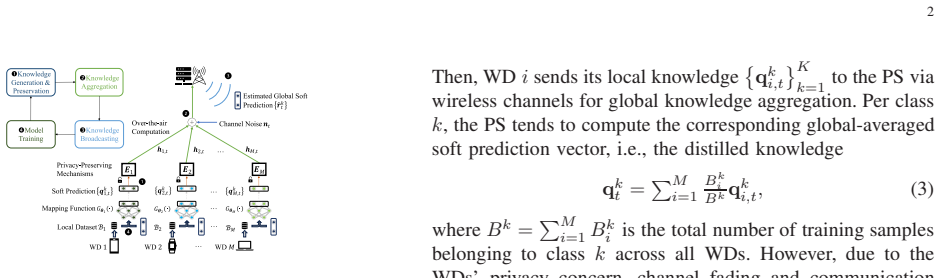
The load-bearing object is the per-class averaged soft-prediction vector $q^k_{i,t}\in\mathbb{R}^K$, whose entries lie in the probability simplex $\{q\succeq 0, \mathbf{1}^\top q=1\}$. Because the simplex diameter is $\sqrt{2}$, the $\ell_2$ sensitivity of one device's disclosed class-$k$ signal is bounded by $\sqrt{2K}|h_{i,t}P^k_{1,i,t}|/B_i$ (Lemma 1). Three mechanisms carry the argument: (i) the Gaussian mechanism, whose per-round noise variance must scale with the sensitivity and the privacy budget; (ii) the moment accountant [10], which accumulates the $T$ rounds of privacy loss and turns the per-round requirement into the aggregate condition (17); and (iii) the over-the-air superposit
What would settle it
Run a rare-class attack: choose a device with $B_i^k=1$, $B_i=1000$; for all possible neighboring datasets that differ in that single class-$k$ sample, compute the exact $\ell_2$ difference of the disclosed $\hat q^k_{i,t}$ with $\theta_{i,t}$ held fixed and also with $\theta_{i,t}$ retrained after the swap; if the observed maximum exceeds $\sqrt{2K}|h_{i,t}P^k_{1,i,t}|/B_i$, then Lemma 1 is false and the Gaussian noise prescribed by (17) is too small to deliver $(\varepsilon_i,\delta_i)$-DP after $T$ rounds.
Extended reading notes
Core claim
The paper's central claim is that the communication-learning co-design for differentially private over-the-air FD reduces to a handful of closed-form quantities. Per round, the optimal knowledge-transmit coefficients make the channel-adjusted signal exactly match the class-weight, i.e., $h_{i,t}P^{k*}_{1,i,t}\sqrt{K}/\lambda^{k*}_t = B^k_i/B^k$, which zeros the misalignment term $\Phi_{1,i,t}$ in the convergence bound. The DP noise powers are then chosen so that the aggregate noise variance satisfies $\sum_{j=1}^M |h_{j,t}P^{k*}_{2,j,t}|^2 + \sigma_n^2 = 4T(\lambda^{k*}_t)^2 \max_{i}(B^k_i/B^k)^2 \rho_i$ when $T$ is large, and can be set to zero when $T$ is small enough that channel noise al
Load-bearing premise
The load-bearing premise is Lemma 1's sensitivity estimate, which puts the device's total sample count $B_i$ in the denominator even though the disclosed signal averages only the $B_i^k$ samples of class $k$, and treats the local model as unchanged when one sample is altered; if the true sensitivity is $O(\sqrt{2K}|h_{i,t}P^k_{1,i,t}|/B_i^k)$ or includes a label change, the required DP noise is larger and the paper's claimed $(\varepsilon_i,\delta_i)$ guarantee does not follo
Editorial extensions
If this is right
- Given any total round count $T$, the optimal per-round transmit powers and post-processing scalars are explicit (Proposition 1), so no iterative transceiver optimization is needed.
- The optimal round count $T^*$ balances convergence (more rounds reduce the gradient-norm bound's first term) against privacy (more rounds demand more noise), giving a parameter-free training schedule from loss bounds, Lipschitz constants, privacy parameters, and class counts.
- The per-round communication cost is $K^2$ symbols, independent of model dimension, so the scheme scales to large models where conventional FL's model-dimension-proportional DP noise and uplink cost become prohibitive.
- Condition (17) is on the sum of all devices' noise powers plus channel noise, meaning the DP burden is shared across devices; when $T$ is small, channel noise alone can satisfy the privacy constraint, so no artificial DP noise is needed.
- Numerically, the proposed FD co-design reaches higher testing accuracy at lower uplink time than constant-$T$ FD and over-the-air FL baselines under the same or stricter DP requirements.
Reading between the lines
- If the sensitivity bound in Lemma 1 is corrected to use the per-class count $B_i^k$ rather than $B_i$, then the privacy condition (17) and the optimal round count $T^*$ would both change: rare classes would require more noise, and the paper's claimed DP guarantee for imbalanced datasets would need re-verification. This is a direct test of the paper's load-bearing step, not a claim the paper makes.
- The framework suggests a channel-aware fairness interpretation the paper does not develop: condition (17) lets devices with stronger channels carry a larger share of the DP noise, so weaker devices can spend power on knowledge transmission; whether this improves worst-case accuracy is an open question.
- The same low-dimensional-signaling structure would extend to multi-label or regression tasks if the probability-simplex bound is replaced by a range bound on the disclosed outputs; the closed-form design would then depend on the output range rather than the class count.
- Since the optimal $T^*$ depends on constants ($f_{i,\max}$, $L_1$, $L_2$, $\gamma$, $\eta_0$) that a device may not know a priori, a practical implementation could estimate these quantities online and re-solve the closed forms periodically; the paper's static analysis leaves this adaptation unexamined.
Editorial analysis
A structured set of objections, weighed in public.
Referee Report
Summary. The paper proposes a differentially private over-the-air federated distillation (FD) framework in which each wireless device transmits noise-perturbed per-class average soft predictions. The authors derive a convergence bound for the FD loss (Theorem 1), a sensitivity bound for the disclosed signal (Lemma 1), and a DP condition after T rounds (Theorem 2). These are used to formulate a two-timescale communication-learning co-design problem and to obtain closed-form transceiver coefficients and an optimal number of training rounds (Propositions 1 and 2). Numerical results on MNIST are presented to compare the proposed scheme with over-the-air FL baselines.
Significance. If the theoretical results were correct, the paper would provide a complete and communication-efficient design for private over-the-air FD: the transmitted signal dimension depends on the number of classes rather than on the model size, and DP noise is shared across devices over the air. The closed-form nature of the design and the inclusion of a moment-accountant privacy analysis are valuable features. The numerical study is extensive. However, the central privacy analysis contains a normalization error in the sensitivity bound that invalidates the main DP guarantee, and the convergence proof also has an unaccounted factor. These are load-bearing for the paper's claims.
major comments (3)
- [Appendix B / Lemma 1 (Eq. (16)) and Theorem 2 (Eq. (17))] The sensitivity bound uses the wrong normalization. The disclosed quantity q^k_{i,t} in Eq. (2) is an average over B_i^k class-k samples, not over all B_i samples. Replacing one class-k sample changes q^k by (G(u')-G(u))/B_i^k, so the l2 sensitivity (for fixed θ) scales as 1/B_i^k, not 1/B_i. Eq. (38) divides by B_i while summing over all samples, although only B_i^k terms contribute to q^k. For K=10, B_i=100, B_i^k=1, the bound is 100 times too small in standard deviation and 10^4 times too small in variance. Since Eq. (17) is derived from Eq. (38) via Eq. (39), the claimed (ε_i,δ_i)-DP guarantee fails. Additionally, changing a sample's label can affect two class averages simultaneously, a case not covered by the per-class derivation. All downstream closed-form results inherit the error.
- [Lemma 1 / Section II.A (Eq. (4)) and Theorem 2] The sensitivity analysis treats θ_{i,t} as fixed, but θ_{i,t} is updated by Eq. (4) on the private dataset B_i. For neighboring datasets B_i and B_i', the local models differ after the first round. The disclosed vector q^k_{i,t} = (1/B_i^k) Σ G_{θ_{i,t}}(u) therefore depends on the dataset through both the sample average and the model parameters. Lemma 1 only perturbs the sample average while holding θ fixed; it does not bound the true sensitivity of the mechanism from data to output. The composition in Theorem 2 therefore does not establish DP for the full T-round algorithm.
- [Appendix A, Eq. (25), step (e)] The inequality (e) ≤ 4γL2η_tS is not justified. From the preceding line, the quantity equals (4γL2/B_i)Σ_i ||Δθ_i||_2 Σ_k (B_i^k)^2/B^k. Since ||Δθ_i||_2 ≤ η_t S, this is at most (4γL2η_tS/B_i)Σ_i Σ_k (B_i^k)^2/B^k. The double sum is not bounded by B_i in general (e.g., M=2, K=1, B_1=1, B_2=100 gives Σ=100.01). Thus Theorem 1's convergence bound is not a valid upper bound without a data-distribution-dependent factor. This invalidates the stated analytical convergence rate, although the factor is constant in the optimization variables and may not change the optimizer.
minor comments (2)
- [References] Reference [10] is cited as 'A. Mart´ın, A. Chu, I. Goodfellow, ...' but 'Martín' is part of the first author's given name (Martín Abadi); the surname is Abadi. Please correct the citation.
- [Throughout] There are several typographical errors: 'intial learning rate' in Theorem 1; 'Regrading the impact of data distributions' in Section IV; 'wiht' in Section II. Please proofread the manuscript.
Circularity Check
No significant circularity: the paper's closed-form transceiver and training-round designs are derived from stated assumptions and optimization of its own analytical bounds, not from fitted data or self-citation chains.
full rationale
The derivation chain is self-contained. Theorem 1 is a convergence bound obtained from Assumptions 1--3 by a standard descent analysis, and Theorem 2 follows from Lemma 1's sensitivity bound combined with an external moments-accountant result [8]. Proposition 1 and Proposition 2 are obtained by minimizing the derived upper bound in closed form; no parameter is fitted to simulation outputs and no experimental curve is used to set the theory's constants. The only self-citations ([5], [6]) supply the baseline and the FD system model, and are not load-bearing for the central learning--privacy trade-off claim. The skeptical concern about Lemma 1's sensitivity denominator (B_i versus B_i^k) is a correctness or conservativeness issue, not a circularity: it does not make the conclusion equivalent to the premise by construction. Accordingly, the circularity score is 0.
Assumptions & free parameters
free parameters (2)
- gamma (distillation loss weight) =
not stated for experiments
- L1, L2, S, f_{i,max} =
not estimated
assumptions (7)
- domain assumption Assumption 1: gradient of local loss F_i is L1-Lipschitz continuous
- domain assumption Assumption 2: model output map G_theta(.) is L2-Lipschitz in theta
- domain assumption Assumption 3: gradient norm uniformly bounded by S
- domain assumption Empirical local loss upper bounded by f_{i,max}
- domain assumption Block fading with perfect CSI at the PS and error-free broadcast downlink
- standard math Moments-accountant composition sigma = Delta sqrt(2T ln(1/delta))/epsilon from Theorem 1 of [8]
- ad hoc to paper Per-round disclosure sensitivity is data-independent given the model (model treated as privacy-inert)
Cite this review
Pith. "Pith review of Communication-Learning Co-Design for Differentially Private Over-the-Air Federated Distillation." pith.science (2026). https://pith.science/paper/2X5KBEMV
@misc{pith2026250806557,
  author       = {Pith},
  title        = {Pith review of: Communication-Learning Co-Design for Differentially Private Over-the-Air Federated Distillation},
  year         = {2026},
  howpublished = {\url{https://pith.science/paper/2X5KBEMV}},
  note         = {Machine review of arXiv:2508.06557}
}
read the original abstract
The ever-growing learning model size nowadays challenges the communication efficiency and privacy preservation of the traditional federated learning (FL). In this paper, we propose a novel differentially private (DP) over-the-air federated distillation (FD) framework, where wireless devices (WDs) periodically share noise-perturbed model outputs with the parameter server by harnessing the superposition property of multi-access channels. Accordingly, over-the-air FD enables the shared responsibility of the DP preservation on the low-dimensional disclosed signals among WDs. We study the communication-learning co-design problem in differentially private over-the-air FD, aiming to maximize the learning convergence rate while meeting the transmit power and DP requirements of WDs. The main challenge is rooted in the intractable learning and privacy analysis in over-the-air FD, together with the strong coupling among the decision variables spanning two timescales. To tackle this problem, we first derive the analytical learning convergence rate and privacy losses of WDs, based on which the optimal transceiver design per FD round and long-term training rounds decision are obtained in the closed forms. Numerical results demonstrate that the proposed differentially private over-the-air FD approach achieves a better learning-privacy trade-off with largely-reduced communication overhead than the conventional FL benchmarks.
Figures

Reference graph
Works this paper leans on
-
[5]
Z. Hu, J. Y an, and Y .-J. A. Zhang, “Communication-Learning Co-Design for Differentially Private Over-the-Air Federated Learni ng with Device Sampling,” in IEEE TWC, vol. 23, no. 11, pp. 16788-16804, Nov. 2024
work page 2024
-
[6]
Optimal Transceiver Design in Over-the-Air Federated Distillation
Z. Hu, J. Y an, Y .-J. A. Zhang, J. Zhang, and K. B. Letaief, “ Opti- mal Transceiver Design in Over-the-Air Federated Distilla tion,” arXiv preprint arXiv:2507.15256, 2025
work page Pith review arXiv 2025
-
[1]
Communication-efficient learning of deep networks from de centralized data,
B. McMahan, E. Moore, D. Ramage, S. Hampson, and B. A. Y . Ar cas, “Communication-efficient learning of deep networks from de centralized data,” in Proc. 20th AISTATS, vol. 54, Apr. 2017, pp.1273–1282
work page 2017
-
[2]
Broadband Analog Aggregat ion for Low-Latency Federated Edge Learning,
G. Zhu, Y . Wang, and K. Huang, “Broadband Analog Aggregat ion for Low-Latency Federated Edge Learning,” in IEEE TWC, vol. 19, no. 1, pp. 491-506, Jan. 2020
work page 2020
-
[3]
C. Dwork, and A. Roth, The Algorithmic F oundations of Differential Privacy, now, 2014
work page 2014
-
[4]
Privacy Amp lification for Federated Learning via User Sampling and Wireless Aggre gation,
M. S. E. Mohamed, W.-T. Chang, and R. Tandon, “Privacy Amp lification for Federated Learning via User Sampling and Wireless Aggre gation,” in IEEE JSAC, vol. 39, no. 12, pp. 3821-3835, Dec. 2021
work page 2021
-
[7]
Selective knowledge sharin g for privacy- preserving federated distillation without a good teacher,
J. Shao, F. Wu, and J. Zhang, “Selective knowledge sharin g for privacy- preserving federated distillation without a good teacher, ” Nature Com- mun., vol. 15, no. 1, pp. 1–11, Jan. 2024
work page 2024
-
[8]
User-Level Privacy-Preserving Federated Learning: Analysis and Performance Optimization,
K. Wei, et al. , “User-Level Privacy-Preserving Federated Learning: Analysis and Performance Optimization,” in IEEE TMC, vol. 21, no. 9, pp. 3388-3401, 1 Sept. 2022
work page 2022
Show all 12 references
-
[9]
Joint Channe l Esti- mation and Feedback for mm-Wave System Using Federated Lear ning,
L. Zhao, H. Xu, Z. Wang, X. Chen, and A. Zhou, “Joint Channe l Esti- mation and Feedback for mm-Wave System Using Federated Lear ning,” in IEEE Commun. Letters, vol. 26, no. 8, pp. 1819-1823, Aug. 2022
2022
-
[10]
Deep learning with differential priv acy,
A. Mart´ ın, A. Chu, I. Goodfellow, H. B. McMahan, I. Miro nov, K. Talwar, and L. Zhang, “Deep learning with differential priv acy,” in Proc. ACM CCS, Vienna, Austria, Oct. 2016, pp. 308–318
2016
-
[11]
IEEE 802.11ac: 5th g eneration wifi networking,
A. Haque, P . Kumar, and A. K. Singh, “IEEE 802.11ac: 5th g eneration wifi networking,” in WAP ,vol. 2, no. 4, pp. 235–241, 2012
2012
-
[12]
On the conver gence of step decay step-size for stochastic optimization,
X. Wang, S. Magn´ usson, and M. Johansson, “On the conver gence of step decay step-size for stochastic optimization,” Advances in Neural Information Processing Systems, vol. 34, pp. 14226-14238, 2021
2021
Reviewed August 6, 2026 · model on record in the stance chip above.
Discussion (0). Continue with ORCID to comment.