Model of Flavors
Pith reviewed 2026-06-27 15:59 UTC · model grok-4.3
The pith
Quantum flavor dynamics generates small Dirac masses whose squares set the W and Z boson masses at the Fermi scale.
A machine-rendered reading of the paper's core claim, the machinery that carries it, and where it could break.
Core claim
The BCS-motivated idea of Weinberg and Salam on dynamical EW symmetry breaking is revived: The Higgs sector of the EW gauge model of three fermion flavors (families) is replaced with the chiral gauge SU(3)_f quantum flavor dynamics (QFD) strongly coupled at a huge scale Λ. With all chiral fermions in flavor triplets the anomaly freedom demands the welcome BSM extension of the SM fermion sector by one EW-sterile neutrino ν_R per flavor. The QFD distinguishes flavors by generating at strong coupling the chirality-prohibited fermion masses: Three different Majorana masses M_f ∼ Λ of ν_R, and three different, arguably small Dirac masses m_f of SM fermions degenerate for all species in each flavo
What carries the argument
The chiral gauge SU(3)_f quantum flavor dynamics (QFD) strongly coupled at scale Λ, which generates the Majorana and Dirac fermion masses and drives the spontaneous symmetry breakdowns.
If this is right
- W and Z boson masses are fixed by the square root of the sum of all standard-model fermion Dirac masses squared.
- Three composite scalar Higgs bosons appear at the electroweak scale.
- Six Majorana neutrino masses become calculable through the seesaw mechanism after Pagels-Stokar splitting.
- All flavor gluons acquire masses of order the large Majorana masses M_f.
- A light pseudo-Nambu-Goldstone Majoron boson appears from the breaking of the flavor symmetry.
Where Pith is reading between the lines
- Applying the Pagels-Stokar splitting in detail could yield explicit numerical predictions for the individual m_f values that can be compared with measured fermion masses.
- The composite Higgs states would generally have different production cross sections and decay branching ratios than a single fundamental Higgs, offering a potential discriminator at colliders.
- The presence of the Majoron and the heavy flavor gluons could leave imprints in early-universe cosmology or rare decays.
Load-bearing premise
The Dirac masses of the standard-model fermions are generated by the quantum flavor dynamics, remain small, and stay nearly degenerate within each flavor so that the Pagels-Stokar dynamical perturbation theory can be applied.
What would settle it
A direct search at the LHC or a future collider that finds only one fundamental scalar Higgs boson rather than three composite 0⁺ states near 246 GeV.
Figures
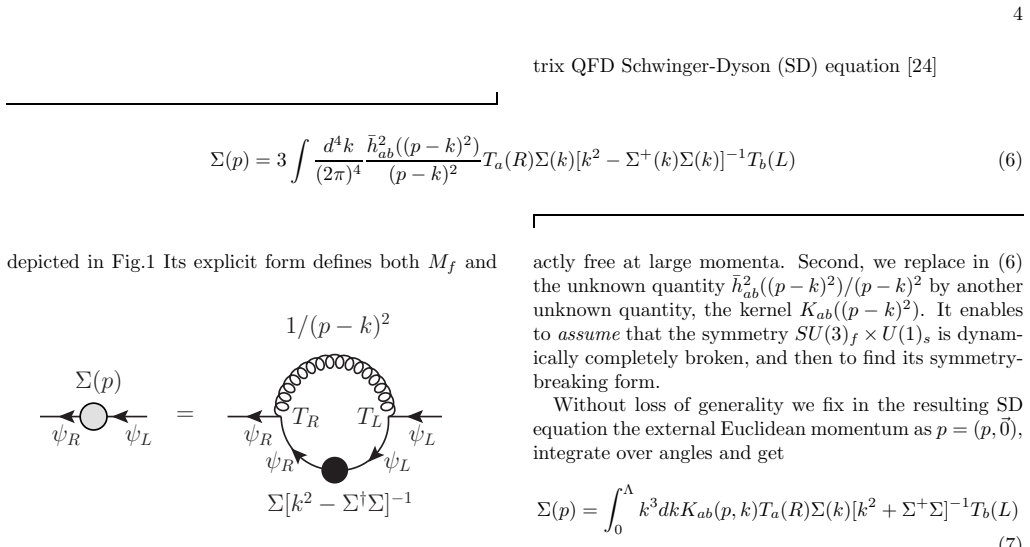
read the original abstract
The BCS-motivated idea of Weinberg and Salam on dynamical EW symmetry breaking is revived: The Higgs sector of the EW gauge model of three fermion flavors (families) is replaced with the chiral gauge $SU(3)_f$ quantum flavor dynamics (QFD) strongly coupled at a huge scale $\Lambda$. I. With all chiral fermions in flavor triplets the anomaly freedom demands the welcome BSM extension of the SM fermion sector by one EW-sterile neutrino $\nu_R$ per flavor. II. The QFD distinguishes flavors by generating at strong coupling the chirality-prohibited (i.e. calculable) fermion masses: Three different Majorana masses $M_f \sim \Lambda$ of $\nu_R$, and three different, arguably small Dirac masses $m_f$ of SM fermions degenerate for all species in each flavor. 1. Complete spontaneous breakdown of $SU(3)_f \times U(1)$ by $M_f$ implies: (i) All flavor gluons acquire self-consistently masses $\sim M_f$. (ii) There is the $\nu_R$-composite pseudo-NG Majoron. (iii) There are three very heavy $0^{+}$ $\nu_R$-composite Higgs bosons. 2. Spontaneous breakdown of the EW $SU(2)_L \times U(1)_Y$ symmetry to $U(1)_{em}$ by $m_f$, in sharp contrast with the Higgs mechanism, implies: (i) The $W$ and $Z$ bosons acquire masses $\sim g(\sum m^2_f)^{1/2}$ and $\sim (g^2+g^{'2})^{1/2}(\sum m^2_f)^{1/2}$ respectively, defining the effective Fermi scale $v=246 \rm GeV$. (ii) There are three SM-fermion-composite $0^{+}$ Higgs bosons $h_f$ at this scale. III. The UV-finite EW dynamical perturbation theory of Pagels and Stokar splits the flavor-degenerate masses of SM-fermions by their electric charges and the ratios $m_f/m_{W,Z}$. Six Majorana neutrino masses are calculable by seasaw.
Editorial analysis
A structured set of objections, weighed in public.
Referee Report
Summary. The manuscript revives dynamical electroweak symmetry breaking via a strongly coupled SU(3)_f quantum flavor dynamics (QFD) at scale Λ. It generates three Majorana masses M_f ~ Λ for right-handed neutrinos and three degenerate Dirac masses m_f for SM fermions per flavor. Spontaneous breaking by M_f gives masses to flavor gluons and produces composite states including a pseudo-NG Majoron. Breaking by m_f yields W and Z masses ~ g (∑ m_f²)^{1/2} and ~ (g² + g'²)^{1/2} (∑ m_f²)^{1/2}, defining v = 246 GeV, plus three composite 0⁺ Higgs bosons h_f. The Pagels-Stokar formalism is invoked to split the degenerate m_f by charge and m_f/m_{W,Z} ratios, with six Majorana neutrino masses claimed calculable via seesaw.
Significance. If the missing derivations were supplied and the Pagels-Stokar application justified, the approach would constitute a parameter-light dynamical alternative to the elementary Higgs, with calculable flavor hierarchies and composite states. The current absence of explicit integrals, gap equations, or quantitative spectra prevents evaluation of whether it reproduces the observed fermion masses or resolves the hierarchy problem beyond the input scale Λ.
major comments (3)
- [Abstract] Abstract and EW symmetry-breaking paragraph: The W/Z mass expressions are written as proportional to (∑ m_f²)^{1/2} with the effective Fermi scale defined by setting v = (∑ m_f²)^{1/2} = 246 GeV through choice of the input m_f values; this renders the mass prediction circular rather than independently derived from the QFD dynamics.
- [Pagels-Stokar splitting] Section on Pagels-Stokar splitting: No explicit integral over a dynamical mass function, gap equation, or effective-action derivation is referenced to show how the UV-finite EW perturbation theory splits the flavor-degenerate m_f; the formalism originates in strong-coupling self-consistency, yet is applied here to perturbative splitting in the weak EW sector without justification of the regime change.
- [Neutrino masses and composite states] Claims of calculable neutrino masses and composite Higgs bosons h_f: The seesaw and composite-Higgs statements are asserted without the required matching conditions, mass matrices, or decay-constant integrals that would follow from the QFD gap equations at scale Λ.
minor comments (2)
- Notation for the three flavor indices and the distinction between M_f and m_f should be introduced with a single table or equation block for clarity.
- The manuscript would benefit from a dedicated paragraph contrasting the present construction with prior dynamical-breaking attempts that also invoke composite scalars.
Simulated Author's Rebuttal
We thank the referee for the careful and constructive review of our manuscript. We address each major comment below with clarifications on the dynamical origin of the scales and structures in the model, and we indicate revisions to improve explicitness where the presentation was insufficient.
read point-by-point responses
-
Referee: [Abstract] Abstract and EW symmetry-breaking paragraph: The W/Z mass expressions are written as proportional to (∑ m_f²)^{1/2} with the effective Fermi scale defined by setting v = (∑ m_f²)^{1/2} = 246 GeV through choice of the input m_f values; this renders the mass prediction circular rather than independently derived from the QFD dynamics.
Authors: The m_f are not free inputs chosen to fit v; they are generated dynamically by the strong SU(3)_f dynamics at scale Λ via the gap equations, with the overall normalization fixed by requiring the resulting electroweak scale to match the observed v = 246 GeV. The individual values and ratios among the three m_f are then determined by the subsequent Pagels-Stokar splitting. We agree the abstract phrasing is ambiguous on this point and will revise it (and the corresponding paragraph) to state explicitly that v is matched to experiment while the spectrum and hierarchies follow from the QFD dynamics. revision: partial
-
Referee: [Pagels-Stokar splitting] Section on Pagels-Stokar splitting: No explicit integral over a dynamical mass function, gap equation, or effective-action derivation is referenced to show how the UV-finite EW perturbation theory splits the flavor-degenerate m_f; the formalism originates in strong-coupling self-consistency, yet is applied here to perturbative splitting in the weak EW sector without justification of the regime change.
Authors: The Pagels-Stokar integral is applied in the effective theory below Λ, where the electroweak couplings are perturbative. The strong dynamics sets the common m_f at scale Λ; the weak gauge interactions then induce the charge-dependent splittings via the standard Pagels-Stokar formula. We will add an appendix containing the explicit integral expression for the splitting, the relevant gap equation, and a short justification that the expansion is valid because g, g' ≪ 1 at the electroweak scale while the strong sector is integrated out at Λ. revision: yes
-
Referee: [Neutrino masses and composite states] Claims of calculable neutrino masses and composite Higgs bosons h_f: The seesaw and composite-Higgs statements are asserted without the required matching conditions, mass matrices, or decay-constant integrals that would follow from the QFD gap equations at scale Λ.
Authors: The composite states and seesaw structure follow directly from the symmetry-breaking pattern of the strong SU(3)_f dynamics, but the manuscript does not supply the explicit matching conditions or integrals. We will add a new section deriving the 3×3 Majorana and Dirac mass matrices from the gap equations, the decay constants f ∼ Λ for the composite Higgses h_f, and the resulting light neutrino spectrum after seesaw diagonalization. This will make the calculability quantitative. revision: yes
Circularity Check
Fermi scale v defined directly from (∑ m_f²)^{1/2} set to 246 GeV, making W/Z masses tautological
specific steps
-
self definitional
[Abstract]
"The W and Z bosons acquire masses ∼ g(∑ m_f²)^{1/2} and ∼ (g²+g'²)^{1/2}(∑ m_f²)^{1/2} respectively, defining the effective Fermi scale v=246 GeV."
The masses are expressed directly in terms of (∑ m_f²)^{1/2}, which is then defined to equal the experimentally known v=246 GeV. The boson masses are therefore constructed to match observation by choice of the m_f magnitudes rather than derived independently from the dynamics.
full rationale
The paper's central derivation states that spontaneous breakdown by m_f implies W/Z masses proportional to (∑ m_f²)^{1/2}, then explicitly defines that quantity as the known v=246 GeV. This reduces the mass expressions to a restatement of the input scale chosen to reproduce experiment, rather than an independent prediction. The m_f values (generated by QFD but degenerate and small) must be selected to enforce the numerical match. No other load-bearing steps (e.g., Pagels-Stokar splitting) exhibit explicit reduction to inputs by the paper's own equations in the provided text; the core EW mass claim is self-definitional.
Axiom & Free-Parameter Ledger
free parameters (2)
- scale Λ
- Dirac masses m_f
axioms (3)
- domain assumption Anomaly freedom of the chiral gauge theory with all fermions in flavor triplets requires one right-handed sterile neutrino ν_R per flavor.
- domain assumption The QFD is strongly coupled at scale Λ and breaks SU(3)_f completely via the Majorana masses M_f.
- domain assumption The UV-finite EW dynamical perturbation theory of Pagels and Stokar applies to split the flavor-degenerate masses.
invented entities (4)
-
ν_R-composite pseudo-NG Majoron
no independent evidence
-
three very heavy 0⁺ ν_R-composite Higgs bosons
no independent evidence
-
three SM-fermion-composite 0⁺ Higgs bosons h_f
no independent evidence
-
flavor gluons with masses ~ M_f
no independent evidence
Reference graph
Works this paper leans on
-
[1]
The name exactly expresses our idea, and we take the liberty of using it here
as the quantum flavor dynamics (QFD) . The name exactly expresses our idea, and we take the liberty of using it here. The hard fermion masses are described by the Lorentz-invariant mass terms, the bridges in the La- grangian between the right-handed (R) and the left- handed (L) fermion fields. In Lf all of them are strictly prohibited by its global chiral s...
-
[2]
in QFD with chirality-prohibited Majorana masses. III. THE QFD-GENERATED m W, mZ MASSES Second necessary condition for realizing the WS pro- gram is the demonstration that the SM fermion self- energies Σ f dynamically generated by QFD imply by Goldstone theorem the softly massive W and Z bosons. This point is theoretically safe and its demonstration is kn...
-
[3]
Since the form of Σ f (p2) is currently unknown we write Σ f (p2) ≡ mfσ (p2) (12) whereσ is an unknown universal dimensionless function
Further, unlike QCD, the Σ f (p2) generated by QFD describe the observable fermion masses. Since the form of Σ f (p2) is currently unknown we write Σ f (p2) ≡ mfσ (p2) (12) whereσ is an unknown universal dimensionless function. The summation over flavors results in the formulas m2 W = 1 4g2c ∑ f m2 f m2 Z = 1 4 (g2 +g′2)c ∑ f m2 f where c is an unknown num...
2012
-
[4]
Here we emphasize the following: These vertices persist also in heuristic, unrealistic unrenormalizable NJL models in which Σ( p2) is a constant
The Σ-dependent pseudoscalar massless NG poles in(15) and in (16), the consequences of the powerful Gold- stone theorem were already employed in Sect.II. Here we emphasize the following: These vertices persist also in heuristic, unrealistic unrenormalizable NJL models in which Σ( p2) is a constant. In such models, however, the mass formula for mW,Z cannot...
-
[5]
Hence, their consequences are entirely absent in the NJL models
We will demonstrate in the following that the polar- vector terms in the EW WT identities are equally impor- tant: These new vectorial momentum-dependent vertices withoutγ matrices changing chirality are proportional to the derivatives of the symmetry-breaking Σ f (p2). Hence, their consequences are entirely absent in the NJL models
-
[6]
Clearly, the diagrams are UV-finite
Interactions of hf with W W, ZZ In the lowest DPT order the amplitudes of these pro- cesses are defined by the fermion-loop triangle Feynman diagrams with one Σ f (p2) either in the fermion propa- gator or with one Σ ′ f (p2)-dependent vertex. Clearly, the diagrams are UV-finite. In the first case due the ap- proximate relations mW ∼ gmf , mZ ∼ (g2 +g′2)1/ 2...
-
[7]
The golden channel hf → γγ The exact EM gauge invariance of this channel, cru- cial for the Higgs-boson identification demands the exact treatment. The amplitude of this process must result in the transverse form M =F (k1.k 2gµν − kµ 2kν 1 )ǫµ (k1)ǫν (k2) (19) In the Standard model F is the known number which consists of contributions from the separately U...
-
[8]
The authors use the QCD-generated degenerate soft mass Σ( p2) in the lowest order of their DPT with the fermion propagator (5) and the EM vertex (14)
The electroweak SM-fermion mass splitting One inspirative point in the prophetic paper [18] of Pagels and Stokar is the computation of the UV-finite EM mass difference of the dynamical (constituent) u,d quarks. The authors use the QCD-generated degenerate soft mass Σ( p2) in the lowest order of their DPT with the fermion propagator (5) and the EM vertex (14...
-
[9]
The photon propagator is taken in the transverse (Landau) gauge, and the nominators of the W,Z prop- agators are taken in the transverse (’renormalizable’) form
-
[10]
Mass splitting due to the W exchange is species- independent in this approximation
-
[11]
In denominators of the fermion propagator the hard fermion mass mf is used for simplicity
-
[12]
The EM contribution agrees with the Eq.(17) of Ref.[18])
-
[13]
With reliable functional strong-coupling form of Σ f (p2) the integrals in δsΣ f are easily computed
It is perhaps worth of mentioning that the symme- try properties of rather unfamiliar Σ ′-dependent fermion- gauge boson vertices are such that their γ-matrix- dependent contributions to δsΣ f (p2) identically vanish (as they should). With reliable functional strong-coupling form of Σ f (p2) the integrals in δsΣ f are easily computed. The so- lution of th...
-
[14]
We believe it is in accord with the first Weinberg’s law of progress in theoretical physics which states: ”Never believe in the lowest order of perturbation theory” [21]
Simple but subtle observation that each SM Dirac-fermion mass breaks the EW SU (2)L × U (1)Y chiral symmetry exactly down to the observed unbro- ken U (1)em as the elementary Higgs-field condensate suggests to replace the tree-level Higgs mechanism by a predictive quantal option. We believe it is in accord with the first Weinberg’s law of progress in theore...
2012
-
[15]
As implicitly contained already in the original BCS WS idea the present BSM with the strong-coupling QFD provides a theoretically consistent framework for the cal- culable fermion mass spectrum: In the first step the strong SU (3)f QFD spontaneously distinguishes three fermion flavors by three different huge soft Majorana masses Mf of sterileνf R, and by thr...
-
[16]
The structure of the BSM sector of the present model follows closely the structure of the SM sector: It is fixed by the pattern of the complete spontaneous breakdown of the SU (3)f × U (1)s symmetry of the νf R sector by three QFD-generated sterile neutrino masses Mf contained in the νf R-composite sextet. The resulting picture is quite transparent (12=5+3...
-
[17]
Here we come to their many-body, macroscopic role
The present model emphasizes the all-important role of fermions and their masses. Here we come to their many-body, macroscopic role. The many-electron BCS derives, in accord with ob- servations, the exponential behavior of the specific heat of the macroscopic quantum super-conducting state [40]. Its shape is entirely due to the gap in the energy spectrum o...
-
[18]
Finally, the theoretically arbitrary scale Λ of the present model is phenomenologically necessarily huge. It might thus be relevant to mention that the theoretical need of a huge particle-physics mass scale is the neces- sary condition of Andrei Sakharov’s effective-field-theory concept of the emergent gravity [43]. The clear mod- ern picture of such a conc...
-
[19]
Weinberg, From BCS to the LHC , CERN Courier 48, No 1, January 2008
S. Weinberg, From BCS to the LHC , CERN Courier 48, No 1, January 2008
2008
-
[20]
Bardeen, L
J. Bardeen, L. N. Cooper and J. R. Schrieffer, Theory of Superconductivity, Phys. Rev. 108(1957), 1175
1957
-
[21]
P. W. Higgs, Broken Symmetries and the Masses of Gauge Bosons , Phys. Re. Lett. 13(1964)508
1964
-
[22]
Ginzburg and L.D
V.L. Ginzburg and L.D. Landau, Zh. Eksp. Teor. Fiz. 20(1950), 1064
1950
-
[23]
t’ Hooft, Renormalizable Lagrangians for massive Yang-Mills fields , Nucl
G. t’ Hooft, Renormalizable Lagrangians for massive Yang-Mills fields , Nucl. Phys. B 35 (1971) 167
1971
-
[24]
ATLAS collaboration, Observation of a new particle in the search for the Standard Model Higgs boson with the ATLAS detector at the LHC , Phys. Lett. B 716 (2012) 1 [arXiv:1207.7214] [INSPIRE]; CMS collaboration, Ob- servation of a New Boson at a Mass of 125 GeV with the CMS Experiment at the LHC , Phys. Lett. B 716 (2012) 30 [arXiv:1207.7235] [INSPIRE]
work page internal anchor Pith review Pith/arXiv arXiv 2012
-
[25]
Weinberg, in Model physicist, CERN Courier 57 No 9, November 2017
S. Weinberg, in Model physicist, CERN Courier 57 No 9, November 2017
2017
-
[26]
Nambu and G
Y. Nambu and G. Jona-Lasinio, Dynamical Model of El- ementary Particles Based on an Analogy with Supercon- ductivity. 1 , Phys. Rev. 122 (1961) 345
1961
-
[27]
Hosek, The Glashow-Weinberg-Salam model without scalar fields , preprint JINR E2-82-542, submitted to Nucl.Phys.B and to XXI ICHEP, Paris, 1982; J
J. Hosek, The Glashow-Weinberg-Salam model without scalar fields , preprint JINR E2-82-542, submitted to Nucl.Phys.B and to XXI ICHEP, Paris, 1982; J. Hosek, Electroweak SU (2)L × U (1)Y gauge model without Higgs fields, preprint CERN-TH.4104/85 (1985), submitted to Nucl.Phys.B; J. Hosek, Model for the Dynamical Gener- ation of Lepton, Quark, and Intermedia...
1982
-
[28]
Bardeen, C.T
W.A. Bardeen, C.T. Hill and M. Lindner, Minimal Dy- namical Symmetry Breaking of the Standard Model , Phys. 11 Rev. D 41 (1990) 1647
1990
-
[29]
Miransky, M
V.A. Miransky, M. Tanabashi and K. Yamawaki, Dynam- ical Electroweak Symmetry Breaking with Large Anoma- lous Dimension and t Quark Condensate , Phys. Lett B 221 (1989) 177
1989
-
[30]
Nambu, Dynamical Symmetry Breaking , preprint EFI 90-88(1990)
Y. Nambu, Dynamical Symmetry Breaking , preprint EFI 90-88(1990)
1990
-
[31]
Jackiw and K
R. Jackiw and K. Johnson, Dynamical Model of Spon- taneously Broken Gauge Symmetries , Phys. Rev. D 8 (1973) 2386 [INSPIRE]; J.M. Cornwall and R.E. Norton, Spontaneous Symmetry Breaking Without Scalar Mesons , Phys. Rev. D 8 (1973) 3338 [INSPIRE]
1973
-
[32]
Weinberg, Implications of dynamical symmetry break- ing: An addendum , Phys
S. Weinberg, Implications of dynamical symmetry break- ing: An addendum , Phys. Rev. D 19 (1979) 1277 [IN- SPIRE]; L. Susskind, Dynamics of Spontaneous Symme- try Breaking in the Weinberg-Salam Theory , Phys. Rev. D 20 (1979) 2619 [INSPIRE]
1979
-
[33]
The idea of gauging the flavor symmetry is so natural that it cannot be new, see e.g. F. Wilczek and A. Zee, Horizontal Interaction and Weak Mixing Angles , Phys. Rev. Lett. 42 (1979) 421 [INSPIRE]; J.L. Chkareuli, Quark-Lepton Families: From SU(5) to SU(8) Symme- try, JETP Lett. 32 (1980) 671 [Pisma Zh. Eksp. Teor. Fiz. bf 32 (1980) 684] [DESY-L-TRANS-253...
1979
-
[34]
Coleman and E
S. Coleman and E. Weinberg, Radiative Corrections as the Origin of Spontaneous Symmetry Breaking , Phys. Rev. D7(1973)1888
1973
-
[35]
Yanagida, Horizontal Symmetry and Mass of the Top Quark, Phys
T. Yanagida, Horizontal Symmetry and Mass of the Top Quark, Phys. Rev. D 20 (1979)2986 [INSPIRE]
1979
-
[36]
Pagels and S
H. Pagels and S. Stokar, The Pion Decay Constant, Electromagnetic Form-Factor and Quark Electromag- netic Selfenergy in QCD , Phys. Rev. D 20 (1979) 2947
1979
-
[37]
Color superconductor with a color-sextet condensate
T. Brauner, R. Sykora and J. Hosek, Color superconduc- tor with a color sextet condensate , Phys. Rev. D 68 (2003) 094004 [hep-ph/0303230]
work page internal anchor Pith review Pith/arXiv arXiv 2003
-
[38]
J. Hosek, Dynamical Origin of Seesaw , arXiv:1704.07172
work page internal anchor Pith review Pith/arXiv arXiv
-
[39]
Weinbeerg, Why the Renormalization Group is a Good Thing, in Asymptotic Realms of Physics, Essays in Honor of Francis E
S. Weinbeerg, Why the Renormalization Group is a Good Thing, in Asymptotic Realms of Physics, Essays in Honor of Francis E. Low. Edited by Alan H. Guth, Kerson Huang, and Robert L. Jaffe. Cambridge, MA: The MIT Press, 1983., p.1
1983
-
[40]
B. D. Josephson, The Discovery of Tunnelling Supercur- rents, Nobel Lecture, December 12, 1973
1973
-
[41]
A. A. Abrikosov, Type II superconductors and the vortex lattice, Nobel Lecture, December 8 (2003)
2003
-
[42]
Pagels, Models of Dynamically Broken Gauge Theo- ries, Phys
H. Pagels, Models of Dynamically Broken Gauge Theo- ries, Phys. Rev. D 21 (1980) 2336
1980
-
[43]
Susskind, Dynamics of Spontaneous Symmetry Break- ing in the Weinberg-Salam Theory , Phys
L. Susskind, Dynamics of Spontaneous Symmetry Break- ing in the Weinberg-Salam Theory , Phys. Rev. D 20 (1979) 2619
1979
-
[44]
A model that underlies the Standard model
J. Hosek, A model that underlies the Standard model , arXiv:1606.03292
work page internal anchor Pith review Pith/arXiv arXiv
-
[45]
Strong Interactions at Low Energy
H. Leutwyler, Strong Interactions at Low Energies , Czech. J. Phys. B512(2002)9; arXiv: hep-ph/0212325
work page internal anchor Pith review Pith/arXiv arXiv 2002
-
[46]
Chiral Symmetry and Lattice Fermions
D.B. Kaplan, Chiral Symmetry and Lattice Fermions , arXiv:0912.2560;M. Creutz, Yang-Mills Fields and the Lattice, hep-lat/0406007
work page internal anchor Pith review Pith/arXiv arXiv
-
[47]
J. S. Schwinger, Gauge Invariance and Mass , Phys. Rev. 125 (1962) 397
1962
-
[48]
Dynamical breakdown of Abelian gauge chiral symmetry by strong Yukawa interactions
P. Benes, T. Brauner and J. Hosek, Dynamical breakdown of Abelian gauge chiral symmetry by strong Yukawa in- teractions, Phys.Rev. D75(2007)056003; hep-ph/0605147 [hep-ph]
work page internal anchor Pith review Pith/arXiv arXiv 2007
-
[49]
Sikivie, An Introduction to Technicolor , preprint TH.2951-CERN(1980)
P. Sikivie, An Introduction to Technicolor , preprint TH.2951-CERN(1980)
1980
-
[50]
T. W. B. Kibble, Symmetry Breaking in Non-Abelian Gauge Symmetries , Phys. Rev. 155(1967)1554
1967
-
[51]
W. J. Marciano, C. Zhang, S. Willenbrock, Higgs decay to two photons , Phys. Rev. D85(2012)013002
2012
-
[52]
Benes, to be published
P. Benes, to be published
- [53]
-
[54]
Indications for New Higgs Bosons
A. Crivellin et al., Indications for New Higgs Bosons , arXiv: 2605.04233
work page internal anchor Pith review Pith/arXiv arXiv
-
[55]
Complex Spinors and Unified Theories
P. Minkowski, µ → eγ at a Rate of One Out of 109 Muon Decays?, Physics Letters B 67 (1977) 421; T. Yanagida, Horizontal Symmetry and Masses Of Neutrinos , Confer- ence Proceedings C7902131 (1979) 95; M. Gell-Mann, P. Ramond and R. Slansky, Complex Spinors and Unified Theories, Conference Proceedings C790927 (1979) 315 [1306.4669]; S. Glashow, The Future of...
work page internal anchor Pith review Pith/arXiv arXiv 1977
-
[56]
Fukugita and T
M. Fukugita and T. Yanagida, Baryogenesis Without Grand Unification , Phys. Lett. B 174 (1986), 45-47
1986
-
[57]
Freese, J
K. Freese, J. A. Frieman, A. V. Olinto, Natural inflation with pseudo-Nambu-Goldstone bosons , Phys. Rev. Lett. 65 (1990) 3233
1990
-
[58]
A. L. Fetter, J. D. Walecka, Quantum Theory of Many- Particle Systems , McGraw-Hill Book Co., New York, 1971
1971
-
[59]
N. N. Bogolubov, On a new method in the theory of su- perconductivity, Nuovo Cim. 7(1958) 794
1958
-
[60]
J. G. Valatin, Comments on the theory of superconduc- tivity, Nuovo Cim. 7 (1958) 843
1958
-
[61]
Sakharov, Vacuum quantum fluctuations in curved space and the theory of gravitation , Sov
A.D. Sakharov, Vacuum quantum fluctuations in curved space and the theory of gravitation , Sov. Phys. Usp. 34 (1991) 394 [Sov. Phys. Dokl. 12 (1968) 1040] [Dokl. Akad. Nauk Ser. Fiz. 177 (1967) 70] [Gen. Rel. Grav. 32 (2000) 365] [Usp. Fiz. Nauk 161 (1991) 64]
1991
-
[62]
S. L. Adler, Sakharov and Induced Gravitation , preprint IAS-SNS-90/16 (1990)
1990
-
[63]
S. L. Adler, Einstein gravity as a symmetry-breaking ef- fect in quantum field theory , Reviews of Modern Physics 54 (1982) 729
1982
-
[64]
Zee, Calculating Newton ’s Gravitational Constant in Infrared Stable Yang-Mills Theories , Phys
A. Zee, Calculating Newton ’s Gravitational Constant in Infrared Stable Yang-Mills Theories , Phys. Rev. Lett. 48 (1982) 295
1982
-
[65]
A. A. Starobinsky, A new type of isotropic cosmological models without singularity , Phys. Lett. B91 (1980) 92
1980
discussion (0)
Sign in with ORCID, Apple, or X to comment. Anyone can read and Pith papers without signing in.