REVIEW 6 major objections 7 minor 59 references
Safe and Trustworthy Robot Pathfinding with BIM, MHA*, and NLP
T0 review · 6 major / 7 minor · reviewed 2026-08-12 · deepseek-v4-flash
Pith's one-line read BIM geometry plus LLM danger scoring adds an 80 percent obstacle-clearance margin to planned robot paths with little path-length cost.
desk verdict The BIM+MHA*+LLM integration is a sensible planning-stage idea with directionally plausible results, but the abstract's 80% clearance / comparable path length claim is not supported by the paper's own Scenario 2, and the MHA* guarantee is misstated. read the letter →
The pith
A machine-rendered reading of the paper's core claim, the machinery that carries it, and where it could break.
The reading
What carries the argument
The load-bearing object is MHA*, a multi-heuristic A* that keeps two open sets: one for the admissible Euclidean-distance heuristic, which preserves A*'s completeness and optimality, and one for a potentially inadmissible APF heuristic, meaning the APF values may overestimate true costs but can still guide the search toward safer regions. The repulsive part of the field is $F_{\mathrm{rep}}(x,y) = k_{\mathrm{rep}}\,e^{-D_{\mathrm{obstacle}}}$, where $D_{\mathrm{obstacle}}$ is the distance to the nearest obstacle; the field is convolved with a Gaussian kernel $G(x,y) = \frac{1}{2\pi\sigma^2} e^{-(x^2+y^2)/(2\sigma^2)}$ to smooth its influence across the grid. The LLM supplies scaling coefficients that multiply each object family's repulsive potential, and the framework prints a natural-language explanation for each coefficient, which is what makes the planning both semantically aware and explainable.
What would settle it
Take the same floor plan and deliberately move or add obstacles after the BIM is captured, then run both GPT-MHA* and naive A* with ground-truth obstacle positions recorded by motion capture; if the 80 percent clearance advantage does not survive a realistic as-built mismatch, the safety claim collapses. A weaker and cheaper version: shift every obstacle in the BIM by the 20 cm localization error the paper cites and check whether the planned path's average distance to obstacles still beats naive A*.
Extended reading notes
Core claim
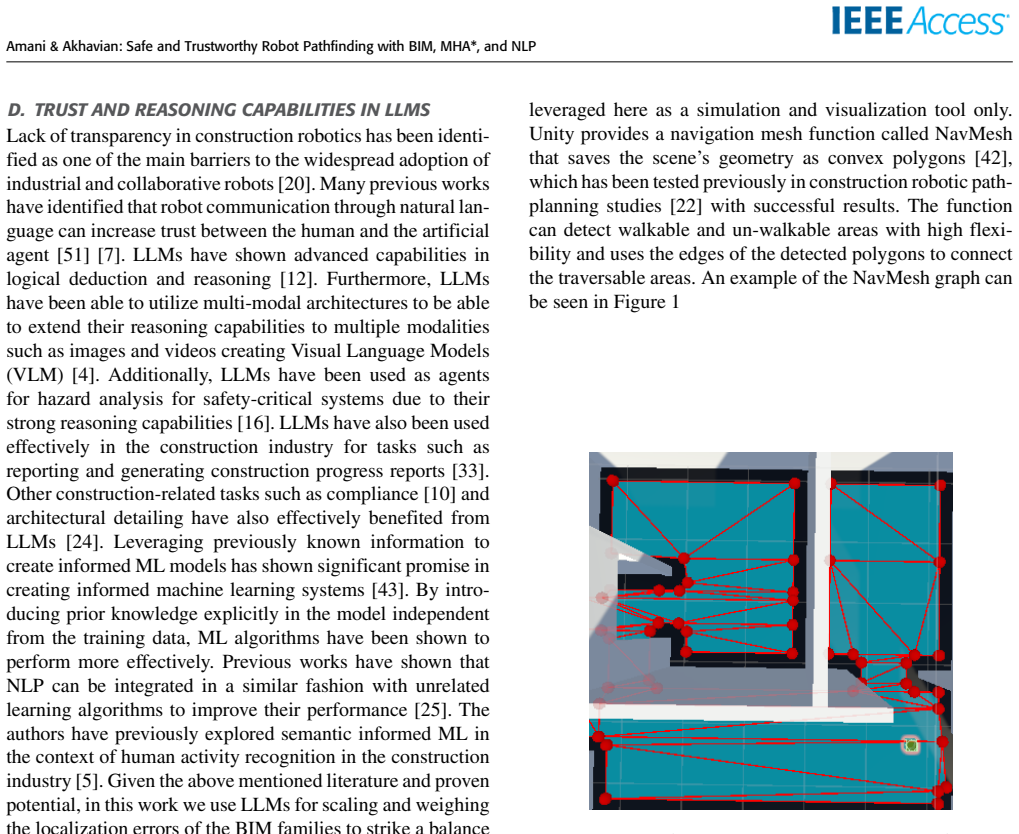
The central claim is that repulsive potential fields derived from BIM spatial data, injected into A* as a second heuristic via MHA*, shift planned paths away from obstacles without a large path-length penalty. The paper's implementation builds a Moore-neighborhood grid from the navigation mesh of the floor, computes an exponential-decay repulsive potential per node, blurs it with a Gaussian kernel, and adds the potential values as a potentially inadmissible heuristic alongside the admissible Euclidean distance. GPT-3.5-turbo then reads the BIM family names and descriptions, assigns danger coefficients such as 0.2 for interior partition walls, 0.5 for chairs, 0.8 for other robots, and 0.9 for grinders, and normalizes the coefficients to a maximum of 0.5 when summed; its text also gives the reason for each coefficient. In the main experiment GPT-MHA* achieves an average distance to obstacle of 0.63 m versus 0.34 m for naive A* with path lengths 4.61 m and 4.29 m, and in a second scenario it takes a longer but safer detour around a cluster of objects near a door. The authors position the result as an additional planning-phase safety layer, not a substitute for real-time obstacle avoidance.
Load-bearing premise
The safety gain depends on the BIM's obstacle layout matching the real job site; if the model is stale (as-designed versus as-built), the repulsive fields push the robot away from phantom obstacles and may miss real ones.
Editorial extensions
If this is right
- If the 80 percent clearance gain holds on real sites, mission planners can reduce reliance on onboard real-time collision avoidance, saving sensor and computation costs.
- Gaussian smoothing removes almost the entire path-length penalty of MHA* while keeping most of the clearance gain, so smoothing is a practical default setting rather than a cosmetic add-on.
- Because the admissible Euclidean heuristic stays in the search, the method keeps A*'s guarantees even though the APF heuristic is inadmissible, fixing a gap in earlier linear A*+APF fusions.
- The LLM's coefficients and explanations let a human tune the planner per object type or room, so safety preferences can be expressed in natural language.
- The method does not replace real-time avoidance; it is an extra safety margin computed before the mission, with re-planning only when the environment changes.
Reading between the lines
- A direct test the paper does not run: perturb the BIM obstacle coordinates by the localization error cited in the paper (about 20 cm) and measure the planned path's clearance. If the advantage over naive A* vanishes under that perturbation, the safety claim is an artifact of a perfect map.
- The danger coefficients come from a model's natural-language reasoning rather than measured risk data; calibrating them against historical collision frequencies or object-mobility statistics would make the safety gain quantitative rather than qualitative.
- The same BIM-text-to-repulsion pipeline should transfer to any facility with a digital model, such as warehouses, hospitals, or laboratories, where static geometry is fairly accurate and the expensive part is knowing which objects are dangerous.
Editorial analysis
A structured set of objections, weighed in public.
Referee Report
Summary. The paper proposes a robot pathfinding framework that combines building information modeling (BIM), multi-heuristic A* (MHA*), artificial potential fields (APF), and large language models (LLMs). Spatial data from a BIM floor plan is converted into a grid and repulsive potentials around obstacles; family names are sent to GPT-3.5-turbo, which returns danger coefficients used to scale these potentials. The authors compare the resulting 'GPT-MHA*' path with a naive A* path on one BIM floor plan in two scenarios, reporting path length and average distance to obstacle (ADO). The abstract claims an 80% improvement in robot-obstacle clearance with comparable path lengths. The experiments show this only in Scenario 1; Scenario 2 has a 57% longer path and a 40% ADO increase. The paper also claims that MHA* guarantees optimality despite an inadmissible APF heuristic.
Significance. If the results were reproducible and generalizable, the contribution would be useful: a low-cost planning-stage safety layer for construction robots that leverages BIM semantics and provides natural-language explanations for scaling decisions. The strongest aspects are the proposed pipeline, the use of an existing MHA* algorithm to avoid the admissibility pitfalls of APF heuristics, and the explicit design for explainability. The ADO improvement is a designed consequence of adding a repulsive heuristic rather than a fitted target, but the exact magnitude is an empirical claim. However, with a single floor plan, no repeated runs, hand-picked parameters, and an unsupported optimality claim, the paper currently reads as a proof of concept rather than a validated method.
major comments (6)
- [Abstract; §IV-B, Table 3] The headline claim '80% improvement ... while maintaining comparable path lengths' is contradicted by the manuscript's own Scenario 2: Table 3 reports path length 5.35 m for GPT-MHA* versus 3.40 m for naive A* (57% longer) and ADO 0.28 m versus 0.20 m (40% higher). The abstract therefore over-generalizes one favorable scenario. The claim must be qualified to Scenario 1 or supported by a multi-scenario/statistical summary.
- [§IV, Tables 1–3; §III-E] Each condition appears to be a single unseeded GPT-3.5-turbo call. No temperature, seed, prompt template, JSON schema, or number of repeated trials is reported. Because LLM outputs are stochastic, the 0.63 m ADO in Table 2 could be one draw; the paper needs repeated runs and dispersion measures before the 80% figure can be considered verified.
- [§III-D, Eq. (4)] The statement that 'MHA* guarantees completeness and optimality even though the APF heuristic is potentially inadmissible' overstates the cited work [3]. Multi-heuristic A* provides bounded sub-optimality when inadmissible heuristics are used, and the guarantee depends on the anchor heuristic and the suboptimality bound. The paper should state the precise bound and confirm that the implementation satisfies the assumptions of [3].
- [§IV-1] The quantitative results depend on a hand-picked potential-field scaling factor of 0.5, with no sensitivity analysis for katt, krep, the Gaussian sigma in Eq. (5), or the grid resolution. Since the reported ADO improvement is generated by these repulsive potentials, varying these parameters is necessary to show that the claimed improvement is not an artifact of a single configuration.
- [§III-E; §IV] The LLM component is not reproducible as described: the exact prompt, the format of the JSON input, the normalization rule ('scaled and normalized to a maximum of 0.5'), and the parsing logic are missing. Without these, an independent implementation cannot reproduce the danger coefficients in the example output, and the effect of the LLM on the final path cannot be separated from the hand-picked heuristic weighting.
- [§II-A; §V] The safety interpretation depends on the BIM model being current and accurate, but the paper only acknowledges the as-designed versus as-built discrepancy without quantifying its effect. Since the proposed framework does not include any sensor-level correction, the conclusion should explicitly state that the 80% clearance improvement is conditional on an up-to-date BIM and is not a guarantee under model error.
minor comments (7)
- [Eq. (2)] Equation (2) misspells 'Euclidean' as 'Euclidian'; the same typo appears in the text after Eq. (1).
- [§III-A] The text contains 'unwalkabale' for 'unwalkable.'
- [§IV, first paragraph] The phrase 'an (i.e., a geometry preserving file format...)' appears to have lost the word 'FBX' before the parenthetical.
- [§IV-1] The text says 'about 75% increase' but Table 1 gives 0.58/0.34 ≈ 1.706, a 70.6% increase; recalculate or round consistently.
- [Figure 7 caption] The caption contains 'Y ellow'; it should be 'Yellow.'
- [General] The paper does not state whether code or data are available; adding a link or stating availability would improve reproducibility.
- [Eqs. (1) and (3)] Equations (1) and (3) do not define Dgoal and Dobstacle precisely (e.g., the metric or how nearest-obstacle distance is computed on the grid); define them explicitly.
Circularity Check
No significant circularity: the claimed 80% clearance improvement is an empirical outcome, and the cited MHA*/APF/LLM machinery is not reduced to its own inputs.
full rationale
The central quantitative claim is an experimental measurement, not a derivation that presupposes its own conclusion. The APF heuristic (Frep = krep * exp(-D_obstacle)) is deliberately designed to move the path away from obstacles, and ADO is the average distance to the nearest obstacle, so the qualitative sign of the comparison with naive A* is a designed sanity check; however, the specific 80% figure in Scenario 1 (Table 2) and the path-length/ADO trade-offs in Tables 1 and 3 are empirical outcomes, not fitted targets. The LLM-generated danger coefficients come from prompting GPT-3.5-turbo with semantic descriptions and are normalized to a maximum 0.5; they are not optimized against ADO or path length. The completeness/optimality guarantee is imported from the external MHA* paper [3], not from the authors' own prior work. Self-citations [5], [19], and [20] are contextual support for semantic-informed ML and trust/explainability and are not load-bearing in the pathfinding derivation. The abstract's general '80% with comparable path lengths' claim is contradicted by Scenario 2's 57% longer path, but that is a correctness/verification problem, not circularity. The acknowledged as-designed/as-built discrepancy in Section II-A is a validity caveat, not a circularity.
Assumptions & free parameters
free parameters (6)
- Potential field scaling factor =
0.5
- Attractive coefficient katt =
not stated
- Repulsive coefficient krep =
not stated
- Gaussian kernel sigma =
not stated
- Grid resolution or node size =
not stated
- LLM danger coefficients =
0 to 1 normalized to max 0.5 per family
assumptions (4)
- standard math MHA* with an admissible consistent heuristic and an inadmissible heuristic guarantees completeness and bounded suboptimality (cited as optimality in the paper).
- domain assumption BIM as-designed geometry approximates the as-built site closely enough for planning.
- ad hoc to paper Exponential repulsive potentials with Gaussian blur produce a useful model of object danger.
- domain assumption LLM danger coefficients are reliable and consistent across runs.
Cite this review
Pith. "Pith review of Safe and Trustworthy Robot Pathfinding with BIM, MHA*, and NLP." pith.science (2026). https://pith.science/paper/2XQHCWFQ
@misc{pith2026241115371,
  author       = {Pith},
  title        = {Pith review of: Safe and Trustworthy Robot Pathfinding with BIM, MHA*, and NLP},
  year         = {2026},
  howpublished = {\url{https://pith.science/paper/2XQHCWFQ}},
  note         = {Machine review of arXiv:2411.15371}
}
read the original abstract
Construction robots have gained significant traction in recent years in research and development. However, the application of industrial robots has unique challenges. Dynamic environments, domain-specific tasks, and complex localization and mapping are significant obstacles in their development. In construction job sites, moving objects and complex machinery can make pathfinding a difficult task due to the possibility of object collisions. Existing methods such as simultaneous localization and mapping are viable solutions to this problem, however, due to the precision and data quality required by the sensors and the processing of the information, they can be very computationally expensive. We propose using spatial and semantic information in building information modeling (BIM) to develop domain-specific pathfinding strategies. In this work, we integrate a multi-heuristic A* (MHA*) algorithm using APFs from the BIM spatial information and process textual information from the BIM using large language models (LLMs) to adjust the algorithm for dynamic object avoidance. We show increased robot object proximity by 80% while maintaining similar path lengths.
Figures


Figures from the paper (7 more)


Reference graph
Works this paper leans on
-
[3]
Sandip Aine, Siddharth Swaminathan, V enkatraman Narayanan, Victor Hwang, and Maxim Likhachev. Multi-heuristic a*. The International Journal of Robotics Research, 35(1-3):224–243, 2016
work page 2016
-
[1]
Wilbert G. Aguilar, V erónica P . Casaliglla, and José L. Pólit. Obstacle avoidance based-visual navigation for micro aerial vehicles. Electronics, 6(1), 2017
work page 2017
-
[2]
Algorithms for finding patterns in strings, handbook of theoretical computer science (vol
Alfred V Aho. Algorithms for finding patterns in strings, handbook of theoretical computer science (vol. a): algorithms and complexity, 1991
work page 1991
-
[4]
Flamingo: a visual language model for few-shot learning, 2022
Jean-Baptiste Alayrac, Jeff Donahue, Pauline Luc, Antoine Miech, Iain Barr, Y ana Hasson, Karel Lenc, Arthur Mensch, Katie Millican, Malcolm Reynolds, Roman Ring, Eliza Rutherford, Serkan Cabi, Tengda Han, Zhi- tao Gong, Sina Samangooei, Marianne Monteiro, Jacob Menick, Sebastian Borgeaud, Andrew Brock, Aida Nematzadeh, Sahand Sharifzadeh, Mikolaj Binkows...
work page 2022
-
[5]
Adaptive robot perception in construc- tion environments using 4d bim, 2024
Mani Amani and Reza Akhavian. Adaptive robot perception in construc- tion environments using 4d bim, 2024. 8 VOLUME 11, 2023 Amani & Akhavian: Safe and Trustworthy Robot Pathfinding with BIM, MHA*, and NLP
work page 2024
-
[6]
Khashayar Asadi, Hariharan Ramshankar, Mojtaba Noghabaei, and Kevin Han. Real-time image localization and registration with bim using perspec- tive alignment for indoor monitoring of construction.Journal of Computing in Civil Engineering , 33(5):04019031, 2019
work page 2019
-
[7]
Transparent interaction based learning for human-robot collaboration
Elahe Bagheri, Joris De Winter, and Bram V anderborght . Transparent interaction based learning for human-robot collaboration. Frontiers in Robotics and AI , 9, 2022
work page 2022
-
[8]
Qiangwei Bao, Pai Zheng, and Sheng Dai. A digital twin-driven dynamic path planning approach for multiple automatic guided vehicles based on deep reinforcement learning. Proceedings of the Institution of Mechanical Engineers, Part B: Journal of Engineering Manufacture , 238(4):488–499, 2024
work page 2024
Show all 59 references
-
[9]
Integration of augmented reality and indoor positioning technologies for on-site viewing of bim information
Hung-Ming Chen and Ting-Y u Chang. Integration of augmented reality and indoor positioning technologies for on-site viewing of bim information. In ISARC. Proceedings of the International Symposium on Automation and Robotics in Construction, volume 31, page 1. IAARC Publications, 2014
2014
-
[10]
Automated building information modeling compliance check through a large language model combined with deep learning and ontology
Nanjiang Chen, Xuhui Lin, Hai Jiang, and Yi An. Automated building information modeling compliance check through a large language model combined with deep learning and ontology. Buildings, 14(7):1983, 2024
1983
-
[11]
Fusing passive rfid and bim for increased accuracy in indoor localization
Aaron M Costin and Jochen Teizer. Fusing passive rfid and bim for increased accuracy in indoor localization. Visualization in Engineering , 3:1–20, 2015
2015
-
[12]
Faithful reasoning using large language models, 2022
Antonia Creswell and Murray Shanahan. Faithful reasoning using large language models, 2022
2022
-
[13]
Optimal scene graph planning with large language model guidance
Zhirui Dai, Arash Asgharivaskasi, Thai Duong, Shusen Lin, Maria- Elizabeth Tzes, George Pappas, and Nikolay Atanasov. Optimal scene graph planning with large language model guidance. In 2024 IEEE Inter- national Conference on Robotics and Automation (ICRA) , pages 14062– 14069, 2024
2024
-
[14]
Analysis and comparison of robotics 3d simulators
Mirella Santos Pessoa De Melo, José Gomes da Silva Neto, Pedro Jorge Lima Da Silva, João Marcelo Xavier Natario Teixeira, and V eronica Teichrieb. Analysis and comparison of robotics 3d simulators. In 2019 21st Symposium on Virtual and Augmented Reality (SVR) , pages 242–251. ...
2019
-
[15]
Bim-based indoor positioning technology using a monocular camera, isarc
Y Deng, H Hong, H Deng, and H Luo. Bim-based indoor positioning technology using a monocular camera, isarc. In Proceedings of the Inter- national Symposium on Automation and Robotics in Construction, Vilnius Gediminas Technical University, Department of Construction Economics ...
2017
-
[16]
Can large language models assist in hazard analysis?, 2023
Simon Diemert and Jens H Weber. Can large language models assist in hazard analysis?, 2023
2023
-
[17]
Multi-resolution a
Wei Du, Fahad Islam, and Maxim Likhachev. Multi-resolution a. In Proceedings of the International Symposium on Combinatorial Search , volume 11, pages 29–37, 2020
2020
-
[18]
Weighted a search – unifying view and application
Rüdiger Ebendt and Rolf Drechsler. Weighted a search – unifying view and application. Artificial Intelligence, 173(14):1310–1342, 2009
2009
-
[19]
Trustworthy ai and robotics: Implications for the aec industry.Automation in Construction, 139:104298, 2022
Newsha Emaminejad and Reza Akhavian. Trustworthy ai and robotics: Implications for the aec industry.Automation in Construction, 139:104298, 2022
2022
-
[20]
Assessing trust in construction ai-powered collaborative robots using structural equation modeling
Newsha Emaminejad, Lisa Kath, and Reza Akhavian. Assessing trust in construction ai-powered collaborative robots using structural equation modeling. Journal of Computing in Civil Engineering , 38(3):04024011, 2024
2024
-
[21]
A class of fast gaussian binomial filters for speech and image processing
Richard A Haddad, Ali N Akansu, et al. A class of fast gaussian binomial filters for speech and image processing. IEEE Transactions on Signal Processing, 39(3):723–727, 1991
1991
-
[22]
A robotic cyber- physical system for automated reality capture and visualization in construc- tion progress monitoring, 2024
Srijeet Halder, Kereshmeh Afsari, and Abiola Akanmu. A robotic cyber- physical system for automated reality capture and visualization in construc- tion progress monitoring, 2024
2024
-
[23]
Nsga-ii based optimal wi-fi access point placement for indoor positioning: A bim-based rss prediction
Hamid Hosseini, Mohammad Taleai, and Sisi Zlatanova. Nsga-ii based optimal wi-fi access point placement for indoor positioning: A bim-based rss prediction. Automation in Construction, 152:104897, 2023
2023
-
[24]
Automated detailing of exterior walls using nadia: Natural-language-based architectural detailing through interaction with ai
Suhyung Jang, Ghang Lee, Jiseok Oh, Junghun Lee, and Bonsang Koo. Automated detailing of exterior walls using nadia: Natural-language-based architectural detailing through interaction with ai. Advanced Engineering Informatics, 61:102532, 2024
2024
-
[25]
Beating atari with natural language guided reinforcement learning, 2017
Russell Kaplan, Christopher Sauer, and Alexander Sosa. Beating atari with natural language guided reinforcement learning, 2017
2017
-
[26]
Ara* : Anytime a* with provable bounds on sub-optimality
Maxim Likhachev, Geoffrey J Gordon, and Sebastian Thrun. Ara* : Anytime a* with provable bounds on sub-optimality. In S. Thrun, L. Saul, and B. Schölkopf, editors, Advances in Neural Information Processing Systems, volume 16. MIT Press, 2003
2003
-
[27]
Scene recognition for indoor localization using a multi-sensor fusion approach
Mengyun Liu, Ruizhi Chen, Deren Li, Y ujin Chen, Guangyi Guo, Zhipeng Cao, and Y uanjin Pan. Scene recognition for indoor localization using a multi-sensor fusion approach. Sensors, 17(12):2847, 2017
2017
-
[28]
A dynamic fusion pathfinding algorithm using delaunay triangulation and improved a-star for mobile robots
Zhihai Liu, Hanbin Liu, Zhenguo Lu, and Qingliang Zeng. A dynamic fusion pathfinding algorithm using delaunay triangulation and improved a-star for mobile robots. IEEE Access, 9:20602–20621, 2021
2021
-
[29]
Surface optimal path planning using an extended dijkstra algorithm
Min Luo, Xiaorong Hou, and Jing Y ang. Surface optimal path planning using an extended dijkstra algorithm. IEEE Access , 8:147827–147838, 2020
2020
-
[30]
Bim-based localization and mapping for mobile robots in construction
Mateus Sanches Moura, Carlos Rizzo, and Daniel Serrano. Bim-based localization and mapping for mobile robots in construction. In 2021 IEEE international conference on autonomous robot systems and competitions (ICARSC), pages 12–18. IEEE, 2021
2021
-
[31]
OpenAI, Josh Achiam, Steven Adler, Sandhini Agarwal, Lama Ah- mad, Ilge Akkaya, Florencia Leoni Aleman, Diogo Almeida, Janko Al- tenschmidt, Sam Altman, Shyamal Anadkat, Red Avila, Igor Babuschkin, Suchir Balaji, V alerie Balcom, Paul Baltescu, Haiming Bao, Mohammad Bavarian, ...
2023
-
[32]
Smooth path planning with subharmonic artificial potential field
Bo Peng, Lingke Zhang, and Rong Xiong. Smooth path planning with subharmonic artificial potential field. arXiv preprint arXiv:2402.11601 , 2024
2024 arXiv
-
[33]
Autorepo: A general framework for multimodal llm-based automated construction reporting
Hongxu Pu, Xincong Y ang, Jing Li, and Runhao Guo. Autorepo: A general framework for multimodal llm-based automated construction reporting. Expert Systems with Applications , 255:124601, 2024
2024
-
[34]
Review of autonomous path planning algorithms for mobile robots
Hongwei Qin, Shiliang Shao, Ting Wang, Xiaotian Y u, Yi Jiang, and Zonghan Cao. Review of autonomous path planning algorithms for mobile robots. Drones, 7(3), 2023
2023
-
[35]
Artificial intelligence: a modern approach
Stuart J Russell and Peter Norvig. Artificial intelligence: a modern approach. Pearson, 2016
2016
-
[36]
The hybrid path planning algorithm based on improved a* and artificial poten- tial field for unmanned surface vehicle formations
Hongqiang Sang, Y usong Y ou, Xiujun Sun, Ying Zhou, and Fen Liu. The hybrid path planning algorithm based on improved a* and artificial poten- tial field for unmanned surface vehicle formations. Ocean Engineering , 223:108709, 2021
2021
-
[37]
Amra*: Anytime multi-resolution multi-heuristic a*
Dhruv Mauria Saxena, Tushar Kusnur, and Maxim Likhachev. Amra*: Anytime multi-resolution multi-heuristic a*. In 2022 International Con- ference on Robotics and Automation (ICRA) . IEEE, May 2022
2022
-
[38]
Automatic work objects calibration via a global–local camera system
Bernard Schmidt and Lihui Wang. Automatic work objects calibration via a global–local camera system. Robotics and Computer-Integrated Manufacturing, 30(6):678–683, 2014
2014
-
[39]
Explainable robotics in human-robot interactions
Rossitza Setchi, Maryam Banitalebi Dehkordi, and Juwairiya Siraj Khan. Explainable robotics in human-robot interactions. Procedia Computer Science, 176:3057–3066, 2020. Knowledge-Based and Intelligent In- formation & Engineering Systems: Proceedings of the 24th International C...
2020
-
[40]
Pathfinding in partially explored games environments: The application of the a* algorithm with occupancy grids in unity3d
John Stamford, Arjab Singh Khuman, Jenny Carter, and Samad Ahmadi. Pathfinding in partially explored games environments: The application of the a* algorithm with occupancy grids in unity3d. In 2014 14th UK Workshop on Computational Intelligence (UKCI), pages 1–6. IEEE, 2014
2014
-
[41]
Gemini Team, Rohan Anil, Sebastian Borgeaud, Jean-Baptiste Alayrac, Jiahui Y u, Radu Soricut, Johan Schalkwyk, Andrew M. Dai, Anja Hauth, Katie Millican, David Silver, Melvin Johnson, Ioannis Antonoglou, Julian Schrittwieser, Amelia Glaese, Jilin Chen, Emily Pitler, Timothy Li...
2023
-
[42]
Inner workings of the navigation system, 2023
Unity Technologies. Inner workings of the navigation system, 2023. Accessed: 2024-06-03
2023
-
[43]
Informed machine learning–a taxon- omy and survey of integrating prior knowledge into learning systems.IEEE Transactions on Knowledge and Data Engineering , 35(1):614–633, 2021
Laura V on Rueden, Sebastian Mayer, Katharina Beckh, Bogdan Georgiev, Sven Giesselbach, Raoul Heese, Birgit Kirsch, Julius Pfrommer, Annika Pick, Rajkumar Ramamurthy, et al. Informed machine learning–a taxon- omy and survey of integrating prior knowledge into learning systems....
2021
-
[44]
C. Warren. Global path planning using artificial potential fields. In 1989 IEEE International Conference on Robotics and Automation , pages 316,317,318,319,320,321, Los Alamitos, CA, USA, may 1989. IEEE Com- puter Society
1989
-
[45]
C.W. Warren. Multiple robot path coordination using artificial potential fields. In Proceedings., IEEE International Conference on Robotics and Automation, pages 500–505 vol.1, 1990
1990
-
[46]
Lidar and camera detection fusion in a real-time industrial multi-sensor collision avoidance system
Pan Wei, Lucas Cagle, Tasmia Reza, John Ball, and James Gafford. Lidar and camera detection fusion in a real-time industrial multi-sensor collision avoidance system. Electronics, 7(6), 2018
2018
-
[47]
A digital twin for 3d path planning of large-span curved- arm gantry robot
Wang Wenna, Ding Weili, Hua Changchun, Zhang Heng, Feng Haibing, and Y ao Y ao. A digital twin for 3d path planning of large-span curved- arm gantry robot. Robotics and Computer-Integrated Manufacturing , 76:102330, 2022
2022
-
[48]
Apf-irrt*: An improved informed rapidly-exploring random trees-star al- gorithm by introducing artificial potential field method for mobile robot path planning
Daohua Wu, Lisheng Wei, Guanling Wang, Li Tian, and Guangzhen Dai. Apf-irrt*: An improved informed rapidly-exploring random trees-star al- gorithm by introducing artificial potential field method for mobile robot path planning. Applied Sciences, 12(21):10905, 2022
2022
-
[49]
Robot path planning based on artificial potential field with deterministic anneal- ing
Zhengtian Wu, Jinyu Dai, Baoping Jiang, and Hamid Reza Karimi. Robot path planning based on artificial potential field with deterministic anneal- ing. ISA transactions, 138:74–87, 2023
2023
-
[50]
A comprehensive capability analysis of gpt-3 and gpt-3.5 series models, 2023
Junjie Y e, Xuanting Chen, Nuo Xu, Can Zu, Zekai Shao, Shichun Liu, Y uhan Cui, Zeyang Zhou, Chao Gong, Y ang Shen, Jie Zhou, Siming Chen, Tao Gui, Qi Zhang, and Xuanjing Huang. A comprehensive capability analysis of gpt-3 and gpt-3.5 series models, 2023
2023
-
[51]
Improved trust in human-robot collaboration with chatgpt
Y ang Y e, Hengxu Y ou, and Jing Du. Improved trust in human-robot collaboration with chatgpt. IEEE Access, 11:55748–55754, 2023
2023
-
[52]
Indoor positioning using visual and inertial sensors
Alper Yilmaz and Ashish Gupta. Indoor positioning using visual and inertial sensors. In 2016 IEEE SENSORS, pages 1–3. IEEE, 2016
2016
-
[53]
Ang, Ker-Wei Y eoh, and Justin
Huan Yin, Jia Min Liew, Wai Leong Lee, Marcelo H. Ang, Ker-Wei Y eoh, and Justin. Towards bim-based robot localization: a real-world case study. In Thomas Linner, Borja García de Soto, Rongbo Hu, Ioannis Brilakis, Thomas Bock, Wen Pan, Alessandro Carbonari, Daniel Castro, Harr...
2022
-
[54]
Applica- tions of machine learning to bim: A systematic literature review
Asem Zabin, Vicente A González, Y ang Zou, and Robert Amor. Applica- tions of machine learning to bim: A systematic literature review. Advanced Engineering Informatics, 51:101474, 2022
2022
-
[55]
A generalized neighborhood for cellular automata
Dmitry A Zaitsev. A generalized neighborhood for cellular automata. Theoretical Computer Science, 666:21–35, 2017
2017
-
[56]
Agv path planning based on improved a-star algorithm
Dengxing Zhang, Chen Chen, and Guanyu Zhang. Agv path planning based on improved a-star algorithm. In 2024 IEEE 7th Advanced Information Technology, Electronic and Automation Control Conference (IAEAC), vol- ume 7, pages 1590–1595. IEEE, 2024
2024
-
[57]
Towards fully bim-enabled building automation and robotics: A perspective of lifecycle information flow
Jiale Zhang, Hanbin Luo, and Jie Xu. Towards fully bim-enabled building automation and robotics: A perspective of lifecycle information flow. Computers in Industry, 135:103570, 2022
2022
-
[58]
Accurate and efficient indoor pathfinding based on building information modeling data
Xiaoping Zhou, Qingsheng Xie, Maozu Guo, Jichao Zhao, and Jia Wang. Accurate and efficient indoor pathfinding based on building information modeling data. IEEE Transactions on Industrial Informatics, 16(12):7459– 7468, 2020
2020
-
[59]
Moh. Zikky. Review of a* (a star) navigation mesh pathfinding as the alternative of artificial intelligent for ghosts agent on the pacman game. EMITTER International Journal of Engineering Technology , 4(1):141– 149, Aug. 2016. MANI AMANI received the B.S. in Cognitive Science...
2010
Reviewed August 12, 2026 · model on record in the stance chip above.
Discussion (0). Continue with ORCID to comment.